Halogenation of Benzene
A concise revision guide to the halogenation of benzene: bromine or chlorine with a catalyst such as AlCl₃ or FeBr₃, how the Br⁺ electrophile is generated, the mechanism, the HBr by-product, and chlorination of the side chain or the ring in methylbenzene.
Before You Start
Benzene does not react with bromine on its own. This page explains how a catalyst makes the reaction possible and what the product is.
- Why benzene does not polarise Br₂ the way an alkene does: Electrophilic Substitution in Benzene.
- The three moves of electrophilic substitution: attack, intermediate with the horseshoe, loss of H⁺.
- Aluminium chloride, AlCl₃, is electron-deficient: the aluminium atom has only six electrons in its outer shell and can accept a pair: Topic 3 Chemical Bonding.
Reagents, Conditions and Products
Benzene reacts with bromine or chlorine only in the presence of a catalyst (halogen carrier). One halogen atom replaces one hydrogen atom.
| Bromination | Chlorination | |
|---|---|---|
| Halogen | Br₂ | Cl₂ |
| Catalyst | AlBr₃ or FeBr₃ | AlCl₃ or FeCl₃ |
| Conditions | room temperature to warm, anhydrous | room temperature to warm, anhydrous |
| Overall equation | C₆H₆ + Br₂ → C₆H₅Br + HBr | C₆H₆ + Cl₂ → C₆H₅Cl + HCl |
| Product | bromobenzene, a colourless liquid | chlorobenzene, a colourless liquid |
| Observation | steamy fumes of HBr | steamy fumes of HCl |
- Anhydrous (dry) conditions are essential: the catalyst reacts with water and is destroyed.
- The halogen is added to benzene and the catalyst at room temperature; gentle warming speeds the reaction.
- The reaction is carried out in the dark when the arene has a side chain, so that free-radical substitution of the side chain does not compete.
- The product is a halogenoarene (aryl halide). Its C–Br bond is stronger than that in a halogenoalkane because the halogen lone pair is drawn into the ring.
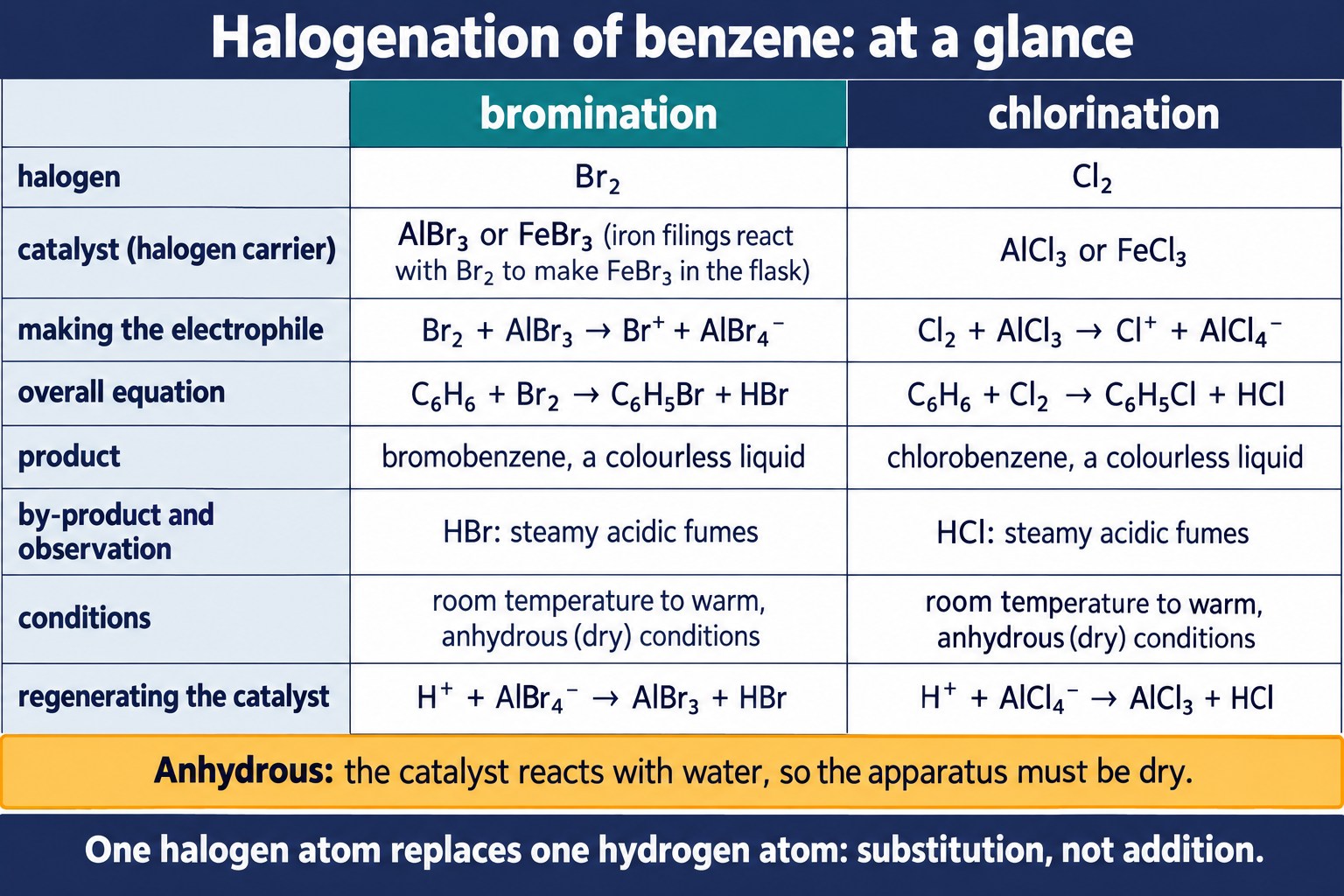
Bromination and chlorination side by side: reagents, catalyst, electrophile, equations, products and observations.
Exam focus: Give the catalyst by formula (for example AlBr₃ or FeBr₃), say anhydrous, and write the HBr by-product. The product is bromobenzene, not an addition product.
Quick Check: Predict the Halogenation
Pick the one accurate statement in each set, using arenes and amounts that are new to this page.
Generating the Electrophile
The catalyst turns the weak electrophile Br₂ into the very strong electrophile Br⁺. The aluminium or iron(III) atom accepts a bromide ion from the bromine molecule.
- Br₂ + AlBr₃ → Br⁺ + AlBr₄⁻
- Br₂ + FeBr₃ → Br⁺ + FeBr₄⁻
- Cl₂ + AlCl₃ → Cl⁺ + AlCl₄⁻
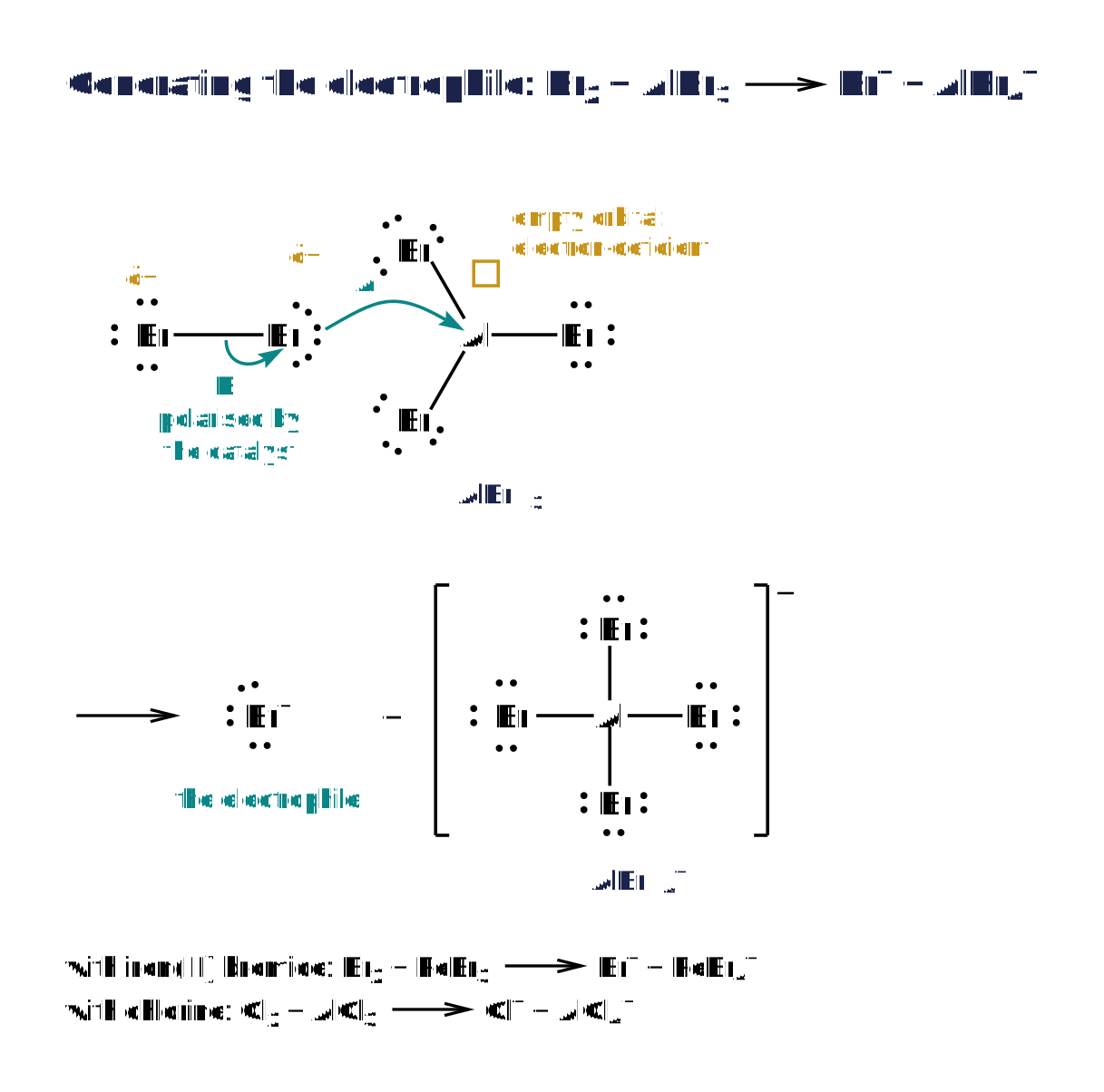
A lone pair on one bromine atom bonds to the electron-deficient aluminium; the Br–Br bond breaks to give Br⁺ and AlBr₄⁻.
- AlBr₃ and FeBr₃ are electron-deficient: the metal atom has room to accept an electron pair.
- As the Br–Br bond breaks, one bromine leaves with both electrons as part of AlBr₄⁻ and the other is left as Br⁺.
- Br⁺ carries a full positive charge and is attracted strongly to the ring, which Br₂ alone is not.
- An alternative wording is that the catalyst polarises the Br–Br bond, giving a Brδ+ atom that the ring attacks.
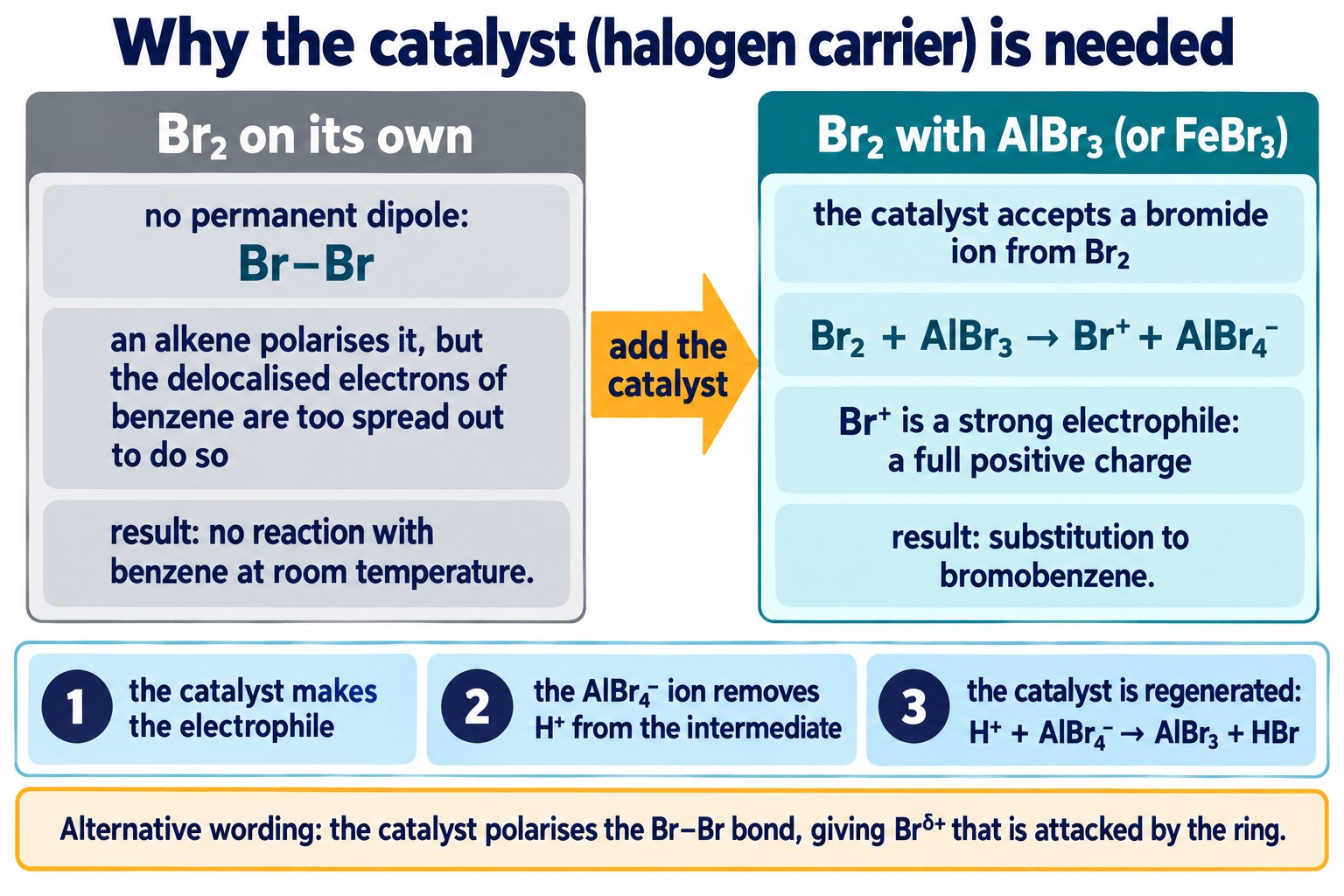
Br₂ alone cannot be polarised enough by benzene. With AlBr₃ it gives Br⁺, a strong electrophile, and the catalyst is returned at the end.
Remember: Either Br⁺ or the polarised Br₂–AlBr₃ complex is accepted as the electrophile. Whichever you draw, the catalyst must appear in the equation that generates it and be regenerated at the end.
Check: Reagents and the Catalyst
Work out the equations that generate a halogen electrophile with a different catalyst, and explain the conditions.
The Mechanism
With Br⁺ in place of E⁺, the general mechanism gives bromobenzene.
- Attack. The Br⁺ electrophile is attracted to the high electron density of the ring. A curly arrow goes from a C=C bond of the ring to the electrophile.
- Intermediate. A C–Br bond forms, so that carbon holds both Br and its H. The positive charge is delocalised over the other five carbons: the horseshoe with a + inside.
- Loss of H⁺. A curly arrow from the C–H bond into the ring restores the delocalised system. The AlBr₄⁻ ion takes the H⁺, which regenerates the AlBr₃ catalyst.
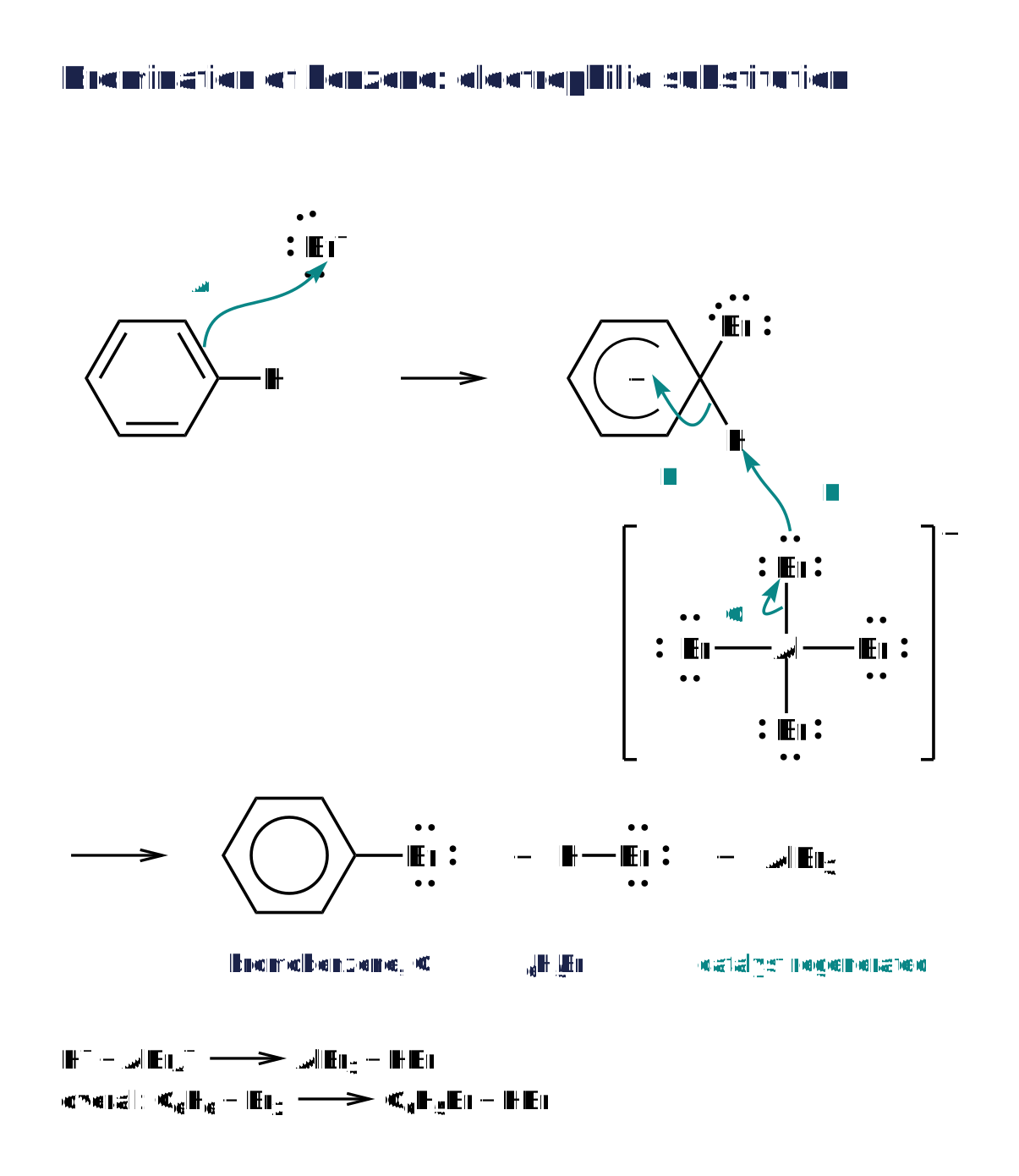
The full mechanism of bromination drawn with the Kekulé form: attack by Br⁺, the horseshoe intermediate and removal of H⁺ by AlBr₄⁻.
- Regeneration: H⁺ + AlBr₄⁻ → AlBr₃ + HBr. With iron(III) bromide: H⁺ + FeBr₄⁻ → FeBr₃ + HBr.
- The HBr escapes as steamy fumes, which is the sign that substitution, not addition, has happened.
- Chlorination is identical with Cl⁺, AlCl₄⁻ and HCl: C₆H₆ + Cl₂ → C₆H₅Cl + HCl.
- Further bromination is slow: the bromine atom on the ring slightly deactivates it, so monosubstitution is the main product.
Exam focus: Three equations are often asked together: generating the electrophile, the overall reaction, and regenerating the catalyst. Check that the three add up to the overall equation.
Quick Check: Follow the Mechanism on a New Arene
The same three moves apply to this new arene with a different halogen and carrier.
Chlorination of Methylbenzene: Substitution in the Ring
Methylbenzene reacts with chlorine and AlCl₃ in the dark at room temperature by the same electrophilic substitution. The methyl group directs the chlorine to the 2 and 4 positions.
- Products: 2-chloromethylbenzene and 4-chloromethylbenzene, a mixture.
- Equation: C₆H₅CH₃ + Cl₂ → CH₃C₆H₄Cl + HCl.
- With Br₂ and AlBr₃ the products are 2-bromomethylbenzene and 4-bromomethylbenzene.
- The methyl group releases electrons into the ring, so methylbenzene reacts faster than benzene.
- Why the 2 and 4 positions: Directing Effects in Electrophilic Substitution.
Side Chain or Ring?
Methylbenzene has two places where chlorine can substitute: the CH₃ side chain and the ring. The conditions decide which.
| Side chain | Ring | |
|---|---|---|
| Conditions | Cl₂ with ultraviolet light, or boiling; no catalyst | Cl₂ with AlCl₃, in the dark, room temperature |
| Mechanism | free-radical substitution (as in alkanes) | electrophilic substitution |
| Attacking species | Cl• radicals from Cl₂ split by light | Cl⁺ (or polarised Cl₂) made by the catalyst |
| Product | (chloromethyl)benzene, C₆H₅CH₂Cl | 2-chloromethylbenzene and 4-chloromethylbenzene |
| Further reaction | C₆H₅CHCl₂, then C₆H₅CCl₃ | slow: Cl deactivates the ring |
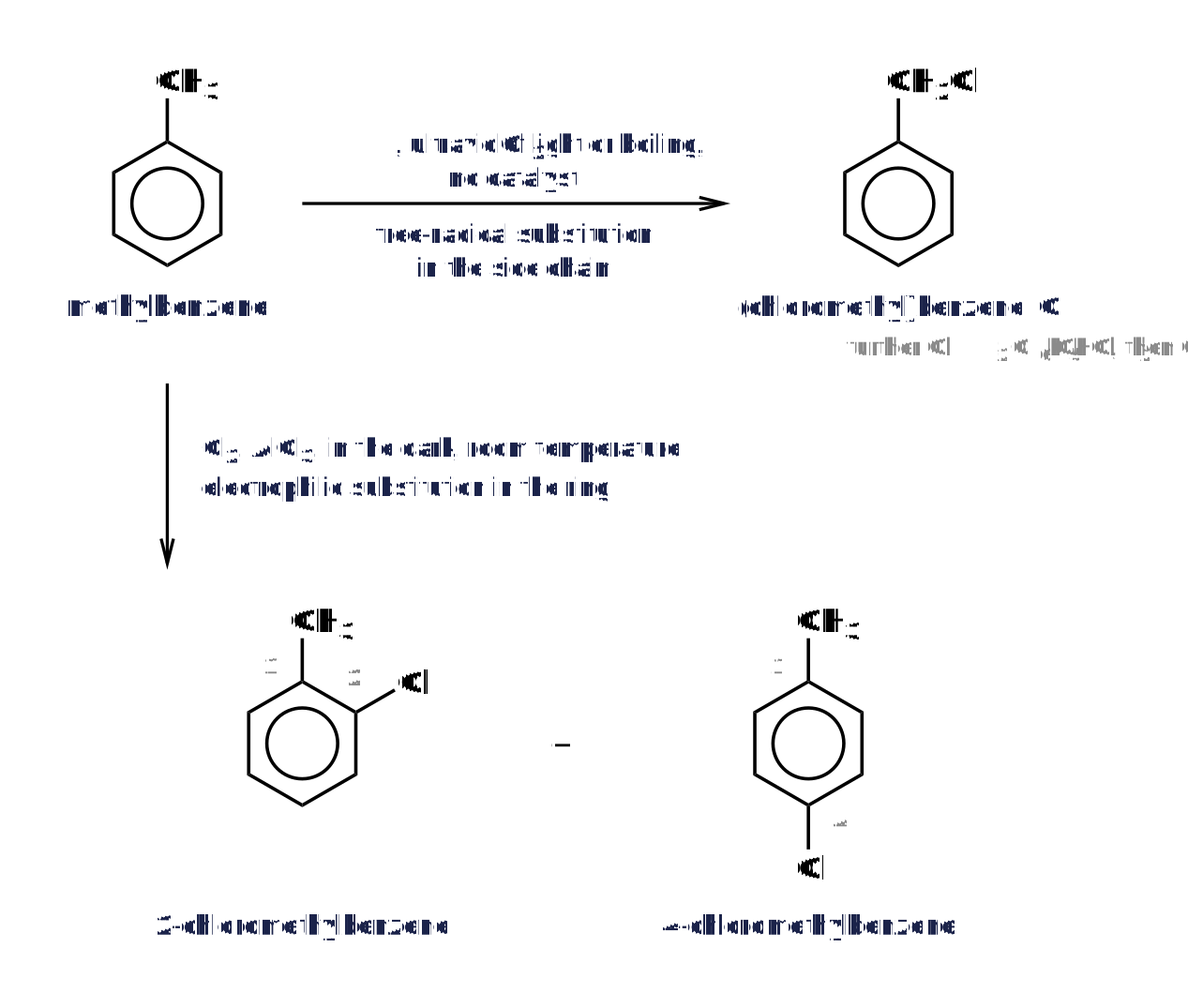
Two routes from methylbenzene: ultraviolet light substitutes the side chain; AlCl₃ in the dark substitutes the ring at the 2 and 4 positions.
- Light or heat without a catalyst breaks Cl₂ into radicals, which attack the C–H bonds of the alkyl side chain, exactly as in an alkane.
- A catalyst in the dark makes an electrophile, which attacks the electron-rich ring and leaves the side chain alone.
- Decision rule: light or boiling, no catalyst → side chain; catalyst, dark, cold → ring.
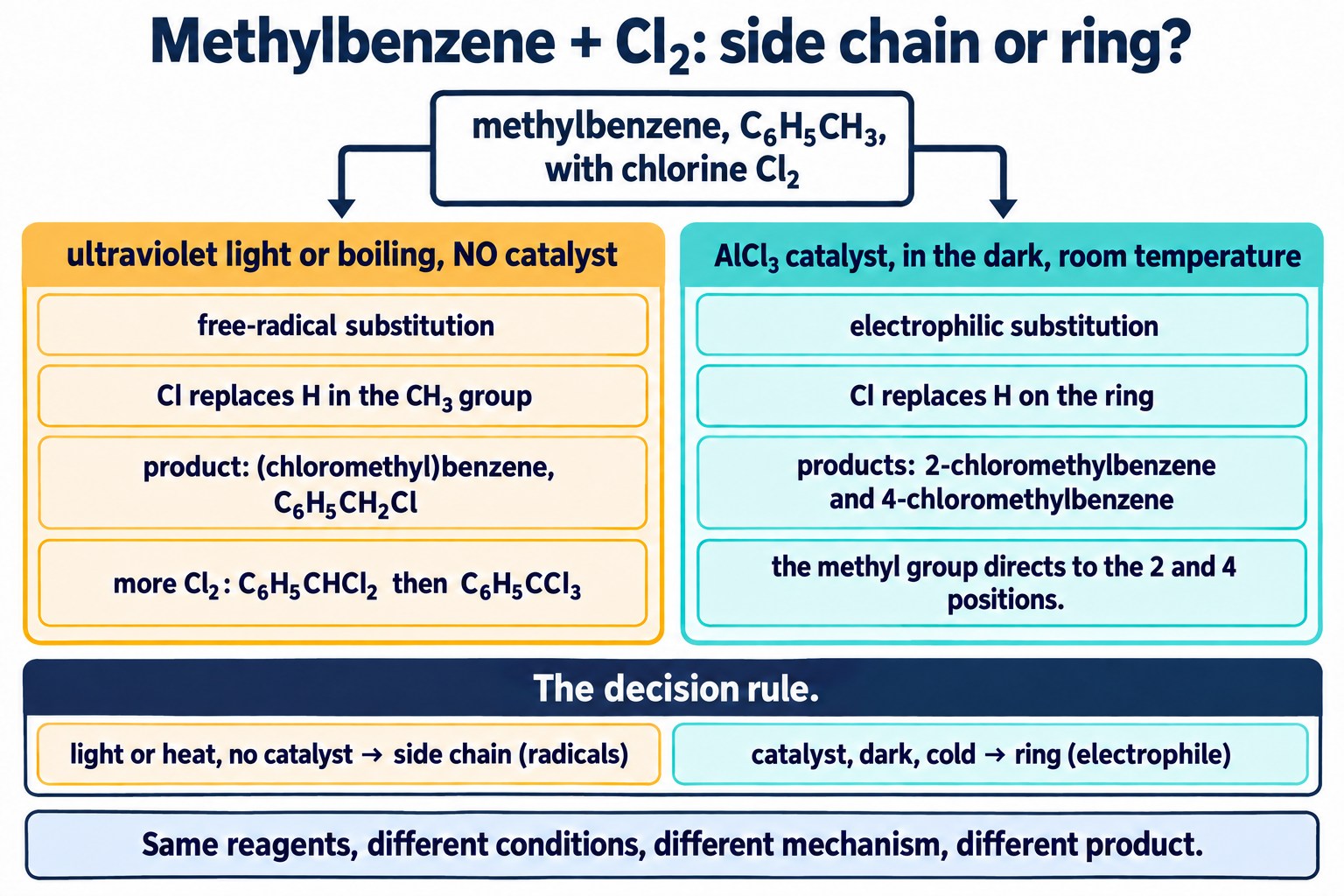
The decision tree for methylbenzene and chlorine: ultraviolet light or boiling gives the side chain, aluminium chloride in the dark gives the ring.
Exam focus: Name the mechanism as well as the product: free-radical substitution for the side chain, electrophilic substitution for the ring. State the condition that causes each.
Check: The Mechanism of Halogenation
Draw and explain the halogenation mechanism with a different halogen and catalyst, and write the regeneration step.
Common Exam Points
- Benzene needs a catalyst (AlBr₃, FeBr₃, AlCl₃ or FeCl₃) because it cannot polarise the halogen molecule itself.
- Br₂ + AlBr₃ → Br⁺ + AlBr₄⁻ generates the electrophile; H⁺ + AlBr₄⁻ → AlBr₃ + HBr regenerates the catalyst.
- Overall: C₆H₆ + Br₂ → C₆H₅Br + HBr. Bromobenzene forms, and HBr fumes are seen.
- Conditions: room temperature to warm, anhydrous.
- The mechanism is the standard three moves; the horseshoe stops at carbons 2 and 6.
- Ultraviolet light, no catalyst: free-radical substitution in the side chain. AlCl₃, dark, cold: electrophilic substitution in the ring at the 2 and 4 positions.
FAQs
Use these quick answers to check why a catalyst is needed, how Br⁺ forms and the mechanism of halogenation, plus ring versus side-chain chlorination of methylbenzene.
Why does benzene need a catalyst to react with bromine?
Bromine is too weak an electrophile to overcome the stability of the delocalised ring. AlBr₃ or FeBr₃, the catalyst, accepts an electron pair from Br₂: Br₂ + AlBr₃ → Br⁺ + AlBr₄⁻. The Br⁺ formed is a powerful electrophile.
What is the overall equation and what would I observe?
C₆H₆ + Br₂ → C₆H₅Br + HBr. Bromobenzene forms and hydrogen bromide escapes as acidic fumes that turn damp blue litmus red. The orange bromine colour fades, but bromine water alone, with no catalyst, gives no reaction at all.
What conditions are needed for halogenation?
Room temperature or gentle warming with an anhydrous catalyst such as AlBr₃, AlCl₃ or FeBr₃. The catalyst reacts with water, so the apparatus must be dry. Chlorination with Cl₂ and AlCl₃ gives chlorobenzene and HCl in the same way.
How is the catalyst regenerated?
The AlBr₄⁻ ion removes H⁺ from the intermediate: H⁺ + AlBr₄⁻ → AlBr₃ + HBr. The catalyst is returned unchanged and the by-product is HBr, which is why the overall equation does not show the catalyst at all.
How do I decide whether chlorine attacks the ring or the methyl group of methylbenzene?
Cl₂ with AlCl₃ in the dark at room temperature is electrophilic substitution on the ring, giving 2-chloromethylbenzene and 4-chloromethylbenzene. Cl₂ with UV light or boiling, and no catalyst, is free-radical substitution in the side chain, giving (chloromethyl)benzene.

Copyright notice: This OLS revision content, including the explanations, layout, diagrams, tables and embedded learning structure, is authored for Online Learning System by Dr. Mohammed Al-Fatah. It may not be copied, reproduced, redistributed or adapted without written permission.
Keep this note — free
Save your progress across every Cambridge topic. A free account remembers which topics you have covered, saves your question scores, and syncs across your phone and laptop.
- Track every topic you have finished
- Keep your practice-question scores
- No payment, no card, free forever
Already registered? Log in