Friedel–Crafts Alkylation and Acylation
A concise revision guide to Friedel–Crafts reactions of benzene: alkylation with a halogenoalkane and acylation with an acyl chloride using anhydrous aluminium chloride, how the carbocation and acylium electrophiles form, the mechanism.
Before You Start
Friedel–Crafts reactions use two reagents you have already met, and the mechanism is the one from the start of this section.
- A halogenoalkane has a polar C–Cl bond; its carbon is δ+: Topic 15 Halogen Compounds (AS).
- An acyl chloride, RCOCl, has a very electron-deficient carbonyl carbon and reacts readily with nucleophiles: Acyl Chlorides.
- A carbocation is a positive ion with a carbon atom carrying the charge; you met them in the mechanisms of alkenes: Topic 14 Hydrocarbons (AS).
- The three moves of electrophilic substitution: Electrophilic Substitution in Benzene.
What Friedel–Crafts Reactions Do
A Friedel–Crafts reaction puts a carbon group onto the benzene ring. Alkylation adds an alkyl group from a halogenoalkane; acylation adds an acyl group, RCO, from an acyl chloride.
- The catalyst is anhydrous aluminium chloride, AlCl₃, which makes the electrophile and is regenerated.
- Conditions: heat, with dry apparatus, because AlCl₃ reacts with water.
- Hydrogen chloride is given off as steamy fumes.
- Both reactions add a carbon chain to the ring, which can then be changed into other groups.
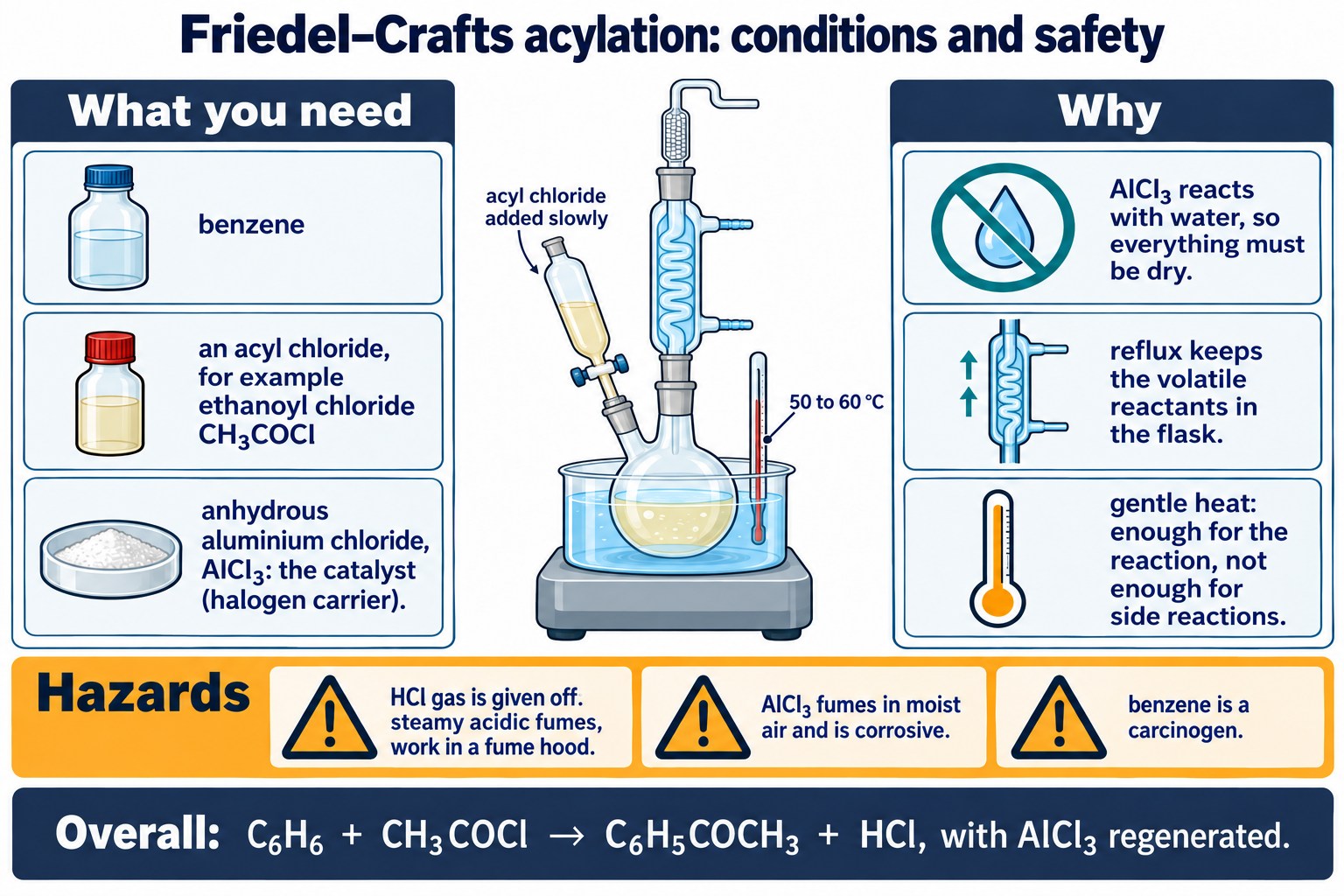
Reflux with a drying tube, anhydrous AlCl₃, gentle heat and a fume cupboard for the HCl: the conditions and the reasons for them.
Exam focus: Say anhydrous AlCl₃ every time. Water hydrolyses it, so moist apparatus destroys the catalyst before the electrophile can form.
Friedel–Crafts Alkylation
A halogenoalkane such as chloroethane reacts with AlCl₃ to give a carbocation, which is the electrophile. The product is an alkylbenzene.
Generating the electrophile. CH₃CH₂Cl + AlCl₃ → CH₃CH₂⁺ + AlCl₄⁻. The aluminium accepts a chloride ion, leaving the ethyl carbocation.
Overall. C₆H₆ + CH₃CH₂Cl → C₆H₅CH₂CH₃ + HCl. Benzene and chloroethane give ethylbenzene; benzene and chloromethane, CH₃Cl, give methylbenzene.
Regenerating the catalyst. H⁺ + AlCl₄⁻ → AlCl₃ + HCl.
- Attack. The CH₃CH₂⁺ electrophile is attracted to the high electron density of the ring. A curly arrow goes from a C=C bond of the ring to the electrophile.
- Intermediate. A C–CH₂CH₃ bond forms, so that carbon holds both CH₂CH₃ and its H. The positive charge is delocalised over the other five carbons: the horseshoe with a + inside.
- Loss of H⁺. A curly arrow from the C–H bond into the ring restores the delocalised system. The AlCl₄⁻ ion takes the H⁺, which regenerates the AlCl₃ catalyst.
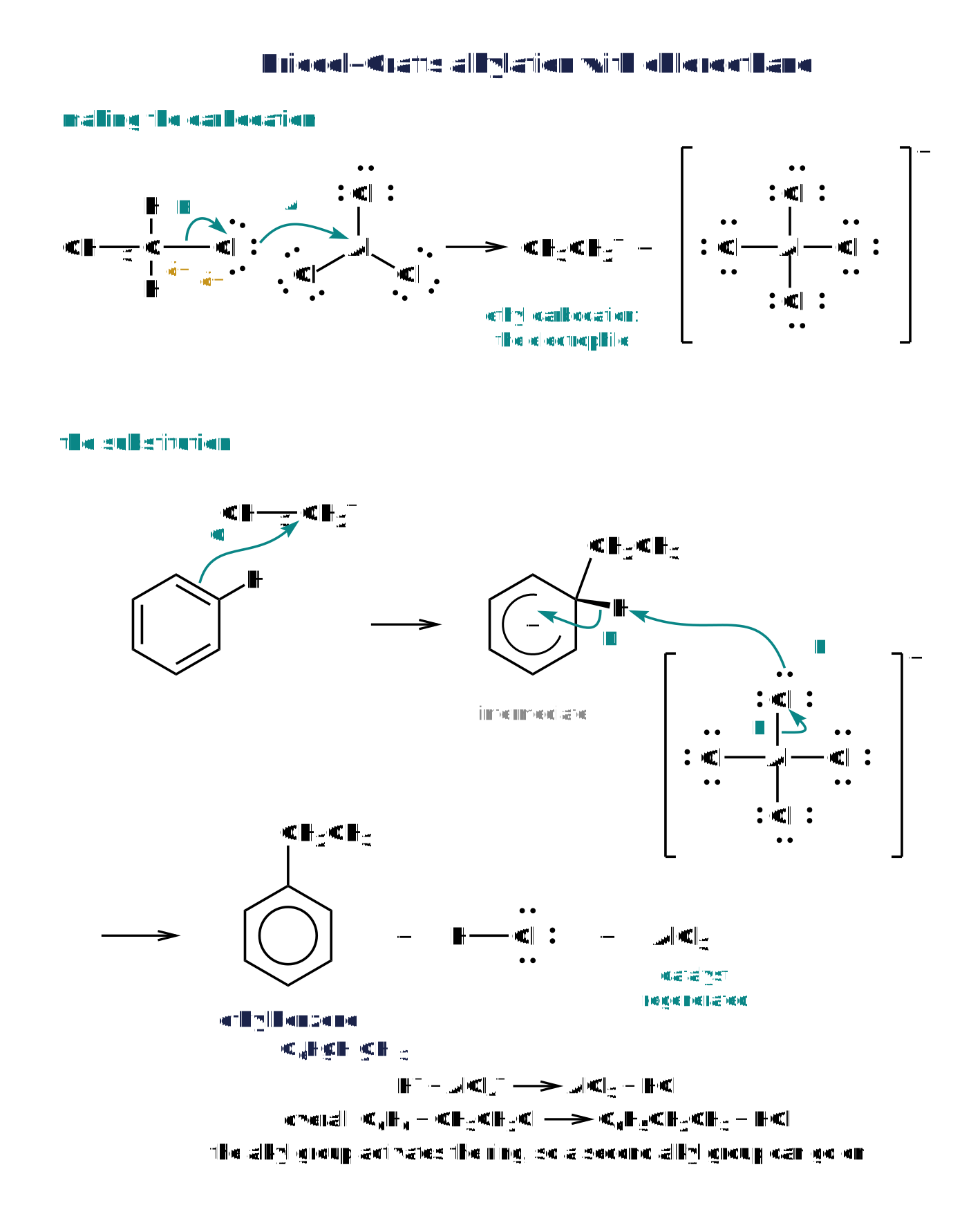
Chloroethane and AlCl₃ give the ethyl carbocation; the standard three moves then give ethylbenzene and HCl.
The drawback of alkylation
- The alkyl group releases electrons into the ring, so the product is more reactive than benzene.
- Further alkylation can occur, giving a mixture of di- and tri-alkylbenzenes (polyalkylation). Using excess benzene limits this.
- With longer chains the carbocation can rearrange to a more stable isomer, so the group on the ring may differ from the one in the halide (extension).
Remember: Alkylation: electrophile R⁺, product an alkylbenzene, further substitution possible. Acylation, below, avoids that problem.
Check: Making the Electrophile with AlCl₃
Write the equations in which anhydrous aluminium chloride generates an electrophile from an acyl chloride and is regenerated.
Friedel–Crafts Acylation
An acyl chloride such as ethanoyl chloride, CH₃COCl, reacts with AlCl₃ to give the acylium ion, CH₃CO⁺, which is the electrophile. The product is a phenyl ketone.
Generating the electrophile. CH₃COCl + AlCl₃ → CH₃CO⁺ + AlCl₄⁻. The acylium ion can be written CH₃CO⁺ or CH₃C≡O⁺.
Overall. C₆H₆ + CH₃COCl → C₆H₅COCH₃ + HCl. Benzene and ethanoyl chloride give phenylethanone.
Regenerating the catalyst. H⁺ + AlCl₄⁻ → AlCl₃ + HCl.
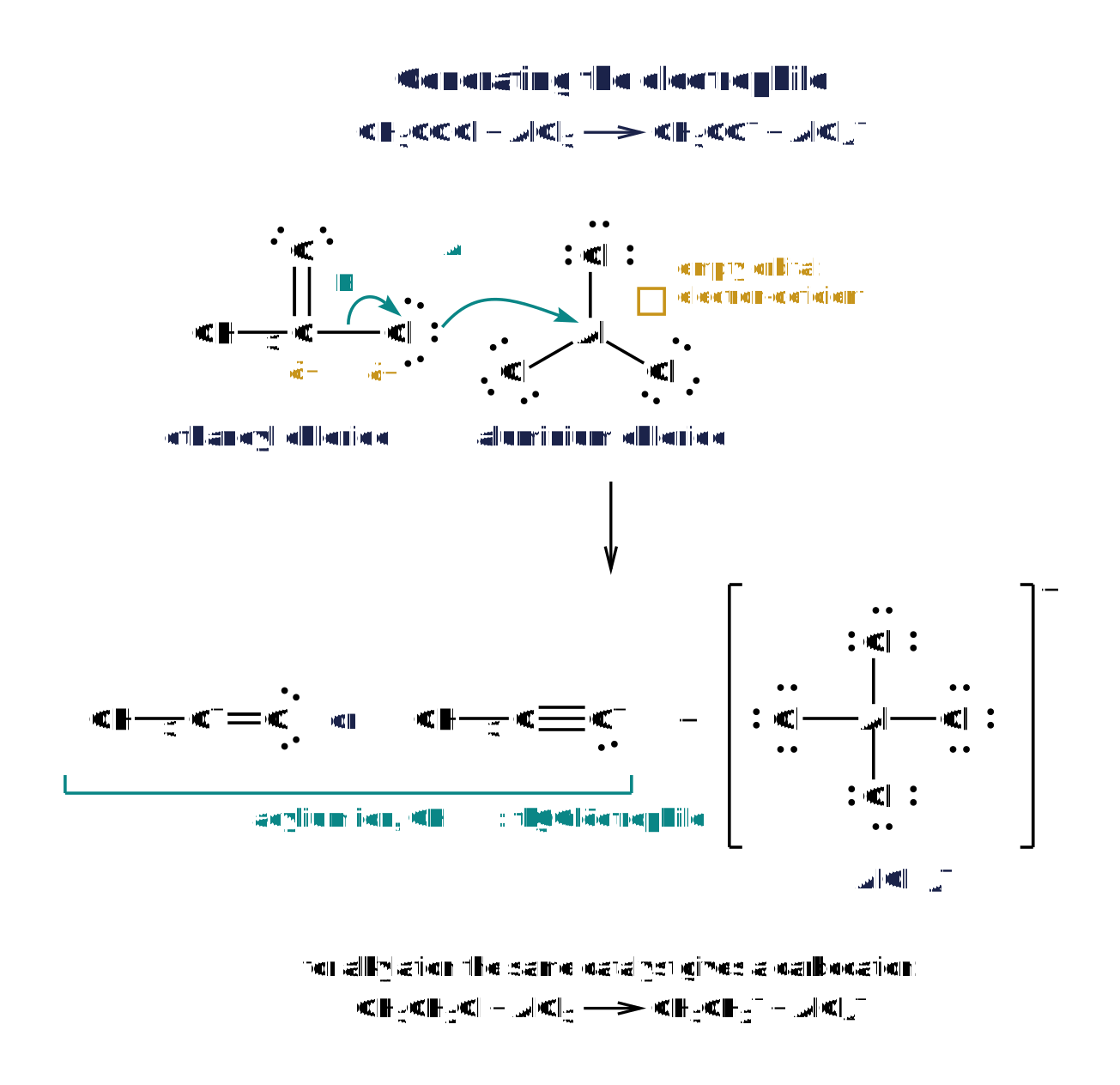
Ethanoyl chloride and AlCl₃ give the acylium ion, drawn both ways, and AlCl₄⁻.
- Attack. The CH₃CO⁺ electrophile is attracted to the high electron density of the ring. A curly arrow goes from a C=C bond of the ring to the electrophile.
- Intermediate. A C–COCH₃ bond forms, so that carbon holds both COCH₃ and its H. The positive charge is delocalised over the other five carbons: the horseshoe with a + inside.
- Loss of H⁺. A curly arrow from the C–H bond into the ring restores the delocalised system. The AlCl₄⁻ ion takes the H⁺, which regenerates the AlCl₃ catalyst.
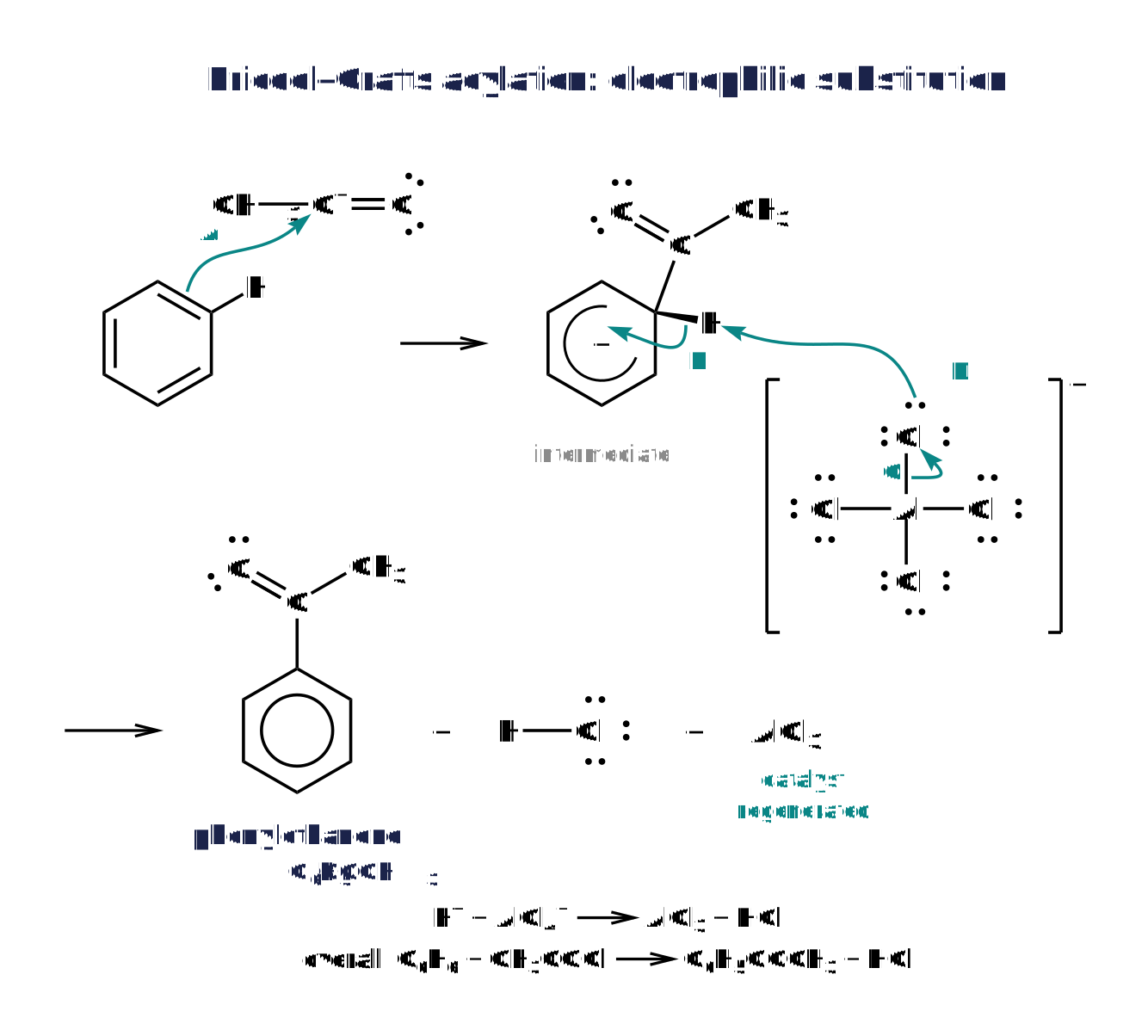
The full mechanism of acylation drawn with the Kekulé form: attack on the positive carbon of CH₃CO⁺, the horseshoe intermediate and removal of H⁺ by AlCl₄⁻.
| Friedel–Crafts acylation | |
|---|---|
| Reagents | acyl chloride, RCOCl, with anhydrous AlCl₃ catalyst |
| Conditions | heat, dry apparatus |
| Electrophile | acylium ion, RCO⁺, for example CH₃CO⁺ |
| Product | a phenyl ketone: phenylethanone, C₆H₅COCH₃, from ethanoyl chloride |
| By-product | HCl (steamy fumes) |
- Any acyl chloride works: propanoyl chloride gives 1-phenylpropan-1-one, C₆H₅COCH₂CH₃.
- The arrow from the ring points to the positive carbon of the acylium ion.
- The reaction stops after one substitution: the C=O group withdraws electrons from the ring and deactivates it.
- The ketone product can be reduced or used in further synthesis.
Exam focus: The electrophile is CH₃CO⁺, not CH₃COCl. Draw the arrow from the ring to the carbon of the acylium ion and write AlCl₄⁻ removing the H⁺.
Check: The Mechanism of Acylation
Draw the three moves for acylation with a different acyl chloride and name the ketone that forms.
Alkylation and Acylation Compared
The two reactions share the catalyst and the mechanism. They differ in the electrophile, the product and whether they stop at one substitution.
| Alkylation | Acylation | |
|---|---|---|
| Reagent | halogenoalkane, for example CH₃CH₂Cl | acyl chloride, for example CH₃COCl |
| Electrophile | carbocation, CH₃CH₂⁺ | acylium ion, CH₃CO⁺ |
| Product | ethylbenzene, C₆H₅CH₂CH₃ | phenylethanone, C₆H₅COCH₃ |
| Stops at one substitution? | no: the alkyl group activates the ring | yes: the C=O group deactivates the ring |
| Catalyst regenerated | H⁺ + AlCl₄⁻ → AlCl₃ + HCl | H⁺ + AlCl₄⁻ → AlCl₃ + HCl |
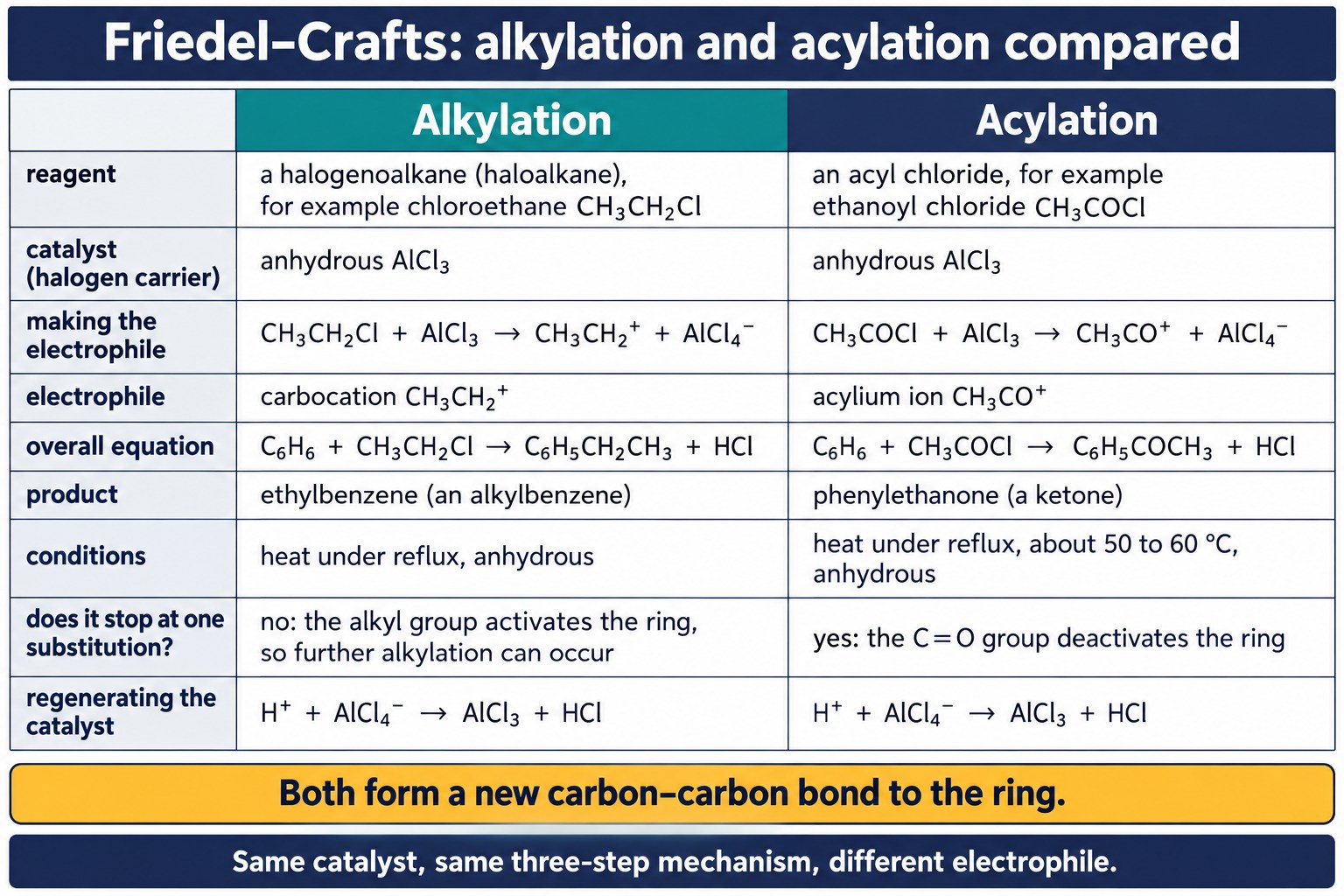
Alkylation and acylation side by side: reagents, electrophiles, products, conditions and whether the reaction stops at one substitution.
Friedel–Crafts Reactions in Synthesis
Both reactions add a carbon chain to the ring, which can then be changed into other groups.
- Phenylethanone is a ketone, so all the reactions of carbonyl compounds are now available on the ring.
- Reduction with NaBH₄ gives 1-phenylethanol; dehydration then gives phenylethene; polymerisation gives poly(phenylethene).
- Acylation is preferred to alkylation in synthesis because it gives a single product.
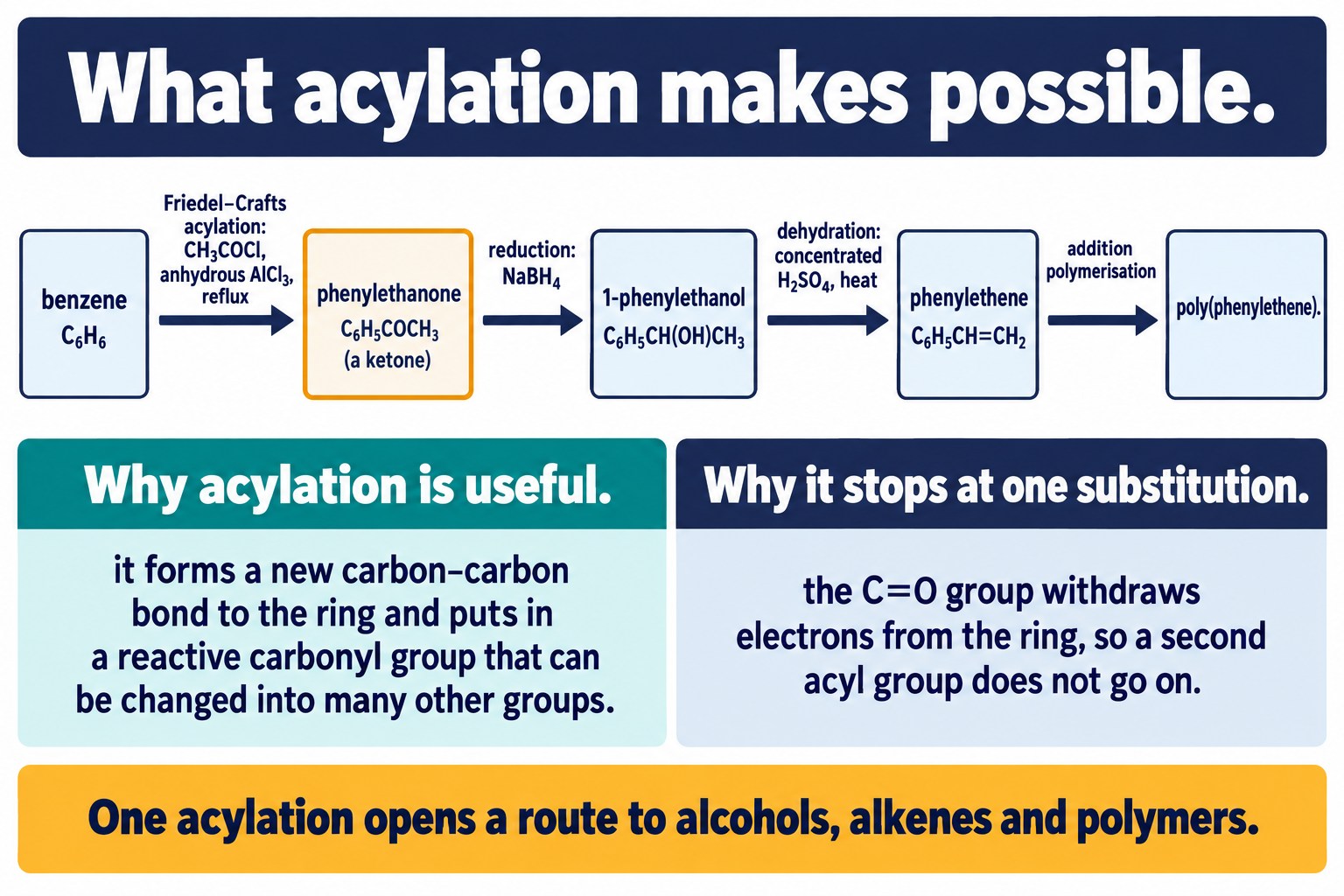
From benzene to a polymer in four steps, written as names: acylation first, then reduction, dehydration and polymerisation.
Exam focus: Link the reaction to what comes next: the ketone can be reduced, or undergo nucleophilic addition, to build other molecules.
Quick Check: Planning With Acyl Chlorides
Pick the one accurate statement in each set, using acyl chlorides that are new to this page.
Friedel–Crafts Reactions of Methylbenzene
Methylbenzene undergoes both reactions with the same reagents, and faster than benzene. The methyl group directs the new group to the 2 and 4 positions.
| Reagents | Products from methylbenzene |
|---|---|
| CH₃Cl and AlCl₃, heat | 1,2-dimethylbenzene and 1,4-dimethylbenzene |
| CH₃COCl and AlCl₃, heat | 1-(2-methylphenyl)ethanone and 1-(4-methylphenyl)ethanone |
- Equation for alkylation: C₆H₅CH₃ + CH₃Cl → CH₃C₆H₄CH₃ + HCl.
- Equation for acylation: C₆H₅CH₃ + CH₃COCl → CH₃C₆H₄COCH₃ + HCl.
- The directing effect of the methyl group: Directing Effects in Electrophilic Substitution.
Remember: The mechanism is unchanged. Only the position of attack is different, and a mixture of the 2- and 4-substituted products forms.
Check: Friedel–Crafts Reactions in Context
Predict products from other acyl chlorides, explain the conditions and say why the reactions matter in synthesis.
Common Exam Points
- The catalyst is anhydrous AlCl₃: it reacts with water, so the apparatus must be dry.
- CH₃COCl + AlCl₃ → CH₃CO⁺ + AlCl₄⁻. The electrophile is the acylium ion.
- C₆H₆ + CH₃COCl → C₆H₅COCH₃ + HCl: phenylethanone and hydrogen chloride.
- H⁺ + AlCl₄⁻ → AlCl₃ + HCl regenerates the catalyst.
- Conditions: heat.
- Acylation stops at one substitution because the C=O group deactivates the ring.
- Alkylation: CH₃CH₂Cl + AlCl₃ → CH₃CH₂⁺ + AlCl₄⁻; product ethylbenzene; further alkylation can occur.
- Methylbenzene gives the 2- and 4-substituted products with CH₃Cl or CH₃COCl and AlCl₃.
FAQs
Use these quick answers to check how AlCl₃ generates the carbocation and acylium electrophiles, the conditions and why Friedel–Crafts reactions matter in synthesis.
How is the acylium ion formed?
AlCl₃ accepts a chloride ion from the acyl chloride: CH₃COCl + AlCl₃ → CH₃CO⁺ + AlCl₄⁻. The acylium ion can also be written CH₃C≡O⁺; its carbon is strongly electron deficient and attacks the π system of benzene.
What is the product when benzene is acylated with ethanoyl chloride?
Phenylethanone, C₆H₅COCH₃, a ketone: C₆H₆ + CH₃COCl → C₆H₅COCH₃ + HCl. One ring hydrogen is replaced by the acyl group, the ring stays delocalised and the hydrogen chloride is released as fumes.
What conditions are needed for a Friedel–Crafts reaction?
Anhydrous AlCl₃, which acts as the catalyst, with dry apparatus and heating under reflux, typically at 50 to 60 °C. Aluminium chloride is hydrolysed by water, so any moisture destroys it. The HCl produced is a corrosive fume, so use a fume cupboard.
Why does alkylation often give more than one product?
An alkyl group releases electrons into the ring, so ethylbenzene is more reactive than benzene and can be alkylated again, giving polyalkylation. Acylation stops at one substitution because the C=O group withdraws electrons and deactivates the ring.
Which products form when methylbenzene undergoes Friedel–Crafts reactions?
The methyl group sends new groups to the 2 and 4 positions. CH₃Cl with AlCl₃ gives 1,2-dimethylbenzene and 1,4-dimethylbenzene; CH₃COCl with AlCl₃ gives phenylethanones with the methyl group at the 2 or 4 position of the ring.

Copyright notice: This OLS revision content, including the explanations, layout, diagrams, tables and embedded learning structure, is authored for Online Learning System by Dr. Mohammed Al-Fatah. It may not be copied, reproduced, redistributed or adapted without written permission.
Keep this note — free
Save your progress across every Cambridge topic. A free account remembers which topics you have covered, saves your question scores, and syncs across your phone and laptop.
- Track every topic you have finished
- Keep your practice-question scores
- No payment, no card, free forever
Already registered? Log in