Directing Effects in Electrophilic Substitution
A concise revision guide to directing effects: how electron-donating groups such as OH and NH₂ direct substitution to the 2 and 4 positions and electron-withdrawing groups such as NO₂ direct to the 3 position, predicting the products of substitution, and why the order of steps matters in synthesis.
Before You Start
A group already on the ring decides where the next electrophile goes and how fast it reacts. This page builds on three earlier ones.
- The three-step mechanism and the positive intermediate: Electrophilic Substitution in Benzene.
- Phenol: the oxygen lone pair is delocalised into the ring and raises its electron density: Phenol: Acidity and Electrophilic Substitution.
- Numbering the ring and naming substituted compounds: Naming Aromatic Compounds.
- The reagents for nitration, halogenation and Friedel–Crafts reactions: Nitration of Benzene, Halogenation of Benzene, Friedel–Crafts Alkylation and Acylation.
Positions on the Ring
Number the ring from the carbon that carries the group already present, carbon 1. The five remaining positions fall into three sets.
| Position | Older name | Equivalent to | Description |
|---|---|---|---|
| 2 | ortho | 6 | next to the group |
| 3 | meta | 5 | one carbon further round |
| 4 | para | none | opposite the group |
- Positions 2 and 6 are the same by symmetry, and so are 3 and 5. A single new group therefore gives a 2-, 3- or 4- product.
- Use IUPAC numbers in names: 4-nitrophenol, not para-nitrophenol.
- When two groups are added, a 2,4-directing group fills 2 and 4 first, then 6: 2,4,6-tribromophenol.
Remember: Carbon 1 always carries the group that was there first. Count round the ring in the direction that gives the lowest numbers.
Electron-Donating Groups: 2,4-Directing
Electron-donating groups push electron density into the ring. They make the ring react faster than benzene (activating) and send the new group to positions 2 and 4.
- OH and NH₂ have a lone pair in a p orbital that is delocalised into the ring. The extra electron density lands mainly on carbons 2, 4 and 6.
- An electrophile is attracted most strongly to the carbons with the highest electron density, so it bonds at 2 or 4.
- Alkyl groups such as CH₃ have no lone pair but are electron releasing through the inductive effect. They activate the ring weakly and also direct to 2 and 4.
- Extension: the positive intermediate formed by attack at 2 or 4 places charge on carbon 1, where the lone pair of O or N can stabilise it.
| Group | How it donates | Effect on rate | Directs to |
|---|---|---|---|
| OH | lone pair delocalised into the ring | much faster: no catalyst needed for bromination | 2 and 4, then 6 |
| NH₂ | lone pair delocalised into the ring | much faster | 2 and 4, then 6 |
| CH₃ and other alkyl groups | inductive (electron-releasing) effect | slightly faster | 2 and 4 |
Exam focus: Explain the direction through electron density: the donating group raises the electron density at 2, 4 and 6, so the electrophile attacks there.
Electron-Withdrawing Groups: 3-Directing
Electron-withdrawing groups pull electron density out of the ring. They slow the reaction (deactivating) and send the new group to position 3.
- NO₂, COOH and COR are bonded to the ring through an atom that carries a double bond to oxygen. The electronegative oxygen atoms draw electron density away from the ring.
- The electron density falls most at positions 2, 4 and 6, so position 3 is the least deactivated and the electrophile attacks there.
- The reaction is slower than with benzene and needs harsher conditions: nitrobenzene is nitrated again only above 60 °C, giving 1,3-dinitrobenzene.
- Chlorination of nitrobenzene with Cl₂ and AlCl₃ gives 3-chloronitrobenzene.
| Group | How it withdraws | Effect on rate | Directs to |
|---|---|---|---|
| NO₂ | N⁺ with two electronegative O atoms | much slower | 3 |
| COOH | C=O draws electron density from the ring | slower | 3 |
| COR (a ketone, e.g. COCH₃) | C=O draws electron density from the ring | slower | 3 |
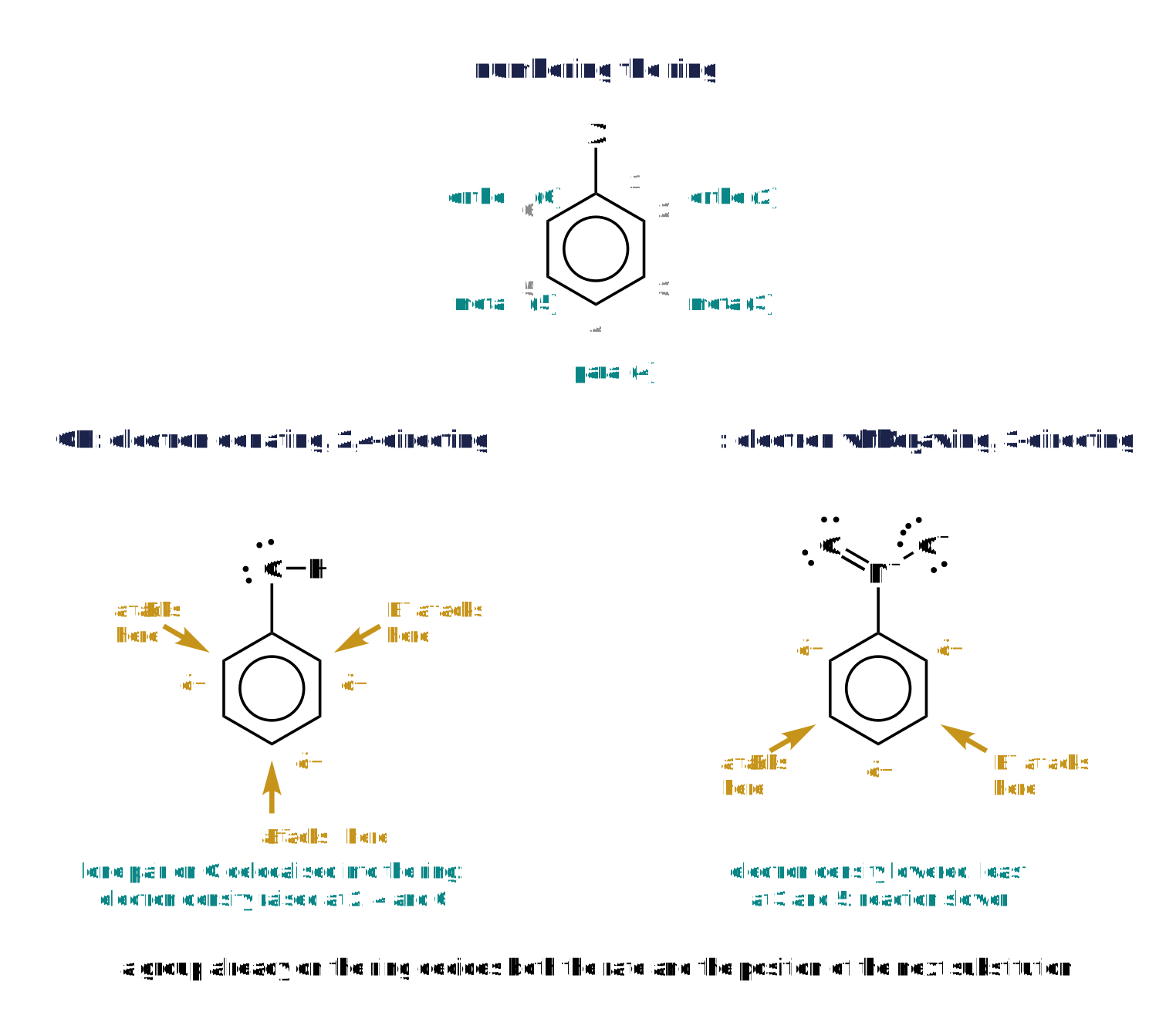
Positions numbered with their older names; the OH group of phenol pointing electrophiles to 2, 4 and 6; the nitro group leaving only position 3.
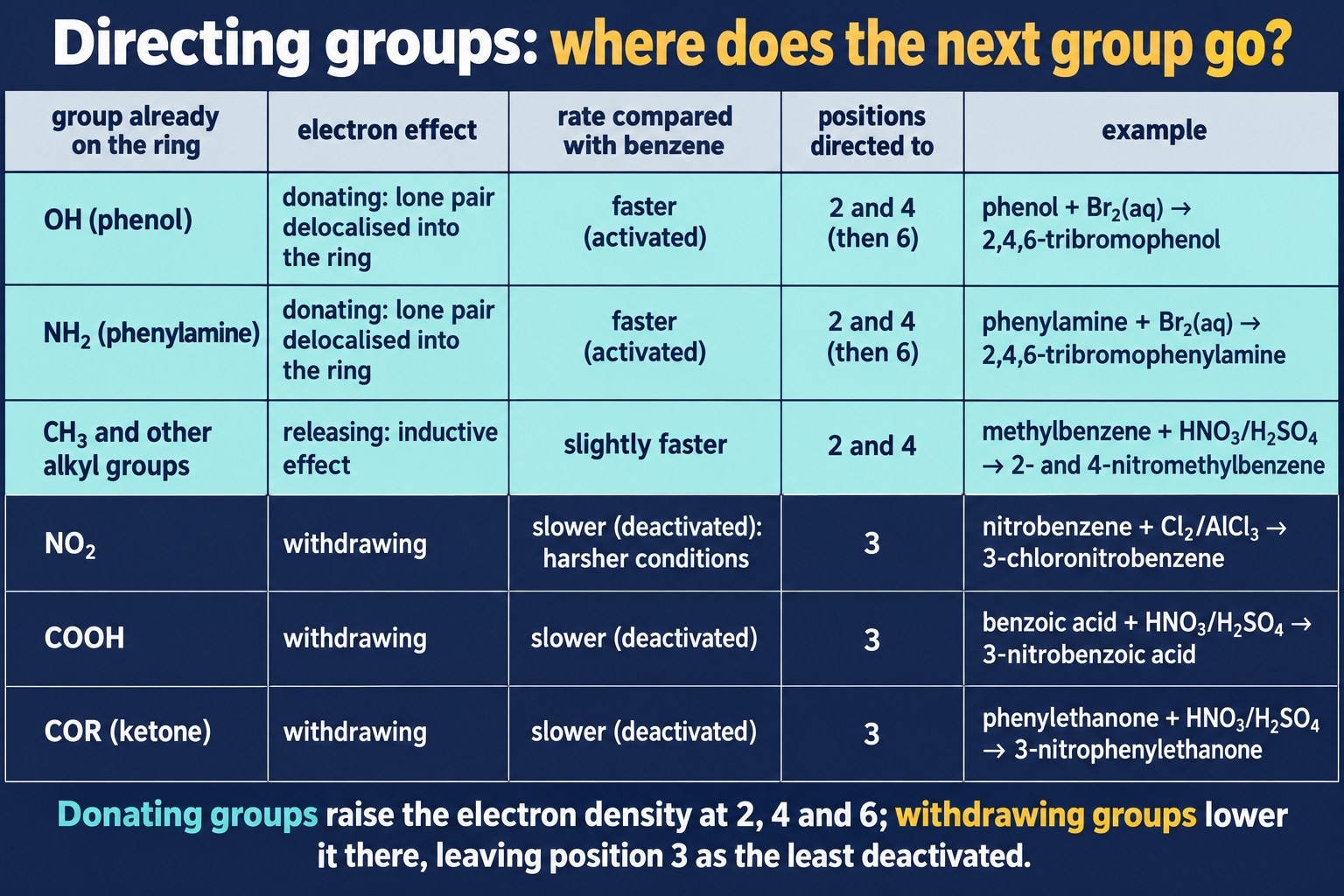
Donating groups in teal, withdrawing groups in navy: the effect on rate, the positions and an example product for each.
Common mistake: A withdrawing group does not “attract” the electrophile to position 3. It lowers the electron density everywhere, least at 3, so attack happens there, slowly.
Check: Directing Groups
Sort groups into donating and withdrawing, give the positions each directs to and explain the effect on rate.
Quick Check: Rank the Rings by Reactivity
Use what each group does to the electron density of the ring.
Predicting the Product
Follow the same three questions every time: what group is on the ring, does it donate or withdraw, and what electrophile do the reagents make.
Worked example: nitration of phenol
Answer. A mixture of 2-nitrophenol and 4-nitrophenol.
Worked example: bromine water and phenylamine
Answer. 2,4,6-Tribromophenylamine forms as a white precipitate, and the bromine water is decolourised.
Worked example: chlorination of nitrobenzene
Answer. 3-Chloronitrobenzene, formed more slowly than chlorobenzene from benzene.
Worked example: nitration of methylbenzene
Answer. A mixture of 2-nitromethylbenzene and 4-nitromethylbenzene.
Worked example: nitration of benzoic acid
Step 1. COOH withdraws electron density through its C=O: deactivating and 3-directing.
Answer. 3-Nitrobenzoic acid.
Worked example: nitration of phenylethanone
Step 1. The COCH₃ group withdraws electron density through its C=O: deactivating and 3-directing.
Answer. 3-Nitrophenylethanone.
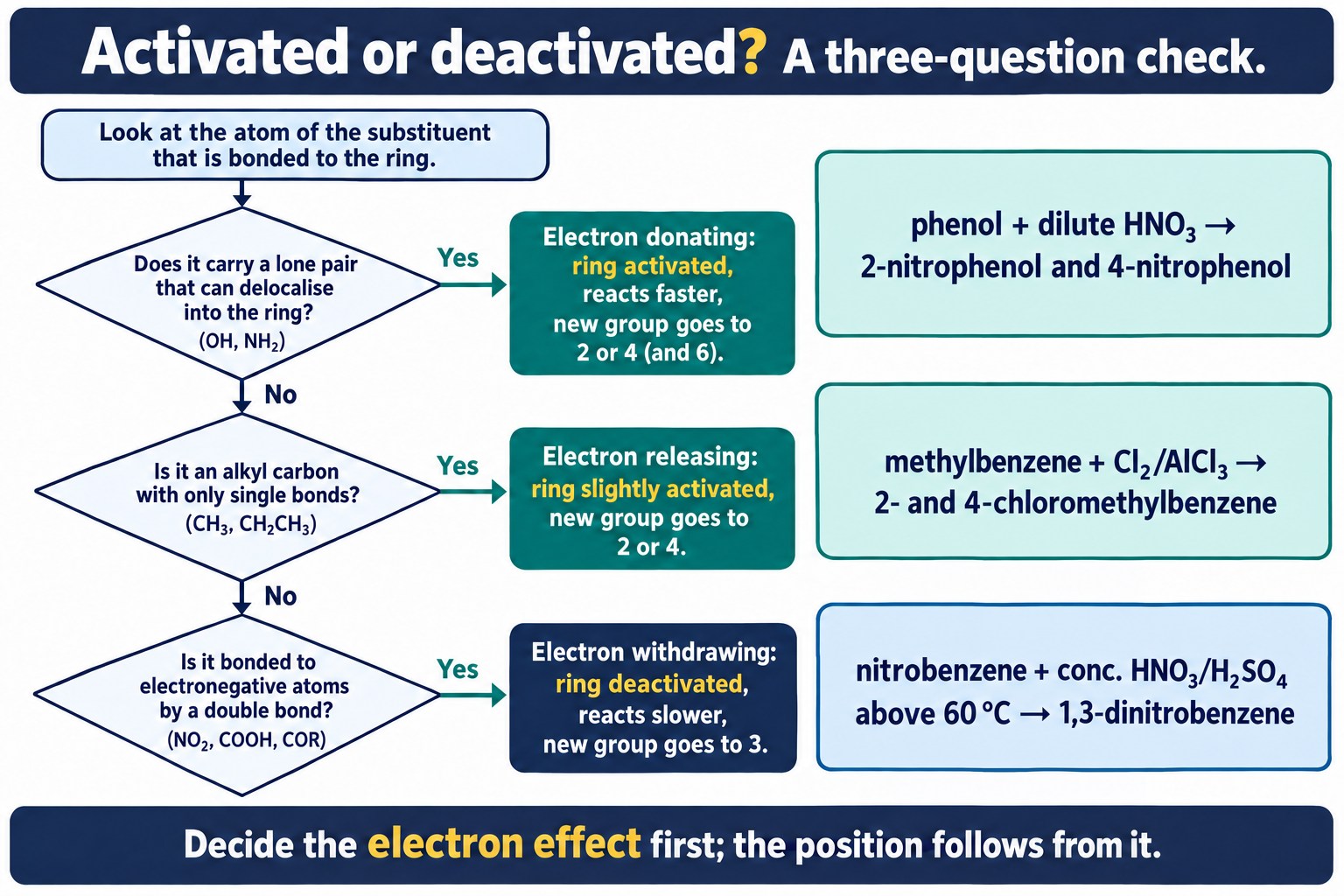
Three questions settle the electron effect of the group on the ring; the position and the rate follow from it.
Exam focus: Name the product with its number. “Nitrophenol” on its own does not show that you know where the group went.
Quick Check: Predicting Products on New Rings
Pick the one accurate statement in each set, using rings that are new to this page.
The Order of Steps in Synthesis
When two groups must be placed on a ring, the group added first decides where the second one goes. The same two steps in a different order give a different isomer.
Worked example: nitrobenzoic acids from methylbenzene
Route A. Oxidise the side chain first (hot alkaline potassium manganate(VII), then dilute acid) to give benzoic acid. Now nitrate: COOH is 3-directing.
Answer A. 3-Nitrobenzoic acid.
Route B. Nitrate first: CH₃ is 2,4-directing, giving mainly 4-nitromethylbenzene (with some 2-nitromethylbenzene). Now oxidise the side chain to COOH.
Answer B. 4-Nitrobenzoic acid (and 2-nitrobenzoic acid from the minor isomer).
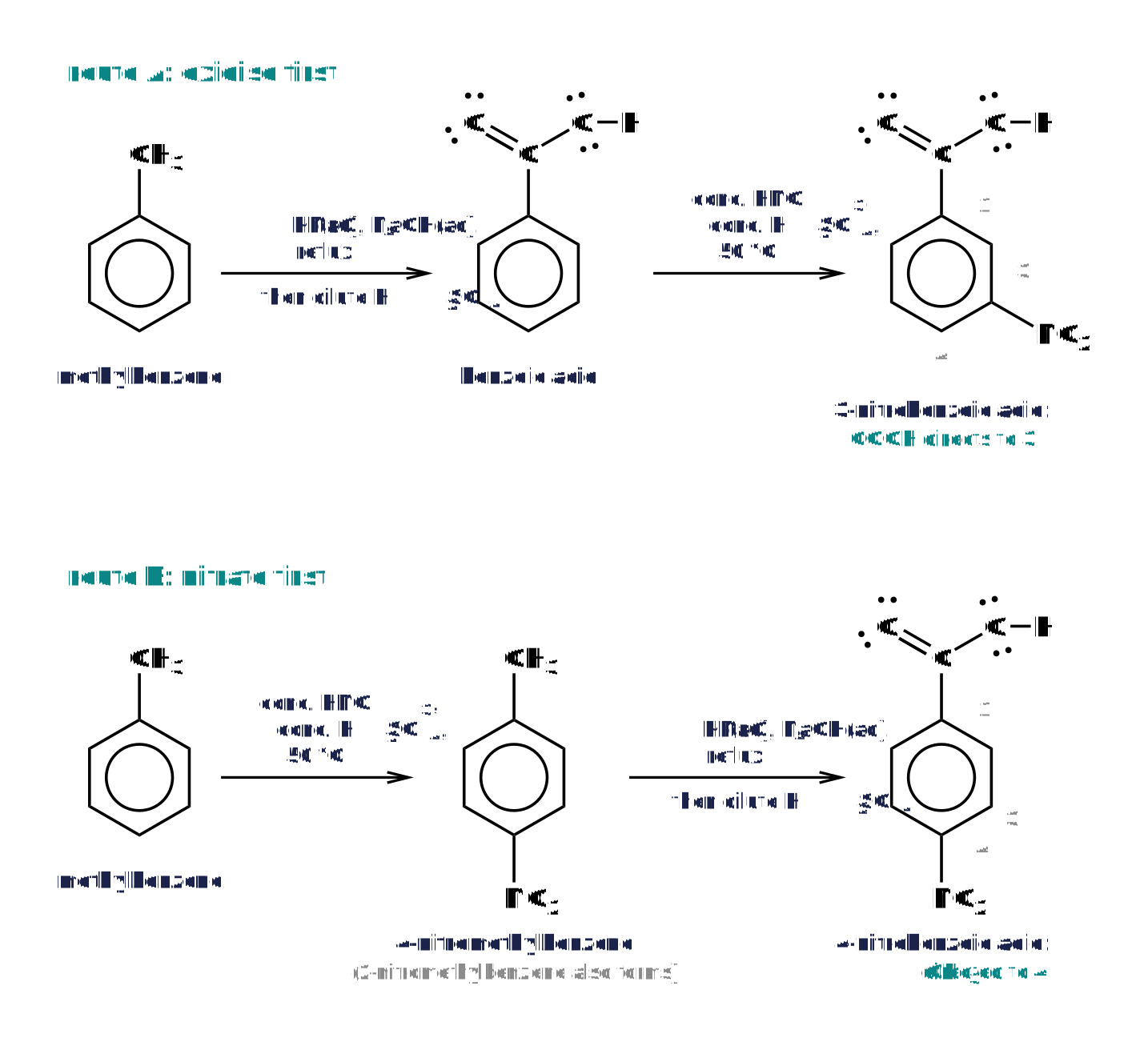
Oxidise then nitrate for the 3-nitro acid; nitrate then oxidise for the 4-nitro acid.
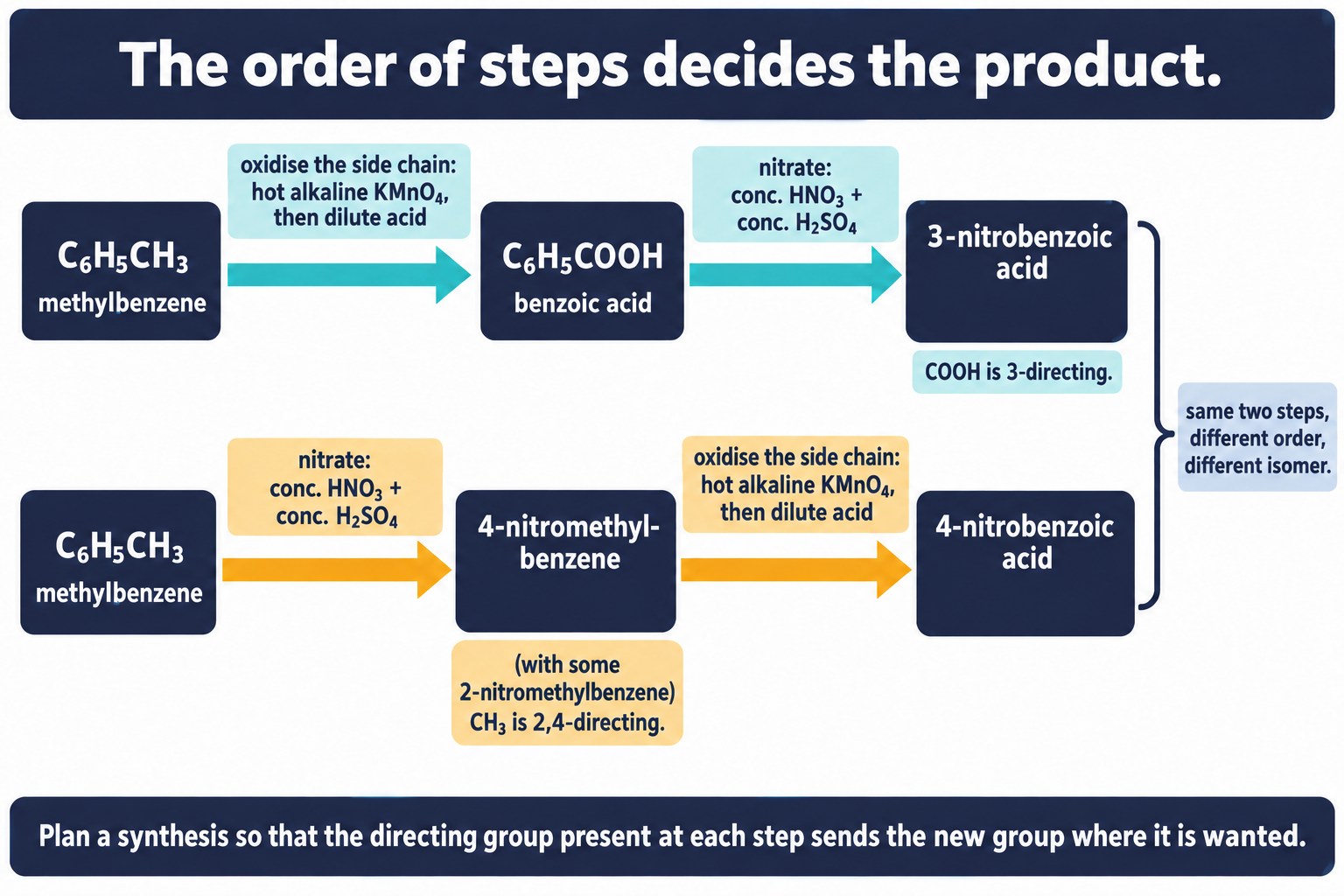
Two routes, two steps each, two different products. The directing group present at the nitration step decides the isomer.
- To put a group at position 3 relative to COOH or NO₂, add the withdrawing group first.
- To put a group at 2 or 4 relative to OH, NH₂ or CH₃, have the donating group in place before the substitution.
- Extension: 3-nitrophenol cannot be made by nitrating phenol, because OH directs to 2 and 4. A different route, starting from nitrobenzene, is needed.
Exam focus: In a synthesis question, write the directing effect of the group present at each step beside your route. That is the reasoning the mark scheme looks for.
Check: Predicting Products
Predict the products of substitutions on substituted rings not worked above, and decide the order of steps in a short synthesis.
Common Exam Points
- OH and NH₂ are electron donating through a delocalised lone pair: activating, 2,4-directing (then 6).
- Alkyl groups release electrons by the inductive effect: weakly activating, 2,4-directing.
- NO₂, COOH and COR are electron withdrawing: deactivating, 3-directing, slower reactions and harsher conditions.
- Positions 2 and 6 are equivalent, as are 3 and 5, so one new group gives a 2-, 3- or 4- isomer.
- Name the product with its locant: 4-nitrophenol, 3-chloronitrobenzene, 2,4,6-tribromophenylamine.
- Oxidise methylbenzene then nitrate: 3-nitrobenzoic acid. Nitrate then oxidise: 4-nitrobenzoic acid.
- Explain every prediction through electron density at the ring positions, not by memorised labels alone.
FAQs
Use these quick answers to check 2,4-directing and 3-directing groups, predicting products and planning the order of steps in a synthesis.
What does 2,4-directing mean?
A substituent that releases electron density into the ring, such as OH, NH₂ or an alkyl group, makes carbons 2, 4 and 6 the most electron rich. The next electrophile substitutes there, so phenol gives 2-nitrophenol and 4-nitrophenol.
Why does NO₂ direct to the 3 position?
The nitro group withdraws electron density from the ring, most strongly from carbons 2, 4 and 6, so the ring is deactivated and reacts more slowly. Carbons 3 and 5 are least depleted, so chlorinating nitrobenzene gives 3-chloronitrobenzene. COOH and COR act the same way.
Why does phenylamine give 2,4,6-tribromophenylamine with bromine water?
The nitrogen lone pair is delocalised into the ring just like the oxygen lone pair in phenol, so the ring is strongly activated. Bromine water reacts at room temperature without a catalyst, and all three activated positions are substituted, giving a white precipitate.
Why does the order of steps matter when making nitrobenzoic acid from methylbenzene?
Oxidising the methyl group first gives benzoic acid, whose COOH group is 3-directing, so nitration then gives 3-nitrobenzoic acid. Nitrating first puts NO₂ at position 2 or 4, because CH₃ is 2,4-directing, so oxidising afterwards gives 4-nitrobenzoic acid or 2-nitrobenzoic acid.
What do ortho, meta and para mean?
They are older names for positions relative to a substituent on carbon 1: ortho is 2 (and 6), meta is 3 (and 5) and para is 4. Use the IUPAC numbers in answers, so 4-nitrophenol rather than para-nitrophenol, but recognise the older terms.

Copyright notice: This OLS revision content, including the explanations, layout, diagrams, tables and embedded learning structure, is authored for Online Learning System by Dr. Mohammed Al-Fatah. It may not be copied, reproduced, redistributed or adapted without written permission.
Keep this note — free
Save your progress across every Cambridge topic. A free account remembers which topics you have covered, saves your question scores, and syncs across your phone and laptop.
- Track every topic you have finished
- Keep your practice-question scores
- No payment, no card, free forever
Already registered? Log in