Phenol: Acidity and Electrophilic Substitution
A concise revision guide to phenol: how the oxygen lone pair is delocalised into the ring, the reaction with bromine water to give 2,4,6-tribromophenol and why phenol reacts more readily than benzene, the weak acidity of phenol compared with water and ethanol, and nitration with dilute nitric acid.
Why Phenol Reacts Faster Than Benzene
Choose a step to watch the oxygen lone pair join the ring, bromine react with phenol without a catalyst, and benzene fail to react.
© Dr. Mohammed Al-Fatah – onlinelearningsystem.net
Before You Start
Phenol is a benzene ring carrying an OH group. Its chemistry combines what you know about arenes with what you know about the OH group.
- The three-step mechanism of electrophilic substitution and the horseshoe intermediate: Electrophilic Substitution in Benzene.
- Benzene needs a catalyst to react with bromine, and only one H is replaced: Halogenation of Benzene.
- Alcohols contain an OH group on a saturated carbon: Topic 16 Hydroxy Compounds (AS).
- Carboxylic acids are weak acids that react with carbonates: Topic 33 Carboxylic Acids and Derivatives.
Phenol: an OH Group on the Ring
Phenol, C₆H₅OH, has a hydroxy group bonded directly to a carbon atom of the benzene ring. Any compound with an OH bonded straight to an aromatic ring is a phenol.
- Phenol is a white crystalline solid, melting at 43 °C. It is only slightly soluble in water and is corrosive to skin.
- Phenylmethanol, C₆H₅CH₂OH, is not a phenol. Its OH is on a CH₂ carbon, so it is an alcohol and reacts like one.
- Because the oxygen lone pair interacts with the ring, phenol does not behave like an alcohol: it is not oxidised and its OH is not easily substituted.
- Uses: antiseptics and disinfectants, and the manufacture of plastics and resins.
| Phenol, C₆H₅OH | Phenylmethanol, C₆H₅CH₂OH | |
|---|---|---|
| OH bonded to | a ring carbon | a CH₂ carbon outside the ring |
| class | phenol | primary alcohol |
| oxidised by acidified K₂Cr₂O₇? | no | yes, to benzaldehyde then benzoic acid |
| reacts with bromine water? | yes, white precipitate | no |
Remember: Look at the carbon that carries the OH. On the ring: a phenol. One carbon away from the ring: an alcohol.
Why the Ring Is Activated
One of the two lone pairs on the oxygen atom of phenol sits in a p orbital. That p orbital lies parallel to the p orbitals of the ring, so it overlaps sideways with the π system.
- The lone pair is partly delocalised into the ring, so the electron density of the ring increases.
- The increase is greatest at positions 2, 4 and 6, the carbons next to and opposite the OH group.
- An electron-rich ring attracts electrophiles more strongly than benzene does. The ring is said to be activated.
- The oxygen is left slightly electron deficient (δ+) and the ring slightly electron rich (δ−).
- This is also why new groups enter at positions 2, 4 and 6: Directing Effects in Electrophilic Substitution.
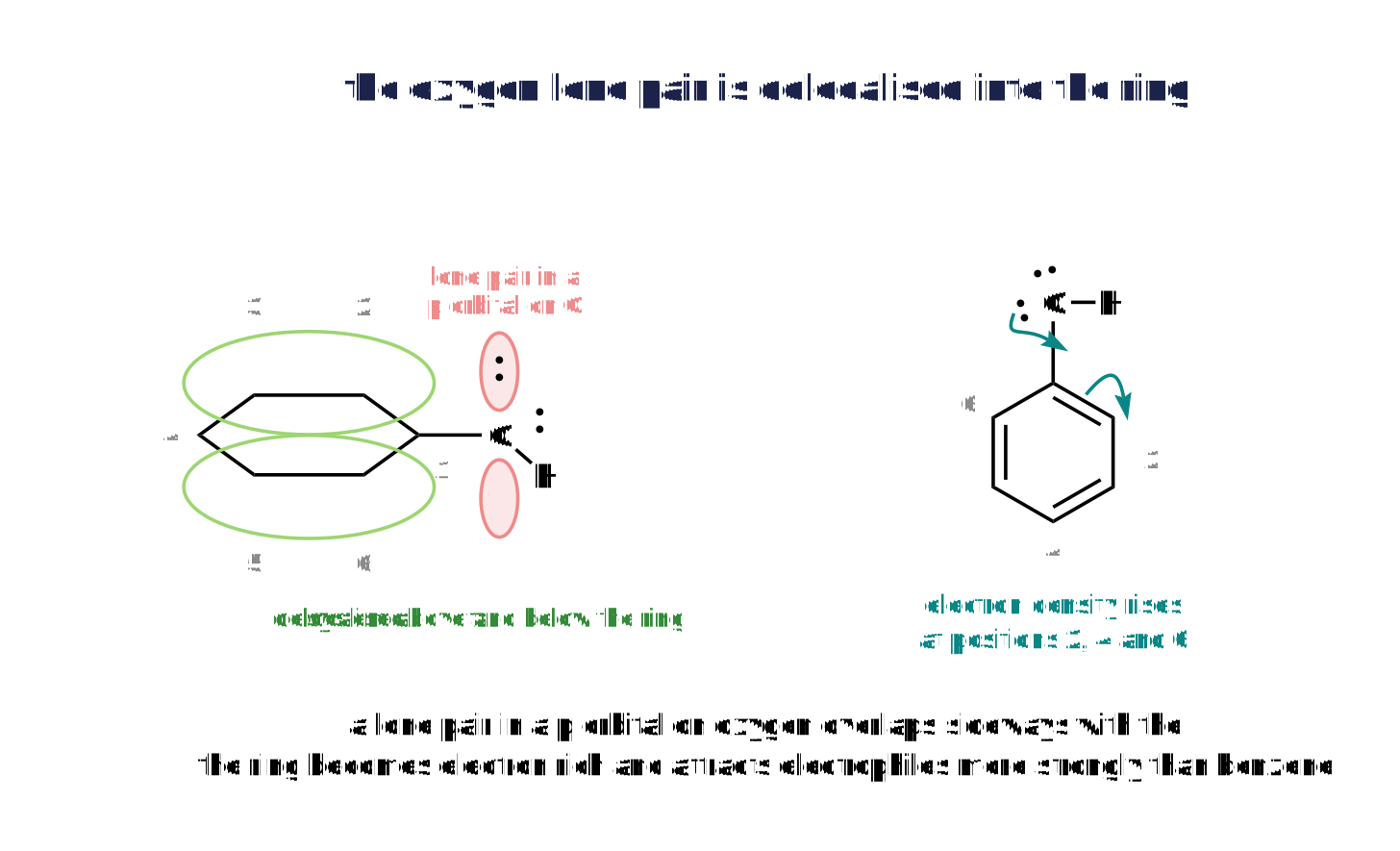
The oxygen p orbital overlaps with the π system above and below the ring. Electron density rises at carbons 2, 4 and 6.
Exam focus: Two phrases earn the marks: “a lone pair on the oxygen is delocalised into the ring” and “the electron density of the ring increases”. Give both.
Check: The Structure of Phenol
Pick out phenols from alcohols and explain, with the lone pair, why the ring in phenol is electron rich.
Reaction with Bromine Water
Shake phenol with bromine water at room temperature. No catalyst is needed and the reaction is immediate.
- Observations: the orange bromine water is decolourised and a white precipitate forms. The mixture has an antiseptic smell.
- The precipitate is 2,4,6-tribromophenol, C₆H₂Br₃OH.
- Equation: C₆H₅OH + 3Br₂ → C₆H₂Br₃OH + 3HBr.
- Three hydrogen atoms are replaced, at the 2, 4 and 6 positions. This is multiple electrophilic substitution.
- An alkene also decolourises bromine water, but by addition and with no precipitate.
Worked example: the equation
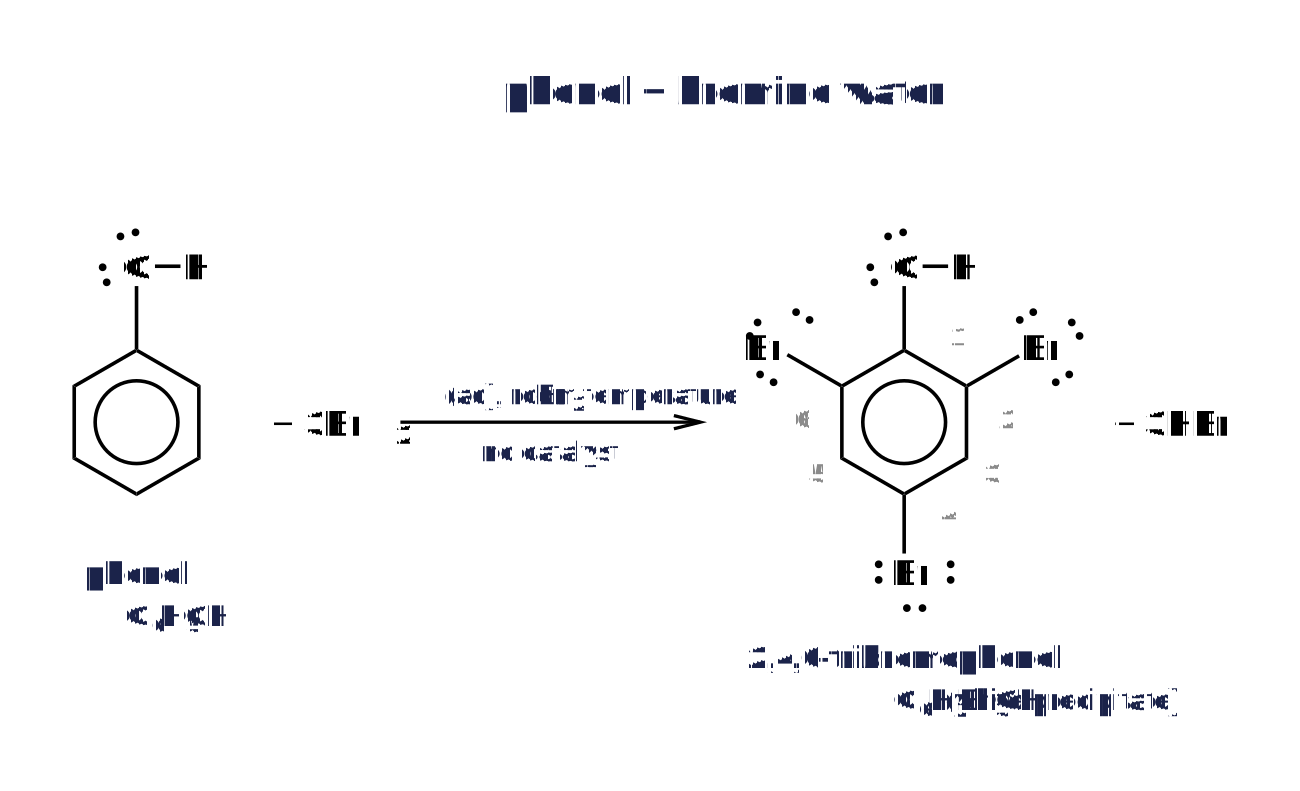
Phenol with three molecules of bromine gives 2,4,6-tribromophenol and three molecules of hydrogen bromide.
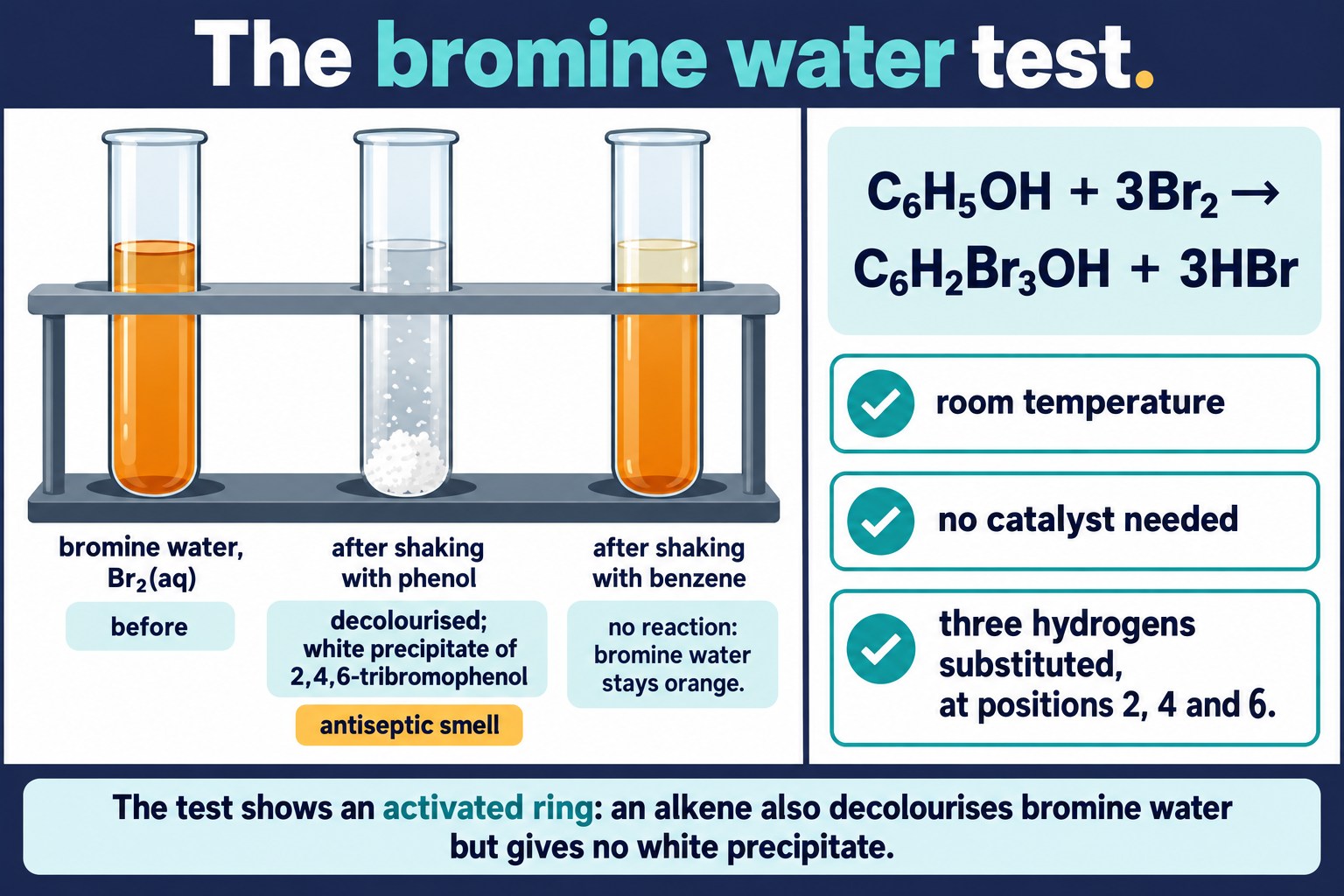
Before and after: orange bromine water becomes colourless and a white solid settles. A benzene control stays orange.
Remember: Name the product in full: 2,4,6-tribromophenol. The carbon carrying the OH is carbon 1, and the three Br atoms are at 2, 4 and 6.
Quick Check: How Much Bromine Is Used?
Work out how many moles of Br₂ each new compound uses, then rank them.
Phenol Compared with Benzene
Benzene does not react with bromine water at all, and needs a catalyst to react with liquid bromine. Phenol reacts with bromine water at once, three times over. The difference is the oxygen lone pair.
- The lone pair on the oxygen is delocalised into the ring.
- The electron density of the ring in phenol is therefore higher than in benzene.
- The electron-rich ring polarises an approaching Br₂ molecule, inducing a dipole: Br δ+ – Br δ−.
- The ring attacks the δ+ bromine without a catalyst. Benzene cannot polarise Br₂ enough, so it needs Br⁺ made by a catalyst.
- The activated ring reacts at all three favoured positions, so substitution does not stop at one Br.
| Phenol | Benzene | |
|---|---|---|
| reagent | bromine water, Br₂(aq) | liquid bromine, Br₂ |
| catalyst | none | AlBr₃ or FeBr₃ needed |
| conditions | room temperature, shake | room temperature to warm, anhydrous |
| Br atoms substituted | three | one |
| product | 2,4,6-tribromophenol + 3HBr | bromobenzene + HBr |
| seen | decolourised; white precipitate | no change with bromine water |
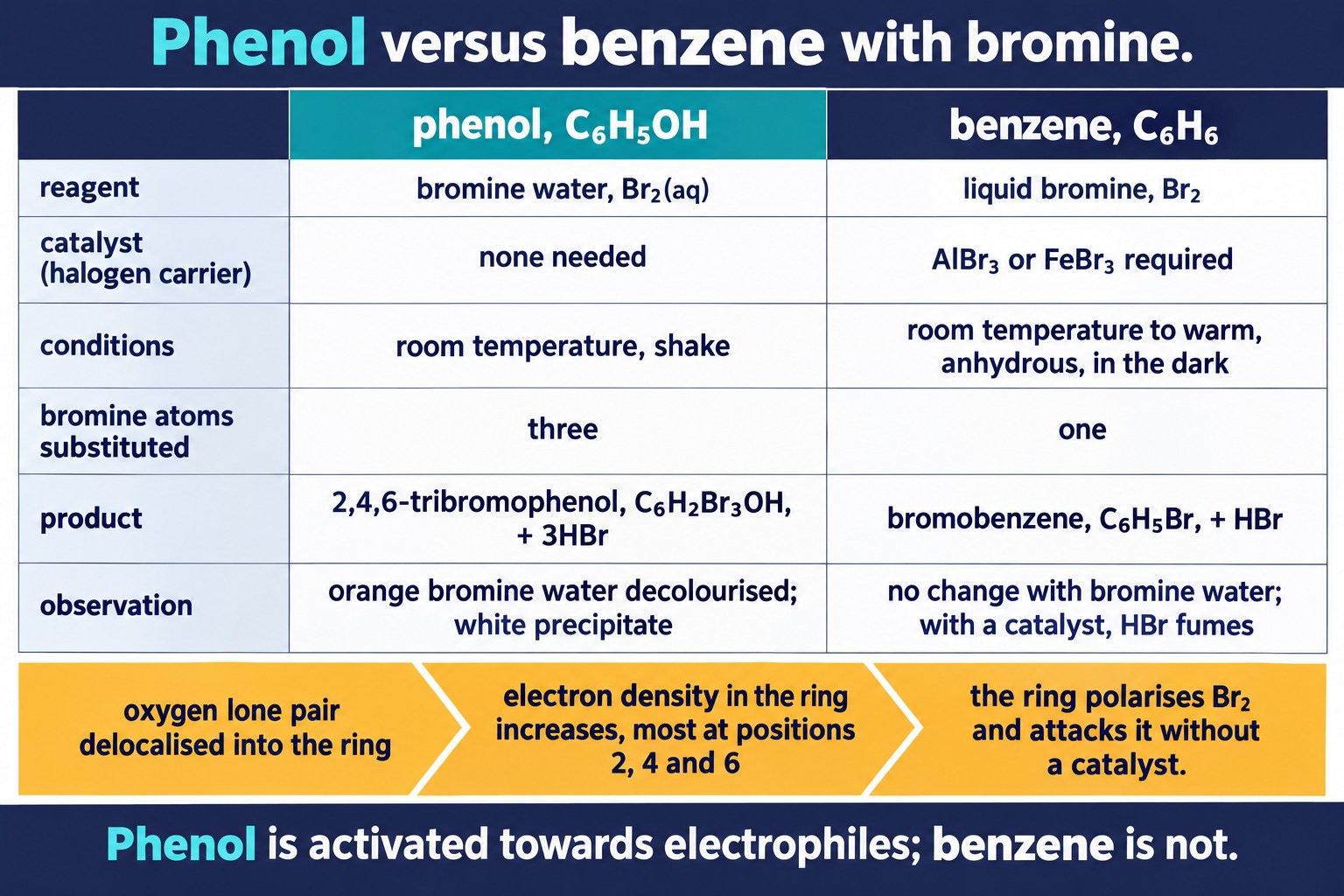
Reagent, catalyst, conditions, product and observation side by side. The bottom strip gives the three-step explanation.
Exam focus: Three ideas score: the lone pair is delocalised into the ring, the electron density is higher, and Br₂ is polarised so no catalyst is needed.
Check: Phenol and Bromine Water
Describe and explain the bromine water test, and account for the difference between phenol and benzene.
Phenol as a Weak Acid
Phenol is a weak acid, with a pKa of about 10. It is a much weaker acid than a carboxylic acid, but a stronger acid than an alcohol.
- In water it ionises only slightly: C₆H₅OH ⇌ C₆H₅O⁻ + H⁺.
- With sodium hydroxide: C₆H₅OH + NaOH → C₆H₅O⁻Na⁺ + H₂O. The solid dissolves because sodium phenoxide is an ionic salt.
- With sodium metal: 2C₆H₅OH + 2Na → 2C₆H₅O⁻Na⁺ + H₂. Hydrogen is given off.
- With sodium carbonate or sodium hydrogencarbonate: no reaction. Phenol is too weak to release CO₂.
- The carbonate test separates a phenol (no fizzing) from a carboxylic acid (fizzing).
- The phenoxide ion formed in NaOH(aq) also couples with benzenediazonium salts to give azo compounds, the basis of many dyes; this is taught in full in the nitrogen compounds topic.
Why phenol is acidic
- The oxygen lone pair is drawn into the ring, which weakens the O–H bond.
- The negative charge of the phenoxide ion, C₆H₅O⁻, is delocalised over the ring, so the ion is stabilised.
- An alkoxide ion from an alcohol has no ring to spread the charge, so alcohols are far weaker acids.
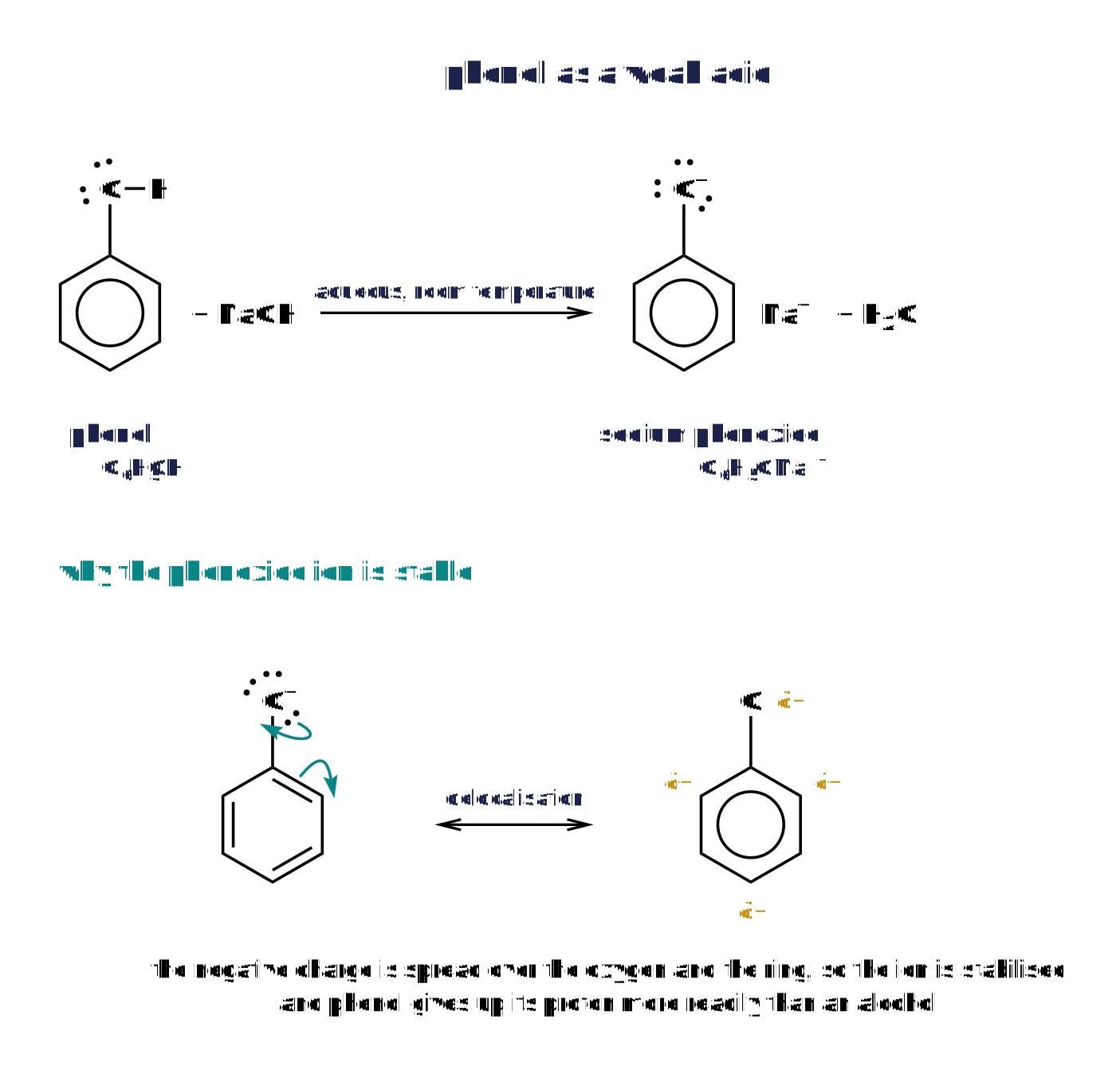
Phenol with sodium hydroxide gives sodium phenoxide. The charge of the phenoxide ion is spread over the oxygen and the ring.
Ethanol, water and phenol
| Compound | Anion formed | Why | Acidity |
|---|---|---|---|
| ethanol, C₂H₅OH (pKa about 16) | ethoxide, C₂H₅O⁻ | the electron-releasing ethyl group pushes electron density onto the O, concentrating the charge: destabilised | weakest |
| water, H₂O | hydroxide, OH⁻ | no group to release or spread electron density | middle |
| phenol, C₆H₅OH (pKa 10.0) | phenoxide, C₆H₅O⁻ | the charge is delocalised into the ring: stabilised | strongest of the three |
| ethanoic acid, CH₃COOH (pKa 4.8) | ethanoate, CH₃COO⁻ | the charge is shared equally by two oxygen atoms | stronger still |
- Order of acidity: ethanol < water < phenol < carboxylic acids.
- The more stable the anion, the further the ionisation lies to the right and the stronger the acid.
- Carboxylic acids are compared in Topic 33 Carboxylic Acids and Derivatives.
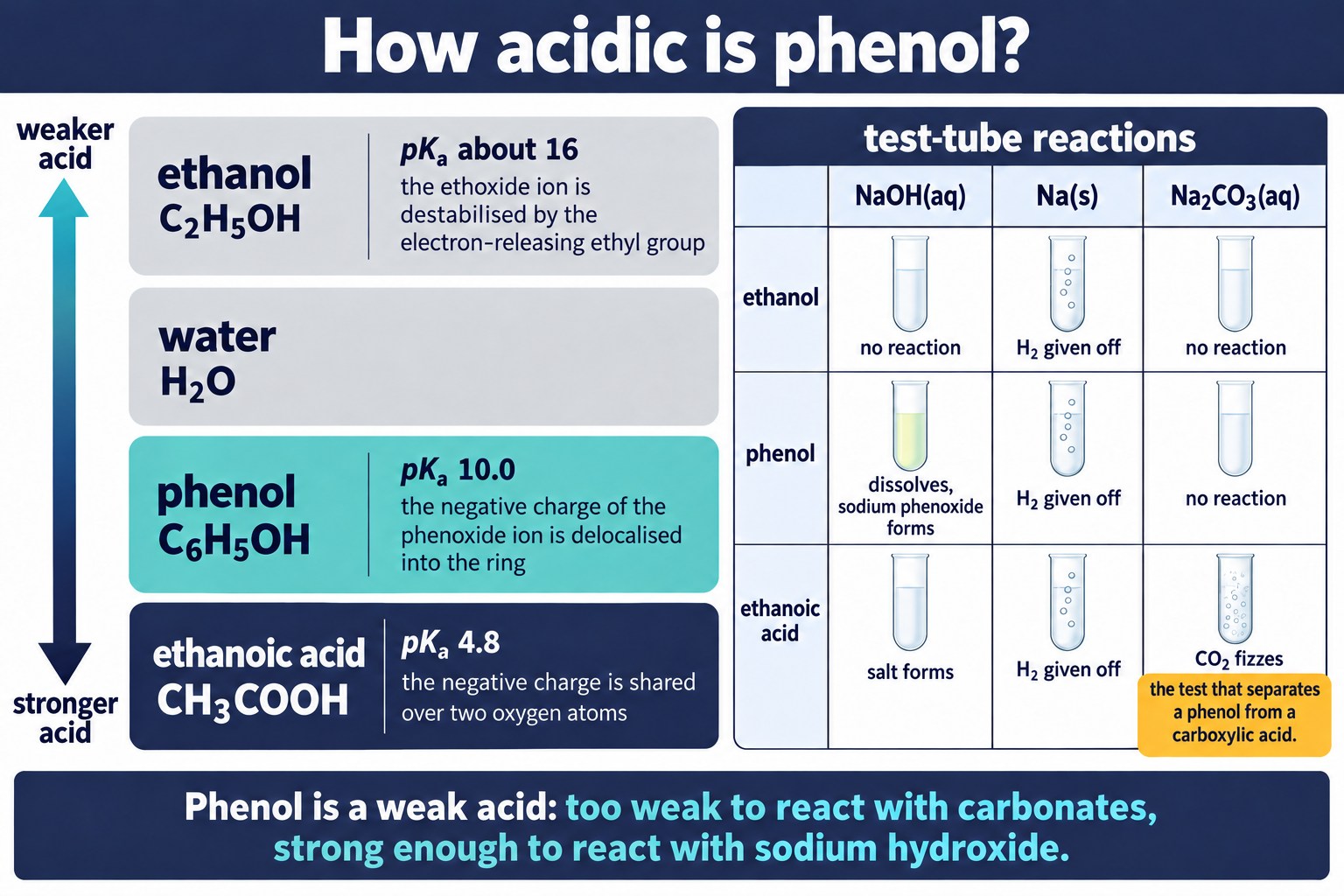
From ethanol at the top to ethanoic acid at the bottom: the more the anion is stabilised, the stronger the acid. Only the carboxylic acid fizzes with carbonate.
Exam focus: Phenol reacts with NaOH and with sodium but not with carbonates. Explain the acidity through the stability of the phenoxide ion: the negative charge is delocalised into the ring.
Quick Check: Does It React?
Decide what happens in each mixture of a new compound and a reagent.
Nitration of Phenol
Phenol is nitrated by dilute nitric acid at room temperature. No concentrated sulfuric acid is needed.
- The product is a mixture of 2-nitrophenol and 4-nitrophenol, which is yellow.
- Equation: C₆H₅OH + HNO₃ → C₆H₄(OH)NO₂ + H₂O.
- Benzene needs concentrated nitric acid, concentrated sulfuric acid as catalyst and between 25 °C and 60 °C: Nitration of Benzene.
- The activated ring of phenol reacts with the small amount of electrophile present in dilute acid; benzene needs the much higher concentration of NO₂⁺ that sulfuric acid provides.
- The new group enters at position 2 or 4 because the OH group raises the electron density there.
- With concentrated nitric acid substitution goes further, to 2,4,6-trinitrophenol (extension).
| Phenol | Benzene | |
|---|---|---|
| nitric acid | dilute | concentrated |
| sulfuric acid | none | concentrated, as catalyst |
| temperature | room temperature | between 25 °C and 60 °C |
| products | 2-nitrophenol and 4-nitrophenol | nitrobenzene |
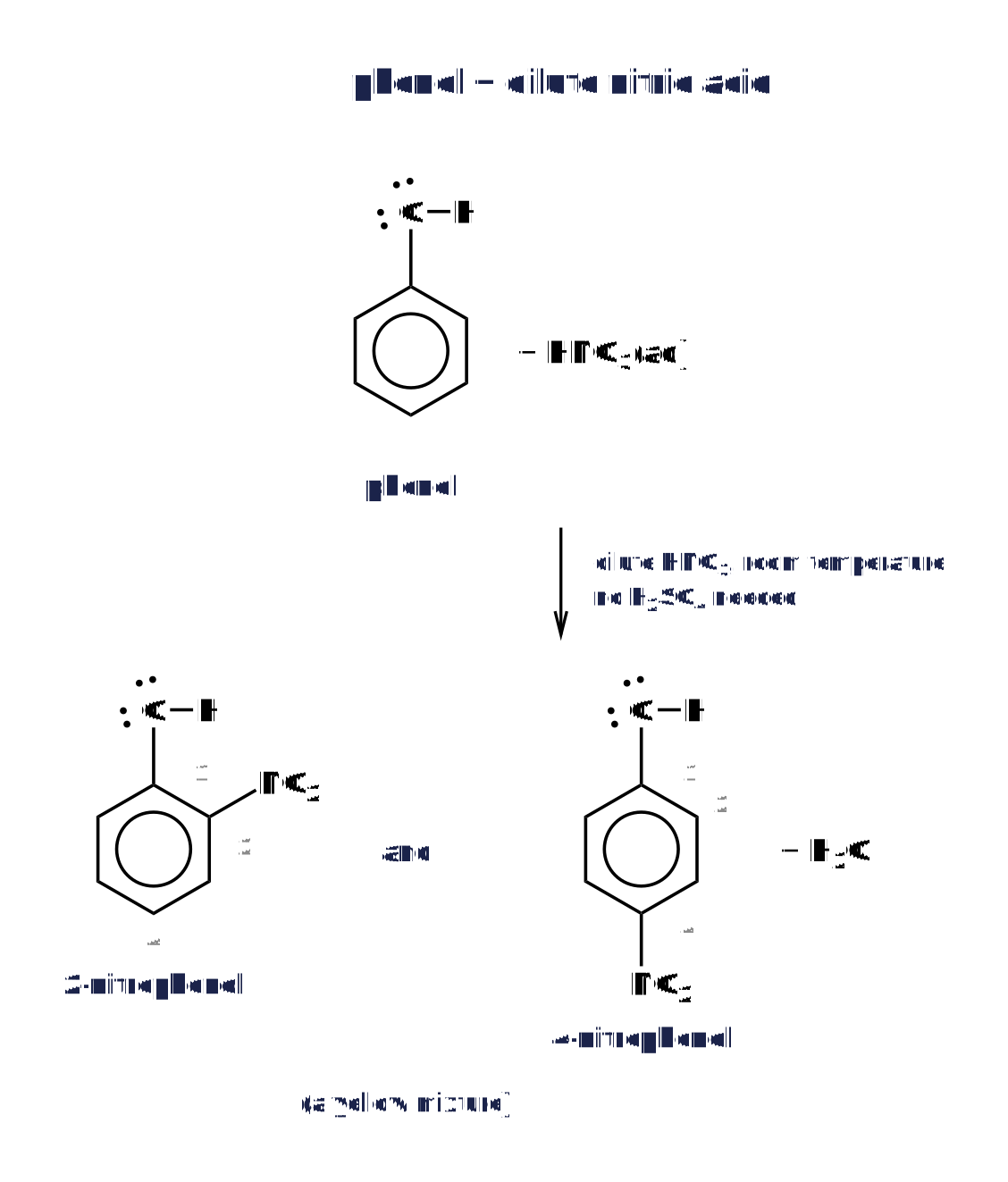
Dilute nitric acid at room temperature gives a mixture of 2-nitrophenol and 4-nitrophenol.
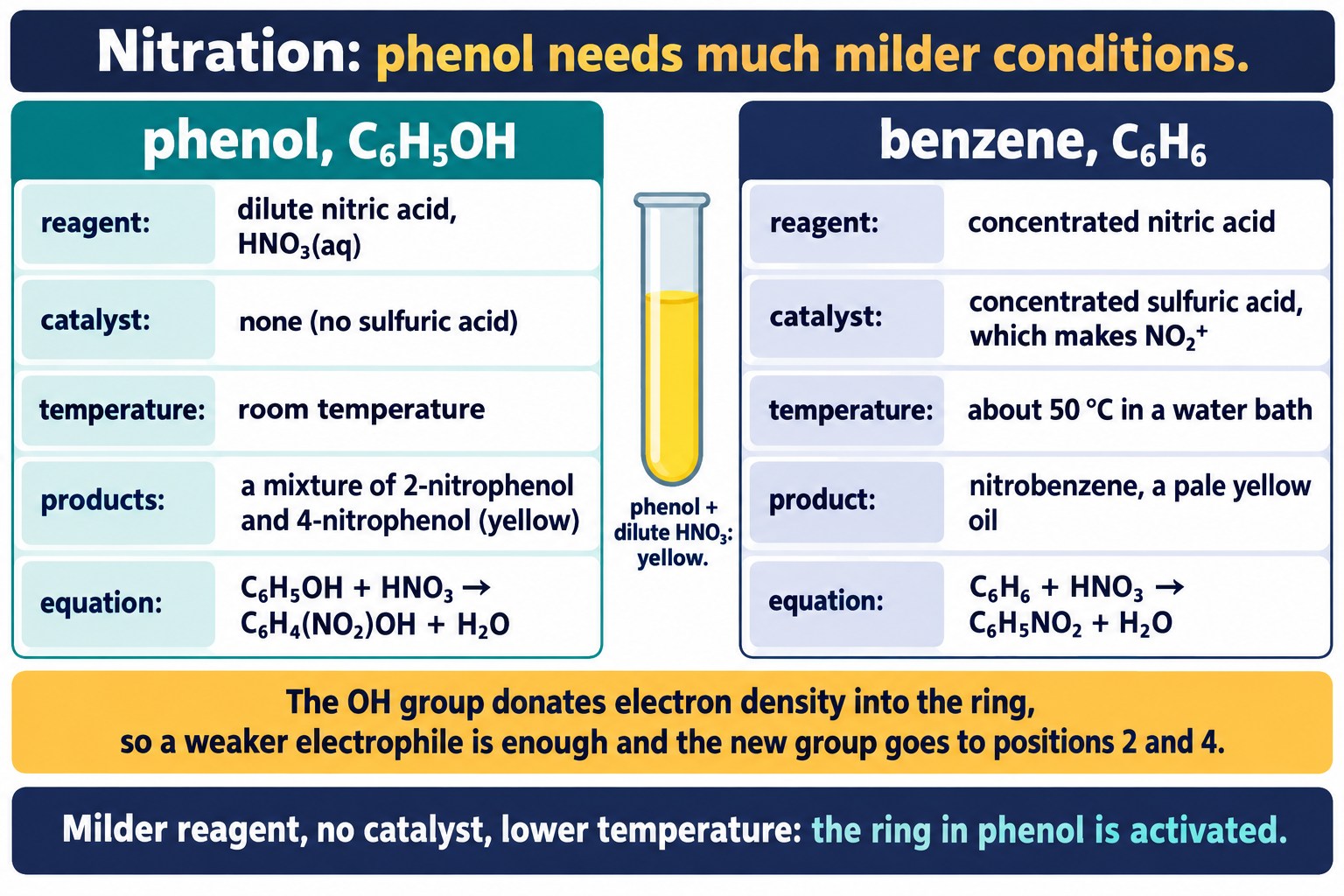
Milder reagent, no catalyst, lower temperature: the conditions for phenol and benzene side by side.
Remember: Phenol: dilute HNO₃, room temperature, 2- and 4-nitrophenol. Benzene: concentrated HNO₃ and H₂SO₄, warmed, nitrobenzene. The difference is the activated ring.
Naphthol and Other Phenols
Any compound with an OH group bonded directly to an aromatic ring is a phenol and shows the same chemistry. 2-Naphthol, C₁₀H₇OH, has its OH on a pair of fused benzene rings.
- Like phenol, 2-naphthol is a weak acid: it dissolves in NaOH(aq) to give sodium 2-naphthoxide and reacts with sodium to give hydrogen.
- It does not react with sodium carbonate.
- It reacts with bromine water without a catalyst, substituting the ring next to the OH group.
- Its lone pair is delocalised into the ring system in the same way, so the ring is activated towards electrophiles.
Exam focus: For an unfamiliar phenolic compound, reason from phenol: weak acid, no reaction with carbonate, bromine water decolourised without a catalyst, substitution next to the OH group.
Check: Phenol Against Benzene
Compare the ring in phenol with the ring in benzene and apply the lone-pair explanation to new examples.
Common Exam Points
- A phenol has the OH bonded directly to the ring. Phenylmethanol, C₆H₅CH₂OH, is an alcohol.
- The lone pair on oxygen is in a p orbital and is delocalised into the ring, raising the electron density, most at positions 2, 4 and 6.
- Bromine water: decolourised, white precipitate of 2,4,6-tribromophenol, no catalyst, room temperature.
- C₆H₅OH + 3Br₂ → C₆H₂Br₃OH + 3HBr: three substitutions, three HBr.
- Benzene does not react with bromine water and needs a catalyst for one substitution, because its lower electron density cannot polarise Br₂.
- Phenol is a weak acid: it reacts with NaOH and sodium but not with carbonates. The phenoxide ion is stabilised by delocalisation.
- Acidity order: ethanol < water < phenol < carboxylic acids, explained by the stability of each anion.
- Nitration of phenol needs only dilute HNO₃ at room temperature and gives 2-nitrophenol and 4-nitrophenol.
- Apply the reactions of phenol to other phenolic compounds such as 2-naphthol.
FAQs
Use these quick answers to check why phenol is activated, the bromine water test, the weak acidity of phenol compared with water and ethanol and its nitration.
Why does phenol react with bromine water when benzene does not?
A lone pair on the oxygen is delocalised into the ring, raising the electron density, especially at the 2, 4 and 6 positions. The ring can now polarise Br₂ and attack it without a catalyst, whereas benzene needs pure bromine and a catalyst.
What do I observe when phenol reacts with bromine water?
Shake phenol with bromine water at room temperature: the orange colour disappears and a white precipitate of 2,4,6-tribromophenol forms, with an antiseptic smell. C₆H₅OH + 3Br₂ → C₆H₂Br₃OH + 3HBr. Three bromine atoms substitute at once.
What happens when phenol is nitrated?
Dilute nitric acid at room temperature is enough, with no sulfuric acid, because the activated ring attacks the weak electrophile. A mixture of 2-nitrophenol and 4-nitrophenol forms, both yellow. Benzene needs concentrated acids at between 25 °C and 60 °C for one nitro group.
Why is phenol a weak acid?
Phenol loses H⁺ to give the phenoxide ion, C₆H₅O⁻, whose negative charge is delocalised into the ring and stabilised. Phenol reacts with NaOH to form sodium phenoxide, but it is too weak to release CO₂ from sodium carbonate, unlike a carboxylic acid.
Why is phenol more acidic than ethanol or water?
The phenoxide ion is stabilised by delocalising its negative charge into the ring, so it forms readily. In ethoxide the electron-releasing ethyl group concentrates the charge on oxygen and destabilises it. The order is ethanol < water < phenol < carboxylic acids.

Copyright notice: This OLS revision content, including the explanations, layout, diagrams, tables and embedded learning structure, is authored for Online Learning System by Dr. Mohammed Al-Fatah. It may not be copied, reproduced, redistributed or adapted without written permission.
Keep this note — free
Save your progress across every Cambridge topic. A free account remembers which topics you have covered, saves your question scores, and syncs across your phone and laptop.
- Track every topic you have finished
- Keep your practice-question scores
- No payment, no card, free forever
Already registered? Log in