Amides
A concise revision guide to amides: the structures of primary and secondary (N-substituted) amides, their preparation from acyl chlorides with ammonia or amines, their hydrolysis with aqueous acid or alkali, their reduction with LiAlH₄ and why they are much weaker bases than amines.
Before You Start
Amides are made from acyl chlorides, so the chemistry of the acyl chloride is the starting point.
- An acyl chloride, RCOCl, has a very δ+ carbonyl carbon and reacts vigorously with nucleophiles at room temperature: Acyl Chlorides.
- The reaction of ethylamine and phenylamine with ethanoyl chloride to give N-substituted (secondary) amides: Amines as Nucleophiles.
- The names ethanamide and N-methylethanamide and the amide group drawn displayed: Amines, Amides and Amino Acids: Structure and Naming.
- A condensation reaction joins two molecules and releases a small molecule, here HCl (the term used for amide formation in this course).
The Amide Group
An amide contains a carbonyl group bonded directly to a nitrogen atom: the –CONH– or –CONH₂ group. The nitrogen may carry hydrogen atoms or carbon groups.
| Class | General formula | Example | Condensed formula |
|---|---|---|---|
| primary amide | RCONH₂ | ethanamide | CH₃CONH₂ |
| N-substituted (secondary) amide | RCONHR′ | N-methylethanamide | CH₃CONHCH₃ |
| tertiary amide (one line only) | RCONR′R″ | N,N-dimethylethanamide | CH₃CON(CH₃)₂ |
- The “N-” in a name means the group is on the nitrogen, not on the carbon chain: N-methylethanamide has a two-carbon acid part and a methyl group on N.
- N-phenylethanamide, CH₃CONHC₆H₅, is the N-substituted (secondary) amide made from phenylamine and ethanoyl chloride.
- A nitrogen bonded to a carbonyl carbon is an amide; a nitrogen bonded only to alkyl or aryl groups and hydrogen is an amine.
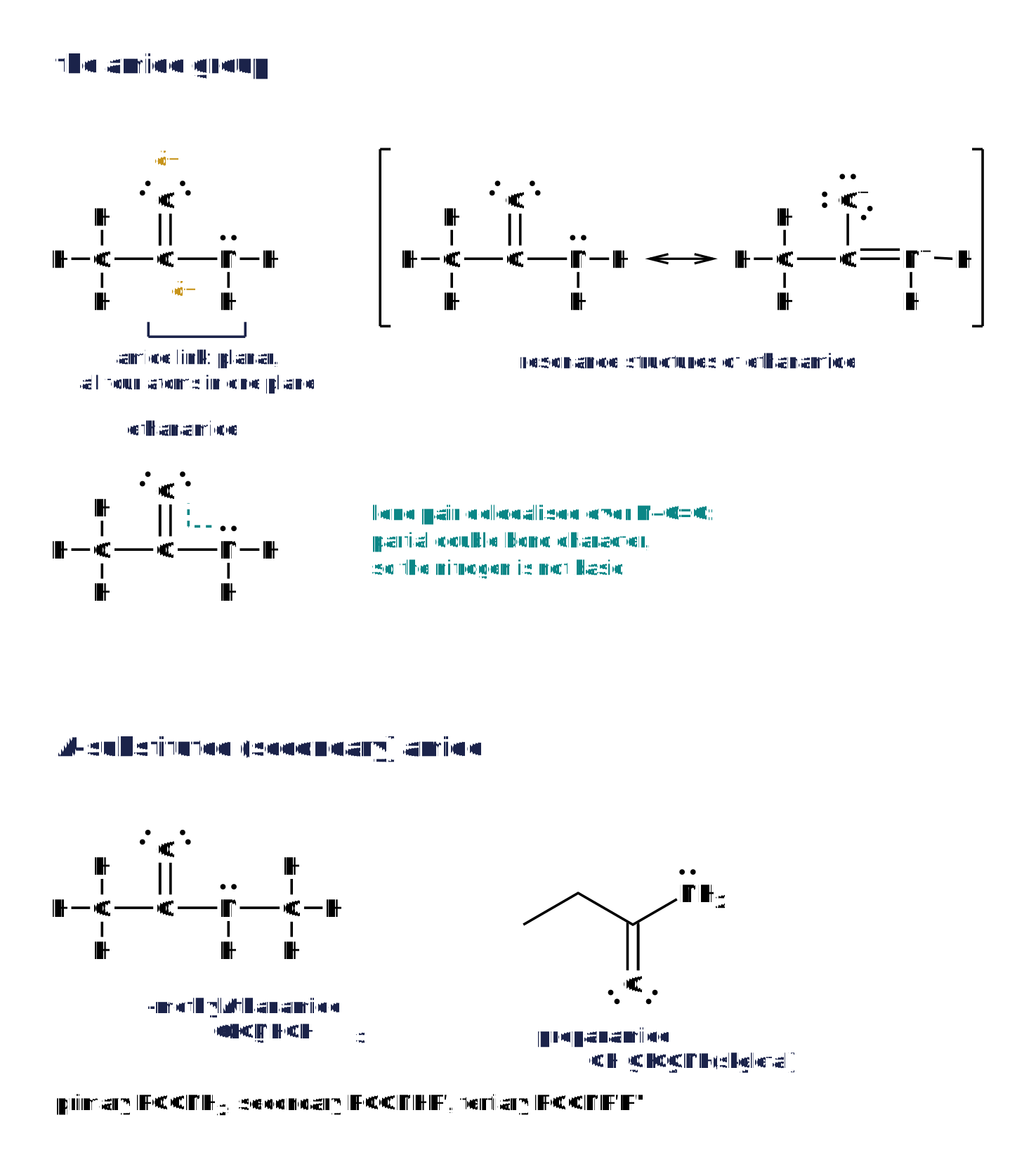
Ethanamide and N-methylethanamide drawn displayed, with the nitrogen lone pair spread over the N–C=O group and the planar amide link labelled; propanamide in skeletal form.
Remember: Primary, secondary and tertiary for amides count the carbon groups on the nitrogen, exactly as for amines. Ethanamide is primary even though its carbon chain is two carbons long.
Quick Check: Amide or Not?
Check what each nitrogen atom is bonded to in these new formulae.
Why the Amide Link Is Planar and Not Basic
The lone pair on the amide nitrogen is not free. It is delocalised over the N–C=O group, so the C–N bond has partial double bond character.
- The C, O, N and the atoms attached to N lie in one plane, and rotation about the C–N bond is restricted.
- The lone pair cannot accept a proton, so amides are much weaker bases than amines: ethanamide solution is almost neutral and forms no salt with dilute acid.
- Compare an amine: its lone pair sits on nitrogen alone and is available, so the amine accepts a proton from water or an acid.
- The C=O oxygen is δ− and the N–H hydrogens are δ+, so amide molecules hydrogen bond strongly with each other and with water.
| Property | Ethylamine, CH₃CH₂NH₂ | Ethanamide, CH₃CONH₂ |
|---|---|---|
| state at room temperature | gas, boiling point 17 °C | white solid, melting point 82 °C |
| solution in water | alkaline | almost neutral |
| with dilute HCl | forms a salt | no salt at room temperature |
| hydrogen bonding | N–H···N, weak | N–H···O=C, two N–H bonds and a C=O |
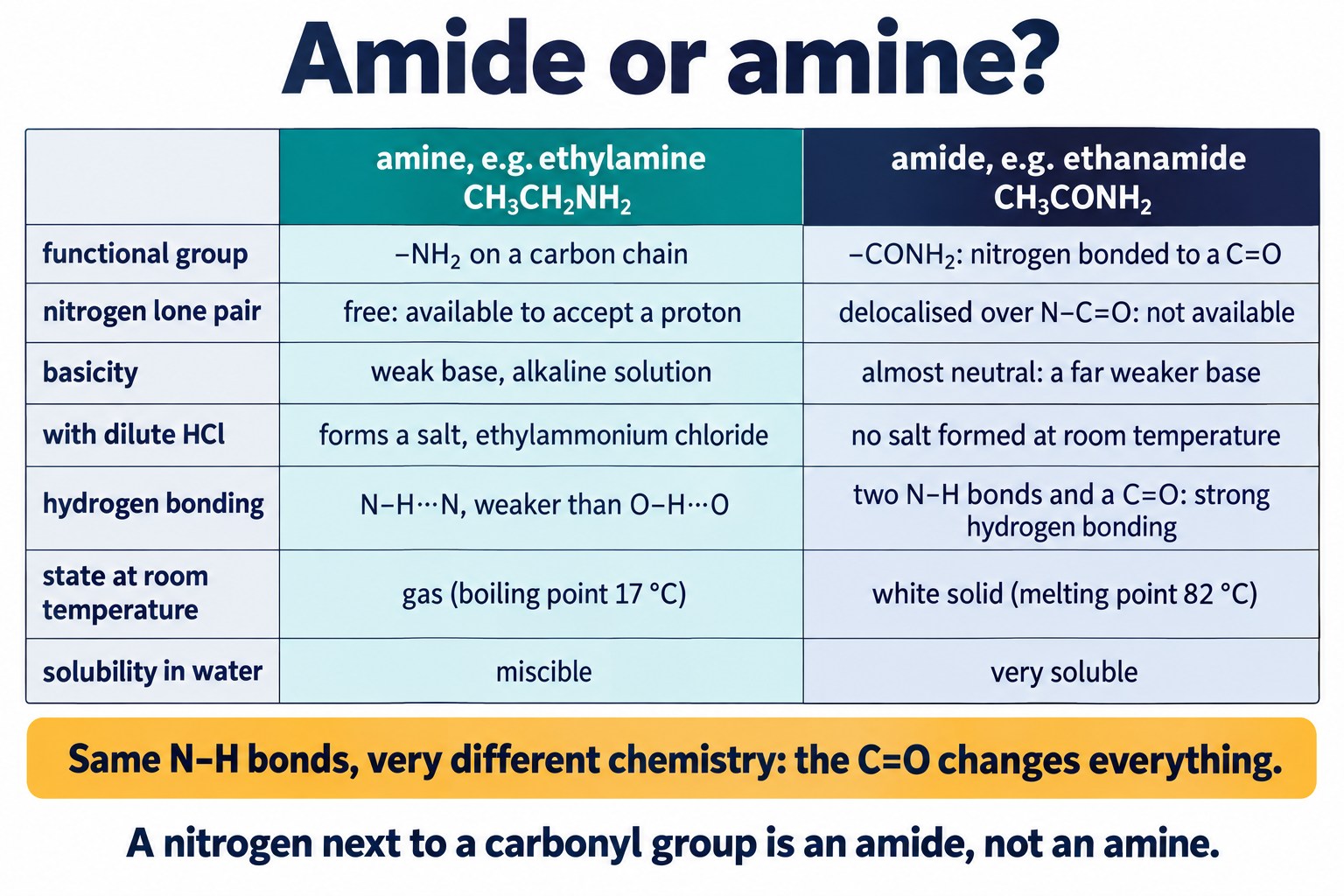
Amide or amine? The lone pair, basicity, hydrogen bonding, state and solubility of ethanamide and ethylamine set side by side.
Exam focus: Explain the weak basicity in two steps: the lone pair on N is delocalised onto the C=O group, so it is much less available to accept a proton than the lone pair of an amine.
Check: Recognising and Naming Amides
Pick out the amide group in condensed formulae, classify amides as primary or N-substituted, and name them from the acid and the group on nitrogen.
Making Amides from Acyl Chlorides
An acyl chloride reacts with ammonia or with a primary amine at room temperature. The nitrogen lone pair attacks the δ+ carbonyl carbon and HCl is lost: a condensation reaction.
With ammonia: a primary amide
- CH₃COCl + NH₃ → CH₃CONH₂ + HCl: ethanoyl chloride gives ethanamide.
- The reaction is vigorous at room temperature and gives white fumes of HCl, which react with more ammonia to form white solid ammonium chloride.
- With excess ammonia the overall equation is CH₃COCl + 2NH₃ → CH₃CONH₂ + NH₄Cl.
With a primary amine: an N-substituted amide
- CH₃COCl + CH₃NH₂ → CH₃CONHCH₃ + HCl: methylamine gives N-methylethanamide.
- With ethylamine: CH₃COCl + CH₃CH₂NH₂ → CH₃CONHCH₂CH₃ + HCl, an N-substituted amide named N-ethylethanamide.
- With phenylamine: CH₃COCl + C₆H₅NH₂ → CH₃CONHC₆H₅ + HCl, N-phenylethanamide, a white solid.
- Excess amine takes the HCl as the ammonium salt: CH₃COCl + 2RNH₂ → CH₃CONHR + RNH₃⁺Cl⁻.
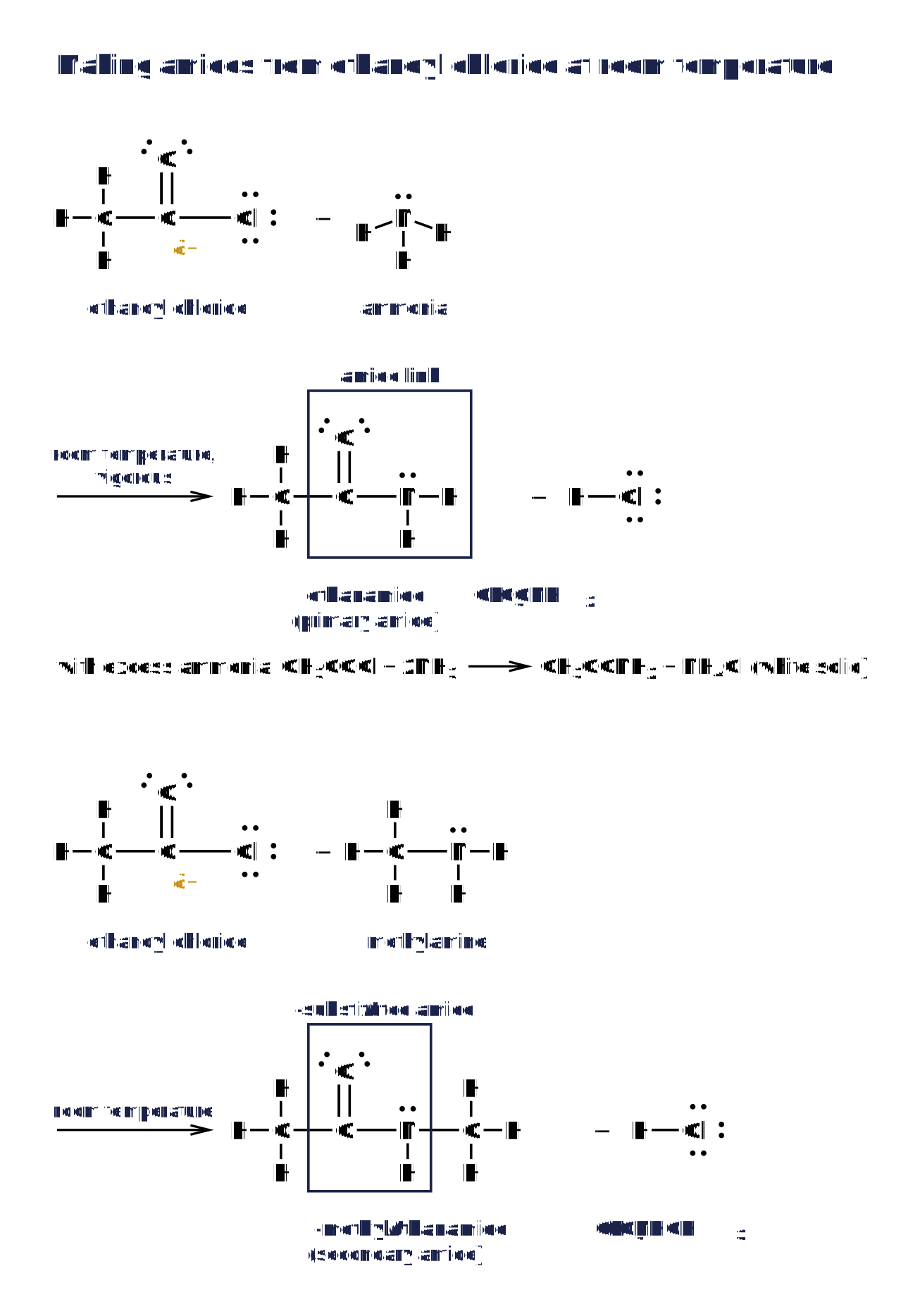
Ethanoyl chloride with ammonia and with methylamine: the lone pair attacks the carbonyl carbon, HCl is lost and the amide link (boxed) is formed.
- Naming: the acid part gives the parent (ethan-, propan-), the ending is -amide, and any group on nitrogen takes the prefix N-.
- A carboxylic acid and an amine do not give an amide at room temperature: an acid-base reaction gives the ammonium salt instead (extension).
Exam focus: Write the small molecule lost: HCl with one mole of ammonia or amine, NH₄Cl or RNH₃⁺Cl⁻ when the base is in excess. State “room temperature” as the condition.
Quick Check: Product and Maximum Amount
Name the product, then decide which reagent runs out first.
Hydrolysis of Amides
Heating an amide under reflux with aqueous acid or aqueous alkali breaks the C–N bond. Water is added across the amide link: hydrolysis.
| Reagent | Conditions | Products | Equation for ethanamide |
|---|---|---|---|
| dilute hydrochloric acid | heat under reflux | carboxylic acid + ammonium salt | CH₃CONH₂ + H₂O + HCl → CH₃COOH + NH₄Cl |
| sodium hydroxide solution | heat under reflux | carboxylate salt + ammonia | CH₃CONH₂ + NaOH → CH₃COONa + NH₃ |
- In alkali the ammonia is given off as a gas and turns damp red litmus paper blue.
- An N-substituted amide gives the amine instead of ammonia: in acid as its salt (CH₃NH₃⁺Cl⁻), in alkali as the free amine.
- The same hydrolysis breaks the amide links of polyamides and the peptide links of proteins: Peptides and Proteins and Condensation Polymers: Polyamides and Polyesters.
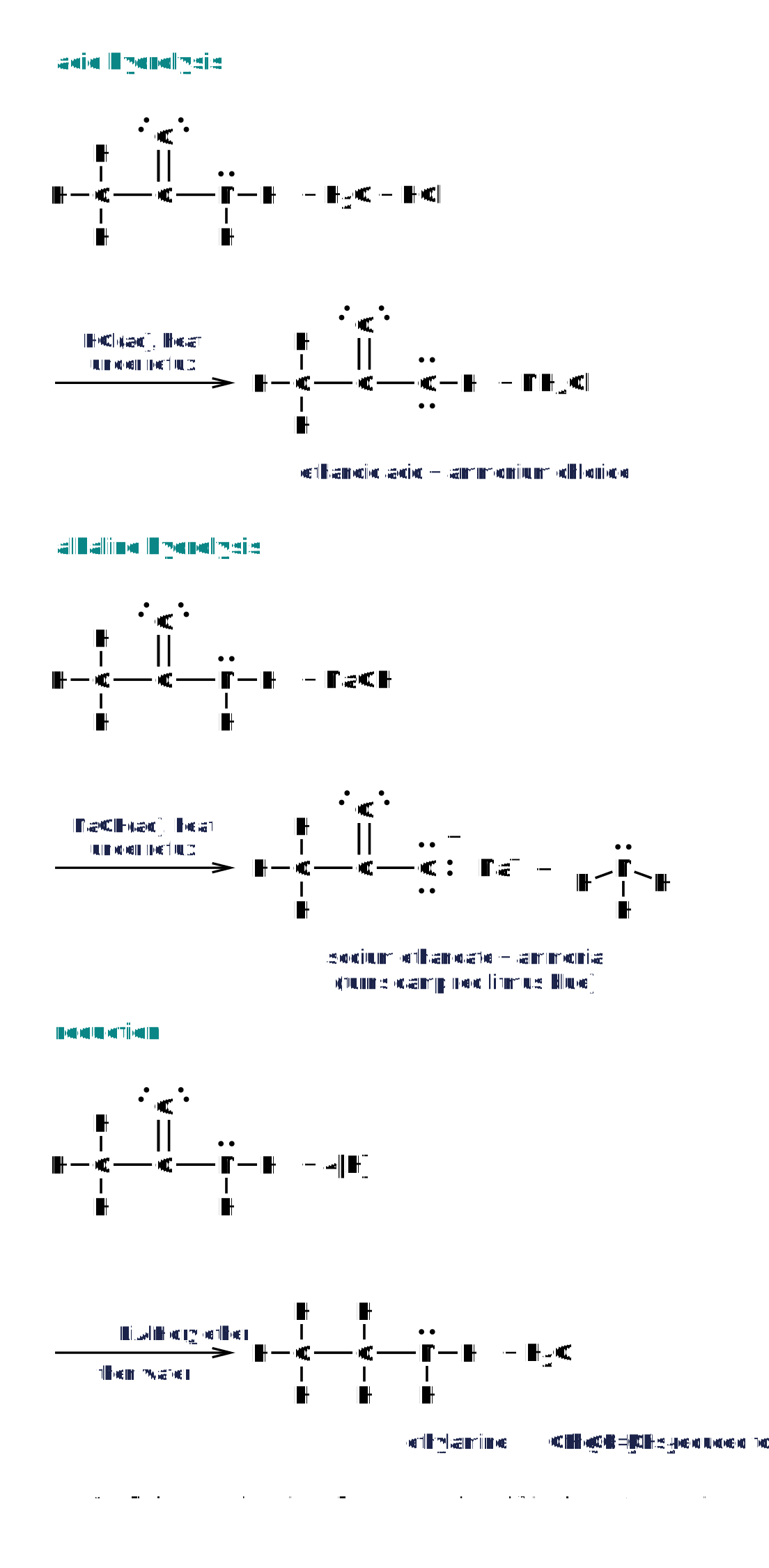
Ethanamide hydrolysed by dilute hydrochloric acid and by sodium hydroxide solution, and reduced by LiAlH₄ to ethylamine: three equations with displayed structures.
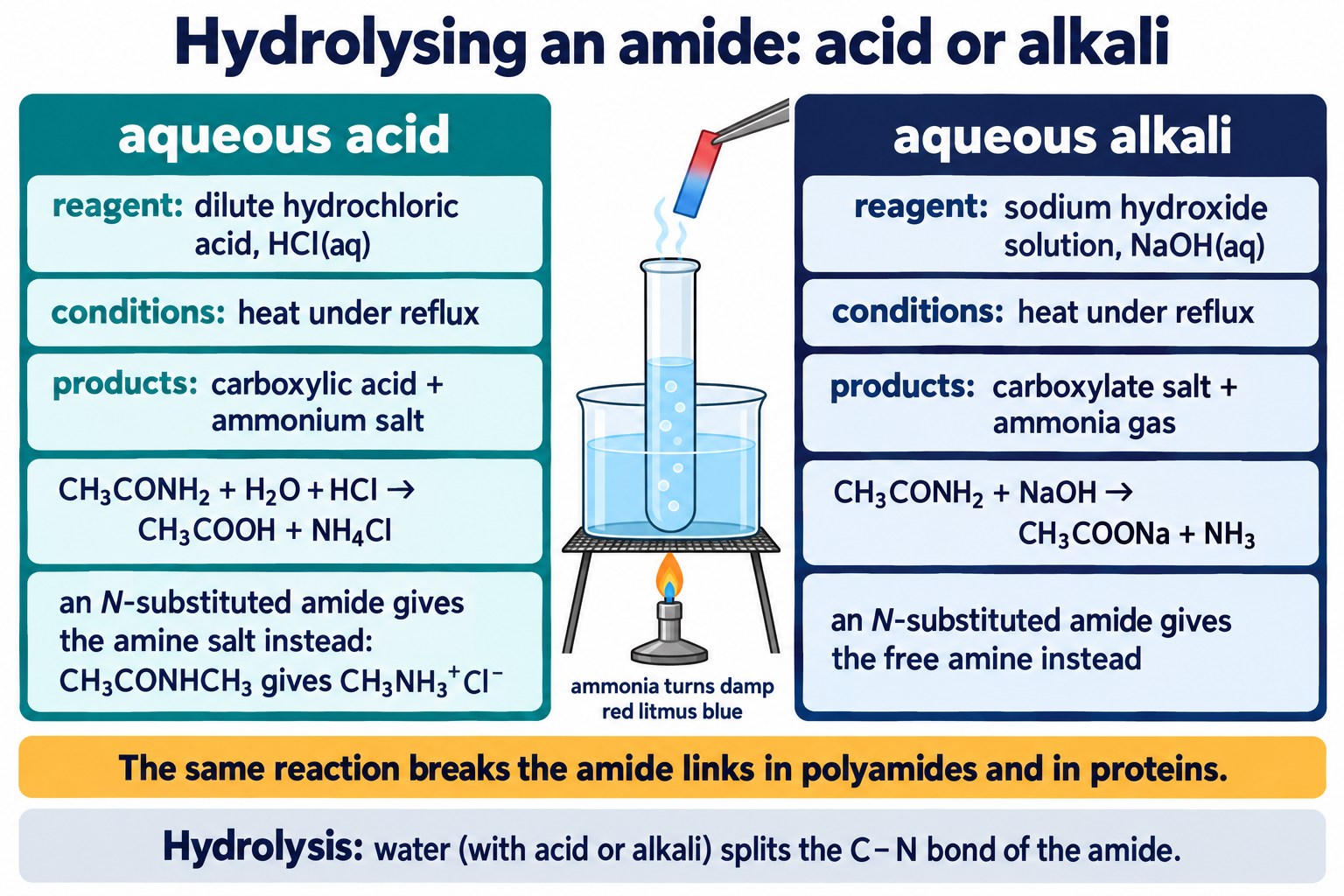
Acid against alkali: reagents, reflux conditions and products for the hydrolysis of ethanamide, with the litmus test for ammonia.
Reduction of Amides
Lithium aluminium hydride, LiAlH₄, in dry ether reduces the C=O group of an amide to CH₂, giving an amine with the same number of carbon atoms.
- CH₃CONH₂ + 4[H] → CH₃CH₂NH₂ + H₂O: ethanamide gives ethylamine.
- Conditions: LiAlH₄ in dry ether, then water (or dilute acid) to release the amine.
- A primary amide gives a primary amine; an N-substituted amide gives a secondary amine (CH₃CONHCH₃ → CH₃CH₂NHCH₃).
- Compare the reduction of a nitrile, RCN + 4[H] → RCH₂NH₂, in Preparing Amines.
Remember: Reduction keeps the carbon count: ethanamide (two carbons) gives ethylamine (two carbons). Hydrolysis loses the nitrogen as ammonia or an ammonium salt.
Quick Check: Predicting the Products
Decide what each reaction gives, using amides that are new to this page.
The Amide Link in Polymers and Proteins
The same –CONH– group joins the units of a polyamide such as nylon and the amino acids in a protein, where it is called the peptide link.
- Nylon-6,6 forms when a diamine and a dicarboxylic acid (or dioyl chloride) join through amide links with loss of water (or HCl): Condensation Polymers: Polyamides and Polyesters.
- A dipeptide forms when the –COOH of one amino acid and the –NH₂ of another join through an amide (peptide) link: Peptides and Proteins.
- Hydrogen bonding between the N–H of one chain and the C=O of another gives polyamides their strength and high melting temperatures.
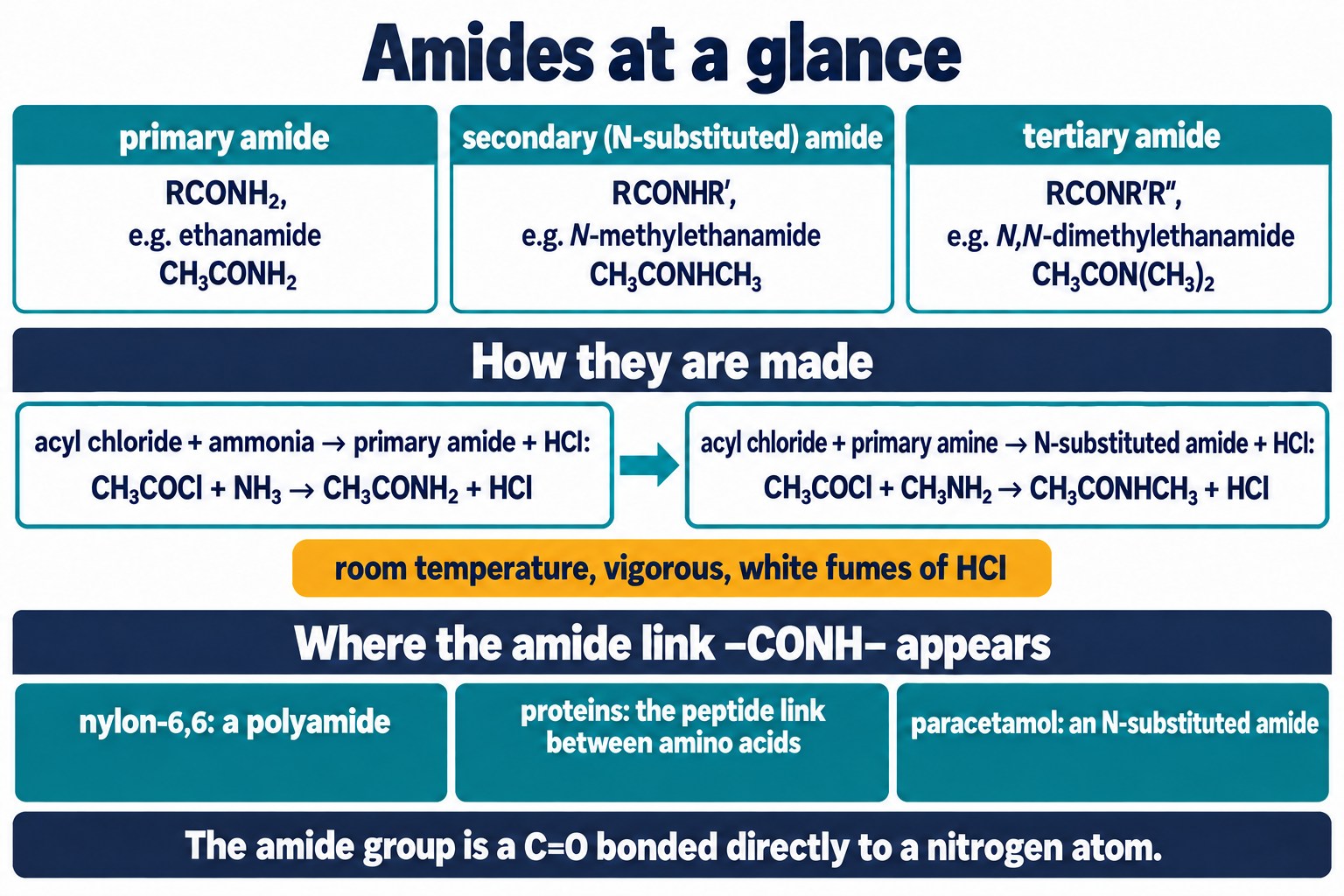
Amides at a glance: the three classes, how each is made from an acyl chloride, and where the amide link appears in nylon and in proteins.
Worked Example: Spot the Amide
Answer. A is N-methylpropanamide, an N-substituted (secondary) amide, made from propanoyl chloride and methylamine with loss of HCl.
A second compound
Check: Preparing Amides
Give the reagents, conditions and products for making primary and N-substituted amides from acyl chlorides, and write the balanced equations.
Common Exam Points
- An amide has a carbonyl group bonded directly to nitrogen: RCONH₂ (primary) or RCONHR′ (N-substituted (secondary) amide).
- Acyl chloride + ammonia → primary amide + HCl; acyl chloride + primary amine → N-substituted (secondary) amide + HCl; room temperature, vigorous.
- With excess ammonia or amine the HCl is taken as the ammonium salt: CH₃COCl + 2NH₃ → CH₃CONH₂ + NH₄Cl.
- The amide nitrogen lone pair is delocalised over N–C=O, so the link is planar and the amide is a much weaker base than an amine.
- Primary amides are solids with high melting points because of hydrogen bonding through two N–H bonds and a C=O.
- Hydrolysis: dilute acid under reflux gives the carboxylic acid and an ammonium salt; aqueous alkali gives the carboxylate salt and ammonia.
- Reduction with LiAlH₄ in dry ether turns the C=O into CH₂: CH₃CONH₂ + 4[H] → CH₃CH₂NH₂ + H₂O.
- Name from the acid with the ending -amide; a group on nitrogen takes the prefix N- (N-methylethanamide).
FAQs
Use these quick answers to check the structure of primary and N-substituted amides, why they are not basic, how they are made from acyl chlorides, and their hydrolysis and reduction.
What is the difference between a primary and an N-substituted amide?
A primary amide, RCONH₂, has two hydrogens on the nitrogen: ethanamide is CH₃CONH₂. In an N-substituted (secondary) amide one of those hydrogens is replaced by a carbon group: N-methylethanamide is CH₃CONHCH₃. Both contain the amide group, a C=O bonded directly to N.
Why are amides not basic like amines?
The nitrogen lone pair is delocalised over the N–C=O system, giving the C–N bond partial double bond character and making the amide link planar.
The lone pair is therefore not available to accept a proton, so amides are much weaker bases than amines.
How do I make a primary amide?
React an acyl chloride with ammonia at room temperature: CH₃COCl + NH₃ → CH₃CONH₂ + HCl. The reaction is vigorous and gives white fumes; with excess ammonia the HCl is captured as ammonium chloride, CH₃COCl + 2NH₃ → CH₃CONH₂ + NH₄Cl, a condensation reaction.
What happens when an amide is hydrolysed?
Heating with aqueous acid under reflux gives the carboxylic acid and an ammonium salt: CH₃CONH₂ + H₂O + HCl → CH₃COOH + NH₄Cl. With sodium hydroxide the carboxylate salt forms and ammonia is released, CH₃CONH₂ + NaOH → CH₃COONa + NH₃, detected with damp litmus.
How can I reduce an amide?
Use LiAlH₄ in dry ether, then add water. The C=O of the amide is reduced to CH₂, giving a primary amine with the same number of carbon atoms: CH₃CONH₂ + 4[H] → CH₃CH₂NH₂ + H₂O. Nitriles are reduced with the same reagent.

Copyright notice: This OLS revision content, including the explanations, layout, diagrams, tables and embedded learning structure, is authored for Online Learning System by Dr. Mohammed Al-Fatah. It may not be copied, reproduced, redistributed or adapted without written permission.
Keep this note — free
Save your progress across every Cambridge topic. A free account remembers which topics you have covered, saves your question scores, and syncs across your phone and laptop.
- Track every topic you have finished
- Keep your practice-question scores
- No payment, no card, free forever
Already registered? Log in