Equilibrium Constants, Entropy and the Extent of Reaction
A concise revision guide to the link between the equilibrium constant and the total entropy change, ΔStotal = R ln K: how temperature changes ΔStotal and so the size of K, and how the size of K shows whether a reaction goes to completion, hardly happens or is reversible.
- 13.8i
- 13.8ii
- 13.9
What these spec points say
- 13.8i understand the effect of a change in temperature on: the value of ΔStotal
- 13.8ii understand the effect of a change in temperature on: the magnitude of the equilibrium constant, since ΔStotal = R lnK
- 13.9 be able to apply knowledge of equilibrium constant values to predict the extent to which a reaction takes place
The Link Between ΔS_total and K
In Topic 12 Entropy and Energetics a reaction was called feasible when its total entropy change, ΔS_total, is positive. That is a yes or no answer.
The equilibrium constant gives the full answer: how far the reaction goes. The two are tied together by one equation.
ΔS_total = R ln K
- R is the gas constant, 8.31 J K⁻¹ mol⁻¹.
- ln K is the natural logarithm of the equilibrium constant, the ln key on a calculator.
- ΔS_total is in J K⁻¹ mol⁻¹, the same units as R, because ln K is a pure number.
Rearranged, the equation gives K from an entropy change.
ln K = (ΔS_total) / (R) so K = eΔStotal/R
| ΔS_total | ln K | K | Mixture at equilibrium |
|---|---|---|---|
| Positive | positive | greater than 1 | products favoured |
| Zero | zero | exactly 1 | balanced |
| Negative | negative | less than 1 | reactants favoured |
Because K depends on e raised to a power, a modest change in ΔS_total makes a very large change in K.
Key idea: ΔS_total = R ln K. The more positive the total entropy change, the larger the equilibrium constant and the further the reaction goes towards products.
Worked Examples
From ΔS_total to K
A reaction has ΔS_total = +50.0 J K⁻¹ mol⁻¹ at 298 K. Calculate K.
Step 1: divide by R.
ln K = (50.0) / (8.31) = 6.02
Step 2: take e to that power, using the eˣ key.
K = e6.02
Answer: K = 410, using the unrounded value of ln K in the calculator.
From K to ΔS_total
A reaction has K = 2.0 × 10⁻³ at a certain temperature. Calculate ΔS_total.
Step 1: take the natural logarithm.
ln K = ln(2.0 × 10⁻³) = −6.21
Step 2: multiply by R.
ΔS_total = 8.31 × (−6.21)
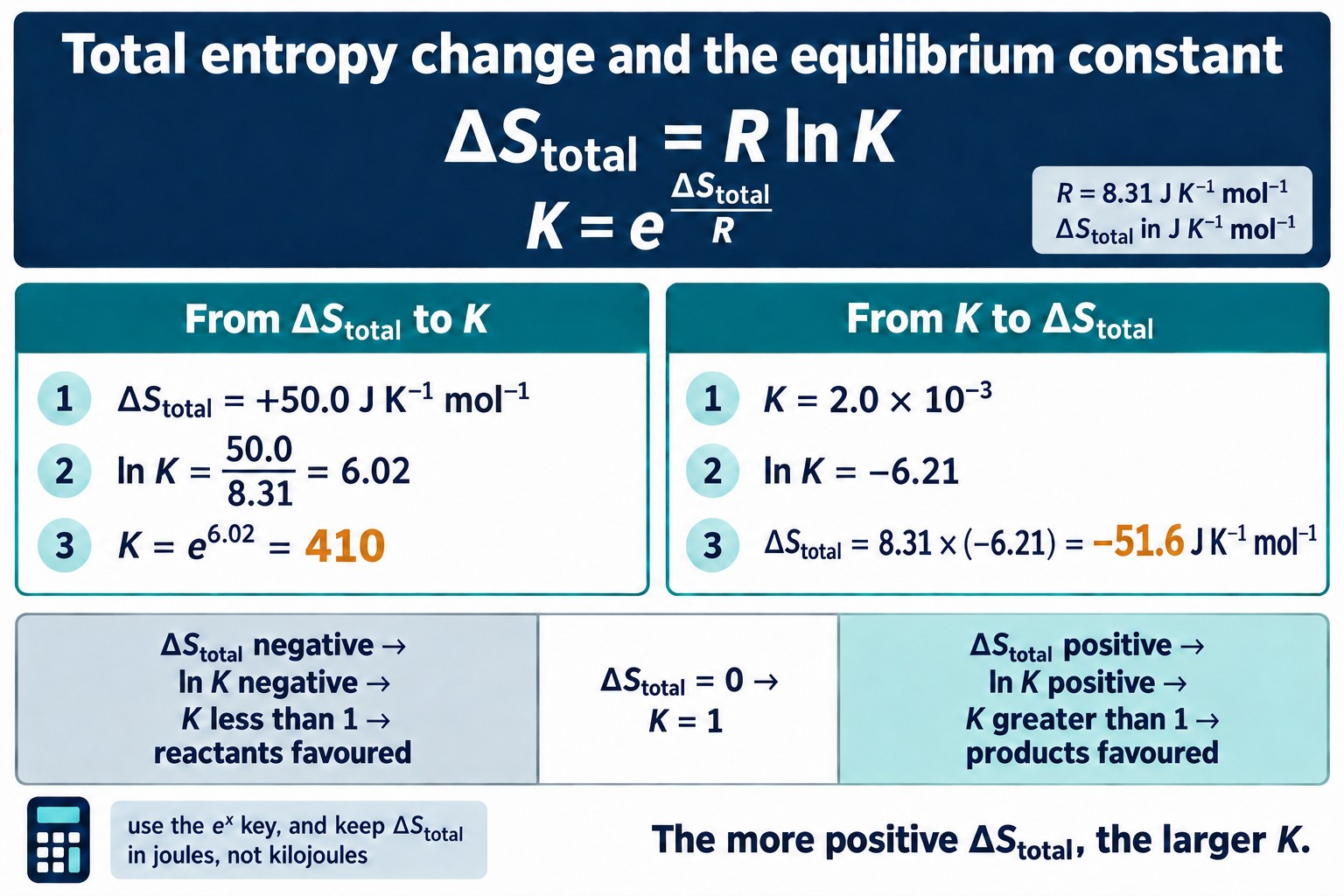
The equation ΔS_total = R ln K with one conversion in each direction, and the rule that a positive total entropy change gives a constant greater than 1.
- Keep ΔS_total in joules. A value in kJ K⁻¹ mol⁻¹ gives an answer that is wrong by an enormous factor.
- Use ln, not log₁₀.
- Do not round ln K before taking eˣ: a small change in the power is a large change in K.
Worked example: ΔS_total = +50.0 J K⁻¹ mol⁻¹: ln K = (50.0) / (8.31) = 6.02, so K = e6.02 = 410. K = 2.0 × 10⁻³: ΔS_total = 8.31 × ln K = 8.31 × (−6.21) = −51.6 J K⁻¹ mol⁻¹.
Check: Converting Between ΔS_total and K
Calculate an equilibrium constant from a total entropy change, and a total entropy change from an equilibrium constant, using R = 8.31 J K⁻¹ mol⁻¹ and values not used on this page.
Why Temperature Changes K
The total entropy change has two parts.
ΔS_total = ΔS_system + ΔS_surroundings and ΔS_surroundings = (−ΔH) / (T)
- ΔS_system changes very little with temperature.
- ΔS_surroundings has T on the bottom, so its size shrinks as the temperature rises.
- So a change in temperature changes ΔS_total, and through ΔS_total = R ln K it changes K.
Exothermic: K falls as T rises
For 2SO₂(g) + O₂(g) ⇌ 2SO₃(g), ΔH = −198 kJ mol⁻¹ and ΔS_system = −188 J K⁻¹ mol⁻¹. ΔS_surroundings = +(198 000) / (T), a positive term.
| T / K | ΔS_surroundings / J K⁻¹ mol⁻¹ | ΔS_total / J K⁻¹ mol⁻¹ | K |
|---|---|---|---|
| 298 | +664.4 | +476.4 | 7.9 × 10²⁴ |
| 700 | +282.9 | +94.9 | 9.1 × 10⁴ |
| 1000 | +198.0 | +10.0 | 3.3 |
| 1200 | +165.0 | −23.0 | 0.063 |
- Heating makes the positive ΔS_surroundings less positive.
- ΔS_total therefore becomes less positive, and at 1200 K it is negative.
- ln K falls with it, so K decreases and the position of equilibrium moves to the left.
Endothermic: K rises as T rises
For N₂O₄(g) ⇌ 2NO₂(g), ΔH = +57.2 kJ mol⁻¹ and ΔS_system = +176 J K⁻¹ mol⁻¹. Now ΔS_surroundings is negative.
- At 298 K: ΔS_surroundings = −191.9, so ΔS_total = −15.9 J K⁻¹ mol⁻¹ and K = 0.15.
- At 350 K: ΔS_surroundings = −163.4, so ΔS_total = +12.6 J K⁻¹ mol⁻¹ and K = 4.5.
- Heating makes the negative ΔS_surroundings less negative, so ΔS_total and K both increase.
Exam wording: “The reaction is exothermic, so ΔS_surroundings (= (−ΔH) / (T)) is positive and becomes less positive as T increases. ΔS_total decreases and, since ΔS_total = R ln K, K decreases.”
Quick Check: K at Two Temperatures
Work out each step on paper, then flip the card to compare. The data are invented for this exercise.
The Size of K and the Extent of Reaction
The magnitude of K says how far a reaction goes before it reaches equilibrium. Chemists use two round figures as the limits.
| Value of K | Extent of reaction | ΔS_total / J K⁻¹ mol⁻¹ |
|---|---|---|
| Greater than 10¹⁰ | goes to completion: effectively all products | more positive than about +191 |
| Between 1 and 10¹⁰ | reversible, with products predominating | between 0 and +191 |
| Equal to 1 | balanced: reactants and products in comparable amounts | 0 |
| Between 10⁻¹⁰ and 1 | reversible, with reactants predominating | between −191 and 0 |
| Less than 10⁻¹⁰ | does not occur: effectively all reactants | more negative than about −191 |
The entropy limits come from the same equation.
ΔS_total = R ln K = 8.31 × ln(10¹⁰) = 8.31 × 23.03 = +191 J K⁻¹ mol⁻¹
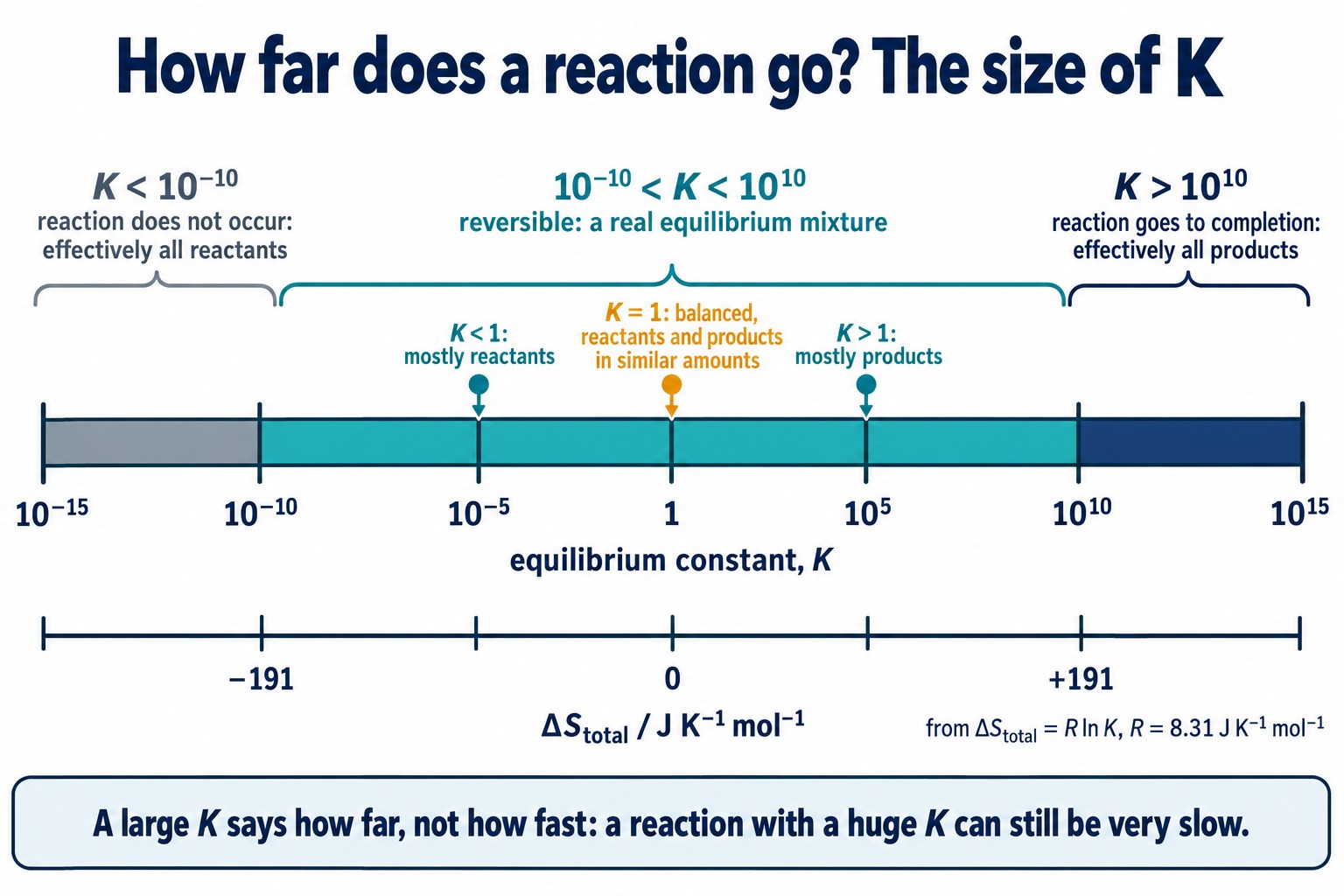
The scale of equilibrium constants: below 10⁻¹⁰ a reaction does not occur, above 10¹⁰ it goes to completion, and in between it is reversible, with K = 1 as the balance point.
Apply the scale to the sulfur trioxide equilibrium above.
- At 298 K, K = 7.9 × 10²⁴: the reaction goes to completion, although without a catalyst it is far too slow to see.
- At 700 K, K = 9.1 × 10⁴: reversible, with sulfur trioxide predominating.
- At 1200 K, K = 0.063: reversible, with the reactants predominating.
A large K says nothing about rate. A reaction can be feasible, with a huge equilibrium constant, and still be held back by a high activation energy.
Remember: K > 10¹⁰: goes to completion. K < 10⁻¹⁰: does not occur. In between: reversible. K = 1 (ΔS_total = 0): balanced, neither side favoured.
Quick Check: How Far Does It Go?
Each line gives a value for a different reaction at equilibrium. Choose the description that fits.
Common Exam Points
Say
- “ΔS_total = R ln K, so a more positive ΔS_total gives a larger K.”
- “ΔS_surroundings = (−ΔH) / (T) becomes less positive as T increases for an exothermic reaction, so ΔS_total and K decrease.”
- “K is greater than 10¹⁰, so the reaction goes to completion.”
Do not say
- “ΔS_system changes a lot with temperature” (it is ΔS_surroundings that changes).
- “K is large, so the reaction is fast.”
- “K is less than 1, so the reaction does not happen” (it is reversible with reactants predominating unless K is below 10⁻¹⁰).
Watch for
- ΔH given in kJ mol⁻¹: multiply by 1000 before dividing by T.
- A question that asks for the temperature at which K = 1: set ΔS_total = 0, so T = (ΔH) / (ΔS_system).
- An answer for K that needs standard form: e raised to a large power is a very large number.
Check: Temperature, ΔS_total and Extent
Explain how a change in temperature alters ΔS_total and K for reactions not used on this page, and use the size of K to describe how far each reaction goes.
FAQs
Use these quick answers to check the link between total entropy, K and how far a reaction goes.
What does ΔStotal = R ln K tell me?
It links feasibility to the equilibrium constant. A positive ΔStotal makes ln K positive, so K is greater than 1 and products are favoured. A negative ΔStotal gives K less than 1. Use R = 8.31 J K⁻¹ mol⁻¹.
How do I calculate K from ΔStotal?
Divide ΔStotal in J K⁻¹ mol⁻¹ by R to obtain ln K, then use the eˣ key. For ΔStotal = +50 J K⁻¹ mol⁻¹, ln K = 6.02 and K is about 410.
Why does K fall with temperature for an exothermic reaction?
ΔSsurroundings = (−ΔH) / (T) is positive for an exothermic reaction but becomes smaller as T rises. ΔStotal therefore decreases, and because ΔStotal = R ln K, the value of K decreases too.
What does the size of K say about how far a reaction goes?
A K above about 10¹⁰ means the reaction goes effectively to completion. A K below about 10⁻¹⁰ means it effectively does not go. Values in between describe a reversible reaction with both reactants and products present.
Does K = 1 mean that nothing happens?
No. K = 1 corresponds to ΔStotal = 0, where reactants and products are equally favoured. The reaction still proceeds in both directions, giving an equilibrium mixture that contains substantial amounts of both.

Copyright notice: This OLS revision content, including the explanations, layout, diagrams, tables and embedded learning structure, is authored for Online Learning System by Dr. Mohammed Al-Fatah. It may not be copied, reproduced, redistributed or adapted without written permission.
Keep this note — free
Save your progress across every Edexcel IAL topic. A free account remembers which topics you have covered, saves your question scores, and syncs across your phone and laptop.
- Track every topic you have finished
- Keep your practice-question scores
- No payment, no card, free forever
Already registered? Log in