What Changes an Equilibrium Constant?
A concise revision guide to what does and does not change an equilibrium constant: why only temperature changes its value, which way it moves for exothermic and endothermic reactions, and why concentration, pressure and a catalyst change the position of equilibrium or the rate but leave the constant alone.
- 13.4-a
- 13.4-b
- 13.4-c
- 13.5-a
- 13.5-b
- 13.5-c
- 13.6-a
- 13.6-b
- 13.6-c
- 13.6-d
- 13.7
What these spec points say
- 13.4-a understand how temperature affects equilibrium composition
- 13.4-b understand how pressure affects equilibrium composition
- 13.4-c understand how the presence of a catalyst affects equilibrium composition
- 13.5-a understand that equilibrium constant is not affected by changes in concentration
- 13.5-b understand that equilibrium constant is not affected by pressure
- 13.5-c understand that equilibrium constant is not affected by addition of a catalyst
- 13.6-a know the effect of changing temperature on Kc for exothermic reactions
- 13.6-b know the effect of changing temperature on Kc for endothermic reactions
- 13.6-c know the effect of changing temperature on Kp for exothermic reactions
- 13.6-d know the effect of changing temperature on Kp for endothermic reactions
- 13.7 understand that the effect of temperature on the position of equilibrium is explained using a change in the value of the equilibrium constant
What Changes an Equilibrium Constant?
Disturb a sealed flask of N2O4 and NO2 at equilibrium in four ways and watch the concentration ratio against Kc on a log-scale gauge: three changes move the ratio, and only temperature moves Kc itself.
© Dr. Mohammed Al-Fatah – onlinelearningsystem.net
GCSE Recap: Reversible Reactions and Equilibrium
Three quick questions on the GCSE ideas this page builds on.
One Constant, Four Possible Changes
An equilibrium constant, Kc or Kp, has one fixed value for a given reaction at a given temperature. It does not depend on how much of each substance was put in at the start.
In Topic 9B Equilibria you used Le Chatelier’s principle to predict which way the position of equilibrium moves. This page asks a sharper question: which changes alter the value of K itself?
| Change made | Value of K | Position of equilibrium |
|---|---|---|
| Concentration of a reactant or product | unchanged | shifts |
| Total pressure of a gas mixture | unchanged | shifts, if the two sides have different numbers of gas molecules |
| Adding a catalyst | unchanged | does not shift; equilibrium is reached sooner |
| Temperature | changes | shifts |
Two ideas must be kept apart.
- The position of equilibrium describes the composition of the mixture: how much product there is compared with reactant.
- The equilibrium constant is the number that every equilibrium mixture of that reaction must satisfy at that temperature.
- Many different mixtures, with different positions, can all give the same value of K.
Key idea: Only a change in temperature changes the value of an equilibrium constant. Changes in concentration and pressure move the position of equilibrium without changing K. A catalyst changes neither.
Temperature: The Only Thing That Changes K
Which way K moves depends on the sign of the enthalpy change of the forward reaction.
| Forward reaction | Temperature raised | Temperature lowered |
|---|---|---|
| Exothermic (ΔH negative) | K decreases | K increases |
| Endothermic (ΔH positive) | K increases | K decreases |
An exothermic example
The Haber equilibrium, N₂(g) + 3H₂(g) ⇌ 2NH₃(g), has ΔH = −92 kJ mol⁻¹. Its Kp falls steeply as the temperature rises.
| Temperature / K | Kp / atm⁻² |
|---|---|
| 298 | 6.76 × 10⁵ |
| 400 | 40.7 |
| 500 | 3.55 × 10⁻² |
| 600 | 1.66 × 10⁻³ |
- From 298 K to 600 K the constant falls by a factor of about four hundred million.
- A smaller Kp means a smaller partial pressure of ammonia compared with nitrogen and hydrogen, so the yield at equilibrium is lower.
- The same pattern holds for H₂(g) + I₂(g) ⇌ 2HI(g), also exothermic: K is 794 at 298 K, 160 at 500 K and 54 at 700 K.
An endothermic example
The reaction N₂(g) + O₂(g) ⇌ 2NO(g) is endothermic in the forward direction, and its constant rises with temperature.
| Temperature / K | K (no units) |
|---|---|
| 298 | 4 × 10⁻³¹ |
| 1000 | 7 × 10⁻⁹ |
| 2000 | 4 × 10⁻⁴ |
At room temperature air contains essentially no nitrogen monoxide. Inside a hot engine the constant is large enough for a measurable amount to form.
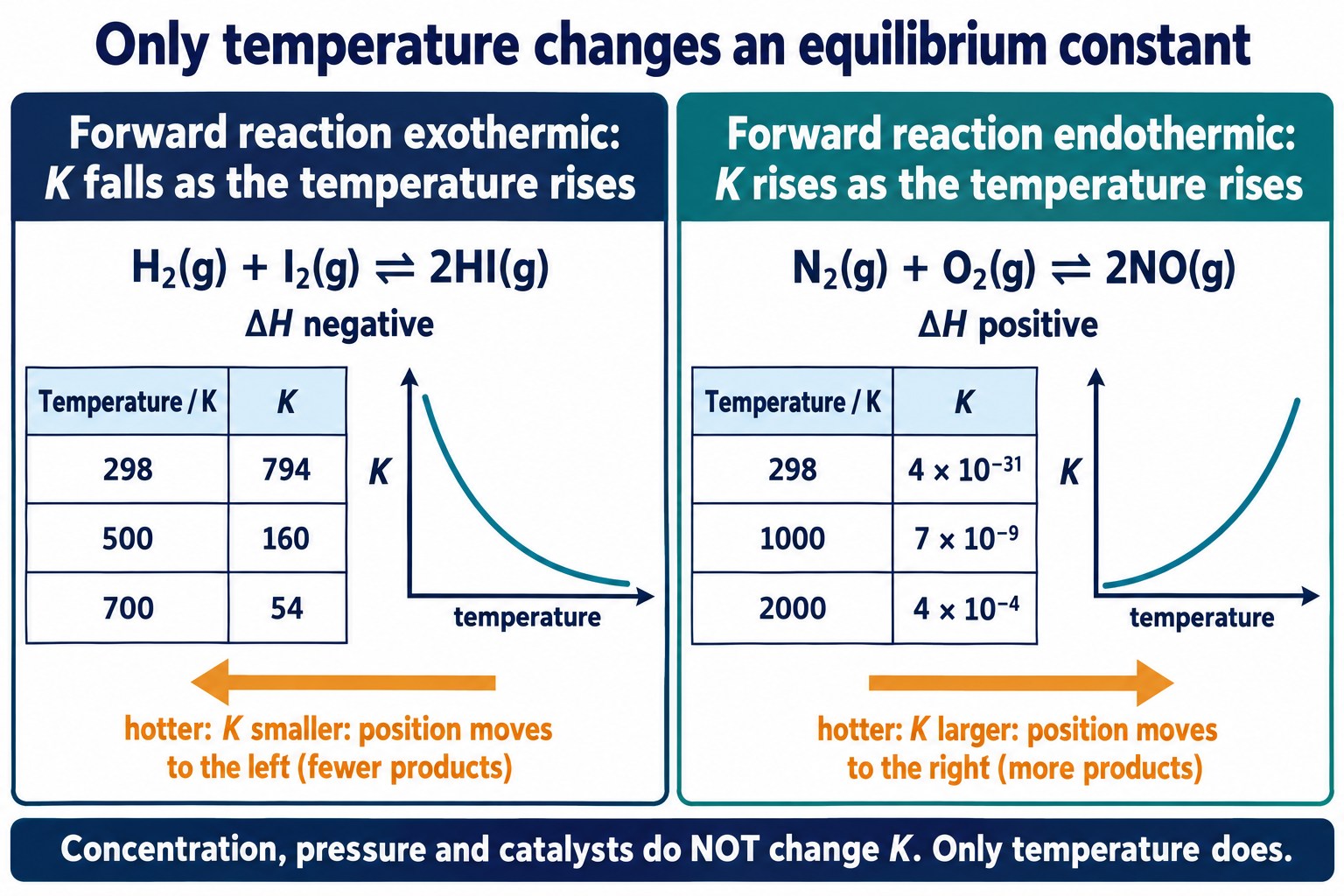
How temperature changes an equilibrium constant: K falls with rising temperature when the forward reaction is exothermic and rises when it is endothermic.
The reason K moves with temperature lies in the total entropy change, which is the subject of the next page.
Exam wording: “The forward reaction is exothermic, so increasing the temperature decreases the value of the equilibrium constant.” Always state the sign of ΔH for the forward reaction first.
How a Change in K Moves the Position
The shift in position when the temperature changes is explained by the change in K. Take an exothermic reaction that is heated.
- The temperature rises, so K becomes smaller.
- At that instant the mixture still has its old composition, so the ratio of products to reactants is now larger than the new K.
- The reverse reaction runs faster than the forward one, turning products back into reactants.
- The ratio falls until it equals the new, smaller K. The position of equilibrium has moved to the left.
For an endothermic reaction that is heated, K becomes larger. The ratio is then too small, the forward reaction runs, and the position moves to the right.
This agrees with Le Chatelier’s principle, which says that heating favours the endothermic direction. The equilibrium constant gives the reason and the size of the effect, not only the direction.
Exam wording: “Kp decreases, so the partial pressures of the products must fall and those of the reactants must rise until the expression equals the new Kp. The position of equilibrium moves to the left.”
Check: Temperature and the Value of K
Decide whether an equilibrium constant rises or falls when the temperature changes, and work out the sign of ΔH from a table of constants, for reactions not used on this page.
Concentration: The Ratio Is Disturbed, Not K
Work out the equilibrium expression with whatever concentrations are present at a given moment and you get a number, called here the ratio. At equilibrium the ratio equals K. At any other moment it does not.
Take H₂(g) + I₂(g) ⇌ 2HI(g) at 700 K, where K = 54. An equilibrium mixture contains 0.10 mol dm⁻³ of H₂, 0.10 mol dm⁻³ of I₂ and 0.735 mol dm⁻³ of HI.
ratio = ([HI]²) / ([H₂][I₂]) = (0.735²) / (0.10 × 0.10) = 54
ratio = (0.735²) / (0.20 × 0.10) = 27
ratio = (0.796²) / (0.169 × 0.0693) = 54
Answer: the position has moved to the right, exactly as Le Chatelier’s principle predicts, and K has not changed.
| Change | Effect on the ratio | Reaction that runs | Position moves |
|---|---|---|---|
| Add a reactant or remove a product | ratio smaller than K | forward | right |
| Add a product or remove a reactant | ratio larger than K | reverse | left |
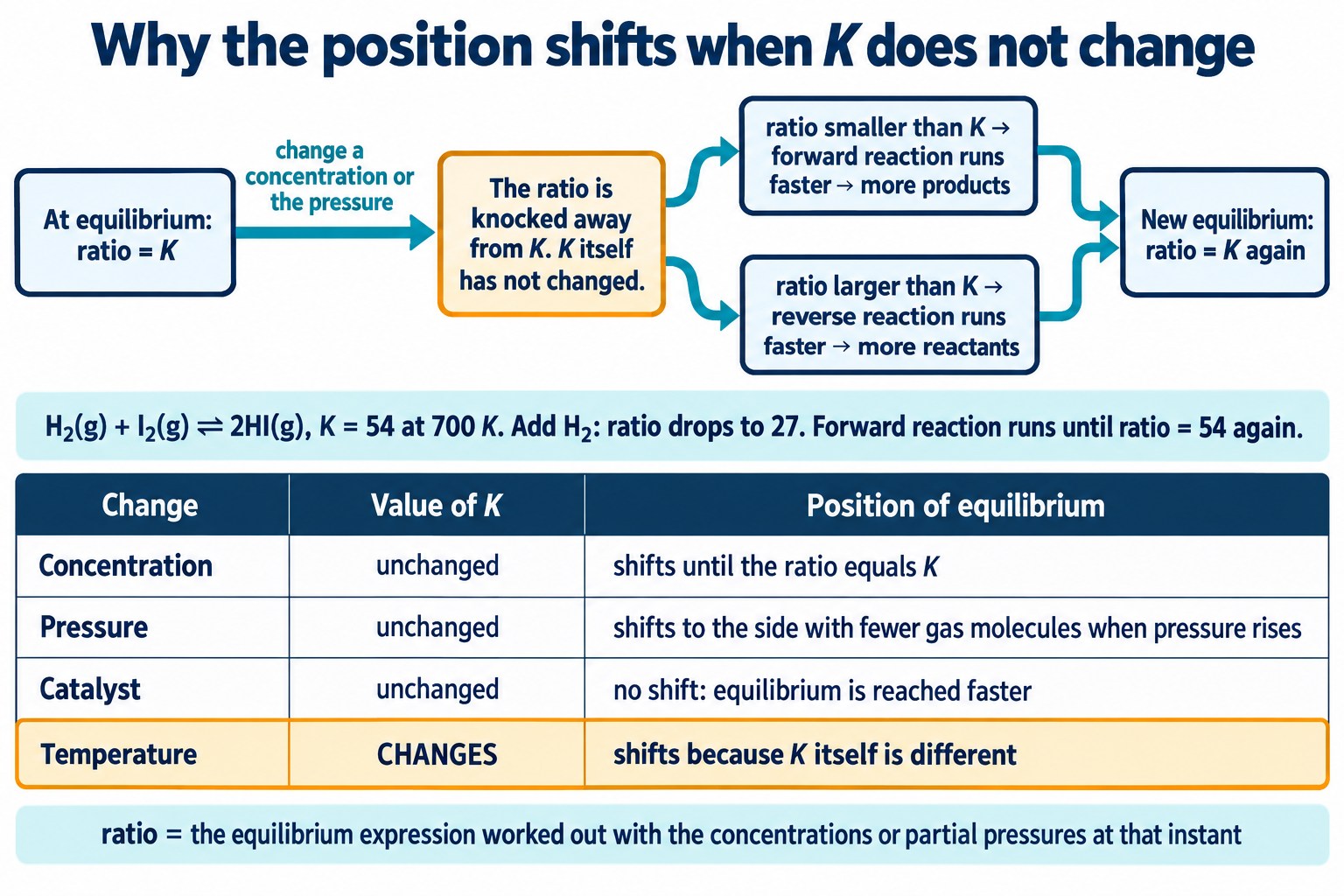
Why the position shifts although K is fixed: a change knocks the ratio away from K, and the reaction runs in whichever direction brings the ratio back to K.
Key idea: A change in concentration makes the ratio differ from K for a moment. The system then reacts, forwards if the ratio is too small and backwards if it is too large, until the ratio equals K again.
Pressure: Same Argument, Partial Pressures
Raising the total pressure of a gas mixture, by pushing it into a smaller volume, raises every partial pressure by the same factor. Whether the ratio changes depends on the powers in the Kp expression.
Take N₂O₄(g) ⇌ 2NO₂(g), with Kp = (p(NO₂)²) / (p(N₂O₄)). At equilibrium p(NO₂) = 0.40 atm and p(N₂O₄) = 1.00 atm.
Kp = (0.40²) / (1.00) = 0.16 atm
ratio = (0.80²) / (2.00) = (0.64) / (2.00) = 0.32 atm
Step 3: the reverse reaction runs, turning NO₂ into N₂O₄, until the ratio is 0.16 atm again.
Answer: the position moves to the left, the side with fewer gas molecules, and Kp is unchanged.
- If both sides have the same number of gas molecules, as in H₂ + I₂ ⇌ 2HI, the factors cancel and the position does not move.
- Lowering the pressure has the opposite effect: the ratio drops below Kp and the forward reaction runs, towards more gas molecules.
- The mole fractions change when the position shifts. The value of Kp does not.
Dynamic Equilibrium in a Closed System
Watch colourless N2O4 split into brown NO2 and NO2 pair up again in a sealed box, until both reactions run at the same rate and the amounts stop changing.
© Dr. Mohammed Al-Fatah – onlinelearningsystem.net
Exam wording: “Increasing the pressure does not change Kp. The ratio of partial pressures is no longer equal to Kp, so the equilibrium shifts to the side with fewer moles of gas until it is.”
Check: Concentration, Pressure and the Ratio
Compare the ratio with K after a change in concentration or pressure, and predict which reaction runs and which way the position moves, for equilibria not used on this page.
Catalysts: Faster, Not Further
A catalyst provides an alternative route with a lower activation energy. It lowers the activation energy of the forward and the reverse reaction by the same amount.
- Both rates rise by the same factor, so they are still equal at the same composition.
- The ratio already equals K and nothing disturbs it, so the position does not move.
- The value of K does not change, and nor does the yield at equilibrium.
- The only effect is on time: the mixture reaches equilibrium sooner.
That is still worth a great deal in industry. A catalyst lets a plant reach an acceptable yield quickly at a lower temperature, where the constant of an exothermic reaction is more favourable.
| Question | Decided by |
|---|---|
| How far does the reaction go? | the equilibrium constant, and so the temperature |
| How fast does it get there? | the rate: temperature, concentration or pressure, and the catalyst |
Exam wording: “A catalyst increases the rates of the forward and reverse reactions equally, so equilibrium is reached more quickly, but the position of equilibrium and the equilibrium constant are unchanged.”
Quick Check: Follow the Ratio Through Three Changes
Apply the ratio argument to a new equilibrium, then flip each card to check.
Common Exam Points
Say
- “Only temperature changes the value of the equilibrium constant.”
- “The forward reaction is exothermic, so K decreases as the temperature increases.”
- “The ratio is now smaller than K, so the forward reaction is favoured until the ratio equals K again.”
Do not say
- “Increasing the pressure increases Kp” (the position moves; Kp does not).
- “Adding a reactant makes K bigger because more product forms.”
- “A catalyst increases the yield” (it shortens the time taken to reach the same yield).
Watch for
- A table of K at several temperatures with a question on the sign of ΔH: K falling as T rises means the forward reaction is exothermic.
- A question that changes temperature and pressure together: deal with K first (temperature), then with the position.
- A reaction with equal numbers of gas molecules on both sides, where pressure changes neither K nor the position.
Check: What Changes and What Does Not
For each change to an equilibrium not used on this page, decide what happens to the value of K, to the position of equilibrium and to the time taken to reach equilibrium.
FAQs
Use these quick answers to check what does and does not change an equilibrium constant.
Why does only temperature change K?
K is fixed by the total entropy change through ΔStotal = R ln K. Temperature alters the entropy change of the surroundings, (−ΔH) / (T), so it alters K. Concentration, pressure and catalysts leave ΔStotal for the reaction unchanged.
Does a catalyst change Kp?
No. A catalyst speeds up the forward and reverse reactions by the same factor, so equilibrium is reached sooner but the composition of the mixture, and therefore Kc and Kp, stays exactly the same.
If pressure does not change Kp, why does the equilibrium position move?
Raising the pressure changes every partial pressure, so the ratio in the Kp expression momentarily no longer equals Kp. The system shifts, towards the side with fewer moles of gas, until the ratio equals Kp again.
How does temperature change K for exothermic and endothermic reactions?
If the forward reaction is exothermic, K falls as temperature rises, so the position moves left. If the forward reaction is endothermic, K rises with temperature and the position moves right. Cooling does the opposite in each case.
Does adding more reactant give a bigger Kc?
No. The extra reactant makes the ratio smaller than Kc for a moment, so the system makes more product until the ratio equals Kc again. The amount of product rises but the constant is unchanged.

Copyright notice: This OLS revision content, including the explanations, layout, diagrams, tables and embedded learning structure, is authored for Online Learning System by Dr. Mohammed Al-Fatah. It may not be copied, reproduced, redistributed or adapted without written permission.
Keep this note — free
Save your progress across every Edexcel IAL topic. A free account remembers which topics you have covered, saves your question scores, and syncs across your phone and laptop.
- Track every topic you have finished
- Keep your practice-question scores
- No payment, no card, free forever
Already registered? Log in