Kc Expressions: Homogeneous and Heterogeneous Systems
A concise revision guide to writing the equilibrium constant Kc: what a homogeneous and a heterogeneous equilibrium are, how the balanced equation fixes the expression and its powers, why solids and pure liquids are left out, and how to work out the units of Kc.
- 13.1
- 13.3-a
- 13.9
What these spec points say
- 13.1 be able to deduce an expression for Kc , for homogeneous and heterogeneous systems, in terms of equilibrium concentrations
- 13.3-a be able to calculate a value for Kc with units where appropriate from experimental data
- 13.9 be able to apply knowledge of equilibrium constant values to predict the extent to which a reaction takes place
AS Recap: Dynamic Equilibrium
Three quick questions on what you already know: what a dynamic equilibrium is, and how changes in concentration, pressure and temperature move its position.
From Position to a Number
At AS (Topic 9B Equilibria) you described an equilibrium in words: the position lies to the left or to the right, and Le Chatelier’s principle predicts which way it moves.
At A Level the position is given a number, the equilibrium constant. This page deals with Kc, the equilibrium constant in terms of concentrations.
- In a dynamic equilibrium the forward and reverse reactions continue at equal rates in a closed system.
- The concentrations of the reactants and products therefore stay constant, although they are not usually equal.
- Whatever amounts are mixed at the start, the equilibrium concentrations always combine to give the same value of Kc at a given temperature.
What the size of Kc means
| Value of Kc | Equilibrium mixture | Position |
|---|---|---|
| Much greater than 1 | mostly products | far to the right |
| About 1 | similar amounts of reactants and products | in the middle |
| Much less than 1 | mostly reactants | far to the left |
Key idea: Kc is a number, fixed at a given temperature, that measures how far a reaction has gone when it reaches equilibrium. A large Kc means the equilibrium mixture is mostly products.
Writing a Kc Expression
For the general equilibrium aA + bB ⇌ cC + dD the equilibrium constant is:
Kc = ([C]ᶜ[D]ᵈ) / ([A]ᵃ[B]ᵇ)
Three rules give the expression for any equation.
- Products over reactants: the substances on the right of the equation go on the top line.
- Powers from the equation: each concentration is raised to the power of its balancing number.
- Square brackets mean the concentration in mol dm⁻³, measured at equilibrium.
The terms on each line are multiplied together, never added.
Homogeneous examples
A homogeneous equilibrium has every substance in the same phase: all gases, or all in one solution. Every substance then appears in the expression.
| Equation | Kc expression |
|---|---|
| N₂(g) + 3H₂(g) ⇌ 2NH₃(g) | Kc = ([NH₃]²) / ([N₂][H₂]³) |
| H₂(g) + I₂(g) ⇌ 2HI(g) | Kc = ([HI]²) / ([H₂][I₂]) |
| 2SO₂(g) + O₂(g) ⇌ 2SO₃(g) | Kc = ([SO₃]²) / ([SO₂]²[O₂]) |
| N₂O₄(g) ⇌ 2NO₂(g) | Kc = ([NO₂]²) / ([N₂O₄]) |
| CH₃COOH(l) + C₂H₅OH(l) ⇌ CH₃COOC₂H₅(l) + H₂O(l) | Kc = ([CH₃COOC₂H₅][H₂O]) / ([CH₃COOH][C₂H₅OH]) |
In the last example the four liquids form one mixture, so water is a reacting substance with a concentration that changes. It stays in the expression.
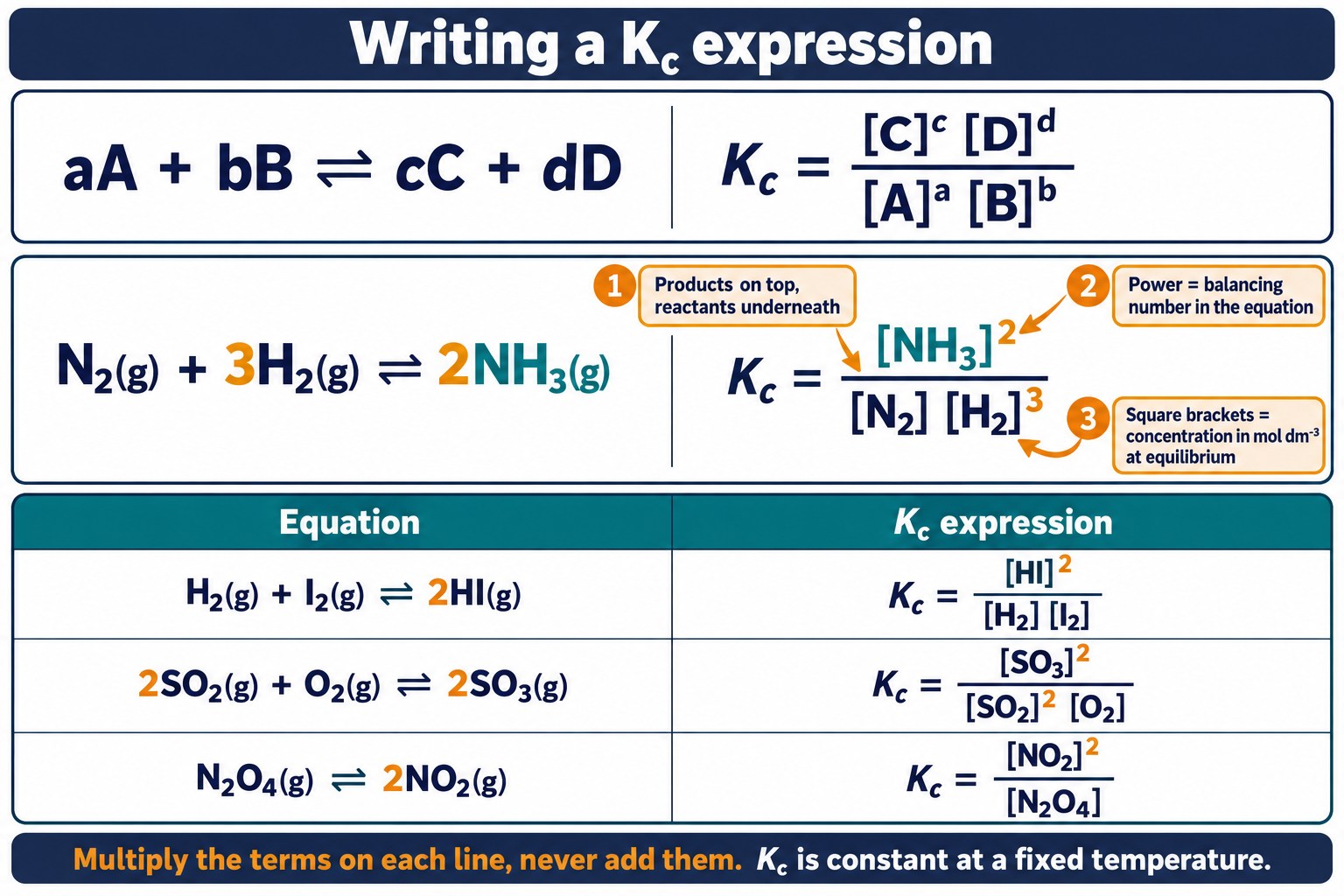
The three rules for a Kc expression shown on the ammonia equilibrium: products over reactants, powers from the balancing numbers, and square brackets for equilibrium concentrations in mol dm⁻³.
Worked example: substituting into Kc
At equilibrium at a fixed temperature a mixture contains [H₂] = 0.0200, [I₂] = 0.0200 and [HI] = 0.140 mol dm⁻³.
Exam focus: Write the expression before any numbers. Use square brackets, put products on top, and copy every balancing number as a power. Round brackets or missing powers lose the mark.
Check: Writing Kc Expressions
Write and recognise Kc expressions, and substitute equilibrium concentrations, for homogeneous equilibria not used on this page.
Heterogeneous Equilibria
A heterogeneous equilibrium has substances in more than one phase, for example a solid in contact with a gas, or a solid in contact with a solution.
The rule is simple: solids and pure liquids are left out of the Kc expression. Only gases and dissolved species appear.
Why they are left out
- The concentration of a pure solid or pure liquid is fixed by its density, so it cannot change during the reaction.
- A constant term carries no information about the position of equilibrium, so it is absorbed into the value of Kc.
- It follows that adding more of the solid does not move the equilibrium, as long as some solid is present.
Examples
| Equation | Left out | Kc expression |
|---|---|---|
| CaCO₃(s) ⇌ CaO(s) + CO₂(g) | both solids | Kc = [CO₂] |
| 3Fe(s) + 4H₂O(g) ⇌ Fe₃O₄(s) + 4H₂(g) | Fe and Fe₃O₄ | Kc = ([H₂]⁴) / ([H₂O]⁴) |
| Ag⁺(aq) + Fe²⁺(aq) ⇌ Ag(s) + Fe³⁺(aq) | solid silver | Kc = ([Fe³⁺]) / ([Ag⁺][Fe²⁺]) |
| Cr₂O₇²⁻(aq) + H₂O(l) ⇌ 2CrO₄²⁻(aq) + 2H⁺(aq) | water, the solvent | Kc = ([CrO₄²⁻]²[H⁺]²) / ([Cr₂O₇²⁻]) |
- For calcium carbonate in a closed container, Kc = [CO₂]: at a given temperature the concentration of carbon dioxide at equilibrium is fixed, however much solid is present.
- In the iron and steam equilibrium the state symbols matter: water is a gas here, so it stays in.
- Water is left out only when it is the solvent, present in large excess so that its concentration hardly changes.
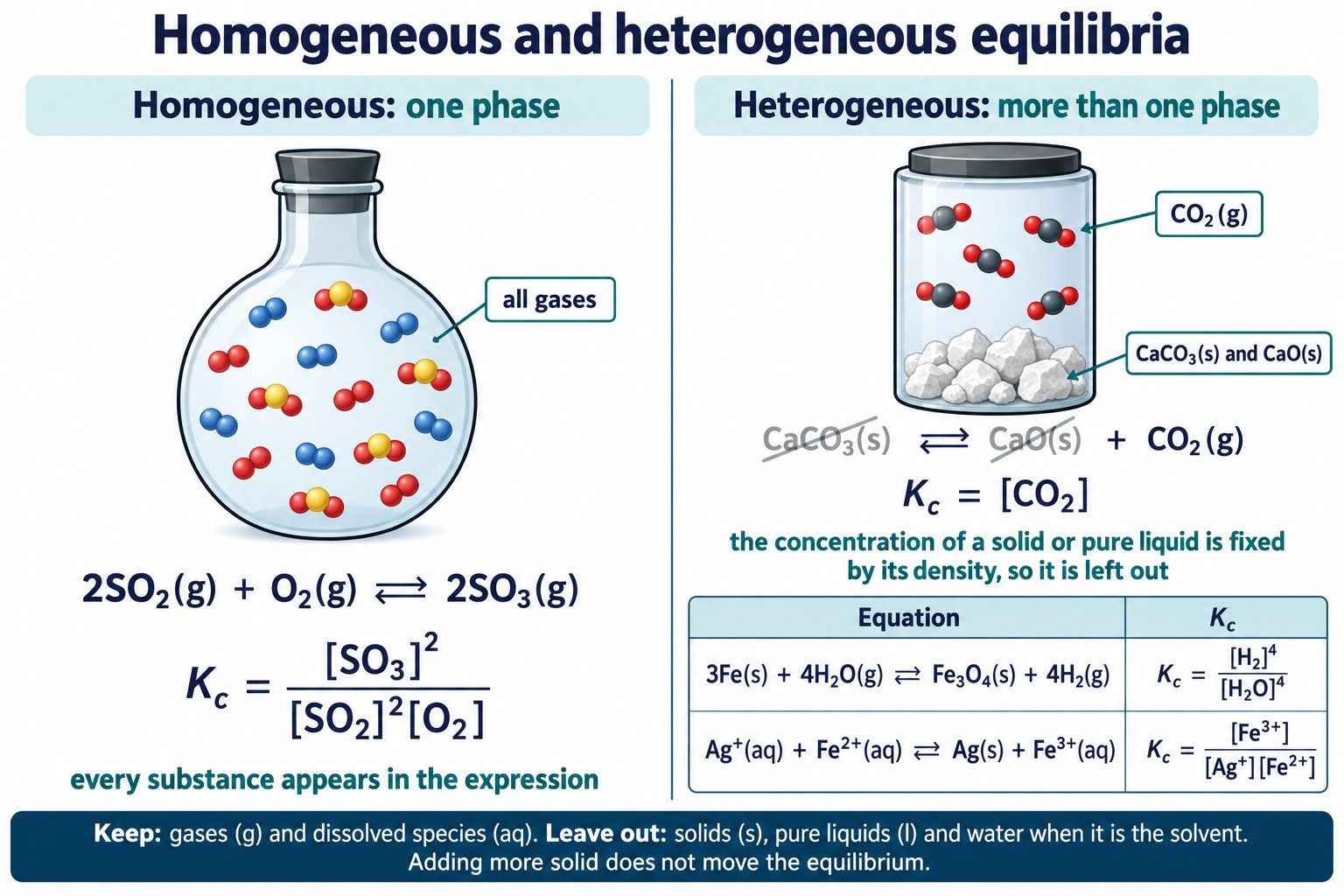
A homogeneous equilibrium, where every substance appears in Kc, beside a heterogeneous one, where the solids are left out, with the rule for what to keep and what to omit.
Remember: Read the state symbols. Keep (g) and (aq). Leave out (s), pure (l) and water acting as the solvent. If water is one of several liquids in a mixture, as in esterification, it stays in.
Check: Heterogeneous Kc
Decide which substances appear in Kc and write the expression for heterogeneous equilibria not used on this page.
Units of Kc
Kc has no fixed units. They depend on the powers in the expression, so they are worked out for each equation by substituting and cancelling.
- Write the Kc expression.
- Replace each concentration with its units, mol dm⁻³, keeping the powers.
- Cancel top against bottom.
- Tidy up what is left, writing the positive power first.
Worked example: sulfur trioxide
Step 1. For 2SO₂(g) + O₂(g) ⇌ 2SO₃(g), Kc = ([SO₃]²) / ([SO₂]²[O₂]).
Step 2. Units = ((mol dm⁻³)²) / ((mol dm⁻³)² × (mol dm⁻³)).
Step 3. The squared terms cancel, leaving (1) / (mol dm⁻³).
Answer. Units of Kc = mol⁻¹ dm³, usually written dm³ mol⁻¹.
The four patterns you will meet
| Equation | Units substituted | Units of Kc |
|---|---|---|
| H₂ + I₂ ⇌ 2HI | ((mol dm⁻³)²) / ((mol dm⁻³)²) | none: everything cancels |
| N₂O₄ ⇌ 2NO₂ | ((mol dm⁻³)²) / (mol dm⁻³) | mol dm⁻³ |
| 2SO₂ + O₂ ⇌ 2SO₃ | ((mol dm⁻³)²) / ((mol dm⁻³)³) | dm³ mol⁻¹ |
| N₂ + 3H₂ ⇌ 2NH₃ | ((mol dm⁻³)²) / ((mol dm⁻³)⁴) | dm⁶ mol⁻² |
A quick check: subtract the total of the powers on the bottom from the total on the top. A result of 0 means no units, +1 means mol dm⁻³, −1 means dm³ mol⁻¹ and −2 means dm⁶ mol⁻².
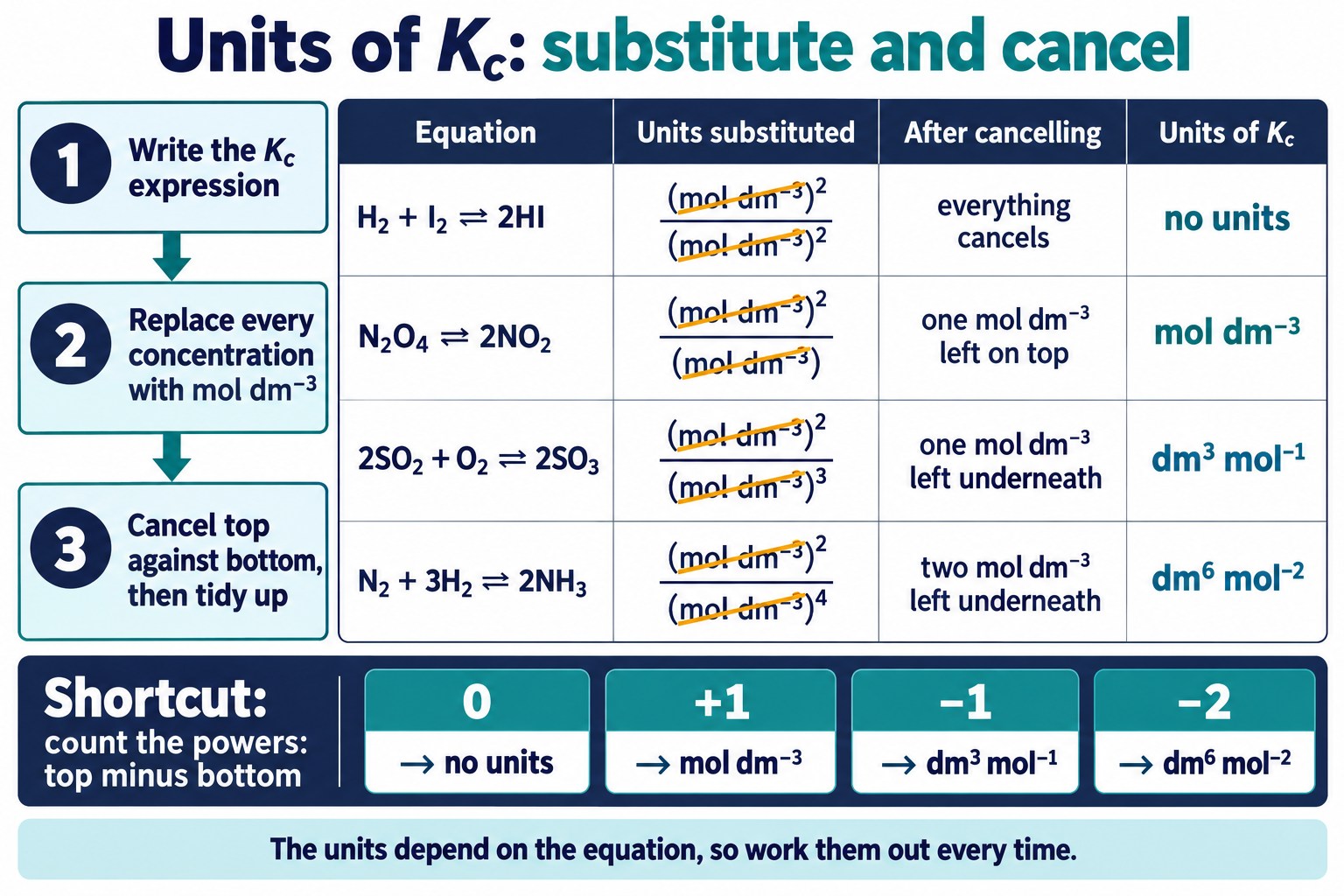
Units of Kc found by substituting mol dm⁻³ for each concentration and cancelling, for four equilibria that give no units, mol dm⁻³, dm³ mol⁻¹ and dm⁶ mol⁻².
The expression belongs to the equation
Kc and its units are tied to the equation as written. Using the hydrogen iodide value of 49.0 from the worked example above:
| Equation as written | Kc expression | Value |
|---|---|---|
| H₂ + I₂ ⇌ 2HI | ([HI]²) / ([H₂][I₂]) | 49.0 |
| 2HI ⇌ H₂ + I₂ (reversed) | ([H₂][I₂]) / ([HI]²) | (1) / (49.0) = 0.0204 |
| ½H₂ + ½I₂ ⇌ HI (halved) | ([HI]) / ([H₂]½[I₂]½) | √49.0 = 7.00 |
Exam focus: Show the units being cancelled, not just the answer. When there are equal numbers of moles on each side of the expression, write “no units” rather than leaving a blank.
Common Exam Points
Say
- “Kc = ([SO₃]²) / ([SO₂]²[O₂])“, with square brackets and powers.
- “Solids are omitted because their concentrations are constant.”
- “Units = ((mol dm⁻³)²) / ((mol dm⁻³)³) = dm³ mol⁻¹.”
- “Kc has no units because the concentration terms cancel.”
Do not say
- “Kc = ([reactants]) / ()” (the expression is upside down).
-
Formulae, Equations and Amount of Substance – Topic 1
Read more -
Atomic Structure and The Periodic Table – Topic 2
£14.40 Add to basket -
Ionic Bonding and Metallic Bonding – Topic 3A/3D
£9.70 Add to basket -
Covalent Bonding and Shapes of Molecules – Topic 3B/3C
£10.20 Add to basket -
Organic Chemistry and Alkanes – Topic 4A\4B
£16.70 Add to basket -
Alkenes – Topic 5
£9.70 Add to basket -
Atomic Structure and The Periodic Table – Topic 1
£14.40 Add to basket -
Covalent Bonding, Structure and Shapes of Molecules – Topic 2A/B
£10.20 Add to basket -

Ionic & Metallic – Bonding & Structure – Topic 2A/B
£9.70 Add to basket -
Formulae, Equations and Amount of Substance – Topic 5
Read more -
Organic Chemistry and Alkanes – Topic 6A/6B
£16.20 Add to basket -
Alkenes – Topic 6C
£9.70 Add to basket
-
- “Kc = (2[NH₃]) / ([N₂] + 3[H₂])” (balancing numbers are powers, and terms are multiplied).
- “Kc = ([CaO][CO₂]) / ([CaCO₃])” (solids do not appear).
- “The units of Kc are mol dm⁻³” for every reaction (they depend on the equation).
Watch for
- An equation written the other way round from the one you learned: the expression and the value both invert.
- State symbols that change the answer: H₂O(g) stays in, H₂O(l) as the solvent does not.
- Concentrations given at the start instead of at equilibrium: only equilibrium values go into Kc. Page 2 shows how to find them.
Check: Units of Kc
Work out the units of Kc, and the effect of reversing an equation, for equilibria not used on this page.
FAQs
Use these quick answers to check how Kc expressions are written.
Why are solids left out of Kc?
The concentration of a pure solid is fixed by its density, so it does not change however much solid is present. It is a constant already built into Kc, so only gases and dissolved species appear in a heterogeneous expression.
Do I use the balancing numbers in the Kc expression?
Yes. Each concentration is raised to the power of its balancing number in the equation as written. For N₂ + 3H₂ ⇌ 2NH₃, Kc = ([NH₃]²) / ([N₂][H₂]³). Products always go on the top line.
What is the difference between a homogeneous and a heterogeneous equilibrium?
In a homogeneous equilibrium every species is in the same phase, such as all gases or all aqueous. In a heterogeneous equilibrium at least two phases are present, for example a solid in contact with a gas or with a solution.
Do the square brackets mean the concentration at any time?
No. In a Kc expression they mean concentrations in mol dm⁻³ measured once equilibrium has been reached. Initial concentrations must never be substituted directly; work out the equilibrium values first.
What happens to Kc if I write the equation the other way round?
The expression turns upside down, so the new value is 1/Kc. Doubling every balancing number squares Kc. A value of Kc therefore only means something alongside the equation it belongs to.

Copyright notice: This OLS revision content, including the explanations, layout, diagrams, tables and embedded learning structure, is authored for Online Learning System by Dr. Mohammed Al-Fatah. It may not be copied, reproduced, redistributed or adapted without written permission.
Keep this note — free
Save your progress across every Edexcel IAL topic. A free account remembers which topics you have covered, saves your question scores, and syncs across your phone and laptop.
- Track every topic you have finished
- Keep your practice-question scores
- No payment, no card, free forever
Already registered? Log in