Reduction and Nucleophilic Addition of Carbonyl Compounds
A concise revision guide to the reduction of aldehydes and ketones with LiAlH₄ and to nucleophilic addition of hydrogen cyanide (HCN in the presence of KCN): reagents, equations, the mechanism with curly arrows, and why the hydroxynitrile can form as a racemic mixture.
- 15.5-c
- 15.8ii
- 15.8iii
What these spec points say
- 15.5-c be able to use optical activity data as evidence for addition to carbonyl compounds
- 15.8ii understand the reactions of carbonyl compounds with: lithium tetrahydridoaluminate(III) (lithium aluminium hydride) in dry ether (ethoxyethane) In equations, the reducing agent can be represented by [H].
- 15.8iii understand the reactions of carbonyl compounds with: HCN, in the presence of KCN, as a nucleophilic addition reaction, using curly arrows, relevant lone pairs, dipoles and evidence of optical activity to show the mechanism
Nucleophilic Addition to a Planar Carbonyl
A cyanide ion can attack the flat C=O group of ethanal from above or from below with equal chance; an H⁺ ion then protonates the oxygen, so the product is an equal mixture of two mirror-image molecules.
© Dr. Mohammed Al-Fatah – onlinelearningsystem.net
Before You Start
This page uses the polar carbonyl group from Aldehydes and Ketones: Structure, Naming and Properties and the idea of a racemic mixture from Optical Activity and Racemic Mixtures.
- The carbon atom of C=O is δ+, so it attracts nucleophiles: species that donate a lone pair to form a new covalent bond.
- The C=O group is planar, so a nucleophile can approach from either side.
- Reduction is the reverse of the oxidation met on the previous page.
Reduction of Aldehydes and Ketones
Reducing agents turn carbonyl compounds back into alcohols. In equations the reducing agent is written as [H].
| Carbonyl compound | Product | Example |
|---|---|---|
| aldehyde | primary alcohol | CH₃CHO + 2[H] → CH₃CH₂OH |
| ketone | secondary alcohol | CH₃COCH₃ + 2[H] → CH₃CH(OH)CH₃ |
Reagents and conditions
| Reducing agent | Conditions | Note |
|---|---|---|
| LiAlH₄, lithium tetrahydridoaluminate(III) | in dry ether (ethoxyethane), then dilute acid | reacts violently with water, so everything must be dry |
- The reagent acts as a source of hydride ions, H⁻.
- Two hydrogen atoms are added across the C=O bond: one to the carbon and one to the oxygen.
- The hydride ion is a nucleophile. It is repelled by the electron-rich C=C bond, so an alkene group in the molecule is not reduced: CH₂=CHCHO gives CH₂=CHCH₂OH.
- Butanone gives butan-2-ol, which has a chiral centre. Attack on the planar C=O from either side gives a racemic mixture.
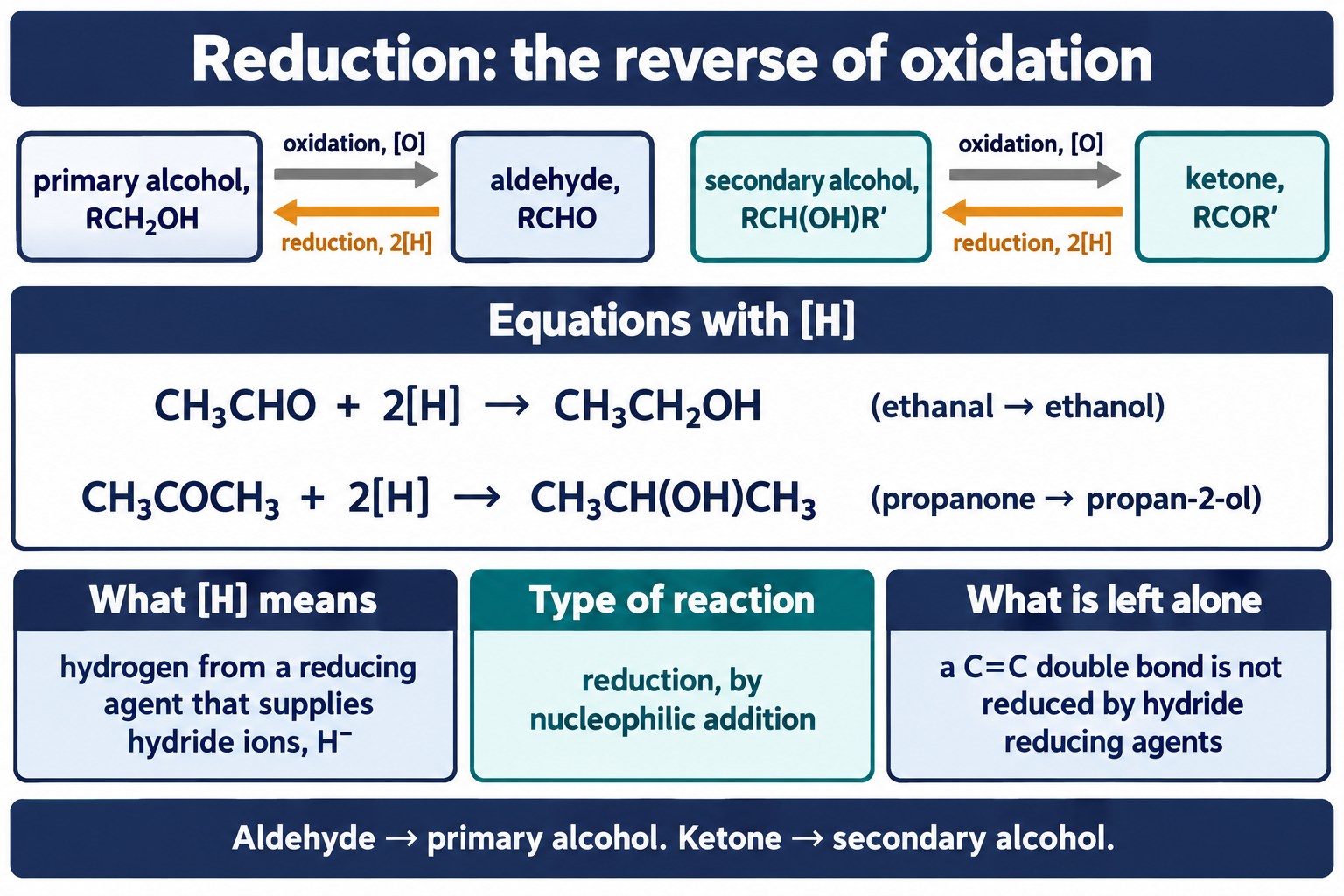
Oxidation and reduction as opposite journeys: primary alcohol and aldehyde, secondary alcohol and ketone, with the two reduction equations.
Exam focus: Balance reduction equations with 2[H]. An aldehyde always gives a primary alcohol and a ketone always gives a secondary alcohol, with the –OH on the carbon that carried the C=O.
Check: Reducing Carbonyl Compounds
Predict the alcohols formed and balance equations with [H], using carbonyl compounds not used on this page.
Addition of Hydrogen Cyanide
Hydrogen cyanide adds across the C=O bond of aldehydes and ketones to form a hydroxynitrile: a molecule with an –OH group and a –CN group on the same carbon.
The reagent is HCN in the presence of KCN.
| Carbonyl compound | Equation | Product |
|---|---|---|
| ethanal | CH₃CHO + HCN → CH₃CH(OH)CN | 2-hydroxypropanenitrile |
| propanone | CH₃COCH₃ + HCN → (CH₃)₂C(OH)CN | 2-hydroxy-2-methylpropanenitrile |
| propanal | CH₃CH₂CHO + HCN → CH₃CH₂CH(OH)CN | 2-hydroxybutanenitrile |
- In the name, the carbon of the –CN group is carbon 1, so the –OH is on carbon 2.
- The product has one more carbon atom than the carbonyl compound: a new C–C bond has formed.
- The reaction is an addition: two molecules join and nothing is lost.
Why a cyanide salt is used
- HCN is a very weak acid. On its own it gives very few CN⁻ ions, so the reaction would be extremely slow.
- KCN is fully ionised and supplies a high concentration of CN⁻ ions, the nucleophile that starts the reaction.
- The CN⁻ ion is regenerated at the end, so it acts as a catalyst.
- HCN is a highly toxic gas that is hard to handle safely. Cyanide salts are also toxic, so the reaction is done in a fume cupboard.
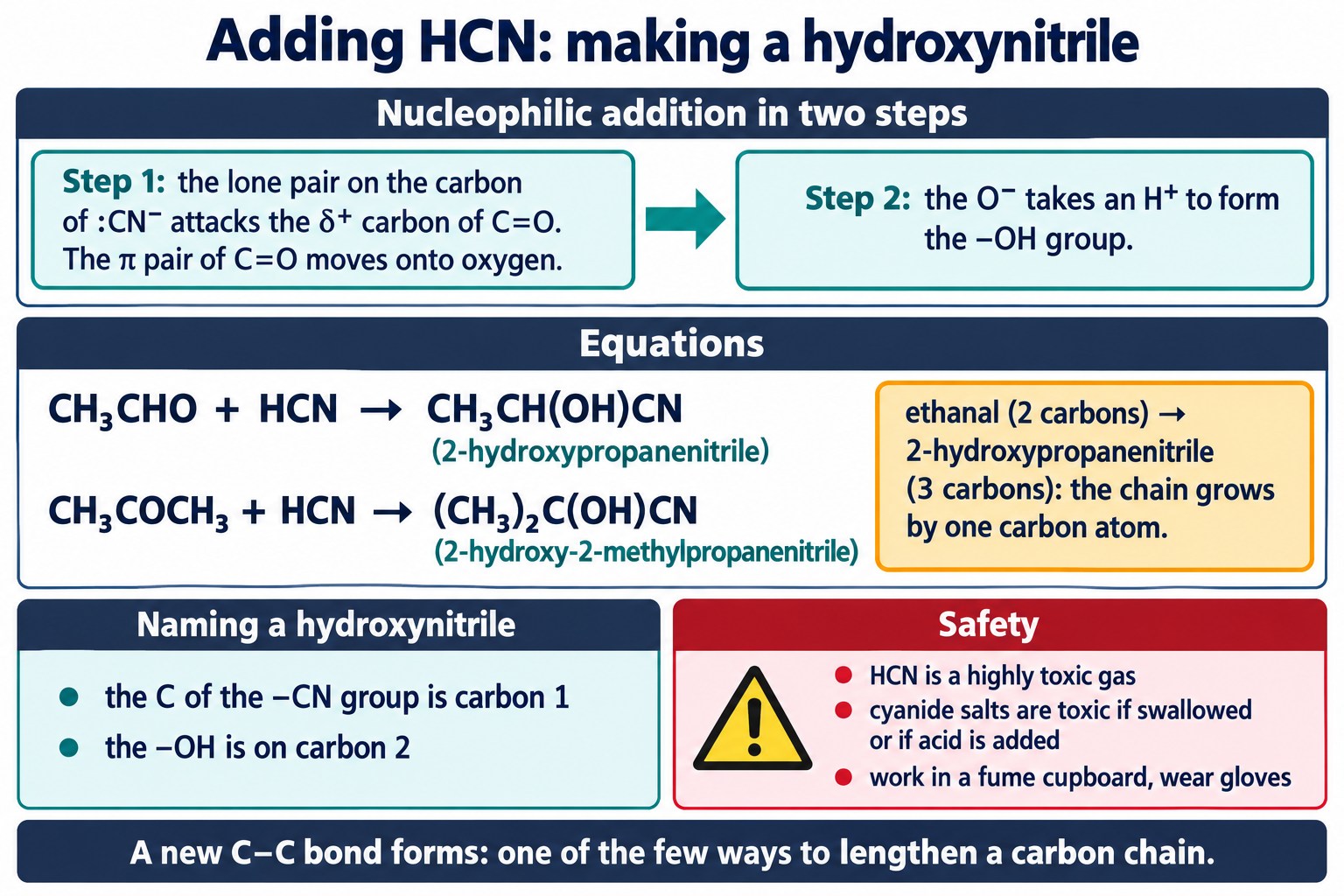
Adding HCN across the C=O bond: the two steps in words, the equations for ethanal and propanone, the extra carbon atom and the safety precautions.
The Mechanism: Nucleophilic Addition
The nucleophile is the cyanide ion, :CN⁻. Its lone pair and its negative charge are on the carbon atom.
Step 1
- The lone pair on the carbon of :CN⁻ attacks the δ+ carbon of the C=O group, forming a C–C bond.
- The π electron pair of the C=O bond moves onto the oxygen atom.
- The intermediate has a negatively charged oxygen, O⁻, carrying three lone pairs.
Step 2
- A lone pair on the O⁻ forms a bond to an H⁺ taken from an HCN molecule.
- The H–CN bond breaks, releasing a CN⁻ ion to replace the one used in step 1.
- The CN⁻ ion is not used up overall: it is a catalyst.
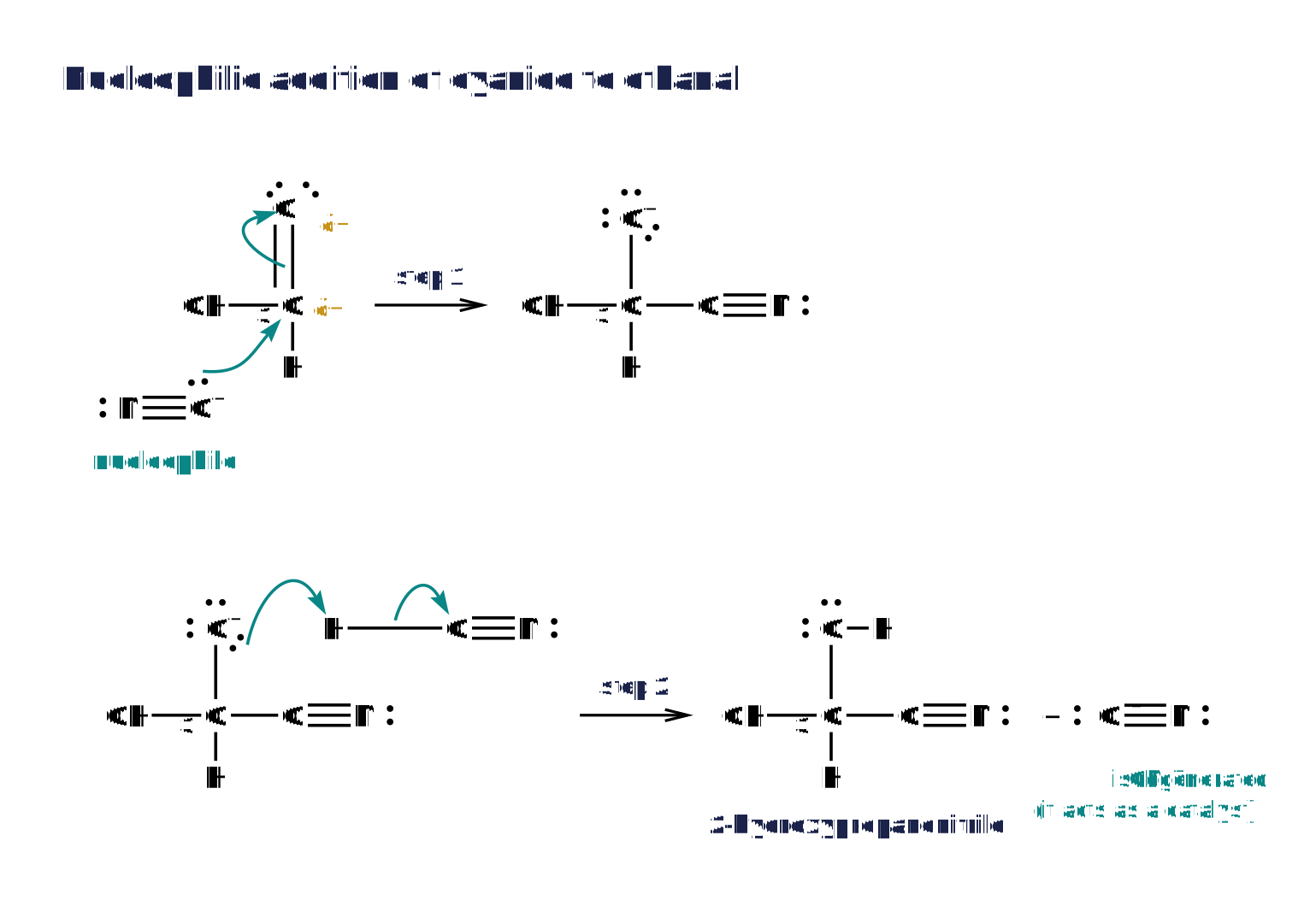
Nucleophilic addition of HCN to ethanal: cyanide attacks the δ+ carbon, the π pair moves to oxygen, then the O⁻ takes a proton from HCN and a cyanide ion is regenerated.
| Curly arrow | Starts at | Ends at |
|---|---|---|
| 1 | the lone pair on the C of :CN⁻ | the δ+ carbon of C=O |
| 2 | the C=O double bond | the oxygen atom |
| 3 | a lone pair on the O⁻ | the H of H–CN |
| 4 | the H–C bond of HCN | the carbon of the CN |
Exam focus: Start the first arrow at the lone pair on the carbon of :CN⁻, not on the nitrogen and not on the charge. Show δ+ and δ− on C=O and the lone pair and charge on the intermediate oxygen.
Check: Hydroxynitriles and the Mechanism
Name the products of adding HCN and follow each curly arrow of nucleophilic addition, with carbonyl compounds not used on this page.
Why the Product Can Be a Racemic Mixture
The carbonyl carbon and the three atoms bonded to it are planar. The cyanide ion can attack from above the plane or from below it.
- The two directions of attack are equally likely.
- If the product carbon carries four different groups, attack from above gives one enantiomer and attack from below gives the other.
- Equal amounts of the two enantiomers form: a racemic mixture, which is optically inactive.
Is the product chiral?
| Carbonyl compound | Groups on the product carbon | Product |
|---|---|---|
| methanal, HCHO | H, H, OH, CN | not chiral |
| ethanal, CH₃CHO | H, CH₃, OH, CN | chiral: racemic mixture |
| propanone, CH₃COCH₃ | CH₃, CH₃, OH, CN | not chiral |
| butanone, CH₃COCH₂CH₃ | CH₃, C₂H₅, OH, CN | chiral: racemic mixture |
| pentan-3-one | C₂H₅, C₂H₅, OH, CN | not chiral |
- Aldehydes other than methanal give a chiral hydroxynitrile.
- Unsymmetrical ketones give a chiral hydroxynitrile; symmetrical ketones do not.
- The same reasoning applies to reduction: butanone gives racemic butan-2-ol.
Exam focus: Explain a racemic mixture in three steps: the C=O group is planar; the nucleophile attacks from either side with equal probability; equal amounts of the two enantiomers form.
Quick Check: Is the Alcohol Racemic?
Each carbonyl compound is reduced with a hydride reducing agent. Decide what forms.
Why Hydroxynitriles Matter
Adding HCN is one of the few reactions that makes a new carbon–carbon bond, so it is used to lengthen a carbon chain in a synthesis.
- The –CN group can then be changed into other groups.
- Hydrolysis with dilute acid turns –CN into –COOH: CH₃CH(OH)CN gives 2-hydroxypropanoic acid, CH₃CH(OH)COOH (see Carboxylic Acids: Structure, Properties and Preparation).
- The two-carbon aldehyde ethanal has become a three-carbon hydroxy acid.
| Reaction | Reagent | Nucleophile | Product |
|---|---|---|---|
| reduction | a hydride reducing agent, [H] | :H⁻ | alcohol |
| addition of HCN | HCN in the presence of KCN | :CN⁻ | hydroxynitrile |
Common Exam Points
Say
- “The mechanism is nucleophilic addition.”
- “The lone pair on the carbon of :CN⁻ attacks the δ+ carbon.”
- “An aldehyde is reduced to a primary alcohol; a ketone to a secondary alcohol.”
- “CN⁻ is regenerated in step 2, so it is a catalyst.”
Do not say
- “Electrophilic addition” (that is the mechanism for alkenes).
- “HCN attacks the carbonyl group” (the attacking species is the CN⁻ ion).
- “The product is hydroxypropanenitrile” without the number: give 2-hydroxypropanenitrile.
- “LiAlH₄ in aqueous solution” (it must be in dry ether).
Watch for
- Curly arrows that start from the negative charge or from the nitrogen of CN⁻.
- Missing lone pair or charge on the oxygen of the intermediate.
- The extra carbon: count the –CN carbon when naming the hydroxynitrile.
- Products with no chiral centre, from methanal or a symmetrical ketone: no enantiomers form.
Check: Mechanism, Chain Length and Optical Activity
Bring together reduction, HCN addition and the formation of racemic mixtures in examples not used on this page.
FAQs
Use these quick answers to check reduction and the nucleophilic addition of hydrogen cyanide.
What do aldehydes and ketones give when they are reduced?
An aldehyde is reduced to a primary alcohol and a ketone to a secondary alcohol. The reducing agent is written as [H] in equations: CH₃CHO + 2[H] → CH₃CH₂OH and CH₃COCH₃ + 2[H] → CH₃CH(OH)CH₃.
Why must LiAlH₄ be used in dry ether?
Lithium tetrahydridoaluminate(III) reacts violently with water, giving hydrogen. The reduction is therefore carried out in dry ether (ethoxyethane), and dilute acid is added only afterwards to release the alcohol.
Why is the reaction with HCN called nucleophilic addition?
The cyanide ion, :CN⁻, uses its lone pair to attack the δ+ carbonyl carbon, and the π electrons of C=O move onto oxygen. The O⁻ then gains H⁺ from HCN, regenerating CN⁻. Overall HCN adds across the C=O bond.
Why is a cyanide salt used rather than HCN on its own?
The reagent is HCN in the presence of KCN. HCN is a very weak acid, so alone it gives very few CN⁻ ions and reacts very slowly, and it is a highly toxic gas. The salt supplies plenty of the CN⁻ nucleophile.
Why is the hydroxynitrile made from ethanal not optically active?
2-Hydroxypropanenitrile, CH₃CH(OH)CN, has a chiral centre, but the planar carbonyl group is attacked by CN⁻ from either side with equal probability. Equal amounts of the two enantiomers form, so the product is a racemic mixture.

Copyright notice: This OLS revision content, including the explanations, layout, diagrams, tables and embedded learning structure, is authored for Online Learning System by Dr. Mohammed Al-Fatah. It may not be copied, reproduced, redistributed or adapted without written permission.
Keep this note — free
Save your progress across every Edexcel IAL topic. A free account remembers which topics you have covered, saves your question scores, and syncs across your phone and laptop.
- Track every topic you have finished
- Keep your practice-question scores
- No payment, no card, free forever
Already registered? Log in