Homogeneous Catalysis and Autocatalysis
A concise revision guide to homogeneous catalysis: catalysts in the same phase, reaction through an intermediate species, Fe²⁺ ions in the reaction between iodide and peroxodisulfate ions, and autocatalysis by Mn²⁺ in the reaction between manganate(VII) and ethanedioate ions.
- 15B.29-b
- 15B.29-d
- 15B.33-a
- 15B.33-b
- 15B.34
- 15B.35
What these spec points say
- 15B.29-b know that transition metals can act as homogeneous catalysts
- 15B.29-d know that transition metal compounds can act as homogeneous catalysts
- 15B.33-a know that a homogeneous catalyst is in the same phase as the reactants
- 15B.33-b appreciate that the catalysed reaction will proceed via an intermediate species
- 15B.34 understand the role of Fe2+ ions in catalysing the reaction between I− and S2O82− ions
- 15B.35 know the role of Mn2+ ions in autocatalysing the reaction between MnO4− and C2O42− ions
Before You Start
This page follows heterogeneous catalysis, where the catalyst is a solid surface. Here the catalyst is an ion in solution. Electrode potentials are covered in Topic 14 Redox II.
- A catalyst provides an alternative route with a lower activation energy and is unchanged at the end.
- Transition metal ions can change oxidation number easily, by gaining or losing electrons.
- Ions with the same sign of charge repel each other. Ions with opposite charges attract.
- A reaction is feasible when E⦵ for the cell is positive.
GCSE Recap: Rates and Catalysts
Three quick questions on the GCSE ideas this page builds on.
Homogeneous Catalysts
A homogeneous catalyst is in the same phase as the reactants. In the examples on this page, the catalyst and the reactants are all ions in aqueous solution.
- The catalysed reaction proceeds through an intermediate species.
- The catalyst reacts with one reactant to form the intermediate.
- The intermediate reacts with the other reactant, and the catalyst is regenerated.
Why variable oxidation numbers matter
- In the first step the transition metal ion changes to a different oxidation number. This new ion is the intermediate.
- In the second step it returns to its original oxidation number.
- So the ion can carry electrons from one reactant to the other, and is not used up.
| Heterogeneous catalyst | Homogeneous catalyst | |
|---|---|---|
| Phase | different from the reactants | same as the reactants |
| Where the reaction happens | at the surface of the solid | throughout the solution |
| How it works | adsorption, reaction, desorption | forms an intermediate species, then is regenerated |
Key idea: Homogeneous catalysis by a transition metal ion is two redox steps. The ion is oxidised in one step and reduced in the other, in either order.
The Reaction Between Iodide and Peroxodisulfate Ions
Peroxodisulfate ions, S₂O₈²⁻, oxidise iodide ions to iodine.
S₂O₈²⁻(aq) + 2I⁻(aq) → 2SO₄²⁻(aq) + I₂(aq)
| Half-equation | E⦵ / V |
|---|---|
| S₂O₈²⁻(aq) + 2e⁻ ⇌ 2SO₄²⁻(aq) | +2.01 |
| I₂(aq) + 2e⁻ ⇌ 2I⁻(aq) | +0.54 |
- E⦵ for the cell = +2.01 − (+0.54) = +1.47 V. The reaction is feasible.
- It is slow without a catalyst, even though the cell value is large and positive.
- Both reactants are negative ions. They repel each other, so few collisions have enough energy.
- The activation energy is high.
Remember: E⦵ values show whether a reaction is feasible. They give no information about its rate.
How Fe²⁺ Ions Catalyse the Reaction
A small amount of iron(II) ions, Fe²⁺(aq), speeds the reaction up. The iron provides a route in two steps, and neither step needs two negative ions to collide.
| Step | Equation | Change to iron |
|---|---|---|
| 1 | S₂O₈²⁻(aq) + 2Fe²⁺(aq) → 2SO₄²⁻(aq) + 2Fe³⁺(aq) | Fe²⁺ is oxidised: +2 to +3 |
| 2 | 2Fe³⁺(aq) + 2I⁻(aq) → 2Fe²⁺(aq) + I₂(aq) | Fe³⁺ is reduced: +3 to +2 |
- Each step is between a positive ion and a negative ion, which attract. Each step has a lower activation energy.
- Fe³⁺ is the intermediate: it is made in step 1 and used up in step 2.
- Fe²⁺ is used in step 1 and regenerated in step 2, so it is the catalyst.
- Adding step 1 and step 2 and cancelling the iron ions gives the overall equation.
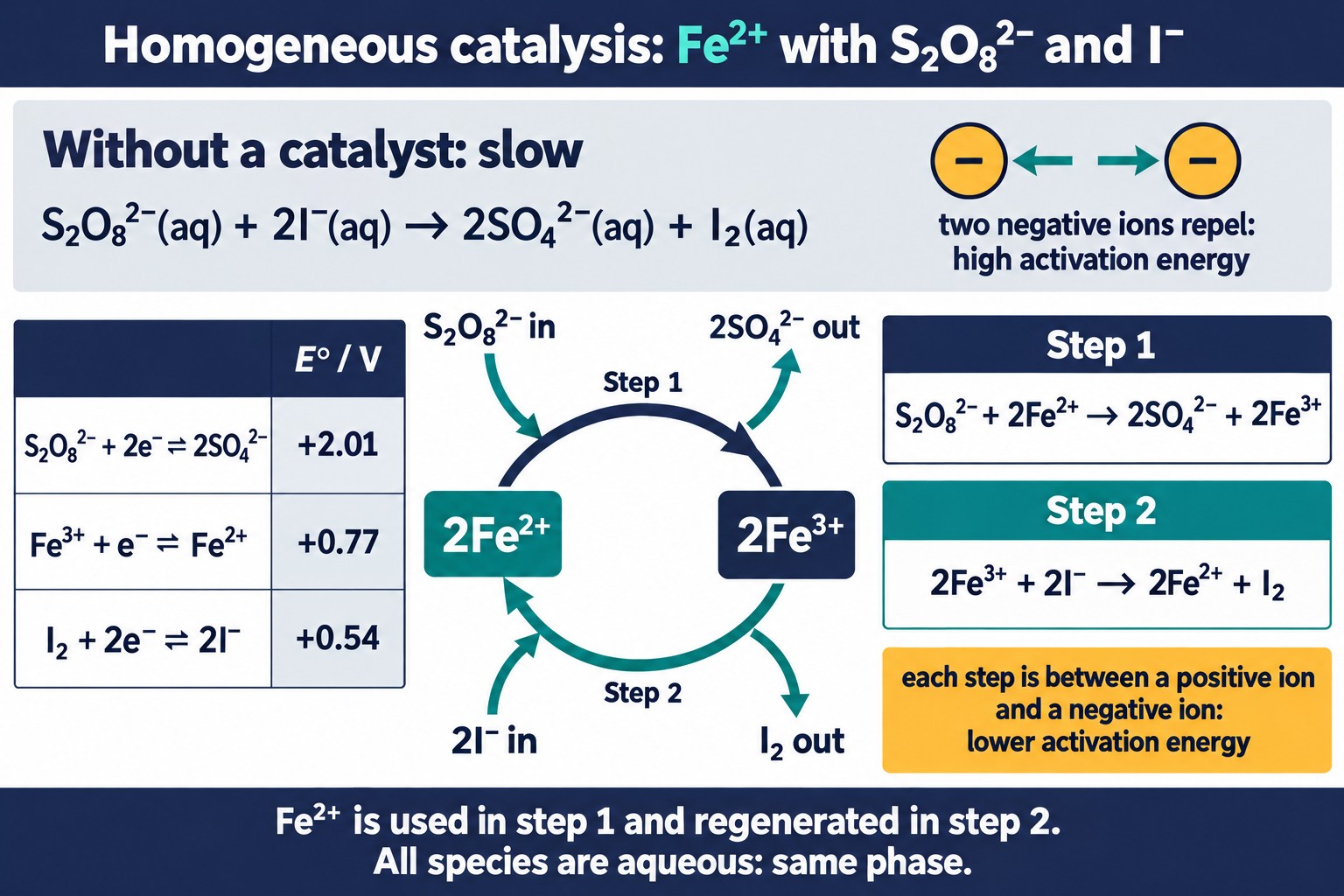
The catalytic cycle: Fe²⁺ is oxidised to Fe³⁺ by S₂O₈²⁻, then Fe³⁺ is reduced back to Fe²⁺ by I⁻. Each step is between oppositely charged ions.
Checking the steps with E⦵ values
| Step | E⦵ for the cell | Feasible? |
|---|---|---|
| 1: S₂O₈²⁻ oxidises Fe²⁺ | +2.01 − (+0.77) = +1.24 V | yes |
| 2: Fe³⁺ oxidises I⁻ | +0.77 − (+0.54) = +0.23 V | yes |
- E⦵ for Fe³⁺/Fe²⁺ is +0.77 V. It lies between the values for the two reactants, +2.01 V and +0.54 V.
- This is why both steps are feasible, and why the iron couple can act as the catalyst.
Fe³⁺ ions work too
The two steps can happen in either order. If Fe³⁺ is added, step 2 happens first: Fe³⁺ oxidises I⁻ and forms Fe²⁺. Step 1 then turns the Fe²⁺ back into Fe³⁺.
Check: Homogeneous Catalysis
Identify catalysts and intermediates, write the two steps of a catalysed route and judge them with electrode potentials, in questions that do not repeat the examples on this page.
Autocatalysis: Manganate(VII) and Ethanedioate
In autocatalysis, a product of the reaction is a catalyst for the reaction. The reaction between manganate(VII) ions and ethanedioate ions in acid is the example to know.
2MnO₄⁻(aq) + 16H⁺(aq) + 5C₂O₄²⁻(aq) → 2Mn²⁺(aq) + 10CO₂(g) + 8H₂O(l)
- At first the reaction is slow. MnO₄⁻ and C₂O₄²⁻ are both negative ions, so they repel and the activation energy is high.
- The Mn²⁺ ions formed are the catalyst. As their concentration rises, the reaction speeds up.
- No catalyst is added: the reaction makes its own.
The catalysed route
| Step | Equation | Change to manganese |
|---|---|---|
| 1 | 4Mn²⁺ + MnO₄⁻ + 8H⁺ → 5Mn³⁺ + 4H₂O | Mn²⁺ is oxidised to Mn³⁺ by MnO₄⁻ |
| 2 | 2Mn³⁺ + C₂O₄²⁻ → 2Mn²⁺ + 2CO₂ | Mn³⁺ is reduced back to Mn²⁺ by C₂O₄²⁻ |
- Step 1 is between positive Mn²⁺ and negative MnO₄⁻. Step 2 is between positive Mn³⁺ and negative C₂O₄²⁻.
- Oppositely charged ions attract, so both steps have a lower activation energy.
- Mn³⁺ is the intermediate. Mn²⁺ is regenerated in step 2.
- Two lots of step 1 added to five lots of step 2 give the overall equation.
Key idea: Mn²⁺ is both a product and the catalyst. That is what makes the reaction autocatalytic.
The Shape of the Curve
Most reactions are fastest at the start, when the reactants are most concentrated. An autocatalysed reaction is different. A graph of MnO₄⁻ concentration against time has three parts.
| Part of the curve | Gradient | Reason |
|---|---|---|
| Start | shallow: slow reaction | very little Mn²⁺ is present, and the uncatalysed reaction has a high activation energy |
| Middle | steep: fast reaction | Mn²⁺ has been formed and catalyses the reaction |
| End | shallow again, then level | the concentrations of MnO₄⁻ and C₂O₄²⁻ are low, so the reaction slows and stops |
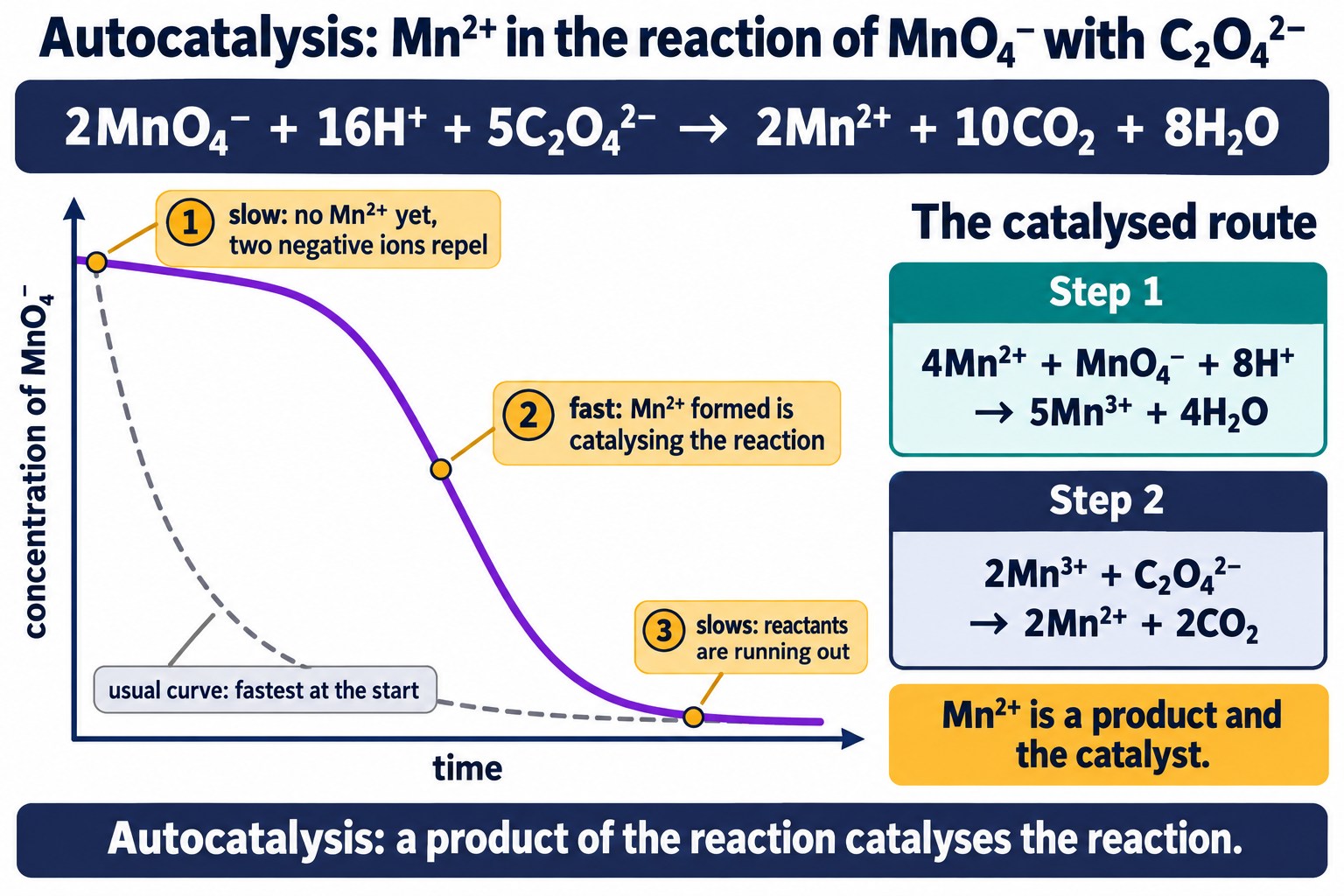
Concentration of MnO₄⁻ against time: a slow start, a steep middle section once Mn²⁺ has formed, and a levelling off as the reactants run out.
- A graph of rate against time rises to a maximum and then falls.
- If a little Mn²⁺, for example MnSO₄(aq), is added at the start, there is no slow first part. The curve is steepest at the start.
- In a titration, the first drops of MnO₄⁻ are decolourised slowly and later drops quickly.
Following the reaction
- MnO₄⁻ is purple and the other species are colourless, so a colorimeter can follow its concentration continuously.
- Or remove samples at timed intervals and titrate them to find the concentration of MnO₄⁻.
Quick Check: An Ester That Speeds Itself Up
Apply the idea of autocatalysis to a reaction with no metal ion, then compare your answer with the model.
Writing the Steps of a Catalysed Route
A question may give an unfamiliar reaction and its catalyst, and ask for two equations that show how the catalyst works.
- Find the two oxidation numbers of the catalyst, for example Fe²⁺ and Fe³⁺.
- Decide which reactant is the oxidising agent and which is the reducing agent.
- Step A: the lower oxidation number of the catalyst reduces the oxidising agent.
- Step B: the higher oxidation number of the catalyst oxidises the reducing agent.
- Balance the electrons in each step. Check that the two steps add up to the overall equation, with the catalyst cancelling.
Worked example: Fe³⁺ as the catalyst
Write two equations to show how Fe³⁺ ions catalyse the reaction S₂O₈²⁻ + 2I⁻ → 2SO₄²⁻ + I₂.
Step 2. The Fe²⁺ formed is oxidised by S₂O₈²⁻: S₂O₈²⁻ + 2Fe²⁺ → 2SO₄²⁻ + 2Fe³⁺.
Check. Adding the two equations cancels 2Fe³⁺ and 2Fe²⁺ and leaves the overall equation. Fe³⁺ is regenerated.
Exam focus: A possible catalyst needs an E⦵ value between those of the two reactants. This shows that both steps are feasible. It does not prove that the rate will increase.
Quick Check: Iron Ions and Hydrogen Peroxide
Build a catalysed route for a reaction that is new to this page, then flip each card to check.
Common Exam Points
Say
- “A homogeneous catalyst is in the same phase as the reactants, and the reaction proceeds through an intermediate species.”
- “The uncatalysed reaction is slow because two negative ions repel, so the activation energy is high.”
- “Fe²⁺ is oxidised to Fe³⁺ by S₂O₈²⁻, and Fe³⁺ is then reduced back to Fe²⁺ by I⁻.”
- “Mn²⁺ is a product of the reaction and acts as the catalyst.”
Do not say
- “The reaction is slow because it is not feasible” (it is feasible but has a high activation energy).
- “Fe²⁺ is not involved in the reaction” (it reacts and is regenerated).
- “The reaction speeds up because it is exothermic” for the autocatalysis curve (the reason is the Mn²⁺ formed).
- “MnO₄⁻ is the autocatalyst” (the catalyst is Mn²⁺).
Watch for
- Balancing: each step needs 2Fe²⁺ or 2Fe³⁺, because S₂O₈²⁻ gains 2 electrons and 2I⁻ lose 2 electrons.
- State symbols (aq) on every species, to show that the catalyst is in the same phase.
- The charges in the explanation: say which ions are negative and which are positive.
- Curve questions: slow, then fast, then slow, with a reason for each part.
Check: Homogeneous Catalysis and Autocatalysis
Bring the page together: catalysed routes, intermediates, autocatalysis and the shape of the curve, in contexts that are not used on this page.
FAQs
Use these quick answers to check homogeneous catalysis by iron ions and autocatalysis by Mn²⁺ ions.
Why is the reaction between S₂O₈²⁻ and I⁻ ions slow without a catalyst?
Both reactants are negative ions, so they repel each other and the activation energy is high. The reaction S₂O₈²⁻ + 2I⁻ → 2SO₄²⁻ + I₂ is feasible, but few collisions are successful, so it is slow.
How do Fe²⁺ ions catalyse the reaction?
First S₂O₈²⁻ + 2Fe²⁺ → 2SO₄²⁻ + 2Fe³⁺, then 2Fe³⁺ + 2I⁻ → 2Fe²⁺ + I₂. Each step is between oppositely charged ions, which attract, so its activation energy is lower. Iron changes oxidation number and Fe²⁺ is regenerated.
Would Fe³⁺ ions catalyse the reaction as well?
Yes. The two steps can happen in either order. Fe³⁺ ions first oxidise iodide ions to iodine and become Fe²⁺ ions. These are then oxidised back to Fe³⁺ by S₂O₈²⁻ ions. The overall equation is unchanged.
What is autocatalysis?
It is catalysis by a product of the reaction. In 2MnO₄⁻ + 16H⁺ + 5C₂O₄²⁻ → 2Mn²⁺ + 10CO₂ + 8H₂O, the Mn²⁺ ions formed act as the catalyst, so the reaction speeds up as it proceeds.
What does the concentration-time curve look like for an autocatalysed reaction?
The curve is shallow at first, because there is very little Mn²⁺ catalyst. It becomes steeper as Mn²⁺ ions build up, then levels off as the reactants run out. Adding Mn²⁺ ions at the start removes the slow first stage.

Copyright notice: This OLS revision content, including the explanations, layout, diagrams, tables and embedded learning structure, is authored for Online Learning System by Dr. Mohammed Al-Fatah. It may not be copied, reproduced, redistributed or adapted without written permission.
Keep this note — free
Save your progress across every Edexcel topic. A free account remembers which topics you have covered, saves your question scores, and syncs across your phone and laptop.
- Track every topic you have finished
- Keep your practice-question scores
- No payment, no card, free forever
Already registered? Log in