Redox Chemistry of Transition metals
A concise revision guide to the redox chemistry of the transition metals: the oxidation states and colours of vanadium, chromium(III), dichromate(VI) and chromate(VI), and using E⦵ values to predict which reactions are feasible.
- 15B.20-a
- 15B.20-b
- 15B.20-c
- 15B.20-d
- 15B.21-a
- 15B.21-b
- 15B.21-c
- 15B.22i
- 15B.22ii
- 15B.23
What these spec points say
- 15B.20-a know the colour of vanadium in oxidation state +5
- 15B.20-b know the colour of vanadium in oxidation state +4
- 15B.20-c know the colour of vanadium in oxidation state +3
- 15B.20-d know the colour of vanadium in oxidation state +2
- 15B.21-a understand redox reactions for interconversion of vanadium +5 and +4 using relevant Eo values
- 15B.21-b understand redox reactions for interconversion of vanadium +4 and +3 using relevant Eo values
- 15B.21-c understand redox reactions for interconversion of vanadium +3 and +2 using relevant Eo values
- 15B.22i understand, in terms of the relevant Eo values, that the dichromate(VI) ion, Cr2O72−: can be reduced to Cr3+ and Cr2+ ions using zinc in acidic conditions
- 15B.22ii understand, in terms of the relevant Eo values, that the dichromate(VI) ion, Cr2O72−: can be produced by the oxidation of Cr3+ ions using hydrogen peroxide in alkaline conditions (followed by acidification)
- 15B.23 know that the dichromate(VI) ion, Cr2O72−, can be converted into chromate(VI) ions as a result of the equilibrium 2CrO42−+ 2H+ ⇌ Cr2O72−+ H2O
Before You Start
This page uses the ideas of Topic 14 Redox II and the variable oxidation numbers introduced on Electron Configurations and Properties of Transition metals.
What you need to remember
- Oxidation is loss of electrons: the oxidation number of the element increases.
- Reduction is gain of electrons: the oxidation number decreases.
- An oxidising agent takes electrons and is itself reduced. A reducing agent gives electrons and is itself oxidised.
- Oxygen is usually −2 and hydrogen +1. The oxidation numbers in an ion add up to its charge.
- A reaction is feasible when E⦵cell is positive: E⦵cell = E⦵(species reduced) − E⦵(species oxidised).
Oxidation Numbers, Colour and Half-Equations
A transition metal has several stable oxidation numbers, so its ions take part in many redox reactions. Each oxidation number has a different number of d electrons, so each has its own colour.
Working out an oxidation number
- In Cr₂O₇²⁻: 2Cr + 7 × (−2) = −2, so each chromium is +6.
- In MnO₄⁻: Mn + 4 × (−2) = −1, so manganese is +7.
- In a simple ion such as Fe³⁺, the oxidation number equals the charge: +3.
Building a half-equation in acid
Dichromate(VI) ions are reduced to chromium(III) ions in acidic solution.
- Balance the metal: Cr₂O₇²⁻ → 2Cr³⁺
- Balance oxygen with water: Cr₂O₇²⁻ → 2Cr³⁺ + 7H₂O
- Balance hydrogen with H⁺: Cr₂O₇²⁻ + 14H⁺ → 2Cr³⁺ + 7H₂O
- Balance charge with electrons: the left is 12+ and the right is 6+, so add 6e⁻ to the left.
Cr₂O₇²⁻ + 14H⁺ + 6e⁻ → 2Cr³⁺ + 7H₂O
Check: each chromium falls from +6 to +3, a gain of three electrons, and there are two chromium atoms.
Combining two half-equations
Step 1. Write both half-equations: Cr₂O₇²⁻ + 14H⁺ + 6e⁻ → 2Cr³⁺ + 7H₂O and Fe²⁺ → Fe³⁺ + e⁻.
Step 2. Multiply the iron half-equation by 6 so that the electrons cancel.
Answer. Cr₂O₇²⁻ + 14H⁺ + 6Fe²⁺ → 2Cr³⁺ + 7H₂O + 6Fe³⁺
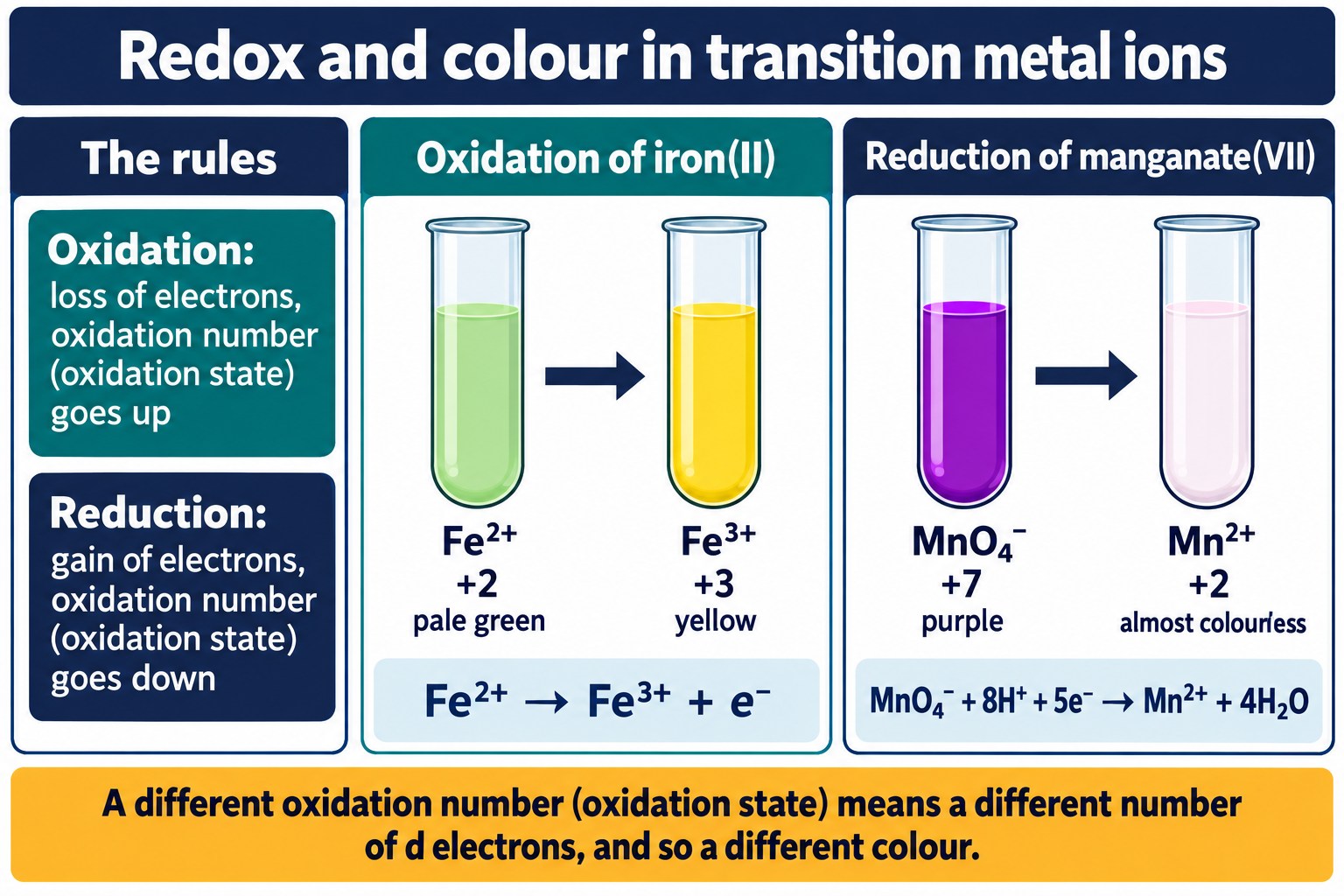
A change of oxidation number changes the colour of a transition metal ion: iron(II) to iron(III), and manganate(VII) to manganese(II).
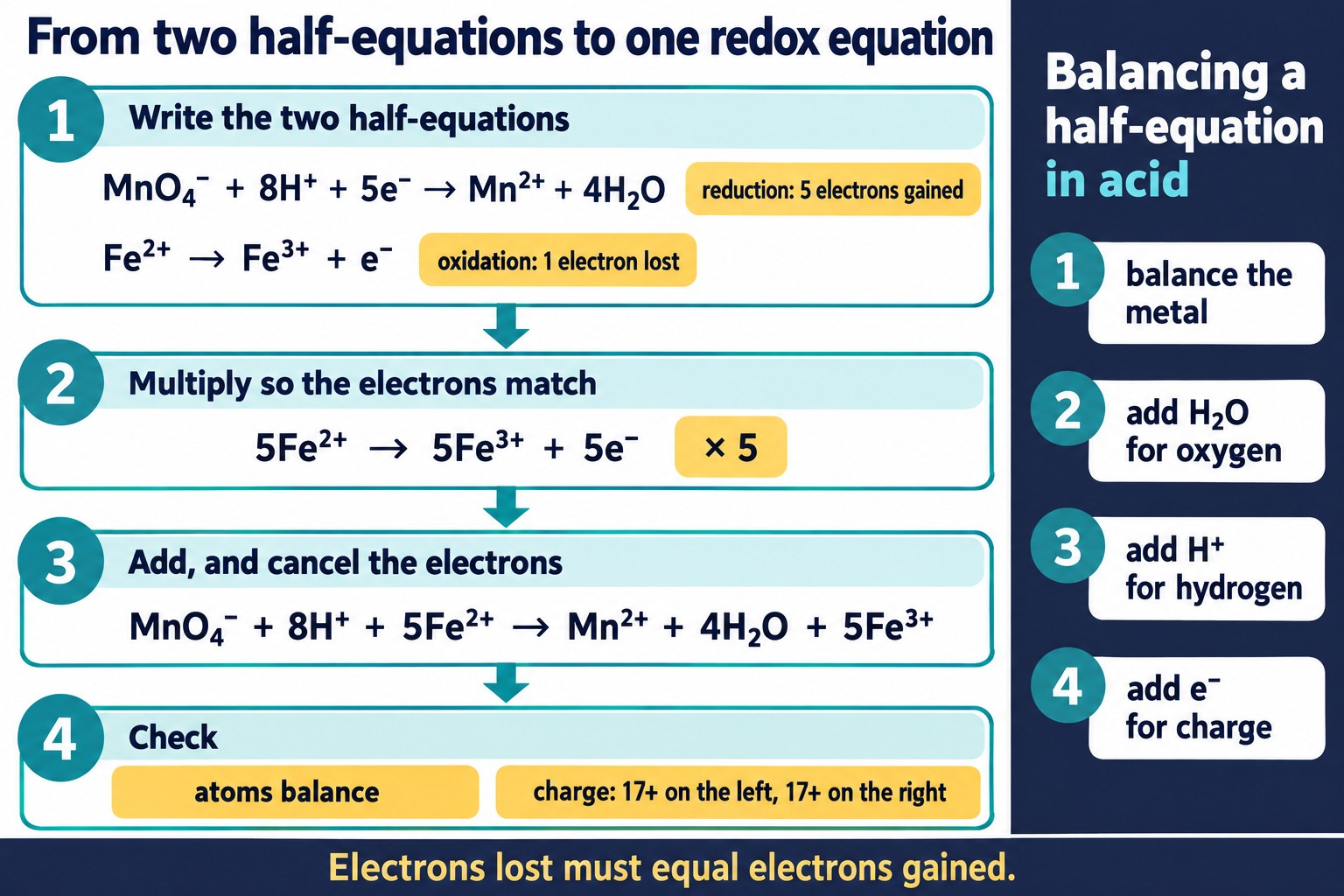
Two half-equations are combined by multiplying them so that the electrons lost equal the electrons gained.
General pattern: Ions with a high oxidation number, such as MnO₄⁻ and Cr₂O₇²⁻, are oxidising agents. Ions with a low oxidation number, such as Fe²⁺, are reducing agents.
Quick Check: Half-Equation for a New Ion
Apply the method to an ion that is new to this card.
The Oxidation Numbers of Vanadium
Vanadium has four common oxidation numbers, each with its own colour in aqueous solution.
| Oxidation number | Ion | Name | Colour |
|---|---|---|---|
| +5 | VO₂⁺ | dioxovanadium(V) | yellow |
| +4 | VO²⁺ | oxovanadium(IV) | blue |
| +3 | V³⁺ | vanadium(III) | green |
| +2 | V²⁺ | vanadium(II) | violet (purple) |
Reduction by zinc in acid
Ammonium vanadate(V), NH₄VO₃, dissolves in acid to give yellow VO₂⁺ ions. Zinc is added, and the flask is swirled.
- Yellow → green: some VO₂⁺ has become blue VO²⁺, and the mixture of yellow and blue looks green.
- Green → blue: all the vanadium is now VO²⁺, +4.
- Blue → green: V³⁺ forms, +3.
- Green → violet: V²⁺ forms, +2.
Equations
- +5 to +4: 2VO₂⁺ + 4H⁺ + Zn → 2VO²⁺ + 2H₂O + Zn²⁺
- +4 to +3: 2VO²⁺ + 4H⁺ + Zn → 2V³⁺ + 2H₂O + Zn²⁺
- +3 to +2: 2V³⁺ + Zn → 2V²⁺ + Zn²⁺
- Zinc in acid is a powerful reducing agent, so the reduction goes all the way to +2.
- The flask is stoppered with cotton wool: hydrogen escapes, but air is kept out.
- In air, violet V²⁺ is quickly oxidised back to green V³⁺.
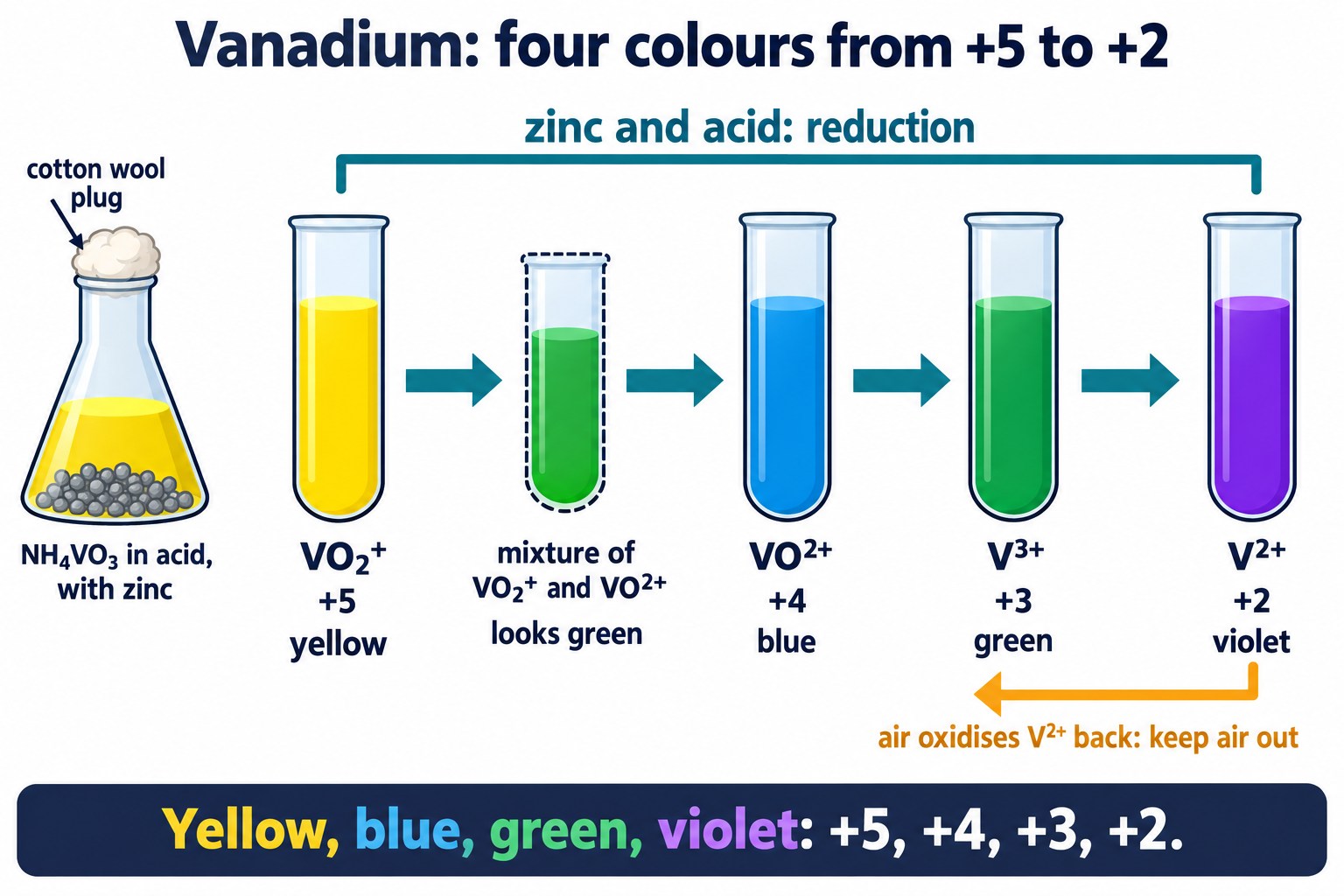
Vanadium is reduced by zinc in acid from +5 to +2. The first green colour is a mixture of yellow and blue ions.
Remember: Yellow, blue, green, violet for +5, +4, +3, +2. Two different greens appear: a mixture of +5 and +4 early on, and V³⁺ later.
Vanadium and E⦵ Values
Standard electrode potentials show which reducing agents can bring about each step.
| Half-equation | E⦵ / V |
|---|---|
| VO₂⁺ + 2H⁺ + e⁻ ⇌ VO²⁺ + H₂O | +1.00 |
| VO²⁺ + 2H⁺ + e⁻ ⇌ V³⁺ + H₂O | +0.34 |
| V³⁺ + e⁻ ⇌ V²⁺ | −0.26 |
| Zn²⁺ + 2e⁻ ⇌ Zn | −0.76 |
Why zinc reduces vanadium(V) all the way to +2
+5 to +4. E⦵cell = (+1.00) − (−0.76) = +1.76 V
+4 to +3. E⦵cell = (+0.34) − (−0.76) = +1.10 V
+3 to +2. E⦵cell = (−0.26) − (−0.76) = +0.50 V
Every E⦵cell is positive, so every step is thermodynamically feasible.
Choosing a reducing agent that stops part-way
A reducing agent reduces a vanadium species only when its own E⦵ is less positive than that of the vanadium half-equation.
| Reducing agent | E⦵ / V | +5 to +4 | +4 to +3 | +3 to +2 | Final species |
|---|---|---|---|---|---|
| Fe²⁺ (Fe³⁺ + e⁻ ⇌ Fe²⁺) | +0.77 | +0.23 V: yes | −0.43 V: no | −1.03 V: no | VO²⁺, blue |
| SO₂ (SO₄²⁻ + 4H⁺ + 2e⁻ ⇌ SO₂ + 2H₂O) | +0.17 | +0.83 V: yes | +0.17 V: yes | −0.43 V: no | V³⁺, green |
| Sn²⁺ (Sn⁴⁺ + 2e⁻ ⇌ Sn²⁺) | +0.15 | +0.85 V: yes | +0.19 V: yes | −0.41 V: no | V³⁺, green |
| Zn (Zn²⁺ + 2e⁻ ⇌ Zn) | −0.76 | +1.76 V: yes | +1.10 V: yes | +0.50 V: yes | V²⁺, violet |
Worked example
Sulfur dioxide is bubbled through an acidified solution of VO₂⁺ ions. Predict the final colour.
Step 1. +5 to +4: E⦵cell = (+1.00) − (+0.17) = +0.83 V, feasible.
Step 2. +4 to +3: E⦵cell = (+0.34) − (+0.17) = +0.17 V, feasible.
Step 3. +3 to +2: E⦵cell = (−0.26) − (+0.17) = −0.43 V, not feasible.
Oxidation by air
For O₂ + 4H⁺ + 4e⁻ ⇌ 2H₂O, E⦵ = +1.23 V. With V²⁺, E⦵cell = (+1.23) − (−0.26) = +1.49 V, so oxygen oxidises violet V²⁺ to green V³⁺.
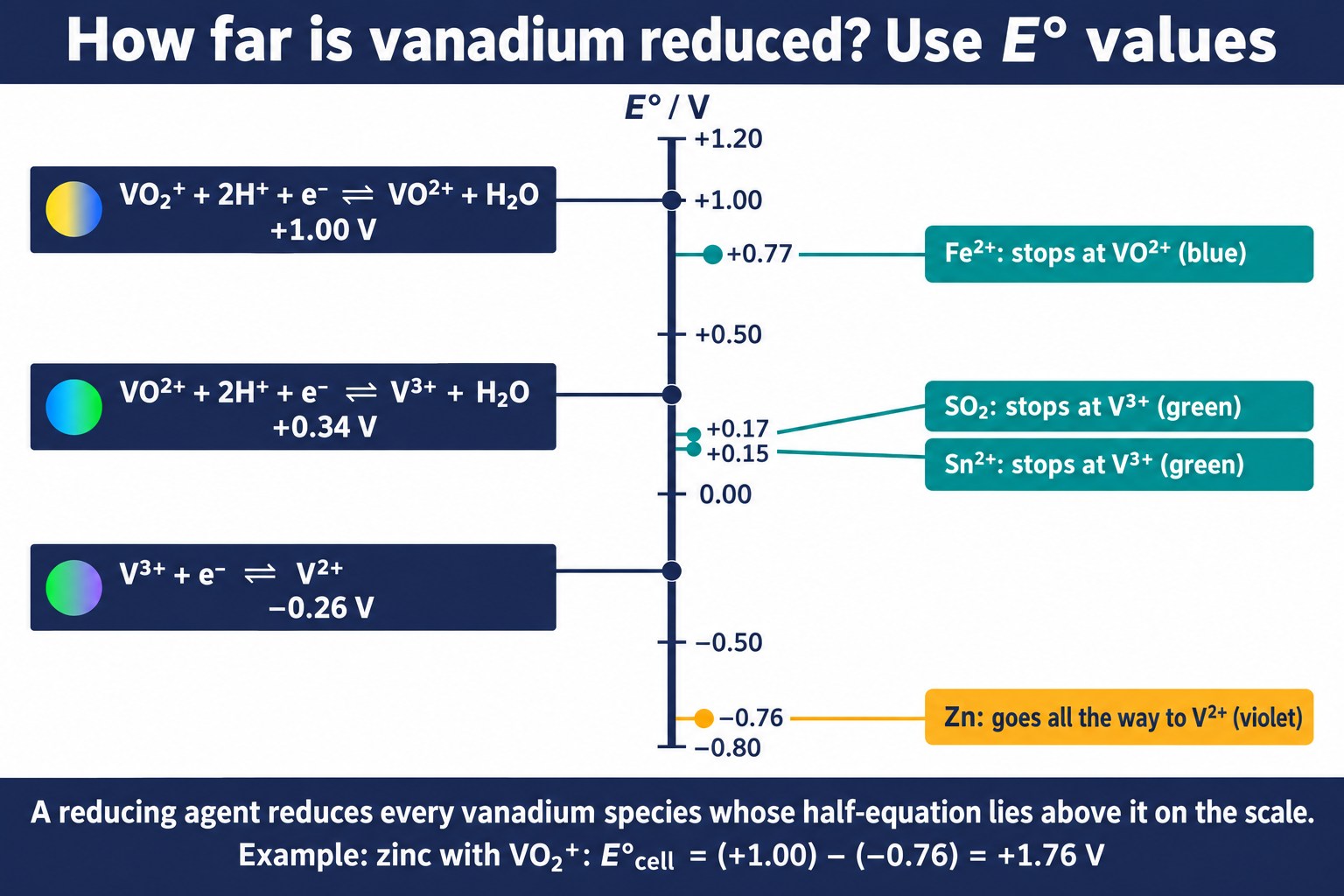
The three vanadium half-equations on an E⦵ ladder. A reducing agent reduces every vanadium species that lies above it.
Check: Oxidation Numbers and Colour Changes
Assign oxidation numbers in transition metal species given in the question, and decide what has been oxidised and what has been reduced.
Chromium: +6, +3 and +2
| Oxidation number | Ion | Colour |
|---|---|---|
| +6 | Cr₂O₇²⁻, dichromate(VI) | orange |
| +6 | CrO₄²⁻, chromate(VI) | yellow |
| +3 | Cr³⁺ | green |
| +2 | Cr²⁺ | blue |
Reduction of dichromate(VI) by zinc in acid
| Half-equation | E⦵ / V |
|---|---|
| Cr₂O₇²⁻ + 14H⁺ + 6e⁻ ⇌ 2Cr³⁺ + 7H₂O | +1.33 |
| Cr³⁺ + e⁻ ⇌ Cr²⁺ | −0.41 |
| Zn²⁺ + 2e⁻ ⇌ Zn | −0.76 |
+6 to +3. E⦵cell = (+1.33) − (−0.76) = +2.09 V, feasible: Cr₂O₇²⁻ + 14H⁺ + 3Zn → 2Cr³⁺ + 7H₂O + 3Zn²⁺
+3 to +2. E⦵cell = (−0.41) − (−0.76) = +0.35 V, feasible: 2Cr³⁺ + Zn → 2Cr²⁺ + Zn²⁺
- The colour changes from orange to green, then to blue.
- Air must be kept out. With oxygen, E⦵cell = (+1.23) − (−0.41) = +1.64 V, so blue Cr²⁺ is quickly oxidised back to green Cr³⁺.
Oxidation of chromium(III) by hydrogen peroxide in alkali
- Add excess sodium hydroxide to Cr³⁺(aq): a green solution of [Cr(OH)₆]³⁻ forms.
- Add hydrogen peroxide and warm: the solution turns yellow as CrO₄²⁻ forms.
- Acidify with dilute sulfuric acid: the yellow solution turns orange as Cr₂O₇²⁻ forms.
| Half-equation in alkali | E⦵ / V |
|---|---|
| CrO₄²⁻ + 4H₂O + 3e⁻ ⇌ Cr(OH)₃ + 5OH⁻ | −0.13 |
| H₂O₂ + 2e⁻ ⇌ 2OH⁻ | +0.88 |
Feasibility. E⦵cell = (+0.88) − (−0.13) = +1.01 V, so hydrogen peroxide oxidises chromium(III) in alkali.
2[Cr(OH)₆]³⁻ + 3H₂O₂ → 2CrO₄²⁻ + 2OH⁻ + 8H₂O
In alkali the chromium E⦵ is −0.13 V. In acid it is +1.33 V. Chromium(III) is therefore far easier to oxidise in alkaline conditions.
Chromate(VI) and dichromate(VI)
2CrO₄²⁻(aq) + 2H⁺(aq) ⇌ Cr₂O₇²⁻(aq) + H₂O(l)
- Adding acid moves the equilibrium to the right: yellow → orange.
- Adding alkali removes H⁺ and moves it to the left: orange → yellow.
- The same equilibrium can be written the other way round: Cr₂O₇²⁻ + H₂O ⇌ 2CrO₄²⁻ + 2H⁺.
- This is not a redox reaction: chromium is +6 in both ions.
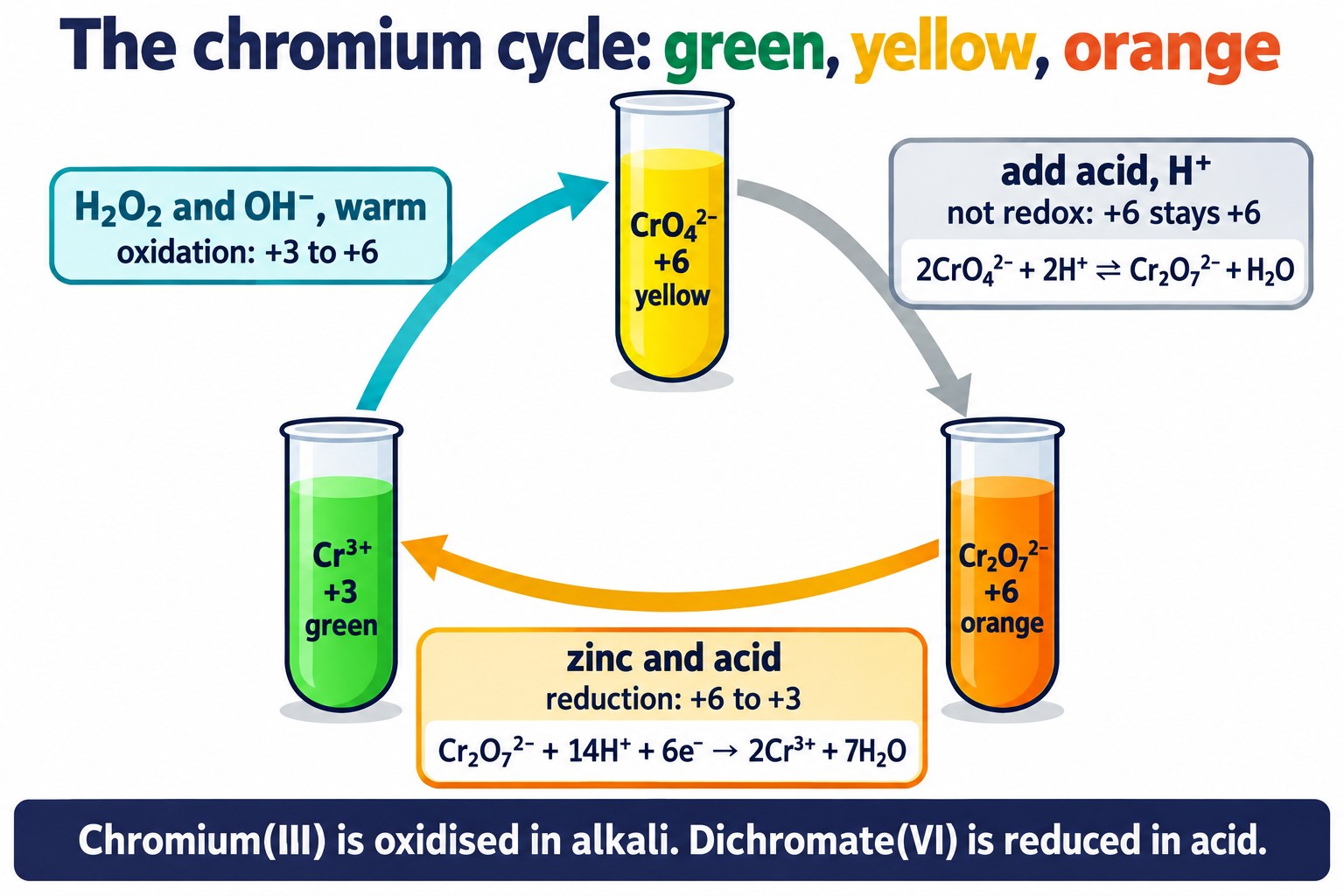
The chromium cycle: chromium(III) is oxidised to chromate(VI) in alkali, acid converts chromate(VI) to dichromate(VI), and zinc in acid reduces it back.
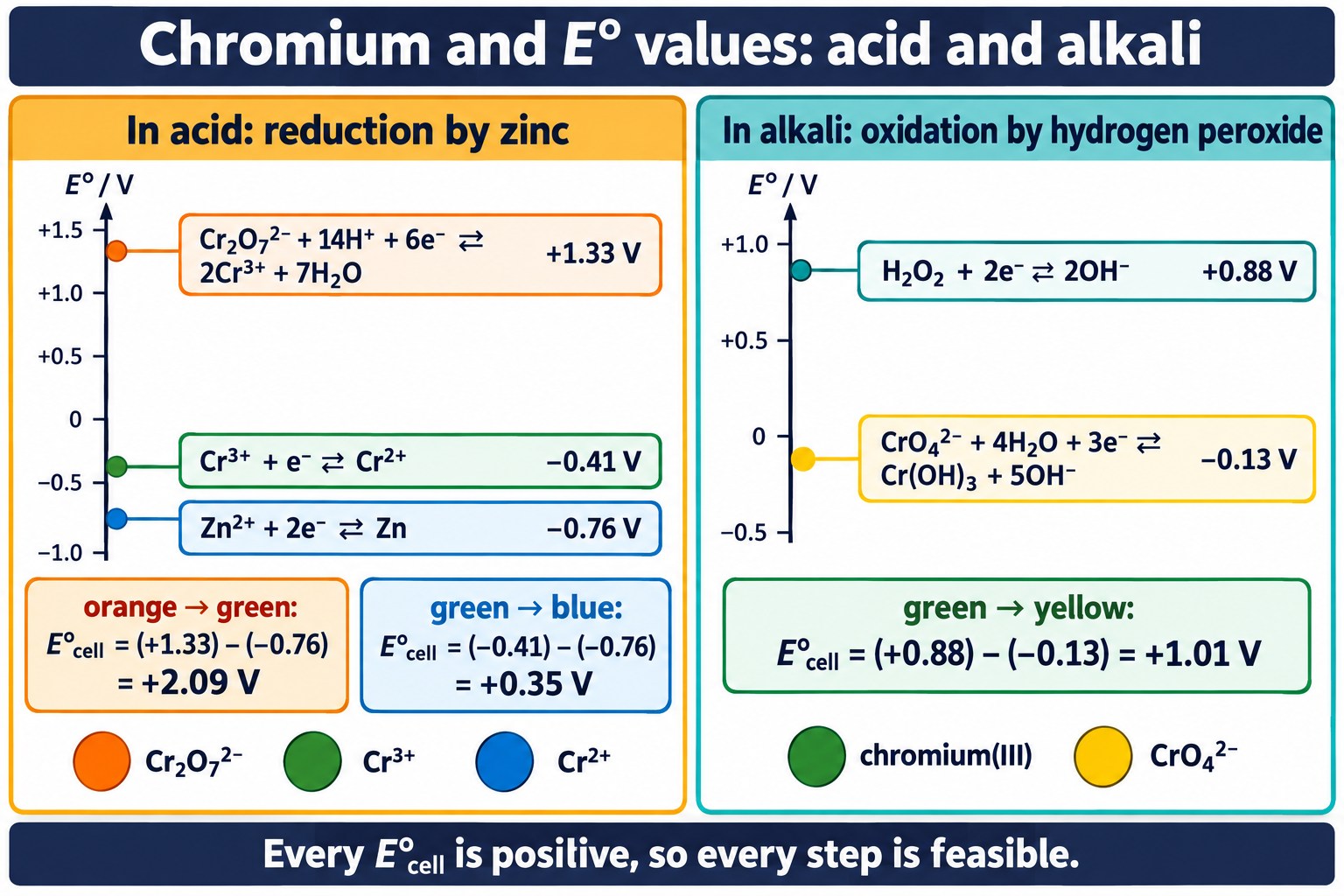
E⦵ values for chromium in acid and in alkali, with the zinc and hydrogen peroxide half-equations.
Check: Half-Equations and Redox Equations
Combine half-equations given in the question into balanced redox equations, and identify the oxidising agent and the reducing agent.
Using E⦵ Values Wisely
The same method works for any transition metal system.
- Write the two half-equations as reductions, with their E⦵ values.
- The species on the left of the more positive half-equation is the oxidising agent.
- E⦵cell = E⦵(half-equation of the species reduced) − E⦵(half-equation of the species oxidised).
- A positive E⦵cell means the reaction is thermodynamically feasible.
Limits of the prediction
- E⦵ values say nothing about rate: a feasible reaction with a high activation energy may be too slow to see.
- E⦵ values apply to standard conditions: 298 K, 100 kPa and 1.00 mol dm⁻³ solutions.
- Half-equations that contain H⁺ or OH⁻ depend strongly on pH, as the chromium values in acid and alkali show.
- Both limits are explained in Topic 14 Redox II.
Common Exam Points
Say
- “The oxidation number of the metal decreases, so it is reduced.”
- “The first green colour is a mixture of yellow VO₂⁺ and blue VO²⁺.”
- “E⦵cell is positive, so the reaction is thermodynamically feasible.”
- “Converting chromate(VI) to dichromate(VI) is not redox: chromium stays at +6.”
Do not say
- “The colour changes” without naming both colours.
- “VO₂⁺ is vanadium(IV)” (VO₂⁺ is +5; VO²⁺ is +4).
- “The E⦵ value is doubled because the half-equation is doubled” (E⦵ values are never multiplied).
Watch for
- Balance the electrons before adding two half-equations.
- Balance oxygen with H₂O and hydrogen with H⁺ in acidic solution.
- Check the final equation: the atoms and the total charge must balance.
- Air re-oxidises ions with a low oxidation number, such as V²⁺, so the flask is closed with cotton wool.
Check: Redox Reactions of Transition metals
Interpret redox reactions that are new to you: oxidation numbers, electrons transferred, balanced equations and the colour changes described.
FAQs
Use these quick answers to check oxidation numbers, half-equations and the redox chemistry of vanadium and chromium.
How do I work out the oxidation number of chromium in Cr₂O₇²⁻?
Oxygen is −2, so seven oxygen atoms total −14. The ion has a charge of 2−, so the two chromium atoms total +12. Each chromium atom is therefore +6. In the same way, manganese in MnO₄⁻ is +7.
How do I combine the dichromate(VI) and iron(II) half-equations?
Cr₂O₇²⁻ + 14H⁺ + 6e⁻ → 2Cr³⁺ + 7H₂O needs six electrons, and each Fe²⁺ → Fe³⁺ + e⁻ supplies one. Multiply the iron half-equation by 6, then add: Cr₂O₇²⁻ + 14H⁺ + 6Fe²⁺ → 2Cr³⁺ + 7H₂O + 6Fe³⁺.
What are the colours of the vanadium oxidation numbers?
VO₂⁺ (+5) is yellow, VO²⁺ (+4) is blue, V³⁺ (+3) is green and V²⁺ (+2) is violet. With zinc in acid the solution goes yellow, green, blue, green, then violet. The first green is a mixture of yellow and blue.
Why does zinc reduce vanadium(V) all the way to vanadium(II)?
E⦵ for Zn²⁺/Zn is −0.76 V, more negative than all three vanadium half-equations (+1.00, +0.34 and −0.26 V). E⦵cell is positive for each step: +1.76, +1.10 and +0.50 V. So every step is feasible.
How is chromium(III) oxidised to chromium(VI)?
Add excess sodium hydroxide, then hydrogen peroxide: 2[Cr(OH)₆]³⁻ + 3H₂O₂ → 2CrO₄²⁻ + 2OH⁻ + 8H₂O. Green turns to yellow. Adding acid then gives orange Cr₂O₇²⁻, which is not a redox change: chromium stays +6.

Copyright notice: This OLS revision content, including the explanations, layout, diagrams, tables and embedded learning structure, is authored for Online Learning System by Dr. Mohammed Al-Fatah. It may not be copied, reproduced, redistributed or adapted without written permission.
Keep this note — free
Save your progress across every Edexcel topic. A free account remembers which topics you have covered, saves your question scores, and syncs across your phone and laptop.
- Track every topic you have finished
- Keep your practice-question scores
- No payment, no card, free forever
Already registered? Log in