Electrophilic Substitution in Benzene
A concise revision guide to electrophilic substitution in benzene: why benzene substitutes rather than adds, why it resists bromination compared with alkenes, the three-step mechanism with the delocalised intermediate, and how the catalyst is regenerated.
Electrophilic Substitution
Choose a step to watch an electrophile attack the ring, the intermediate form, H⁺ leave and the delocalised ring return.
© Dr. Mohammed Al-Fatah – onlinelearningsystem.net
Before You Start
This page builds on the bonding in benzene and on the electrophilic addition reactions of alkenes.
- An electrophile is an electron-pair acceptor. It is attracted to a region of high electron density.
- In an alkene the C=C bond is electron-rich enough to polarise a molecule such as Br₂, which then adds across the double bond: Topic 6 Organic Chemistry I.
- Benzene has six π electrons delocalised above and below the planar ring: Structure and Bonding in Benzene.
- The delocalised ring is about 150 kJ mol⁻¹ more stable than the Kekulé structure would be, the delocalisation energy: Evidence for the Structure of Benzene.
Substitution, Not Addition
Benzene is attacked by electrophiles, as alkenes are, but the outcome is different. An alkene adds the electrophile. Benzene substitutes one hydrogen atom for the new group.
| Addition across one bond | Substitution of one H | |
|---|---|---|
| What happens to the π system | two of the six π electrons are used to make the new bonds | briefly disturbed, then fully restored |
| Delocalisation | lost: only four π electrons remain and the ring is no longer delocalised | kept: six π electrons over six carbons in the product |
| Energy | about 150 kJ mol⁻¹ of delocalisation energy is lost | the stability is kept |
| Outcome | not favourable | the reaction that is observed |
- Addition would break up the delocalised π system and lose its extra stability.
- Substitution keeps the ring intact, so the product is as stable as benzene itself.
- The ring has a high electron density above and below the plane, so it attracts electrophiles.
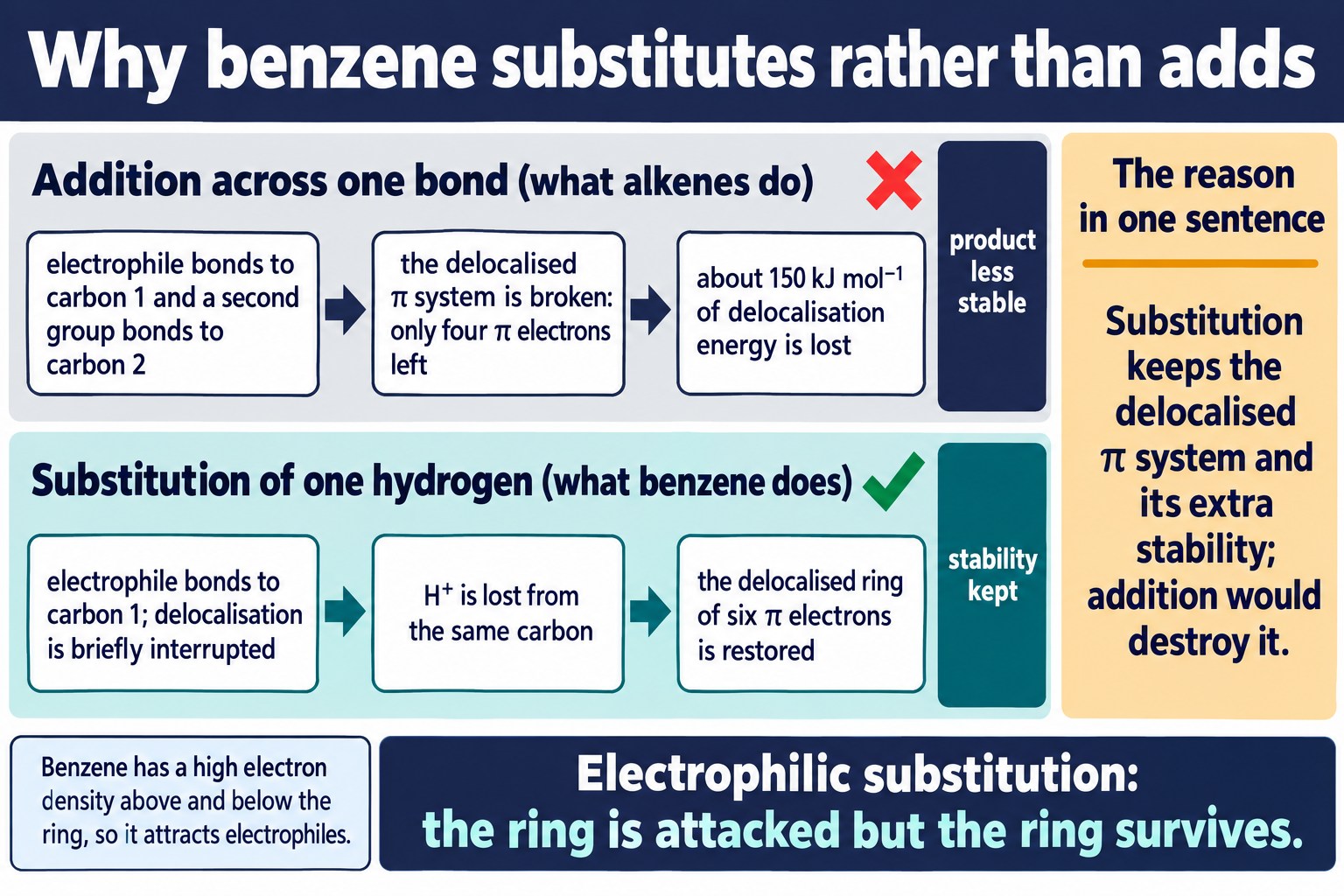
Addition would destroy the delocalised system and its stability. Substitution disturbs it only in the intermediate and then restores it.
Exam focus: The explanation has two parts: the delocalised π system makes benzene stable, and addition would destroy that delocalisation. Substitution keeps the ring and its delocalisation energy.
Why Benzene Resists Bromination
An alkene reacts with bromine at room temperature with no catalyst. Benzene does not. The difference is where the π electrons are.
| Alkene, for example cyclohexene | Benzene | |
|---|---|---|
| π electrons | two, localised between two carbon atoms | six, delocalised over six carbon atoms |
| Electron density of the π system | high | lower: the same kind of electrons spread over a larger volume |
| Effect on Br₂ | polarises it: induces a dipole, Brδ+–Brδ− | cannot polarise it enough to react |
| With bromine water | orange to colourless | stays orange: no reaction |
| Reaction type | electrophilic addition | electrophilic substitution, only with a catalyst |
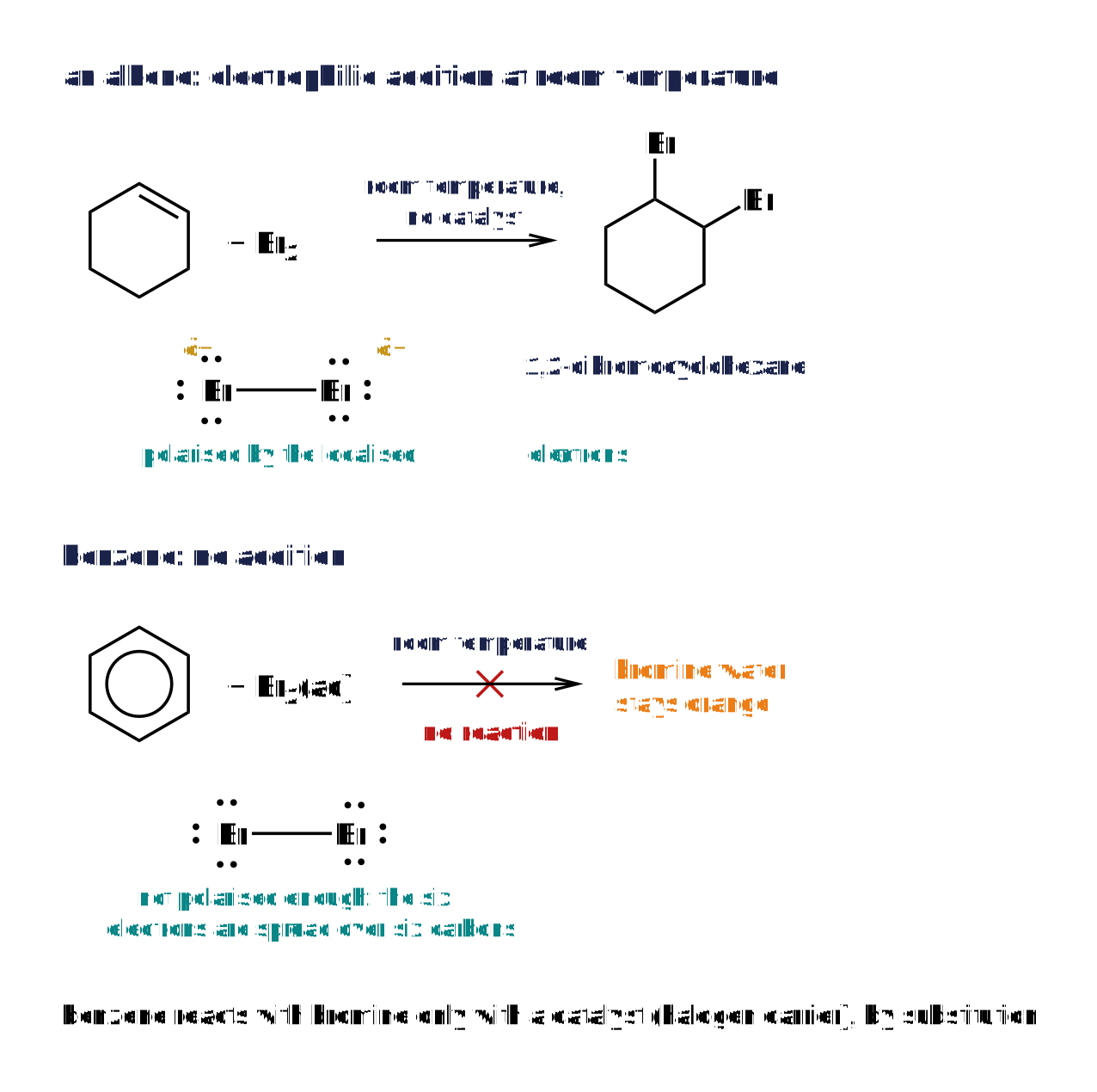
Cyclohexene adds bromine at room temperature. Benzene does not react with bromine water: the delocalised electrons cannot polarise Br₂ enough.
- In an alkene the two π electrons are concentrated between two carbons: a region of high electron density.
- As Br₂ approaches, this density repels the electrons of the Br–Br bond, inducing a dipole. The Brδ+ end is then attacked.
- In benzene the six π electrons are spread over six carbons, so the electron density is lower.
- Benzene cannot induce a large enough dipole in Br₂, so there is no reaction with bromine water.
- A catalyst is needed to make a much stronger electrophile, Br⁺: Halogenation of Benzene.
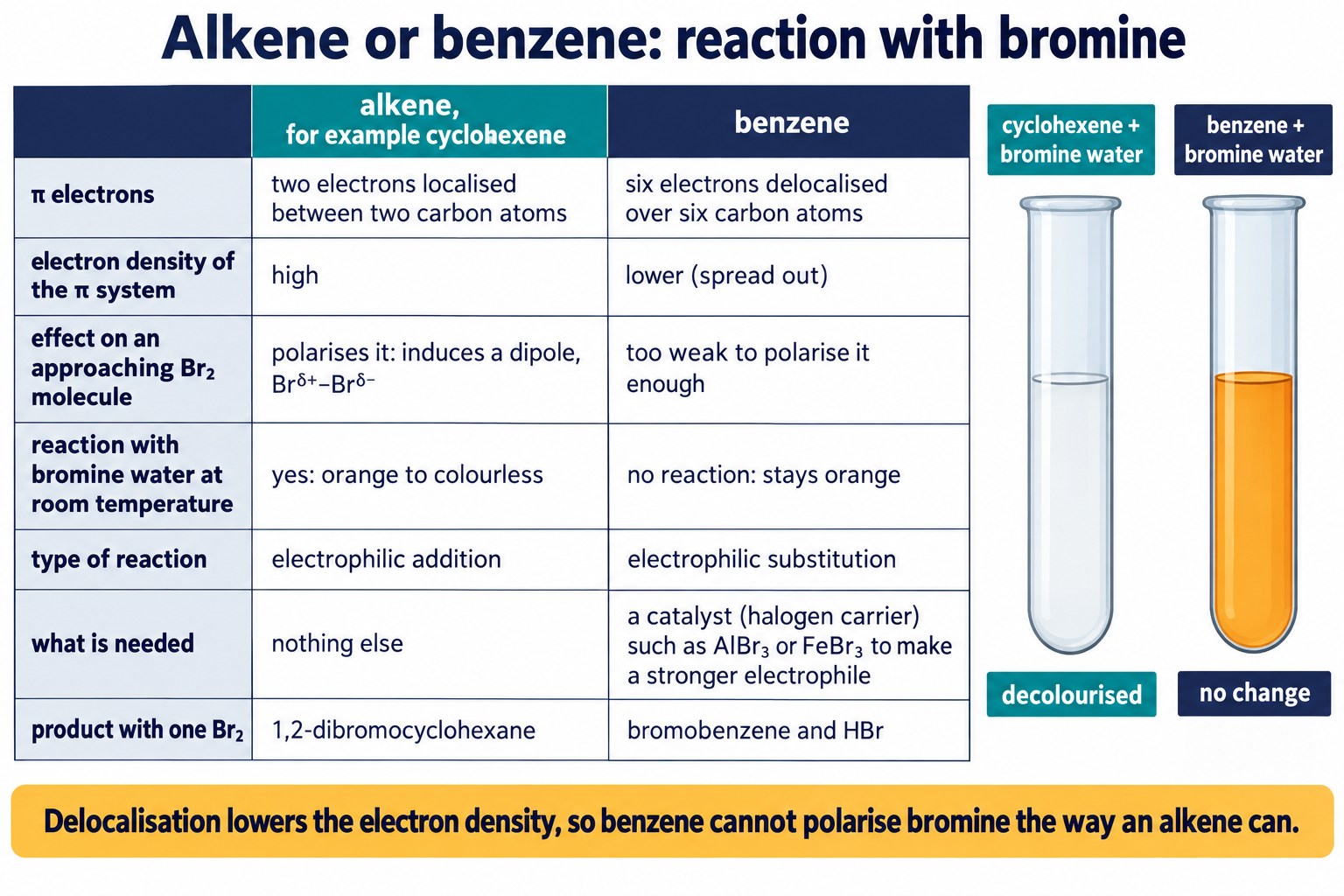
The same bromine, two different results: an alkene polarises Br₂ and adds; benzene does neither without a catalyst.
Exam focus: Use the words localised and delocalised. The alkene π bond is a localised region of high electron density that polarises Br₂; the delocalised π system of benzene has a lower electron density and cannot.
Check: Substitution Versus Addition
Explain why electrophiles substitute into benzene rather than add, using the stability of the delocalised ring.
The General Mechanism
Every electrophilic substitution of benzene follows the same three moves. Learn them once with a general electrophile, E⁺, and then apply them to each reagent.
- Attack. The E⁺ electrophile is attracted to the high electron density of the ring. A curly arrow goes from a C=C bond of the ring to the electrophile.
- Intermediate. A C–E bond forms, so that carbon holds both E and its H. The positive charge is delocalised over the other five carbons: the horseshoe with a + inside.
- Loss of H⁺. A curly arrow from the C–H bond into the ring restores the delocalised system. The catalyst anion takes the H⁺, which regenerates the catalyst.
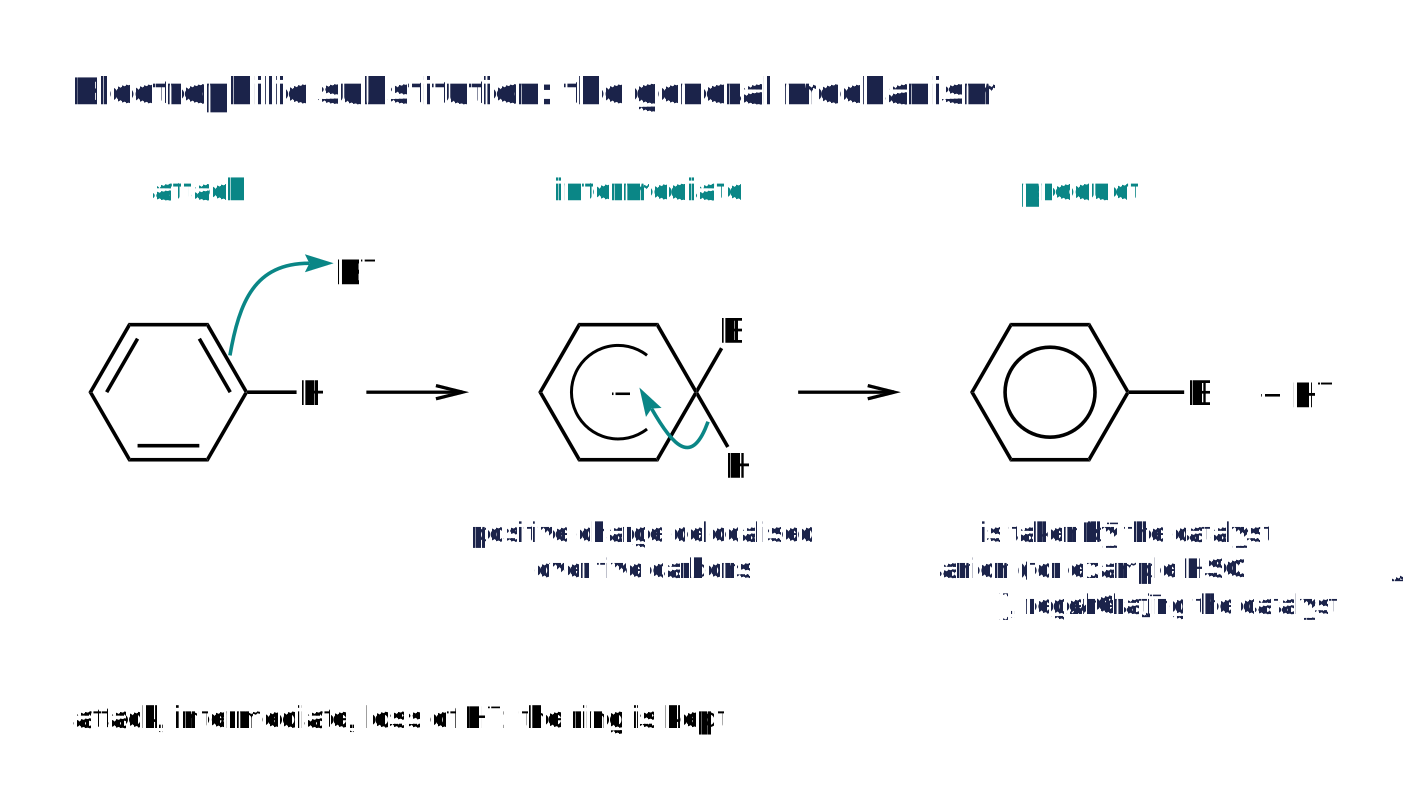
The three frames of the general mechanism. In the intermediate the positive charge is spread over five carbons: the horseshoe stops short of the carbon that holds E and H.
The intermediate in detail
- The carbon under attack changes from three bonds in the plane to four bonds, with E and H pointing above and below the ring.
- That carbon is no longer part of the π system, so only four π electrons remain, shared over five carbons.
- The missing electron leaves the five carbons with a positive charge. Draw it as a + inside a horseshoe from carbon 2 round to carbon 6.
- The horseshoe must not reach the carbon that holds E and H.
Remember: Two curly arrows in total: one from the ring to E⁺ and one from the C–H bond back into the ring.
The charge in the intermediate is drawn as a horseshoe, not an arrow. The arrow starts on the bond, never on the H atom.
Regenerating the Catalyst
The H⁺ lost in the last step does not float away. It is taken by the negative ion formed when the electrophile was made, and this regenerates the catalyst.
| Reaction | Electrophile | Anion that takes H⁺ | Catalyst regenerated |
|---|---|---|---|
| nitration | NO₂⁺ | HSO₄⁻ | H⁺ + HSO₄⁻ → H₂SO₄ |
| bromination | Br⁺ | AlBr₄⁻ or FeBr₄⁻ | H⁺ + AlBr₄⁻ → AlBr₃ + HBr |
| acylation | CH₃CO⁺ | AlCl₄⁻ | H⁺ + AlCl₄⁻ → AlCl₃ + HCl |
- The catalyst is used to make the electrophile and is returned at the end, so only a small amount is needed.
- In the overall equation the catalyst does not appear: C₆H₆ + E–X → C₆H₅E + HX.
- Writing the regeneration equation is often a separate mark.
Check: The Three Moves of the Mechanism
Place the curly arrows, the charge and the horseshoe correctly for an electrophile you have not met on this page.
Drawing the Mechanism in an Exam
Examiners look for the same five features every time. Most lost marks come from the intermediate.
- The arrow to the electrophile starts on a C=C bond of the ring (Kekulé form) or on the circle.
- The electrophile is written with its charge: E⁺, not E.
- The intermediate shows the new group and the H on the same carbon.
- The horseshoe runs from carbon 2 to carbon 6 with a + inside, never touching carbon 1.
- The second arrow starts on the C–H bond and points into the ring.
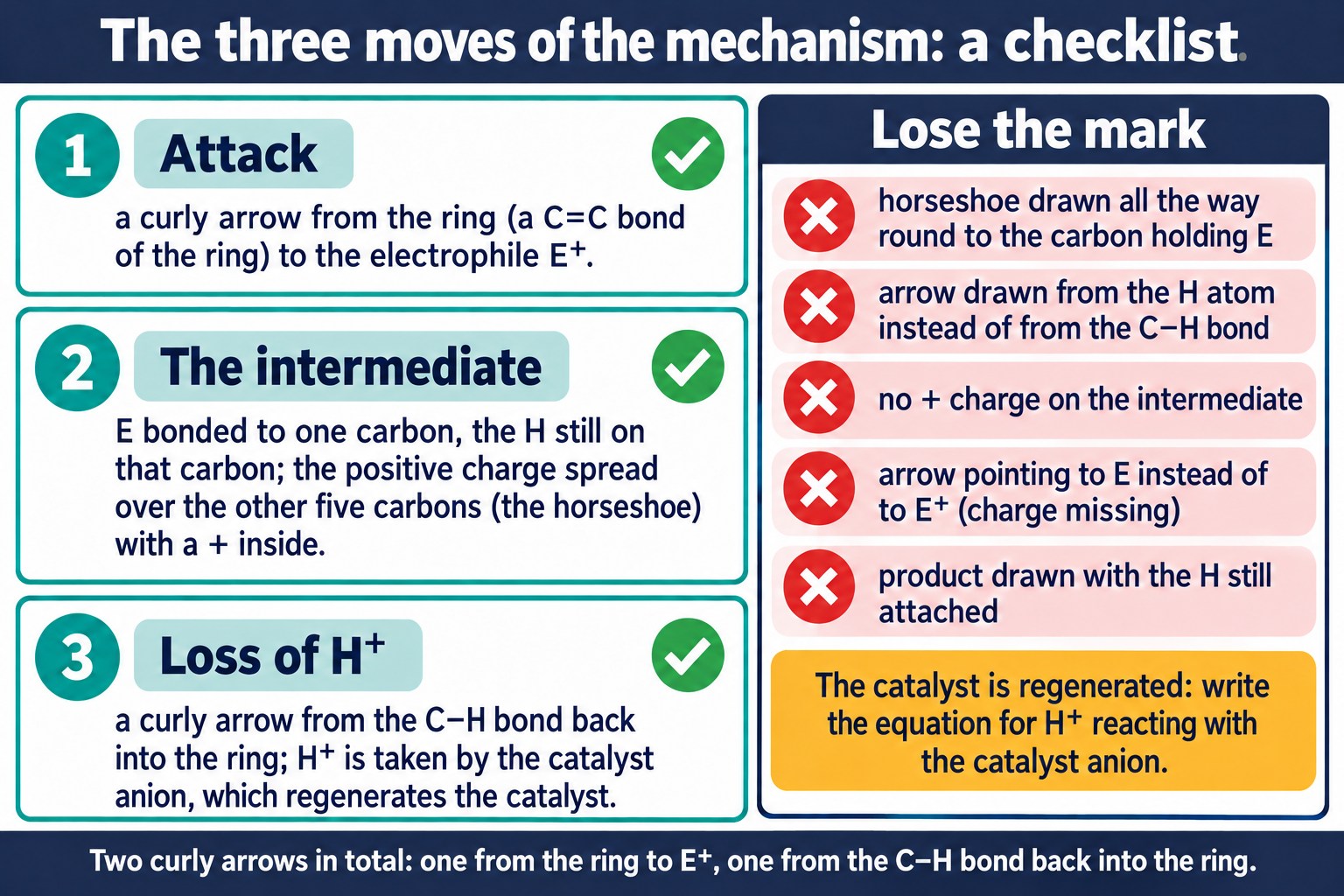
The three moves as a checklist, with the five most common mistakes marked.
Common mistake: A horseshoe drawn all the way round the ring says the charge is on all six carbons, including the one that already has four bonds. That carbon cannot carry the charge, so the mark is lost.
Check: Applying the Mechanism
Use the general mechanism to decide what forms, what is lost and what regenerates the catalyst in substitutions with other electrophiles.
Where the Mechanism Is Used
The reactions that follow are all electrophilic substitutions. Only the electrophile and the catalyst change.
| Reaction | Reagents | Electrophile | Product |
|---|---|---|---|
| Nitration of Benzene | conc. HNO₃ and conc. H₂SO₄ | NO₂⁺ | nitrobenzene |
| Halogenation of Benzene | Br₂ with a catalyst such as AlBr₃ or FeBr₃ | Br⁺ | bromobenzene |
| Friedel–Crafts alkylation | halogenoalkane and AlCl₃ | a carbocation, R⁺ | an alkylbenzene |
| Friedel–Crafts acylation | acyl chloride and AlCl₃ | an acylium ion, RCO⁺ | a phenyl ketone |
Phenol has an activated ring and substitutes far more readily than benzene: Phenol.
Quick Check: Acylation with a New Catalyst
Apply the same mechanism to a reagent and a catalyst that are new to this page.
Common Exam Points
- Benzene substitutes rather than adds because addition would destroy the delocalised π system and lose its delocalisation energy.
- An alkene has a localised region of high electron density that polarises Br₂; the delocalised electrons of benzene cannot, so benzene does not react with bromine water.
- Three moves: attack by the electrophile, the intermediate with the charge over five carbons, loss of H⁺.
- The horseshoe runs from carbon 2 to carbon 6 and never touches the carbon holding the new group.
- The second curly arrow starts on the C–H bond, not on the H atom.
- H⁺ reacts with the catalyst anion, regenerating the catalyst: write this equation.
FAQs
Use these quick answers to check why benzene substitutes rather than adds, the three steps of the mechanism and how the catalyst is regenerated.
Why does benzene undergo substitution rather than addition?
The delocalised π system gives benzene about 152 kJ mol⁻¹ of extra stability. Addition across one bond would break the delocalisation and lose that energy. Substituting a hydrogen keeps the ring intact, so the product is still stabilised.
What is the horseshoe in the intermediate?
It is the partial circle inside the ring after the electrophile has bonded.
The positive charge is delocalised over the five carbons still in the π system, so the horseshoe runs from carbon 2 round to carbon 6 and never touches the carbon bonded to E.
Where do the curly arrows start and finish?
The first arrow goes from the ring (a C=C bond of the Kekulé form, or the circle) to the electrophile.
The second goes from the C–H bond of the carbon bonded to E into the ring, restoring delocalisation as H⁺ leaves. Never start an arrow on the hydrogen.
What happens to the H⁺ that leaves the ring?
It is removed by the anion formed when the electrophile was generated: HSO₄⁻ in nitration, or AlCl₄⁻ when AlCl₃ acts as the catalyst. This regenerates the catalyst, so it is not used up and does not appear in the overall equation.
Why does benzene need a catalyst to react with bromine when alkenes do not?
In an alkene the π electrons are concentrated between two carbons, so the electron density is high enough to polarise Br₂ and induce a dipole. In benzene six π electrons are spread over six carbons, so Br₂ is not polarised and a catalyst is needed.

Copyright notice: This OLS revision content, including the explanations, layout, diagrams, tables and embedded learning structure, is authored for Online Learning System by Dr. Mohammed Al-Fatah. It may not be copied, reproduced, redistributed or adapted without written permission.
Keep this note — free
Save your progress across every Edexcel topic. A free account remembers which topics you have covered, saves your question scores, and syncs across your phone and laptop.
- Track every topic you have finished
- Keep your practice-question scores
- No payment, no card, free forever
Already registered? Log in