Purifying Liquids: Distillation, Steam Distillation and Solvent Extraction
A concise revision guide to purifying a liquid organic product: simple and fractional distillation, steam distillation of a product that decomposes near its boiling temperature, solvent extraction with a separating funnel, washing and drying with an anhydrous salt, and checking purity by boiling temperature and by chromatography or spectroscopy.
Before You Start: the AS Techniques
Heating under reflux, simple distillation and the basic use of a separating funnel and drying agent are taught in full on Preparing and Purifying Organic Liquids. The one-card recap below is what this page builds on.
- Reflux: vertical condenser, vapour returns to the flask, nothing is lost during long heating; the top stays open.
- Simple distillation: still head with the thermometer bulb level with the side arm, sloping condenser, collect the fraction at the boiling temperature of the product.
- Separating funnel: immiscible layers settle; remove the stopper, run off the lower layer through the tap.
- Drying: add an anhydrous salt until the liquid runs clear, then decant or filter.
- This page adds fractional distillation, solvent extraction in detail, washing, steam distillation, redistillation and the checks for purity.
- Choosing the procedure in the first place: Choosing Procedures and Managing Hazards.
GCSE Recap: Separating Mixtures and Purity
Three quick questions on the GCSE ideas this page builds on.
Distillation: Simple and Fractional
Distillation separates liquids by boiling temperature. Simple distillation handles liquids whose values are far apart; fractional distillation is needed when they are close.
| Simple distillation | Fractional distillation | |
|---|---|---|
| apparatus | flask, still head, thermometer, sloping condenser, receiver | the same with a fractionating column packed with glass beads between flask and still head |
| when | boiling temperatures differ by more than about 25 °C | close boiling temperatures |
| how it separates | the more volatile liquid boils off first | vapour condenses and re-evaporates many times up the column; the vapour at the top is richer in the more volatile liquid |
| example | ethyl ethanoate (77 °C) from the acid catalyst and most of the water | ethanol (78 °C) from water (100 °C) |
- The thermometer bulb sits level with the side arm so it reads the temperature of the vapour that is leaving.
- Collect only the fraction that distils within a degree or two of the boiling temperature of the product; change the receiver before and after.
- Anti-bumping granules give smooth boiling; water enters the condenser at the lower end.
- A steady reading means one liquid is distilling; a reading that drifts upwards means a mixture.
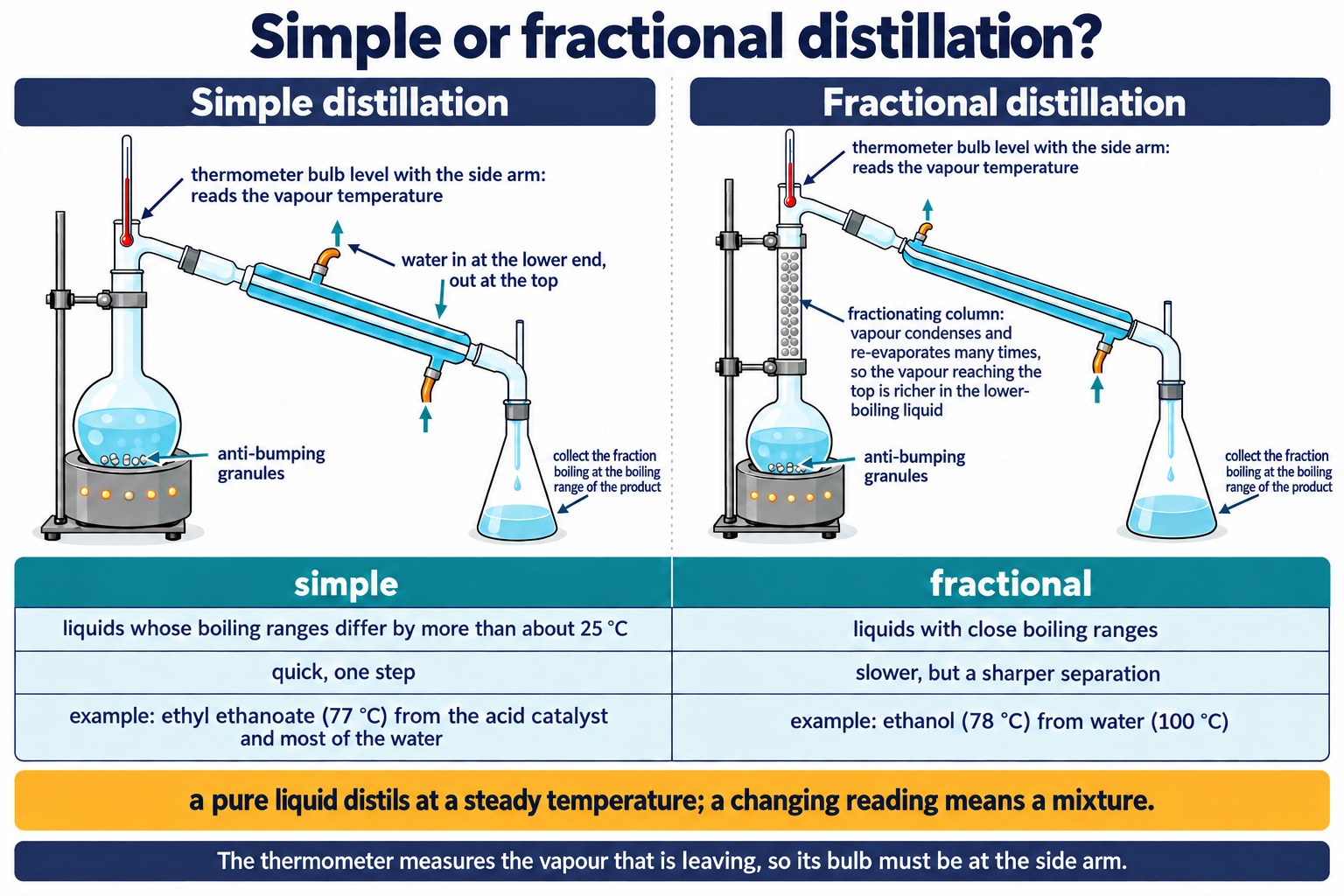
Simple and fractional distillation side by side, the thermometer position, and when each is chosen.
Exam focus: “Thermometer bulb level with the side arm” and “collect the fraction at the boiling temperature of the product” are the two marks examiners look for.
Quick Check: Reading a Distillation
Pick the one accurate statement in each set, using mixtures that are new to this page.
Solvent Extraction with a Separating Funnel
Solvent extraction moves the product from an aqueous mixture into an organic solvent in which it is far more soluble. The two liquids must not mix, so they form layers in the separating funnel.
Choosing the solvent
- The product must be much more soluble in the solvent than in water.
- The solvent must be immiscible with water, so two layers form.
- A low boiling temperature makes the solvent easy to distil off afterwards: ethoxyethane boils at 35 °C.
- Which layer is which depends on density: ethoxyethane (0.71 g cm⁻³) floats on water; a bromoalkane sinks below it.
Method
- Add the solvent to the aqueous mixture in the funnel, stopper it, invert and shake; open the tap while inverted to release any pressure.
- Stand the funnel in a ring until the layers are sharp. Remove the stopper.
- Open the tap and run off the lower layer; collect the organic layer in a clean flask.
- Repeat with a fresh small portion of solvent and combine the organic layers.
- Several small portions beat one large one: each shake moves the same fraction of what is left, so three 10 cm³ portions remove far more than one 30 cm³ portion.
- If unsure which layer is organic, add a drop of water and watch which layer grows.
- Afterwards the solvent is removed by distillation, leaving the product.
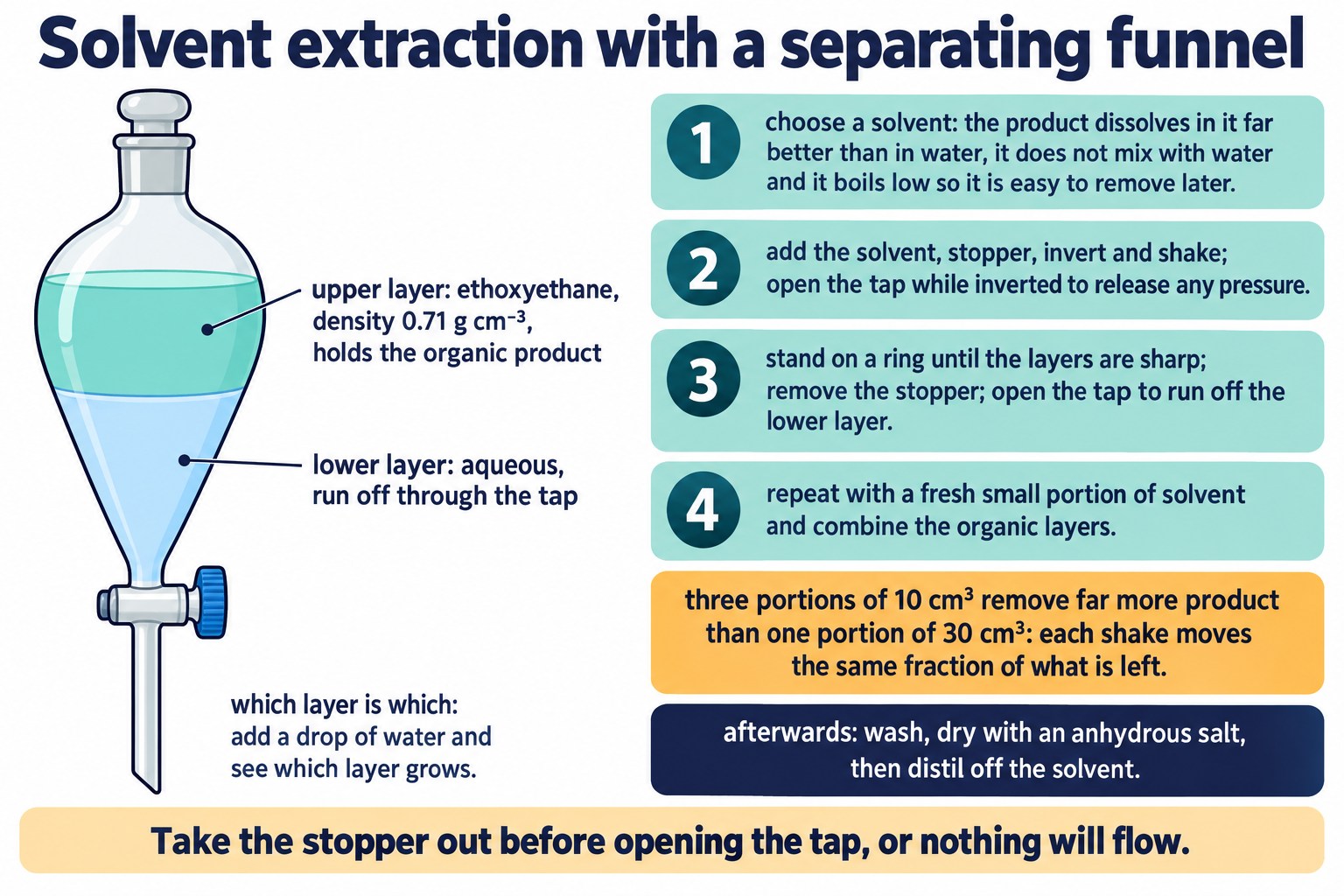
Ethoxyethane on top, the aqueous layer below, the four-step method and why small portions are repeated.
Common mistake: Opening the tap with the stopper in: nothing flows. Shaking without releasing the pressure: the stopper can blow out, especially after a carbonate wash.
Check: Distillation and Extraction
Choose simple or fractional distillation, decide which layer is which from density and plan an extraction for liquids that are not used on this page.
Washing and Drying
The organic layer still holds dissolved reagents, acid and water. Washing in the separating funnel removes the first two; an anhydrous drying agent removes the water.
| Wash with | Removes | Watch for |
|---|---|---|
| water | soluble reagents and salts | shake gently: emulsions form if shaken too hard |
| sodium carbonate solution (or sodium hydrogencarbonate) | acidic impurities such as leftover ethanoic or sulfuric acid, as their soluble sodium salts | carbon dioxide fizzes; invert and open the tap to release the pressure, then shake again |
| saturated sodium chloride solution (brine) | most of the dissolved water from the organic layer | the product is less soluble in brine than in water, so less is lost |
| Drying agent | How to use | How you know it is dry |
|---|---|---|
| anhydrous magnesium sulfate | add a spatula at a time and swirl | the liquid turns from cloudy to clear and some powder stays free-running |
| anhydrous calcium chloride | the same; avoid for alcohol products, which it absorbs | the same |
| anhydrous sodium sulfate | the same, slower | the same |
- Decant or filter the dry liquid away from the solid, then redistil and collect the pure fraction.
- The word anhydrous is the mark: a hydrated salt cannot take up more water.
- Too much drying agent traps product on the solid and lowers the yield; add it in small amounts.
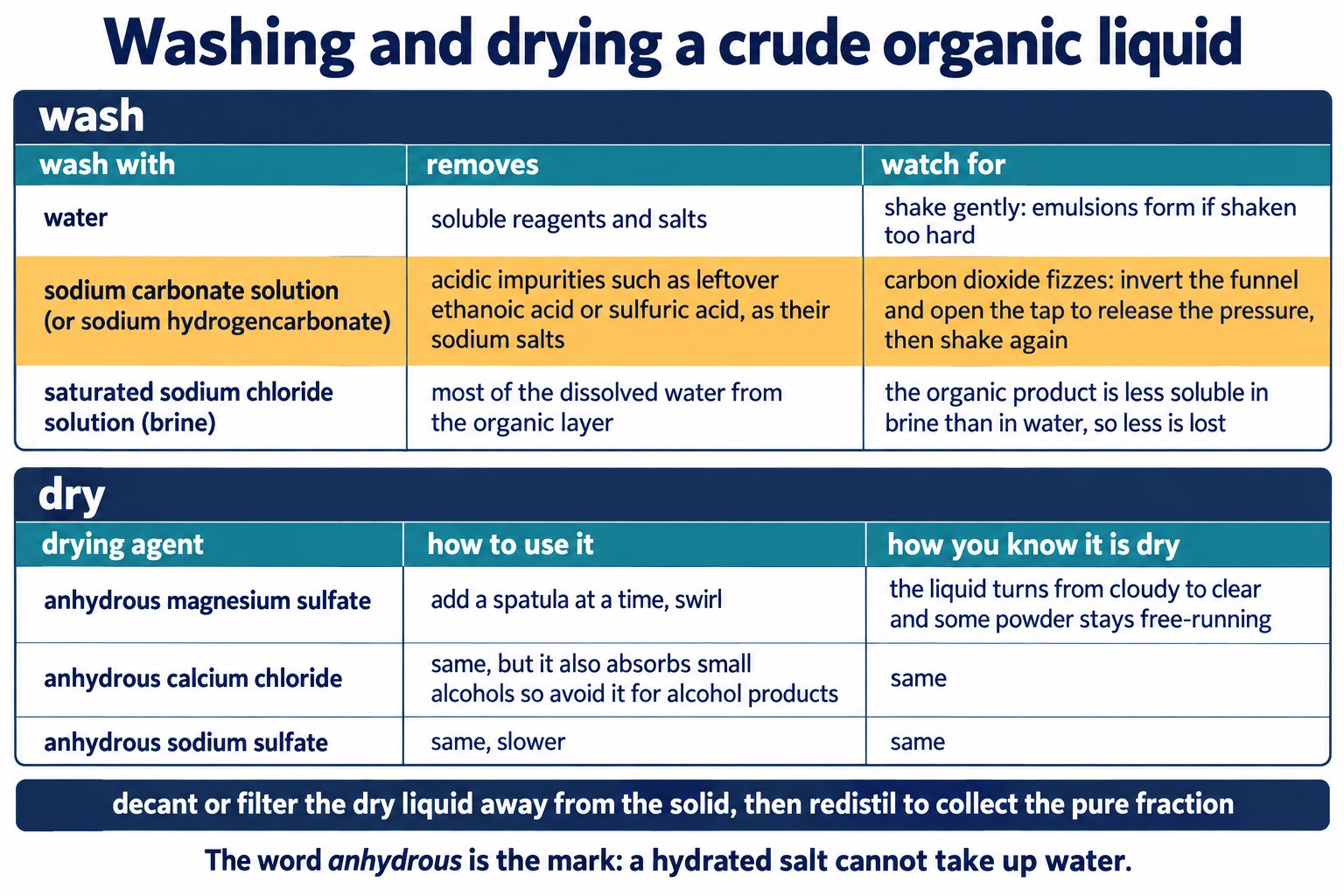
Water, carbonate and brine washes, then the anhydrous drying agents and how to tell the liquid is dry.
Exam wording: “Wash with sodium carbonate solution to remove acidic impurities, releasing the pressure as carbon dioxide forms; dry with anhydrous magnesium sulfate; decant; redistil.”
Quick Check: Washing and Drying Decisions
Make a fast decision for each new situation in a work-up.
Steam Distillation
Steam distillation distils an organic liquid that does not mix with water by passing steam through the mixture. The product comes over with the steam at a temperature below 100 °C.
Why it boils below 100 °C
- The organic liquid and water are immiscible, so each exerts its own vapour pressure.
- The mixture boils when the two vapour pressures add up to atmospheric pressure, which happens below the boiling temperature of either liquid.
- Phenylamine boils at 184 °C, yet it distils with steam at about 98 °C.
When to use it
- A product that decomposes or darkens near its own boiling temperature: phenylamine after the reduction of nitrobenzene with tin and concentrated hydrochloric acid (Preparing Amines).
- Products immiscible with water and volatile in steam, such as the essential oils of plants.
- Separating the product from tarry residues and inorganic salts left in the flask.
Apparatus and work-up
- A steam generator feeds steam into the reaction flask; the vapour passes through a still head and condenser into a receiver.
- The distillate is water with droplets of the organic product in a second layer.
- Separate the layers, or extract the product into ethoxyethane; dry with an anhydrous salt; distil off the solvent.
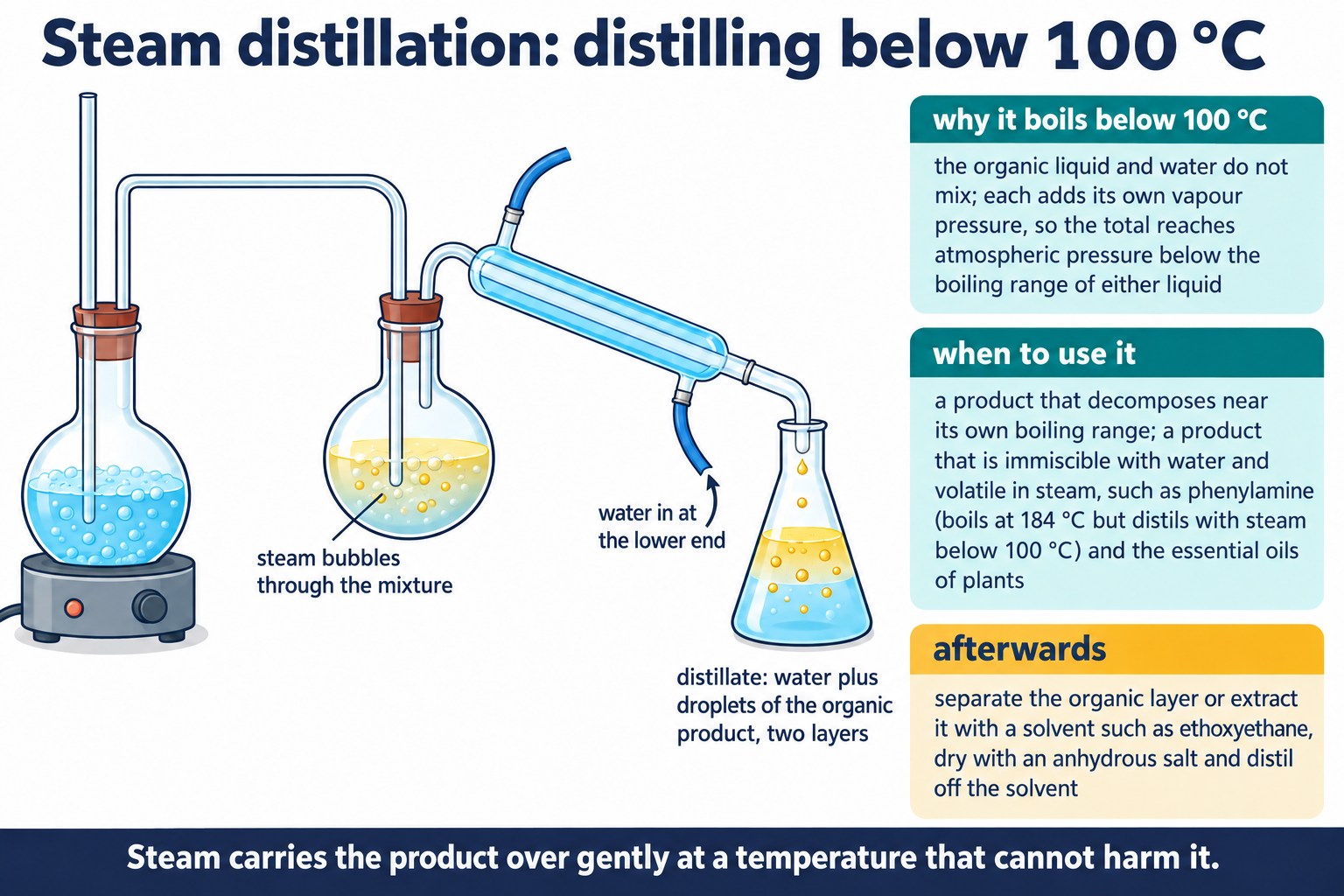
Steam generator, reaction flask, condenser and two-layer distillate, with the vapour pressure reason for boiling below 100 °C.
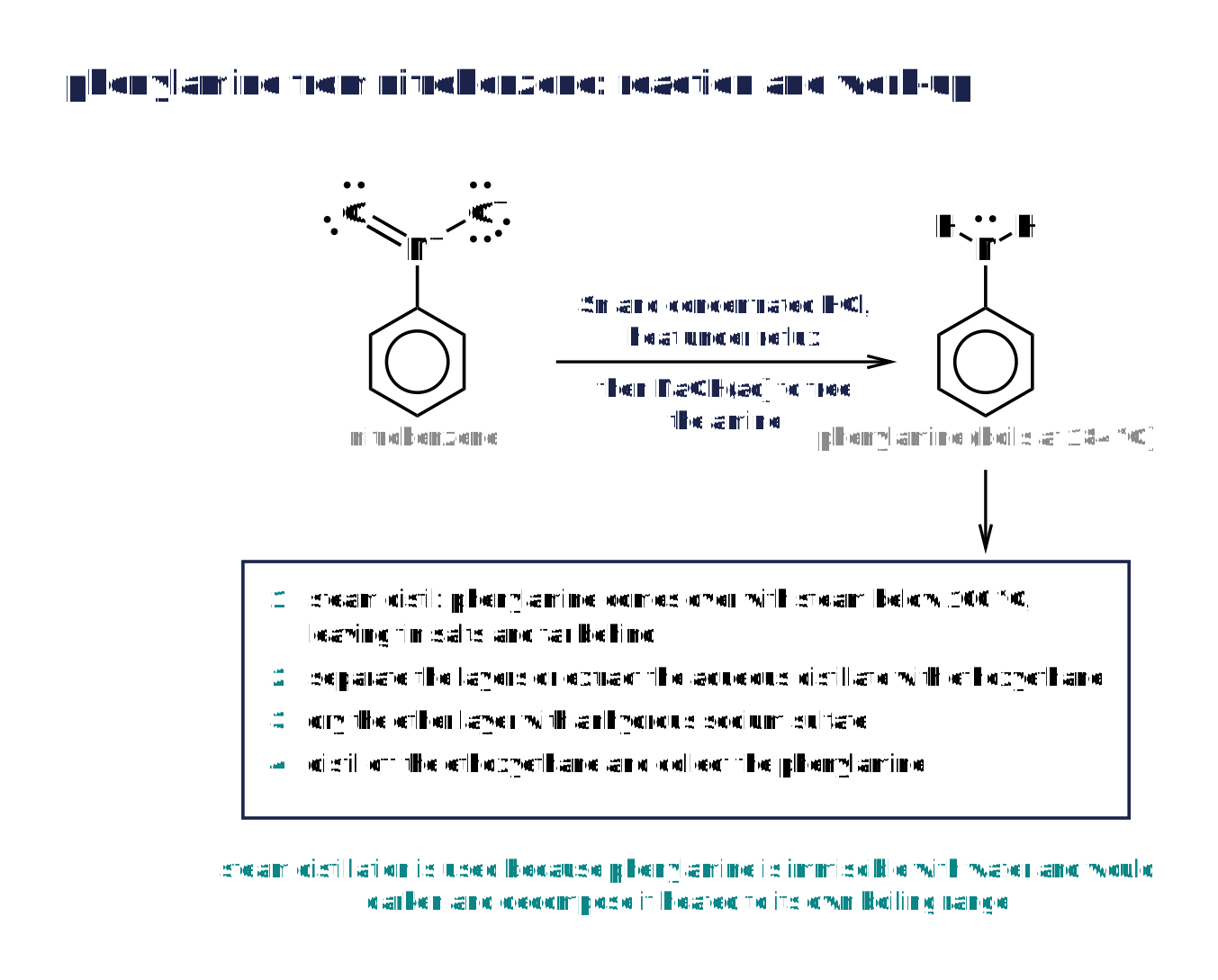
Nitrobenzene to phenylamine with tin and concentrated hydrochloric acid, then the work-up: steam distil, extract, dry, distil.
Exam focus: Two reasons for steam distillation: the product is immiscible with water, and it would decompose if heated to its own boiling temperature. The mixture boils below 100 °C because the vapour pressures add.
Quick Check: Steam Distilling a Plant Oil
Apply the explanation to a new oil, then compare your answer with the model.
Checking Purity: Boiling Temperature, Chromatography and Spectra
A pure liquid distils at a steady, characteristic boiling temperature. Measuring it is the first check on the product; chromatography and spectroscopy confirm it.
Measuring the boiling temperature
- By distillation: redistil the dried product and record the steady temperature; a pure liquid distils within 1 to 2 °C of the data-book value.
- Small-scale: warm a little liquid in a small tube with an inverted capillary in a Thiele tube or beaker of water or oil.
- A stream of bubbles leaves the capillary; as it cools, the temperature at which liquid is drawn back into the capillary is the boiling temperature.
- An impure liquid boils over a range of temperatures rather than at one steady value.
Other checks
| Check | Pure sample | Impure sample |
|---|---|---|
| thin-layer chromatography | one spot, same Rf value as the known compound | two or more spots |
| gas chromatography | one peak at the retention time of the known compound | extra peaks; areas give the proportions |
| infrared spectra (Topic 7 – Modern Analytical Techniques I) and NMR spectra (Topic 19 Modern Analytical Techniques II) | only the peaks expected, for example no broad O–H band in an ester | extra peaks from reagents or solvent |
- A boiling temperature alone is not proof: two liquids can share a value, so combine it with chromatography or a spectrum.
- The parallel checks for a solid, melting temperature and recrystallisation, are on Preparing and Purifying Organic Solids.
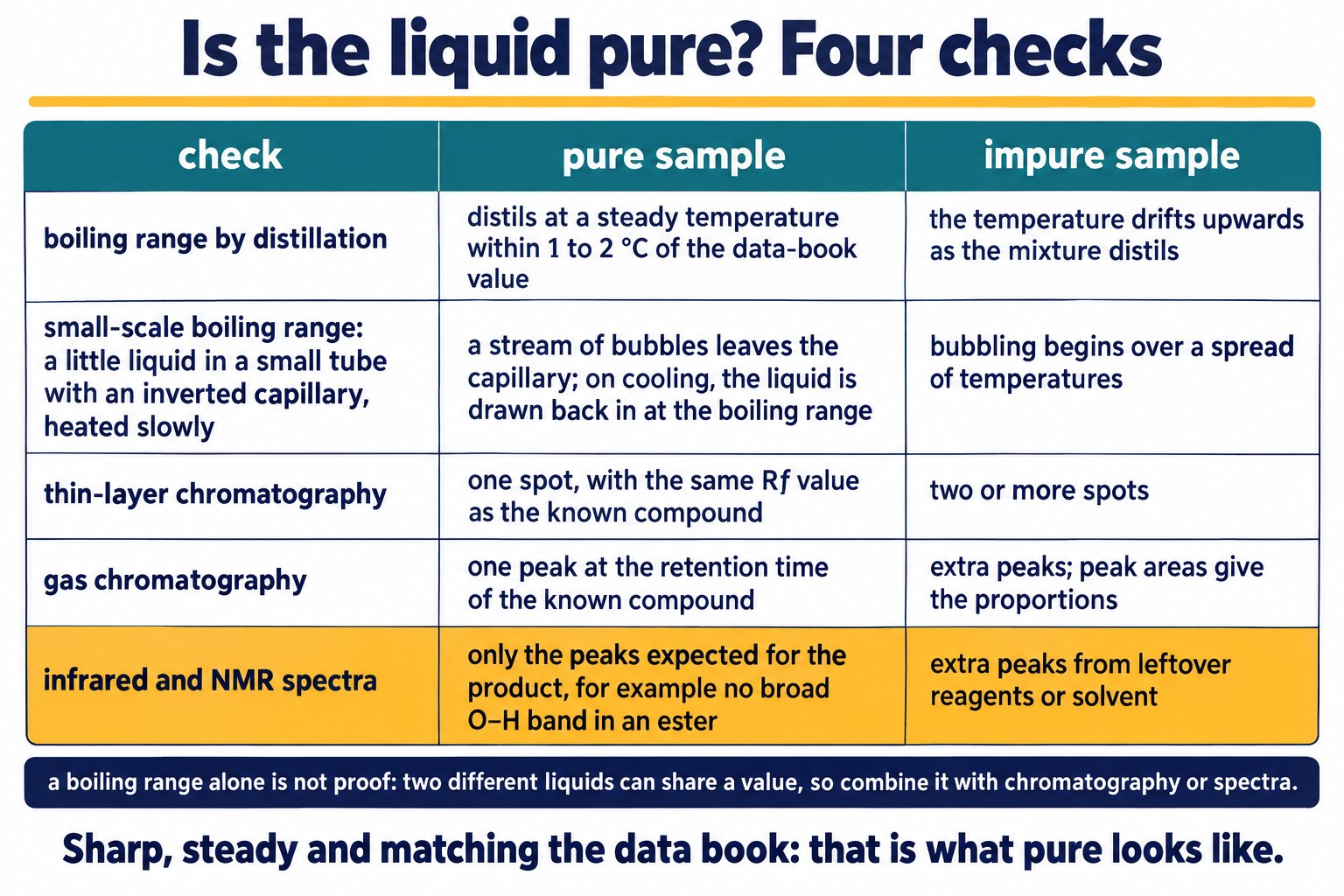
Four checks on a liquid product: boiling range, TLC, GC and spectra, with what pure and impure look like in each.
Exam wording: “Pure: distils at a constant boiling temperature matching the data-book value; one spot on TLC; one peak on GC.” Impure: a range, extra spots, extra peaks.
Check: Washing, Drying and Purity
Choose washes and drying agents, and interpret boiling behaviour, chromatograms and spectra for liquids that are not used above.
Common Exam Points
- Simple distillation for boiling temperatures far apart; fractional distillation with a packed column for close boiling temperatures; thermometer bulb at the side arm.
- Collect the fraction at the boiling temperature of the product; a drifting reading means a mixture is distilling.
- Solvent extraction: product far more soluble in the solvent, solvent immiscible with water and easy to distil off; which layer is which comes from density.
- Separating funnel: shake, release the pressure, stand, remove the stopper, run off the lower layer; repeat with small portions.
- Wash with sodium carbonate solution to remove acids (carbon dioxide released, so vent the funnel), then water or brine.
- Dry with anhydrous magnesium sulfate, calcium chloride or sodium sulfate until the liquid is clear; decant; redistil.
- Steam distillation for products immiscible with water that decompose near their own boiling temperature (phenylamine): the vapour pressures add, so the mixture boils below 100 °C.
- Pure liquid: steady boiling temperature within 1 to 2 °C of the data-book value, one TLC spot, one GC peak, no extra spectral peaks.
FAQs
Use these quick answers to check the thermometer position in distillation, which layer is which in a separating funnel, washing and drying, why steam distillation works below 100 °C.
Where should the thermometer bulb be during a distillation?
Level with the side arm of the still head, where the vapour turns into the condenser. It then reads the boiling temperature of the vapour actually being collected, not the liquid temperature. Collect the fraction that distils within about 2 °C of the expected value.
How do I know which layer is which in a separating funnel?
Compare densities: ethoxyethane (0.71 g cm⁻³) floats on the aqueous layer, while a dense liquid such as a chloroalkane sinks. If unsure, add a few drops of water and watch which layer grows. Run off the lower layer through the tap.
Why is the organic layer washed with sodium carbonate solution, and why does it fizz?
The carbonate neutralises acidic impurities such as leftover acid catalyst or carboxylic acid, converting them to salts that dissolve in the aqueous layer.
The fizzing is carbon dioxide, so swirl gently first with the stopper off, then stopper it, invert and open the tap often to release the pressure.
How do I know I have added enough drying agent?
Add anhydrous magnesium sulfate, calcium chloride or sodium sulfate a little at a time, swirling. While water remains the solid clumps together; when fresh solid stays powdery and the liquid turns from cloudy to clear, enough has been added. Decant or filter, then redistil.
Why does steam distillation work below 100 °C?
Phenylamine and water are immiscible, so each exerts its own vapour pressure and the two add together. The mixture boils when the total reaches atmospheric pressure, at about 98 °C, far below the boiling temperature of phenylamine (184 °C), so heat-sensitive compounds distil without decomposing.

Copyright notice: This OLS revision content, including the explanations, layout, diagrams, tables and embedded learning structure, is authored for Online Learning System by Dr. Mohammed Al-Fatah. It may not be copied, reproduced, redistributed or adapted without written permission.
Keep this note — free
Save your progress across every Edexcel topic. A free account remembers which topics you have covered, saves your question scores, and syncs across your phone and laptop.
- Track every topic you have finished
- Keep your practice-question scores
- No payment, no card, free forever
Already registered? Log in