Identifying Functional Groups by Chemical Tests
A concise revision guide to the characteristic reactions used to identify functional groups: the test-tube tests for alkenes, halogenoalkanes, alcohols, aldehydes and ketones, carboxylic acids, phenols, amines and esters, how to use them on a molecule with several groups, and how to predict the properties and reactions of an unfamiliar compound.
Before You Start
Every test on this page was met when its functional group was first taught. This page gathers them so that an unknown can be worked through.
- A positive test is an observation: a colour change, a precipitate, a gas or a smell. Always record what is seen, not what it means.
- The reagent and the conditions earn marks too: “warm with Tollens’ reagent” rather than “Tollens'”.
- Spectra and formulae: Deducing Formulae from Analytical Data. The test-tube work itself: Identifying Unknown Compounds and CP 15 Analysis of Inorganic and Organic Unknowns.
- A molecule with several groups shows every test that each group would show alone, which is how routes are checked in Planning a Synthetic Route.
GCSE Recap: Simple Chemical Tests
Three quick questions on the GCSE tests this page builds on.
The Test Table
Learn each row as reagent, conditions, observation and conclusion. The observation is the mark that students most often leave out.
| Group | Reagent and conditions | Positive observation | What it shows |
|---|---|---|---|
| alkene, C=C | bromine water, shake at room temperature | orange to colourless | electrophilic addition across the double bond |
| halogenoalkane, C–X | warm with NaOH(aq), acidify with dilute HNO₃, add AgNO₃(aq) | white precipitate (Cl), cream (Br), yellow (I); the white one dissolves in dilute NH₃(aq), the cream in concentrated, the yellow not at all | a halide ion released by hydrolysis is precipitated as the silver halide |
| alcohol, O–H | PCl₅ at room temperature | misty fumes of HCl | an O–H group (water and carboxylic acids react too) |
| primary or secondary alcohol | warm with acidified potassium dichromate(VI) | orange to green | oxidation to an aldehyde, ketone or acid; a tertiary alcohol stays orange |
| aldehyde, CHO | warm with Tollens’ reagent (ammoniacal silver nitrate); or warm with Fehling’s solution | silver mirror; brick-red precipitate | an aldehyde is oxidised; a ketone gives no change |
| aldehyde or ketone, C=O | 2,4-dinitrophenylhydrazine (2,4-DNPH) solution | orange precipitate | a carbonyl group; the melting temperature of the purified derivative identifies the compound |
| carboxylic acid, COOH | sodium carbonate or sodium hydrogencarbonate solution; universal indicator | fizzing, the gas turns limewater milky; indicator red | an acid strong enough to release CO₂ from a carbonate |
| phenol | bromine water | decolourised and a white precipitate forms | an activated ring; weakly acidic, so no fizz with carbonate |
| amine, NH₂ | smell; damp red litmus; a drop of concentrated HCl held nearby; copper(II) sulfate solution | fishy smell; litmus turns blue; white smoke of the ammonium salt; pale blue precipitate then a deep blue solution in excess amine | a basic nitrogen lone pair |
| ester, COOR | smell; warm with NaOH(aq) then acidify | sweet fruity smell; the smell goes and a carboxylic acid forms | hydrolysis of the ester link |
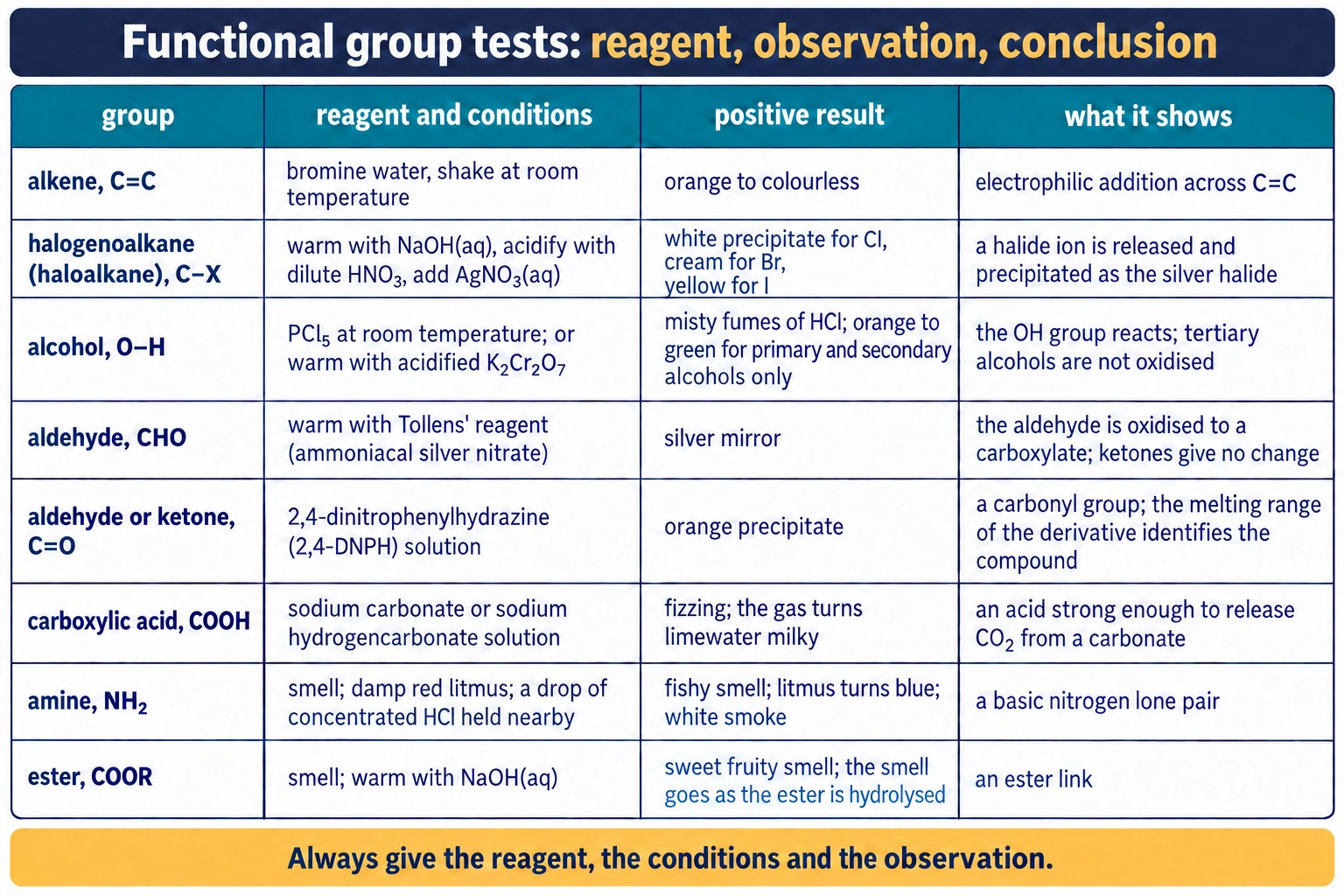
The whole table as a poster: reagent, conditions, observation and conclusion for every group.
Exam focus: For the halogenoalkane test, say why each step is there: NaOH hydrolyses the C–X bond, nitric acid destroys the excess hydroxide (which would give Ag₂O), silver nitrate precipitates the halide.
Quick Check: Reading the Test Results
Pick the one accurate statement in each set, for compounds that are new to this page.
The Oxygen Groups in Detail
Most unknowns contain oxygen, so the alcohol, carbonyl and acid tests carry the most marks. Three distinctions matter.
- Aldehyde or ketone? Both give the orange 2,4-DNPH precipitate; only an aldehyde gives the silver mirror or the brick-red copper(I) oxide.
- Which alcohol? Primary and secondary alcohols turn acidified dichromate(VI) green; a tertiary alcohol does not. Distilling the product and testing it (aldehyde or ketone) separates primary from secondary.
- Acid or phenol? Both are acidic to indicator, but only a carboxylic acid fizzes with sodium carbonate. Only a phenol gives a white precipitate with bromine water.
- Methyl ketone or ethanol? Warm with iodine and sodium hydroxide: a pale yellow precipitate of triiodomethane (the iodoform test). Details in Topic 17 – Organic Chemistry II.
- The orange 2,4-DNPH derivative can be filtered, recrystallised and its melting temperature compared with data-book values to name the carbonyl compound: Reduction and Nucleophilic Addition.
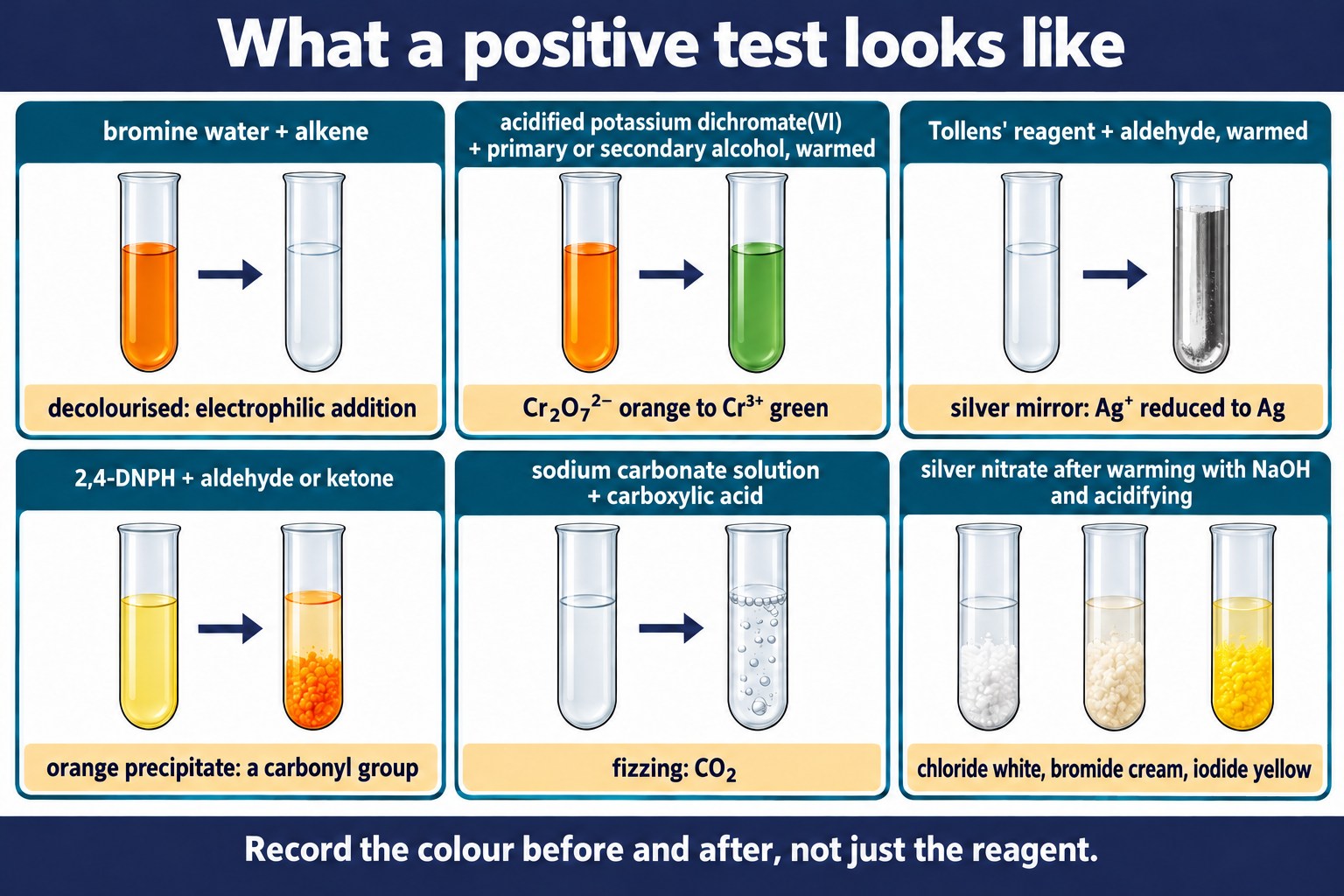
The colour changes side by side: orange to colourless, orange to green, silver mirror, orange precipitate, fizzing and the three silver halide colours.
Common mistake: Writing “colourless” for bromine water with a phenol. With a phenol the orange goes and a white precipitate forms: both observations are needed.
Check: Tests and Observations
Match each reagent to its positive observation and conclusion, choose the test that separates two compounds, and explain the steps of the halide test.
An Unknown Compound: Which Test First?
Choose tests in an order that rules out the most each time. Start with cheap, quick tests and finish with the ones that confirm.
- Shake a little with water and add universal indicator. Orange to red means a carboxylic acid, yellow to orange a phenol, which is much weaker; blue means an amine (fishy smell).
- Add sodium carbonate solution to an acidic unknown: fizzing means a carboxylic acid; no fizz means a phenol.
- Shake with bromine water: orange to colourless means an alkene; a white precipitate means a phenol.
- Add 2,4-DNPH: an orange precipitate means a carbonyl group. Then warm with Tollens’ reagent to separate aldehyde (silver mirror) from ketone.
- Warm with acidified dichromate(VI): orange to green means a primary or secondary alcohol (an aldehyde also reacts).
- Warm with NaOH(aq), acidify with HNO₃ and add AgNO₃(aq): a precipitate means a halogenoalkane; its colour gives the halogen.
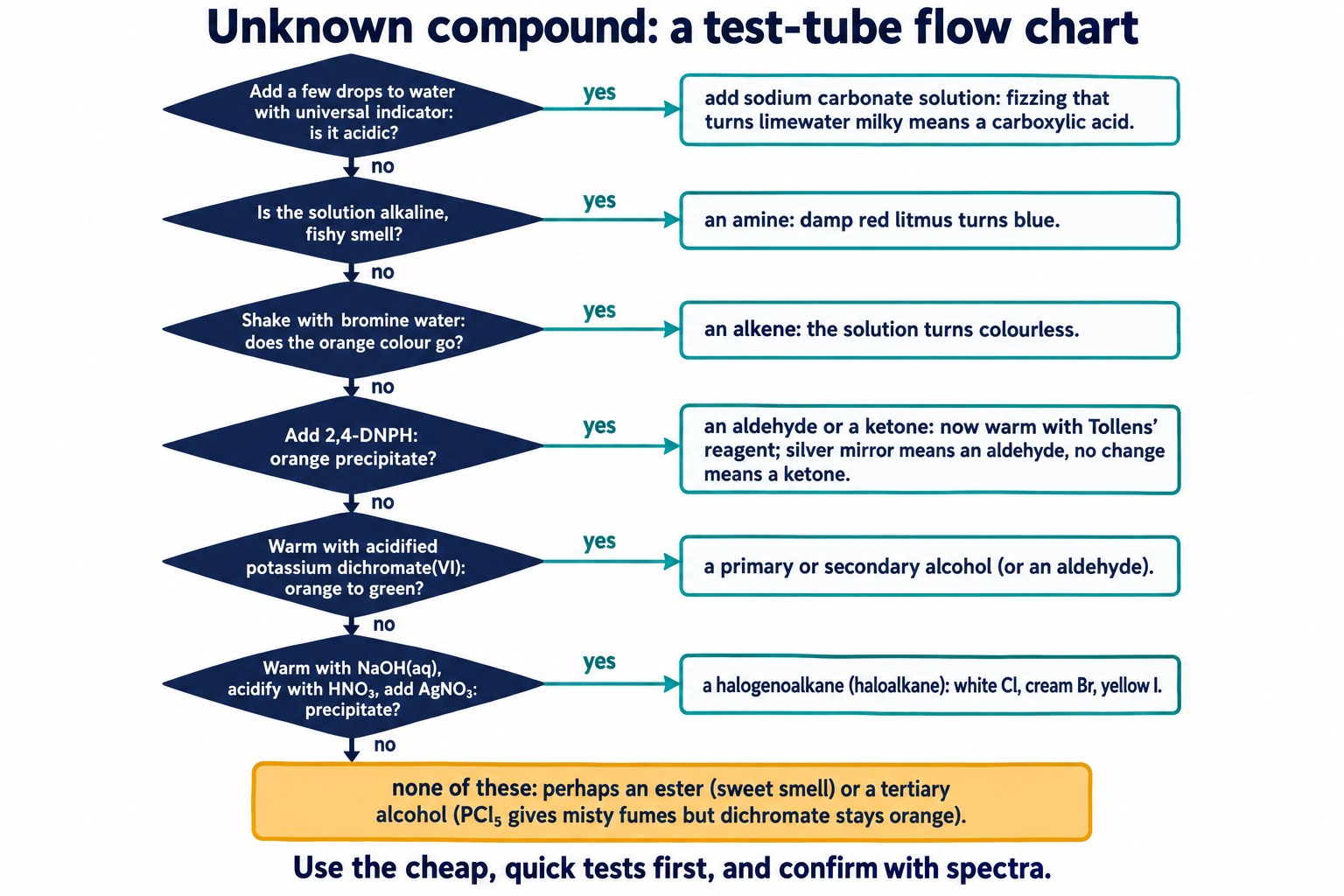
The flow chart as yes / no decisions, from indicator and carbonate down to the silver nitrate test (add the phenol branches from the list above).
Remember: A negative result is evidence too. “No precipitate with 2,4-DNPH, so no carbonyl group” removes aldehydes, ketones and their isomers in one line.
Quick Check: Deducing an Unknown
Work out what each set of results shows, then flip the card to check.
A Molecule with Several Functional Groups
Each group on a molecule reacts as it would on its own. List the groups, then predict the test result for each in turn.
Worked example: 3-hydroxybutanal, CH₃CH(OH)CH₂CHO
Step 1. Identify the groups: an aldehyde, CHO, at carbon 1 and a secondary alcohol, OH, at carbon 3.
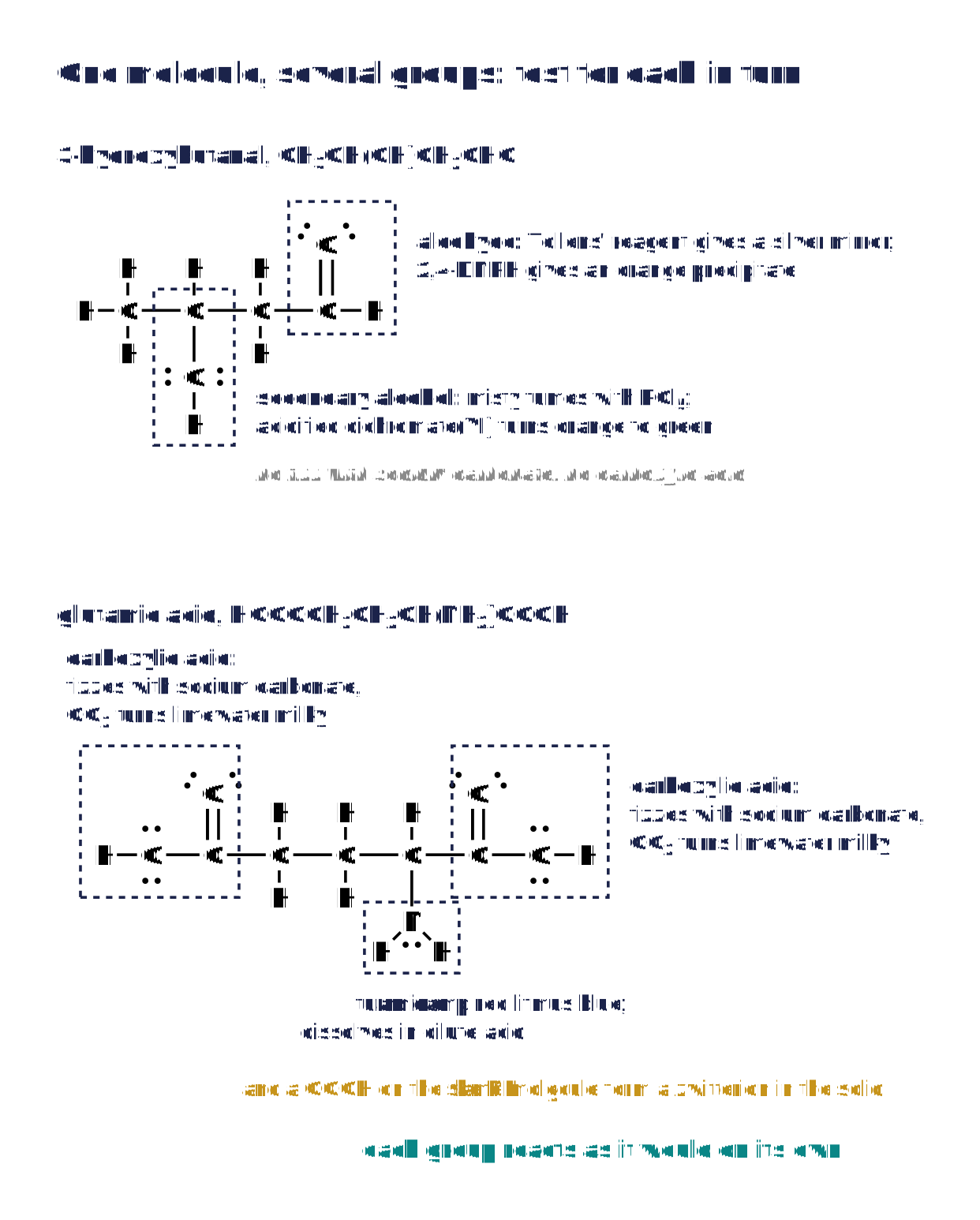
3-Hydroxybutanal (aldehyde, secondary alcohol) and glutamic acid (amine, two acids), each group boxed with the test that detects it.
- A phenol with an aldehyde, such as 4-hydroxybenzaldehyde, adds the phenol results: bromine water gives a white precipitate, and sodium carbonate does not fizz.
- Glutamic acid fizzes with sodium carbonate (two COOH groups) and dissolves in dilute acid (the NH₂ group is protonated).
- Two groups can interact: an amine and a carboxylic acid on the same molecule form a zwitterion, so amino acids are high-melting solids soluble in water.
Exam focus: Say which group is responsible for each observation: “the silver mirror shows the aldehyde group; the misty fumes with PCl₅ show the hydroxyl group”.
Predicting the Properties of an Unfamiliar Compound
An unfamiliar molecule is a set of familiar groups. Its physical properties follow from the groups, and so do its reactions.
| Group present | Intermolecular forces | Effect on boiling temperature and solubility |
|---|---|---|
| O–H (alcohol, phenol, acid) or N–H (amine, amide) | hydrogen bonding with itself and with water | high boiling temperature; small molecules dissolve in water |
| C=O (aldehyde, ketone, ester) or C–X | permanent dipole-dipole and London forces | moderate boiling temperature; C=O compounds hydrogen bond to water but not to themselves; halogenoalkanes do not hydrogen bond to water |
| hydrocarbon chain or ring only | London forces | boiling temperature rises with chain length; insoluble in water, soluble in non-polar solvents |
| COOH and NH₂ on the same molecule | ionic zwitterion in the solid | crystalline solid, soluble in water, dissolves in acid and in alkali |
Worked example: 2-hydroxypropanoic acid, CH₃CH(OH)COOH
- Each group reacts in the way learnt for that group, with the same reagents and conditions.
- Order of acidity: carboxylic acid > phenol > alcohol. Only the acid reacts with carbonates; the acid and phenol react with NaOH; all three react with sodium.
- An amine group makes the compound basic: it dissolves in dilute acid as a salt (Preparing Amines).
- A C=C bond will add bromine whatever else is on the molecule; a benzene ring will not unless a phenol or amine activates it.
Remember: Work group by group: name each group, predict its forces, predict its tests, predict its reactions. Then look for interactions such as the zwitterion.
Check: Several Groups and Unfamiliar Compounds
Predict which tests a molecule with two or three groups will give, explain the observations group by group, and predict solubility and reactivity from the groups present.
Common Exam Points
- Give reagent, conditions and observation together: “warm with Tollens’ reagent; a silver mirror forms”.
- Bromine water: alkene gives orange to colourless; phenol gives colourless plus a white precipitate.
- Halogenoalkane: warm with NaOH(aq), acidify with HNO₃, add AgNO₃(aq): white, cream or yellow precipitate for Cl, Br or I.
- Acidified dichromate(VI) turns green with primary and secondary alcohols and with aldehydes, never with tertiary alcohols or ketones.
- 2,4-DNPH shows any carbonyl group; Tollens’ reagent or Fehling’s solution then picks out the aldehyde.
- Carboxylic acids fizz with sodium carbonate; phenols are acidic to indicator but do not fizz.
- Iodine in sodium hydroxide gives a pale yellow precipitate with a methyl ketone (or ethanol): the iodoform test.
- On a molecule with several groups, each group gives its own test result; explain every observation by naming the group responsible.
- Predict properties from the groups: O–H and N–H mean hydrogen bonding, a high boiling temperature and water solubility; an acid plus an amine means a zwitterion.
FAQs
Use these quick answers to check the test-tube tests for alkenes, halogenoalkanes, alcohols, aldehydes, ketones, carboxylic acids and phenols, and how to apply them to a molecule with more than one functional group.
How do I tell an aldehyde from a ketone?
Both give an orange precipitate with 2,4-dinitrophenylhydrazine, so that only shows a carbonyl group. Warm with Tollens’ reagent: an aldehyde gives a silver mirror and a ketone does not. Fehling’s solution turns from blue to a brick-red precipitate with an aldehyde only.
How do I test for a halogenoalkane and identify the halogen?
Warm the halogenoalkane with aqueous sodium hydroxide to release the halide ion, acidify with dilute nitric acid, then add silver nitrate solution. A white precipitate means chloride, cream means bromide and yellow means iodide; only the white one dissolves in dilute ammonia solution.
How do I tell a carboxylic acid from a phenol when both are acidic?
Add sodium carbonate or sodium hydrogencarbonate solution: a carboxylic acid fizzes as carbon dioxide is released, while a phenol is too weak an acid to react. Phenol instead gives a white precipitate with bromine water at room temperature.
How can I tell a primary, a secondary and a tertiary alcohol apart?
Warm each with acidified potassium dichromate(VI). Primary and secondary alcohols turn it orange to green; a tertiary alcohol leaves it orange because it cannot be oxidised. Then test the product: the aldehyde from a primary alcohol gives a silver mirror with Tollens’ reagent.
What do I do when a molecule has more than one functional group?
Treat each group as if it were alone, so every test for a group present is positive. Vanillin, 4-hydroxy-3-methoxybenzaldehyde, gives a silver mirror (aldehyde) and a white precipitate with bromine water (phenol), but no fizzing with carbonate because there is no COOH group.

Copyright notice: This OLS revision content, including the explanations, layout, diagrams, tables and embedded learning structure, is authored for Online Learning System by Dr. Mohammed Al-Fatah. It may not be copied, reproduced, redistributed or adapted without written permission.
Keep this note — free
Save your progress across every Edexcel topic. A free account remembers which topics you have covered, saves your question scores, and syncs across your phone and laptop.
- Track every topic you have finished
- Keep your practice-question scores
- No payment, no card, free forever
Already registered? Log in