Electrochemical Cells and Cell Potentials
A concise revision guide to electrochemical cells: the three types of half-cell, the salt bridge and the high-resistance voltmeter, and calculating the standard cell potential from two standard electrode potentials.
- 5.2.3(g)(i)
- 5.2.3(g)(ii)
- 5.2.3(h)
What these spec points say
- 5.2.3(g)(i) the techniques and procedures used for the measurement of cell potentials of metals or non-metals in contact with their ions in aqueous solution
- 5.2.3(g)(ii) the techniques and procedures used for the measurement of cell potentials of ions of the same element in different oxidation states in contact with a Pt electrode
- 5.2.3(h) calculation of a standard cell potential by combining two standard electrode potentials
The zinc–copper cell
A zinc half-cell and a copper half-cell joined by a wire and a salt bridge. Follow the electrons and the ions at each electrode, in the wire and in the salt bridge.
© Dr. Mohammed Al-Fatah – onlinelearningsystem.net
Before You Start
This page follows Standard Electrode Potentials and the Hydrogen Electrode: every half-cell has a standard electrode (redox) potential, E⦵, measured against the standard hydrogen electrode.
- Half-equations in data tables are written as reductions: oxidised form + electrons ⇌ reduced form.
- A more negative E⦵ means the half-cell releases electrons more readily.
- Standard conditions are 298 K, 100 kPa for gases and 1.00 mol dm⁻³ for ions.
- From GCSE: a simple cell is made from two different metals in an electrolyte, and it produces a voltage.
GCSE Recap: Simple Cells and the Reactivity Series
Three quick questions on the GCSE ideas this page builds on.
Three Types of Half-Cell
An electrochemical cell is made by joining two half-cells. Each half-cell contains an element in two oxidation numbers, in equilibrium.
| Type | Electrode | Example | Half-equation |
|---|---|---|---|
| metal and its ions | the metal itself | zinc in Zn²⁺(aq) | Zn²⁺(aq) + 2e⁻ ⇌ Zn(s) |
| gas and its ions | platinum | Cl₂(g) bubbling into Cl⁻(aq) | Cl₂(g) + 2e⁻ ⇌ 2Cl⁻(aq) |
| two ions of one element in different oxidation numbers | platinum | Fe³⁺(aq) and Fe²⁺(aq) | Fe³⁺(aq) + e⁻ ⇌ Fe²⁺(aq) |
- A platinum electrode is used when neither form is a solid metal. It is inert and carries electrons in and out.
- The standard hydrogen electrode is a gas half-cell: H₂(g) and H⁺(aq) with platinum.
- In an ion half-cell under standard conditions, both ions have a concentration of 1.00 mol dm⁻³ in the same solution.
- The MnO₄⁻/Mn²⁺ half-cell also contains H⁺(aq) at 1.00 mol dm⁻³, because H⁺ appears in its half-equation.
- Count the ions in each formula: 0.50 mol dm⁻³ Fe₂(SO₄)₃ supplies 1.00 mol dm⁻³ of Fe³⁺ ions.
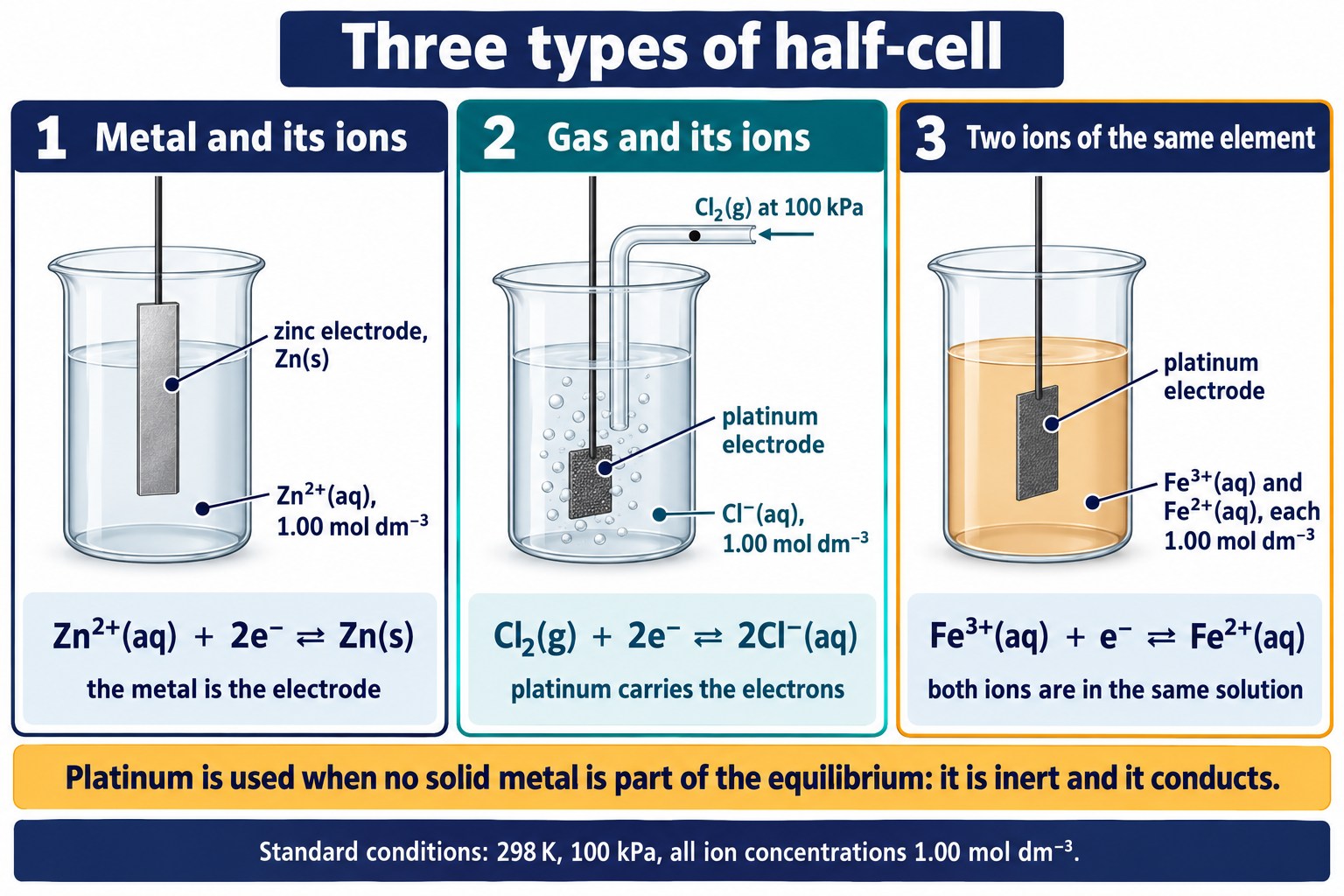
The three types of half-cell: a metal in its ions, a gas bubbling over platinum, and platinum in a solution of two ions of the same element.
Remember: Every species in the half-equation must be present. For MnO₄⁻(aq) + 8H⁺(aq) + 5e⁻ ⇌ Mn²⁺(aq) + 4H₂O(l), the solution holds MnO₄⁻, H⁺ and Mn²⁺ ions with a platinum electrode.
Building a Cell: Salt Bridge and Voltmeter
Two half-cells become a cell when they are joined in two places: the electrodes by a wire, and the solutions by a salt bridge.
The salt bridge
- A salt bridge is often a strip of filter paper soaked in saturated potassium nitrate solution, KNO₃(aq).
- It completes the circuit: ions move through it, while electrons move through the wire.
- The moving ions balance the charges that would otherwise build up in the two solutions.
- Its ions must not react with either solution. Potassium chloride is avoided with Ag⁺(aq), because silver chloride would precipitate.
- A metal wire cannot replace the salt bridge: the wire would set up a new half-cell of its own with each solution.
The high-resistance voltmeter
- The electrodes are joined through a high-resistance voltmeter.
- Its high resistance allows almost no current to flow.
- With no current, the concentrations do not change and the reading is the full potential difference: the standard cell potential of the cell.
- If a lamp replaces the voltmeter, a current flows, the reactants are used up and the voltage gradually falls towards zero.
Remember: Electrons travel through the wire only. Ions travel through the solutions and the salt bridge only. Without a salt bridge the reading is zero.
Check: Half-Cells, Salt Bridge and Voltmeter
Choose the right electrode and solution for a half-cell and explain the job of each part of a cell.
Which Electrode Is Negative?
Compare the two E⦵ values. The half-cell with the more negative E⦵ releases electrons more readily.
| More negative E⦵ | More positive E⦵ | |
|---|---|---|
| Electrode | negative | positive |
| Change | oxidation | reduction |
| Half-equation runs | backwards (right to left) | forwards (left to right) |
| Electrons | leave it through the wire | arrive through the wire |
- Electrons flow in the external circuit from the negative electrode to the positive electrode.
- In the zinc–copper cell, zinc (−0.76 V) is negative and copper (+0.34 V) is positive.
- Electrons flow from zinc to copper. Zinc atoms are oxidised and Cu²⁺ ions are reduced.
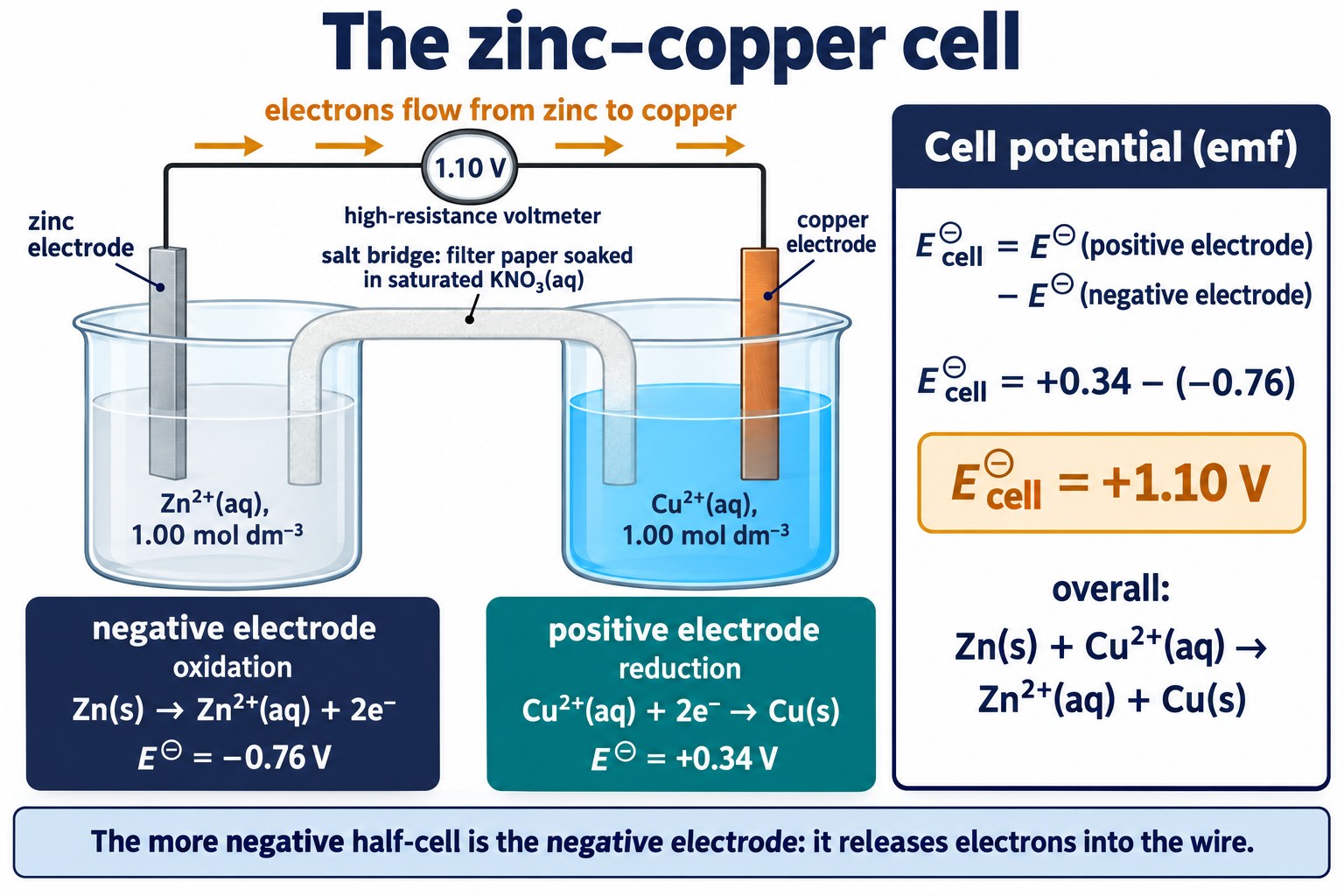
The zinc–copper cell: the negative and positive electrodes, the direction of electron flow and the calculation of the standard cell potential.
Remember: More negative E⦵: negative electrode, oxidation, electrons leave. More positive E⦵: positive electrode, reduction, electrons arrive.
Calculating the Standard cell potential
The standard cell potential, E⦵cell, is the potential difference between the two half-cells under standard conditions, measured when no current flows.
E⦵cell = E⦵(positive electrode) − E⦵(negative electrode)
- The positive electrode is where reduction happens; the negative electrode is where oxidation happens.
- Some texts write this as E⦵cell = E⦵(reduction) − E⦵(oxidation).
- Use the E⦵ values exactly as they appear in the data table. Do not change a sign before subtracting.
- Do not multiply an E⦵ value when a half-equation is multiplied. A potential does not depend on the amount.
Worked example 1: the zinc–copper cell
Data: Zn²⁺(aq) + 2e⁻ ⇌ Zn(s), E⦵ = −0.76 V. Cu²⁺(aq) + 2e⁻ ⇌ Cu(s), E⦵ = +0.34 V.
Step 2. E⦵cell = +0.34 − (−0.76) = +1.10 V.
Worked example 2: zinc with an iron(III)/iron(II) half-cell
Data: Zn²⁺(aq) + 2e⁻ ⇌ Zn(s), E⦵ = −0.76 V. Fe³⁺(aq) + e⁻ ⇌ Fe²⁺(aq), E⦵ = +0.77 V.
Step 2. E⦵cell = +0.77 − (−0.76) = +1.53 V.
Exam focus: Show the subtraction with both signs, as in +0.34 − (−0.76), and give the answer with a sign and the unit V. A working cell always has a positive standard cell potential.
Check: Electrodes, Electron Flow and the Standard cell potential
Decide which electrode is negative, the direction of electron flow and the standard cell potential for pairs of half-cells not used on this page.
Measuring E⦵ and Cell Potentials in the Laboratory
To measure the E⦵ of a half-cell, connect it to a standard hydrogen electrode. The reading of the voltmeter is the E⦵ of that half-cell.
- With the copper half-cell, copper is the positive electrode and the reading is 0.34 V, so E⦵ = +0.34 V.
- With the zinc half-cell, zinc is the negative electrode and the reading is 0.76 V, so E⦵ = −0.76 V.
- The hydrogen electrode contributes 0.00 V, so the whole reading belongs to the other half-cell.
Making a cell from two metal half-cells
- Clean each metal strip with emery paper to remove the oxide layer, then rinse and dry it.
- Place each strip in a beaker of a 1.00 mol dm⁻³ solution of its own ions.
- Join the two solutions with a fresh salt bridge of filter paper soaked in saturated KNO₃(aq).
- Connect the strips to a high-resistance voltmeter with leads and crocodile clips.
- Record the reading, and note which strip is joined to the negative terminal.
- Wiping each strip with propanone removes any grease, which improves the electrical contact with the solution.
The practical details and sources of error are covered in Practical Activity Groups.
Common Exam Points
Say
- “The salt bridge completes the circuit by allowing ions to move between the solutions.”
- “The half-cell with the more negative E⦵ is the negative electrode, where oxidation happens.”
- “Electrons flow through the external circuit from the zinc electrode to the copper electrode.”
Do not say
- “Electrons flow through the salt bridge” (only ions move through it).
- “The salt bridge balances the electrons” (it balances the charge by movement of ions).
- “Double the E⦵ because the half-equation was doubled.”
Watch for
- Sign errors when subtracting a negative value: +0.34 − (−0.76) is +1.10, not −0.42.
- Half-cells with no metal: they need a platinum electrode.
- Two positive E⦵ values: the less positive one is still the negative electrode.
- Overall equations that still contain electrons.
Check: Working with Electrochemical Cells
Bring the ideas together: overall cell reactions, the standard cell potential and how a cell is set up and measured, with cells not used on this page.
FAQs
Use these quick answers to check half-cells, the salt bridge and the standard cell potential.
What does the salt bridge do?
It completes the circuit by letting ions move between the two solutions, which keeps each solution electrically neutral. It is usually filter paper soaked in saturated KNO₃, chosen because its ions do not react with either solution.
Why must the voltmeter have a high resistance?
It lets almost no current flow, so the concentrations of the ions do not change and the full potential difference between the two half-cells is measured. If a current flowed, the reading would be lower than the standard cell potential.
How do I calculate the standard cell potential?
Subtract the more negative E⦵ from the more positive one. For zinc and copper, E⦵cell = +0.34 − (−0.76) = +1.10 V. Never multiply an E⦵ value, even when a half-equation is multiplied to balance the electrons.
Which electrode is the negative one?
The half-cell with the more negative E⦵. Its equilibrium releases electrons, so oxidation happens there. Electrons flow from it through the wire to the more positive half-cell, where reduction happens. In the zinc-copper cell, zinc is negative.
Why does the Fe³⁺/Fe²⁺ half-cell need a platinum electrode?
Both species are aqueous ions, so there is no solid metal to carry electrons into or out of the solution. Platinum is inert and conducts, so it provides a surface for electron transfer. Both ions are at 1.00 mol dm⁻³.

Copyright notice: This OLS revision content, including the explanations, layout, diagrams, tables and embedded learning structure, is authored for Online Learning System by Dr. Mohammed Al-Fatah. It may not be copied, reproduced, redistributed or adapted without written permission.
Keep this note — free
Save your progress across every OCR topic. A free account remembers which topics you have covered, saves your question scores, and syncs across your phone and laptop.
- Track every topic you have finished
- Keep your practice-question scores
- No payment, no card, free forever
Already registered? Log in