Standard Electrode Potentials and the Hydrogen Electrode
A concise revision guide to the standard electrode (redox) potential, E⦵: how an electrode potential arises, the standard conditions, the standard hydrogen electrode and why a reference electrode is needed.
- 5.2.3(f)-i
- 5.2.3(f)-ii
What these spec points say
- 5.2.3(f)-i use of the term standard electrode (redox) potential, E⦵
- 5.2.3(f)-ii the measurement of standard electrode (redox) potential using a hydrogen electrode
The standard hydrogen electrode
The reference half-cell that every standard electrode potential is measured against, set at 0.00 V by definition.
© Dr. Mohammed Al-Fatah – onlinelearningsystem.net
Before You Start
This page builds on Redox, Oxidation Numbers and Half-Equations: oxidation is the loss of electrons and reduction is the gain of electrons.
- A half-equation shows one half of a redox reaction, with the electrons written in.
- A reducing agent donates electrons; an oxidising agent accepts them.
- A reversible change reaches a dynamic equilibrium, and its position shifts when the conditions change.
- More reactive metals lose electrons more readily.
GCSE Recap: Reactivity, Cells and Electron Transfer
Three quick questions on the GCSE ideas this page builds on.
How an Electrode Potential Arises
Dip a strip of metal into a solution of its own ions. Two opposite changes begin at the surface of the metal.
- Metal atoms leave the surface as ions, and their electrons stay behind on the metal.
- Metal ions from the solution take electrons from the metal and are deposited as atoms.
- The two rates soon become equal: a dynamic equilibrium is set up.
Mⁿ⁺(aq) + ne⁻ ⇌ M(s)
At equilibrium the metal carries a small charge compared with the solution. This difference is the electrode potential of the metal.
| Zinc in Zn²⁺(aq) | Copper in Cu²⁺(aq) | |
|---|---|---|
| Equilibrium | Zn²⁺(aq) + 2e⁻ ⇌ Zn(s) | Cu²⁺(aq) + 2e⁻ ⇌ Cu(s) |
| Reactivity of the metal | more reactive | less reactive |
| Position of equilibrium | further to the left | further to the right |
| Electrons left on the metal | more | fewer |
| Electrode potential | more negative | more positive |
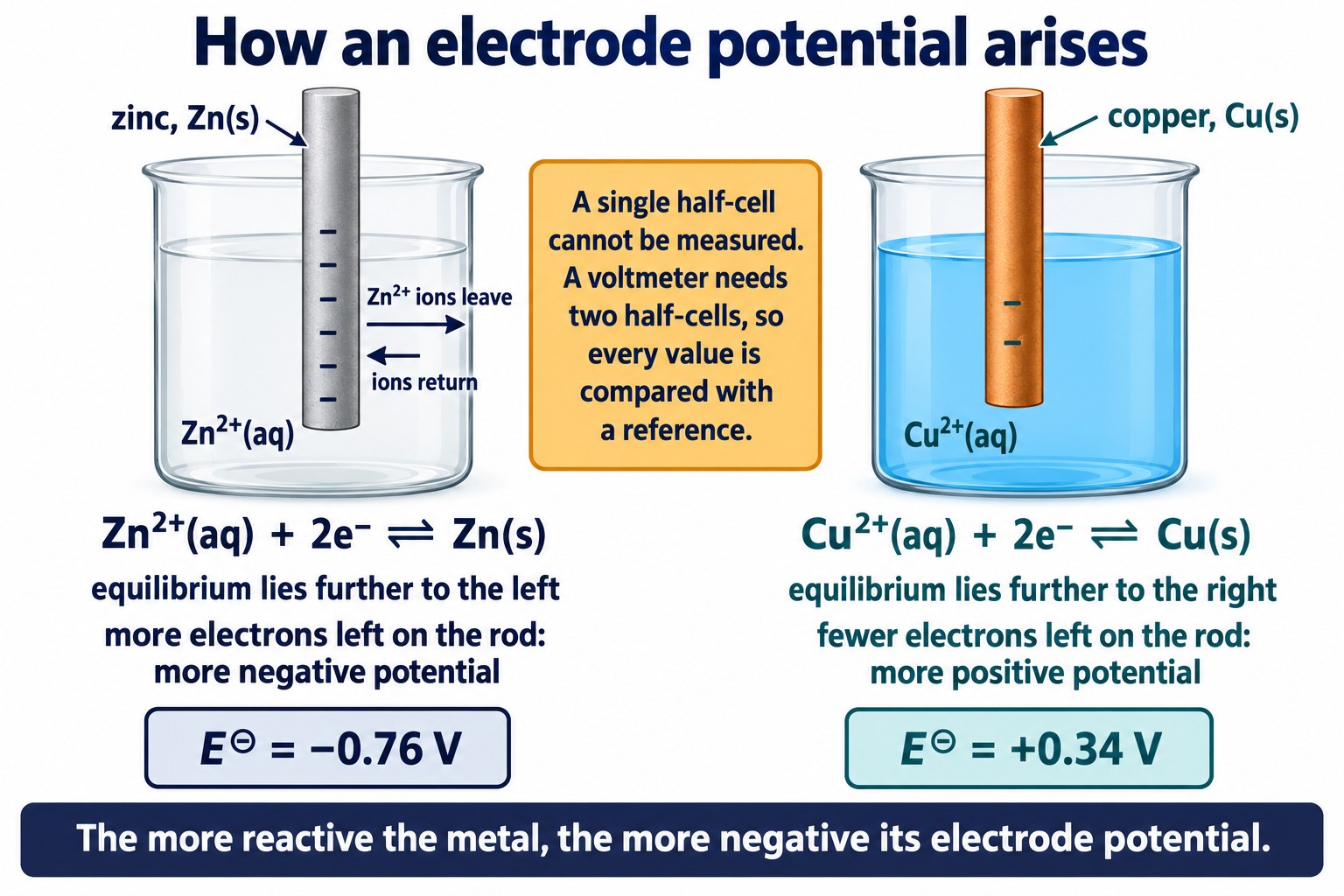
Zinc and copper half-cells compared: the more reactive metal forms ions more readily, keeps more electrons on the rod and has the more negative potential.
Remember: The more reactive the metal, the further the equilibrium Mⁿ⁺(aq) + ne⁻ ⇌ M(s) lies to the left, and the more negative the electrode potential.
Why a Reference Electrode Is Needed
A metal dipping into a solution of its ions is called a half-cell. The potential of one half-cell on its own cannot be measured.
- A voltmeter has two terminals. It measures a potential difference between two points.
- One terminal can be joined to the metal, but the other must also be connected to the solution.
- Any second connection dipped into the solution is itself a second half-cell.
- So only the difference between two half-cells can ever be measured.
The solution is to choose one half-cell as a reference and to give it a potential of exactly zero. Every other half-cell is then measured against it.
The hydrogen electrode is awkward to set up, so laboratories often use a simpler secondary reference electrode whose potential has already been measured against it.
Remember: Absolute electrode potentials cannot be measured, only differences. All values are quoted against the standard hydrogen electrode, which is given the value 0.00 V.
Check: Half-Cells and Electrode Potentials
Test how an electrode potential arises and why a single half-cell cannot be measured, using metals not compared on this page.
The Standard Hydrogen Electrode
The reference half-cell is the standard hydrogen electrode. It is based on the equilibrium between hydrogen ions and hydrogen gas.
2H⁺(aq) + 2e⁻ ⇌ H₂(g) E⦵ = 0.00 V
| Feature | Detail |
|---|---|
| Gas | hydrogen, H₂(g), at a pressure of 100 kPa |
| Electrode | platinum coated in platinum black |
| Solution | an acid with [H⁺(aq)] = 1.00 mol dm⁻³, such as HCl(aq) |
| Temperature | 298 K |
| Potential | 0.00 V by definition |
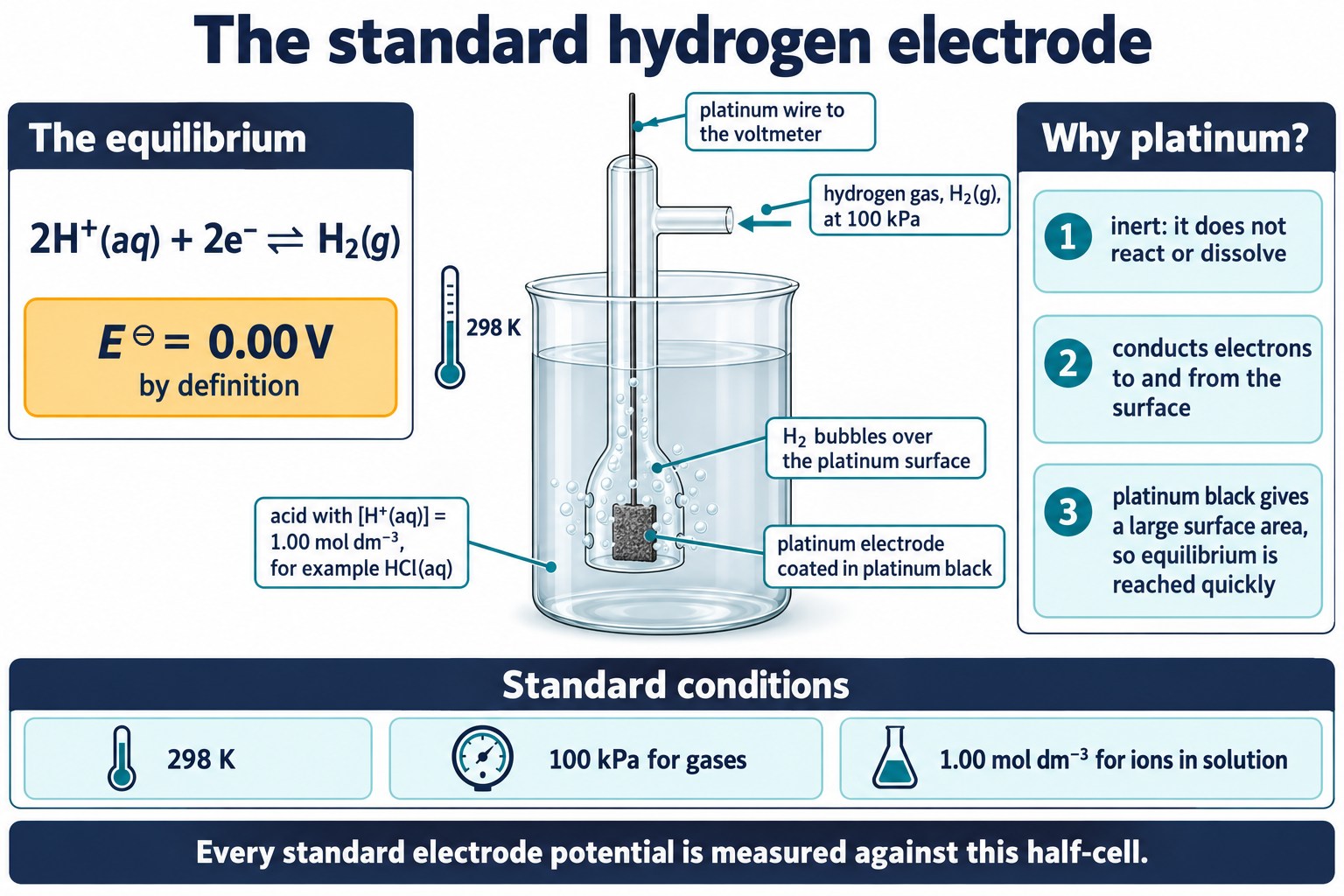
The standard hydrogen electrode: hydrogen at 100 kPa bubbles over a platinum black electrode in acid with a hydrogen ion concentration of 1.00 mol dm⁻³ at 298 K.
Why platinum?
- Hydrogen is a gas and cannot be made into an electrode, so a solid conductor is needed.
- Platinum is inert: it does not react with the acid or take part in the equilibrium.
- Platinum conducts, so electrons can travel to and from the surface.
- Platinum black is a rough, porous coating with a large surface area, so equilibrium is reached quickly.
Why not 1.00 mol dm⁻³ sulfuric acid?
- The condition is 1.00 mol dm⁻³ of H⁺ ions, not of acid.
- Each H₂SO₄ can release two H⁺ ions, so a 1.00 mol dm⁻³ solution would contain more than 1.00 mol dm⁻³ of H⁺.
- A 1.00 mol dm⁻³ solution of a strong monoprotic acid, such as HCl, gives the right concentration.
Exam focus: Four features earn the marks: H₂ gas at 100 kPa, a platinum electrode, a solution with 1.00 mol dm⁻³ H⁺ ions, and a temperature of 298 K.
Standard Conditions
The position of a half-cell equilibrium changes with temperature, pressure and concentration, so the potential changes too. Values can be compared only if they are measured under the same standard conditions.
| Condition | Standard value | Applies to |
|---|---|---|
| Temperature | 298 K (25 °C) | every half-cell |
| Pressure | 100 kPa | any gas, such as H₂ or Cl₂ |
| Concentration | 1.00 mol dm⁻³ | every ion in solution |
- The symbol ⦵ in E⦵ shows that the value was measured under standard conditions.
- A change in any one of the three conditions gives a different potential, written E without the ⦵ sign.
- A solid metal electrode needs no standard condition other than being pure.
Check: The Hydrogen Electrode and Standard Conditions
Pick out the correct features of the standard hydrogen electrode and the standard conditions, and explain the choice of platinum.
The Standard electrode (redox) potential, E⦵
The standard electrode (redox) potential, E⦵, of a half-cell is the emf measured when the half-cell is connected to a standard hydrogen electrode under standard conditions.
Measuring it
- Set up the half-cell under standard conditions: 298 K, with every ion at 1.00 mol dm⁻³.
- Join its solution to the standard hydrogen electrode with a salt bridge.
- Join the two electrodes through a high-resistance voltmeter.
- The voltmeter reading is E⦵ of the half-cell, with a sign.
| Half-cell | Against the hydrogen electrode it is | E⦵ / V |
|---|---|---|
| Zn²⁺(aq) + 2e⁻ ⇌ Zn(s) | the negative electrode | −0.76 |
| Cu²⁺(aq) + 2e⁻ ⇌ Cu(s) | the positive electrode | +0.34 |
What the sign means
- A negative E⦵: the half-cell releases electrons more readily than hydrogen does. Zinc atoms are oxidised and electrons flow to the hydrogen electrode.
- A positive E⦵: the half-cell accepts electrons more readily than H⁺ ions do. Cu²⁺ ions are reduced and electrons flow from the hydrogen electrode.
- Always include the sign, even when it is positive.
Written as reductions
By convention every half-equation in a data table is written as a reduction, with the electrons on the left.
| Half-equation | E⦵ / V |
|---|---|
| Mg²⁺(aq) + 2e⁻ ⇌ Mg(s) | −2.37 |
| Zn²⁺(aq) + 2e⁻ ⇌ Zn(s) | −0.76 |
| Fe²⁺(aq) + 2e⁻ ⇌ Fe(s) | −0.44 |
| 2H⁺(aq) + 2e⁻ ⇌ H₂(g) | 0.00 |
| Cu²⁺(aq) + 2e⁻ ⇌ Cu(s) | +0.34 |
| Ag⁺(aq) + e⁻ ⇌ Ag(s) | +0.80 |
The salt bridge and the voltmeter are explained on the next page, Electrochemical Cells and Cell Potentials.
Definition: The standard electrode (redox) potential is the emf of a half-cell connected to a standard hydrogen electrode, measured at 298 K with all solutions at 1.00 mol dm⁻³ and all gases at 100 kPa.
Quick Check: From Voltmeter Readings to E⦵
Turn each reading into a signed value before you rank the metals.
Common Exam Points
Say
- “The standard hydrogen electrode has a potential of 0.00 V by definition.”
- “Platinum is inert and conducts electricity.”
- “298 K, 100 kPa and 1.00 mol dm⁻³ for the ions.”
Do not say
- “Room temperature and pressure” (state the values).
- “1.00 mol dm⁻³ acid” (the condition is 1.00 mol dm⁻³ of H⁺ ions).
- “The electrode potential of zinc was measured” without naming the reference half-cell.
Watch for
- Signs left off positive values: write +0.34 V.
- Half-equations copied backwards: data tables show reductions.
- A reactive metal has a negative E⦵, because its equilibrium lies towards the ions.
- The pressure applies only to gases, and the concentration only to ions in solution.
Check: Defining and Measuring E⦵
Use the definition, the sign of E⦵ and the way it is measured, with half-cells not used on this page.
FAQs
Use these quick answers to check the standard electrode (redox) potential, standard conditions and the standard hydrogen electrode.
Why can the potential of a single half-cell not be measured?
A voltmeter measures a potential difference, so it needs two electrodes. Adding a second electrode makes a second half-cell. Every half-cell is therefore compared with the same reference, the standard hydrogen electrode, which is given the value 0.00 V.
What does standard electrode (redox) potential mean?
E⦵ is the voltage measured when a half-cell is connected to the standard hydrogen electrode under standard conditions. The half-equation is always written as a reduction, with the electrons on the left.
What are the standard conditions?
A temperature of 298 K, a gas pressure of 100 kPa and all aqueous ions at a concentration of 1.00 mol dm⁻³. Changing any of these shifts the position of the half-cell equilibrium, so the measured potential changes.
Why is platinum used in the standard hydrogen electrode?
Hydrogen is a gas, so it cannot be an electrode itself. Platinum is inert and conducts electrons. A coating of platinum black gives a large surface area, on which the equilibrium 2H⁺(aq) + 2e⁻ ⇌ H₂(g) is established quickly.
Why is E⦵ negative for zinc but positive for copper?
Zinc is the more reactive metal, so Zn²⁺(aq) + 2e⁻ ⇌ Zn(s) lies further to the left and leaves more electrons on the metal: −0.76 V. Copper(II) ions accept electrons more readily than H⁺ ions do: +0.34 V.

Copyright notice: This OLS revision content, including the explanations, layout, diagrams, tables and embedded learning structure, is authored for Online Learning System by Dr. Mohammed Al-Fatah. It may not be copied, reproduced, redistributed or adapted without written permission.
Keep this note — free
Save your progress across every OCR topic. A free account remembers which topics you have covered, saves your question scores, and syncs across your phone and laptop.
- Track every topic you have finished
- Keep your practice-question scores
- No payment, no card, free forever
Already registered? Log in