Redox Titrations: Iodine and Thiosulfate
A concise revision guide to iodine–thiosulfate titrations: liberating iodine with an oxidising agent, titrating with sodium thiosulfate, the starch end point and the calculations, including unfamiliar redox systems.
- 5.2.3(d)-ii
- 5.2.3(e)(i)-b
- 5.2.3(e)(ii)
What these spec points say
- 5.2.3(d)-ii the techniques and procedures used when carrying out redox titrations including those involving I2/S2O32– (see also 2.1.5 e–f)
- 5.2.3(e)(i)-b structured and non-structured titration calculations, based on experimental results of redox titrations involving I2/S2O32–
- 5.2.3(e)(ii) structured and non-structured titration calculations, based on experimental results of redox titrations involving non-familiar redox systems
Before You Start
This page follows Redox Titrations: Iron(II) and Manganate(VII). The titration skills are the same; the chemistry is different. Iodine and its reactions were first met in 2.1.5 Redox.
- Iodine, I₂, is brown in aqueous solution. Iodide ions, I⁻, are colourless.
- Iodide ions are reducing agents: 2I⁻ → I₂ + 2e⁻.
- Starch turns blue-black with iodine. This is the test for iodine.
- Moles = concentration × volume in dm³, and the mole ratio comes from the balanced equation.
GCSE Recap: Halogen Displacement and Moles in Solution
Three quick questions on the GCSE ideas this page builds on.
The Idea: Two Stages
An iodine–thiosulfate titration measures the amount of an oxidising agent. The oxidising agent is not titrated directly. It is used to make iodine, and the iodine is then titrated.
Stage 1: liberate the iodine
- An excess of potassium iodide, KI(aq), is added to a measured amount of the oxidising agent.
- The oxidising agent oxidises I⁻ ions to I₂, and the solution turns brown.
- Because the KI is in excess, the amount of I₂ formed depends only on the amount of oxidising agent.
Stage 2: titrate the iodine
The iodine is titrated with a standard solution of sodium thiosulfate, Na₂S₂O₃. Thiosulfate ions reduce the iodine back to iodide ions.
2S₂O₃²⁻(aq) + I₂(aq) → S₄O₆²⁻(aq) + 2I⁻(aq)
| Change | Half-equation |
|---|---|
| Oxidation | 2S₂O₃²⁻ → S₄O₆²⁻ + 2e⁻ |
| Reduction | I₂ + 2e⁻ → 2I⁻ |
- S₂O₃²⁻ is the thiosulfate ion. S₄O₆²⁻ is the tetrathionate ion. Both are colourless.
- The average oxidation number of sulfur rises from +2 in S₂O₃²⁻ to +2.5 in S₄O₆²⁻.
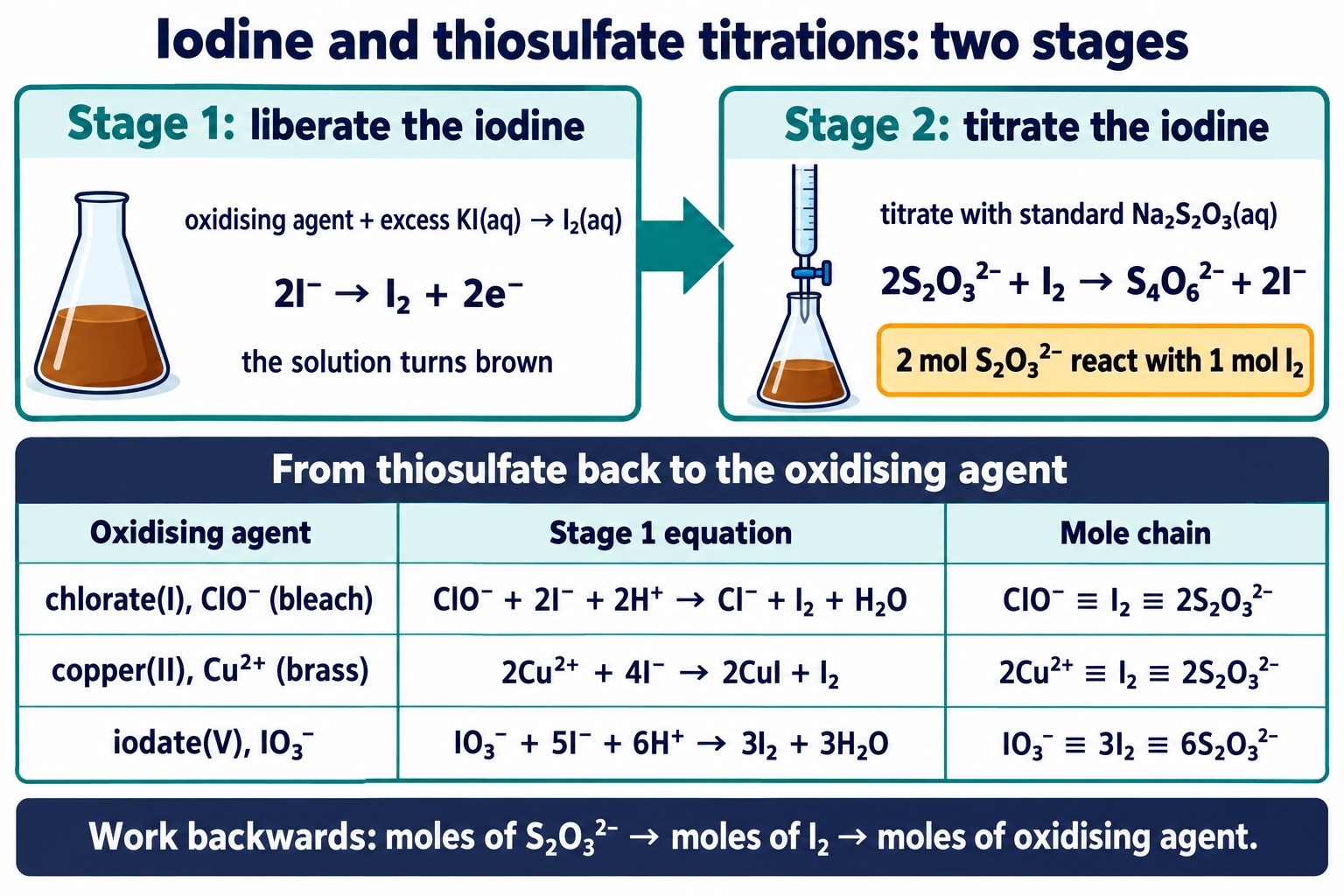
The two stages of an iodine–thiosulfate titration, with the mole ratios that link chlorate(I), copper(II) and iodate(V) ions to iodine and to thiosulfate.
Key idea: 2 mol of S₂O₃²⁻ react with 1 mol of I₂. So moles of I₂ = moles of (S₂O₃²⁻) / (2) in every calculation.
Starch and the End Point
As thiosulfate is added, the iodine is used up and the brown colour fades. The last change, from pale yellow to colourless, is hard to see. Starch makes it sharp.
| Stage of the titration | Colour in the flask |
|---|---|
| Start | brown (or yellow-brown) |
| Near the end point | pale straw (pale yellow) |
| Starch added | blue-black |
| End point | colourless |
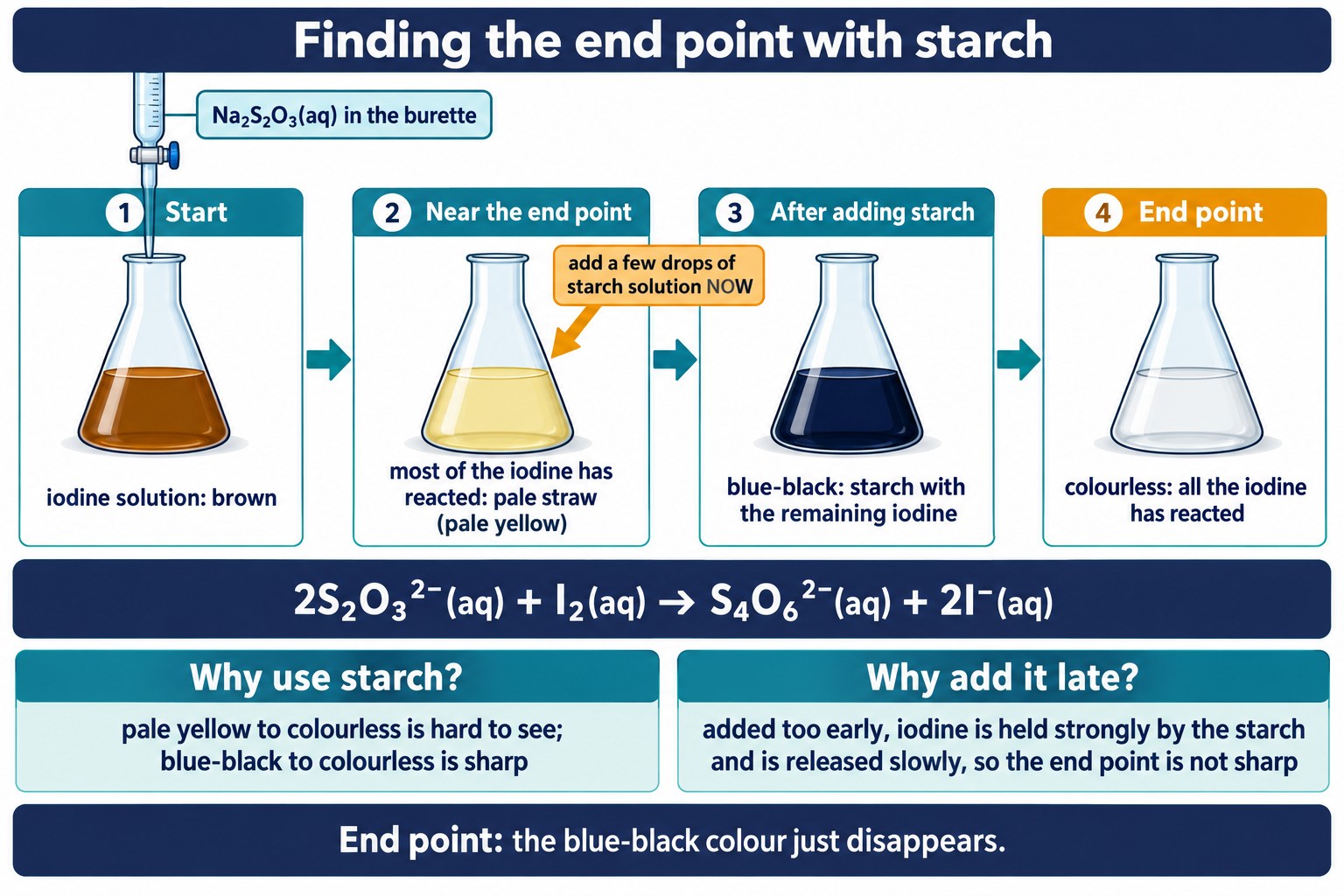
Colour changes in the flask: brown iodine fades to pale straw, starch then gives a blue-black colour, and the end point is reached when the blue-black colour just disappears.
Why the starch is added late
- Starch is added only when the solution is pale straw, when very little iodine is left.
- If starch is added early, a lot of iodine is held strongly in the blue-black starch–iodine complex.
- This iodine is released slowly, so the colour fades slowly and the end point is overshot.
Exam wording: “Add starch near the end point, when the solution is pale straw. The end point is when the blue-black colour just disappears to leave a colourless solution.”
Check: Iodine, Thiosulfate and Starch
Use the thiosulfate and iodine equation, the two stages and the starch end point, in questions that do not repeat the examples on this page.
The Method Step by Step
- Use a pipette to transfer 25.0 cm³ of the oxidising agent solution to a conical flask.
- Add an excess of potassium iodide solution, and dilute acid if the equation needs H⁺ ions. The mixture turns brown.
- Fill a burette with standard sodium thiosulfate solution and record the initial reading.
- Add thiosulfate with swirling until the solution is pale straw.
- Add a few drops of starch solution. The mixture turns blue-black.
- Add thiosulfate drop by drop until the blue-black colour just disappears. Record the final reading.
- Repeat until two titres are concordant, then calculate the mean titre.
Practical points
- The KI must be in excess, so that all of the oxidising agent reacts. Its exact volume does not matter.
- Titrate the iodine soon after it forms. Iodine is volatile and some can be lost from an open flask.
- Starch solution should be freshly made.
- This titration is part of the assessed practical work: see Practical Activity Groups.
What Can Be Analysed?
Each oxidising agent has its own Stage 1 equation. This gives the ratio of the oxidising agent to iodine, and so to thiosulfate.
| Oxidising agent | Stage 1 equation | Overall ratio |
|---|---|---|
| Chlorate(I), ClO⁻, in bleach | ClO⁻ + 2I⁻ + 2H⁺ → Cl⁻ + I₂ + H₂O | 1 ClO⁻ ≡ 1 I₂ ≡ 2 S₂O₃²⁻ |
| Copper(II), Cu²⁺, from an alloy | 2Cu²⁺ + 4I⁻ → 2CuI + I₂ | 2 Cu²⁺ ≡ 1 I₂ ≡ 2 S₂O₃²⁻ |
| Iodate(V), IO₃⁻ | IO₃⁻ + 5I⁻ + 6H⁺ → 3I₂ + 3H₂O | 1 IO₃⁻ ≡ 3 I₂ ≡ 6 S₂O₃²⁻ |
Notes on each one
- Bleach contains sodium chlorate(I), NaClO. It is usually diluted first, so that the titre is a sensible size.
- Copper(II) ions form copper(I) iodide, CuI, a white precipitate. The mixture looks brown because of the iodine.
- With copper, the end point is the blue-black colour disappearing to leave an off-white precipitate.
- For copper the ratio simplifies: moles of Cu²⁺ = moles of S₂O₃²⁻.
- Potassium iodate(V), KIO₃, can be weighed accurately. It is used to find the exact concentration of a thiosulfate solution.
Analysing an alloy
- Dissolve a weighed sample of brass or bronze in concentrated nitric acid. The copper becomes Cu²⁺(aq).
- Neutralise the excess acid, then make the solution up to 250 cm³.
- Add excess KI to 25.0 cm³ portions and titrate the iodine with thiosulfate.
Structured Calculation: Chlorate(I) in Bleach
10.0 cm³ of bleach was diluted to 250 cm³. Excess KI and dilute acid were added to a 25.0 cm³ portion. The iodine needed 20.40 cm³ of 0.100 mol dm⁻³ Na₂S₂O₃.
Calculate the concentration of ClO⁻ ions in the undiluted bleach.
Step 1. Moles of S₂O₃²⁻ = (0.100 × 20.40) / (1000) = 2.04 × 10⁻³ mol.
Step 2. Moles of I₂ = (2.04 × 10⁻³) / (2) = 1.02 × 10⁻³ mol.
Answer. Concentration = (1.02 × 10⁻²) / (0.0100) = 1.02 mol dm⁻³
Quick Check: Purity of Potassium Bromate(V)
Follow a new oxidising agent through the chain of ratios, then flip each card to check.
Unstructured Calculation: Copper in Brass
2.50 g of brass was dissolved in nitric acid, neutralised and made up to 250 cm³. Excess KI was added to a 25.0 cm³ portion. The iodine needed 26.50 cm³ of 0.100 mol dm⁻³ Na₂S₂O₃.
Calculate the percentage by mass of copper in the brass. (Ar of Cu = 63.5)
Step 1. Moles of S₂O₃²⁻ = (0.100 × 26.50) / (1000) = 2.65 × 10⁻³ mol.
Step 3. Moles of Cu²⁺ in 250 cm³ = 10 × 2.65 × 10⁻³ = 2.65 × 10⁻² mol.
Step 4. Mass of copper = 2.65 × 10⁻² × 63.5 = 1.68275 g, which is 1.68 g to 3 significant figures.
Answer. Percentage of copper = (1.68275) / (2.50) × 100 = 67.3%
Standardising thiosulfate with iodate(V)
Excess KI and dilute acid were added to 25.0 cm³ of 0.0200 mol dm⁻³ KIO₃. The iodine needed 24.00 cm³ of sodium thiosulfate solution. Find the concentration of the thiosulfate.
Step 1. Moles of IO₃⁻ = (0.0200 × 25.0) / (1000) = 5.00 × 10⁻⁴ mol.
Step 2. Moles of I₂ = 3 × 5.00 × 10⁻⁴ = 1.50 × 10⁻³ mol.
Step 3. Moles of S₂O₃²⁻ = 2 × 1.50 × 10⁻³ = 3.00 × 10⁻³ mol.
Answer. Concentration = (3.00 × 10⁻³) / (0.02400) = 0.125 mol dm⁻³
Exam focus: Write the chain of ratios first, for example IO₃⁻ ≡ 3I₂ ≡ 6S₂O₃²⁻. Then every step of the calculation is a single multiplication or division.
Check: Iodine–Thiosulfate Calculations
Work back from a thiosulfate titre to the amount of an oxidising agent, in structured and unstructured calculations with data not used on this page.
Unfamiliar Redox Systems
A question may use an oxidising agent that is not on this page. The half-equations are given. Use them to find the Stage 1 ratio, then calculate as usual.
- Combine the half-equation of the oxidising agent with 2I⁻ → I₂ + 2e⁻, balancing the electrons.
- Read off the ratio of oxidising agent to I₂.
- Link I₂ to thiosulfate: 1 I₂ ≡ 2 S₂O₃²⁻.
- Work back from the titre.
Worked example: dichromate(VI)
Excess KI and dilute acid were added to 25.0 cm³ of potassium dichromate(VI) solution. The iodine needed 27.00 cm³ of 0.100 mol dm⁻³ Na₂S₂O₃. Find the concentration of the dichromate(VI) ions.
Cr₂O₇²⁻ + 14H⁺ + 6e⁻ → 2Cr³⁺ + 7H₂O
Step 2. The chain of ratios is Cr₂O₇²⁻ ≡ 3I₂ ≡ 6S₂O₃²⁻.
Step 4. Moles of Cr₂O₇²⁻ = (1.35 × 10⁻³) / (3) = 4.50 × 10⁻⁴ mol.
Answer. Concentration = (4.50 × 10⁻⁴) / (0.0250) = 0.0180 mol dm⁻³
Remember: The thiosulfate step never changes. Only the first ratio, oxidising agent to iodine, depends on the new half-equation.
Common Exam Points
Say
- “Excess potassium iodide is added, so that all of the oxidising agent reacts.”
- “Starch is added near the end point, when the solution is pale straw.”
- “The end point is when the blue-black colour just disappears.”
Do not say
- “The solution turns blue-black at the end point” (it turns from blue-black to colourless).
- “Moles of iodine = 2 × moles of thiosulfate” (divide by 2, do not multiply).
- “Starch is added at the start” (the end point would not be sharp).
Watch for
- The iodate(V) ratio: one IO₃⁻ gives three I₂, so it is equivalent to six S₂O₃²⁻.
- The copper ratio: moles of Cu²⁺ equal moles of S₂O₃²⁻.
- Dilution steps: scale up to the whole flask, then back to the original sample.
- State symbols: CuI is a solid, CuI(s).
Check: Iodine–Thiosulfate Titrations
Bring the whole page together: equations, method, end point and calculations for different oxidising agents, in contexts not used on this page.
FAQs
Use these quick answers to check iodine-thiosulfate titrations.
Why is an excess of potassium iodide added first?
The oxidising agent reacts with iodide ions to release iodine, for example ClO⁻ + 2I⁻ + 2H⁺ → Cl⁻ + I₂ + H₂O. An excess makes sure that all of the oxidising agent reacts, so the amount of iodine depends only on the oxidising agent.
What is the equation for the titration with thiosulfate?
2S₂O₃²⁻ + I₂ → S₄O₆²⁻ + 2I⁻. Two moles of thiosulfate ions react with one mole of iodine, so moles of I₂ = moles of (S₂O₃²⁻) / (2). The brown colour of the iodine fades as the thiosulfate is added.
Why is starch added only near the end point?
Added early, starch traps a large amount of iodine in a blue-black complex that breaks down slowly, which makes the end point inaccurate. Add it when the solution is pale straw. The end point is blue-black to colourless.
How is the copper in brass found by this method?
Dissolve the brass to give Cu²⁺(aq), then add excess KI: 2Cu²⁺ + 4I⁻ → 2CuI + I₂, with a white precipitate of CuI. Since 2Cu²⁺ ≡ I₂ ≡ 2S₂O₃²⁻, the moles of Cu²⁺ equal the moles of thiosulfate in the titre.
How is a sodium thiosulfate solution standardised?
Titrate it against the iodine released by a known amount of potassium iodate(V): IO₃⁻ + 5I⁻ + 6H⁺ → 3I₂ + 3H₂O. Each mole of IO₃⁻ gives 3 mol of I₂, which react with 6 mol of S₂O₃²⁻.

Copyright notice: This OLS revision content, including the explanations, layout, diagrams, tables and embedded learning structure, is authored for Online Learning System by Dr. Mohammed Al-Fatah. It may not be copied, reproduced, redistributed or adapted without written permission.
Keep this note — free
Save your progress across every OCR topic. A free account remembers which topics you have covered, saves your question scores, and syncs across your phone and laptop.
- Track every topic you have finished
- Keep your practice-question scores
- No payment, no card, free forever
Already registered? Log in