Oxidation and Tests for Carbonyl Compounds
A concise revision guide to the oxidation of aldehydes and the tests that tell aldehydes from ketones: Tollens’ reagent, acidified dichromate(VI), 2,4-dinitrophenylhydrazine.
- 6.1.2(a)
- 6.1.2(d)(i)
- 6.1.2(d)(ii)
- 6.1.2(e)(i)
- 6.1.2(e)(ii)
What these spec points say
- 6.1.2(a) oxidation of aldehydes using Cr2O72–/H+ (i.e. K2Cr2O7/H2SO4) to form carboxylic acids
- 6.1.2(d)(i) use of 2,4-dinitrophenylhydrazine to detect the presence of a carbonyl group in an organic compound
- 6.1.2(d)(ii) use of 2,4-dinitrophenylhydrazine to identify a carbonyl compound from the melting point of the derivative
- 6.1.2(e)(i) use of Tollens' reagent (ammoniacal silver nitrate) to detect the presence of an aldehyde group
- 6.1.2(e)(ii) use of Tollens' reagent (ammoniacal silver nitrate) to distinguish between aldehydes and ketones, explained in terms of the oxidation of aldehydes to carboxylic acids with reduction of silver ions to silver
Before You Start
This page follows Aldehydes and Ketones: Structure, Naming and Properties and uses the oxidation of alcohols from 4.2.1 Alcohols.
- An aldehyde has a hydrogen atom on its C=O carbon; a ketone does not.
- Acidified potassium dichromate(VI) is an oxidising agent: it turns from orange to green when it is reduced.
- In equations the oxidising agent is written as [O].
Oxidation of Aldehydes
Aldehydes are easily oxidised to carboxylic acids. Ketones are not oxidised by the same reagents.
CH₃CHO + [O] → CH₃COOH
- The reagent is potassium dichromate(VI), K₂Cr₂O₇, acidified with dilute sulfuric acid, and the mixture is heated under reflux.
- The orange dichromate(VI) ion, Cr₂O₇²⁻, is reduced to the green chromium(III) ion, Cr³⁺.
- A ketone leaves the solution orange.
Why ketones resist oxidation
- Oxidising an aldehyde removes the hydrogen on the C=O carbon and puts an –OH in its place. Only a C–H bond is broken.
- A ketone has no hydrogen on its C=O carbon. Oxidation would need a strong C–C bond to break.
- Because they are so easily oxidised, aldehydes are reducing agents. Every test below uses this.
The ionic equation
3CH₃CHO + Cr₂O₇²⁻ + 8H⁺ → 3CH₃COOH + 2Cr³⁺ + 4H₂O
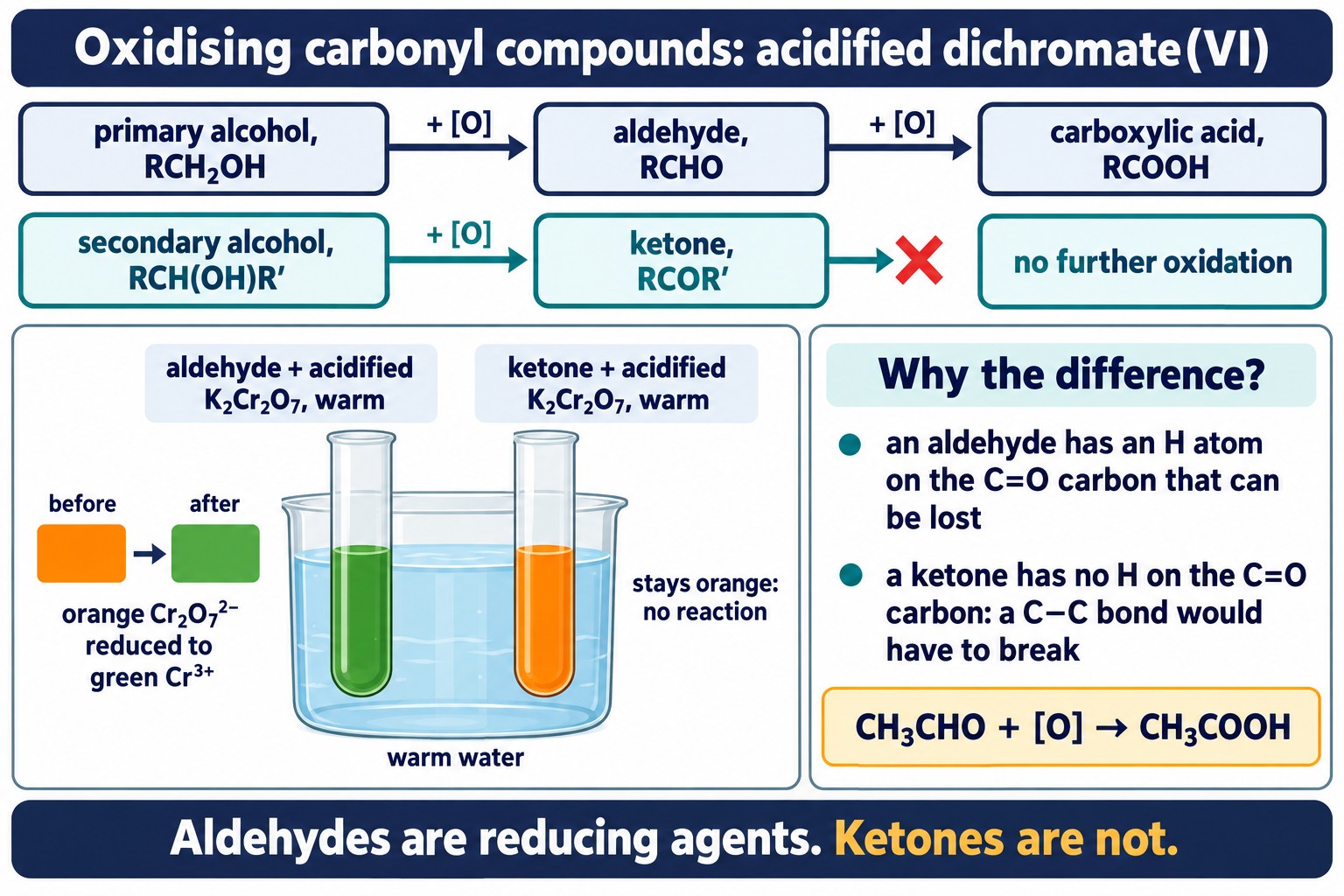
Oxidation routes from primary and secondary alcohols, and the colour change with acidified dichromate(VI): green with an aldehyde, still orange with a ketone.
Remember: Acidified dichromate(VI) also turns green with primary and secondary alcohols. It separates an aldehyde from a ketone, but it does not prove that a compound is an aldehyde.
Tollens’ Reagent: the Silver Mirror Test
Tollens’ reagent is a colourless solution of silver nitrate in aqueous ammonia. It contains the complex ion [Ag(NH₃)₂]⁺ and is a mild oxidising agent.
Method
- Add a few drops of NaOH(aq) to silver nitrate solution: a brown precipitate of silver oxide forms.
- Add dilute ammonia drop by drop until the precipitate just dissolves.
- Add the carbonyl compound and warm the tube in a water bath at about 60 °C.
| Compound | Observation | Explanation |
|---|---|---|
| aldehyde | a silver mirror forms on the inside of the tube | aldehyde oxidised; Ag⁺ reduced to Ag |
| ketone | no change: colourless solution | ketones are not oxidised |
- The aldehyde is oxidised to a carboxylic acid, which forms its carboxylate ion in the alkaline solution.
- The silver ions are reduced to silver: Ag⁺(aq) + e⁻ → Ag(s).
- Overall: CH₃CHO + 2[Ag(NH₃)₂]⁺ + 3OH⁻ → CH₃COO⁻ + 2Ag + 4NH₃ + 2H₂O.
- A water bath is used because carbonyl compounds are flammable. The reagent is made fresh and never stored.
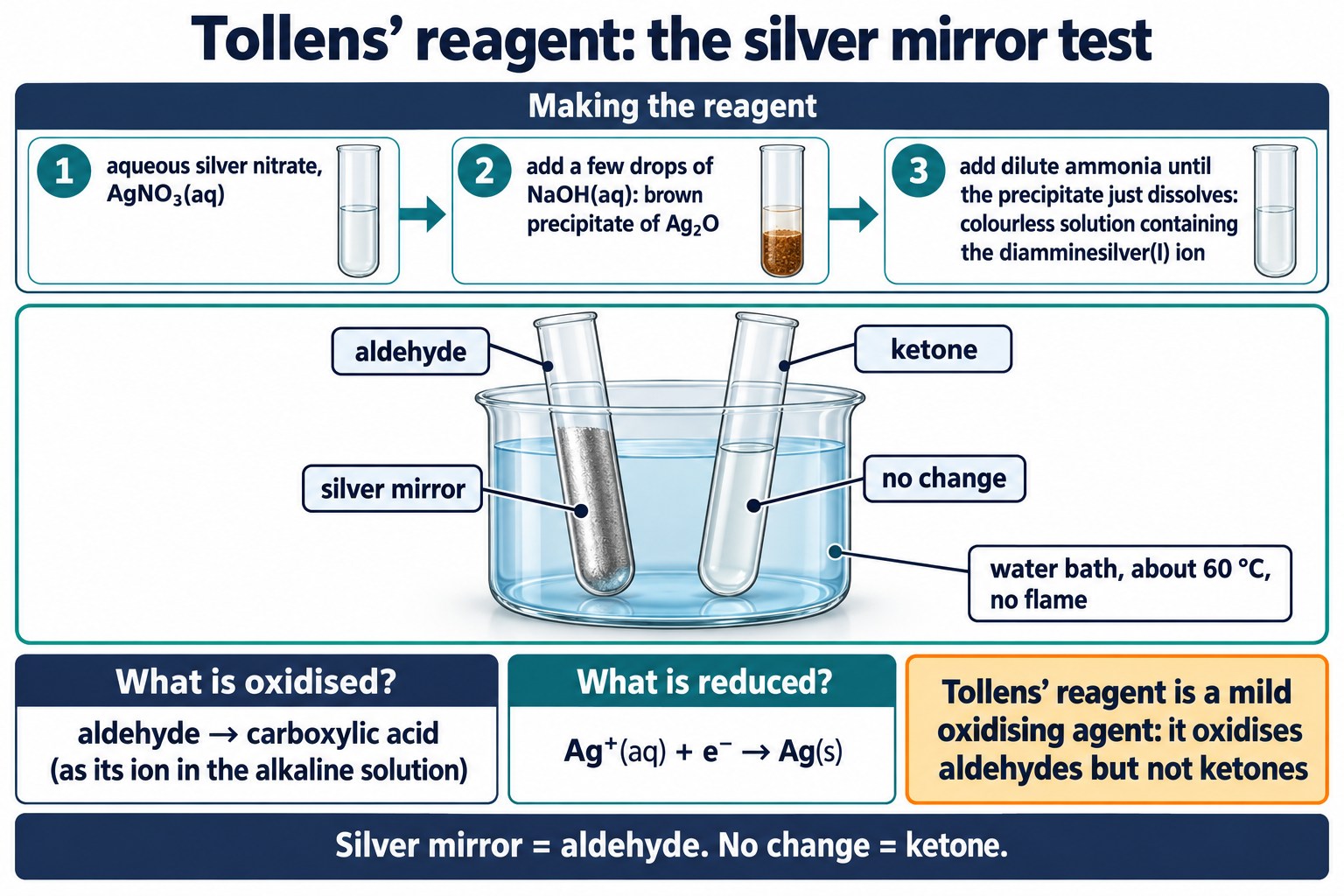
Making Tollens’ reagent and using it: a silver mirror with an aldehyde, no change with a ketone, and silver ions gaining electrons.
Exam focus: Explain the silver mirror as a redox reaction: the aldehyde is oxidised to a carboxylic acid, and silver ions are reduced to silver, Ag⁺ + e⁻ → Ag.
Check: Telling Aldehydes From Ketones
Predict the result of oxidising tests and explain them as redox reactions, with compounds not used on this page.
Quick Check: Reasoning With Oxidation Tests
Pick the one accurate statement in each set, using compounds that are new to this page.
2,4-Dinitrophenylhydrazine: Detecting and Identifying
2,4-Dinitrophenylhydrazine (2,4-DNPH) reacts with the C=O group of both aldehydes and ketones.
Detecting a carbonyl group
- Add a few drops of the unknown to a solution of 2,4-DNPH.
- A yellow-orange precipitate shows that an aldehyde or a ketone is present.
- Alcohols, carboxylic acids and esters give no precipitate, so the test is specific to aldehydes and ketones.
Identifying the carbonyl compound
The precipitate is a solid derivative (a 2,4-dinitrophenylhydrazone). Each carbonyl compound gives a derivative with its own sharp melting point.
- Filter off the precipitate.
- Recrystallise it from the minimum volume of hot solvent to purify it.
- Filter, wash and dry the crystals.
- Measure the melting point of the purified derivative.
- Compare the value with a table of known derivatives.
Worked example
The purified derivative of an unknown ketone melts at 116 °C. Data: propanone derivative 126 °C, butanone derivative 116 °C, pentan-3-one derivative 156 °C.
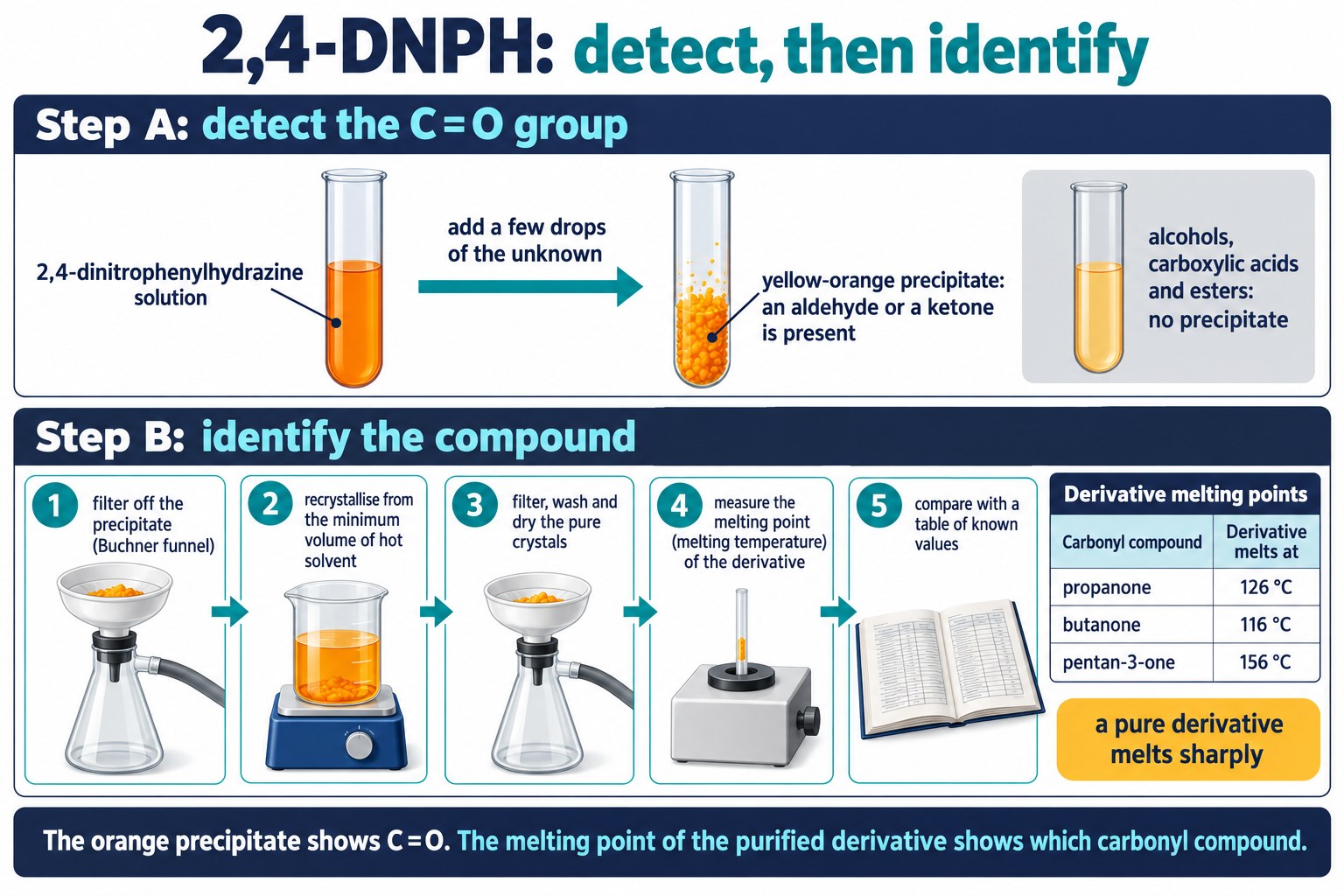
2,4-DNPH in two stages: an orange precipitate detects the carbonyl group, then the purified derivative is identified from its melting point.
Exam focus: 2,4-DNPH shows that a carbonyl group is present; it does not separate aldehydes from ketones. Follow it with Tollens’ reagent, and use the melting point of the derivative to name the compound.
Summary of the Tests
| Reagent | Aldehyde | Ketone | Distinguishes |
|---|---|---|---|
| Acidified K₂Cr₂O₇, warm | orange solution turns green | stays orange | aldehyde from ketone |
| Tollens’ reagent, warm | silver mirror | no change | aldehyde from ketone |
| 2,4-DNPH | yellow-orange precipitate | yellow-orange precipitate | carbonyl from other compounds |
- First show that the compound is a carbonyl compound: 2,4-DNPH gives a yellow-orange precipitate.
- Then decide between aldehyde and ketone with Tollens’ reagent.
- Finally, identify the compound from the melting point of its purified 2,4-DNPH derivative.
Exam focus: A full answer to “describe a test” gives the reagent, the conditions, the observation with each compound and what the observation shows.
Check: Choosing and Reading the Tests
Match reagents to observations and decide what each result shows, using compounds not used on this page.
Carbonyl Tests in Qualitative Analysis
The carbonyl tests join the other test-tube tests for functional groups. In an unknown, they are used in a logical order.
| Functional group | Test | Positive observation |
|---|---|---|
| alkene | bromine water | orange to colourless |
| haloalkane | AgNO₃(aq) in ethanol, warm | white, cream or yellow precipitate |
| carbonyl | 2,4-DNPH | yellow-orange precipitate |
| aldehyde | Tollens’ reagent, warm | silver mirror |
| primary or secondary alcohol, aldehyde | acidified K₂Cr₂O₇, warm | orange to green |
| carboxylic acid | Na₂CO₃(aq) | effervescence: CO₂ |
- A compound that reacts with 2,4-DNPH but not with Tollens’ reagent is a ketone.
- A compound that turns acidified dichromate(VI) green but gives no precipitate with 2,4-DNPH is an alcohol, not an aldehyde.
Worked Example: Identifying an Unknown
Compound X has the molecular formula C₄H₈O. It gives a yellow-orange precipitate with 2,4-DNPH. It gives a silver mirror with Tollens’ reagent.
The oxidation product of butanal would be butanoic acid: CH₃CH₂CH₂CHO + [O] → CH₃CH₂CH₂COOH.
Common Exam Points
Say
- “The aldehyde is oxidised to a carboxylic acid.”
- “Silver ions are reduced to silver, forming a silver mirror.”
- “Recrystallise the derivative, measure its melting point and compare with known values.”
Do not say
- “Goes clear” (say colourless) or “silver precipitate” (say silver mirror).
- “The ketone is oxidised slowly” (it is not oxidised by these reagents).
- “2,4-DNPH is a test for aldehydes” (it detects aldehydes and ketones).
- “Measure the boiling point of the precipitate” (it is the melting point of the purified derivative).
Watch for
- Acidified dichromate(VI) reacting with alcohols as well as aldehydes.
- Equations with [O]: one [O] per aldehyde, and no water formed.
- Alkaline reagents: the acid is formed as its carboxylate ion, RCOO⁻.
Check: Identifying Unknown Carbonyl Compounds
Combine the results of several tests to work out structures, with unknowns not used on this page.
FAQs
Use these quick answers to check the oxidation of aldehydes and the tests for carbonyl compounds.
Why can aldehydes be oxidised but ketones cannot?
An aldehyde has a hydrogen atom on its carbonyl carbon, which is replaced as the CHO group becomes COOH. A ketone has no such hydrogen, so oxidation would mean breaking a carbon-carbon bond, and mild oxidising agents cannot do that.
What happens in the silver mirror test?
An aldehyde, warmed gently with Tollens’ reagent, coats the tube with a silver mirror. The aldehyde is oxidised to a carboxylic acid, present as its salt, while [Ag(NH₃)₂]⁺ ions are reduced to silver. A ketone leaves the solution colourless.
What is seen when an aldehyde is warmed with acidified dichromate(VI)?
The solution turns from orange to green as Cr₂O₇²⁻ is reduced to Cr³⁺ and the aldehyde is oxidised to a carboxylic acid. A ketone leaves it orange. Primary and secondary alcohols also give this change, so the test is not specific.
What does 2,4-DNPH tell me?
2,4-Dinitrophenylhydrazine gives a yellow-orange precipitate with any aldehyde or ketone, so it detects the C=O group but cannot tell them apart. Recrystallising the precipitate and measuring its melting point identifies the original compound from data tables.
How do I tell propanal from propanone?
Warm each with Tollens’ reagent. Propanal gives a silver mirror because it is oxidised to propanoic acid. Propanone gives no change because ketones are not oxidised by this reagent.

Copyright notice: This OLS revision content, including the explanations, layout, diagrams, tables and embedded learning structure, is authored for Online Learning System by Dr. Mohammed Al-Fatah. It may not be copied, reproduced, redistributed or adapted without written permission.
Keep this note — free
Save your progress across every OCR topic. A free account remembers which topics you have covered, saves your question scores, and syncs across your phone and laptop.
- Track every topic you have finished
- Keep your practice-question scores
- No payment, no card, free forever
Already registered? Log in