Oxides, Hydroxides and Carbonates
A concise revision guide to the oxides and hydroxides of the s-block metals with water and dilute acid, the pH of the solutions rising down Group 2, the carbonates with acid, and the uses of calcium hydroxide, magnesium hydroxide and calcium carbonate as bases.
Where This Sits in Your Specification
AQA 3.2.2 examines Group 2 only. The Group 1 metals are kept in the tables for comparison, because the same reasoning explains both groups, but questions will be set on magnesium to barium.
Oxides with Water
The s-block oxides are basic oxides. Those that dissolve react with water to form the metal hydroxide, and the solution is alkaline because hydroxide ions are released.
Na₂O + H₂O → 2NaOH CaO + H₂O → Ca(OH)₂ BaO + H₂O → Ba(OH)₂
Calcium oxide (quicklime) reacts vigorously, giving out enough heat to make the water steam, and the product, calcium hydroxide, is slaked lime. Magnesium oxide reacts only slightly, because magnesium hydroxide is barely soluble, so the solution is only weakly alkaline.
The pH of the solution rises down Group 2. Magnesium hydroxide solution is about pH 9 to 10, calcium hydroxide about 12, and barium hydroxide about 13. The trend follows the solubility of the hydroxides: the more hydroxide dissolves, the higher the concentration of OH⁻(aq) and the higher the pH.
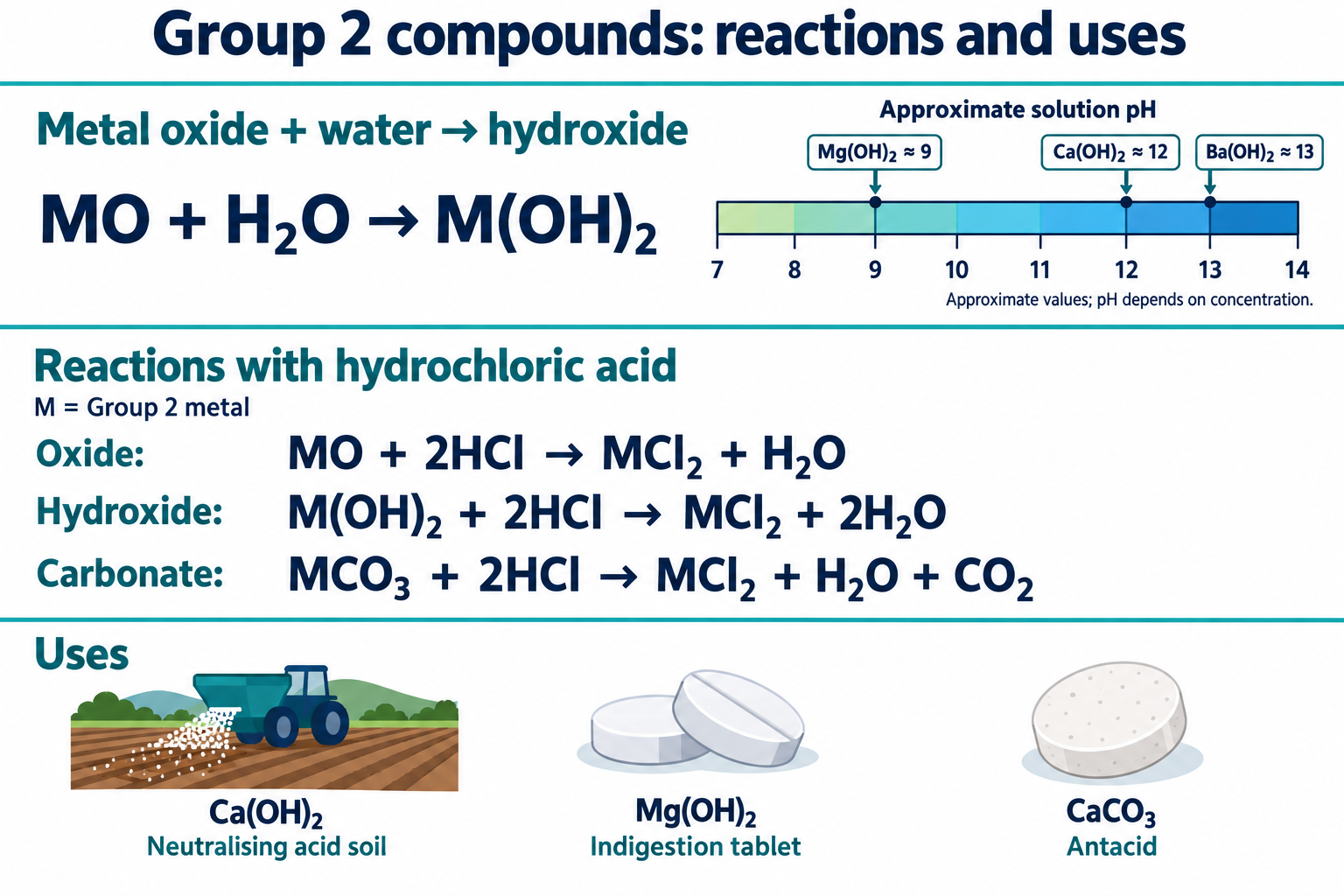
The pH strip shows why the trend exists: more hydroxide dissolves down the group, so the solution holds more OH⁻ ions.
Exam focus: Link pH to solubility, not to “reactivity”. Barium hydroxide gives the most alkaline solution because it is the most soluble hydroxide, so its solution has the highest concentration of hydroxide ions.
Check: Oxides and pH
Predict and explain the pH of solutions made from oxides and hydroxides not named above.
Oxides and Hydroxides with Acids
As bases, the oxides and hydroxides neutralise acids to give a salt and water. The salt takes its name from the acid: chlorides from hydrochloric acid, sulfates from sulfuric acid, nitrates from nitric acid.
MgO + 2HCl → MgCl₂ + H₂O CaO + H₂SO₄ → CaSO₄ + H₂O 2KOH + H₂SO₄ → K₂SO₄ + 2H₂O
Ca(OH)₂ + 2HNO₃ → Ca(NO₃)₂ + 2H₂O ionic: OH⁻ + H⁺ → H₂O and for an oxide: O²⁻ + 2H⁺ → H₂O
These are acid–base reactions, not redox reactions: no oxidation number changes. The magnesium stays at +2 and the hydrogen at +1 throughout.
Key idea: Metal oxide or hydroxide + acid → salt + water. The only difference between the two is that the oxide needs two H⁺ ions for each oxide ion.
Carbonates
The Group 1 carbonates are soluble in water and give alkaline solutions; the Group 2 carbonates are insoluble, so they do not react with water at all. Both react with acids to give a salt, water and carbon dioxide, which is the fizzing seen when an acid is added to any carbonate:
CaCO₃ + 2HCl → CaCl₂ + H₂O + CO₂ MgCO₃ + H₂SO₄ → MgSO₄ + H₂O + CO₂ ionic: CO₃²⁻ + 2H⁺ → H₂O + CO₂
The gas turns limewater cloudy, which is the test for a carbonate ion. The thermal decomposition of the carbonates is treated on the Thermal Stability and Flame Colours page.
Remember: Carbonate + acid gives three products, not two. Forgetting the carbon dioxide is the most common balancing error in this section.
Check: Salt, Water and Gas
Complete and balance equations for oxides, hydroxides and carbonates with acids, using compounds that are not on this page.
Uses as Bases
Because they are cheap, mild bases, several Group 2 compounds are used to neutralise acids in everyday settings.
| Compound | Use | Equation |
|---|---|---|
| Calcium hydroxide, Ca(OH)₂ (slaked lime) | spread on fields to neutralise acidic soil so crops grow better | Ca(OH)₂ + 2H⁺ → Ca²⁺ + 2H₂O |
| Magnesium hydroxide, Mg(OH)₂ (milk of magnesia) | antacid that neutralises excess stomach acid | Mg(OH)₂ + 2HCl → MgCl₂ + 2H₂O |
| Calcium carbonate, CaCO₃ | antacid tablets; also neutralises acidic soil and lakes | CaCO₃ + 2HCl → CaCl₂ + H₂O + CO₂ |
| Calcium oxide, CaO (quicklime) | neutralises acidic soil; removes sulfur dioxide from flue gases | CaO + SO₂ → CaSO₃ |
Magnesium hydroxide is chosen as an antacid rather than sodium hydroxide because it is only sparingly soluble, so it neutralises acid without making the stomach alkaline. Calcium carbonate gives off carbon dioxide as it works, which is why some tablets cause belching.
The removal of sulfur dioxide from flue gases with calcium oxide or calcium carbonate is examined in this section and is explained in full on the Oxides of Sulfur page.
Exam wording: When asked why magnesium hydroxide is safe to swallow, answer with its low solubility and its weak alkalinity, not simply “it is a base”.
Check: Choosing a Base
Decide which compound suits each use and justify the choice from solubility and the products formed.
Common Exam Points
Write the equation for a Group 2 oxide with water
MO + H₂O → M(OH)₂, and state that the solution is alkaline because of the hydroxide ions.
Explain the trend in pH of the hydroxide solutions
Solubility increases down the group, so the concentration of hydroxide ions increases and the pH rises.
Give a use of calcium hydroxide with an equation
Neutralising acidic soil: Ca(OH)₂ + 2H⁺ → Ca²⁺ + 2H₂O.
Do not say
“Barium hydroxide is a stronger base” (it is more soluble); “carbonate + acid → salt + water” without the carbon dioxide.
FAQs
Use these quick answers to check the oxides, hydroxides and carbonates.
Why is a solution of calcium oxide alkaline?
Calcium oxide reacts with water to form calcium hydroxide, which releases hydroxide ions into the solution.
Why does the pH of the hydroxide solutions rise down Group 2?
The hydroxides become more soluble down the group, so more hydroxide ions are in solution and the pH is higher.
Is a metal oxide reacting with an acid a redox reaction?
No. It is an acid–base reaction: the oxide ion takes two hydrogen ions to form water and no oxidation number changes.
Why is magnesium hydroxide a safe antacid?
It is only sparingly soluble and weakly alkaline, so it neutralises excess acid without making the stomach alkaline.
What happens when a carbonate reacts with an acid?
A salt, water and carbon dioxide form; the fizzing is the carbon dioxide, which turns limewater cloudy.
Copyright and author footprint: This OLS revision page was written for Online Learning System by Dr. Mohammed Al-Fatah. It is designed for A Level Chemistry revision and should not be copied or redistributed without permission.
Keep this note — free
Save your progress across every AQA topic. A free account remembers which topics you have covered, saves your question scores, and syncs across your phone and laptop.
- Track every topic you have finished
- Keep your practice-question scores
- No payment, no card, free forever
Already registered? Log in