Tests for Ions
A concise revision guide to the test-tube tests, with ionic equations, for carbonate and hydrogencarbonate, sulfate, halide and ammonium ions, and how to plan the order of tests on an unknown.
GCSE Recap: Tests for Gases
Three quick questions on the gas tests you will use to confirm the results of these ion tests: carbon dioxide, ammonia and hydrogen.
Carbonate and Hydrogencarbonate Ions
Add a dilute acid (hydrochloric or nitric acid) to the solid or solution. Effervescence shows a carbonate or hydrogencarbonate; the gas turns limewater cloudy, confirming carbon dioxide:
CO₃²⁻ + 2H⁺ → CO₂ + H₂O HCO₃⁻ + H⁺ → CO₂ + H₂O
To tell the two apart, add magnesium sulfate solution to the cold solution: carbonate ions give a white precipitate of magnesium carbonate at once, while hydrogencarbonate ions give a precipitate only on heating, because heating converts them to carbonate: 2HCO₃⁻ → CO₃²⁻ + H₂O + CO₂.
Exam focus: The observation is “fizzing” and the confirmation is “limewater turns cloudy”. Both are needed for full marks.
Sulfate Ions
Acidify with dilute hydrochloric acid, then add barium chloride solution. A white precipitate of barium sulfate confirms sulfate ions: Ba²⁺(aq) + SO₄²⁻(aq) → BaSO₄(s). The acid removes carbonate ions first, because they would also give a white precipitate. The full reasoning is on the Solubility Trends and the Sulfate Test page.
Remember: Hydrochloric acid, then barium chloride. Never sulfuric acid.
Check: Carbonate and Sulfate
Interpret the observations from acid and barium chloride tests on unknown solids, including a case designed to mislead.
Halide Ions
Acidify with dilute nitric acid, then add silver nitrate solution. The colour of the precipitate identifies the halide: white for chloride, cream for bromide, yellow for iodide. Adding ammonia solution confirms the result: silver chloride dissolves in dilute ammonia, silver bromide only in concentrated ammonia, and silver iodide in neither.
Ag⁺(aq) + Cl⁻(aq) → AgCl(s) Ag⁺(aq) + Br⁻(aq) → AgBr(s) Ag⁺(aq) + I⁻(aq) → AgI(s)
Nitric acid is used rather than hydrochloric acid because hydrochloric acid would add chloride ions and give a white precipitate whatever the sample contained. The acid removes carbonate and hydroxide ions, which also precipitate with silver ions. The chemistry of the halides is developed on the Halide Ions: Reducing Agents and Tests page.
Exam wording: Say “acidified silver nitrate solution”, name the colour, then the ammonia result: “white precipitate that dissolves in dilute ammonia, so chloride ions”.
Ammonium Ions
Add sodium hydroxide solution and warm gently. Ammonium ions give off ammonia gas, which turns damp red litmus paper blue and has a sharp smell:
NH₄⁺ + OH⁻ → NH₃ + H₂O
The litmus must be damp, because ammonia only acts as a base once it has dissolved in the water on the paper, and it must be held just above the mouth of the tube, not dipped into the alkaline solution, which would turn it blue by itself.
Common mistake: Testing the solution instead of the gas. The colour change must come from the ammonia gas reaching the damp litmus.
Planning the Order of Tests
Some ions interfere with the tests for others, so the order matters. Test for carbonate first, because carbonate gives a white precipitate in both the sulfate and the halide tests. Use the right acid: hydrochloric acid before barium chloride, nitric acid before silver nitrate. Test the gas, not the liquid, when a gas is the evidence. Record every observation, including “no change”, because a negative result is part of the identification.
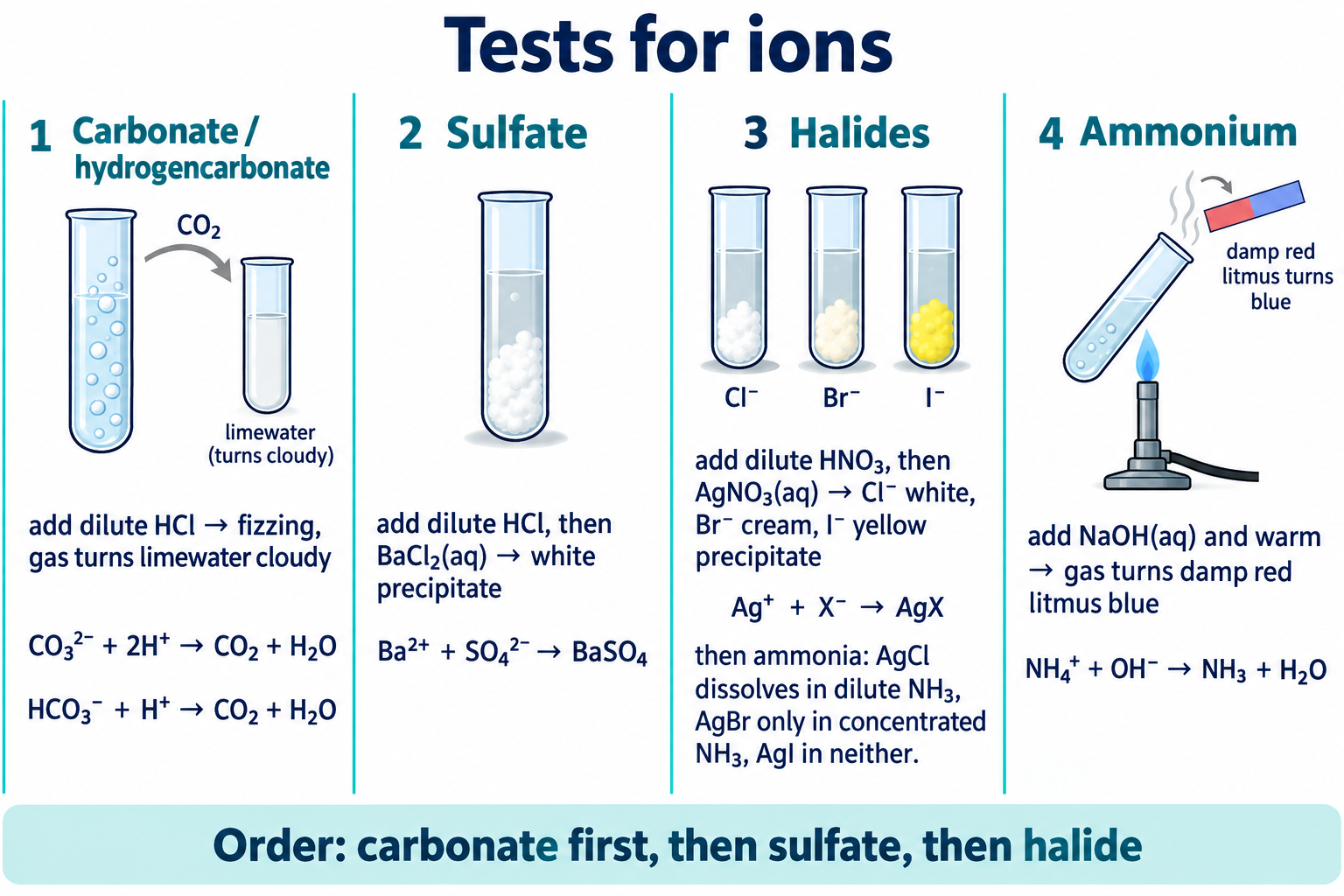
Each test has three parts to record: the reagent, the observation and the ionic equation for what happened.
Metal ions in the same sample can be identified by a flame test (Group 1 and 2 metals) or by adding sodium hydroxide solution and watching for a precipitate, as described on the Thermal Stability and Flame Colours and Solubility Trends pages.
These tests are assessed practically in Required practical 4 (tests for ions).
Technique point: A test is only valid when the reagent could not have produced the observation on its own. That is why the acid is always named and always added first.
Check: Identifying an Unknown
Work through the results of a sequence of tests on an unknown salt and name both ions.
Common Exam Points
Describe the test for a halide ion
Add dilute nitric acid, then silver nitrate solution; a white, cream or yellow precipitate forms for chloride, bromide or iodide; confirm with dilute and concentrated ammonia.
Explain why nitric acid is used and not hydrochloric acid
Hydrochloric acid contains chloride ions, which would give a white precipitate with silver ions whatever the sample.
Write the ionic equation for the ammonium test
NH₄⁺ + OH⁻ → NH₃ + H₂O.
Do not say
“Add silver nitrate then hydrochloric acid”; “the litmus paper is dipped into the solution”; “carbon dioxide turns limewater milky” without stating the fizzing first.
FAQs
Use these quick answers to check the tests for ions.
Why is nitric acid used in the halide test?
Hydrochloric acid contains chloride ions, which would give a white precipitate with silver ions. Nitric acid removes carbonate and hydroxide ions without adding a halide.
Why test for carbonate before sulfate?
Carbonate ions give a white precipitate with barium ions, so they must be removed by acid before barium chloride is added.
How do I test for ammonium ions?
Add sodium hydroxide solution and warm; ammonia gas is given off and turns damp red litmus paper blue.
How do I tell a carbonate from a hydrogencarbonate?
Both fizz with acid. Add magnesium sulfate solution: carbonate ions give a precipitate in the cold, hydrogencarbonate ions only on heating.
What confirms a halide after the silver nitrate test?
Ammonia solution: silver chloride dissolves in dilute ammonia, silver bromide in concentrated ammonia, silver iodide in neither.
Copyright and author footprint: This OLS revision page was written for Online Learning System by Dr. Mohammed Al-Fatah. It is designed for A Level Chemistry revision and should not be copied or redistributed without permission.
Keep this note — free
Save your progress across every AQA topic. A free account remembers which topics you have covered, saves your question scores, and syncs across your phone and laptop.
- Track every topic you have finished
- Keep your practice-question scores
- No payment, no card, free forever
Already registered? Log in