Disproportionation Reactions of Chlorine
A concise revision guide to chlorine with water (and in sunlight), with cold dilute alkali to make bleach and with hot alkali, tracked with oxidation states, the analogous reactions of bromine and iodine, and the benefits and risks of chlorinating water.
Chlorine and Water
Chlorine dissolves slightly in water and reacts with it in a disproportionation reaction. One chlorine atom is reduced to chloride (0 to −1) and the other is oxidised to chlorate(I) (0 to +1):
Cl₂(g) + H₂O(l) ⇌ HCl(aq) + HClO(aq)
The solution, chlorine water, is a pale green mixture of hydrochloric acid and chloric(I) acid. Chloric(I) acid is a weak acid but a strong oxidising agent, which is what makes chlorine water a bleach: it turns damp litmus red and then white.
In bright sunlight a different reaction takes over: the chloric(I) acid decomposes, and overall chlorine oxidises water to oxygen while it is itself reduced to chloride:
2Cl₂ + 2H₂O → 4HCl + O₂
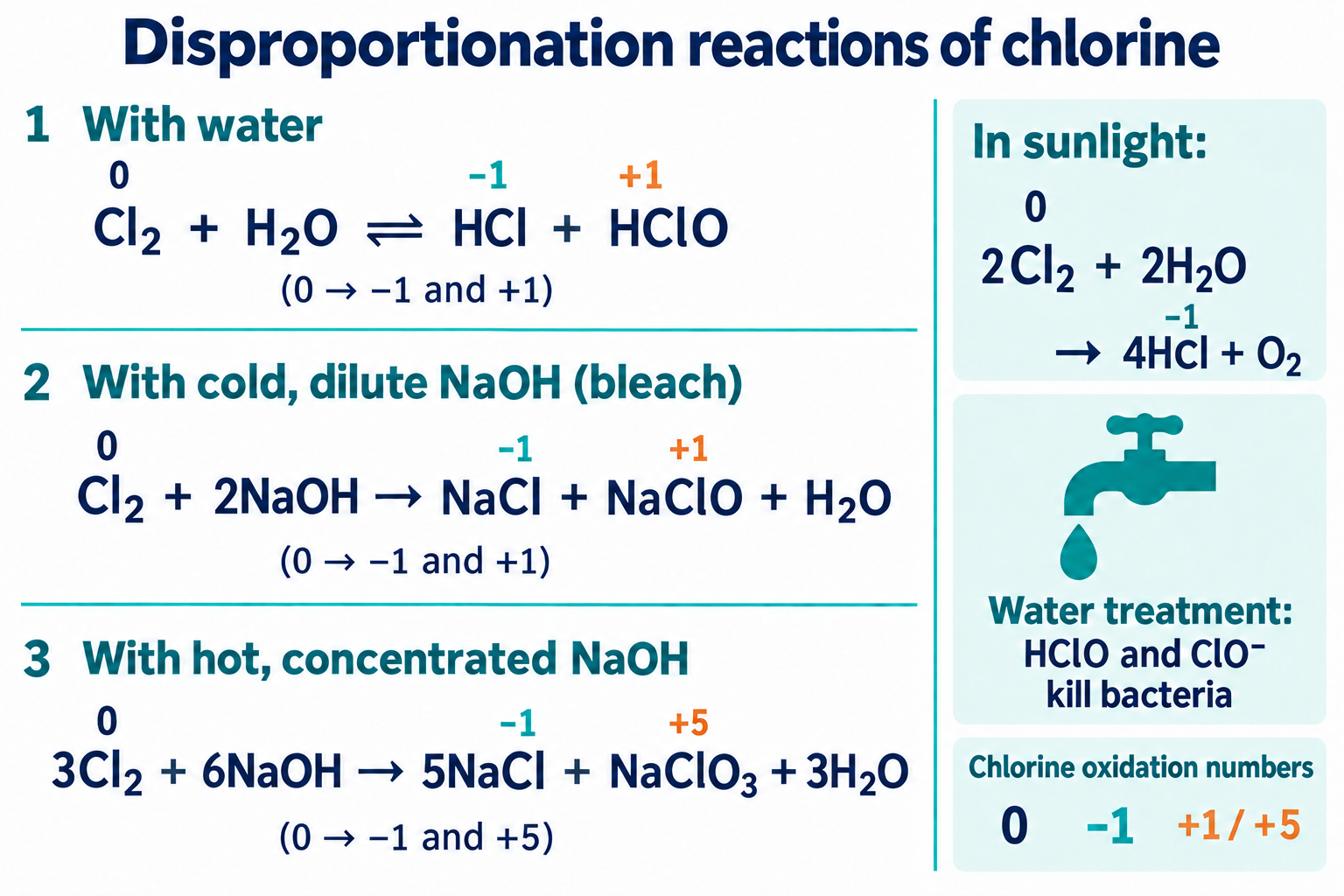
Track the chlorine oxidation numbers on each equation: every time Cl₂ goes both up and down it is a disproportionation.
Exam focus: Write the oxidation states above each chlorine and state both changes: “chlorine is reduced from 0 to −1 in HCl and oxidised from 0 to +1 in HClO”.
Check: Tracking Chlorine
Assign oxidation states in equations involving chlorine that are not printed above and decide which are disproportionation.
Water Treatment
Small amounts of chlorine are added to drinking water and swimming pools. The chloric(I) acid and chlorate(I) ions it forms are strong oxidising agents that kill bacteria, so chlorination has almost eliminated cholera, typhoid and other water-borne diseases where it is used. The dose is kept low, a few milligrams per cubic decimetre, so that the treated water is safe to drink.
There are risks. Chlorine gas is toxic, so storing and handling it needs care. Chlorine can also react with organic matter in the water to form chlorinated hydrocarbons, some of which are suspected of causing cancer. Society judges that the health benefits of preventing water-borne disease far outweigh these risks, but the decision is a judgement, not a certainty, and it is reviewed as the evidence changes.
Exam wording: A question on the benefits and risks wants both sides: “kills bacteria that cause disease” against “toxic gas; may form chlorinated hydrocarbons”, with the conclusion that the benefits outweigh the risks.
Chlorine and Cold Dilute Alkali: Bleach
With cold, dilute sodium hydroxide chlorine disproportionates in the same way as with water, but the acids are neutralised as they form, so the reaction goes to completion:
Cl₂ + 2NaOH → NaCl + NaClO + H₂O (about 15 °C)
The product, a solution of sodium chloride and sodium chlorate(I), is household bleach. Chlorine is reduced from 0 to −1 in NaCl and oxidised from 0 to +1 in NaClO. The chlorate(I) ion is the active ingredient: it oxidises coloured dyes to colourless products and kills microbes, which is why the same solution disinfects.
Key idea: Bleach is made from chlorine and cold dilute alkali; the oxidising ion in it is chlorate(I), ClO⁻, with chlorine at +1.
Check: Making Bleach
Complete the equation and oxidation number changes for the reaction of chlorine with cold alkali, then explain what the product does.
Chlorine and Hot Concentrated Alkali
With hot, concentrated sodium hydroxide (about 70 °C) chlorine reaches a higher oxidation state. The chlorate(I) ions formed at first disproportionate again, and the products are chloride and chlorate(V):
3Cl₂ + 6NaOH → 5NaCl + NaClO₃ + 3H₂O
Five chlorine atoms are reduced from 0 to −1 and one is oxidised from 0 to +5. The total decrease (5 × 1) equals the total increase (1 × 5), which is how the equation can be balanced from the oxidation states alone. Sodium chlorate(V) is used as a weedkiller and in making matches.
| Conditions | Products | Chlorine oxidation states | Use of product |
|---|---|---|---|
| water | HCl + HClO | −1 and +1 | water treatment |
| cold dilute NaOH, 15 °C | NaCl + NaClO | −1 and +1 | bleach |
| hot concentrated NaOH, 70 °C | NaCl + NaClO₃ | −1 and +5 | weedkiller |
Common mistake: Mixing up the two alkali reactions. Cold and dilute gives chlorate(I); hot and concentrated gives chlorate(V). The temperature is part of the answer.
Analogous Reactions of the Other Halogens
Bromine and iodine react with water and with alkali in the same way, though less readily. Bromine with cold dilute alkali gives bromide and bromate(I), Br₂ + 2NaOH → NaBr + NaBrO + H₂O, and with hot alkali gives bromate(V). Iodine with hot alkali gives iodide and iodate(V): 3I₂ + 6NaOH → 5NaI + NaIO₃ + 3H₂O. The equations are written by replacing Cl with the other halogen, because the oxidation states are the same.
Technique point: An unfamiliar halogen and alkali equation is balanced from the oxidation numbers: count how many atoms go to −1 for each that goes to +1 or +5.
Check: Analogous Equations
Write and balance the reaction of a different halogen with alkali under stated conditions, using oxidation numbers to fix the ratio.
Common Exam Points
Write the equation for chlorine with cold dilute sodium hydroxide and give the oxidation states
Cl₂ + 2NaOH → NaCl + NaClO + H₂O; chlorine 0 to −1 and 0 to +1.
Explain why chlorine is added to drinking water
It forms chloric(I) acid and chlorate(I) ions, which are oxidising agents that kill bacteria.
Give a risk of chlorinating water
Chlorine is toxic, and it may form chlorinated hydrocarbons that are suspected carcinogens.
Do not say
“Chlorine kills bacteria” without naming the oxidising species; “NaClO₃ forms with cold alkali”; “the reaction is neutralisation” for chlorine and alkali.
FAQs
Use these quick answers to check the disproportionation reactions of chlorine.
What happens when chlorine dissolves in water?
It disproportionates: Cl₂ + H₂O ⇌ HCl + HClO, with chlorine going to −1 in HCl and +1 in HClO.
Why is chlorine added to drinking water?
It forms chloric(I) acid and chlorate(I) ions, which are oxidising agents that kill bacteria.
What are the risks of chlorinating water?
Chlorine gas is toxic, and chlorine can react with organic matter to form chlorinated hydrocarbons, which may be carcinogenic.
What is the difference between cold dilute and hot concentrated alkali?
Cold dilute alkali gives chloride and chlorate(I), which is bleach; hot concentrated alkali gives chloride and chlorate(V).
What is the active ingredient in bleach?
The chlorate(I) ion, ClO⁻, in which chlorine is +1; it oxidises dyes and kills microbes.
Copyright and author footprint: This OLS revision page was written for Online Learning System by Dr. Mohammed Al-Fatah. It is designed for A Level Chemistry revision and should not be copied or redistributed without permission.
Keep this note — free
Save your progress across every AQA topic. A free account remembers which topics you have covered, saves your question scores, and syncs across your phone and laptop.
- Track every topic you have finished
- Keep your practice-question scores
- No payment, no card, free forever
Already registered? Log in