Trends in the Halogens
A concise revision guide to the trends in Group 7 (17): physical states and colours, melting and boiling points from London forces, electronegativity, bond strength and volatility, the fall in reactivity down the group, and predictions for fluorine and astatine.
GCSE Recap: The Halogens
Three quick questions on the halogens as you met them at GCSE: their outer shell, the ions they form and the family name.
Physical States and Colours
The halogens (Group 7 (17)) are non-metals that exist as diatomic molecules, X₂, held together by a single covalent bond. Each atom has seven outer electrons (ns² np⁵), so a halogen atom gains one electron in most of its reactions to form a halide ion, X⁻, and each element is one electron short of the noble gas after it.
| Element | State at room temperature | Colour | Boiling point / °C |
|---|---|---|---|
| Fluorine, F₂ | gas | pale yellow | −188 |
| Chlorine, Cl₂ | gas | pale green | −34 |
| Bromine, Br₂ | liquid | red-brown (orange vapour) | 59 |
| Iodine, I₂ | solid | grey-black (purple vapour) | 184 |
| Astatine, At₂ | solid (predicted) | black (predicted) | about 300 (predicted) |
The colours darken and the boiling points rise down the group, so the elements go from gas to liquid to solid. Iodine sublimes on gentle warming, going straight from the solid to a purple vapour.
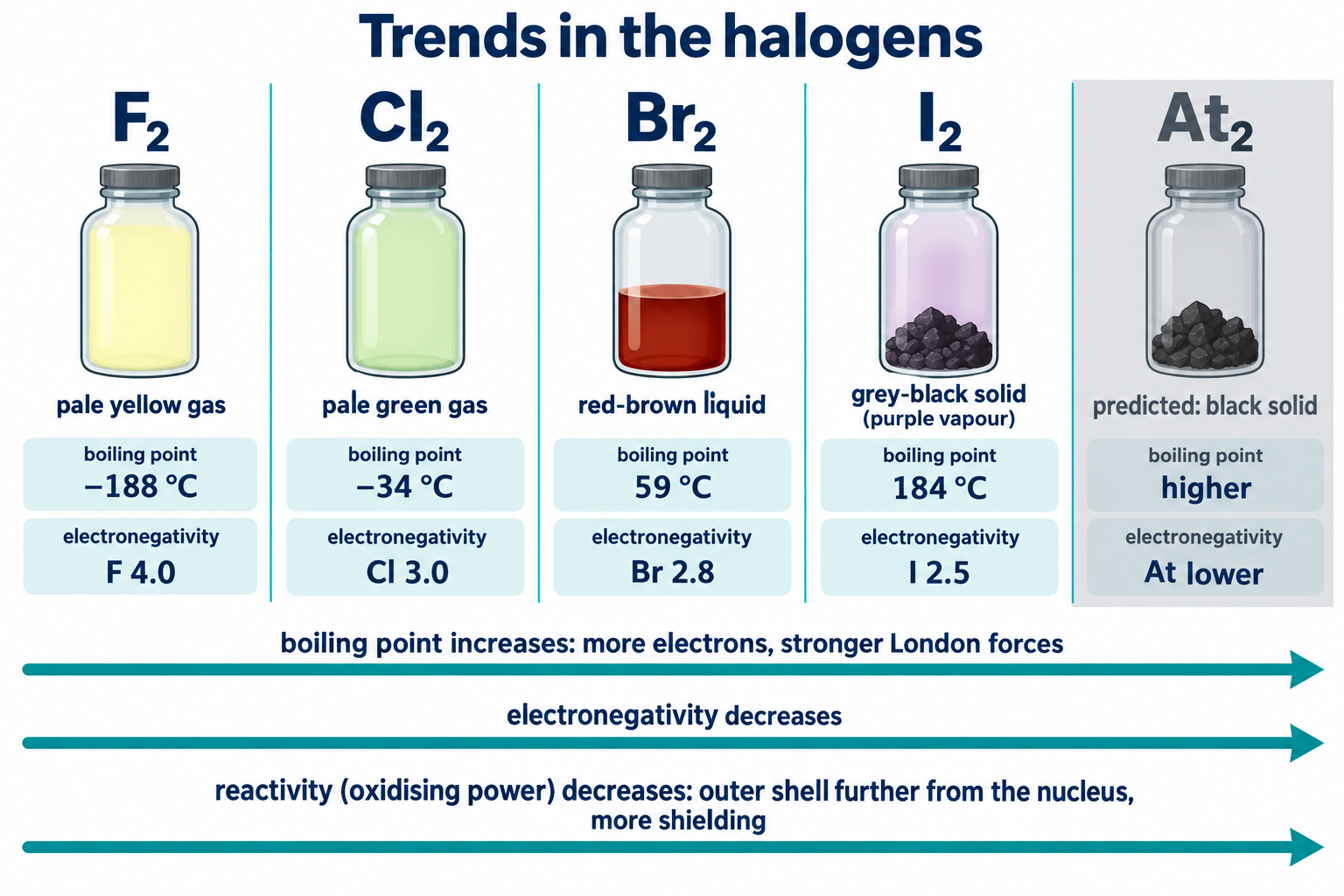
The strip shows the three trends together: colour deepening and boiling point rising down the group while electronegativity falls.
Exam focus: Learn the states and colours. Bromine is the only liquid non-metal element, and iodine vapour is purple, not brown.
Melting and Boiling Points
The halogen molecules are non-polar, so the only forces between them are London forces (instantaneous dipole–induced dipole forces). Down the group each molecule has more electrons, so the instantaneous dipoles are larger and the London forces are stronger. More energy is needed to separate the molecules, and the melting and boiling points increase down the group.
The covalent bond inside each molecule is not broken on boiling, so its strength is irrelevant to the boiling point. Answers that mention “stronger bonds” for the boiling point trend lose the mark.
Exam sentence: Iodine has a higher boiling point than chlorine because iodine molecules have more electrons, so the London forces between them are stronger and more energy is needed to overcome them.
Check: Volatility Down the Group
Explain the state and boiling point of a halogen from its electron count, and spot the answer that confuses covalent bonds with intermolecular forces.
Electronegativity
Electronegativity decreases down the group. Fluorine, at 4.0 on the Pauling scale, is the most electronegative element of all; chlorine is 3.0, bromine 2.8 and iodine 2.5. Down the group the bonding pair in a covalent bond is further from the halogen nucleus and shielded by more inner shells, so the nucleus attracts it less strongly, and the higher nuclear charge does not make up the difference.
The same argument explains why the halogens become weaker oxidising agents down the group: an atom that attracts a bonding pair less strongly also attracts an extra electron less strongly.
| Element | Electronegativity | Atomic radius / pm | X–X bond enthalpy / kJ mol⁻¹ |
|---|---|---|---|
| F | 4.0 | 71 | 158 |
| Cl | 3.0 | 99 | 243 |
| Br | 2.8 | 114 | 193 |
| I | 2.5 | 133 | 151 |
Key idea: Electronegativity, oxidising power and reactivity all fall down the group for the same reason: the outer shell is further from the nucleus and more shielded.
Reactivity Down the Group
A halogen reacts by gaining an electron to complete its outer shell. Reactivity decreases down the group because the incoming electron enters a shell further from the nucleus, shielded by more inner electrons, so it is less strongly attracted. Fluorine is the most reactive element; iodine reacts only slowly and often reversibly.
The trend shows most clearly in the displacement reactions, where a more reactive halogen takes electrons from the ions of a less reactive one. These are treated on the Halogens as Oxidising Agents page.
Exam sentence: Reactivity decreases down the group because the atomic radius and shielding increase, so the nucleus attracts an incoming electron less strongly and a halide ion forms less readily.
Check: Explaining the Reactivity Trend
Choose the complete explanation for the falling reactivity of the halogens and correct an incomplete one.
Predicting Fluorine and Astatine
Trends allow predictions about the elements at each end of the group. Fluorine is a pale yellow gas, the strongest oxidising agent of the group, so reactive that it attacks water and glass, and it forms only the −1 oxidation state because nothing is more electronegative. Its hydride, HF, is a weak acid with hydrogen bonding between its molecules. Astatine is predicted to be a black solid with a high boiling point, the weakest oxidising agent of the group, displaced from its salts by every other halogen, forming a silver salt that is insoluble and does not dissolve in ammonia, and having positive oxidation states in its compounds with oxygen.
| Property | Fluorine (top) | Astatine (bottom) |
|---|---|---|
| State and colour | pale yellow gas | black solid |
| Oxidising power | strongest | weakest |
| Displacement | displaces all other halogens | displaced by all other halogens |
| Reaction with hydrogen | explosive even in the dark | very slow, reversible |
| Silver halide | soluble, no precipitate | insoluble, insoluble in ammonia |
Technique point: A prediction question wants the trend, the value at the nearest known element, and the predicted value. “Iodine is a solid, so astatine, which is lower, will also be a solid with a higher melting point.”
Check: Predictions from Trends
Use the trends to predict properties of astatine and fluorine that are not listed in the table above.
Common Exam Points
Explain the trend in boiling points
More electrons per molecule down the group give stronger London forces, so more energy is needed to separate the molecules.
Explain the trend in electronegativity
The bonding pair is further from the nucleus and more shielded down the group, so it is less strongly attracted.
Predict a property of astatine
Continue the trend from iodine: solid, dark, least reactive, weakest oxidising agent.
Do not say
“Stronger bonds so higher boiling point”; “iodine vapour is brown”; “fluorine is less reactive because it is small”.
FAQs
Use these quick answers to check the trends in the Group 7 (17) elements.
Why do the boiling points increase down the group?
The molecules have more electrons, so the London forces between them are stronger and more energy is needed to separate them.
Why does electronegativity decrease down the group?
The bonding pair is further from the nucleus and more shielded, so the nucleus attracts it less strongly.
Why is fluorine the most reactive halogen?
Its outer shell is closest to the nucleus and least shielded, so it attracts an extra electron most strongly.
What colour is iodine vapour?
Purple. The solid is grey-black and its solution in water is brown, but the vapour is purple.
What can I predict about astatine?
It is below iodine, so it should be a dark solid with a higher boiling point, the weakest oxidising agent of the group, and displaced from its salts by every other halogen.
Copyright and author footprint: This OLS revision page was written for Online Learning System by Dr. Mohammed Al-Fatah. It is designed for A Level Chemistry revision and should not be copied or redistributed without permission.
Keep this note — free
Save your progress across every AQA topic. A free account remembers which topics you have covered, saves your question scores, and syncs across your phone and laptop.
- Track every topic you have finished
- Keep your practice-question scores
- No payment, no card, free forever
Already registered? Log in