Halide Ions: Reducing Agents and Tests
A concise revision guide to the halide ions as reducing agents, shown by the solid halides with concentrated sulfuric acid, the silver nitrate test followed by ammonia, and the hydrogen halides with ammonia and with water.
Halide Ions as Reducing Agents
A halide ion acts as a reducing agent by giving up an electron to become the halogen. The reducing power increases down the group: iodide ions are strong reducing agents, bromide ions moderate, chloride ions weak and fluoride ions barely reducing at all. The larger the ion, the further the outer electrons are from the nucleus, the more they are shielded, and the more easily one is lost.
This is the mirror image of the trend in the halogens as oxidising agents. Chlorine is the best at taking electrons; iodide is the best at giving them.
Key idea: Oxidising power of the halogens falls down the group; reducing power of the halide ions rises down the group. Both follow atomic radius and shielding.
Solid Halides with Concentrated Sulfuric Acid
Concentrated sulfuric acid is both an acid and an oxidising agent, so what it does to a solid halide depends on how good a reducing agent the halide ion is. Every halide first gives the hydrogen halide in an acid–base reaction:
NaCl + H₂SO₄ → NaHSO₄ + HCl (steamy fumes of HCl)
Chloride ions are too weak a reducing agent to reduce the sulfuric acid, so the reaction stops there. Bromide ions reduce the sulfuric acid to sulfur dioxide, and the hydrogen bromide formed is oxidised to bromine:
NaBr + H₂SO₄ → NaHSO₄ + HBr then 2HBr + H₂SO₄ → Br₂ + SO₂ + 2H₂O
Iodide ions are strong enough to reduce sulfuric acid all the way from +6 to +4, 0 and −2:
2HI + H₂SO₄ → I₂ + SO₂ + 2H₂O 6HI + H₂SO₄ → 3I₂ + S + 4H₂O 8HI + H₂SO₄ → 4I₂ + H₂S + 4H₂O
| Solid halide | Products | Observations | Lowest oxidation state of sulfur |
|---|---|---|---|
| NaCl | HCl only | steamy white fumes | +6 (not reduced) |
| NaBr | HBr, Br₂, SO₂ | steamy fumes, orange-brown vapour, sharp choking gas | +4 |
| NaI | HI, I₂, SO₂, S, H₂S | steamy fumes, purple vapour and black solid, yellow solid, bad-egg smell | −2 |
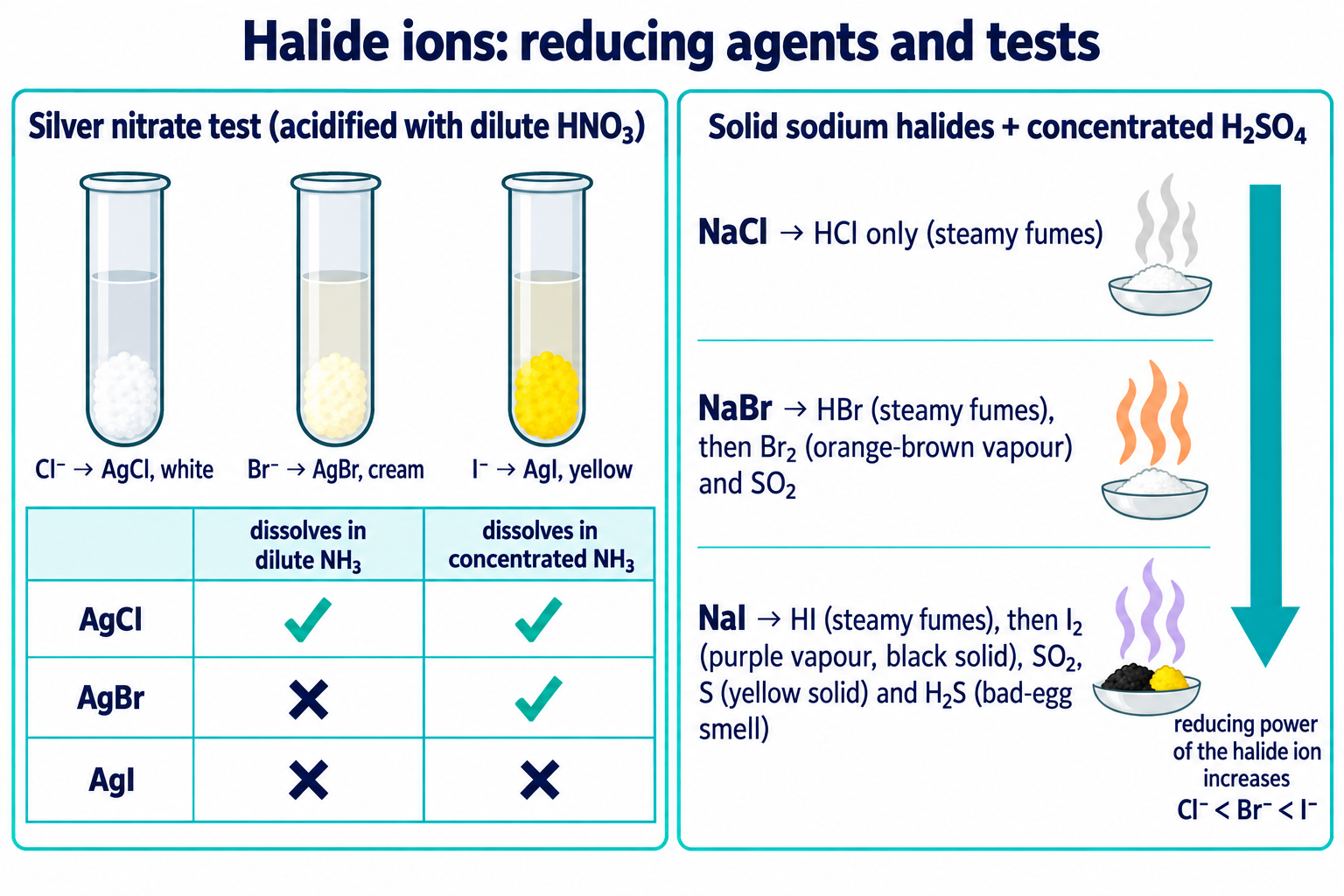
The products on the right show the reducing power rising from chloride to iodide, and the precipitates on the left show the test that distinguishes them.
Exam focus: Give the oxidation state of sulfur for each product: +6 in H₂SO₄, +4 in SO₂, 0 in S, −2 in H₂S. The further it falls, the stronger the reducing agent that caused it.
Check: Halides and Concentrated Sulfuric Acid
Predict the products and observations for a halide not used above, and give the oxidation number changes of sulfur.
The Silver Nitrate Test
To identify a halide ion in solution, first add dilute nitric acid, then silver nitrate solution. The halide ions precipitate as silver halides of different colours:
Ag⁺(aq) + Cl⁻(aq) → AgCl(s) white Ag⁺(aq) + Br⁻(aq) → AgBr(s) cream Ag⁺(aq) + I⁻(aq) → AgI(s) yellow
The nitric acid removes carbonate and hydroxide ions, which would otherwise give precipitates of silver carbonate or silver oxide and confuse the result. Hydrochloric acid cannot be used because it contains chloride ions. Fluoride ions give no precipitate, because silver fluoride is soluble.
The colours are close, so the result is confirmed with ammonia solution. Silver chloride dissolves in dilute ammonia, silver bromide dissolves only in concentrated ammonia, and silver iodide does not dissolve in either. The silver ions are removed from the solid as the complex ion [Ag(NH₃)₂]⁺, and the less soluble the halide, the harder this is.
| Halide | Precipitate | Dilute NH₃(aq) | Concentrated NH₃(aq) |
|---|---|---|---|
| Chloride | white AgCl | dissolves | dissolves |
| Bromide | cream AgBr | insoluble | dissolves |
| Iodide | yellow AgI | insoluble | insoluble |
Exam wording: “Acidify with dilute nitric acid, add silver nitrate solution: a cream precipitate that is insoluble in dilute ammonia but dissolves in concentrated ammonia shows bromide ions.”
Check: Reading a Silver Nitrate Result
Identify the halide from precipitate and ammonia results for samples not described above, and explain a false result.
The Hydrogen Halides
The hydrogen halides are colourless gases that fume in moist air. They dissolve in water to give acids, because the H–X bond breaks heterolytically and releases hydrogen ions: HCl(g) + H₂O(l) → H₃O⁺(aq) + Cl⁻(aq), often written HCl → H⁺ + Cl⁻. Hydrochloric, hydrobromic and hydriodic acids are strong acids; hydrofluoric acid is weak, because the H–F bond is so strong and the fluoride ion is strongly hydrogen bonded to water.
With ammonia gas the hydrogen halides form white smoke of the solid ammonium halide, an acid–base reaction in which a hydrogen ion moves from the acid to the lone pair on ammonia:
HCl(g) + NH₃(g) → NH₄Cl(s) HBr(g) + NH₃(g) → NH₄Br(s)
The white smoke forming where the two gases meet is the classic test for either gas.
Remember: Hydrogen halide + water is an acid forming; hydrogen halide + ammonia is a salt forming. Neither is a redox reaction: the halogen stays at −1 throughout.
Check: Reactions of the Hydrogen Halides
Write equations for the hydrogen halides with water and with ammonia, and decide which reactions on this page are redox.
Common Exam Points
Explain why iodide ions are stronger reducing agents than chloride ions
The iodide ion is larger, its outer electrons are further from the nucleus and more shielded, so an electron is lost more easily.
Give the products when sodium bromide reacts with concentrated sulfuric acid
HBr, then Br₂ and SO₂ with water; sulfur is reduced from +6 to +4.
Describe how to distinguish chloride, bromide and iodide ions
Acidified silver nitrate gives white, cream or yellow precipitates; dilute then concentrated ammonia dissolves AgCl, only AgBr, and neither, respectively.
Do not say
“Sodium chloride gives chlorine with concentrated sulfuric acid”; “acidify with hydrochloric acid”; “silver iodide dissolves in concentrated ammonia”.
FAQs
Use these quick answers to check the halide ion reactions and the silver nitrate test.
Why are iodide ions better reducing agents than chloride ions?
The iodide ion is larger, so its outer electrons are further from the nucleus and more shielded, and one is lost more easily.
What does sodium chloride give with concentrated sulfuric acid?
Only hydrogen chloride, seen as steamy fumes, because chloride ions cannot reduce sulfuric acid.
Why is a bad-egg smell seen with sodium iodide?
Iodide ions reduce sulfuric acid all the way to hydrogen sulfide, in which sulfur is −2.
Why acidify with nitric acid before adding silver nitrate?
To remove carbonate and hydroxide ions, which would also give precipitates with silver ions, without adding chloride ions.
Why does silver chloride dissolve in ammonia but silver iodide does not?
Ammonia forms the complex ion [Ag(NH₃)₂]⁺ with silver ions. Silver chloride is soluble enough to supply them, silver iodide is too insoluble.
Copyright and author footprint: This OLS revision page was written for Online Learning System by Dr. Mohammed Al-Fatah. It is designed for A Level Chemistry revision and should not be copied or redistributed without permission.
Keep this note — free
Save your progress across every AQA topic. A free account remembers which topics you have covered, saves your question scores, and syncs across your phone and laptop.
- Track every topic you have finished
- Keep your practice-question scores
- No payment, no card, free forever
Already registered? Log in