Electron Transfer and Half-Equations
A concise revision guide to oxidation and reduction as electron transfer and as changes in oxidation number, oxidising and reducing agents, why metals form positive and non-metals negative ions, and how to write and combine ionic half-equations.
GCSE Recap: OIL RIG
Three quick questions on oxidation and reduction as gain and loss of oxygen and of electrons.
Oxidation and Reduction as Electron Transfer
At GCSE, oxidation meant gaining oxygen. At A Level the definition is widened so that it covers every reaction: oxidation is the loss of electrons and reduction is the gain of electrons. The memory line OIL RIG (Oxidation Is Loss, Reduction Is Gain) is still the fastest way to keep the two the right way round.
Electrons cannot be lost into thin air, so oxidation and reduction always happen together. When magnesium burns in chlorine, each magnesium atom loses two electrons and each chlorine atom gains one. The reaction is a redox reaction: one species is oxidised while another is reduced.
Definition: Oxidation is the loss of electrons; reduction is the gain of electrons. A redox reaction is one in which both happen.
Oxidation and Reduction as Changes in Oxidation number
Because an oxidation number counts the electrons an atom controls, electron transfer shows up as a change in oxidation number. An atom that is oxidised loses electrons, so its oxidation number increases. An atom that is reduced gains electrons, so its oxidation number decreases.
This second definition is more useful in practice, because it works even when no ions are formed. In the reaction of hydrogen with chlorine, H₂ + Cl₂ → 2HCl, no electron is transferred outright, but hydrogen goes from 0 to +1 and chlorine from 0 to −1. Hydrogen has been oxidised and chlorine reduced.
| Process | Electrons | oxidation number | Example |
|---|---|---|---|
| Oxidation | lost | increases | Mg → Mg²⁺ + 2e⁻ (0 to +2) |
| Reduction | gained | decreases | Cl₂ + 2e⁻ → 2Cl⁻ (0 to −1) |
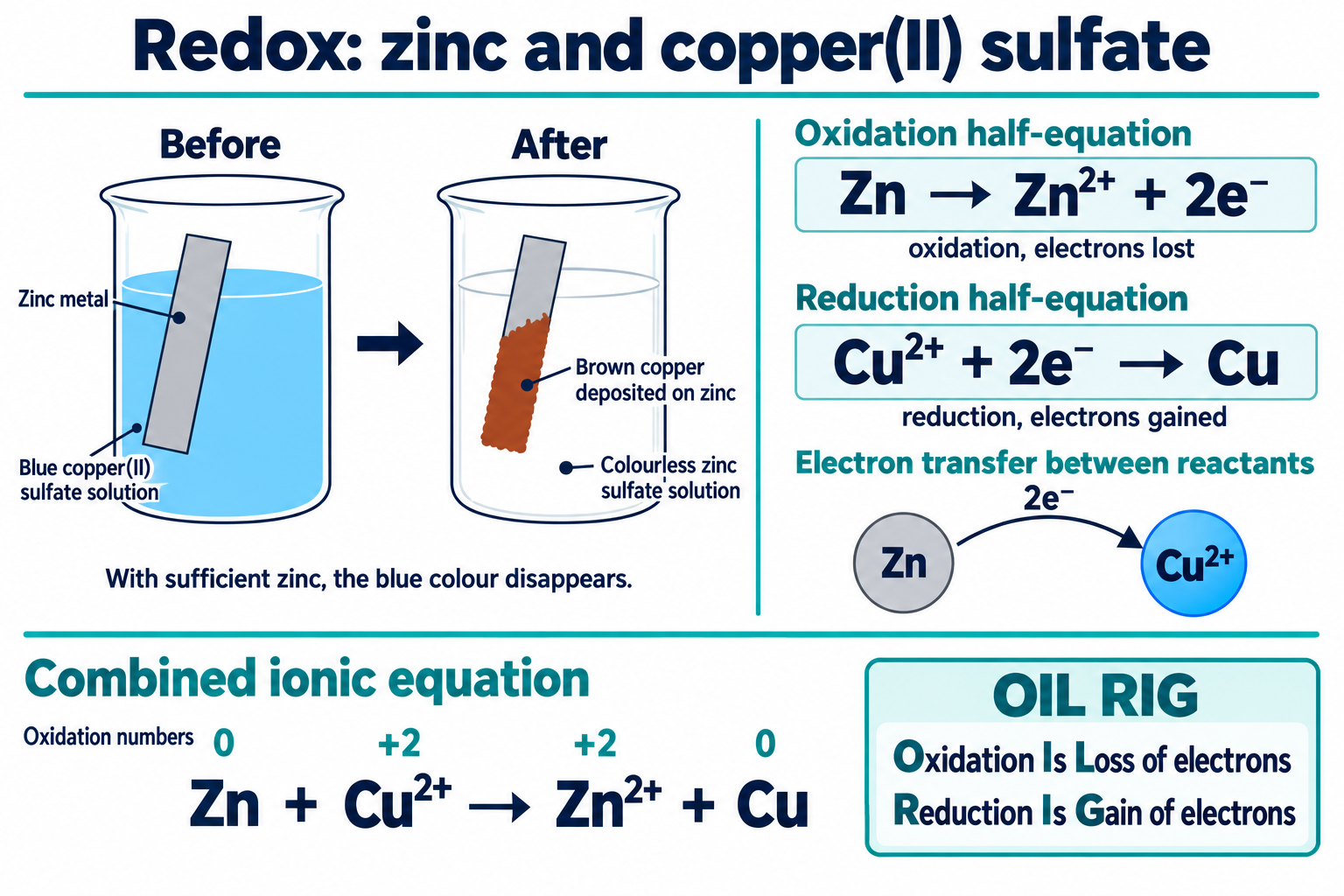
Zinc is oxidised (0 to +2) and copper is reduced (+2 to 0); the two electrons lost by zinc are the two gained by each copper ion.
Exam focus: State both halves of the change: “magnesium is oxidised because its oxidation number increases from 0 to +2” scores; “magnesium is oxidised” alone often does not.
Check: Oxidised or Reduced?
Decide, from the change in oxidation number, which element is oxidised and which is reduced in reactions you have not met on this page.
Oxidising Agents and Reducing Agents
An oxidising agent oxidises another species, so it must take electrons from it. The oxidising agent is therefore itself reduced. A reducing agent gives electrons to another species and is itself oxidised. The names describe what the substance does to something else, which is why students so often reverse them.
In the reaction Zn + Cu²⁺ → Zn²⁺ + Cu, zinc loses electrons, so zinc is the reducing agent, and copper(II) ions gain electrons, so Cu²⁺ is the oxidising agent. Common oxidising agents include oxygen, chlorine, acidified potassium manganate(VII) and acidified potassium dichromate(VI). Common reducing agents include reactive metals, hydrogen, carbon monoxide and iodide ions.
Memory line: The oxidising agent gets reduced; the reducing agent gets oxidised. An agent always does the opposite of what happens to it.
Metals and Non-Metals Forming Ions
Metals have few outer electrons that are weakly held, so a metal atom loses them to form a positive ion. Its oxidation number rises from 0 to a positive value, which is oxidation. Non-metals have nearly full outer shells and attract electrons strongly, so a non-metal atom gains electrons to form a negative ion. Its oxidation number falls from 0 to a negative value, which is reduction.
In sodium reacting with sulfur, 2Na + S → Na₂S, sodium is oxidised (0 to +1) and sulfur is reduced (0 to −2). The general pattern, metal oxidised and non-metal reduced, holds for every reaction between a metal and a non-metal.
Key idea: Metal atoms are reducing agents because they give electrons away; non-metal atoms such as the halogens are oxidising agents because they take electrons.
Writing Ionic Half-Equations
A half-equation shows one half of a redox reaction, either the oxidation or the reduction, with the electrons written in explicitly. Electrons appear on the right of an oxidation half-equation (they are lost) and on the left of a reduction half-equation (they are gained).
- Write the species before and after the change: Fe²⁺ → Fe³⁺.
- Balance the atoms. Here the iron is already balanced.
- Balance the charge by adding electrons to the more positive side: Fe²⁺ → Fe³⁺ + e⁻.
Half-equations in acidic solution often need H⁺ and H₂O to balance oxygen and hydrogen. For the reduction of manganate(VII) ions: MnO₄⁻ → Mn²⁺; add 4H₂O on the right to balance the four oxygens; add 8H⁺ on the left to balance the hydrogens; the charge is now +7 on the left and +2 on the right, so add 5e⁻ on the left: MnO₄⁻ + 8H⁺ + 5e⁻ → Mn²⁺ + 4H₂O.
Technique point: Balance atoms first, charge last. The number of electrons must equal the total change in oxidation number: manganese falls from +7 to +2, which is five electrons gained.
Check: Building a Half-Equation
Put the steps of writing a half-equation in order, then complete a half-equation for an ion not used above.
Combining Half-Equations
To build the full ionic equation, the electrons lost in the oxidation half-equation must equal the electrons gained in the reduction half-equation. Multiply one or both half-equations until the electrons match, add them, and cancel the electrons and anything else that appears on both sides.
Worked example: acidified manganate(VII) ions oxidising iron(II) ions.
Oxidation: Fe²⁺ → Fe³⁺ + e⁻ (× 5)
Reduction: MnO₄⁻ + 8H⁺ + 5e⁻ → Mn²⁺ + 4H₂O
Adding gives MnO₄⁻ + 8H⁺ + 5Fe²⁺ → Mn²⁺ + 4H₂O + 5Fe³⁺. Check: the charge on the left is −1 + 8 + 10 = +17; on the right +2 + 15 = +17.
Oxidation numbers give a second way to balance a redox equation. The total increase in oxidation number must equal the total decrease. Iron rises by 1 per ion and manganese falls by 5 per ion, so five iron(II) ions are needed for each manganate(VII) ion, which is the same ratio the electrons gave.
Exam focus: After adding, check three things: atoms balance, charges balance, and no electrons are left in the equation. A leftover e⁻ means the multiplying step was missed.
Check: Combining Half-Equations
Combine two half-equations for a redox reaction not shown on this page, then check the charge balance.
Common Exam Points
Define oxidation and reduction
Oxidation is loss of electrons or an increase in oxidation number; reduction is gain of electrons or a decrease in oxidation number.
Identify the oxidising agent
The species that is reduced (gains electrons, oxidation number falls). Name the species, for example “Cu²⁺”, not the element alone.
Write a half-equation in acid
Balance the main atoms, add H₂O for oxygen, H⁺ for hydrogen, then electrons for charge.
Do not say
“The oxidising agent is oxidised”; “oxidation is gain of oxygen” as the only definition; “electrons on both sides” in a finished ionic equation.
FAQs
Use these quick answers to check the electron-transfer ideas and half-equations.
What is the quickest way to remember oxidation and reduction?
OIL RIG: oxidation is loss of electrons, reduction is gain. In terms of oxidation numbers, oxidation is an increase and reduction is a decrease.
Why is the oxidising agent the one that is reduced?
An oxidising agent takes electrons from something else. Gaining those electrons is reduction, so the oxidising agent is reduced while it does its job.
Where do the electrons go in a half-equation?
On the right for oxidation, because they are lost, and on the left for reduction, because they are gained. Add enough to balance the charge.
How do I balance a half-equation in acid?
Balance the main element, add water to balance oxygen, add hydrogen ions to balance hydrogen, then add electrons to balance the charge.
How do I combine two half-equations?
Multiply them so the electrons lost equal the electrons gained, add them, and cancel the electrons and anything that appears on both sides.
Copyright and author footprint: This OLS revision page was written for Online Learning System by Dr. Mohammed Al-Fatah. It is designed for A Level Chemistry revision and should not be copied or redistributed without permission.
Keep this note — free
Save your progress across every Cambridge topic. A free account remembers which topics you have covered, saves your question scores, and syncs across your phone and laptop.
- Track every topic you have finished
- Keep your practice-question scores
- No payment, no card, free forever
Already registered? Log in