Disproportionation
A concise revision guide to disproportionation: one element in a single species oxidised and reduced at the same time, how to spot it with oxidation numbers, the chlorine and hydrogen peroxide examples, and which species can and cannot disproportionate.
What Disproportionation Is
Disproportionation is a redox reaction in which the same element in a single species is both oxidised and reduced at the same time. Some of the atoms of that element go up in oxidation number while others go down. The element must be in an intermediate oxidation number to begin with, so that it has room to move in both directions.
Chlorine gas reacting with water is the classic case. Chlorine starts at 0; in the products it is −1 in hydrochloric acid and +1 in chloric(I) acid:
Cl₂(g) + H₂O(l) ⇌ HCl(aq) + HClO(aq)
One chlorine atom has been reduced (0 to −1) and the other oxidised (0 to +1). Chlorine is both the oxidising agent and the reducing agent.
Definition: A disproportionation reaction is one in which an element in a single species is simultaneously oxidised and reduced.
Spotting It with Oxidation numbers
To decide whether a reaction is a disproportionation, assign oxidation numbers to every atom on both sides and look for one element that appears at one value on the left and at two different values on the right, one higher and one lower.
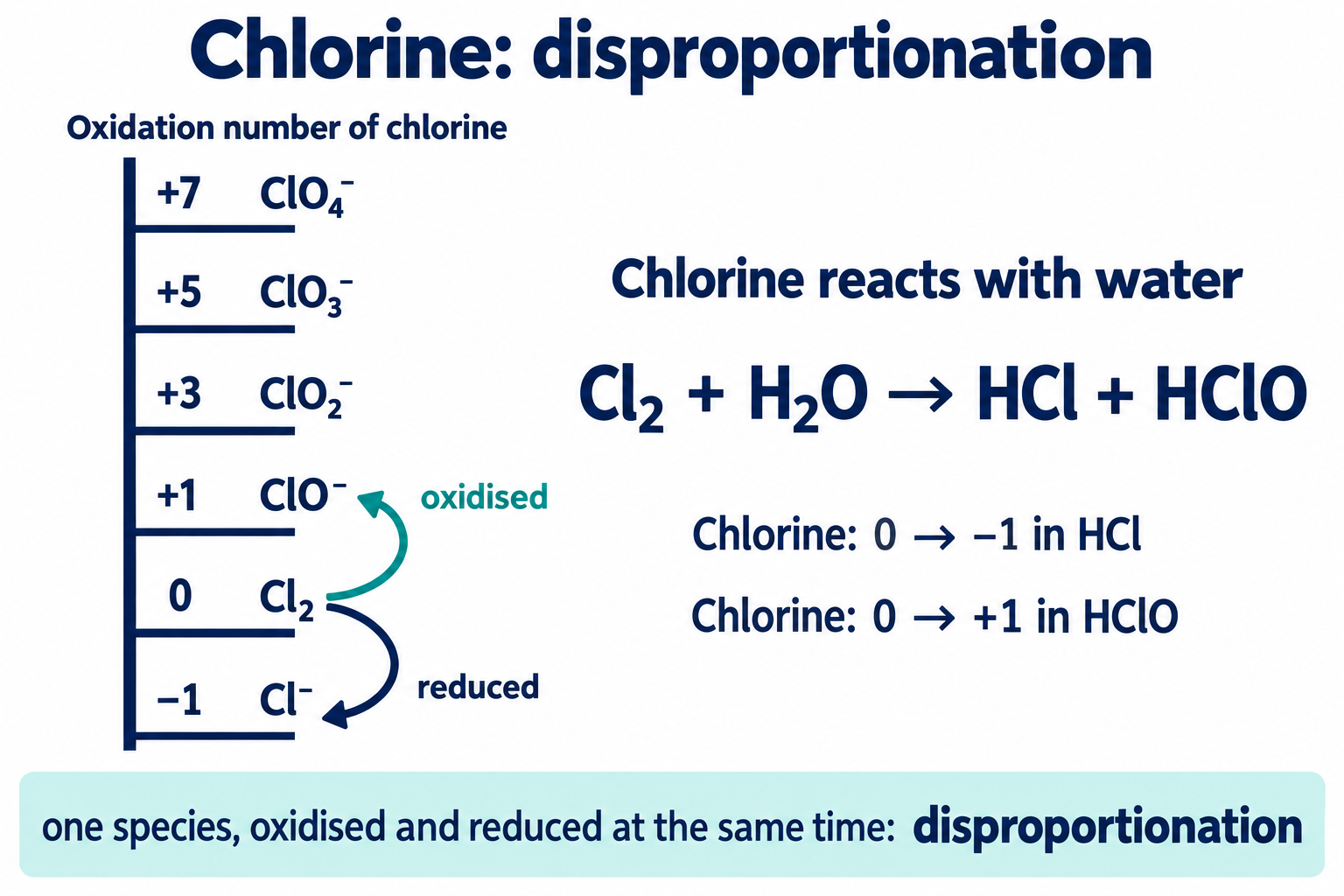
From the 0 rung, chlorine goes down to −1 and up to +1 at the same time, which is the pattern that defines disproportionation.
Worked example: copper(I) ions in solution. 2Cu⁺(aq) → Cu(s) + Cu²⁺(aq). Copper starts at +1 and finishes at 0 (reduced) and +2 (oxidised). This is disproportionation, and it is why copper(I) sulfate cannot exist in water.
Worked example: hydrogen peroxide decomposing. 2H₂O₂ → 2H₂O + O₂. Oxygen starts at −1 and finishes at −2 in water (reduced) and 0 in oxygen gas (oxidised). Disproportionation again.
Exam focus: Write the oxidation number above every atom of the element concerned on both sides, then state both changes with their numbers: “chlorine is reduced from 0 to −1 and oxidised from 0 to +1”.
Check: Is It Disproportionation?
Assign oxidation numbers in reactions not shown above and decide which are disproportionation.
Why Chlorine Disproportionates
Chlorine sits at 0, and it forms stable compounds both below (chloride, −1) and above (chlorate(I) +1, chlorate(V) +5). A reaction that sends some atoms each way can therefore be favourable. Which higher state forms depends on the conditions: with water or cold dilute alkali chlorine reaches +1, but with hot concentrated alkali it goes to +5, forming chlorate(V) ions, ClO₃⁻, alongside chloride.
These reactions are so important in water treatment and bleach manufacture that they have a page of their own in the Group 17 section: Disproportionation Reactions of Chlorine. Here the point is the pattern, not the industrial detail.
Key idea: An element can only disproportionate if it is in an intermediate oxidation number. Fluorine cannot, because it has no positive oxidation numbers; sodium cannot, because it has no negative ones.
The Reverse Process
The reverse of disproportionation, in which two species containing the same element at different oxidation numbers react to give one product at an intermediate value, is called comproportionation. Iodate(V) ions and iodide ions in acid give iodine: IO₃⁻ + 5I⁻ + 6H⁺ → 3I₂ + 3H₂O. Iodine goes from +5 and −1 to 0. The name is rarely examined, but recognising the pattern helps when an unfamiliar equation appears.
Remember: Disproportionation: one element, one starting value, two finishing values. Comproportionation: one element, two starting values, one finishing value.
Check: Which Elements Can Disproportionate?
Use the idea of intermediate oxidation numbers to decide which of a list of species could disproportionate.
Common Exam Points
Define disproportionation
A reaction in which an element in a single species is simultaneously oxidised and reduced.
Show that a reaction is a disproportionation
Give the oxidation number of the element in the reactant and in each product, and state which change is oxidation and which is reduction.
Do not say
“Two different elements are oxidised and reduced” (that is ordinary redox); “chlorine is neutralised”; “the oxidation number of chlorine in HClO is −1”.
FAQs
Use these quick answers to check the disproportionation idea.
What is disproportionation?
A redox reaction in which the same element in one species is both oxidised and reduced at the same time.
How do I recognise it in an equation?
Assign oxidation numbers. If one element starts at a single value and finishes at two different values, one higher and one lower, the reaction is a disproportionation.
Why can chlorine disproportionate but fluorine cannot?
Chlorine starts at 0 and has stable oxidation numbers both above and below it. Fluorine has no positive oxidation numbers, so it can only be reduced.
Is the reaction of chlorine with water reversible?
Yes. Chlorine water contains chlorine, hydrochloric acid and chloric(I) acid in equilibrium. With alkali the acids are neutralised and the reaction goes to completion.
Is a reaction where two different elements are oxidised and reduced a disproportionation?
No. That is an ordinary redox reaction. Disproportionation needs the same element going both ways.
Copyright and author footprint: This OLS revision page was written for Online Learning System by Dr. Mohammed Al-Fatah. It is designed for A Level Chemistry revision and should not be copied or redistributed without permission.
Keep this note — free
Save your progress across every Cambridge topic. A free account remembers which topics you have covered, saves your question scores, and syncs across your phone and laptop.
- Track every topic you have finished
- Keep your practice-question scores
- No payment, no card, free forever
Already registered? Log in