Equilibria in Industry
A concise revision guide to the Haber and Contact processes as the compromise between yield and rate: choosing temperature, pressure and catalyst, recycling unreacted gases, and evaluating data on conditions.
- 9.10-a
- 9.10-b
- 9.10-c
- 9.10-d
- 9.11
What these spec points say
- 9.10-a be able to predict the qualitative effect of temperature changes on the position of equilibrium in a homogeneous system
- 9.10-b be able to justify the qualitative effect of temperature changes on the position of equilibrium in a homogeneous system
- 9.10-c be able to predict the qualitative effect of pressure changes on the position of equilibrium in a homogeneous system
- 9.10-d be able to justify the qualitative effect of pressure changes on the position of equilibrium in a homogeneous system
- 9.11 evaluate data to explain why industrial processes compromise between yield and rate of reaction
The Compromise Between Yield and Rate
Many important industrial reactions are reversible and exothermic.
Le Chatelier’s principle says that the equilibrium yield of such a reaction is highest at a low temperature, but a low temperature means a low rate, so the product forms too slowly to be economic.
A high temperature gives a fast rate but a poor yield. Industry therefore uses a compromise temperature: high enough for the reaction to reach equilibrium quickly, low enough to keep a reasonable yield.
A catalyst helps by giving a good rate at that moderate temperature.
Pressure involves a different compromise. For a reaction with fewer gas moles on the right, a high pressure raises both the yield and the rate.
But compressing gases needs a great deal of energy, and pipes and vessels able to withstand high pressures are expensive and potentially dangerous.
So a moderate pressure is chosen that gives a worthwhile yield at an affordable cost.
Key idea: Conditions are chosen to give an acceptable yield in an acceptable time at an acceptable cost, not the highest possible yield.
The Haber Process
Ammonia is made from nitrogen (from the air) and hydrogen (from natural gas): N₂(g) + 3H₂(g) ⇌ 2NH₃(g), ΔH = −92 kJ mol⁻¹.
The forward reaction is exothermic and reduces the number of gas moles from four to two, so a low temperature and a high pressure would give the best equilibrium yield.
| Condition | Effect on yield | Effect on rate | Choice made |
|---|---|---|---|
| Temperature | Low favours yield (exothermic) | Low gives a slow rate | About 450 °C, a compromise |
| Pressure | High favours yield (4 gas moles → 2) | High increases rate | About 200 atm, limited by cost and safety |
| Catalyst | None | Faster, so a lower temperature is possible | Iron, with promoters |
| Removing product | Ammonia condensed out as a liquid, equilibrium moves right | Unreacted N₂ and H₂ recycled | Overall conversion high even though each pass gives about 15% |
Removing the ammonia and recycling the unreacted gases means that the low yield per pass does not matter: almost all the nitrogen and hydrogen are eventually converted.
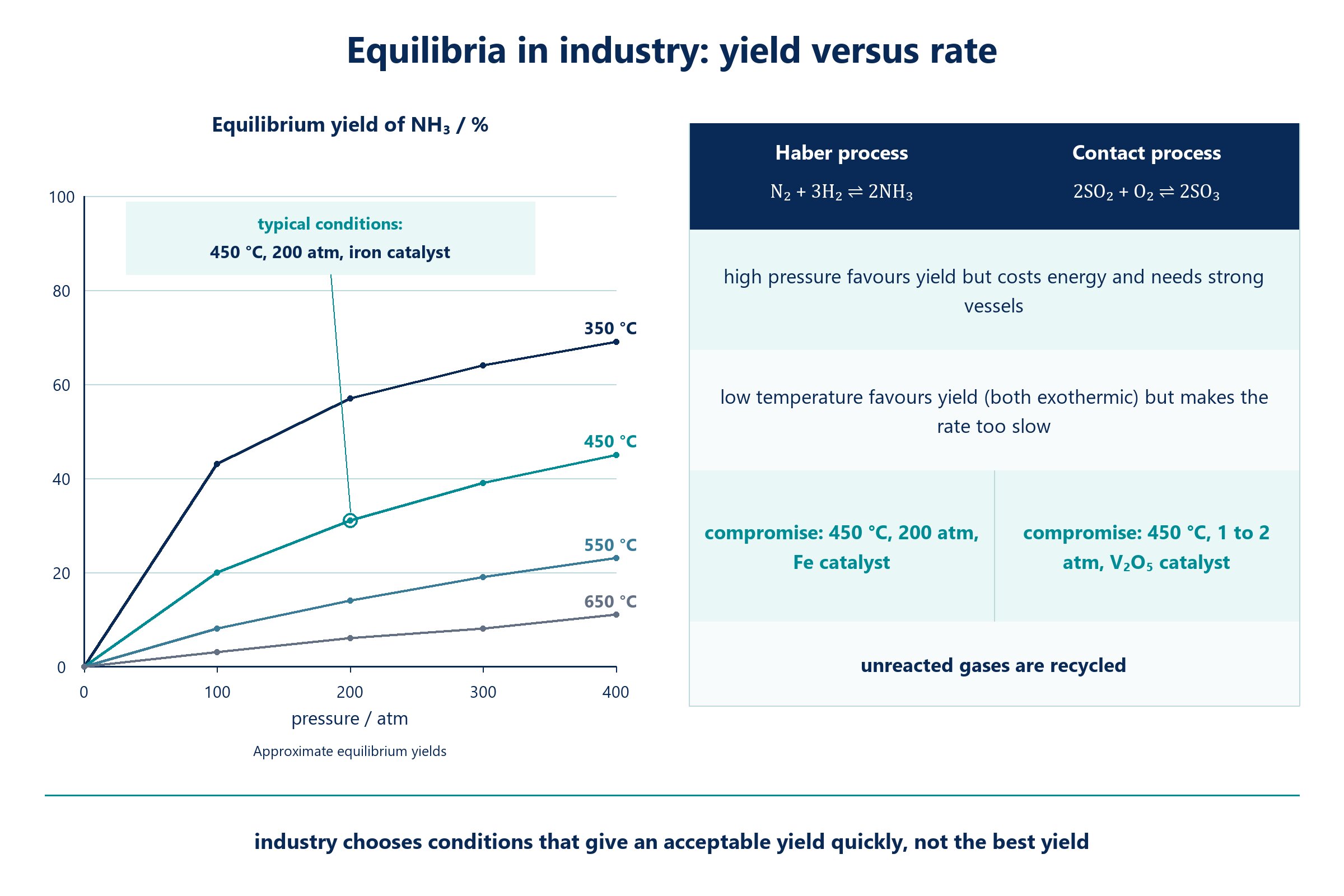
The equilibrium yield of ammonia against pressure at several temperatures, and the conditions chosen for the Haber and Contact processes.
Check: Reading Yield Data
Interpret yield–temperature–pressure data for a process not described here.
The Contact Process
Sulfuric acid is made through the Contact process, whose key stage is the oxidation of sulfur dioxide: 2SO₂(g) + O₂(g) ⇌ 2SO₃(g), ΔH = −196 kJ mol⁻¹.
Again the forward reaction is exothermic and reduces the number of gas moles, so the same reasoning applies. A compromise temperature of about 450 °C is used with a vanadium(V) oxide catalyst.
Here the equilibrium already lies far to the right at ordinary pressure, so only a slightly raised pressure of 1 to 2 atm is used. The small extra yield from a high pressure would not pay for the cost of achieving it.
The sulfur trioxide is absorbed in concentrated sulfuric acid to give oleum, which is diluted to the acid.
Exam wording: For any process, structure the answer as: what Le Chatelier predicts; why that is not used in full (rate, cost, safety); the compromise chosen; the role of the catalyst.
Evaluating Conditions from Data
Questions often give a table or graph of yield against temperature and pressure and ask you to choose or justify conditions.
Read off the trend in each direction first: yield falls as temperature rises for an exothermic reaction; yield rises with pressure when gas moles fall.
Then bring in what the data cannot show: the rate, the energy cost of heating and compressing, the strength of the plant, and whether the product can be removed and the reactants recycled.
Exam tip: the best answer names a specific compromise and explains both sides of it.
Watch for: A question saying “explain why the yield in the actual plant is lower than the equilibrium yield”: the gases do not stay in the converter long enough to reach equilibrium, because a shorter contact time gives more product per day.
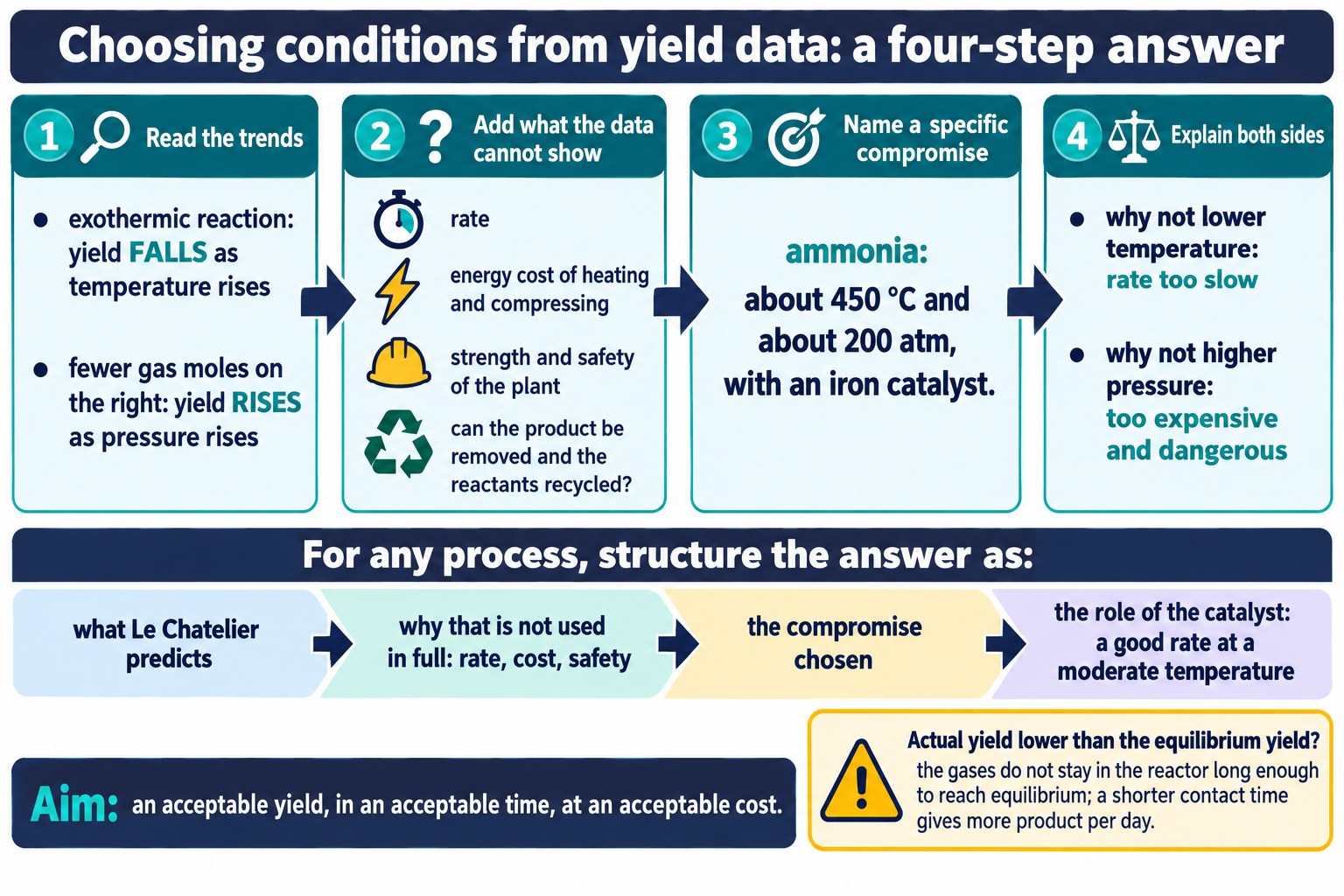
Read the yield trends first, then bring in rate, cost, safety and recycling, and finish by naming a specific compromise and explaining both sides of it.
Check: Choosing Conditions
Justify conditions for an industrial equilibrium you have not met above.
FAQs
Use these quick answers to check the industrial equilibria.
Why is 450 °C called a compromise?
A lower temperature would give a higher equilibrium yield of the exothermic reaction, but the rate would be too slow; a higher temperature gives a fast rate but a poor yield. 450 °C balances the two.
Why not use a much higher pressure in the Haber process?
A higher pressure would raise the yield and the rate, but compressing the gases costs a lot of energy and the pipes and vessels would have to be much stronger and more expensive, with greater safety risks.
Why is the pressure in the Contact process so low?
The equilibrium already lies far to the right at about 1 to 2 atm, so a high pressure would add very little yield for a large cost.
How can the overall conversion be high if the yield per pass is only about 15%?
The ammonia is removed by condensing it and the unreacted nitrogen and hydrogen are recycled through the converter, so almost all of them are eventually converted.
What does the catalyst do in these processes?
It increases the rate so that an acceptable rate is reached at the compromise temperature. It does not change the yield.
Copyright notice: This OLS revision content, including the explanations, layout, diagrams, tables and embedded learning structure, is authored for Online Learning System by Dr. Mohammed Al-Fatah. It may not be copied, reproduced, redistributed or adapted without written permission.
Keep this note — free
Save your progress across every Edexcel IAL topic. A free account remembers which topics you have covered, saves your question scores, and syncs across your phone and laptop.
- Track every topic you have finished
- Keep your practice-question scores
- No payment, no card, free forever
Already registered? Log in