CP 9a and 9b Iodine–Propanone Kinetics and a Clock Reaction
A focused revision guide to Core Practicals 9a and 9b for Edexcel International A Level Chemistry: following the acid-catalysed iodination of propanone by sampling, quenching and titrating, reading the order from a titre–time graph, the iodine clock reaction and initial rates from 1/t, the rate equation and mechanism, errors and uncertainty.
The Iodine Clock: Initial Rates From 1/t
Four flasks, one change each: time the sudden blue-black colour, read the orders from the times, and see why the rate is proportional to 1/t.
© Dr. Mohammed Al-Fatah – onlinelearningsystem.net
Recap: Rates, Orders and Rate Equations
Four quick questions on the rate ideas this practical builds on: orders, the rate equation and what continuous monitoring means.
What This Practical Is Testing
Core Practicals 9a and 9b on the Edexcel International course follows a reaction as it happens, in two ways. Part A samples the iodination of propanone every few minutes and titrates the iodine left. Part B times an iodine clock to compare initial rates.
Both methods answer the same question: how does the rate depend on each concentration? The answer is a rate equation, rate = k[A]ᵐ[B]ⁿ, and the orders m and n point to the rate-determining step.
The practical is examined through the Unit 6 practical skills paper (WCH16), which asks for methods, apparatus choices, data processing, uncertainty and evaluation. Expect to justify the quenching, to plot and read a concentration–time graph, to deduce orders from 1/t, and to evaluate the timing.
Your specification names the acid-catalysed iodination of propanone: you must obtain the orders with respect to propanone, iodine and hydrogen ions, and use them to propose a mechanism.
The burette technique is the one you learned in Core Practical 3 (concentration of hcl by titration); the iodine–thiosulfate titration itself is covered in full on Core Practicals 13a and 13b (redox titrations).
Key idea: Continuous monitoring follows one mixture through time; an initial-rate method compares the start of several mixtures. Both give orders, and the orders give the rate equation.
Safety and Apparatus
Part A needs titration glassware and a stopwatch; Part B needs a way of measuring five volumes quickly and the same stopwatch.
| Item | What it is for | Precision or note |
|---|---|---|
| 250 cm³ conical flask | Holds the 100 cm³ reaction mixture for Part A | swirl; keep at a steady room temperature |
| 10.0 cm³ pipette and filler | Withdraws each portion of the mixture | the same volume every time, so titres compare like with like |
| Six 100 cm³ conical flasks | Each holds the NaHCO₃(aq) quench, ready for one portion | label each with its sampling time |
| 50 cm³ burette | Delivers Na₂S₂O₃(aq) to each quenched portion | ±0.05 cm³ per reading |
| Stopwatch | Times each sampling in Part A and each clock run in Part B | ±1 s from human reaction time |
| Burettes or measuring cylinders | Measure the KI, H₂O₂, acid and water for each clock run | 10 cm³ cylinder ±0.1 cm³; burette ±0.05 cm³ |
| Thermometer | Checks that every run is at the same temperature | ±0.5 °C |
| Starch solution and white tile | Shows the end point and the clock colour change | freshly made starch |
Safety: Iodine solution stains skin and clothing. Propanone is flammable: no flames anywhere in the laboratory. Sulfuric acid at the strengths used here harms skin and eyes, and hydrogen peroxide is an oxidising agent.
Wear eye protection throughout. Teachers: check the current CLEAPSS Hazcard, or your local equivalent, for the concentrations used.
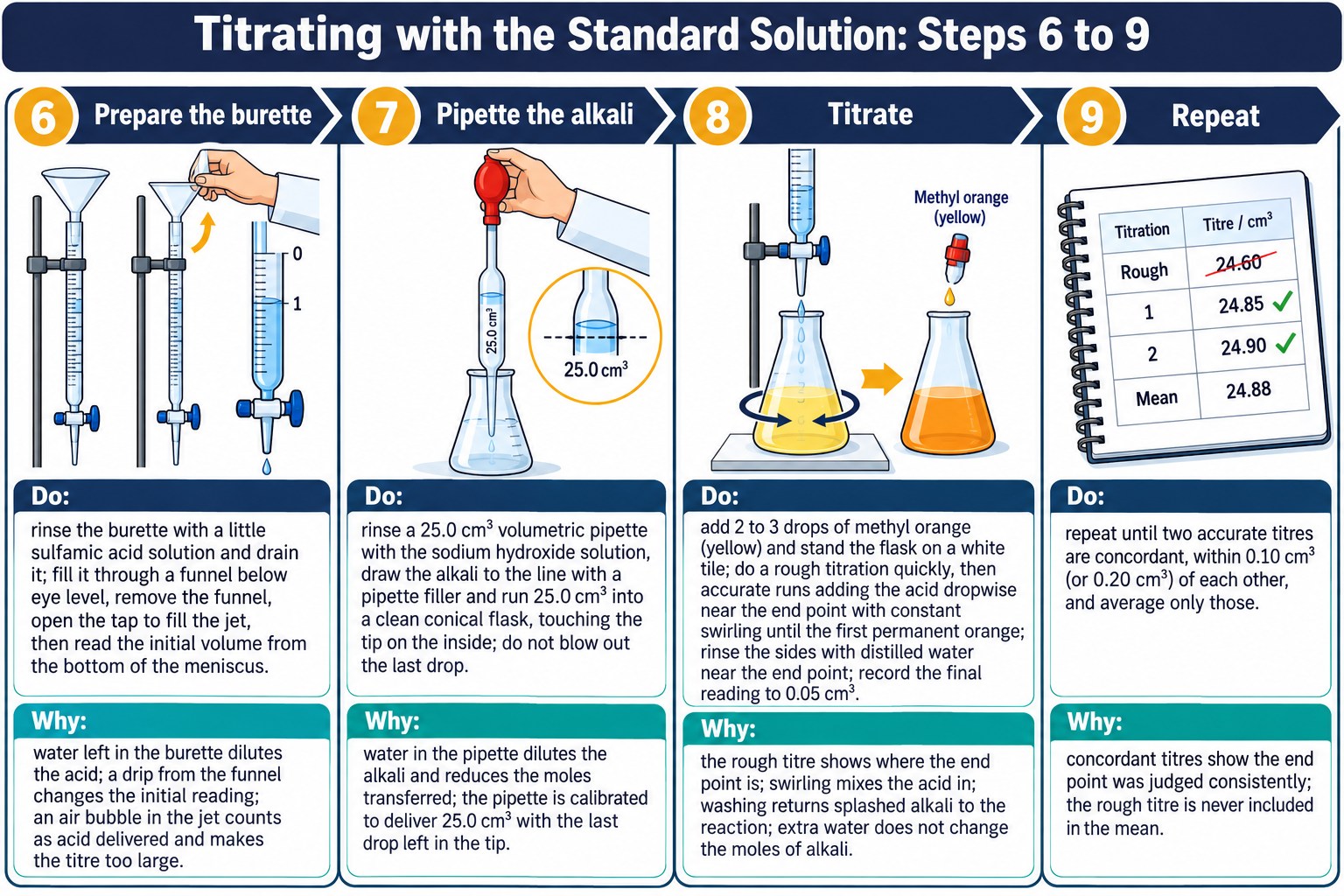
The titration glassware used for every quenched portion: burette, pipette, conical flask and white tile, with the reading technique.
Method Part A: Sampling, Quenching and Titrating
Iodine and Propanone: Sampling, Quenching and Titrating
One mixture, six timed portions: stop each portion in bicarbonate, titrate the iodine left, and read the rate from a straight-line graph.
© Dr. Mohammed Al-Fatah – onlinelearningsystem.net
Propanone and acid are in large excess, so only the iodine concentration changes appreciably. Each portion is stopped the instant it is withdrawn, then the iodine left in it is titrated.
CH₃COCH₃(aq) + I₂(aq) → CH₃COCH₂I(aq) + HI(aq) (H⁺ catalyst)
| Step | What you do | Why |
|---|---|---|
| Prepare the quench flasks | Put 20 cm³ of 1.00 mol dm⁻³ NaHCO₃(aq) into each of six 100 cm³ conical flasks. | Each portion must be stopped the moment it leaves the pipette; this is twice the hydrogencarbonate its acid can use. |
| Mix and start the clock | Add 25.0 cm³ of 3.00 mol dm⁻³ propanone to 25.0 cm³ of 2.00 mol dm⁻³ H₂SO₄, then 50.0 cm³ of 0.0200 mol dm⁻³ iodine in KI(aq); start the stopwatch as the iodine goes in. | Propanone and acid are in large excess, so their concentrations stay effectively constant. |
| Take the first portion | Straight away pipette 10.0 cm³ of the mixture into the first NaHCO₃ flask and note the time it reaches the hydrogencarbonate, about 0.5 min. | A pipette cannot sample at t = 0, so this is the first real point; the starting titre comes from extrapolating the line. |
| Quench | Run the portion slowly into the hydrogencarbonate and swirl; it fizzes and froths. | HCO₃⁻ removes the H⁺ catalyst, so the reaction stops and the titre records [I₂] at that moment. |
| Titrate | Titrate the iodine with 0.0100 mol dm⁻³ Na₂S₂O₃(aq); add starch when the solution is pale yellow and stop at colourless. | The titre is proportional to the moles of I₂ left; starch added early binds iodine and blurs the end point. |
| Repeat every 3 minutes | Withdraw and quench portions at 3, 6, 9, 12 and 15 minutes; quenched portions can wait, so titrate them afterwards. | Six points give a reliable titre–time graph. |
| Record the temperature | Note the temperature of the mixture at the start and at the end. | The rate constant changes with temperature; a drift would curve the line. |
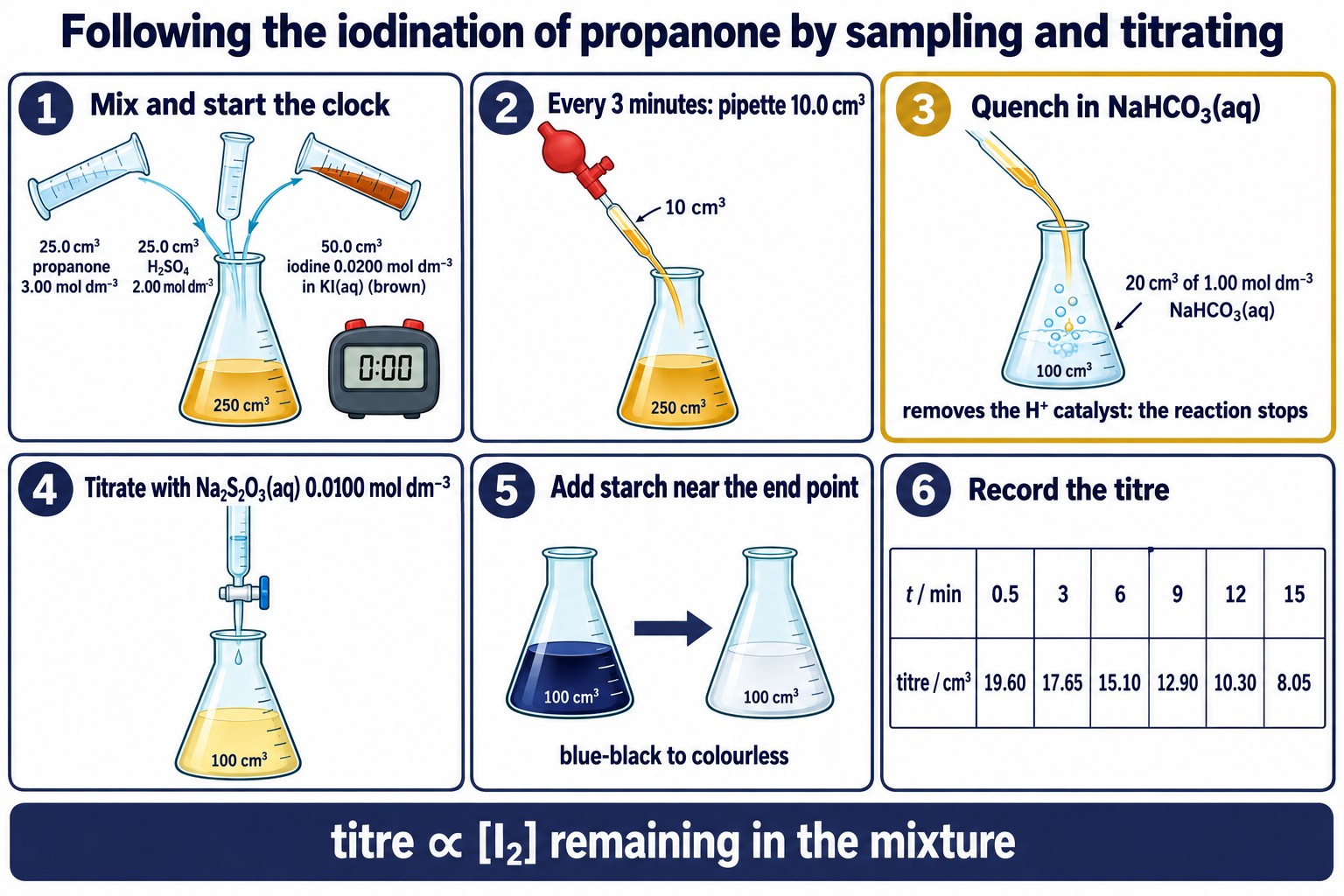
The sampling-and-quench method as six steps: mix and start the clock, pipette 10.0 cm³ every 3 minutes, quench in sodium hydrogencarbonate, titrate with thiosulfate, add starch near the end, record the titres.
HCO₃⁻(aq) + H⁺(aq) → H₂O(l) + CO₂(g) (quenching)
I₂(aq) + 2S₂O₃²⁻(aq) → 2I⁻(aq) + S₄O₆²⁻(aq) (titration)
Exam wording: “The portion is run into sodium hydrogencarbonate solution to remove the acid catalyst, which stops the reaction, so the titre measures the iodine present at the time of sampling.”
Check: Following an Ester Hydrolysis by Titration
Order the sampling-and-quenching method for a different reaction followed by titration.
Results: the Titre–Time Graph and the Order in Iodine
Two thiosulfate ions react with each iodine molecule, so the titre is a direct measure of the iodine left. A worked set of results at 20 °C is shown below.
| Time / min | 0.5 | 3 | 6 | 9 | 12 | 15 |
|---|---|---|---|---|---|---|
| Titre of Na₂S₂O₃(aq) / cm³ | 19.60 | 17.65 | 15.10 | 12.90 | 10.30 | 8.05 |
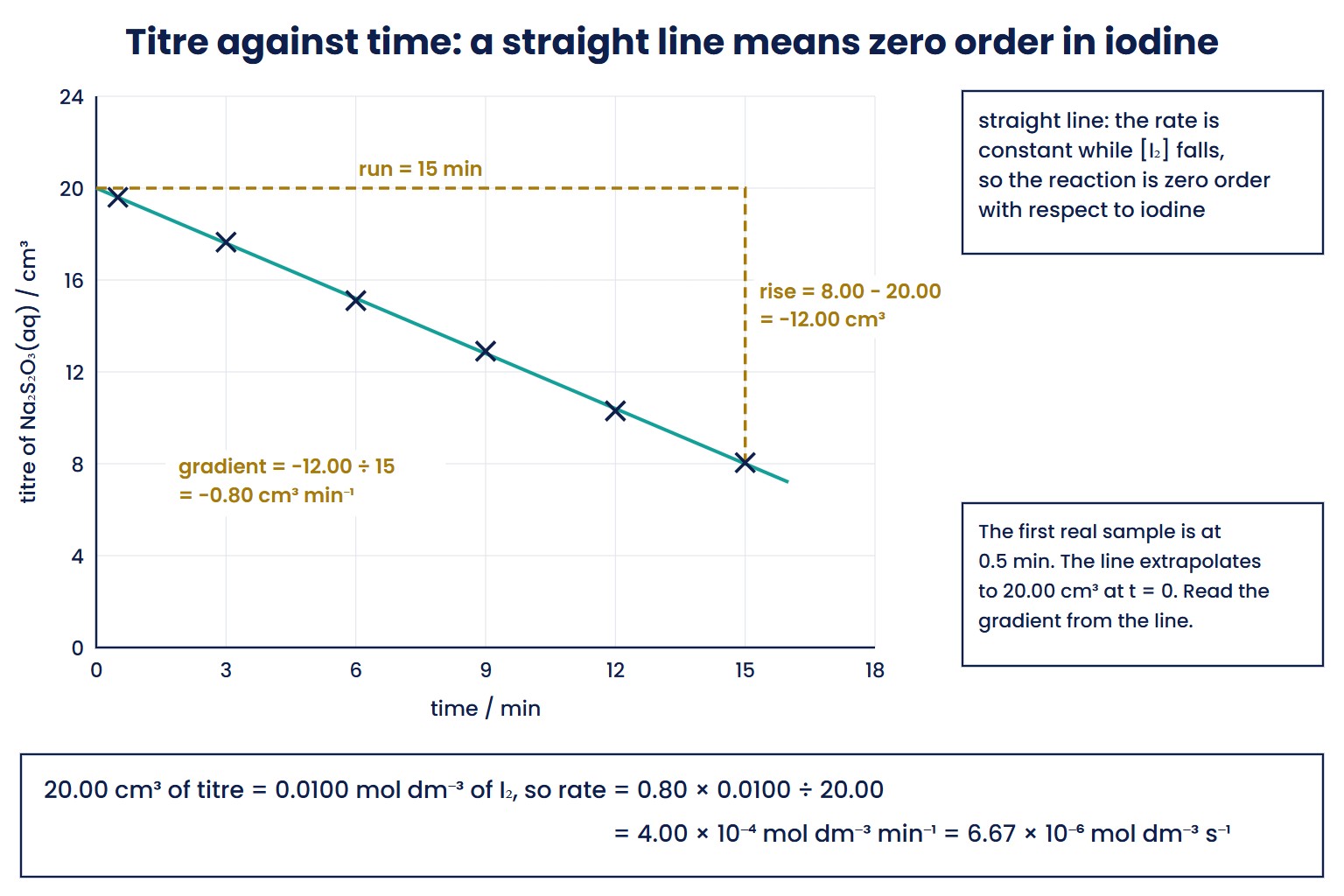
Titre against time: the six points lie about a straight line of gradient −0.80 cm³ min⁻¹ that extrapolates to 20.00 cm³ at t = 0. The rate is constant while [I₂] falls, so the reaction is zero order with respect to iodine.
The titre falls by about 2.4 cm³ every 3 minutes, and the points stay within 0.10 cm³ of the best-fit line. A straight line means a constant rate even though [I₂] is falling: the reaction is zero order with respect to iodine.
Step 1: the line extrapolates to 20.00 cm³ at t = 0, so moles of S₂O₃²⁻ at t = 0 = 0.0100 × 20.00 ÷ 1000 = 2.00 × 10⁻⁴ mol
Step 2: moles of I₂ in 10.0 cm³ = ½ × 2.00 × 10⁻⁴ = 1.00 × 10⁻⁴ mol, so [I₂]₀ = 1.00 × 10⁻⁴ ÷ 0.0100 = 0.0100 mol dm⁻³
Step 3: reading (0, 20.00) and (15, 8.00) from the line, gradient = (8.00 − 20.00) ÷ 15 = −0.80 cm³ min⁻¹
Step 4: 20.00 cm³ of titre ≡ 0.0100 mol dm⁻³, so rate = 0.80 × 0.0100 ÷ 20.00 = 4.00 × 10⁻⁴ mol dm⁻³ min⁻¹
Answer: rate = 4.00 × 10⁻⁴ mol dm⁻³ min⁻¹ = 6.67 × 10⁻⁶ mol dm⁻³ s⁻¹ (3 s.f.). The extrapolated 0.0100 mol dm⁻³ starting concentration checks: 50.0 cm³ of 0.0200 mol dm⁻³ iodine diluted to 100 cm³.
Had the line curved, flattening as the titre fell, the rate would be falling with [I₂] and the order in iodine would be first (constant half-life) or second. A straight line is the signature of zero order.
Graph skills: Plot titre (or [I₂]) on the y-axis and time on the x-axis, draw the best-fit straight line, and take the gradient from two points far apart on the line, not from two data points.
Check: Rate From a Titre–Time Line
Process a new set of titres: gradient, order, starting concentration and rate.
The Rate Equation and the Mechanism
One run gives the order in iodine only. To find the other orders, repeat Part A with one concentration changed at a time and compare the gradients.
Double [propanone]: the gradient doubles to −1.60 cm³ min⁻¹, so the reaction is first order in propanone.
Double [H⁺]: the gradient also doubles, so the reaction is first order in hydrogen ions. The acid is a catalyst, yet it appears in the rate equation because it takes part in the slow step.
rate = k[CH₃COCH₃][H⁺] (zero order in I₂, second order overall)
Step 1: concentrations after mixing in 100 cm³: [CH₃COCH₃] = 3.00 × 25.0 ÷ 100 = 0.750 mol dm⁻³; [H⁺] = 2.00 × 25.0 ÷ 100 = 0.500 mol dm⁻³ (H₂SO₄ taken as monoprotic)
Step 2: k = rate ÷ ([CH₃COCH₃][H⁺]) = 6.67 × 10⁻⁶ ÷ (0.750 × 0.500) = 1.78 × 10⁻⁵ dm³ mol⁻¹ s⁻¹
Answer: k = 1.78 × 10⁻⁵ dm³ mol⁻¹ s⁻¹ at 20 °C (3 s.f.). State the assumption about the acid: H₂SO₄ is taken as monoprotic because HSO₄⁻ is a weak acid and gives up little of its second H⁺ here.
Counting both H⁺ would make [H⁺] 1.00 mol dm⁻³ and k 8.89 × 10⁻⁶ dm³ mol⁻¹ s⁻¹.
What the orders say about the mechanism
Propanone and H⁺ appear in the rate equation, so both take part in, or before, the rate-determining step. Iodine does not, so it reacts after the slow step, in a fast step.
The slow step is the acid-catalysed conversion of propanone to its enol, propen-2-ol (keto–enol tautomerism). The enol then reacts rapidly with iodine, and the catalyst is released as HI.
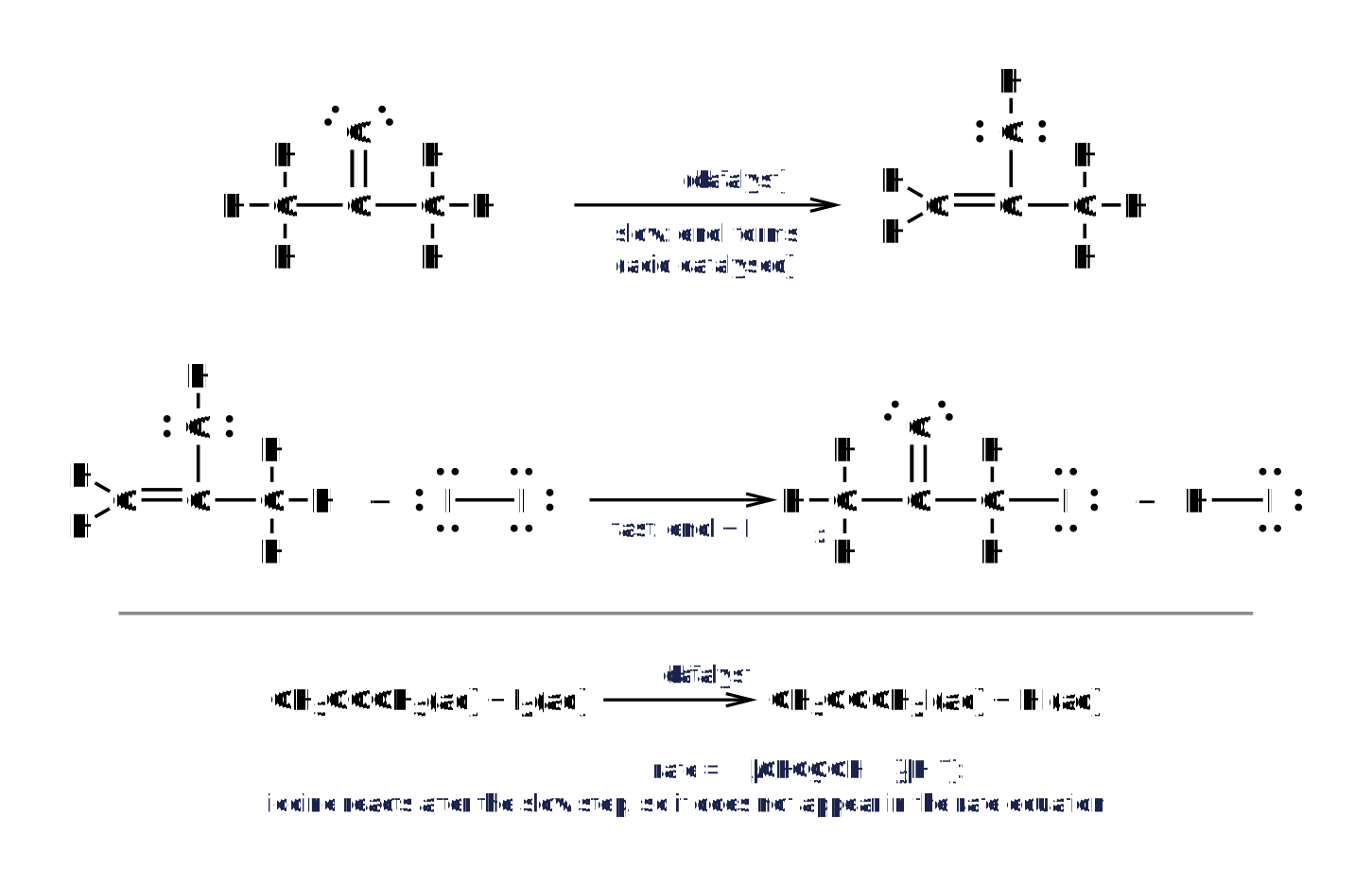
The acid-catalysed iodination of propanone: the slow formation of the enol, the fast reaction of the enol with iodine, and the overall equation with the rate equation beneath.
Exam wording: “Iodine is zero order, so it is not involved in the rate-determining step; propanone and H⁺ are first order, so one molecule of each is involved in the rate-determining step.”
Check: Orders From Initial Rates
Deduce the orders, the rate constant and its units for a different reaction.
Following the Colour With a Colorimeter
Iodine is brown, so its concentration can be followed continuously without sampling. A colorimeter measures the absorbance of the mixture in a cuvette; the more iodine, the more light is absorbed.
Filter: a blue filter, the colour complementary to the brown-yellow of iodine, gives the largest change in absorbance.
Calibration: measure the absorbance of iodine solutions of known concentration first and plot absorbance against [I₂]. The reaction mixture’s readings are then converted to concentrations with this calibration curve.
Result: absorbance falls in a straight line with time for a zero-order reaction, exactly like the titre; a reading every 30 s gives far more points than six titrations.
Advantages: no quenching, no portions to withdraw, no end point to judge, and a data logger can record the whole run automatically.
Choose and justify: Titration suits a reaction that can be quenched and has a titratable species; colorimetry suits one with a coloured reactant or product; gas collection or mass loss suits one that releases a gas.
Method Part B: the Iodine Clock
The clock reaction (Harcourt–Esson) is an initial-rate method. Hydrogen peroxide oxidises iodide ions to iodine, and a small fixed amount of thiosulfate removes the iodine as it forms.
H₂O₂(aq) + 2I⁻(aq) + 2H⁺(aq) → I₂(aq) + 2H₂O(l) (slow, the reaction being studied)
I₂(aq) + 2S₂O₃²⁻(aq) → 2I⁻(aq) + S₄O₆²⁻(aq) (fast, while thiosulfate lasts)
When the thiosulfate is used up, free iodine appears and the starch turns blue-black suddenly. The time t to the colour change is measured for mixtures in which one concentration is changed at a time.
| Step | What you do | Why |
|---|---|---|
| Measure the fixed solutions | Put 10.0 cm³ KI(aq), 10.0 cm³ Na₂S₂O₃(aq), 5 cm³ H₂SO₄(aq), 2 cm³ starch and 13 cm³ water into a 100 cm³ flask (concentrations in the table below). | Everything except the peroxide is mixed first; water brings the total to 50.0 cm³. |
| Measure the peroxide | Measure 10.0 cm³ of 0.100 mol dm⁻³ H₂O₂(aq) into a boiling tube. | Added last and all at once, so t = 0 is sharp. |
| Mix and start | Pour the H₂O₂ in, start the stopwatch, swirl once and stand the flask on a white tile. | Swirling mixes evenly; the tile shows the colour change clearly. |
| Stop at blue-black | Stop the stopwatch at the first trace of blue-black and record t. | The thiosulfate has just run out: a fixed amount of iodine has formed. |
| Change one variable | Repeat with 20.0 cm³ KI (3 cm³ water), then 20.0 cm³ H₂O₂ (3 cm³ water), then 10 cm³ acid (8 cm³ water). | Constant total volume keeps concentration proportional to volume taken; only one concentration changes. |
| Same temperature | Use solutions that have stood together on the bench; record the temperature. | Rate roughly doubles for a 10 °C rise, so a warm solution would ruin the comparison. |
| Repeat | Repeat each run and average the times; discard a run where the change was missed. | Reduces the random error of judging the colour change. |
Why the thiosulfate stays fixed: Thiosulfate is the clock, not a reactant being studied. Doubling it would double the iodine needed and double every time, without telling you anything about the orders.
Clock Results: Orders and the Initial Rate From 1/t
Four runs at 20 °C, each 50.0 cm³ in total and each with 10.0 cm³ of 0.0100 mol dm⁻³ Na₂S₂O₃(aq) and 2 cm³ of starch.
| Run | KI 0.100 mol dm⁻³ / cm³ | H₂O₂ 0.100 mol dm⁻³ / cm³ | H₂SO₄ 1.0 mol dm⁻³ / cm³ | Water / cm³ | t / s | 1/t / s⁻¹ |
|---|---|---|---|---|---|---|
| 1 | 10.0 | 10.0 | 5 | 13 | 48 | 0.0208 |
| 2 | 20.0 | 10.0 | 5 | 3 | 24 | 0.0417 |
| 3 | 10.0 | 20.0 | 5 | 3 | 24 | 0.0417 |
| 4 | 10.0 | 10.0 | 10 | 8 | 48 | 0.0208 |
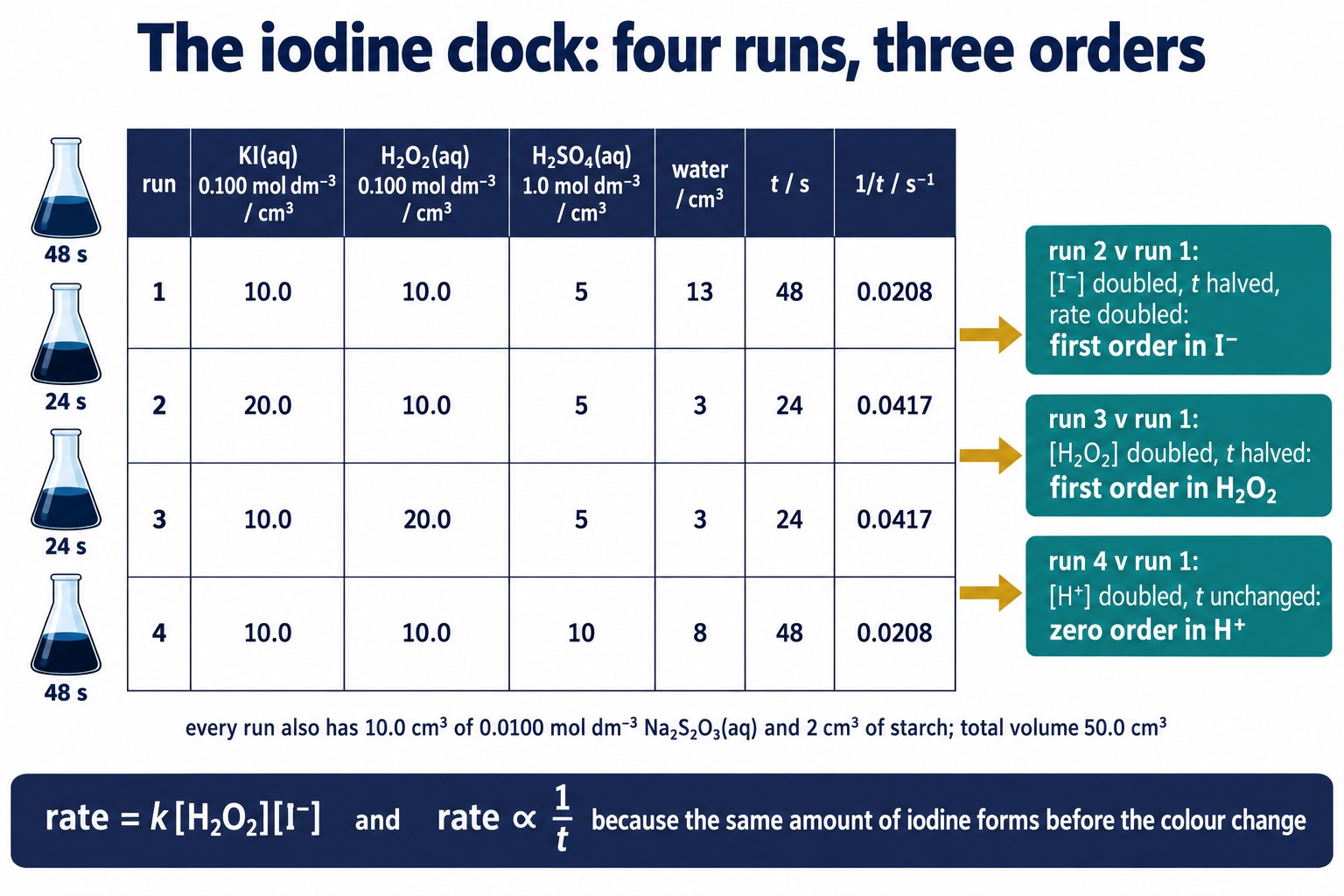
The four clock runs as an illustrated table: doubling [I⁻] or [H₂O₂] halves the time, doubling [H⁺] changes nothing, so rate = k[H₂O₂][I⁻].
Run 2 against run 1: [I⁻] doubled, t halved, so the rate doubled: first order in I⁻.
Run 3 against run 1: [H₂O₂] doubled, t halved: first order in H₂O₂.
Run 4 against run 1: [H⁺] doubled, t unchanged: zero order in H⁺ under these conditions.
rate = k[H₂O₂][I⁻]
Turning a time into a rate
Step 1: moles of S₂O₃²⁻ = 0.0100 × 10.0 ÷ 1000 = 1.00 × 10⁻⁴ mol, so moles of I₂ formed before the colour change = 5.00 × 10⁻⁵ mol
Step 2: Δ[I₂] = 5.00 × 10⁻⁵ ÷ 0.0500 = 1.00 × 10⁻³ mol dm⁻³ (total volume 50.0 cm³)
Step 3: initial rate (run 1) = 1.00 × 10⁻³ ÷ 48 = 2.08 × 10⁻⁵ mol dm⁻³ s⁻¹
Step 4: [H₂O₂] = [I⁻] = 0.100 × 10.0 ÷ 50.0 = 0.0200 mol dm⁻³, so k = 2.08 × 10⁻⁵ ÷ (0.0200 × 0.0200) = 0.0520 dm³ mol⁻¹ s⁻¹
Answer: initial rate 2.08 × 10⁻⁵ mol dm⁻³ s⁻¹ and k = 0.0520 dm³ mol⁻¹ s⁻¹ at 20 °C (3 s.f.).
Why 1/t works
The clock measures the time for a fixed small change: the same 5.00 × 10⁻⁵ mol of iodine forms in every run. Rate = fixed change ÷ t, so rate ∝ 1/t.
It is an average rate over the first seconds, close to the initial rate only while the concentrations have barely changed: here about 5% of the peroxide is used. Keep the thiosulfate small so that less than about 10% of any reactant reacts.
Exam wording: “The same amount of iodine is produced in each run before the colour change, so the rate is proportional to 1/t; the time is short enough for the concentrations to be almost unchanged, so 1/t approximates the initial rate.”
Check: A Clock Reaction With New Numbers
Work out the initial rate and orders for a clock reaction with different volumes, then flip each card.
Errors, Uncertainty and Improvements
The chemistry adds errors that no burette or stopwatch can remove. For each one, say which way it moves the result and how to reduce it.
| Source of error | Effect on the result | Improvement |
|---|---|---|
| Reaction continues during pipetting | Titre too low for its recorded time; points scatter | Have the quench ready and run the portion in at once; record the time the portion enters the quench |
| Temperature drifts during a run | k changes, so the titre–time line curves | Stand the flask in a water bath; record the temperature at the start and the end |
| Judging the first trace of blue-black | Random error of about ±1 s or more in t | Same observer, white tile, repeat runs; or a light sensor and data logger |
| Clock runs too short | ±1 s is a large fraction of 24 s | Dilute the mixtures so the fastest run lasts at least about 60 s |
| Iodine evaporates from the mixture | Less iodine titrated: titres too low, gradient too steep | Stopper the reaction flask between samples; titrate promptly |
| Thiosulfate decomposes on standing | Concentration lower than the label: every titre too high | Use a freshly made solution or standardise it first |
| Starch added too early | End point late and blurred | Add the starch only when the solution is pale yellow |
Timing uncertainty. A human reaction time of ±1 s on run 2 (24 s) is 1 ÷ 24 × 100 = 4.2%; on run 1 (48 s) it is 2.1%. Halving the concentration of one reactant would double the times and halve these percentages.
Burette uncertainty. A titre is two readings of ±0.05 cm³, so ±0.10 cm³: on the 8.05 cm³ titre at 15 min that is 0.10 ÷ 8.05 × 100 = 1.24%, but only 0.51% on the 19.60 cm³ titre at 0.5 min.
The later portions therefore carry the larger uncertainty; a more concentrated thiosulfate would make them smaller still, so a more dilute titrant, about 0.00500 mol dm⁻³, improves the late points.
Exam focus: Percentage uncertainty = uncertainty ÷ reading × 100. The improvement that scores is the one that makes the reading larger (longer times, bigger titres) or removes the human judgement.
Check: Evaluating Rate Experiments
Pick the correct evaluation of each new situation: quenching, timing, temperature, sensors and the shape of the graph.
Common Mistakes
The same slips appear in write-ups and exam answers every year. Each costs a mark that the corrected version earns.
Zero order means no reaction. No: the iodine reacts steadily; its concentration simply does not affect how fast.
Orders from the equation. Orders come only from experiment; 2I⁻ in the equation does not make the reaction second order in iodide.
Catalyst not in the rate equation. H⁺ is a catalyst and is first order: it takes part in the slow step.
Forgetting the quench. Saying “titrate the portion” without stopping the reaction first loses the method mark.
Thiosulfate as a variable. Changing the thiosulfate changes the amount of iodine clocked, not the rate: keep it fixed.
Rate = t. A longer time is a slower rate: compare 1/t, never t.
Gradient from two data points. Take the gradient from the best-fit line, using points far apart.
Missing the ½. One I₂ needs two S₂O₃²⁻: moles of iodine are half the moles of thiosulfate.
Common Exam Points
Say
“Sodium hydrogencarbonate removes the H⁺ catalyst and stops the reaction.” “A straight titre–time line means zero order in iodine.” “The same iodine forms in every run, so rate ∝ 1/t.” “Iodine reacts after the rate-determining step, so it is not in the rate equation.”
Do not say
“Iodine is zero order because it is used up.” “Second order in iodide because the equation has 2I⁻.” “Rate is proportional to the time taken.” “Add more thiosulfate to see the colour change” (it changes the clock, not the rate).
Watch for
The ½ between iodine and thiosulfate; concentrations after mixing; units of k; water keeping the total volume constant; uncertainty from the actual time; graph shapes for each order; Core Practical 10 (finding the activation energy), where the same clock runs at different temperatures.
FAQs
Short answers to the questions students most often ask about following reaction rates.
Why is the reaction quenched with sodium hydrogencarbonate?
The iodination is catalysed by H⁺. Hydrogencarbonate ions remove the acid (they fizz as CO₂ forms), so the reaction stops the moment the portion enters the flask and the titre records the iodine present at the sampling time.
How can the reaction be zero order in iodine when iodine is a reactant?
Iodine reacts in a fast step after the slow, rate-determining formation of the enol. The rate is set by the slow step, which involves propanone and H⁺ only, so [I₂] does not appear in the rate equation.
Why is 1/t a measure of the initial rate in a clock reaction?
The fixed amount of thiosulfate means the same small amount of iodine forms before the colour change in every run. Rate = fixed change ÷ time, so rate is proportional to 1/t, provided only a small fraction of the reactants is used.
Why must the total volume be kept constant with water?
With a fixed total volume, the concentration of each solution in the mixture is proportional to the volume taken, so doubling a volume doubles that concentration while every other concentration stays the same.
Does the clock reaction give the true initial rate?
Not exactly. It gives an average rate over the first few seconds, which is close to the initial rate when less than about 10% of the reactants has reacted. Keeping the thiosulfate amount small keeps the approximation good.
Copyright notice: This OLS revision content, including the explanations, layout, diagrams, tables and embedded learning structure, is authored for Online Learning System by Dr. Mohammed Al-Fatah. It may not be copied, reproduced, redistributed or adapted without written permission.
Keep this note — free
Save your progress across every Edexcel IAL topic. A free account remembers which topics you have covered, saves your question scores, and syncs across your phone and laptop.
- Track every topic you have finished
- Keep your practice-question scores
- No payment, no card, free forever
Already registered? Log in