Core Practical 8: Analysis of Organic and Inorganic Unknowns
This practical is an evidence trail. Students test unknown organic liquids A, B and C, then inorganic solids X, Y and Z. The exam skill is to connect each observation to an inference, then use the full pattern of results to identify the unknown.
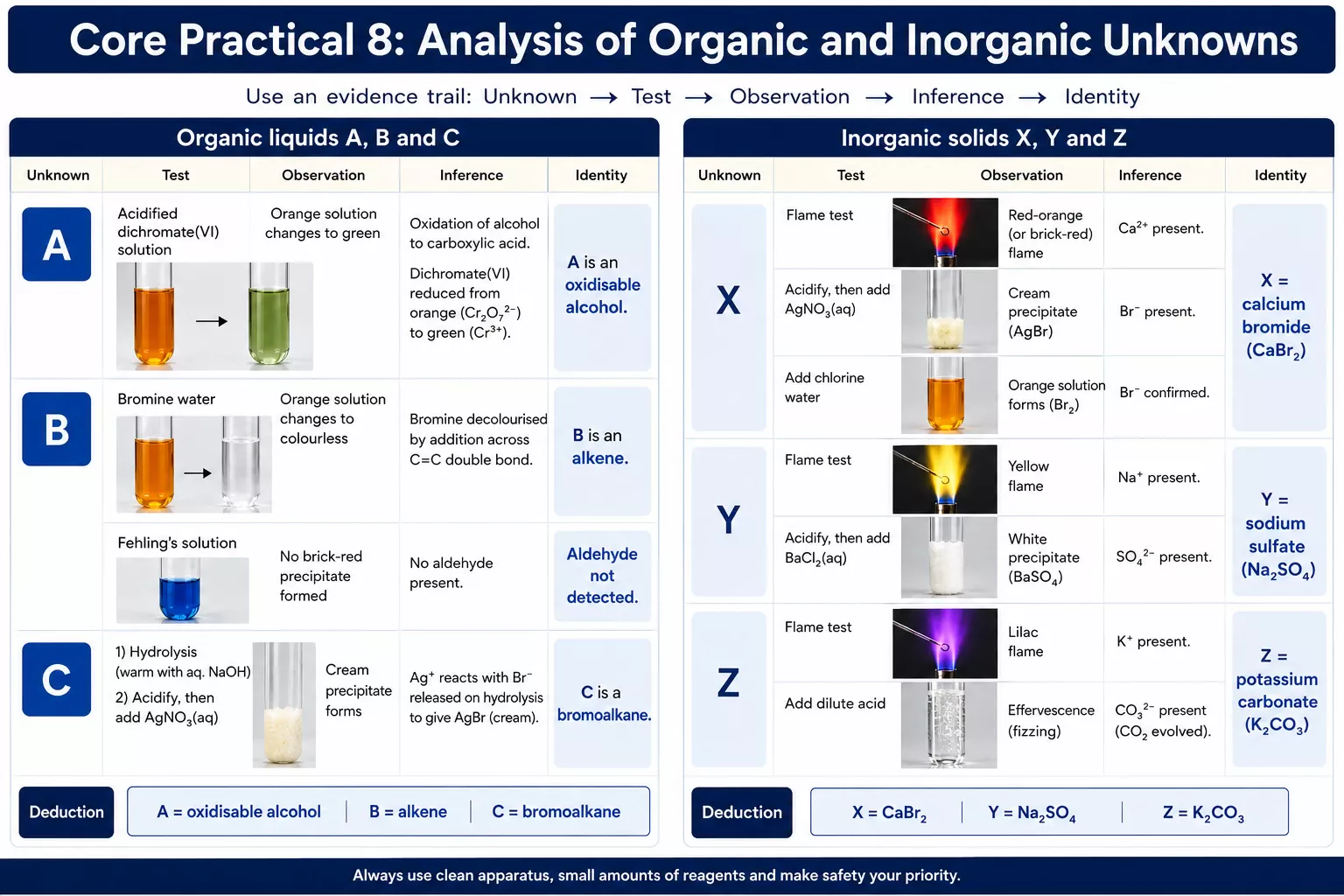
The CP8 evidence trail
Unknown → test → observation → inference → identity. This is the logic students should use throughout the practical.
How CP8 Works
The objective is to identify several unknown colourless organic liquids and inorganic solids. The practical does not rely on one isolated result. It relies on the pattern of positive and negative tests.
Key idea: Negative tests are useful. They tell you what the unknown is not, which helps remove incorrect identities.
Organic Unknowns A, B and C
The organic section uses four tests: bromine water, acidified potassium dichromate(VI), Fehling’s solution, and hydrolysis followed by silver nitrate. In the sample data, each organic unknown is identified by the test it responds to.
| Test | A | B | C | Inference |
|---|---|---|---|---|
| Bromine water | No change | Orange → colourless | No change | B contains a C=C double bond, so B is an alkene. |
| Acidified potassium dichromate(VI) | Orange → green | No change | No change | A is oxidised, so A contains an oxidisable functional group. |
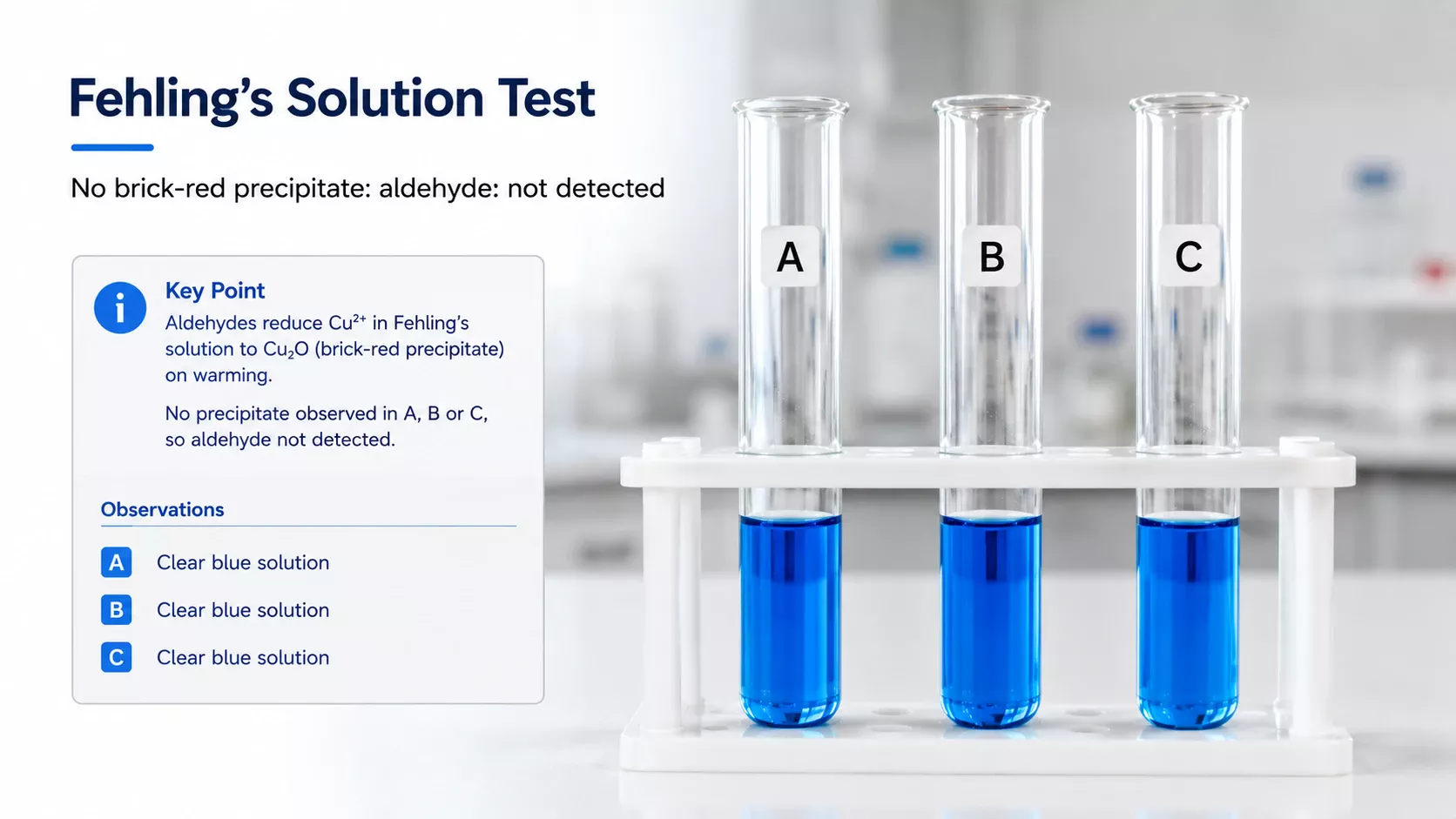
| Fehling’s solution | No brick-red precipitate | No brick-red precipitate | No brick-red precipitate | No aldehyde is detected in the sample data. |
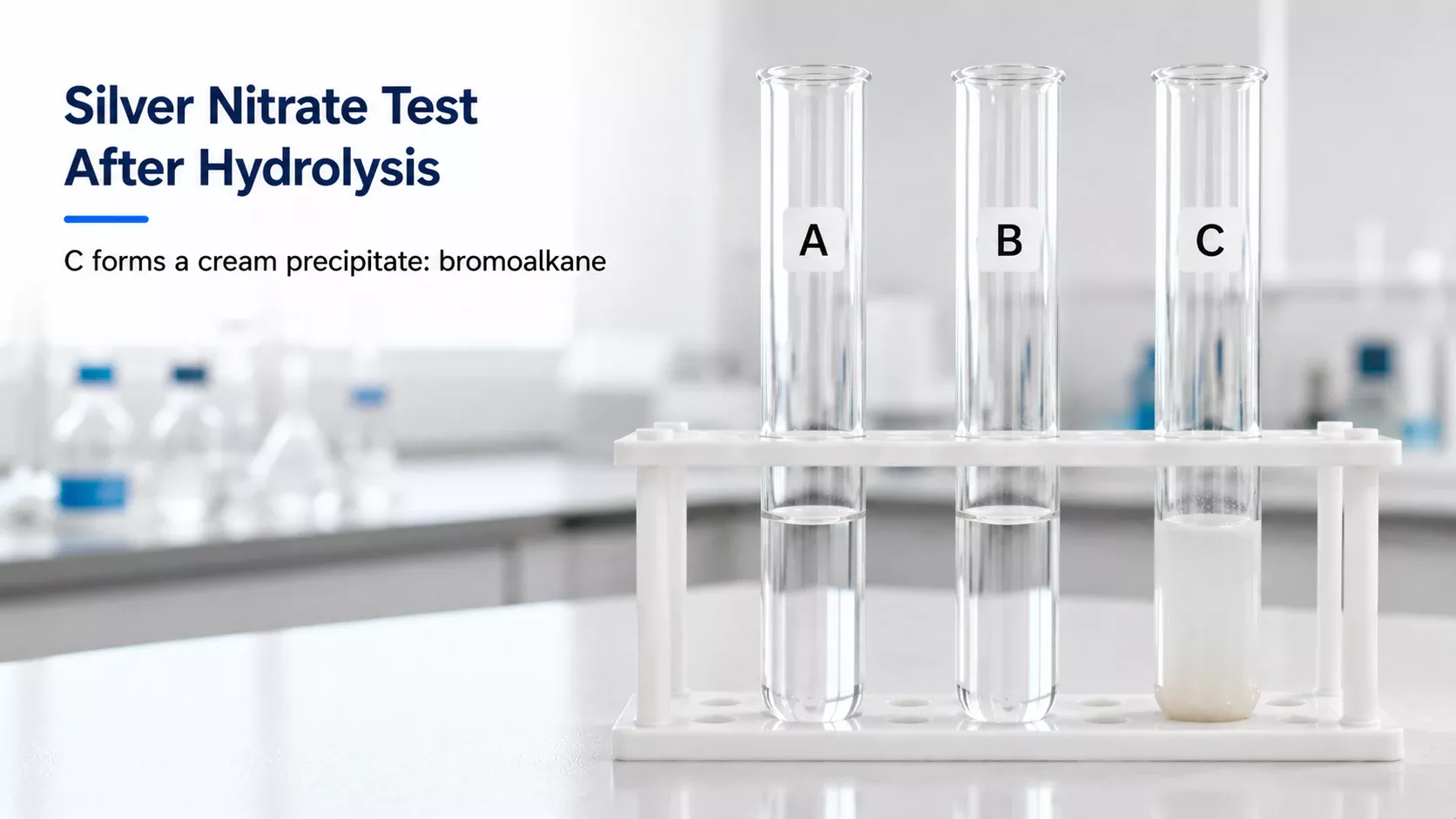
| Hydrolysis, acidification, then AgNO3 | No precipitate | No precipitate | Cream precipitate | C contains bromine after hydrolysis, so C is a bromoalkane. |
Final organic identifications: A = oxidisable alcohol, B = alkene, C = bromoalkane.
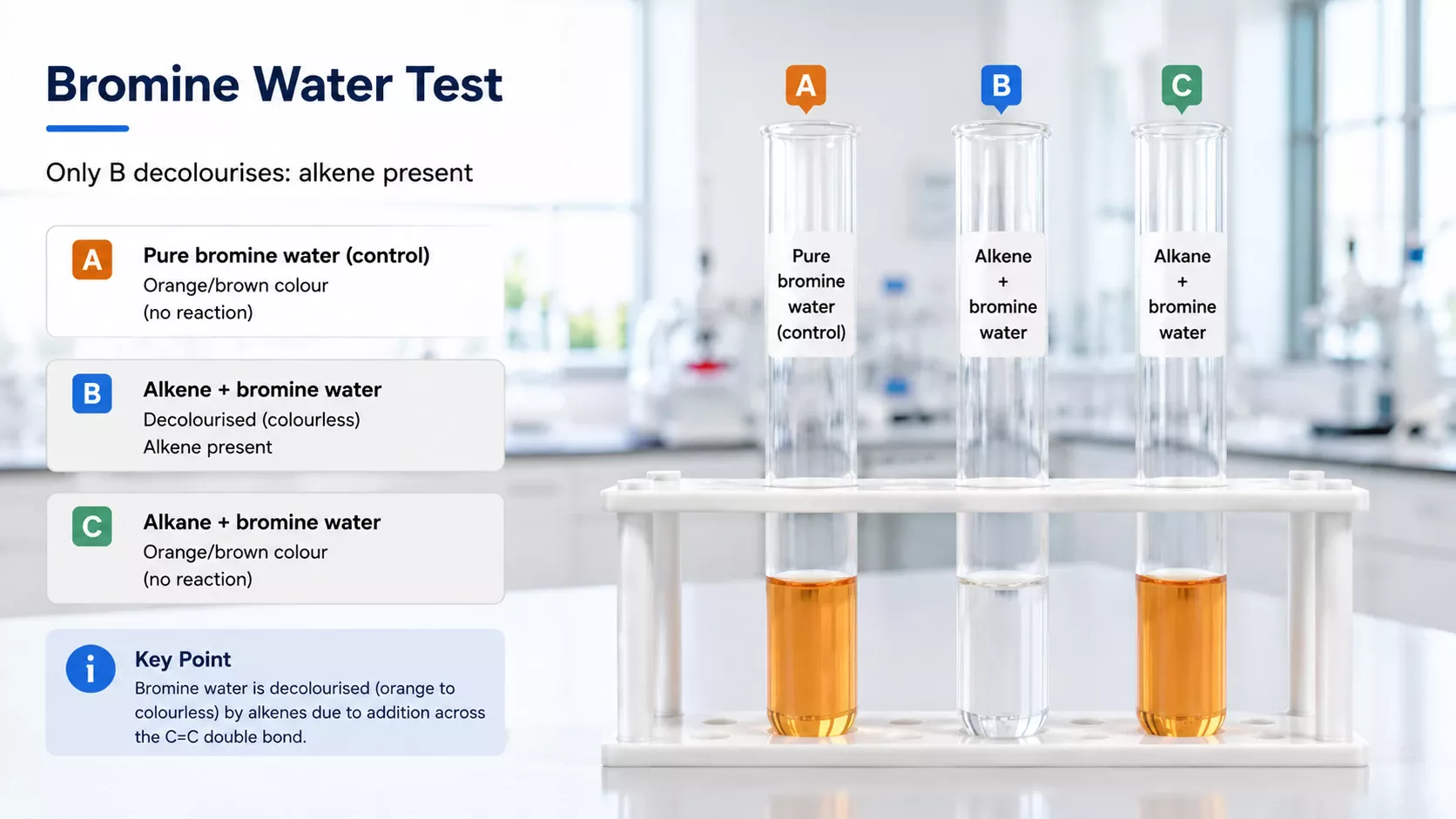
Bromine water
Only B decolourises bromine water. This is evidence for an alkene.
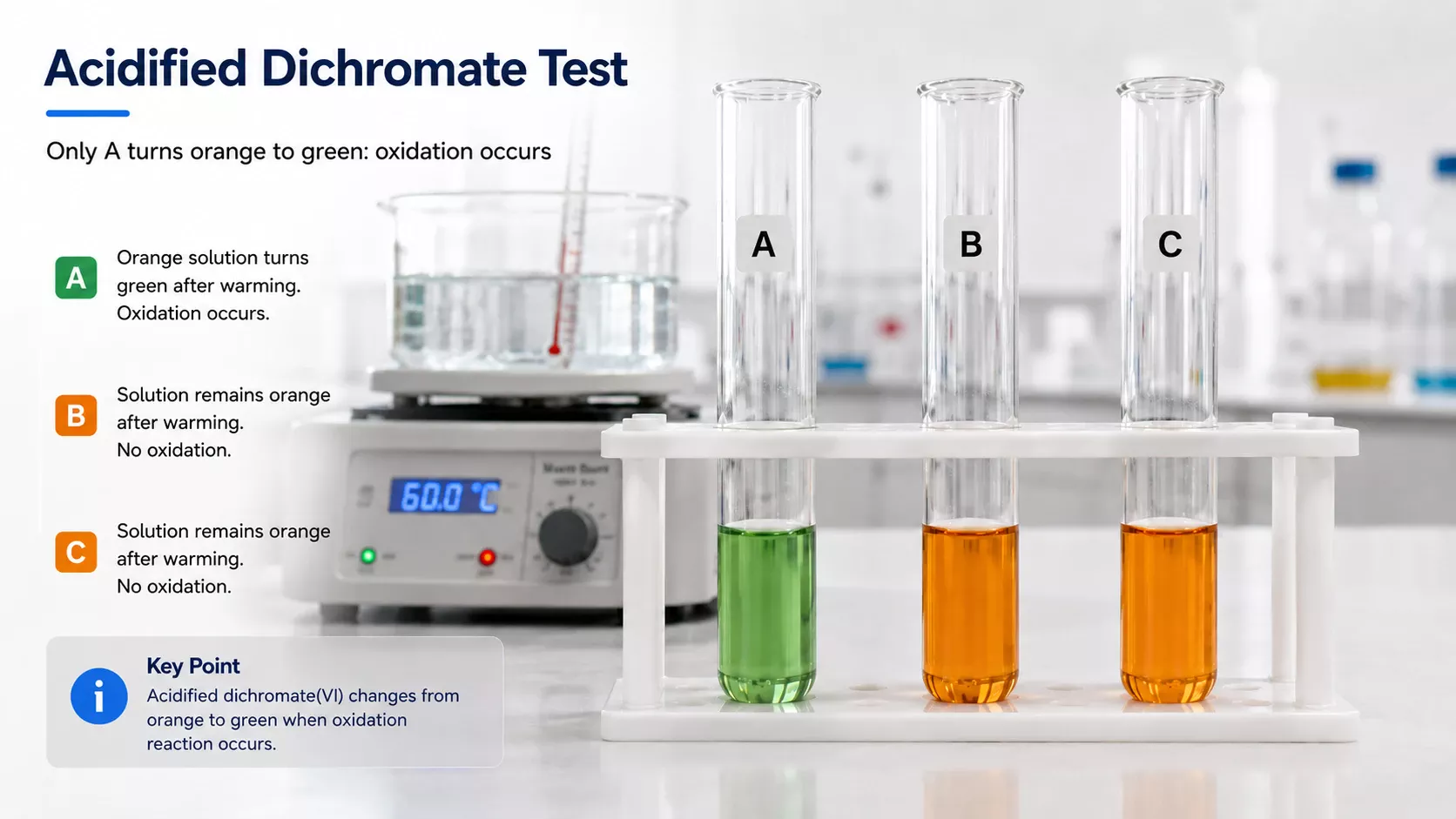
Acidified dichromate
Only A changes from orange to green, showing oxidation.
Fehling’s solution
No brick-red precipitate forms in the CP8 sample data, so an aldehyde is not detected.
Hydrolysis then silver nitrate
C gives a cream precipitate after hydrolysis, acidification and silver nitrate, consistent with a bromoalkane.
Fehling’s Test: Positive Control
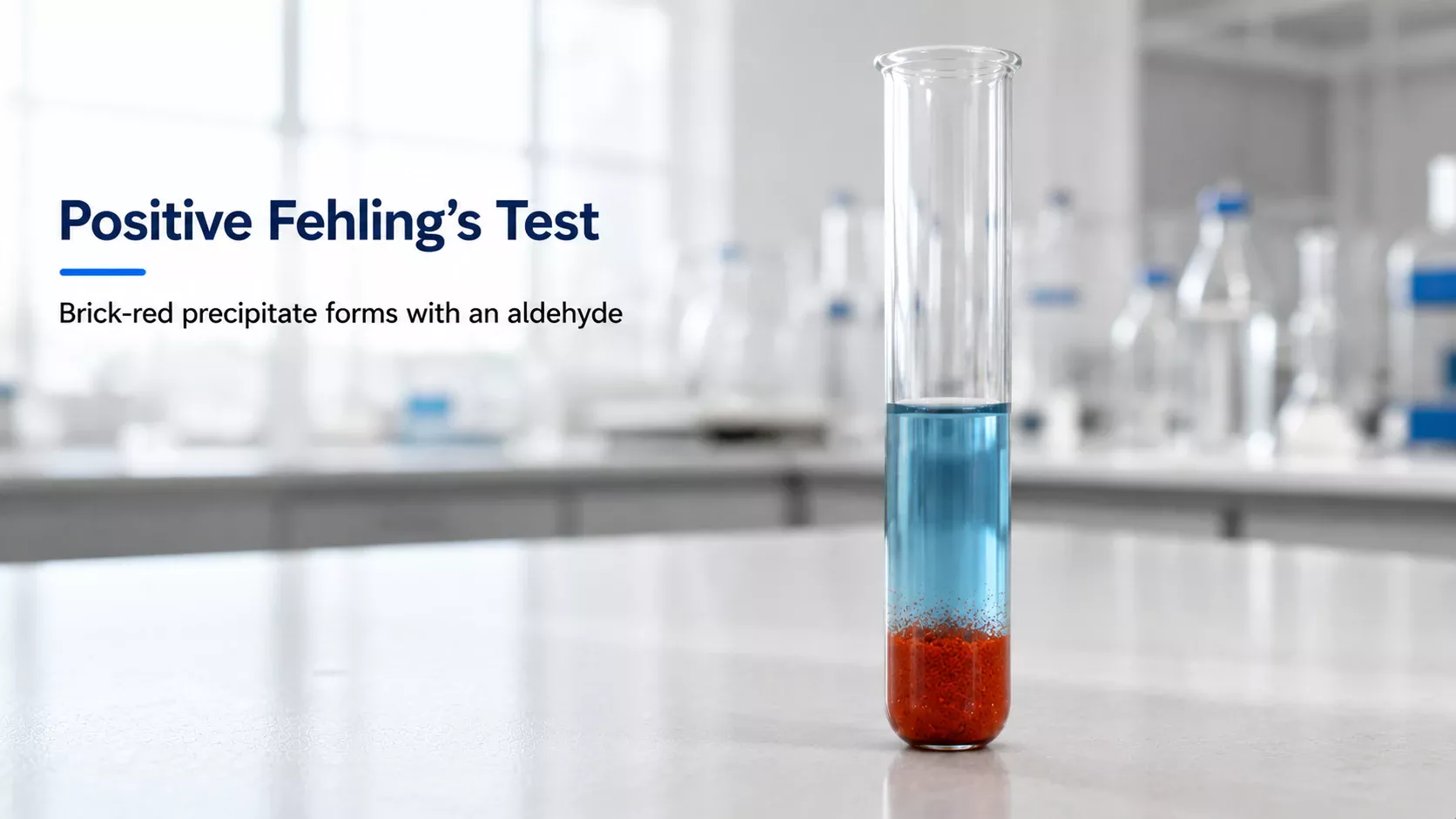
The CP8 sample data gives no Fehling’s reaction. However, students still need to recognise what a positive result would look like. Aldehydes reduce Fehling’s solution to a brick-red precipitate of copper(I) oxide. Ketones do not react under these conditions.
Reference positive result
This is a positive control image, not the CP8 sample result. A brick-red precipitate would indicate an aldehyde.
Link to silver halides
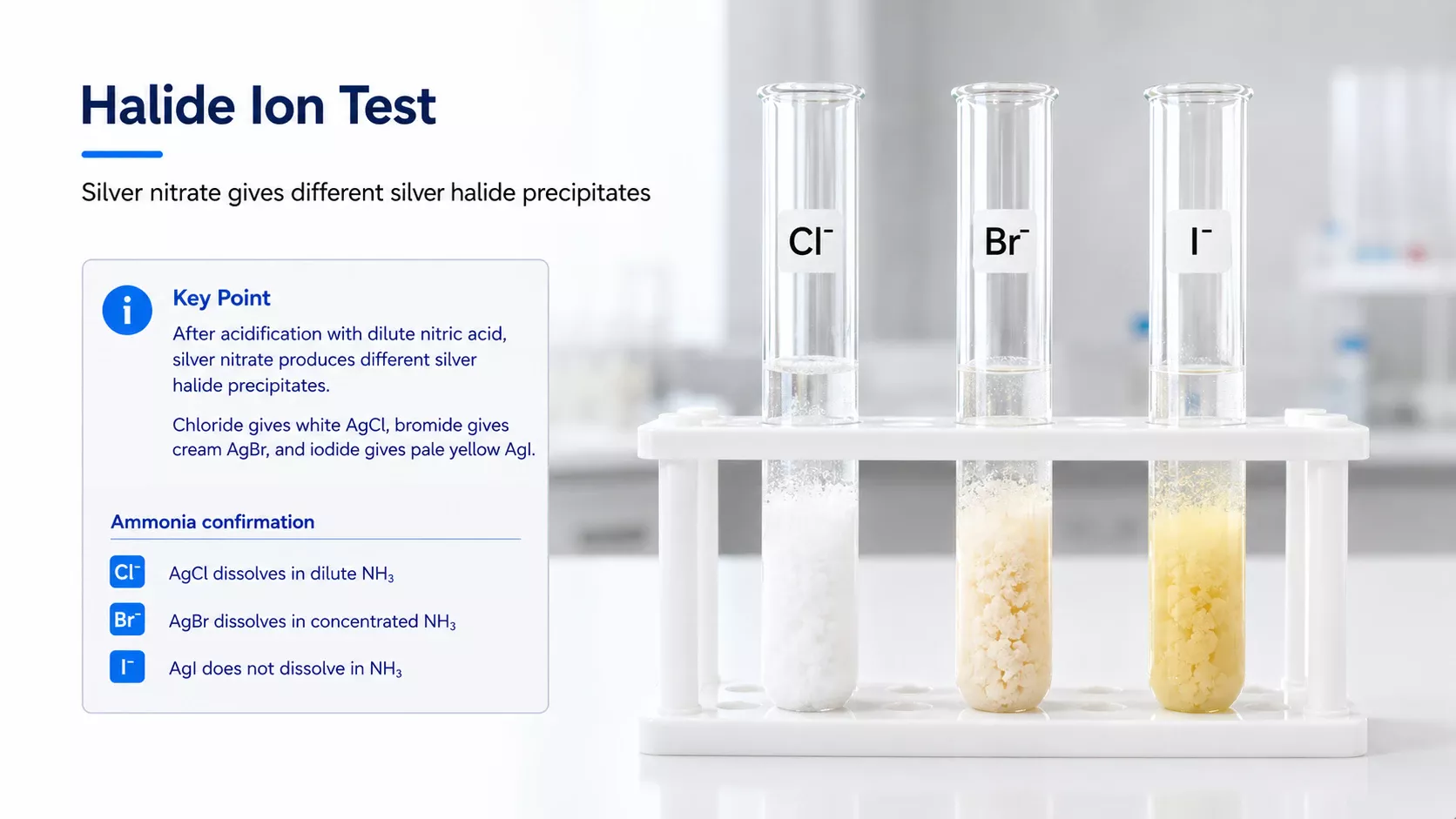
After hydrolysis, silver nitrate can detect released halide ions by precipitate colour.
Inorganic Unknowns X, Y and Z
The inorganic section uses flame tests to identify cations, then precipitation and displacement tests to identify anions. The full identity comes from combining cation and anion evidence.
| Test | X | Y | Z |
|---|---|---|---|
| Flame test | Red-orange, so Ca2+ | Yellow, so Na+ | Lilac, so K+ |
| HNO3, AgNO3, then dilute NH3 | Cream precipitate, not dissolved in dilute NH3, so Br– | No change | Fizzing with acid, then no further silver halide evidence |
| HNO3, then BaCl2 | No change | White precipitate, so SO42- | Fizzing with acid, then no lasting white precipitate |
| Chlorine water | Orange solution forms, so Br2 is produced from Br– | No change | Slight fizzing |
Final inorganic identifications: X = calcium bromide, CaBr2; Y = sodium sulfate, Na2SO4; Z = potassium carbonate, K2CO3.
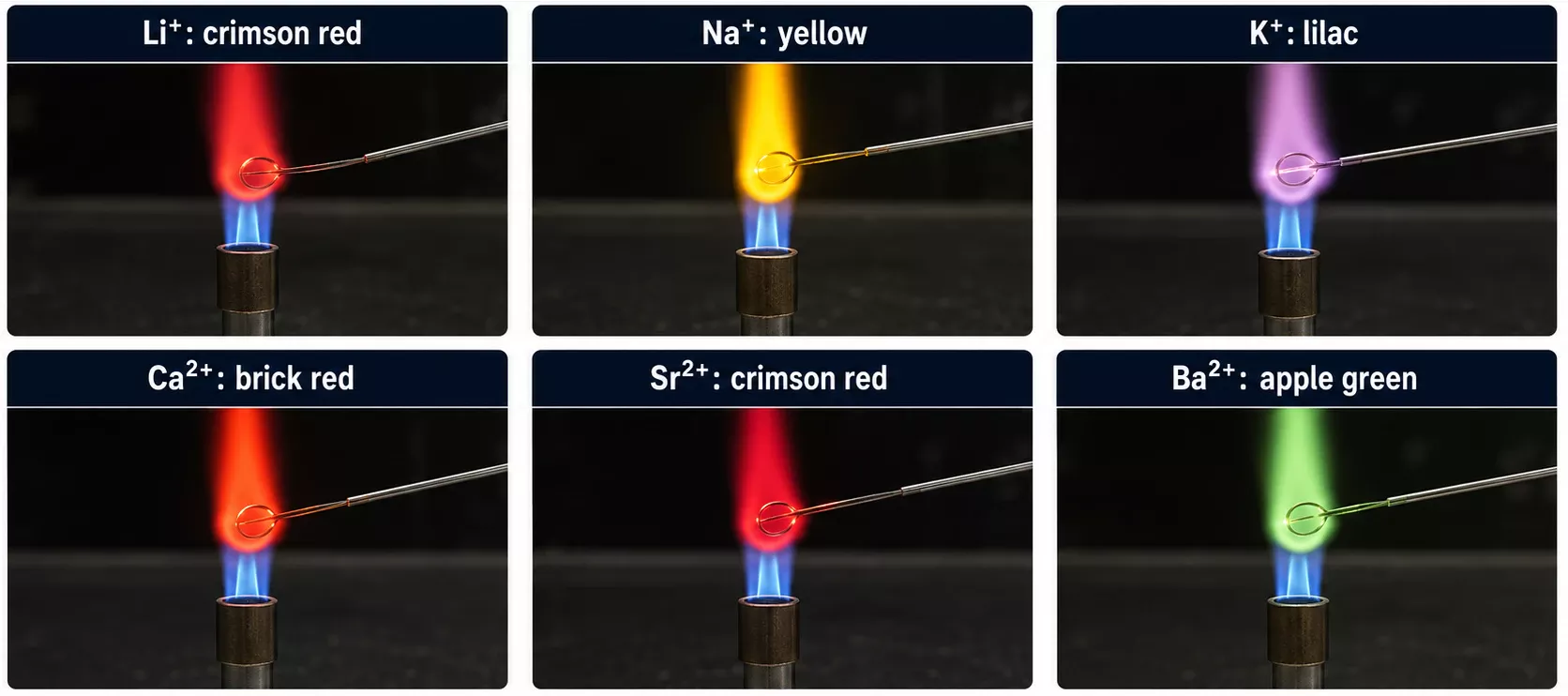
Flame tests
Students should recognise the required cation colours, including Na+ yellow, K+ lilac and Ca2+ brick red or red-orange.
Halide ion test
Silver nitrate gives AgCl white, AgBr cream and AgI pale yellow. X gives the bromide result.
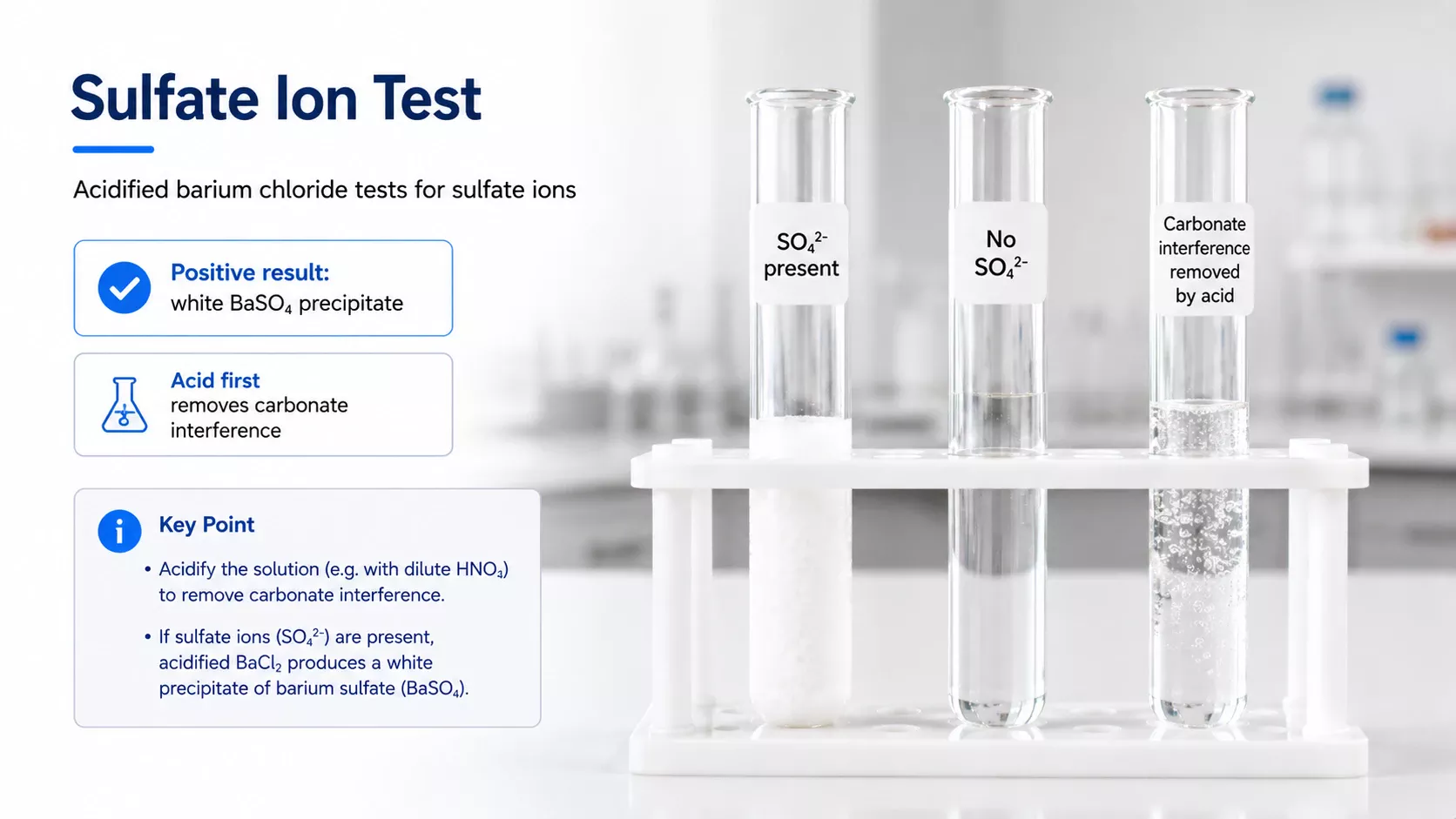
Sulfate ion test
Y gives a white precipitate with acidified barium chloride, showing sulfate ions.
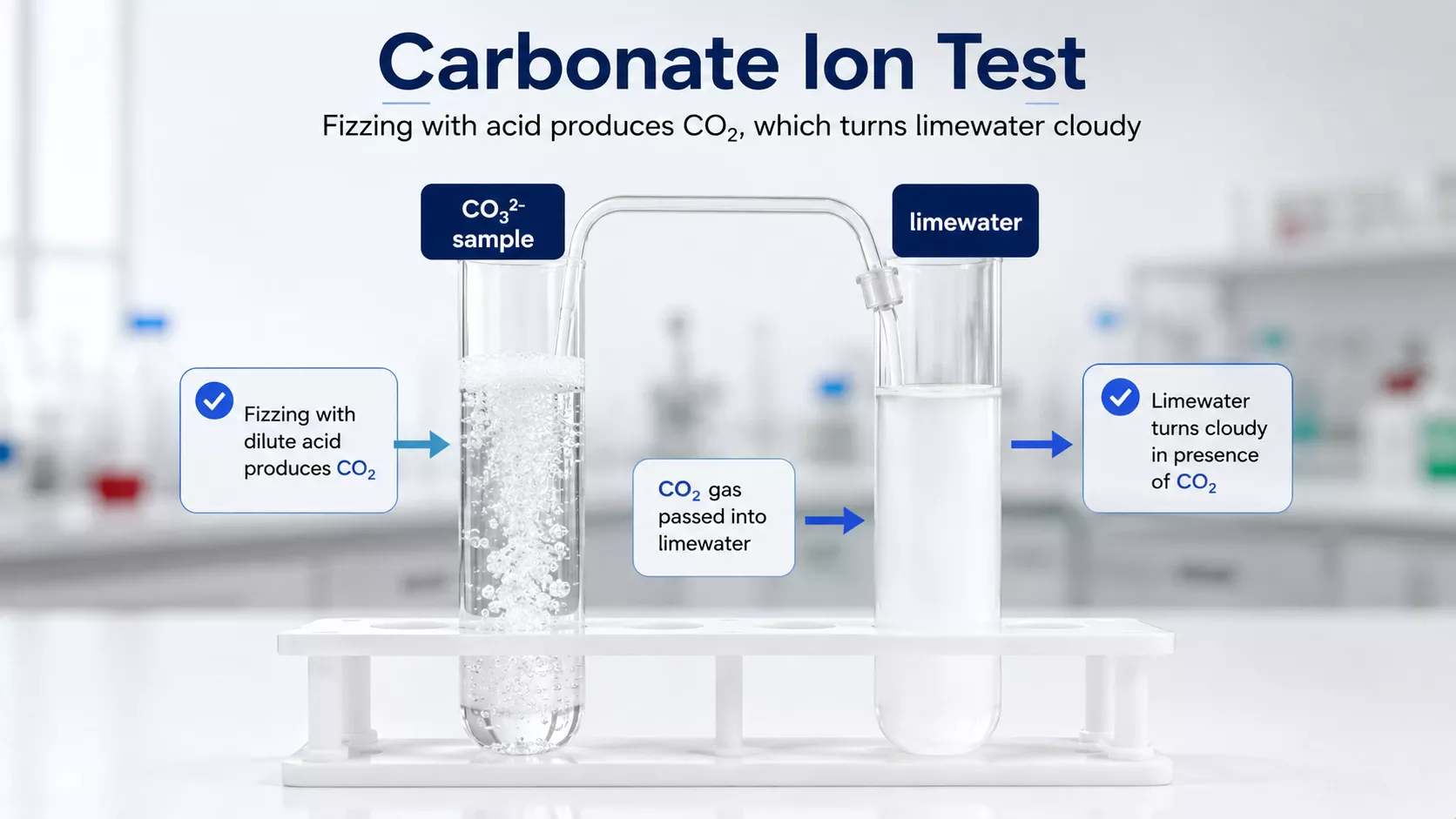
Carbonate clue
Z fizzes with acid, showing carbonate ions are present.
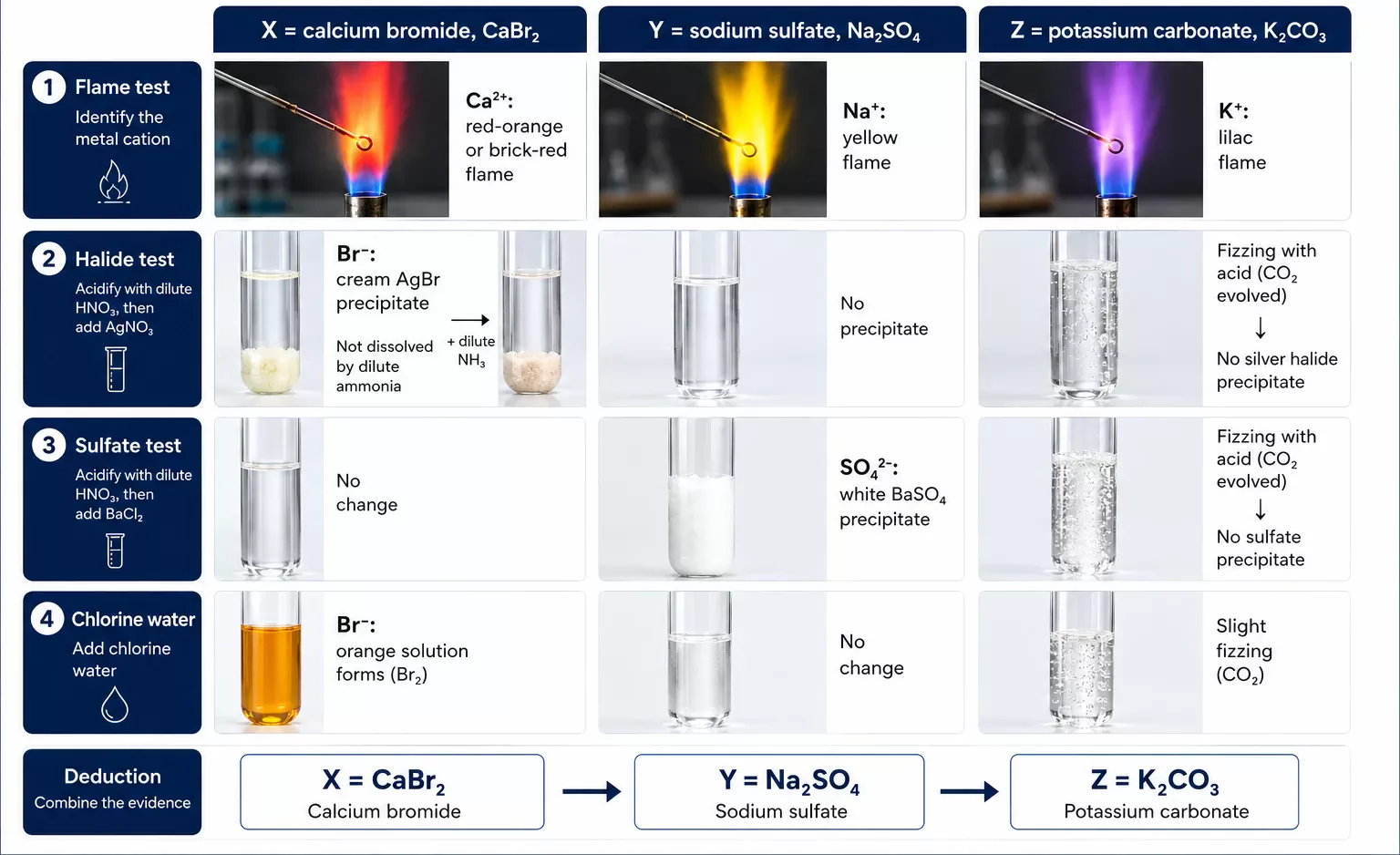
Inorganic unknowns guide
This visual summary links the flame test, halide test, sulfate test and chlorine water test to X, Y and Z.
Chlorine Water Displacement
Chlorine is more reactive than bromine and iodine, so chlorine can displace bromide and iodide ions from solution. In CP8, X forms an orange solution with chlorine water, showing that bromide ions have been oxidised to bromine.
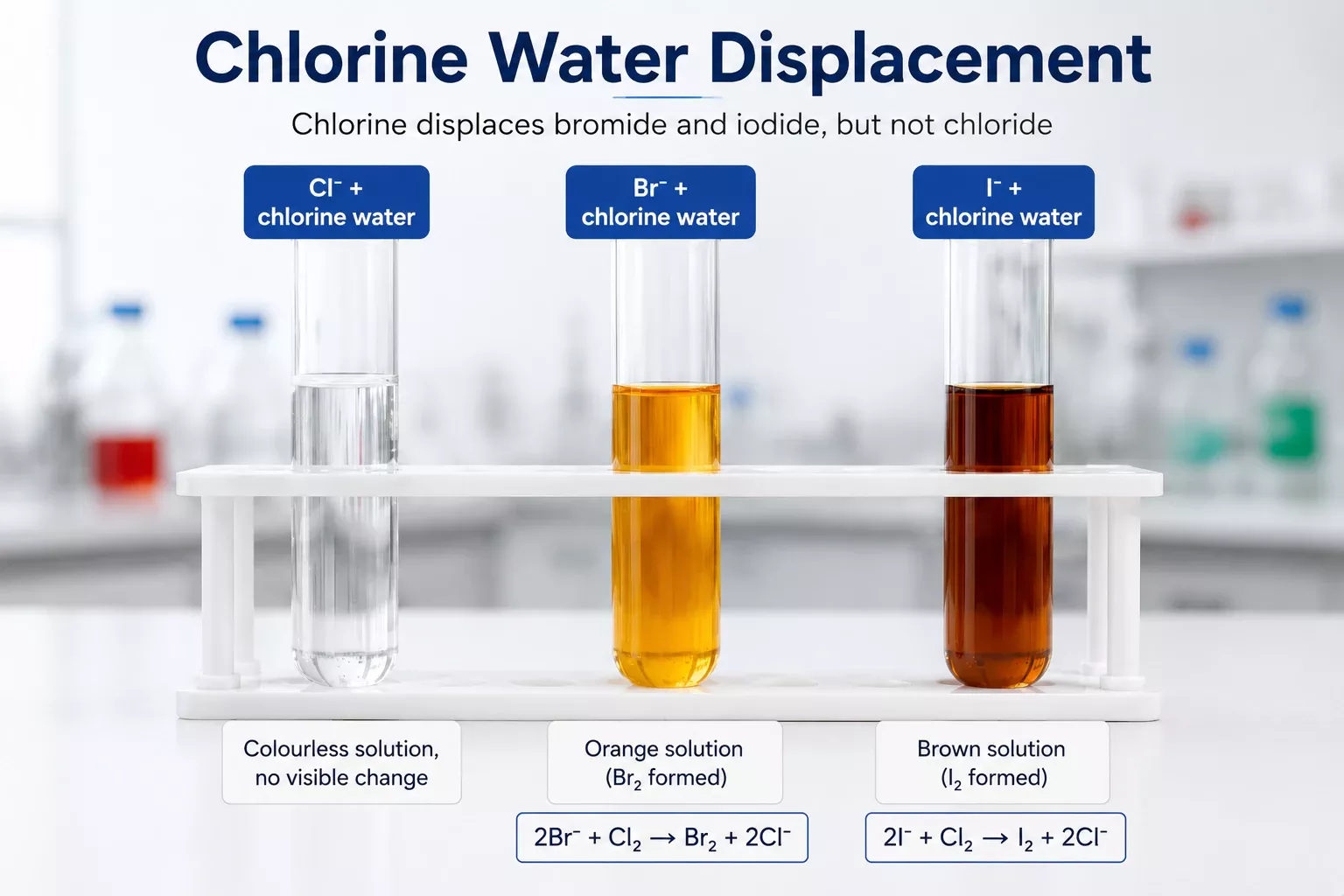
Displacement comparison
Chloride gives no visible displacement, bromide gives orange bromine, and iodide gives brown iodine.
Consistent evidence for bromide
The chlorine water result agrees with the cream AgBr precipitate from the silver nitrate test.
Interactive Evidence Trail
Click each button to reveal how the observations lead to the identity. This mirrors the thinking students need in the practical and in exam questions.
A = oxidisable alcohol
- Acidified dichromate changes orange to green.
- Fehling’s solution gives no brick-red precipitate.
- The best functional-group inference is an oxidisable alcohol rather than an aldehyde.
B = alkene
- Bromine water changes from orange to colourless.
- This is an addition reaction across a C=C double bond.
- The organic product is a 1,2-dibromo compound.
C = bromoalkane
- C is warmed with ethanol and sodium hydroxide to hydrolyse the halogenoalkane.
- The mixture is acidified with nitric acid before silver nitrate is added.
- A cream precipitate shows AgBr, so C is a bromoalkane.
X = calcium bromide, CaBr2
- Red-orange flame indicates Ca2+.
- Cream precipitate with AgNO3 indicates Br–.
- Orange solution with chlorine water confirms Br2 is formed from Br–.
Y = sodium sulfate, Na2SO4
- Yellow flame indicates Na+.
- White precipitate with acidified barium chloride indicates SO42-.
- No halide or chlorine-water displacement evidence is observed.
Z = potassium carbonate, K2CO3
- Lilac flame indicates K+.
- Fizzing with acid indicates CO32-.
- The carbonate ion reacts with acid to produce carbon dioxide gas.
Ionic Equations and Reagent Roles
These are the equations students should be able to write from the CP8 data. They also explain why acidification is important before precipitation tests.
Carbonate with acid
Silver bromide precipitate
Barium sulfate precipitate
Bromide displaced by chlorine
Exam trap: Nitric acid is added before silver nitrate to react with carbonate ions. This prevents silver carbonate forming and masking the halide result.
Exam-Style Data Practice
CP8 links directly to exam questions where students must identify unknowns from observations, spectra or calculation data.
Unknown solution matrix
Four unknown solutions are sodium carbonate, barium chloride, dilute hydrochloric acid and dilute sulfuric acid. From the pairwise observations, the identities are:
| Letter | Identity | Reasoning clue |
|---|---|---|
| A | Sulfuric acid | Forms a white precipitate with barium chloride and reacts with carbonate. |
| B | Hydrochloric acid | Reacts with carbonate but does not form a sulfate precipitate. |
| C | Barium chloride | Forms a white precipitate with sulfuric acid. |
| D | Sodium carbonate | Effervescence occurs with acids. |
Spectroscopy and formula question
The organic compound has percentage composition 38.7% carbon, 9.7% hydrogen and 52.6% oxygen. The answer pathway is:
- Empirical formula = CH2O.
- Molecular ion peak at m/z = 62, so Mr = 62.
- Molecular formula = C2H6O2.
- Broad absorption at approximately 3400 cm-1 shows O-H.
- A fragment such as CHO+ at m/z 31 supports the structure.
- The compound is CH2OHCH2OH, ethane-1,2-diol.
What Students Usually Miss
- Do not ignore negative results. Fehling’s solution has no reaction in the CP8 sample data, which helps rule out an aldehyde.
- Do not identify C directly from silver nitrate. The halogenoalkane must first be hydrolysed so halide ions are released.
- Do not forget acidification. Nitric acid removes carbonate interference before the silver nitrate test.
- Do not use flame colour alone for the full identity. The flame test gives the cation only. You still need the anion tests.
- Do not confuse AgBr and BaSO4. AgBr is cream and comes from silver nitrate with bromide. BaSO4 is white and comes from barium chloride with sulfate.