CP 16 Preparation of Aspirin
A focused revision guide to Core Practical 16 for Edexcel International A Level Chemistry: making aspirin from 2-hydroxybenzoic acid and ethanoic anhydride, crystallising and filtering under reduced pressure, recrystallising from ethanol and water, the yield calculation, the melting temperature as checks of purity, and the errors examiners ask about.
Preparing Aspirin and Testing Its Purity
Make aspirin from 2-hydroxybenzoic acid and ethanoic anhydride, crystallise it, filter it under reduced pressure and recrystallise it, then work out the percentage yield and test its purity from the melting range.
© Dr. Mohammed Al-Fatah – onlinelearningsystem.net
Recap: Esters, Phenols and Yields
Three quick questions on the ideas this practical builds on: naming an ester, why a phenol needs an acid anhydride, and percentage yield from the limiting reagent.
What This Practical Is Testing
This practical, Core Practical 16 on the Edexcel International course, prepares a pure organic solid, aspirin, from 2-hydroxybenzoic acid and ethanoic anhydride, then tests its purity. The phenol OH group is esterified; the carboxylic acid group is untouched.
C₆H₄(OH)COOH(s) + (CH₃CO)₂O(l) → C₆H₄(OCOCH₃)COOH(s) + CH₃COOH(l)
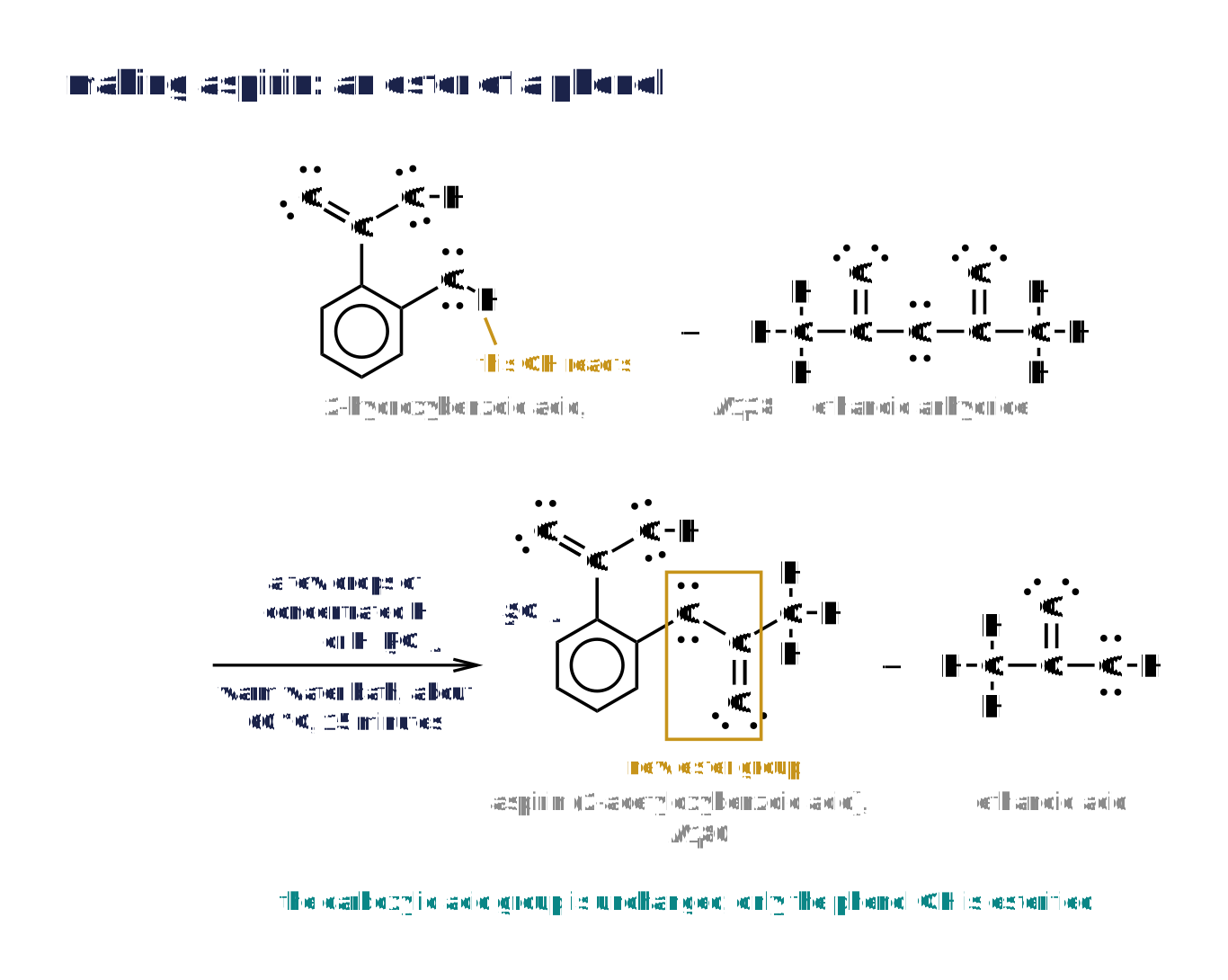
The equation with displayed structures: the phenol OH of 2-hydroxybenzoic acid is esterified by ethanoic anhydride, with ethanoic acid as the by-product.
Three skills are examined. Preparation: a reaction warmed under controlled conditions, then crystallisation. Purification: filtration under reduced pressure and recrystallisation. Checking: the melting temperature and the percentage yield, with the reasons for every step.
On the Edexcel International course this practical is examined through the Unit 6 practical skills paper (WCH16), which asks for methods, apparatus choices, data processing, uncertainty and evaluation.
The specification references are 20.4 (the preparation of aspirin) and 20.5 (recrystallisation, washing, drying and the melting temperature).
The yield calculation follows the same pattern as Core Practical 6 (chlorination of 2-methylpropan-2-ol); the purity logic is the same for any solid you prepare.
Key idea: Every step is justified by solubility or by hazard: the product is very soluble hot and almost insoluble cold, and the anhydride is corrosive and flammable. Say the reason, not just the step.
Safety and Apparatus
The reagents are the hazard here, not the glassware. Ethanoic anhydride and concentrated sulfuric acid are both corrosive, and the anhydride is flammable, so the whole preparation is done in a fume cupboard with no flame.
| Item | What it is for | Precision or note |
|---|---|---|
| Balance reading to 0.01 g | Weighs the 2-hydroxybenzoic acid and the dry product | ±0.005 g per reading |
| 100 cm³ conical flask | The reaction vessel; swirled in the water bath | not a measuring vessel |
| 10 cm³ measuring cylinder | Measures 4.0 cm³ of ethanoic anhydride | ±0.1 cm³; the anhydride is in excess, so this is precise enough |
| Water bath on an electric hotplate, with thermometer | Holds the flask at 60 °C for 15 minutes | ±0.5 °C; no flame |
| Ice bath and glass rod | Crystallises the product; scratching starts crystal growth | cool for about 10 minutes |
| Büchner funnel, thick-walled flask and pump | Filtration under reduced pressure, twice | wet the flat paper first so it seals |
| Boiling tube and about 5 cm³ of ethanol | Recrystallisation solvent, with warm water added until just cloudy | ethanol is flammable: water bath only |
| Melting temperature apparatus or Thiele tube | Measures the melting temperature of the dry product in a capillary tube | ±0.5 °C per reading; heat slowly near the value |
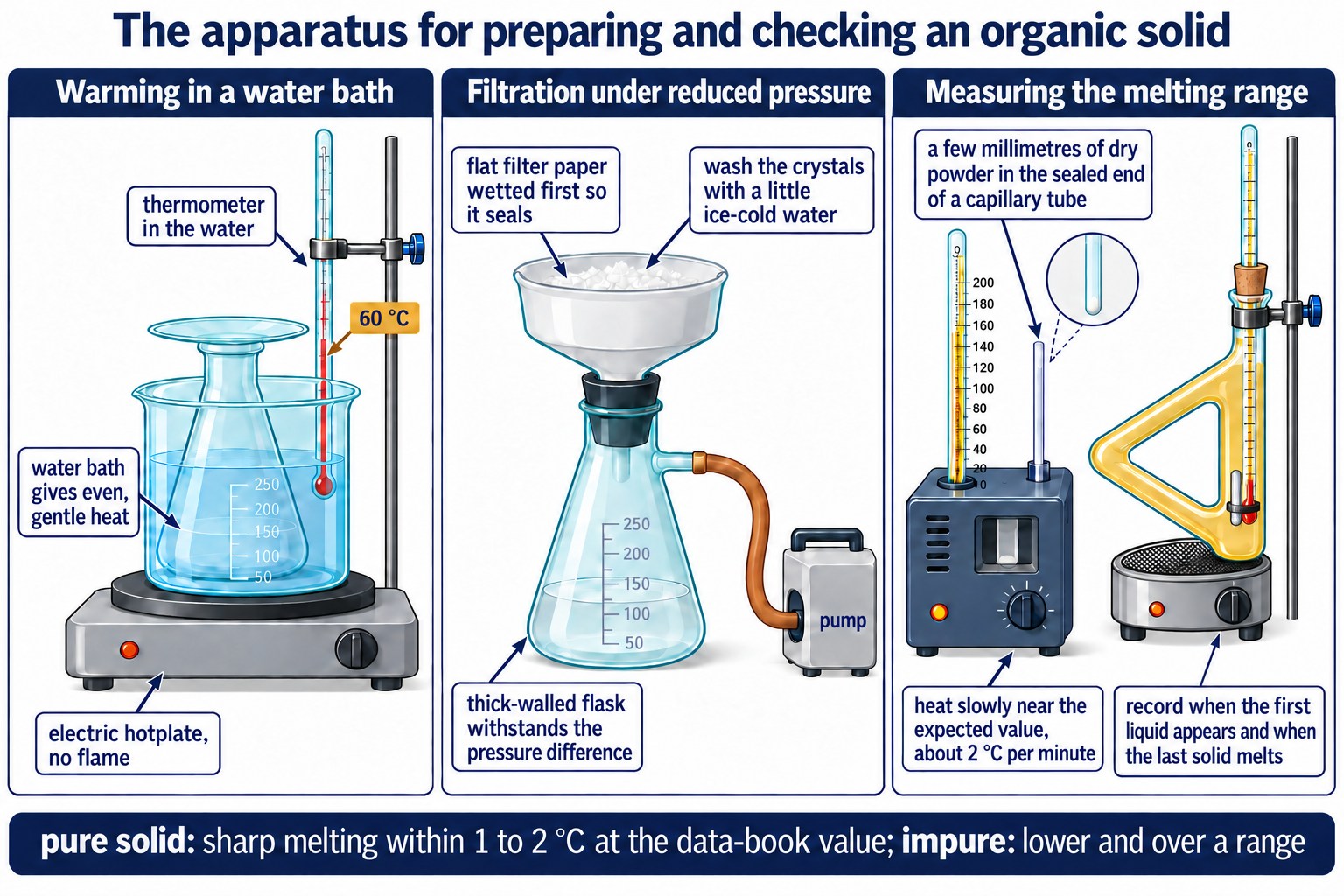
The three pieces of apparatus the exam asks about: the water bath on a hotplate, filtration under reduced pressure, and the melting temperature apparatus with a Thiele tube alongside.
Safety: Ethanoic anhydride is corrosive and flammable and its vapour irritates: fume cupboard, gloves, eye protection. Concentrated sulfuric acid is corrosive. Ethanol is flammable: water bath only. Adding water to the excess anhydride is exothermic and fumes, so add it slowly.
Method: Step by Step (Preparation)
The preparation takes about half an hour. The quantities below give a crude product that is mostly aspirin with some unreacted 2-hydroxybenzoic acid mixed in, which is why recrystallisation follows.
| Step | What you do | Why |
|---|---|---|
| Weigh | Weigh 2.00 g of 2-hydroxybenzoic acid into a dry 100 cm³ conical flask. | The limiting reagent (0.01448 mol). Dry glassware: water hydrolyses the anhydride. |
| Add the anhydride | In the fume cupboard add 4.0 cm³ (4.32 g, 0.0423 mol) of ethanoic anhydride. | About threefold excess, so all the 2-hydroxybenzoic acid reacts. |
| Catalyst | Add 5 drops of concentrated sulfuric acid and swirl. | Protonates the anhydride, making its carbonyl carbon more electrophilic. |
| Warm | Stand the flask in a water bath at 60 °C for 15 minutes, swirling, until the solid dissolves. | Gentle heat, no flame; above 70 °C side reactions lower the yield. |
| Hydrolyse the excess | Add 20 cm³ of cold water slowly, in the fume cupboard. | Excess anhydride becomes soluble ethanoic acid; exothermic, with fumes. |
| Crystallise | Cool in an ice bath for about 10 minutes; scratch the wall with a glass rod if needed. | Aspirin is almost insoluble in cold water; scratching starts crystal growth. |
| Filter | Filter under reduced pressure through a Büchner funnel. | Fast, and leaves the crystals almost dry; ethanoic acid and catalyst leave in the filtrate. |
| Wash | Wash the crystals with a little ice-cold water; draw air through for a few minutes. | Removes soluble impurities without dissolving the product. |
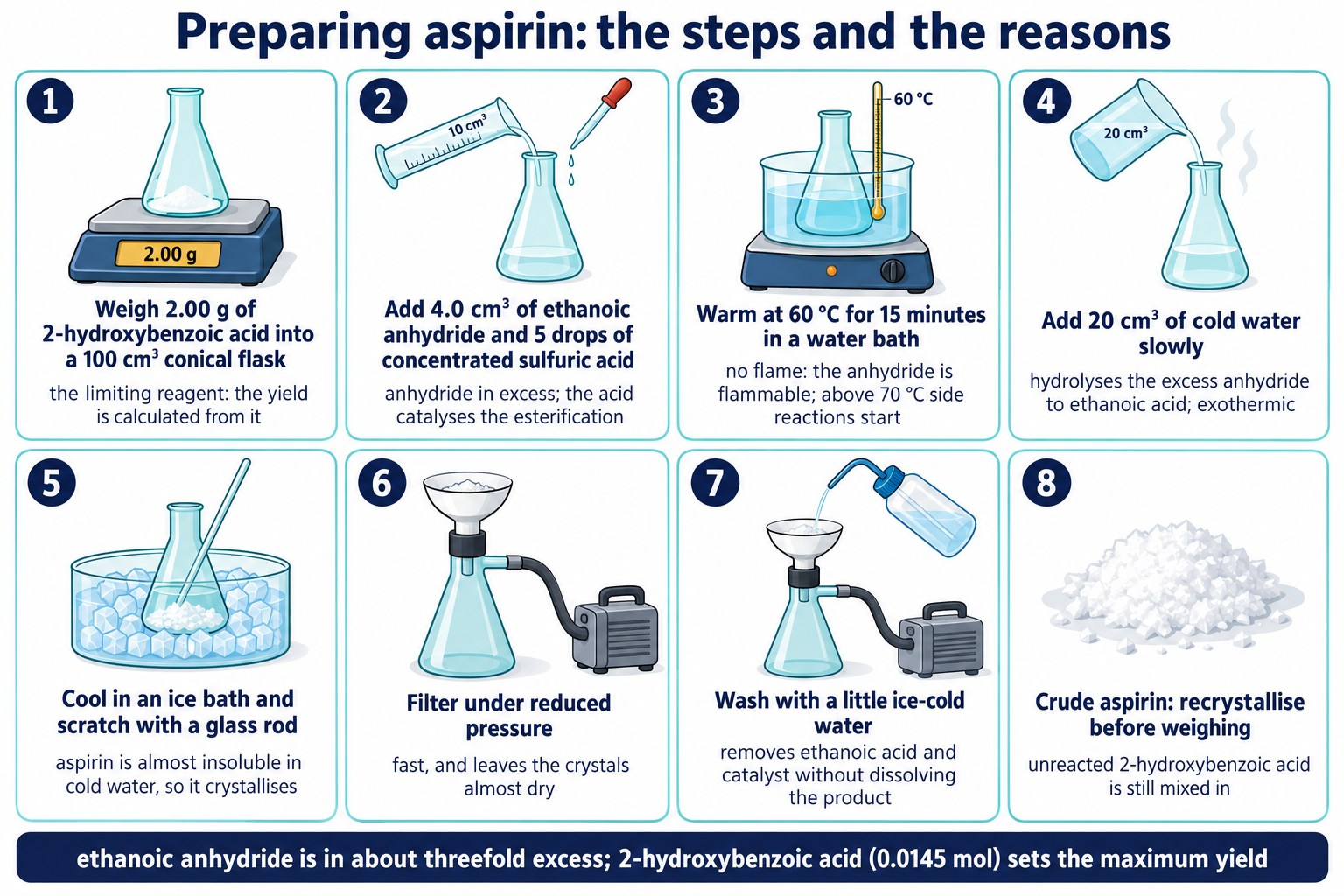
The eight preparation steps with their quantities and reasons: 2.00 g of 2-hydroxybenzoic acid, 4.0 cm³ of ethanoic anhydride, 5 drops of catalyst, 60 °C for 15 minutes, water, ice, filter, wash.
Washing with sodium carbonate: A neutral product such as a simple ester can be washed with sodium carbonate solution to remove acidic impurities. Aspirin is itself a carboxylic acid and would dissolve as its salt, so it is washed with water only.
Check: Making N-Phenylethanamide
Order the steps for a different solid made with the same reagent, ethanoic anhydride.
Method: Step by Step (Purification and Checking)
The crude solid is recrystallised from ethanol and water. Aspirin dissolves readily in hot ethanol and hardly at all in cold water, so the mixed solvent gives the large hot-to-cold solubility difference recrystallisation needs.
| Step | What you do | Why |
|---|---|---|
| Dissolve | Put the crude solid in a boiling tube with about 5 cm³ of ethanol; warm in the 60 °C water bath until it just dissolves. | Minimum hot solvent gives a saturated solution, so the most product crystallises on cooling. |
| Add water | Add warm water dropwise until the solution just turns cloudy, then warm until clear. | Water lowers the solubility of aspirin; the cloud point marks saturation. |
| Cool slowly | Cool to room temperature undisturbed, then stand in the ice bath. | Slow cooling grows large pure crystals; the impurities stay dissolved. |
| Filter | Filter under reduced pressure through a Büchner funnel. | Draws off the cold mother liquor that holds the impurities. |
| Wash | Rinse the crystals with a little ice-cold water. | Removes the last mother liquor while dissolving almost no product. |
| Dry | Press between filter papers, then dry in a desiccator or in air; never in an oven above 60 °C. | Residual solvent raises the mass and lowers the melting temperature; hot ovens melt or hydrolyse the ester. |
| Weigh | Weigh the dry product: 1.85 g in this run. | The actual yield for the percentage yield calculation. |
| Melting temperature | Heat a capillary of powder slowly near 135 °C; record first liquid and last solid. | Pure aspirin melts sharply at 135 to 136 °C; crude melts lower, over a range. |
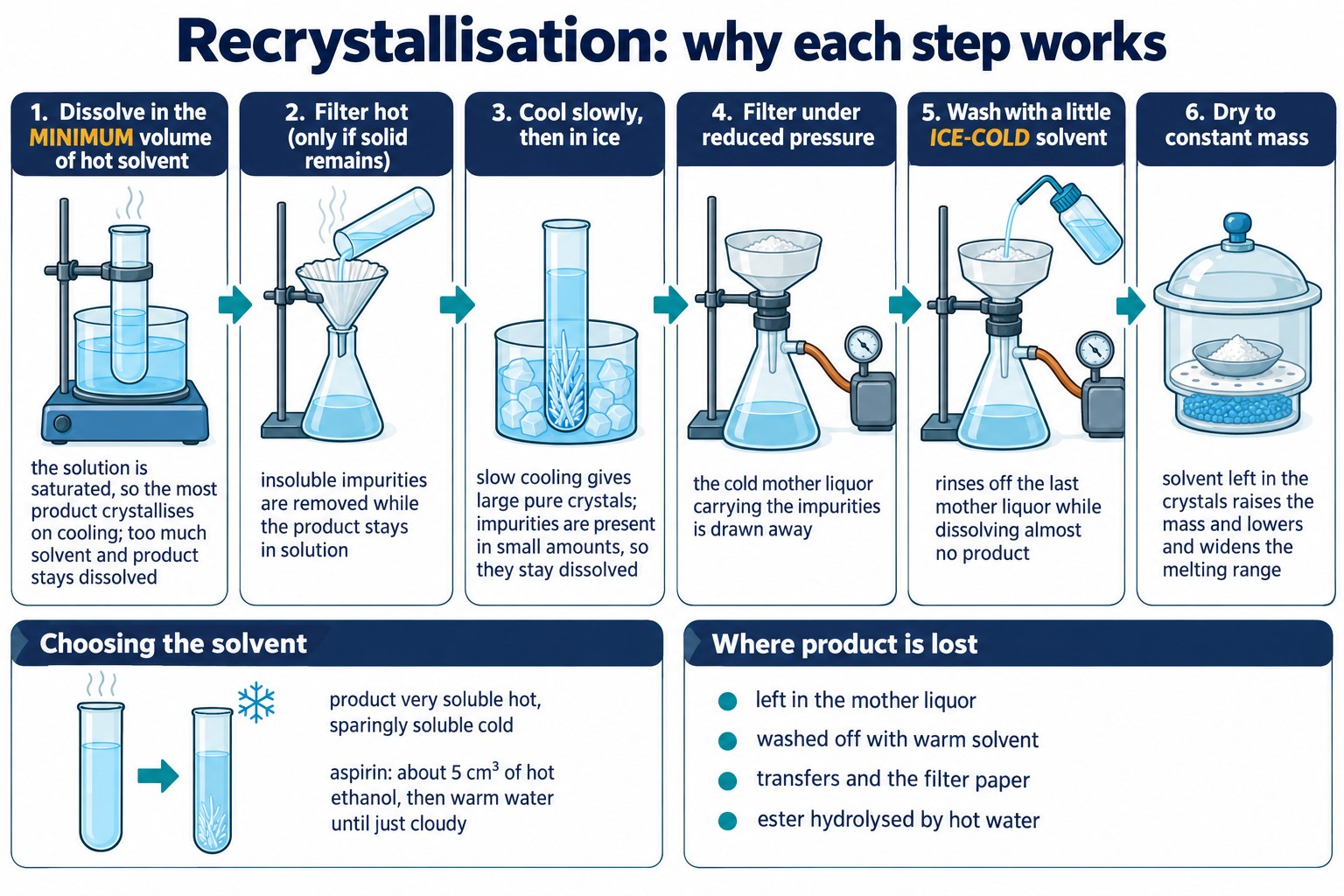
Why each recrystallisation step works: minimum hot solvent, hot filtration if needed, slow cooling, the impurities left in the mother liquor, ice-cold washing and drying to constant mass.
Exam wording: “Dissolve in the minimum volume of hot solvent, cool slowly, filter under reduced pressure, wash with a little ice-cold solvent, dry.” Give the reason beside each step: the marks are for the reasons.
Check: Recrystallising Benzoic Acid
Justify the recrystallisation steps for a different solid with its own solubility data.
The Chemistry: Acylating a Phenol
2-Hydroxybenzoic acid carries two functional groups on the benzene ring: a phenol OH and a carboxylic acid. Only the phenol OH reacts. Ethanoic anhydride transfers an ethanoyl (CH₃CO) group to the phenol oxygen, forming the ester and releasing ethanoic acid.
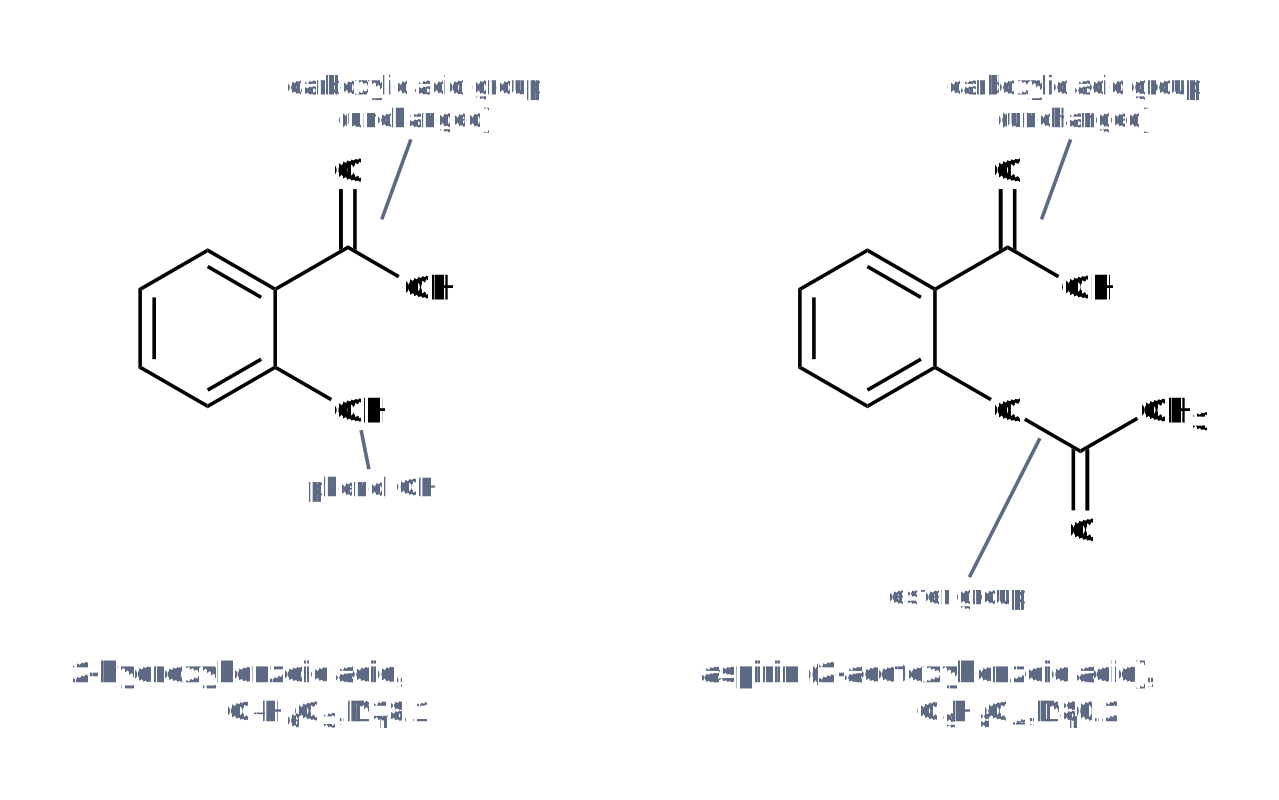
The two molecules side by side: the phenol OH of 2-hydroxybenzoic acid becomes the ester group of aspirin; the carboxylic acid group is unchanged.
Why an anhydride. A phenol is too weak a nucleophile to be esterified by a carboxylic acid, even with a catalyst. Anhydrides and acyl chlorides are far more reactive; the anhydride is cheaper, less corrosive and does not fume hydrogen chloride.
Why the catalyst. Concentrated sulfuric acid protonates a carbonyl oxygen of the anhydride, making the carbonyl carbon more electrophilic so the phenol oxygen attacks faster. Phosphoric acid works equally well and is less aggressive.
Why not a condensation of an acid and an alcohol. That description costs the mark: the reaction is the acylation of a phenol by an acid anhydride, an addition–elimination at the carbonyl carbon.
Atom economy. Only one product is wanted: atom economy = 180.2 ÷ (138.1 + 102.1) × 100 = 75.0%. The ethanoic acid carries away the rest of the mass, whatever the yield.
Exam wording: “The phenol OH group is esterified (acylated) by ethanoic anhydride; the carboxylic acid group does not react. Ethanoic acid is the by-product.”
Worked Calculation: Percentage Yield
The yield is always calculated from the limiting reagent. Check first which reagent that is: the anhydride is in excess, so 2-hydroxybenzoic acid sets the maximum mass of aspirin.
| Quantity | 2-hydroxybenzoic acid | Ethanoic anhydride |
|---|---|---|
| Mass used | 2.00 g | 4.0 cm³ × 1.08 g cm⁻³ = 4.32 g |
| Mr | 138.1 | 102.1 |
| Moles | 2.00 ÷ 138.1 = 0.01448 mol | 4.32 ÷ 102.1 = 0.0423 mol |
| Role | limiting reagent (1 : 1 with aspirin) | about 2.9 times the moles needed: in excess |
Step 1: moles of 2-hydroxybenzoic acid = 2.00 ÷ 138.1 = 0.01448 mol
Step 2: theoretical moles of aspirin = 0.01448 mol (1 : 1), so theoretical mass = 0.01448 × 180.2 = 2.61 g
Step 3: percentage yield = 1.85 ÷ 2.61 × 100 = 70.9%
Answer: 70.9%, to three significant figures, matching the masses. A yield near 70% is typical for a recrystallised solid; a crude yield is higher but the product is impure.
Where the other 29% went. Product left dissolved in the mother liquor and the washings; crystals left on the filter paper and in the flask; a little aspirin hydrolysed back to 2-hydroxybenzoic acid by hot water; an incomplete reaction.
Common slip: Students who start from the anhydride (0.0423 mol × 180.2 = 7.62 g) get a “yield” of 24%. Always find the limiting reagent first.
Check: Yields and Atom Economy for Other Solids
Work each calculation on paper for different solids, then flip the card to see the full working.
Testing Purity: the Melting temperature
A pure crystalline solid melts sharply, within 1 to 2 °C, at a characteristic value. Impurities disrupt the regular lattice, so less energy is needed to break it: melting starts lower and finishes over a range of several degrees.
Method. Tap a few millimetres of the dry powder into the sealed end of a capillary tube. Heat it in a melting temperature apparatus, or strapped to a thermometer in a Thiele tube of oil.
Readings. Heat slowly near the expected value, about 2 °C per minute. Record the temperature when the first liquid appears and when the last solid melts; the two readings are the melting range.
| Sample | Melting behaviour | What it tells you |
|---|---|---|
| Pure aspirin (data book) | 135 to 136 °C, sharp | identity confirmed and the sample is pure |
| Recrystallised product | 134 to 136 °C | pure within the ±0.5 °C of the thermometer |
| Crude product | softens at 128 °C, liquid by 133 °C | unreacted 2-hydroxybenzoic acid and residual solvent present |
| Wet crystals | low and wide, mass too high | dry to constant mass and measure again |
Why slowly. Heated fast, the sample lags behind the thermometer, so the reading is too high and the range looks wide. Why dry. Residual solvent is itself an impurity. Why a sharp value matters. A range written for the pure compound is marked wrong.
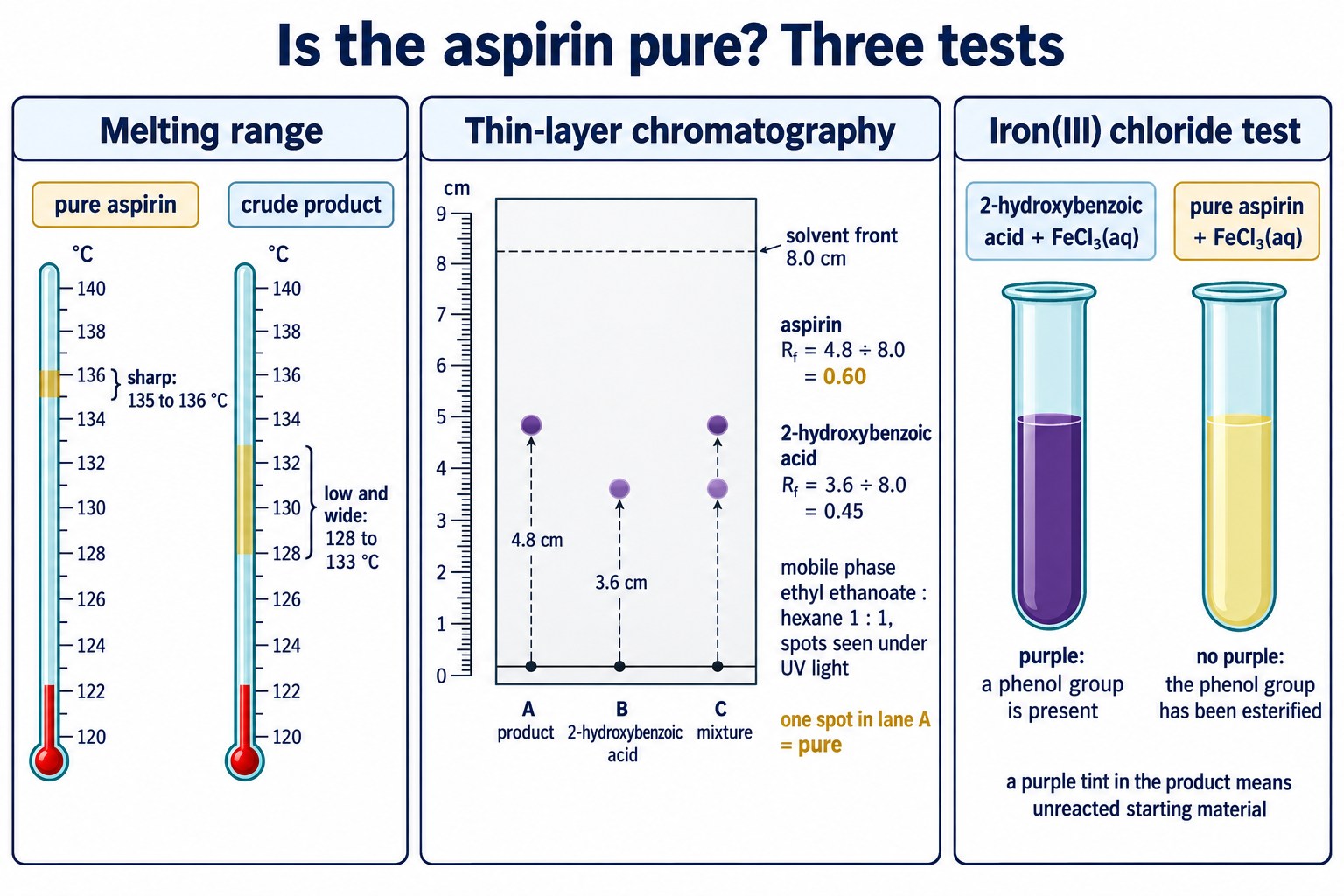
The purity checks side by side: the melting temperature of pure and crude aspirin, a thin-layer chromatogram with Rf 0.60 for aspirin and 0.45 for 2-hydroxybenzoic acid, and the iron(III) chloride test for the phenol group.
Exam wording: “A pure solid melts sharply at the data-book value (aspirin 135 to 136 °C); an impure solid melts lower and over a range of several degrees.” Give both halves.
Check: Reading a Purity Result
Pick the correct statement about melting behaviour, residual solvent and yields above 100% for solids other than aspirin.
Errors, Uncertainty and Improvements
The measuring uncertainties are tiny; the yield is lost in the chemistry and the handling. The evaluation marks go to naming the loss, saying which way it moves the result and giving a specific improvement.
| Source of error | Effect on the result | Improvement |
|---|---|---|
| Water in the glassware or an old bottle of anhydride | Anhydride hydrolysed before it reacts: lower yield | Dry glassware; a freshly opened bottle; keep the excess |
| Overheating above 70 °C or a naked flame | Side reactions and decomposition: lower yield, coloured impure product; fire risk | Water bath on a hotplate at 60 °C with a thermometer |
| Too much ethanol in the recrystallisation | Solution not saturated on cooling: product stays dissolved, yield falls | Add hot solvent a little at a time until the solid just dissolves |
| Washing with water at room temperature | Dissolves some product: yield falls | Ice-cold water, a small volume |
| Hot water in contact with the product for long | Ester hydrolysed back to 2-hydroxybenzoic acid: lower yield, purple with FeCl₃ | Keep the hot stage short; cool promptly |
| Product not fully dried | Mass too high (yield can exceed 100%); melting temperature low and wide | Dry to constant mass in a desiccator |
| Melting temperature heated too fast | Sample lags behind the thermometer: value too high, range looks wide | About 2 °C per minute near the expected value; repeat |
Percentage uncertainties. The 2.00 g is weighed by difference, two readings at ±0.005 g: 0.010 ÷ 2.00 × 100 = 0.50%. The 1.85 g of product likewise: 0.010 ÷ 1.85 × 100 = 0.54%. Combined, about 1.0% of the yield: 70.9% ± 0.7%.
Other readings. The melting temperature is read to ±0.5 °C, so 135 to 136 °C is still sharp. The 4.0 cm³ of anhydride (±0.1 cm³, 2.5%) does not matter: it is in excess, and the yield is not calculated from it.
Exam focus: The measured uncertainty (about 1%) cannot explain a 29% loss. Say so, then name the chemical and handling losses.
Check: Faults in a Solid Preparation
Decide how each fault moves the yield or the purity in new situations.
Common Mistakes
The same slips appear in write-ups and exam answers every year. Each one costs a mark that the corrected version earns.
Wrong reaction type. Calling the synthesis a condensation of an acid and an alcohol. It is the acylation of a phenol by an acid anhydride; a carboxylic acid will not esterify a phenol.
Wrong limiting reagent. Calculating the theoretical yield from the anhydride. It is in excess; 2-hydroxybenzoic acid (0.01448 mol) sets the 2.61 g maximum.
A range for a pure compound. Writing “melts at 128 to 136 °C” for pure aspirin. Pure: sharp at 135 to 136 °C; a range of several degrees means impure.
Steps without reasons. “Filter, wash, dry” earns nothing on its own; “wash with ice-cold water because warm water dissolves the product” earns the mark.
Heating with a flame. The anhydride, the ethanoic acid vapour and the ethanol are all flammable; a water bath on a hotplate is the only acceptable answer.
Weighing wet crystals. A yield over 100% is reported as a success instead of a sign that the sample is wet or impure.
Confusing atom economy with yield. Atom economy (75.0%) comes from the equation and never changes; yield (70.9%) comes from the masses in this run.
Common Exam Points
Say
“The minimum volume of hot solvent gives a saturated solution, so the most product crystallises on cooling.” “A pure solid melts sharply at the data-book value; an impure one melts lower, over a range.” “2-Hydroxybenzoic acid is the limiting reagent.”
Do not say
“Aspirin is made by a condensation of an acid and an alcohol.” (It is a phenol acylated by an acid anhydride.) “Heat the mixture over a Bunsen burner.” “Wash the crystals with warm water.” “Pure aspirin melts at 128 to 136 °C.”
Watch for
Yield calculated from the anhydride; a melting “range” written for the pure compound; “dry in an oven” with no temperature (keep well below 135 °C); method steps with no reasons; atom economy (75.0%) confused with yield (70.9%).
FAQs
Short answers to the questions students most often ask about preparing aspirin and testing its purity.
Why is ethanoic anhydride used rather than ethanoic acid?
A phenol is too weak a nucleophile to be esterified by a carboxylic acid. The anhydride is a much more reactive acylating agent, and it is cheaper, safer and less violent than ethanoyl chloride, which fumes hydrogen chloride.
Why do we add water at the end of the reaction?
Water hydrolyses the excess ethanoic anhydride to ethanoic acid, which is soluble and washes away. Aspirin is almost insoluble in cold water, so cooling in ice then crystallises the product out of the mixture.
Why is the melting temperature measured on the dry product only?
Any solvent left in the crystals is an impurity: it lowers and widens the melting range and makes the mass too high. Dry to constant mass between filter papers or in a desiccator before weighing or testing.
Why is the yield only about 70% when the anhydride is in excess?
Product stays dissolved in the mother liquor and the washings, some is lost in transfers and on the filter paper, and a little aspirin is hydrolysed back to 2-hydroxybenzoic acid by the hot water added during recrystallisation.
How can I tell whether my aspirin is pure?
Measure its melting temperature. Pure aspirin melts sharply at 135 to 136 °C. A crude sample softens from about 128 °C and melts over a range of several degrees, because unreacted 2-hydroxybenzoic acid disrupts the lattice.
Copyright notice: This OLS revision content, including the explanations, layout, diagrams, tables and embedded learning structure, is authored for Online Learning System by Dr. Mohammed Al-Fatah. It may not be copied, reproduced, redistributed or adapted without written permission.
Keep this note — free
Save your progress across every Edexcel IAL topic. A free account remembers which topics you have covered, saves your question scores, and syncs across your phone and laptop.
- Track every topic you have finished
- Keep your practice-question scores
- No payment, no card, free forever
Already registered? Log in