CP 15 Analysis of Inorganic and Organic Unknowns
A focused revision guide to Core Practical 15 for Edexcel International A Level Chemistry: identifying transition metal ions with sodium hydroxide and ammonia added dropwise then in excess, the equations behind every precipitate and every complex, the second-year organic tests for phenols, carbonyls, acyl chlorides and amines, and six worked unknowns deduced from their observations.
Identifying Metal Ions with Sodium Hydroxide and Ammonia
Five unknown solutions, two reagents, each added a few drops at a time and then in excess: watch every precipitate form, see which ones dissolve, and read the ions from the grid.
© Dr. Mohammed Al-Fatah – onlinelearningsystem.net
Recap: The AS Tests You Build On
Three quick questions on the anion tests and the ammonium test from the first year, which this practical assumes you can already do.
What This Practical Is Testing
Core Practical 15 asks you to identify unknown substances from test-tube observations alone.
It extends Core Practical 8 (analysis of inorganic and organic unknowns): the anion tests are unchanged, but the cations are now transition metal ions and the organic groups are the second-year ones.
The inorganic half. A solution of a transition metal ion is treated with sodium hydroxide and, on a fresh portion, with ammonia, a few drops at a time and then in excess. The precipitate colour, and whether it dissolves in excess, identifies the ion.
The organic half. Phenols, carboxylic acids, carbonyl compounds, alcohols, halogenoalkanes, esters, acyl chlorides, amines, amides and amino acids each have a reagent that gives a visible change. The skill is choosing the tests in an order that rules groups out.
On the Edexcel International course this practical is examined through the Unit 6 practical skills paper (WCH16), which asks for methods, apparatus choices, data processing, uncertainty and evaluation.
Questions give observations and ask for the ion or group, ask for ionic equations with state symbols for the precipitates, or ask why a test is done in a particular order.
Key idea: Two reagents, sodium hydroxide and ammonia, each added dropwise then in excess, distinguish Cr³⁺, Mn²⁺, Fe²⁺, Fe³⁺, Co²⁺, Ni²⁺, Cu²⁺ and Zn²⁺. Record the colour of the precipitate and what happens in excess: both observations carry marks.
Safety and Apparatus
Test-tube reactions need small volumes and a clear record. A results grid drawn before you start is the most useful piece of apparatus on the bench.
| Item | What it is for | Precision or note |
|---|---|---|
| Test tubes in a rack | One fresh 2 cm³ portion of the unknown for every reagent | about 2 cm depth; never reuse a tube between reagents |
| Dropping pipettes | Add reagents a few drops at a time, then in excess | count the drops; wash between reagents |
| 10 cm³ measuring cylinder | Measures about 2 cm³ portions and the water used to dissolve solids | ±0.1 cm³; precision is not critical here |
| Water bath or Bunsen burner | Warming for the ammonium test, Tollens’ reagent and dichromate(VI) | never heat flammable organic liquids over a flame |
| Damp red litmus paper | Detects ammonia at the mouth of a warmed tube | hold it at the mouth; do not dip it into the liquid |
| Spatula and white tile | Transfers solids; the tile shows precipitate colours clearly | a pea-sized sample is enough |
| Results grid | Rows for each portion, columns for each reagent and observation | write what you see, not what you expect |
Safety: Sodium hydroxide and ammonia (2 mol dm⁻³) are corrosive. Chromium(VI) compounds are toxic and carcinogenic; bromine water is toxic; 2,4-DNPH is kept wet (explosive when dry). Acyl chlorides and concentrated ammonia go in a fume cupboard. Eye protection throughout; treat every unknown as harmful.
Method: Step by Step
The inorganic method below is for a solid or solution containing one cation and one anion. Every reagent goes on a fresh portion; a precipitate from one test would hide or confuse the next.
| Step | What you do | Why |
|---|---|---|
| Appearance | Record the colour of the solid and of its solution in about 10 cm³ of distilled water. | Many transition metal ions are coloured in solution; the colour is the first clue. |
| NaOH(aq), a few drops | Add sodium hydroxide dropwise to a 2 cm³ portion and record the precipitate colour. | Hydroxide ions deprotonate the water ligands and the metal hydroxide precipitates. |
| NaOH(aq), excess | Add about 2 cm³ more and record whether the precipitate dissolves and the colour of any solution. | An amphoteric hydroxide (chromium(III) and zinc) dissolves; most others do not. |
| NH₃(aq), a few drops | Add ammonia dropwise to a fresh portion and record the precipitate. | Ammonia is a weak base and gives the same hydroxide precipitate. |
| NH₃(aq), excess | Add about 2 cm³ more and record any dissolving and the solution colour. | The copper(II), cobalt(II), nickel(II) and zinc precipitates dissolve by ligand exchange; the others stay. |
| Ammonium check | Warm a fresh portion with sodium hydroxide and hold damp red litmus at the mouth. | Ammonium salts release ammonia, which turns the litmus blue. |
| Anion tests | On fresh portions: dilute acid for carbonate, then acidified BaCl₂(aq), then acidified AgNO₃(aq) and ammonia. | The fixed order stops carbonate giving false white precipitates. |
| Conclude | Combine the cation and anion evidence; name the compound and write its formula. | The name and formula together earn the final mark. |
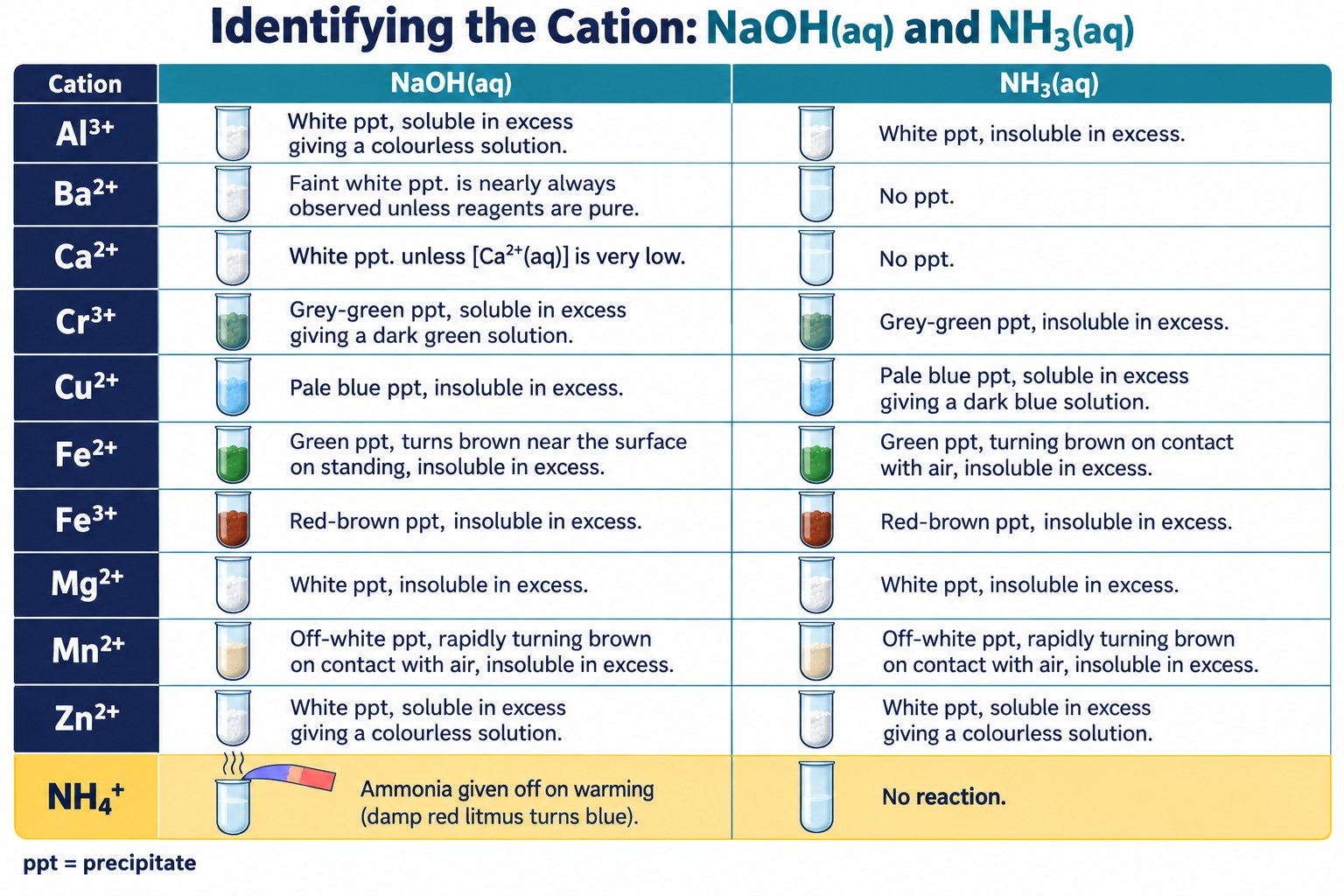
The AS version of the hydroxide and ammonia tests: the same technique, a few drops then excess, now applied to the ions on this page.
Technique point: Add the first few drops slowly and look for the precipitate before adding more. If you tip in an excess straight away you cannot tell whether the precipitate formed and then dissolved, or never formed at all.
Check: Analysing a Green Solid
Put the steps of a complete analysis of a new unknown into a sensible order.
Transition metal Ions with Sodium Hydroxide and Ammonia
The table gives the observations for the ions on the Edexcel International course. The hydroxide precipitates have the same colour with either base; the difference is what happens in excess.
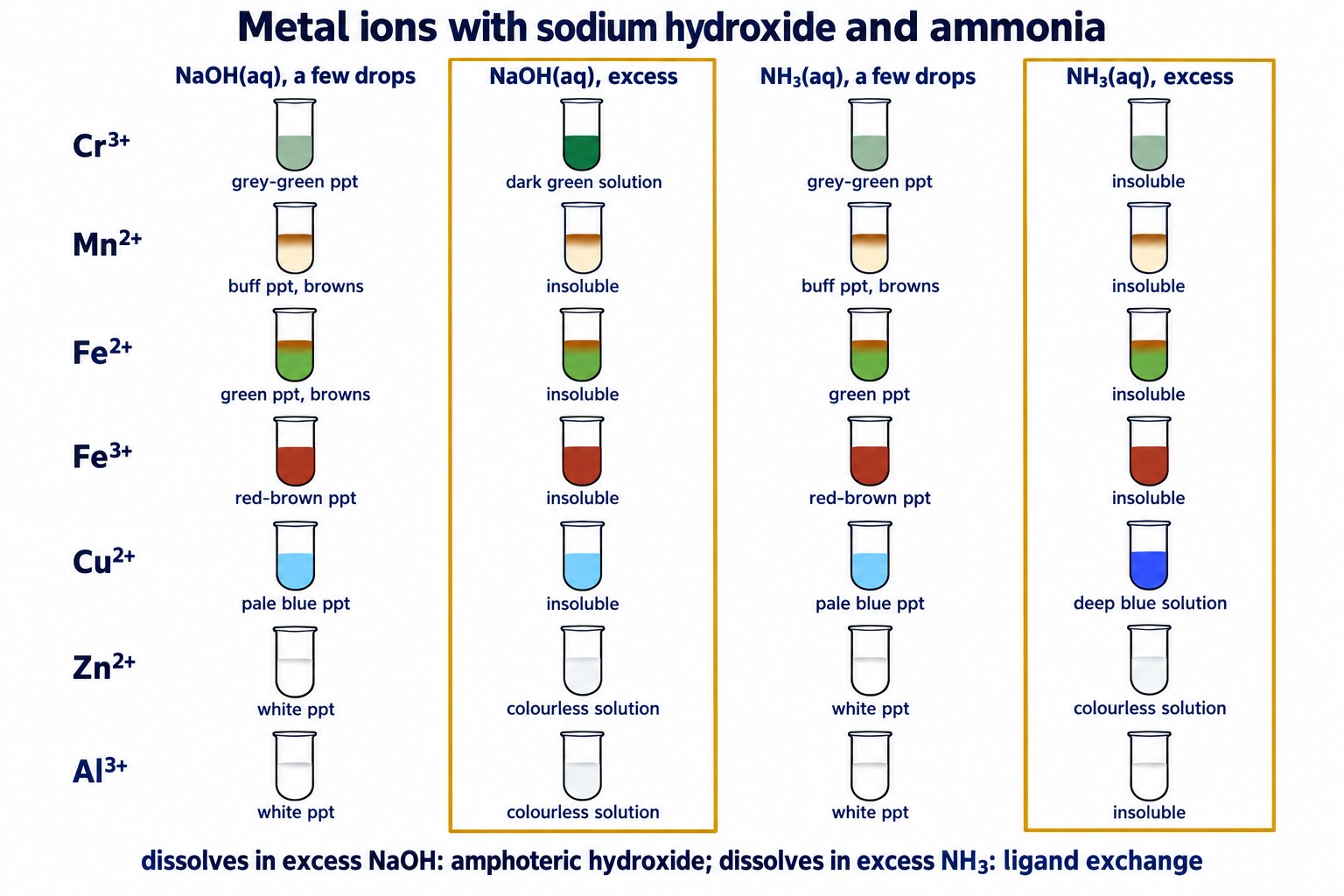
The hydroxide and ammonia observations as a tube grid, a few drops then excess, with every colour written. Use the rows for the ions your course names.
| Ion | NaOH(aq): a few drops, then excess | NH₃(aq): a few drops, then excess |
|---|---|---|
| Cr³⁺ | grey-green ppt; dissolves in excess to a dark green solution, [Cr(OH)₆]³⁻ | grey-green ppt; insoluble in excess |
| Mn²⁺ | off-white (buff) ppt, darkens to brown in air; insoluble in excess | off-white (buff) ppt, darkens to brown; insoluble in excess |
| Fe²⁺ | green ppt, turns brown at the surface on standing; insoluble in excess | green ppt, turns brown at the surface; insoluble in excess |
| Fe³⁺ | red-brown ppt; insoluble in excess | red-brown ppt; insoluble in excess |
| Co²⁺ | blue ppt, pink on standing or warming; insoluble in excess | blue ppt; dissolves in excess to a yellow-brown solution that darkens in air |
| Ni²⁺ | green ppt; insoluble in excess | green ppt; dissolves in excess to a blue-violet solution |
| Cu²⁺ | pale blue ppt; insoluble in excess | pale blue ppt; dissolves in excess to a deep blue solution, [Cu(NH₃)₄(H₂O)₂]²⁺ |
| Zn²⁺ | white ppt; dissolves in excess to a colourless solution, [Zn(OH)₄]²⁻ | white ppt; dissolves in excess to a colourless solution, [Zn(NH₃)₄]²⁺ |
| NH₄⁺ | no ppt; on warming, ammonia gas turns damp red litmus blue | no change |
Reading the table. A precipitate that dissolves in excess sodium hydroxide marks an amphoteric hydroxide. A precipitate that dissolves in excess ammonia marks ligand exchange to an ammine complex. Iron(II) and manganese(II) precipitates darken on standing because air oxidises the metal.
Exam wording: “A grey-green precipitate that dissolves in excess sodium hydroxide to a dark green solution shows Cr³⁺. A pale blue precipitate that dissolves in excess ammonia to a deep blue solution shows Cu²⁺.” Name both colours.
Check: Which Ion Is It?
Match new sets of observations to the ion that causes them.
Why the Precipitates Form: the Equations
In water a metal ion is a hexaaqua complex, [M(H₂O)₆]ⁿ⁺. The metal pulls electron density from the O–H bonds of the water ligands, so the complex is a weak acid. A base removes protons until the complex is neutral and precipitates.
[Cu(H₂O)₆]²⁺(aq) + 2OH⁻(aq) → Cu(OH)₂(H₂O)₄(s) + 2H₂O(l)
[Fe(H₂O)₆]³⁺(aq) + 3OH⁻(aq) → Fe(OH)₃(H₂O)₃(s) + 3H₂O(l)
[Fe(H₂O)₆]²⁺(aq) + 2NH₃(aq) → Fe(OH)₂(H₂O)₄(s) + 2NH₄⁺(aq)
Why 3+ ions are more acidic. A 3+ ion has a higher charge density than a 2+ ion of similar size, polarises the water ligands more, and weakens their O–H bonds.
Solutions of Fe³⁺ are noticeably acidic; solutions of Fe²⁺ barely so.
Dissolving in excess sodium hydroxide. An amphoteric hydroxide reacts with more hydroxide ions to give a soluble anionic complex.
Cr(OH)₃(H₂O)₃(s) + 3OH⁻(aq) → [Cr(OH)₆]³⁻(aq) + 3H₂O(l) dark green
Zn(OH)₂(s) + 2OH⁻(aq) → [Zn(OH)₄]²⁻(aq) colourless
Dissolving in excess ammonia. Here ammonia acts as a ligand, not a base: it replaces water ligands and the precipitate dissolves. This is the ligand exchange you carry out on a larger scale in Core Practical 14 (preparing a complex).
Cu(OH)₂(H₂O)₄(s) + 4NH₃(aq) → [Cu(NH₃)₄(H₂O)₂]²⁺(aq) + 2OH⁻(aq) + 2H₂O(l) deep blue
Co(OH)₂(H₂O)₄(s) + 6NH₃(aq) → [Co(NH₃)₆]²⁺(aq) + 2OH⁻(aq) + 4H₂O(l) yellow-brown, darkens in air
Ni(OH)₂(H₂O)₄(s) + 6NH₃(aq) → [Ni(NH₃)₆]²⁺(aq) + 2OH⁻(aq) + 4H₂O(l) blue-violet
Zn(OH)₂(s) + 4NH₃(aq) → [Zn(NH₃)₄]²⁺(aq) + 2OH⁻(aq) colourless
Why the colours. Changing the ligand changes the splitting of the d orbitals, so the frequency of light absorbed changes: water-ligand copper is pale blue, ammonia-ligand copper deep blue. Zn²⁺ has no partly filled d subshell, so every complex is colourless.
Exam wording: “Hydroxide ions act as a base and remove protons from the water ligands; the neutral hydroxide is insoluble. In excess ammonia, ammonia acts as a ligand and replaces water: ligand exchange gives a soluble complex.”
Check: Why the Precipitates Form
Complete the explanation of the acid–base and ligand-exchange chemistry behind the tests.
The Anion Tests: a One-Card Recap
The anion tests are unchanged from Core Practical 8 (analysis of inorganic and organic unknowns); what matters here is their order, because the cation you have just found does not interfere but a missed carbonate would.
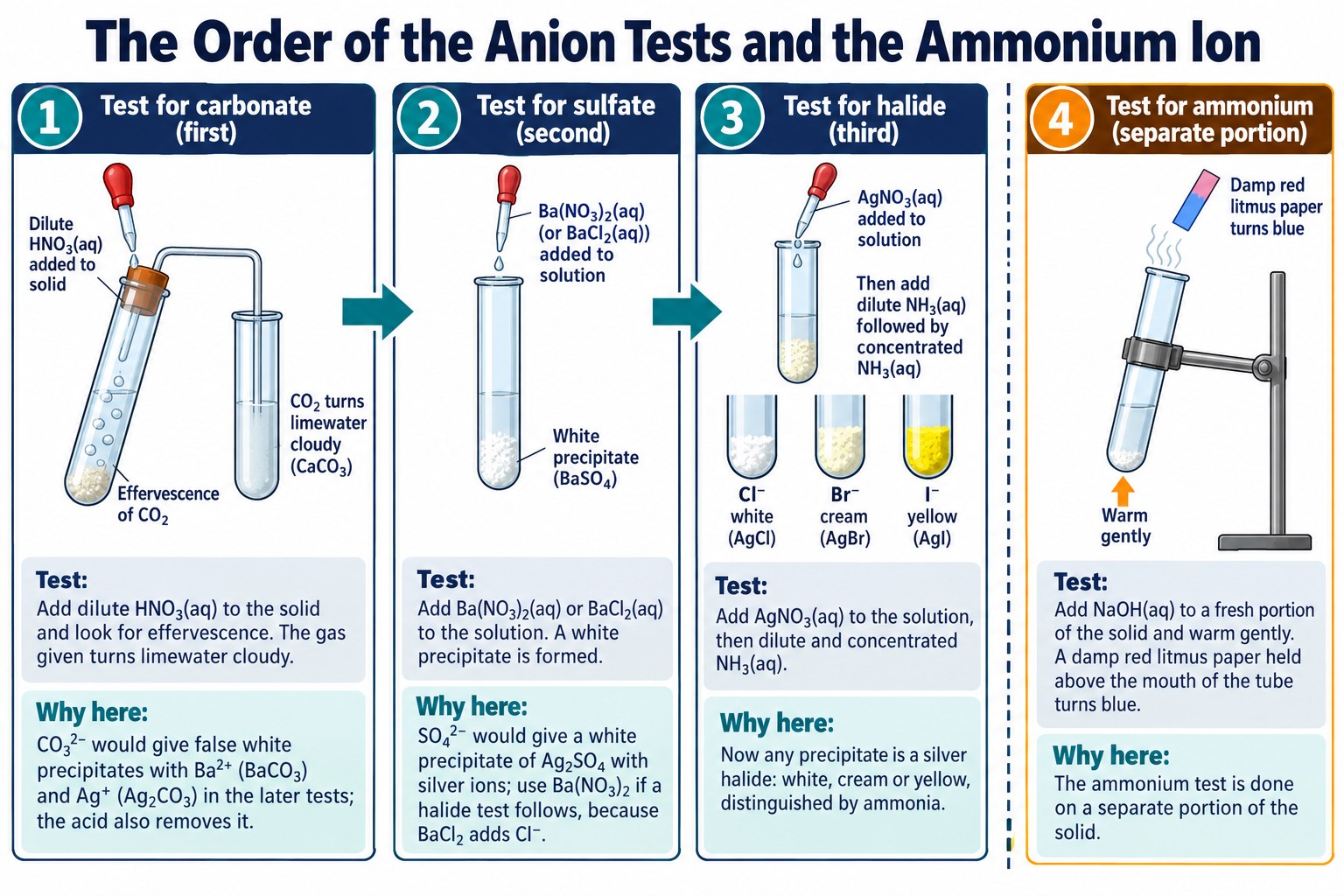
The anion test order: dilute acid for carbonate first, then acidified barium chloride for sulfate, then acidified silver nitrate and ammonia for the halides.
1. Carbonate. Dilute nitric acid: fizzing, and the gas turns limewater milky. CO₃²⁻(aq) + 2H⁺(aq) → CO₂(g) + H₂O(l). Done first because carbonate also gives white precipitates with Ba²⁺ and Ag⁺.
2. Sulfate. Acidified barium chloride (or nitrate): a white precipitate. Ba²⁺(aq) + SO₄²⁻(aq) → BaSO₄(s). The acid has already removed any carbonate.
3. Halides. Nitric acid then silver nitrate: white AgCl (dissolves in dilute ammonia), cream AgBr (concentrated ammonia only), yellow AgI (insoluble). Nitric acid, never hydrochloric, which would add chloride.
Nitrate. No precipitate with any of the three; heating the solid gives brown fumes of NO₂ and oxygen relights a glowing splint, as in the thermal decomposition of the s-block nitrates.
Why the order matters: BaCO₃, Ag₂CO₃ and Ag₂SO₄ are all white. Testing for carbonate first, with an acid that destroys it, means a later white precipitate can only be the ion you are testing for.
Organic Tests at A Level
The first-year tests for alkenes, alcohols, aldehydes and halogenoalkanes still apply. The second year adds phenols, acyl chlorides, amines, amides and amino acids, and asks you to tell apart groups that look alike.
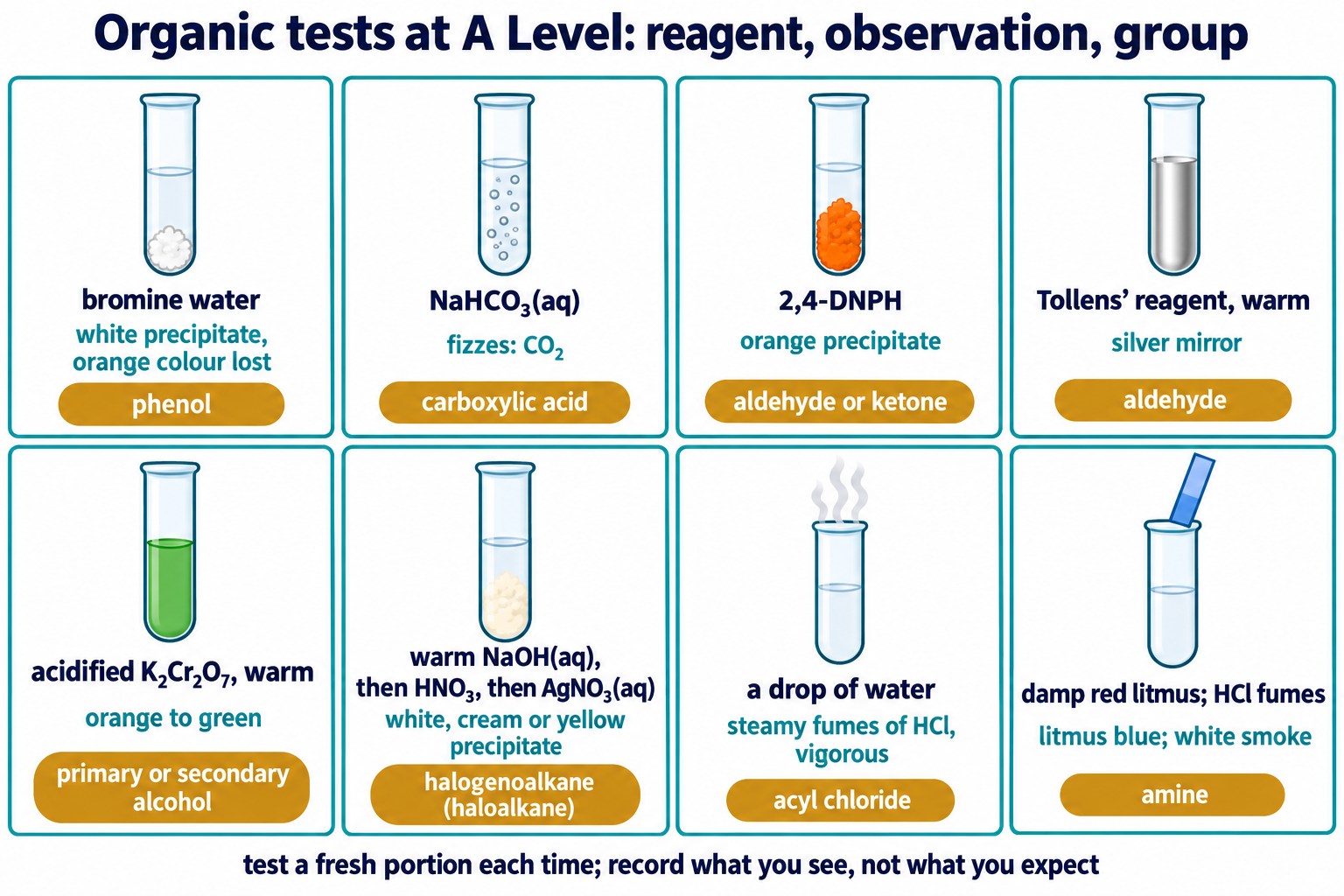
The A Level organic tests as tiles: reagent, what you see and the group it shows. Test a fresh portion each time.
| Reagent and conditions | Observation | Group shown |
|---|---|---|
| Bromine water, room temperature | White precipitate (2,4,6-tribromophenol); orange colour lost | Phenol (an alkene decolourises it with no precipitate) |
| Sodium hydrogencarbonate solution | Fizzing: CO₂ | Carboxylic acid (a phenol does not fizz) |
| 2,4-DNPH (Brady’s reagent) | Orange precipitate | Aldehyde or ketone |
| Tollens’ reagent, warm | Silver mirror | Aldehyde only |
| Acidified K₂Cr₂O₇, warm | Orange to green | Primary or secondary alcohol, or aldehyde |
| Warm with NaOH(aq), then acidify, then test | Sweet smell at first; an oily acid layer separates after hydrolysis | Ester |
| A drop of water | Steamy fumes of HCl, vigorous; the solution then gives white AgCl with AgNO₃(aq) | Acyl chloride |
| Reagent and conditions | Observation | Group shown |
|---|---|---|
| Warm with NaOH(aq), acidify with HNO₃, add AgNO₃(aq) | White, cream or yellow precipitate | Halogenoalkane: chloro, bromo or iodo |
| Damp red litmus; the mouth of a bottle of concentrated HCl | Litmus blue; white smoke of the ammonium-type salt; fishy smell | Amine |
| A few drops added to Cu²⁺(aq) | Deep blue solution | Amine (acts as a ligand, like ammonia) |
| Warm with NaOH(aq) | Ammonia released: damp red litmus blue | Amide |
| Ninhydrin spray, warm (after chromatography) | Purple colour | Amino acid |
| Dilute acid and dilute alkali separately | Dissolves in both | Amino acid (amphoteric) |
The phenol test in detail. The oxygen lone pair is delocalised into the ring and activates the 2, 4 and 6 positions, so phenol reacts with bromine water in the cold with no catalyst.
Solubility. Phenol is only slightly soluble in cold water but dissolves in sodium hydroxide solution, forming the phenoxide ion; it is too weak an acid to fizz with hydrogencarbonate.
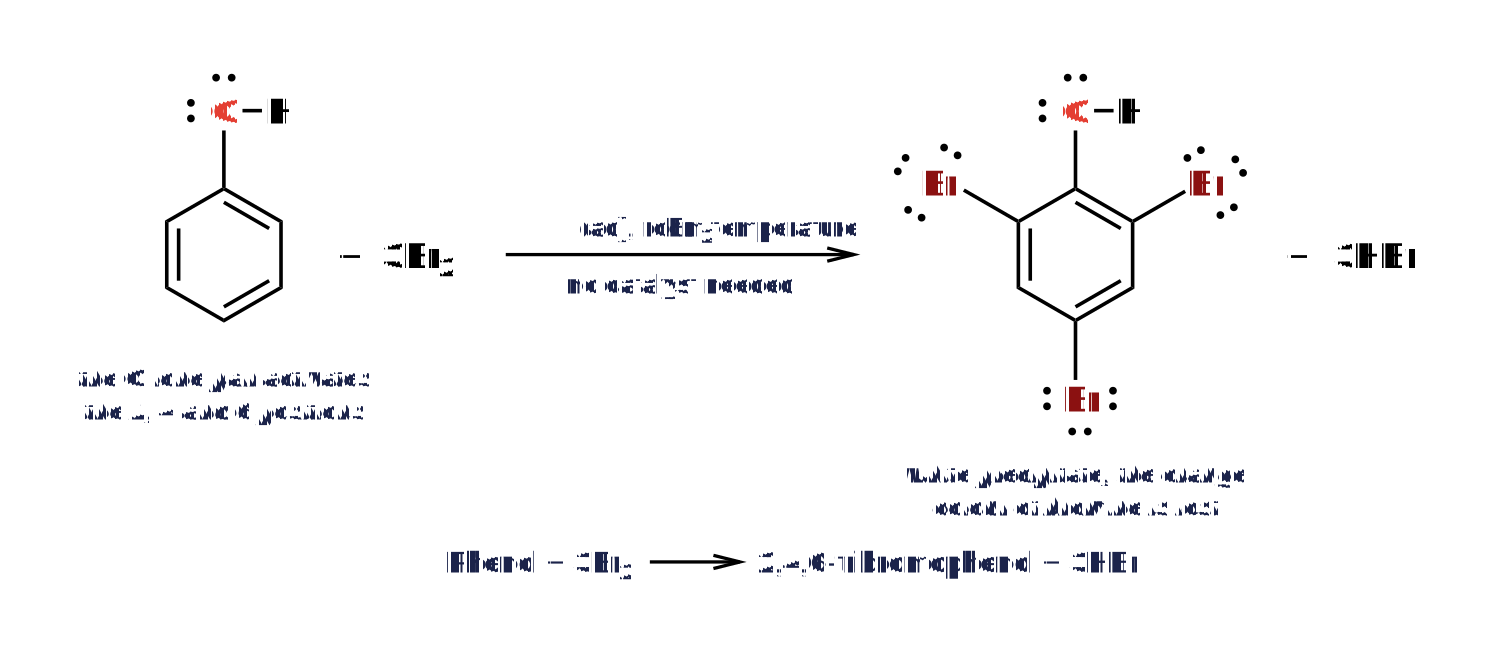
Phenol with three molecules of bromine gives 2,4,6-tribromophenol, the white precipitate, and three molecules of hydrogen bromide.
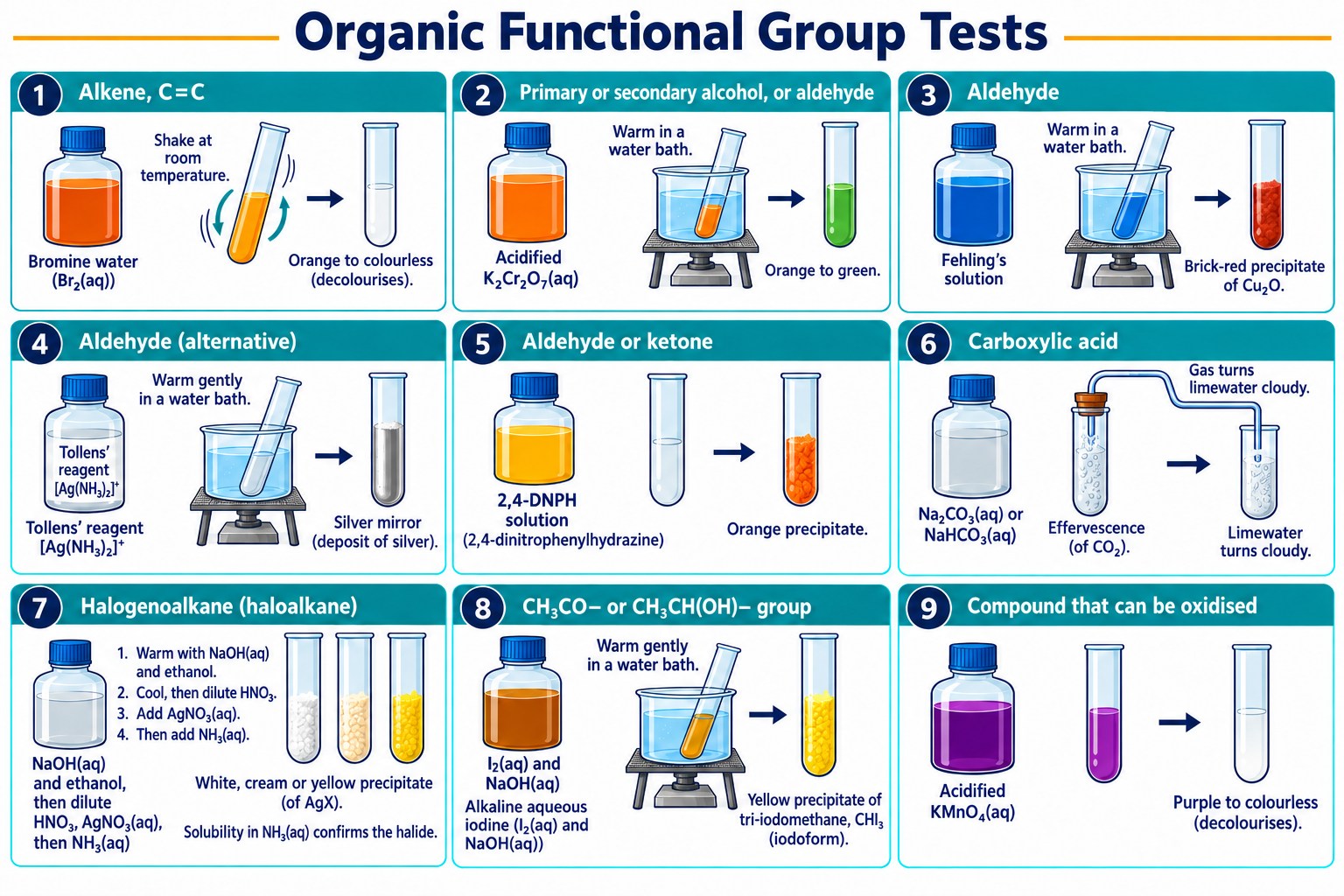
The first-year organic tests, kept for reference: alkene, alcohol, aldehyde, ketone, carboxylic acid and halide tests with their observations.
Telling look-alikes apart: Phenol and a carboxylic acid: only the acid fizzes with NaHCO₃. Aldehyde and ketone: only the aldehyde gives a silver mirror. Alcohol and halogenoalkane: only the halogenoalkane gives a silver halide after hydrolysis.
Check: Organic Unknowns
Place new organic compounds in their groups from the tests they pass and fail.
Worked Unknowns: J, K and L
Three inorganic unknowns, each a single salt dissolved in water. Read the observations, deduce the ions, and name the compound. Every deduction names the evidence.
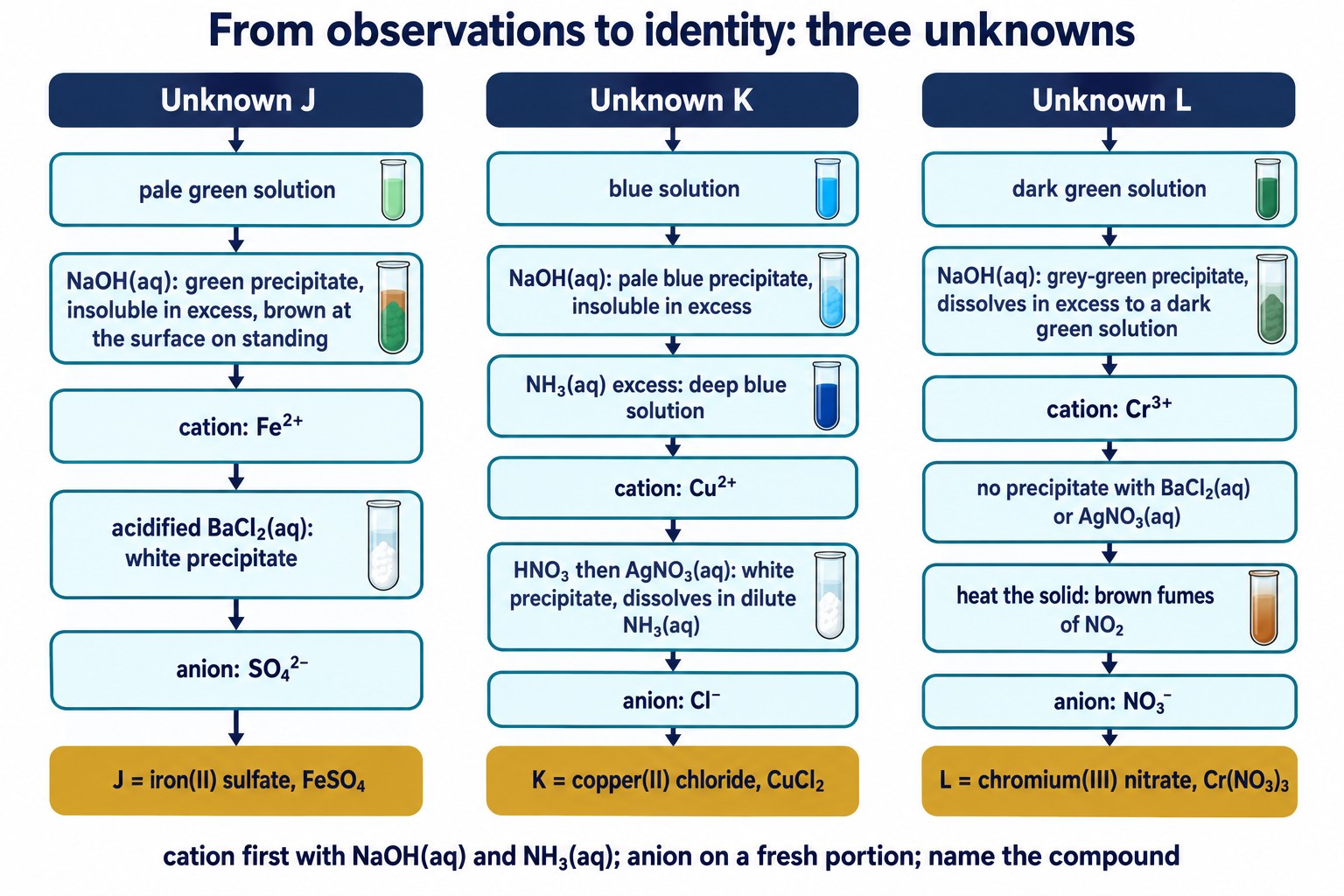
The deduction trail for J, K and L: cation from sodium hydroxide and ammonia, anion from the fixed order of tests, then the name and formula.
| Test | J | K | L |
|---|---|---|---|
| Solution colour | pale green | blue | dark green |
| NaOH(aq), dropwise then excess | green ppt, insoluble; brown at the surface on standing | pale blue ppt, insoluble | grey-green ppt; dissolves to a dark green solution |
| NH₃(aq), dropwise then excess | green ppt, insoluble | pale blue ppt; deep blue solution in excess | grey-green ppt, insoluble |
| Dilute HNO₃ | no fizz | no fizz | no fizz |
| Acidified BaCl₂(aq) | white ppt | no ppt | no ppt |
| HNO₃ then AgNO₃(aq) | no ppt | white ppt; dissolves in dilute NH₃(aq) | no ppt |
| Heat the solid | no visible gas | no visible gas | brown fumes |
J. Green hydroxide insoluble in both bases, browning in air: Fe²⁺. White precipitate with acidified barium chloride: sulfate. J is iron(II) sulfate, FeSO₄; the air oxidation is Fe(OH)₂ → Fe(OH)₃.
K. Pale blue hydroxide that dissolves in excess ammonia to deep blue [Cu(NH₃)₄(H₂O)₂]²⁺: Cu²⁺. White silver halide soluble in dilute ammonia: chloride. K is copper(II) chloride, CuCl₂.
L. Grey-green precipitate dissolving in excess sodium hydroxide to dark green [Cr(OH)₆]³⁻ but not in ammonia: Cr³⁺. No carbonate, sulfate or halide; brown NO₂ on heating: nitrate. L is chromium(III) nitrate, Cr(NO₃)₃.
Mark scheme habit: Each conclusion is “observation, therefore ion”. “Pale blue precipitate soluble in excess ammonia giving a deep blue solution, so Cu²⁺” scores; “Cu²⁺” on its own may not.
Worked Unknowns: M, N and P
Three organic liquids or solids, one functional group each. The same discipline applies: name the test, the observation and the group it proves or rules out.
| Test | M | N | P |
|---|---|---|---|
| Appearance and smell | white crystalline solid, antiseptic smell | colourless liquid, fumes in moist air | colourless liquid, fishy smell |
| Cold water | only slightly soluble | vigorous reaction, steamy fumes | dissolves; solution turns damp red litmus blue |
| NaHCO₃(aq) | no fizz | the aqueous product fizzes | no fizz |
| Bromine water | white precipitate | no change | no change |
| AgNO₃(aq) on the aqueous mixture | no ppt | white ppt | no ppt |
| Concentrated HCl vapour | no change | no change | white smoke |
| A few drops added to Cu²⁺(aq) | no change | no change | deep blue solution |
M. White precipitate with bromine water but no fizz with hydrogencarbonate: a phenol, not a carboxylic acid. Only slightly soluble in cold water, dissolves in sodium hydroxide. M is phenol, C₆H₅OH.
N. Fumes in moist air and reacts violently with water, giving HCl (white AgCl) and a carboxylic acid that fizzes with NaHCO₃: an acyl chloride. N is ethanoyl chloride, CH₃COCl. CH₃COCl(l) + H₂O(l) → CH₃COOH(aq) + HCl(g).
P. Fishy, basic to litmus, white smoke with HCl vapour, deep blue with Cu²⁺(aq) because the amine is a ligand like ammonia: a primary amine.
P is propylamine, CH₃CH₂CH₂NH₂. CH₃CH₂CH₂NH₂(l) + HCl(g) → CH₃CH₂CH₂NH₃⁺Cl⁻(s).
Ruling groups out: Record the negative results too. “No orange precipitate with 2,4-DNPH” rules out a carbonyl group and is worth as much as a positive test when the question asks you to justify an identity.
Check: Four More Unknowns
Work out each new unknown from its observations, then flip the card to check your reasoning.
Errors, Uncertainty and Improvements
Qualitative analysis has few measured numbers, so the marks for evaluation go to technique: fresh portions, the right amount of reagent, and honest recording.
| Source of error | Effect on the result | Improvement |
|---|---|---|
| Excess base added at once | The precipitate is missed; an amphoteric ion looks like “no reaction” | Add dropwise, record the precipitate, then add excess |
| Reagents added to the same tube | Hydroxide already present stops the ammonia complex forming | A fresh 2 cm³ portion for every reagent |
| Precipitate left standing before recording | Iron(II) green reads as brown: wrongly called Fe³⁺ | Record the first colour at once; note any change on standing separately |
| Dirty or reused test tubes | Traces of a previous reagent give false precipitates | Rinse with distilled water between tests |
| Silver nitrate added before acidifying | Carbonate or hydroxide gives a white precipitate read as chloride | Acidify with nitric acid first |
| Organic tests on wet or warm samples | Acyl chlorides hydrolyse; esters smell changes; Tollens’ silvers early | Dry, cold samples; warm Tollens’ gently in a water bath |
| Judging colours alone | “Blue” and “pale blue” or “green” and “grey-green” confused | Compare against a known solution beside the unknown on a white tile |
Where the numbers come in. When you must make the test solution yourself, the uncertainty is in the weighing and the volume. Dissolving 1.25 g of CuSO₄·5H₂O (Mr 249.7, 5.01 × 10⁻³ mol) in a 50 cm³ measuring cylinder gives 0.100 mol dm⁻³.
Step 1: mass by difference on a 2 d.p. balance, two readings at ±0.005 g: ±0.010 g on 1.25 g = (0.010 ÷ 1.25) × 100 = 0.80%
Step 2: 50 cm³ measuring cylinder ±0.5 cm³: (0.5 ÷ 50) × 100 = 1.0%
Answer: total percentage uncertainty in the concentration about 0.80 + 1.0 = 1.8%, which is far smaller than the effect of a missed precipitate
Evaluation wording: “A fresh portion is used for each reagent because hydroxide ions already in the tube would prevent the ammonia complex forming, so the copper test would appear negative.”
Common Mistakes
The same slips cost marks every year; each corrected line is a mark earned.
Precipitate only. Writing “blue precipitate” for Cu²⁺ without saying it dissolves in excess ammonia to a deep blue solution: half the evidence.
Wrong role. Saying ammonia “neutralises” the precipitate in excess. It is a ligand replacing water: ligand exchange.
Same tube. Adding ammonia to the tube that already contains sodium hydroxide, then reporting that the copper precipitate did not dissolve.
Brown means Fe³⁺. Calling the aged iron(II) precipitate iron(III). The first colour was green; the brown is air oxidation.
Missing state symbols. Every ionic equation for a precipitate needs (aq) for the ions and (s) for the precipitate.
Phenol fizzes. It does not; only a carboxylic acid releases CO₂ from NaHCO₃. Phenol gives the white precipitate with bromine water.
Hydrochloric acid before silver nitrate. It adds chloride ions and every sample “contains chloride”. Acidify with nitric acid.
Ion, not compound. Stopping at “Fe²⁺ and SO₄²⁻” when the question asks for the compound: write iron(II) sulfate, FeSO₄.
Check: Avoiding the Common Errors
Pick the correct statement in each round about technique, order and interpretation.
Common Exam Points
Say
“Grey-green precipitate, dissolving in excess sodium hydroxide to a dark green solution: Cr³⁺.” “Ammonia is a base here and a ligand in excess: ligand exchange gives the deep blue complex.” “Carbonate is tested first because it also gives white precipitates with Ba²⁺ and Ag⁺.”
Do not say
“The precipitate dissolves because ammonia is a strong base.” “Iron(II) hydroxide is brown.” “Phenol fizzes with sodium hydrogencarbonate.” “Add hydrochloric acid before silver nitrate.” “Fe²⁺ was present” with no observation to justify it.
Watch for
Ionic equations with state symbols for every precipitate and complex; the solution colour as well as the precipitate colour; an unknown decided by one negative result; ligand exchange as in Core Practical 14 (preparing a complex).
FAQs
Short answers to the questions students most often ask about identifying transition metal ions and organic unknowns.
Why do sodium hydroxide and ammonia give the same precipitate?
Both are bases. Each removes protons from the water ligands of the hexaaqua ion until the complex is neutral and precipitates, so the hydroxide that forms, and its colour, is the same whichever base you add.
Why does the copper precipitate dissolve in excess ammonia but not in excess sodium hydroxide?
Ammonia is also a ligand. In excess it replaces water around the copper ion to give the soluble deep blue complex [Cu(NH₃)₄(H₂O)₂]²⁺. Hydroxide ions do not form a soluble complex with copper, so the precipitate stays.
What does “amphoteric” mean for chromium(III) hydroxide?
It dissolves in both acids and alkalis. Acid re-forms the hexaaqua ion; excess sodium hydroxide gives a soluble anionic hydroxo complex. A precipitate that disappears in excess sodium hydroxide is the sign of an amphoteric hydroxide.
Why must I use a fresh portion for every reagent?
Because the first reagent changes the tube. Hydroxide ions left over from the sodium hydroxide test stop the ammonia complex forming, so the copper test looks negative, and a precipitate from one test can hide the colour of the next.
How do I tell a phenol from a carboxylic acid, and an aldehyde from a ketone?
A carboxylic acid fizzes with sodium hydrogencarbonate; a phenol does not, but gives a white precipitate with bromine water. An aldehyde gives a silver mirror with warm Tollens’ reagent; a ketone gives the orange 2,4-DNPH precipitate but no mirror.

Copyright notice: This OLS revision content, including the explanations, layout, diagrams, tables and embedded learning structure, is authored for Online Learning System by Dr. Mohammed Al-Fatah. It may not be copied, reproduced, redistributed or adapted without written permission.
Keep this note — free
Save your progress across every Edexcel IAL topic. A free account remembers which topics you have covered, saves your question scores, and syncs across your phone and laptop.
- Track every topic you have finished
- Keep your practice-question scores
- No payment, no card, free forever
Already registered? Log in