CP 14 Preparation of a Transition Metal Complex
A focused revision guide to Core Practical 14 for Edexcel International A Level Chemistry: preparing tetraamminediaquacopper(II) sulfate from copper(II) sulfate and concentrated ammonia, the pale blue precipitate and the deep blue ligand exchange product, why ethanol brings out the crystals, why the product is washed with ethanol and never heated, and the percentage yield calculation with its sources of loss.
Preparing a Copper(II) Ammonia Complex
From pale blue copper(II) sulfate to deep blue-violet crystals: watch ammonia act first as a base, then as a ligand, then bring the product out with ethanol, filter it, dry it and work out the yield.
© Dr. Mohammed Al-Fatah – onlinelearningsystem.net
Recap: Ligands, Complexes and Colour
Three quick questions on the ideas this practical builds on: what a ligand is, coordination number and shape, and why complexes are coloured.
What This Practical Is Testing
This practical, Core Practical 14 on the Edexcel International course, prepares a crystalline transition metal complex, tetraamminediaquacopper(II) sulfate monohydrate, [Cu(NH₃)₄(H₂O)₂]SO₄·H₂O, from hydrated copper(II) sulfate and concentrated ammonia solution.
The chemistry is ligand exchange: four ammonia molecules replace four of the six water ligands around Cu²⁺, and pale blue becomes deep blue. The skills are weighing, crystallising with an anti-solvent, filtering under reduced pressure, washing, drying and a percentage yield.
It is examined through the Unit 6 practical skills paper (WCH16), which asks for methods, apparatus choices, data processing, uncertainty and evaluation. Questions ask for the reason behind each step, both equations with state symbols, every colour, the yield and where the missing product went.
Key idea: [Cu(H₂O)₆]²⁺(aq) + 4NH₃(aq) → [Cu(NH₃)₄(H₂O)₂]²⁺(aq) + 4H₂O(l). The coordination number stays 6, the shape stays octahedral, and the deeper colour comes from a larger splitting of the d orbitals by NH₃.
Safety and Apparatus
The quantities are small and the glassware is simple; the hazard is the concentrated ammonia, so the addition is done in a fume cupboard.
| Item | What it is for | Precision or note |
|---|---|---|
| 2 d.p. balance and watch glass | Weighs the CuSO₄·5H₂O and the dry product | ±0.005 g per reading |
| 100 cm³ beaker and glass rod | Dissolving, adding ammonia and ethanol | total volume only 30 cm³ |
| 10 cm³ measuring cylinders | Water, concentrated ammonia, ethanol | ±0.1 cm³; volumes need not be exact |
| Dropping pipette | Adds the ammonia dropwise | shows the precipitate form and dissolve |
| Ice bath | Cools the mixture for 10 minutes | lower solubility, more crystals |
| Büchner funnel, side-arm flask, pump | Filtration under reduced pressure | fast; leaves a drier cake |
| Filter papers or desiccator | Drying without heat | heat drives off ammonia |
Safety: Concentrated ammonia solution (about 15 mol dm⁻³) is corrosive and its vapour is toxic and irritant: fume cupboard, gloves, eye protection. Ethanol is highly flammable: no flames; warm with a water bath only. Copper(II) sulfate is harmful if swallowed and an irritant.
Method: Step by Step
Every step has a reason, and the reasons are what the examiners ask for. The colours are the evidence that each step has worked.
| Step | What you do | Why |
|---|---|---|
| Weigh | Weigh 5.00 g of CuSO₄·5H₂O (Mr 249.7) on a 2 d.p. balance. | 0.0200 mol of copper: the figure the yield is calculated from. |
| Dissolve | Add 10 cm³ of water, warm gently and swirl until the solution is clear and pale blue. | Minimum water: the product is soluble, so extra water lowers the yield. |
| Add ammonia | In a fume cupboard, add 10 cm³ of concentrated ammonia dropwise with stirring. | A pale blue precipitate forms first, then dissolves to a deep blue solution. |
| Check the colour | Keep adding until no precipitate remains and the solution is clear deep blue. | Unreacted hydroxide would contaminate the product. |
| Add ethanol | Pour 10 cm³ of ethanol slowly down the side of the beaker, then stir. | The complex is far less soluble in ethanol–water: crystals form. |
| Cool | Stand the beaker in ice for 10 minutes. | Solubility falls further as the temperature falls. |
| Filter | Filter under reduced pressure with a Büchner funnel. | Fast, and the suction pulls most of the liquor out of the crystals. |
| Wash | Wash with a little 1 : 1 ethanol–concentrated ammonia, then with ethanol. | Removes the liquor; water would dissolve the product. |
| Dry | Press between filter papers or leave in a desiccator; then weigh. | Heat drives off ammonia and decomposes the complex. |
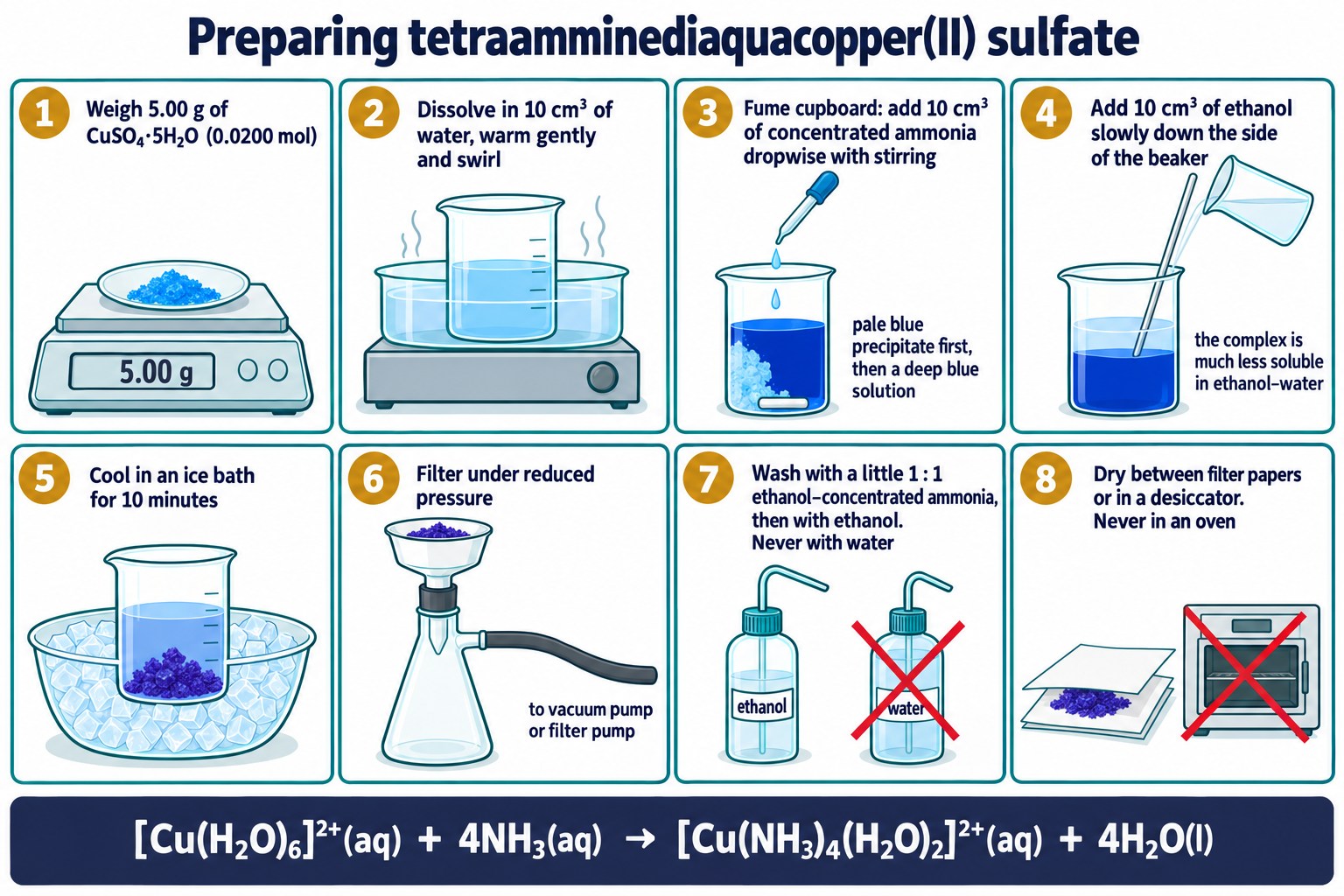
The preparation as eight numbered steps, with the colour of the beaker at every stage and the reason for each step.
Technique point: Add the ammonia with a dropping pipette and watch the pale blue precipitate form and then dissolve: the ligand exchange question is built on that observation. Core Practical 16 (preparation of aspirin) uses the same filtration and washing routine.
Check: Preparing Hexaamminenickel(II) Chloride
Order the method for a different ammine complex made by the same route.
The Chemistry: Ligand Exchange and Colour
Copper(II) sulfate dissolves to give the hexaaquacopper(II) ion, pale blue and octahedral. Ammonia reacts with it in two stages, and only the second is ligand exchange.
Stage 1: ammonia as a base
The first drops of ammonia remove H⁺ from two of the water ligands, and the neutral hydroxide precipitates. This is an acid–base reaction; NaOH(aq) gives the same pale blue solid.
[Cu(H₂O)₆]²⁺(aq) + 2NH₃(aq) → Cu(OH)₂(H₂O)₄(s) + 2NH₄⁺(aq)
Stage 2: ammonia as a ligand
In excess ammonia the precipitate dissolves. Four ammonia molecules bond to copper through the lone pair on nitrogen, replacing four water ligands, and the deep blue complex forms.
Cu(OH)₂(H₂O)₄(s) + 4NH₃(aq) → [Cu(NH₃)₄(H₂O)₂]²⁺(aq) + 2OH⁻(aq) + 2H₂O(l)
Overall: [Cu(H₂O)₆]²⁺(aq) + 4NH₃(aq) → [Cu(NH₃)₄(H₂O)₂]²⁺(aq) + 4H₂O(l)
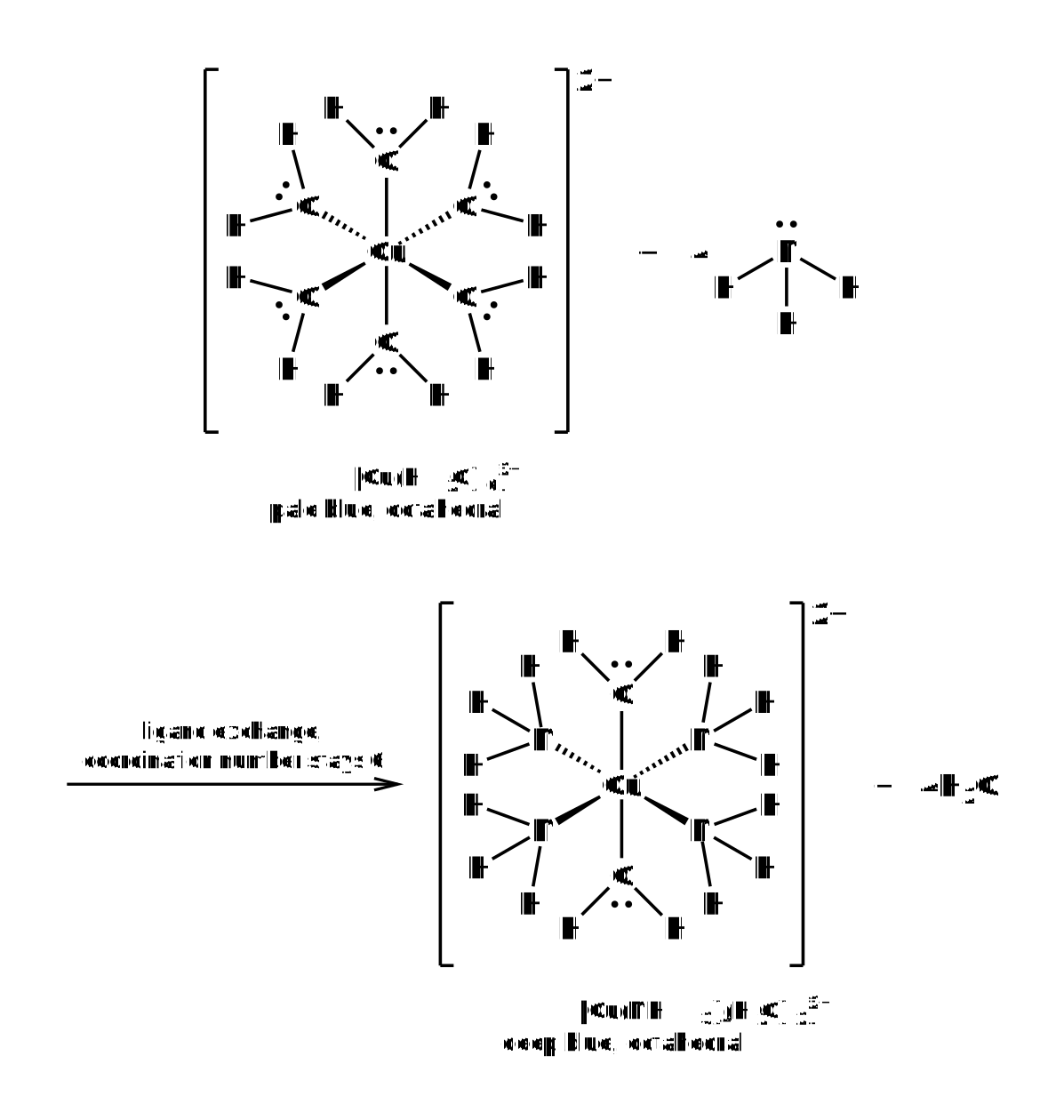
The ligand exchange: hexaaquacopper(II) and tetraamminediaquacopper(II) drawn as octahedral complexes, with the lone pairs on the donor atoms and the charge outside the brackets.
Shape, and why only four ammonia
Both ions are six-coordinate and octahedral: NH₃ and H₂O are similar in size and both uncharged, so the coordination number does not change. The four NH₃ lie in a plane with the two remaining H₂O above and below.
In aqueous ammonia the fifth and sixth substitutions are unfavourable, so the exchange stops at four. Writing [Cu(NH₃)₆]²⁺ as the product of this preparation loses the mark.
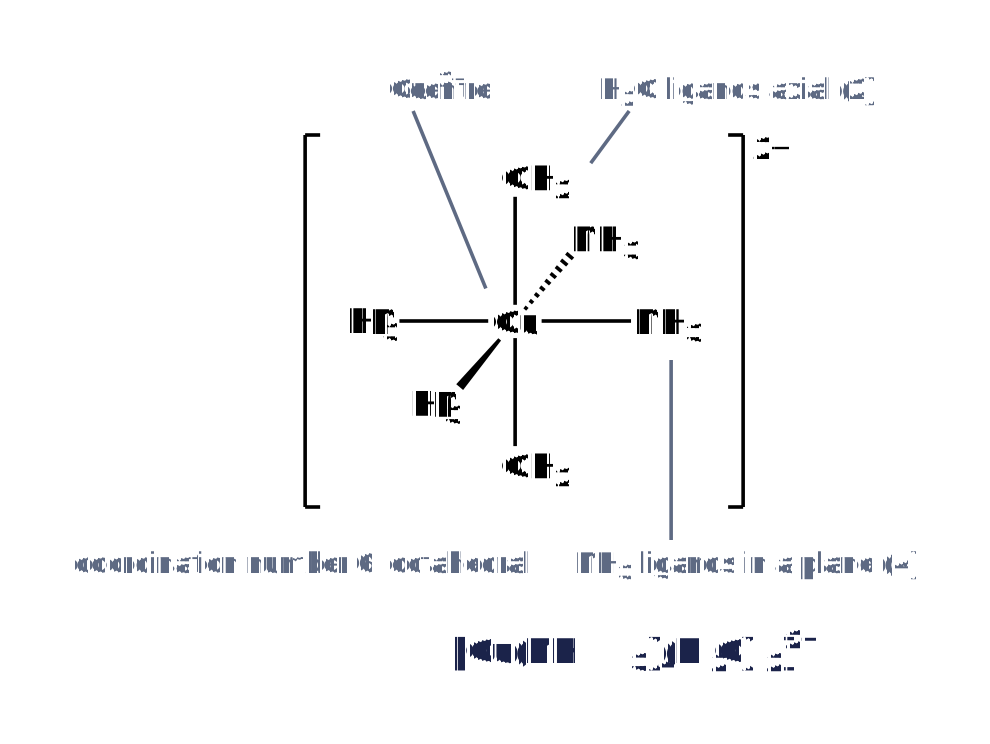
The tetraamminediaquacopper(II) ion as a ball-and-stick model: four nitrogen atoms in a square plane around copper and two oxygen atoms on the axis.
Why the colour deepens
Cu²⁺ is d⁹. The ligands split the d orbitals, and an electron absorbs visible light as it is promoted between them (a d–d transition); the colour seen is the light not absorbed.
Ammonia splits the orbitals more than water, so the wavelength absorbed shifts and pale blue becomes deep blue. A different ligand means a different splitting and a different colour.
Exam wording: “Ammonia molecules act as ligands, donating a lone pair on nitrogen to form coordinate bonds with Cu²⁺; four water ligands are replaced, the coordination number stays 6 and the d-orbital splitting changes, so the colour changes.”
Check: Other Ligand Changes
Predict the products and coordination numbers for new metal ions and ligands.
What You See at Each Stage
Examiners ask for the colour and state of every stage, and for the species responsible. Keep the words pale blue and deep blue apart: they are different ions.
| Stage | What you see | Species present |
|---|---|---|
| Solid CuSO₄·5H₂O | Blue crystals | hydrated copper(II) sulfate |
| Dissolved in water | Clear pale (sky) blue solution | [Cu(H₂O)₆]²⁺(aq) |
| First drops of NH₃(aq) | Pale blue precipitate | Cu(OH)₂(H₂O)₄(s) |
| Excess NH₃(aq) | Precipitate dissolves: clear deep royal blue solution | [Cu(NH₃)₄(H₂O)₂]²⁺(aq) |
| Ethanol added, then ice | Paler layer, then deep blue-violet crystals | [Cu(NH₃)₄(H₂O)₂]SO₄·H₂O(s) |
| Product plus dilute acid | Deep blue returns to pale blue | NH₄⁺(aq) and [Cu(H₂O)₆]²⁺(aq) |

Four beakers, one for each stage of the preparation, with the colour and the copper species named at each.
The crystals are a slightly different shade from the solution because the colour of a solid also depends on how the ions pack and on the water of crystallisation; a question will accept deep blue for both.
Check: Colours, Shapes and Donor Atoms
Quick recall of complex-ion facts for ions other than copper.
Isolating and Testing the Product
Why ethanol
The complex is very soluble in water, so cooling alone gives few crystals. Ethanol mixes with water and the complex is much less soluble in ethanol–water, so adding ethanol brings it out of solution. Slow addition and stirring give larger, cleaner crystals.
Why filter under reduced pressure
Suction pulls the liquor through quickly and leaves a drier cake than gravity filtration, so less product is lost to the wet paper and less ammonia escapes during a long filtration.
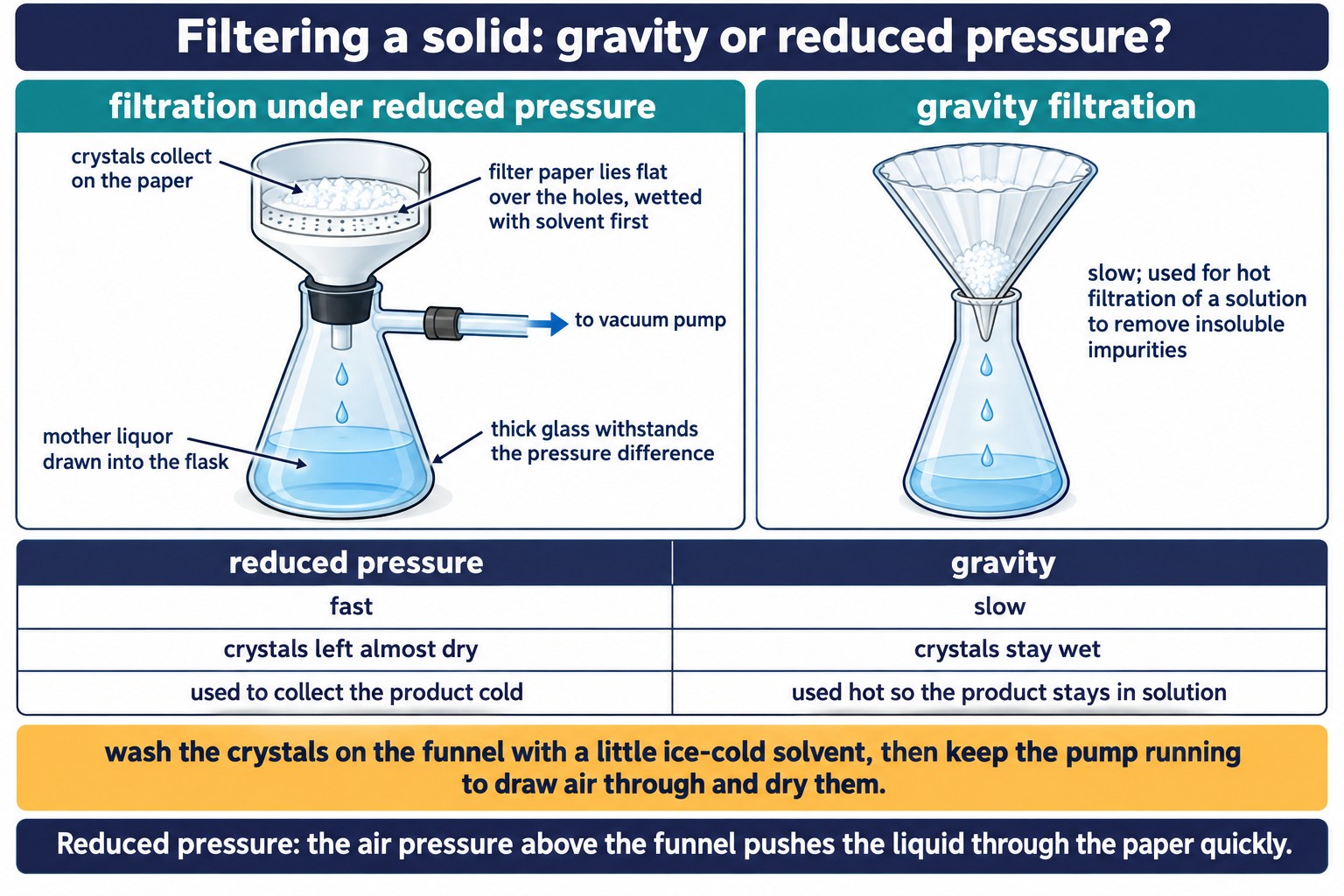
Filtration under reduced pressure: Büchner funnel in the neck of a side-arm flask connected to the pump; wash the crystals on the paper, then dry them without heat.
Why not water, and why not an oven
Washing with water redissolves the product, so the crystals are washed with a little 1 : 1 ethanol–concentrated ammonia and then ethanol. Heating drives ammonia out of the lattice and the complex decomposes, so the crystals dry between filter papers or in a desiccator.
Testing the product
Dissolve a few crystals in water: a deep blue solution shows the ammine complex is intact. Warm a crystal gently: the smell of ammonia confirms the ligands.
Add dilute sulfuric acid to the solution: the pale blue of [Cu(H₂O)₆]²⁺ returns because the NH₃ ligands are protonated to NH₄⁺ and water takes their place, reversing the ligand exchange.
[Cu(NH₃)₄(H₂O)₂]²⁺(aq) + 4H⁺(aq) + 4H₂O(l) → [Cu(H₂O)₆]²⁺(aq) + 4NH₄⁺(aq)
Link: The precipitation and ammonia tests for Cu²⁺ and the other transition metal ions are covered in Core Practical 15 (analysis of unknowns (a level)).
Percentage Yield: Worked Calculation
The copper is conserved, so one mole of CuSO₄·5H₂O gives at most one mole of the complex. Use the hydrated formula masses for both.
Step 1: n(CuSO₄·5H₂O) = 5.00 ÷ 249.7 = 0.0200 mol
Step 2: Mr of [Cu(NH₃)₄(H₂O)₂]SO₄·H₂O = 63.5 + 68.0 + 36.0 + 96.1 + 18.0 = 281.6
Step 3: theoretical mass = 0.0200 × 281.6 = 5.63 g
Answer: percentage yield = 4.20 ÷ 5.63 × 100 = 74.6%
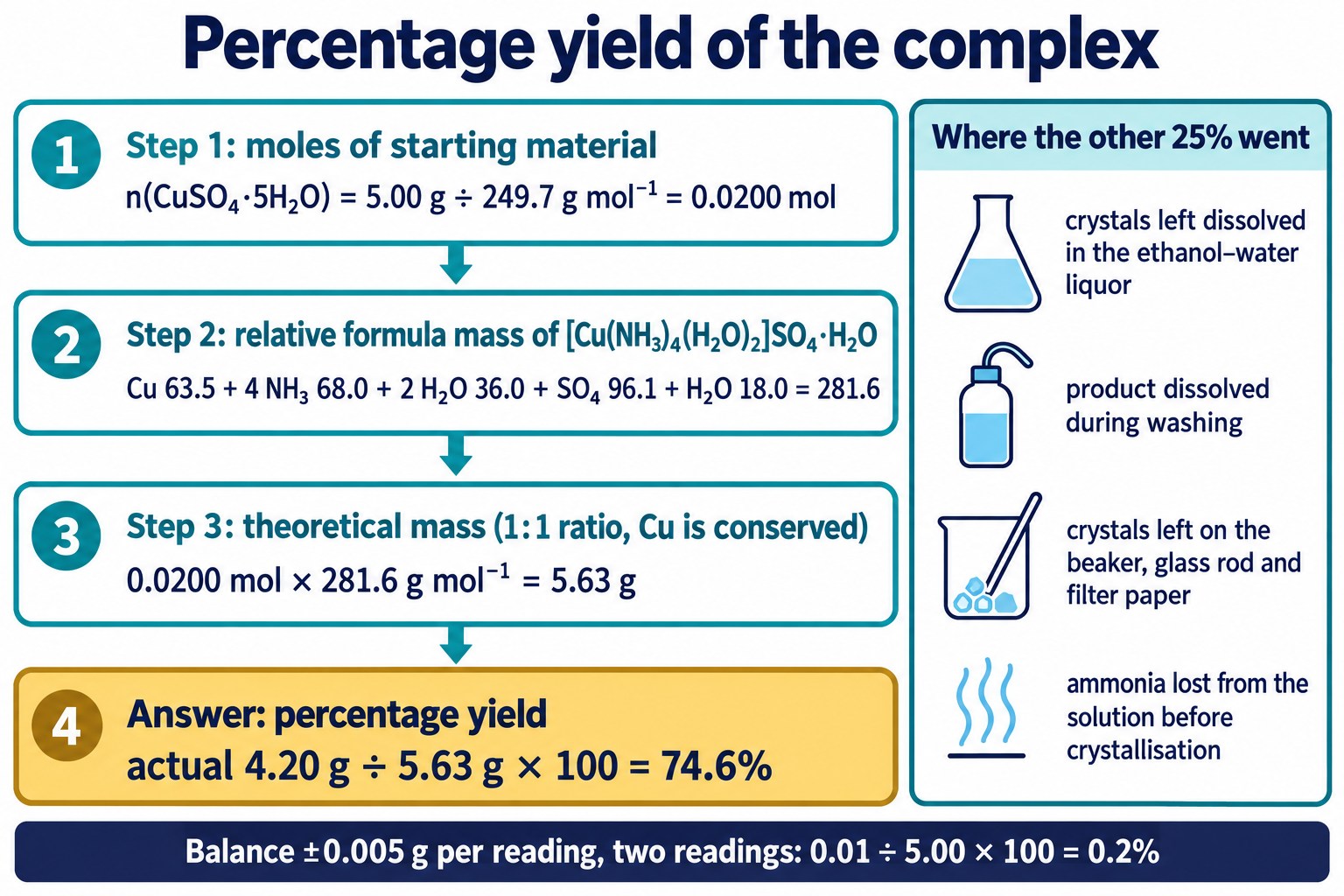
The yield calculation as four text boxes, with a side panel of where the missing quarter of the product went.
Where the product went
Liquor: the complex is still partly soluble in the ethanol–water mixture. Washing: every rinse dissolves a little. Transfer: crystals stay on the beaker, rod and paper. Ammonia loss: ammonia that evaporates before crystallisation shifts the equilibrium back towards the aqua ion.
A yield above 100% means the crystals were still wet with ethanol or water, or contain unreacted copper(II) sulfate; it never means the reaction made extra product.
Answer to 3 s.f.: The mass readings are to 2 d.p. and the Mr values to 1 d.p., so quote 74.6%, not 74.60%. The expected yield for this preparation is 70 to 80%.
Check: Yield of Hexaamminenickel(II) Chloride
Work through the same calculation for a different complex with new masses.
Other Complexes You May Prepare
The same route (dissolve, add the ligand in excess, crystallise with an anti-solvent or by cooling, filter, wash, dry) gives other transition metal complexes. Two that appear in exam questions are named here only.
Potassium trioxalatoferrate(III): green crystals of K₃[Fe(C₂O₄)₃]·3H₂O made from iron(III) and ethanedioate (oxalate) ions; light sensitive, so the crystals are dried in the dark.
Hexaamminecobalt(III) chloride: orange crystals of [Co(NH₃)₆]Cl₃ made from cobalt(II) chloride, ammonia and an oxidising agent, with a charcoal catalyst.
Transferable skills: Whatever the complex, the evaluation questions are the same: why the volume of solvent is kept small, why the washing solvent is chosen, why the product is not heated, and where the yield was lost.
Errors, Uncertainty and Improvements
The weighing uncertainty is tiny; the yield is lost in the chemistry and the handling, so the evaluation marks go to the rows below.
| Source of error | Effect on the result | Improvement |
|---|---|---|
| Ammonia lost from a warm, open beaker | Less complex forms: yield low | Cool first; add ammonia in the fume cupboard; cover the beaker |
| Too much water to dissolve the salt | More product stays dissolved: yield low | Minimum volume (10 cm³), warmed gently |
| Precipitate not fully dissolved | Cu(OH)₂ in the crystals: mass high, impure | Add ammonia until clear deep blue |
| Crystals washed with water | Product dissolves: yield low | Wash with ethanol–ammonia, then ethanol |
| Dried in an oven | Ammonia driven off: mass low, colour fades | Filter papers or a desiccator |
| Crystals weighed wet | Mass high: yield too high | Dry to constant mass |
| Transfer losses | Crystals left on glassware: yield low | Rinse the beaker onto the filter with wash liquid |
Percentage uncertainty. The mass of CuSO₄·5H₂O is found from two balance readings, each ±0.005 g, so ±0.01 g in total: 0.01 ÷ 5.00 × 100 = 0.2%. The product mass carries 0.01 ÷ 4.20 × 100 = 0.24%.
The yield therefore has a weighing uncertainty of only about 0.4%, yet 25% of the product is missing. The gap is systematic loss, not measurement uncertainty, which is why a better balance would not improve the result.
Exam focus: For every error, say which way the yield moves and why: “the yield is too high because the crystals were still wet, so the mass includes solvent”.
Common Mistakes
The same slips appear in write-ups every year. Each costs a mark the corrected version earns.
Six ammonia: writing [Cu(NH₃)₆]²⁺. In aqueous ammonia only four water ligands are replaced.
One stage: missing the pale blue precipitate. The first drops give Cu(OH)₂(H₂O)₄; the deep blue solution needs excess ammonia.
Wrong colour words: “blue to blue”. Say pale blue solution, pale blue precipitate, deep blue solution.
Water washing: the product dissolves; washing is with ethanol.
Oven drying: the complex loses ammonia; dry between filter papers or in a desiccator.
Anhydrous Mr: using 159.6 for copper(II) sulfate or 263.6 for the complex. Both formulae carry water of crystallisation: 249.7 and 281.6.
Yield from the ammonia: ammonia is in excess; the copper salt is the limiting reagent.
Check: Isolating and Drying a Complex
Pick the correct statement about washing, drying, ethanol and yield in each round.
Common Exam Points
Say
“Ammonia first acts as a base, giving pale blue Cu(OH)₂(H₂O)₄; in excess it acts as a ligand and four NH₃ replace four H₂O to give deep blue [Cu(NH₃)₄(H₂O)₂]²⁺.” “Ethanol is added because the complex is far less soluble in ethanol–water.” “Heating drives off ammonia.”
Do not say
“All six water ligands are replaced.” “The precipitate is copper(II) oxide.” “Wash the crystals with water to remove the ammonia.” “Dry the product in an oven at 100 °C.” “The yield is low because the reaction is reversible” (said without naming a real loss).
Watch for
Both equations with state symbols; coordination number and shape before and after; the colour of every stage; the yield from the hydrated formula masses (249.7 and 281.6); a yield above 100% (wet crystals); the acid test that reverses the ligand exchange; why a fume cupboard.
FAQs
Short answers to the questions students most often ask about preparing a transition metal complex.
Why does a pale blue precipitate form before the deep blue solution?
The first drops of ammonia act as a base: they remove H⁺ from two water ligands and Cu(OH)₂(H₂O)₄ precipitates. Only when ammonia is in excess does it act as a ligand and dissolve the solid as the deep blue complex.
Why do only four ammonia molecules replace water?
In aqueous ammonia the fifth and sixth substitutions are unfavourable, so the ligand exchange stops at four. The product is [Cu(NH₃)₄(H₂O)₂]²⁺, still six-coordinate and octahedral, with the two water ligands on the axis.
Why is ethanol added, and why slowly?
The complex is very soluble in water but much less soluble in ethanol–water, so adding ethanol makes it crystallise. Adding it slowly down the side of the beaker and then stirring gives larger, purer crystals rather than a fine powder.
Why must the crystals not be washed with water or dried in an oven?
Water dissolves the product, so some of the yield would run through the filter. Heat drives ammonia out of the crystals and the complex decomposes, so the product is dried between filter papers or in a desiccator.
What is a good percentage yield, and why is it not 100%?
About 70 to 80%. Some complex stays dissolved in the ethanol–water liquor, some dissolves during washing, crystals are left on the glassware, and some ammonia is lost before the crystals form. Weighing errors contribute far less than 1%.

Copyright notice: This OLS revision content, including the explanations, layout, diagrams, tables and embedded learning structure, is authored for Online Learning System by Dr. Mohammed Al-Fatah. It may not be copied, reproduced, redistributed or adapted without written permission.
Keep this note — free
Save your progress across every Edexcel IAL topic. A free account remembers which topics you have covered, saves your question scores, and syncs across your phone and laptop.
- Track every topic you have finished
- Keep your practice-question scores
- No payment, no card, free forever
Already registered? Log in