CP 12 Investigating Electrochemical Cells
A focused revision guide to Core Practical 12 for Edexcel International A Level Chemistry: building zinc, copper, silver and iron(III)/iron(II) half-cells, the salt bridge and high-resistance voltmeter, measured against calculated cell potentials, the effect of concentration, the standard hydrogen electrode, feasibility and its limits, errors and uncertainty.
Electrochemical Cells: Measuring Cell Potentials
Clean the electrodes, build zinc and copper half-cells, join them with a salt bridge and a high-resistance voltmeter, then swap in silver and iron(III)/iron(II) half-cells and dilute the copper(II).
© Dr. Mohammed Al-Fatah – onlinelearningsystem.net
Recap: Redox and Displacement
Three quick questions on the ideas this practical builds on: oxidation numbers, electron transfer in a displacement reaction and the reactivity series.
What This Practical Is Testing
In Core Practical 12 you build cells from two half-cells, join them with a salt bridge and read the cell potential, E⦵cell, on a high-resistance voltmeter. The aim is to measure the emf of several cells and compare each with the calculated value.
The chemistry is redox at a distance. Oxidation happens in one beaker, reduction in the other, and the electrons released travel through the wire. The voltmeter measures how strongly the two half-cells together push electrons round the circuit.
On the Edexcel International course this practical is examined through the Unit 6 practical skills paper (WCH16), which asks for methods, apparatus choices, data processing, uncertainty and evaluation.
Expect to draw and label a cell, write the half-equations, calculate E⦵cell from data, explain why the measured value is a little lower, and evaluate the method.
Key idea: E⦵cell = E⦵(positive electrode) − E⦵(negative electrode). The half-cell with the more negative electrode potential is the negative terminal, where oxidation happens.
Safety and Apparatus
Each half-cell is a clean metal strip standing in a 1.00 mol dm⁻³ solution of its own ions. The solutions are made up accurately, as in Core Practical 4 (preparation of a standard solution).
| Item | What it is for | Precision or note |
|---|---|---|
| Zinc, copper and silver strips | The electrodes: cleaned with emery paper and degreased with propanone | surface must be free of oxide and grease |
| Platinum (or graphite) electrode | Inert conductor for the Fe³⁺(aq), Fe²⁺(aq) half-cell | no metal of its own to react |
| Two 100 cm³ beakers per cell | Hold the two solutions | same depth of liquid in each |
| 1.00 mol dm⁻³ ZnSO₄(aq), CuSO₄(aq), AgNO₃(aq), Fe³⁺/Fe²⁺(aq) | The standard concentration of each ion | made in a 250 cm³ volumetric flask, ±0.3 cm³ |
| Filter paper and saturated KNO₃(aq) | The salt bridge | a fresh strip for every cell |
| High-resistance digital voltmeter | Reads the cell potential while drawing almost no current | ±0.01 V |
| Crocodile-clip leads | Connect the electrodes to the voltmeter | clean, firm contacts |
| Thermometer | Checks that the solutions are at 25 °C | ±0.5 °C |
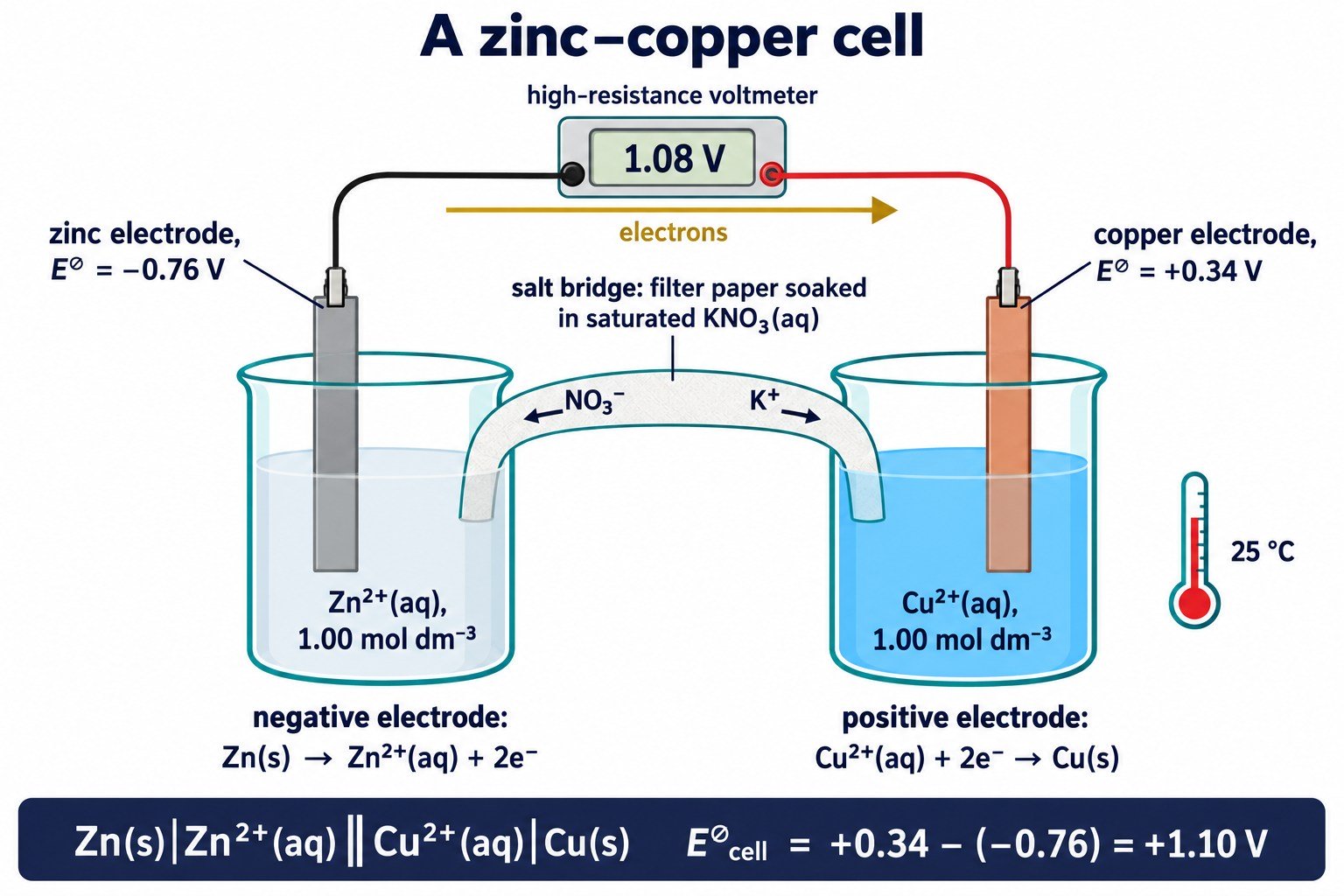
The zinc–copper cell: zinc in colourless Zn²⁺(aq) and copper in blue Cu²⁺(aq), joined by a potassium nitrate salt bridge, with the voltmeter reading 1.08 V.
Safety: Silver nitrate solution at this concentration is corrosive and oxidising, stains skin and is very toxic to aquatic life; copper(II) sulfate and iron(III) solutions are irritants; propanone is highly flammable, so no flames nearby.
Wear eye protection and collect silver residues for disposal.
Method: Step by Step
The method below is for the zinc–copper cell. Every other cell is built in the same way, swapping one half-cell for another and using a fresh salt bridge each time.
| Step | What you do | Why |
|---|---|---|
| Clean the electrodes | Rub each metal strip with emery paper until bright, then wipe it with propanone. | Oxide and grease block the contact between the metal and its ions. |
| Make the half-cells | Pour 1.00 mol dm⁻³ ZnSO₄(aq) into one beaker and 1.00 mol dm⁻³ CuSO₄(aq) into another; stand the matching strip in each. | A half-cell is a metal in a standard solution of its own ions. |
| Check the temperature | Read the temperature of the solutions; they should be at 25 °C. | Electrode potentials change with temperature. |
| Make the salt bridge | Soak a strip of filter paper in saturated KNO₃(aq) and lay it with one end in each solution. | Ions can move through it; the two solutions do not mix. |
| Connect the voltmeter | Clip the leads to the strips: red to copper, black to zinc, into a high-resistance voltmeter. | A high resistance stops current flowing, so the reading is the equilibrium potential. |
| Record the reading | Wait until the display is steady and record it to 0.01 V with its sign. | A positive reading confirms which electrode is positive. |
| Repeat | Lift and replace the salt bridge and take a second reading; use the mean. | Shows the reading is reproducible. |
| Change the cell | Replace one half-cell with the silver, or the Fe³⁺/Fe²⁺, half-cell and repeat with a fresh salt bridge. | Compares several cells under the same conditions. |
| Compare | Calculate E⦵cell from the standard electrode potentials and compare with each reading. | Tests the data-book values against the laboratory. |
Technique point: A reversed reading (a minus sign) is not a mistake: it simply tells you the red lead is on the negative electrode. Swap the leads and record the positive value with the correct polarity.
Check: Building a Nickel–Silver Cell
Order the method for a different pair of half-cells.
The Chemistry: Electrons, Ions and the Cell Diagram
Zinc has the more negative electrode potential, so the zinc strip is the negative electrode: zinc atoms are oxidised and the electrons left behind flow through the wire to the copper. Copper(II) ions are reduced at the positive electrode.
Negative electrode (oxidation): Zn(s) → Zn²⁺(aq) + 2e⁻
Positive electrode (reduction): Cu²⁺(aq) + 2e⁻ → Cu(s)
Overall: Zn(s) + Cu²⁺(aq) → Zn²⁺(aq) + Cu(s)
The cell diagram puts the oxidised half-cell on the left, a double line for the salt bridge, and the reduced half-cell on the right; the single lines mark a change of phase.
Zn(s)|Zn²⁺(aq)‖Cu²⁺(aq)|Cu(s) E⦵cell = +0.34 − (−0.76) = +1.10 V
What moves where
Electrons travel through the wire from zinc to copper. Ions travel through the salt bridge: K⁺ towards the copper half-cell, which is losing positive charge as Cu²⁺ is removed, and NO₃⁻ towards the zinc half-cell, which is gaining Zn²⁺.
Why a salt bridge. Without it the circuit is open and no reading appears; a metal wire in its place would set up its own electrode.
Why potassium nitrate. Neither K⁺ nor NO₃⁻ reacts with the solutions. KCl cannot be used with a silver half-cell: Ag⁺ and Cl⁻ give a precipitate of AgCl.
Why a high-resistance voltmeter. It draws almost no current, so the electrode reactions do not run, the concentrations stay standard and the reading is the potential difference at equilibrium. A low-resistance meter lets current flow and the reading falls.
Exam wording: “The electrons flow through the external wire from the zinc electrode to the copper electrode; ions carry the charge through the salt bridge, which completes the circuit without the solutions mixing.”
Check: A Magnesium–Silver Cell
Fill the gaps for a cell made from two different half-cells.
Results and Calculations
Four cells were built from the half-cells Zn(s)|Zn²⁺(aq) (E⦵ = −0.76 V), Cu(s)|Cu²⁺(aq) (+0.34 V), Ag(s)|Ag⁺(aq) (+0.80 V) and Pt|Fe³⁺(aq),Fe²⁺(aq) (+0.77 V). Each reading is the mean of two, recorded to 0.01 V.
| Cell | Calculation | Calculated E⦵cell | Measured |
|---|---|---|---|
| Zn(s)|Zn²⁺(aq)‖Cu²⁺(aq)|Cu(s) | +0.34 − (−0.76) | +1.10 V | 1.08 V |
| Cu(s)|Cu²⁺(aq)‖Ag⁺(aq)|Ag(s) | +0.80 − (+0.34) | +0.46 V | 0.45 V |
| Zn(s)|Zn²⁺(aq)‖Ag⁺(aq)|Ag(s) | +0.80 − (−0.76) | +1.56 V | 1.54 V |
| Cu(s)|Cu²⁺(aq)‖Fe³⁺(aq),Fe²⁺(aq)|Pt(s) | +0.77 − (+0.34) | +0.43 V | 0.42 V |
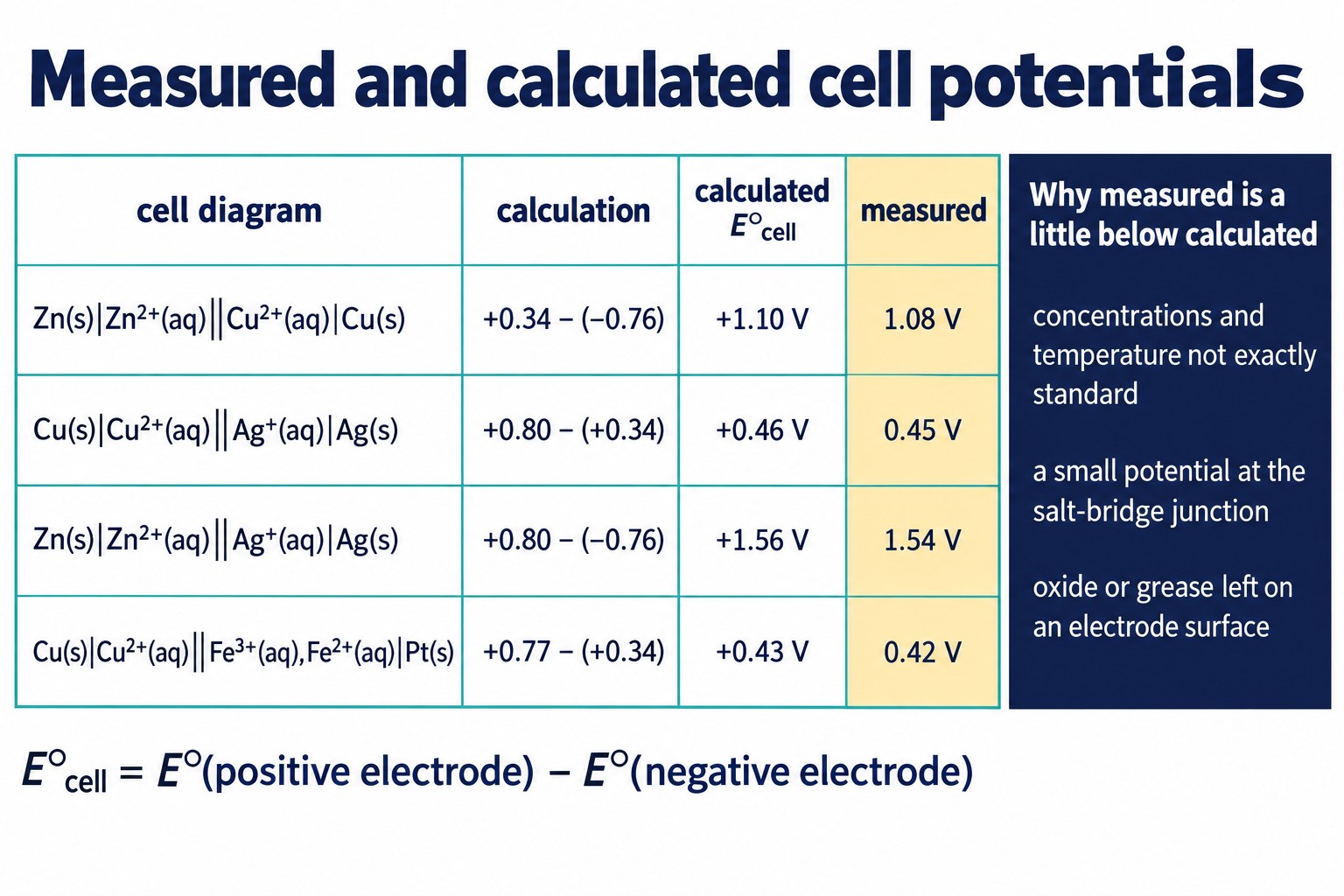
The four cells: cell diagram, the subtraction, the calculated value and the measured reading, with the three reasons the measured values sit a little lower.
Worked example: the zinc–silver cell
Step 1: the more negative half-cell is oxidised: Zn(s) → Zn²⁺(aq) + 2e⁻, E⦵ = −0.76 V
Step 2: the more positive half-cell is reduced: Ag⁺(aq) + e⁻ → Ag(s), E⦵ = +0.80 V (× 2 to balance electrons; E⦵ is not doubled)
Step 3: E⦵cell = +0.80 − (−0.76) = +1.56 V
Answer: +1.56 V, with zinc as the negative electrode; overall Zn(s) + 2Ag⁺(aq) → Zn²⁺(aq) + 2Ag(s). The measured 1.54 V is 0.02 V lower, a difference of 0.02 ÷ 1.56 × 100 = 1.3%.
Why the readings are slightly low
Three small effects move the readings away from the calculated values. The concentrations and temperature are never exactly 1.00 mol dm⁻³ and 25 °C; the salt-bridge junction has a small potential of its own; and a trace of oxide or grease remains on the electrode surfaces.
The Fe³⁺/Fe²⁺ half-cell needs an inert electrode, platinum or graphite, because neither ion is a solid conductor; the solution must be 1.00 mol dm⁻³ in each ion. The same electrode potentials give the ratios used in Core Practicals 13a and 13b (redox titrations).
Sign rule: Never double an electrode potential when you double a half-equation: E⦵ is a potential, not an amount. Multiply the equation, leave the voltage alone.
Check: Calculating Cell Potentials
Calculate E⦵cell for three new pairs of half-cells and name the negative electrode.
Changing the Concentration
Each half-cell is an equilibrium, and Le Chatelier’s principle predicts how its potential shifts when the solution is no longer standard.
Cu²⁺(aq) + 2e⁻ ⇌ Cu(s) E⦵ = +0.34 V
Dilute the copper(II) ions to 0.100 mol dm⁻³ and the equilibrium shifts to the left: fewer Cu²⁺ ions are available to accept electrons, the copper electrode becomes less positive, and the zinc–copper reading falls from 1.08 V to about 1.05 V.
Raise the zinc(II) concentration and Zn²⁺(aq) + 2e⁻ ⇌ Zn(s) shifts to the right, so the zinc electrode becomes less negative and the gap between the two electrodes narrows; the reading falls again.
The rule. In a half-equation written as a reduction, increasing the concentration of the species on the left (the oxidised form) makes the electrode potential more positive; increasing the concentration of the species on the right (the reduced form) makes it less positive.
The size of the shift needs an equation beyond this course; you need only the direction and the reason.
Exam wording: “Lowering [Cu²⁺] shifts the equilibrium Cu²⁺ + 2e⁻ ⇌ Cu to the left, so the electrode potential of the copper half-cell becomes less positive and E cell decreases.”
Check: Cells, True Statements Only
Pick the correct statement in each round about electron flow, the subtraction, concentration and the voltmeter.
The Standard Hydrogen Electrode
A single electrode potential cannot be measured: a voltmeter needs two electrodes. Every E⦵ value in the data book is therefore the potential of a half-cell measured against one agreed reference, the standard hydrogen electrode, which is defined as 0.00 V.
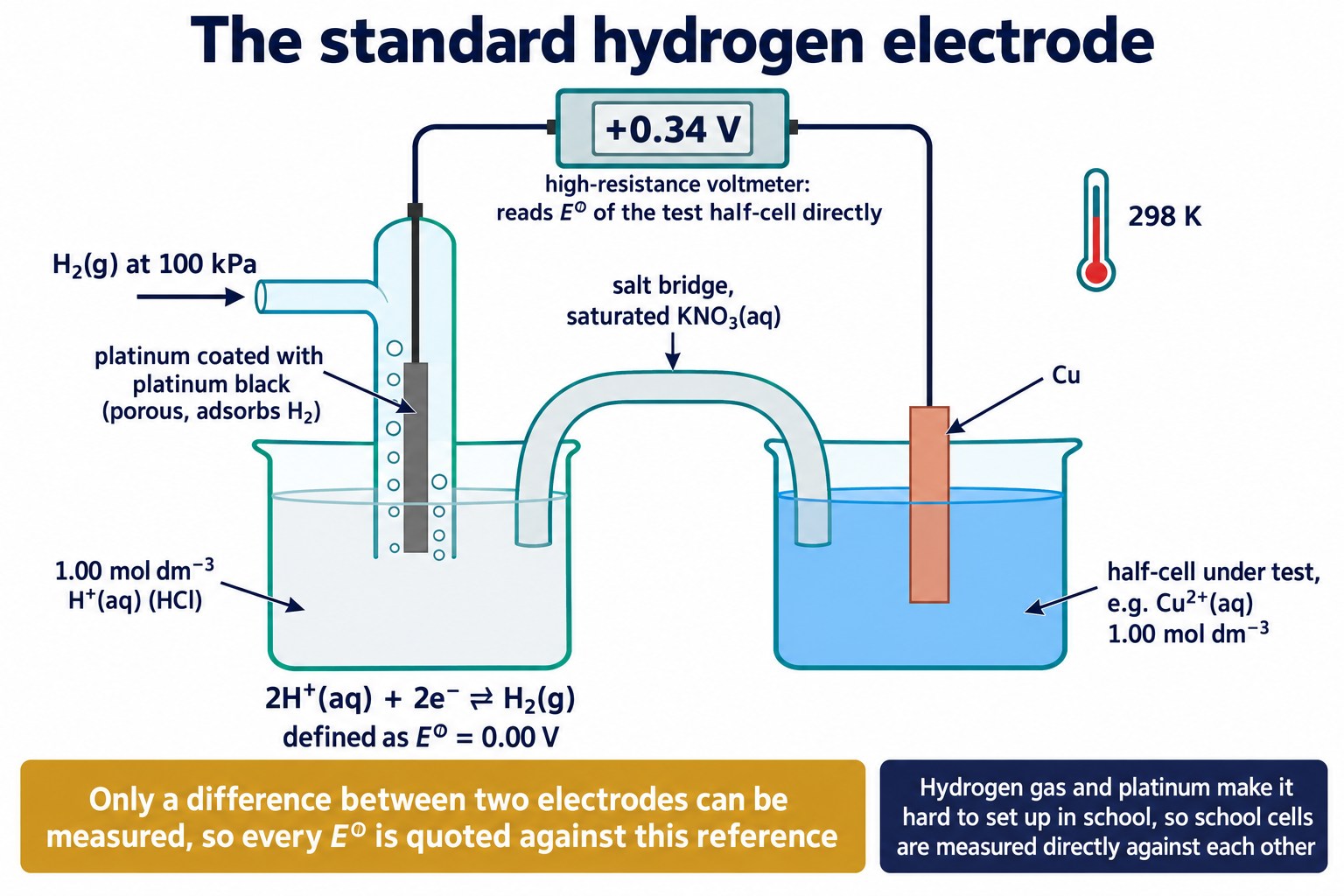
The standard hydrogen electrode: hydrogen gas at 100 kPa over platinum black in 1.00 mol dm⁻³ H⁺(aq) at 298 K, connected by a salt bridge to the half-cell under test.
2H⁺(aq) + 2e⁻ ⇌ H₂(g) E⦵ = 0.00 V by definition
The conditions. Hydrogen gas at 100 kPa bubbles over a platinum electrode coated in porous platinum black, which adsorbs the gas, standing in 1.00 mol dm⁻³ H⁺(aq) at 298 K. Platinum is used because it is inert and conducts.
Standard conditions matter because each half-cell is an equilibrium: change the concentration, pressure or temperature and the potential moves. The E⦵ sign tells you the direction: a negative value means the half-cell gives electrons to the hydrogen electrode.
Why schools do not use it. Hydrogen gas, platinum electrodes and a controlled pressure are hard to set up safely. Laboratories either use a secondary reference electrode calibrated against it, or simply measure cell potentials between metal half-cells, as in this practical.
Cell diagram: The hydrogen electrode is written Pt|H₂(g)|H⁺(aq)‖ on the left, so the reading on the voltmeter is the E⦵ of the half-cell on the right, sign included.
Feasibility and Its Limits
A positive E⦵cell means the reaction written in the cell diagram, left-hand side oxidised and right-hand side reduced, is feasible under standard conditions. The more positive half-cell is always reduced; the more negative is always oxidised.
Example. Will Fe³⁺(aq) oxidise copper metal? Fe³⁺/Fe²⁺ is +0.77 V and Cu²⁺/Cu is +0.34 V, so E⦵cell = 0.77 − 0.34 = +0.43 V: yes, 2Fe³⁺(aq) + Cu(s) → 2Fe²⁺(aq) + Cu²⁺(aq), exactly the cell measured above.
Limit 1: rate. A positive E⦵cell says the reaction can happen, not that it will happen quickly. A large activation energy can make a feasible reaction too slow to observe.
Limit 2: conditions. E⦵ values apply to 1.00 mol dm⁻³, 298 K and 100 kPa. A small positive value can change sign when the concentrations are different, so a prediction may fail in a real beaker.
Limit 3: the data. The values are for aqueous ions; a reaction in a different solvent, or involving solids and gases that are not at standard pressure, is not covered.
Exam wording: “E⦵cell is positive, so the reaction is feasible under standard conditions; it may still be slow because of a high activation energy, and the conditions in the experiment were not standard.”
Check: Will It React?
Use electrode potentials to decide whether new reactions are feasible, and what feasibility does not tell you.
Errors, Uncertainty and Improvements
The voltmeter is precise; the chemical and practical errors are what pull the reading away from the standard value.
| Source of error | Effect on the reading | Improvement |
|---|---|---|
| Solution not exactly 1.00 mol dm⁻³ | Electrode potential shifts; reading above or below the standard value | Make up solutions accurately in a volumetric flask |
| Electrodes not cleaned | Oxide or grease adds resistance at the surface; reading low and unsteady | Emery paper then propanone, immediately before use |
| Salt bridge contaminated or reused | Ions from the previous cell react or add a junction potential | A fresh strip of filter paper soaked in KNO₃ for each cell |
| KCl used as the salt bridge with Ag⁺ | AgCl precipitates; the bridge is blocked and the reading drifts | Use KNO₃, which reacts with nothing |
| Voltmeter draws a current | Reactions run, concentrations change, reading falls | Use a high-resistance digital voltmeter |
| Temperature not 25 °C | Both electrode potentials shift | Stand the solutions in a water bath at 25 °C |
| Reading taken before it is steady | Random error of several hundredths of a volt | Wait for a stable display; repeat and take the mean |
Percentage uncertainty. The voltmeter reads to ±0.01 V, so for the zinc–copper cell the uncertainty is 0.01 ÷ 1.08 × 100 = 0.93%, under 1%.
Is the gap real? The difference between measured and calculated, 1.10 − 1.08 = 0.02 V, is twice the uncertainty, so it is a systematic effect, not reading error.
The smaller the cell potential, the larger the percentage uncertainty: for the copper–silver cell it is 0.01 ÷ 0.45 × 100 = 2.2%. Choosing half-cells far apart in E⦵ gives the most precise comparison.
Exam focus: For every error, say which half-cell is affected, which way its equilibrium shifts and therefore which way the reading moves: “a lower [Cu²⁺] makes the copper electrode less positive, so E cell is lower”.
Check: Evaluating a Cell Experiment
Decide the effect of each change on a cell and calculate a percentage uncertainty.
Common Mistakes
The same slips appear in write-ups and exam answers every year. Each one costs a mark that the corrected version earns.
Sign. Writing E⦵cell = −1.10 V for a working cell: the cell potential of a feasible cell is positive, and the more negative value is subtracted.
Adding. Adding the two electrode potentials instead of subtracting: +0.34 + (−0.76) is wrong, +0.34 − (−0.76) = +1.10 V is right.
Doubling. Doubling E⦵ when the half-equation is doubled to balance electrons.
Salt bridge. Saying electrons flow through the salt bridge, or that it “balances the charge” without saying that ions move through it.
Which electrode. Calling the zinc electrode positive because it “gives” electrons: the electrode that releases electrons is the negative terminal, because electrons build up on it and leave through the wire.
Feasibility. Claiming a positive E⦵cell guarantees a fast reaction, or that a negative one means a reaction never happens under any conditions.
Conditions. Forgetting to state 1.00 mol dm⁻³, 298 K and 100 kPa when defining a standard electrode potential.
Common Exam Points
Say
“E⦵cell = E⦵(positive electrode) − E⦵(negative electrode); the more negative half-cell is oxidised.” “Electrons flow through the wire; ions flow through the salt bridge.” “A high-resistance voltmeter draws negligible current, so the reading is the equilibrium cell potential.”
Do not say
“Electrons flow through the salt bridge.” “The cell potential is the sum of the electrode potentials.” “A positive E⦵cell means the reaction is fast.” “E⦵ doubles when the half-equation is doubled.”
Watch for
Cell diagrams with the oxidised half-cell on the left and ‖ for the salt bridge; why KNO₃, not KCl, with Ag⁺; measured against calculated, three reasons for the gap; percentage uncertainty from ±0.01 V; an E⦵ prediction that fails on rate or conditions.
FAQs
Short answers to the questions students most often ask about measuring cell potentials.
Why does the voltmeter have to be high resistance?
So that almost no current flows. If current flowed, the electrode reactions would run, the concentrations would drift from 1.00 mol dm⁻³ and the reading would fall. With negligible current the reading is the cell potential at equilibrium.
What does the salt bridge actually do?
It completes the circuit by letting ions move between the two solutions without mixing them: K⁺ drifts towards the half-cell being reduced and NO₃⁻ towards the one being oxidised. Electrons never travel through it; they go through the wire.
Why is my reading lower than the value I calculated?
The calculated value assumes exactly 1.00 mol dm⁻³, 25 °C and perfectly clean electrodes. Real solutions and temperatures are slightly off, the salt-bridge junction adds a small potential and the surfaces carry traces of oxide, so readings sit a little low.
Why use potassium nitrate in the salt bridge and not potassium chloride?
Neither K⁺ nor NO₃⁻ reacts with any of the solutions. Chloride ions would precipitate silver chloride in the silver half-cell and can form complexes with copper(II) ions, which changes the potential you are trying to measure.
Does a positive cell potential mean the reaction will definitely happen?
No. A positive value means the reaction is feasible under standard conditions. It says nothing about rate, so a high activation energy can stop it being observed, and at other concentrations or temperatures the sign can change.

Copyright notice: This OLS revision content, including the explanations, layout, diagrams, tables and embedded learning structure, is authored for Online Learning System by Dr. Mohammed Al-Fatah. It may not be copied, reproduced, redistributed or adapted without written permission.
Keep this note — free
Save your progress across every Edexcel IAL topic. A free account remembers which topics you have covered, saves your question scores, and syncs across your phone and laptop.
- Track every topic you have finished
- Keep your practice-question scores
- No payment, no card, free forever
Already registered? Log in