CP6: Chlorination of 2-methylpropan-2-ol
In this core practical, you prepare and purify 2-chloro-2-methylpropane from 2-methylpropan-2-ol and concentrated hydrochloric acid. The key skill is following the product through reaction, layer separation, washing, drying, distillation and chemical analysis.
What This Practical Is Testing
This practical tests how an alcohol can be converted into a halogenoalkane. The hydroxyl group in 2-methylpropan-2-ol is replaced by chlorine to form 2-chloro-2-methylpropane.
(CH3)3COH + HCl → (CH3)3CCl + H2OThe reaction is only the first part. In exam questions, you also need to explain why the product is separated, washed, dried, distilled and then tested.
Make crude product
React 2-methylpropan-2-ol with concentrated hydrochloric acid in a fume cupboard.
Purify
Use layer separation, sodium hydrogencarbonate washing and drying to remove impurities.
Analyse
Distil the correct boiling fraction, then test the distillate for chloride ions.
Key idea: CP6 is not just a preparation practical. It is a purification practical. Track where the organic product is at every stage.
Safety and Apparatus
This procedure must be carried out in a working fume cupboard. Concentrated hydrochloric acid produces fumes that are toxic and corrosive, and the organic product is flammable.
Main chemicals
2-methylpropan-2-ol, concentrated hydrochloric acid, sodium hydrogencarbonate solution, anhydrous calcium chloride, anhydrous sodium sulfate, ethanol, sodium hydroxide, nitric acid and silver nitrate solution.
Main equipment
Conical flask with bung, separating funnel, measuring cylinders, filter funnel, distillation apparatus, pear-shaped or round-bottomed flask, thermometer, test tubes and sample tube.
Personal protection
Wear eye protection and gloves. Avoid skin contact with reactants and products.
Vapour risk
Avoid inhaling vapours. The concentrated acid fumes are especially hazardous for anyone with a respiratory problem.
Safety wording: Do not just write “wear goggles”. Link the fume cupboard to toxic and corrosive HCl fumes, and link no naked flames to flammable organic product.
Reaction Stage: Forming the Crude Chloroalkane
The Pearson method uses 10 cm3 of 2-methylpropan-2-ol and 35 cm3 of concentrated hydrochloric acid. Some centre notes use a smaller-scale version, but the chemistry and purification logic are the same.
Add reactants
Pour the alcohol and concentrated hydrochloric acid into a large conical flask.
Swirl gently
Very gently swirl the contents. The reaction mixture should remain controlled.
Bung and vent
Fit the bung, swirl, then remove the bung to release pressure.
Repeat
Continue swirling with intermittent pressure release for about 20 minutes.
Two layers form
The upper layer is the crude organic product. The lower layer is aqueous.
Prepare to purify
The crude product still contains impurities, so it must be separated, washed and dried.
Layer logic: The desired product is the upper organic layer. This is the layer you keep during separation.
The Reaction Equation and a Common Image Mix-up
The CP6 reaction is the substitution of an alcohol group by chlorine. The product is 2-chloro-2-methylpropane, not an alkene.
(CH3)3COH + HCl → (CH3)3CCl + H2O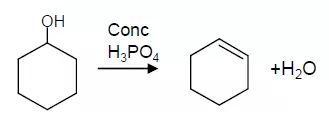
Connected organic preparation: dehydration of cyclohexanol
This small reaction image shows cyclohexanol forming cyclohexene using concentrated H3PO4. It is useful as a comparison, but it is not the CP6 chlorination reaction. In CP6, an alcohol is converted into a chloroalkane.
Purification: What Each Step Removes
The purification stage is the centre of this practical. The aim is to keep the organic product while removing acid, water and unreacted alcohol.
| Stage | Action | What it removes or achieves | Exam point |
|---|---|---|---|
| Add anhydrous calcium chloride | Swirl until dissolved. | Helps ensure unreacted alcohol is in the lower aqueous layer. | The crude organic product is still impure. |
| Use separating funnel | Allow two layers to settle. | Separates the upper organic layer from the lower aqueous layer. | Keep the upper organic layer. |
| Wash with NaHCO3 | Add sodium hydrogencarbonate solution and swirl. | Removes unreacted HCl by neutralisation. | CO2 forms, so release pressure frequently. |
| Repeat wash | Wash again and run off lower layer. | Removes remaining acid and aqueous impurities. | Make sure no aqueous layer remains in the tap. |
| Dry with Na2SO4 | Add anhydrous sodium sulfate and leave until clear. | Removes water from the organic liquid. | The liquid should look completely clear before distillation. |
Neutralisation equation: HCl + NaHCO3 → NaCl + CO2 + H2O
Interactive: Purify the Product
Click through the stages to follow the organic product from crude reaction mixture to purified sample. Each step explains what is kept, what is removed and what observation matters.
Product tracker
Choose each stage
Start here
Begin by reacting 2-methylpropan-2-ol with concentrated hydrochloric acid. Your goal is to keep the organic product and remove anything that would contaminate it.
Click step 1Simple Distillation: Collecting the Pure Product
After drying, the organic liquid is distilled. The pure product is collected as the fraction that boils between 50 °C and 52 °C. This is close to the boiling temperature of 2-chloro-2-methylpropane, which is about 51 °C.
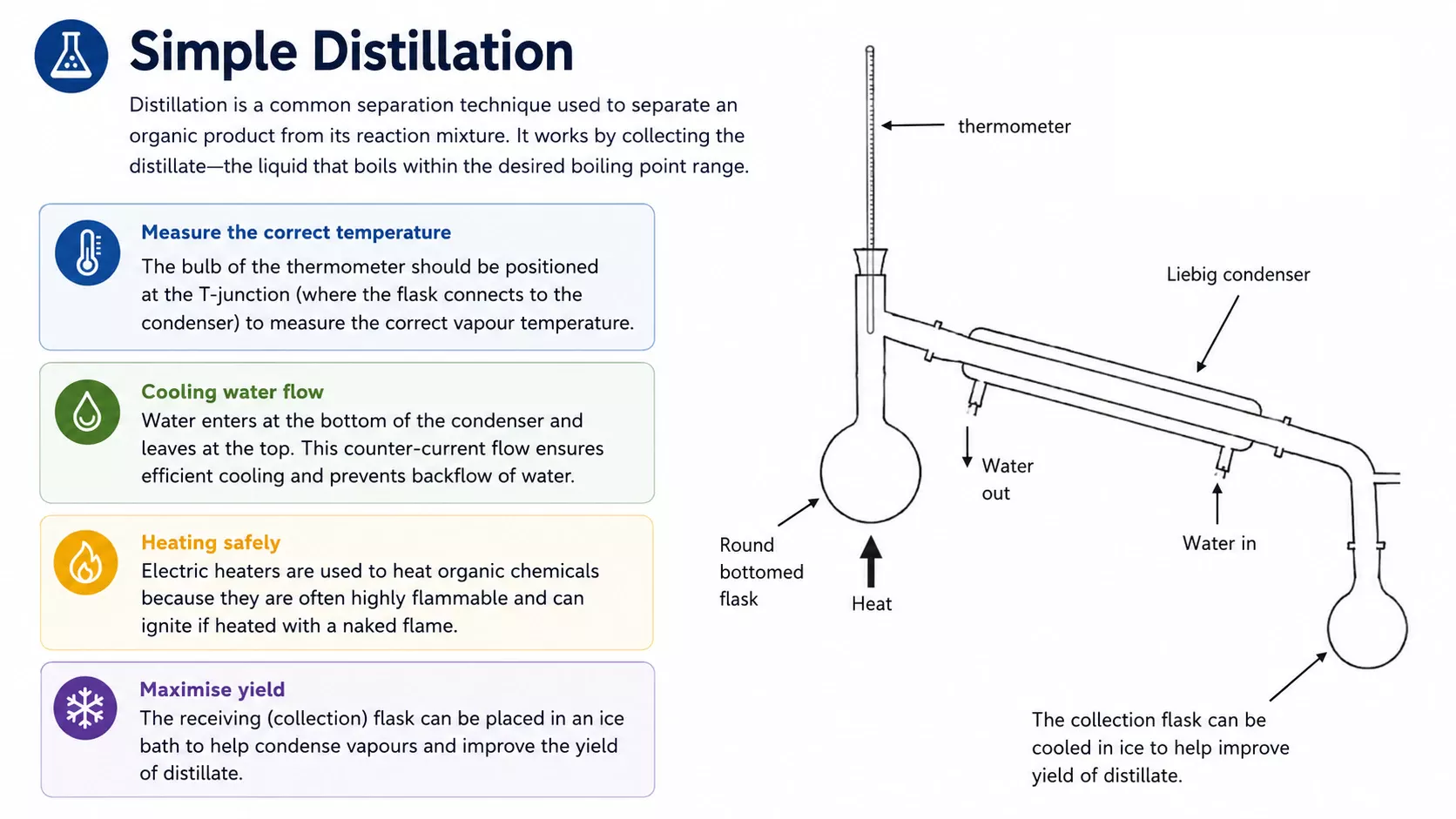
Simple distillation process
This visual focuses on the practical technique: thermometer position, condenser water flow, safe heating and collection of the distillate.
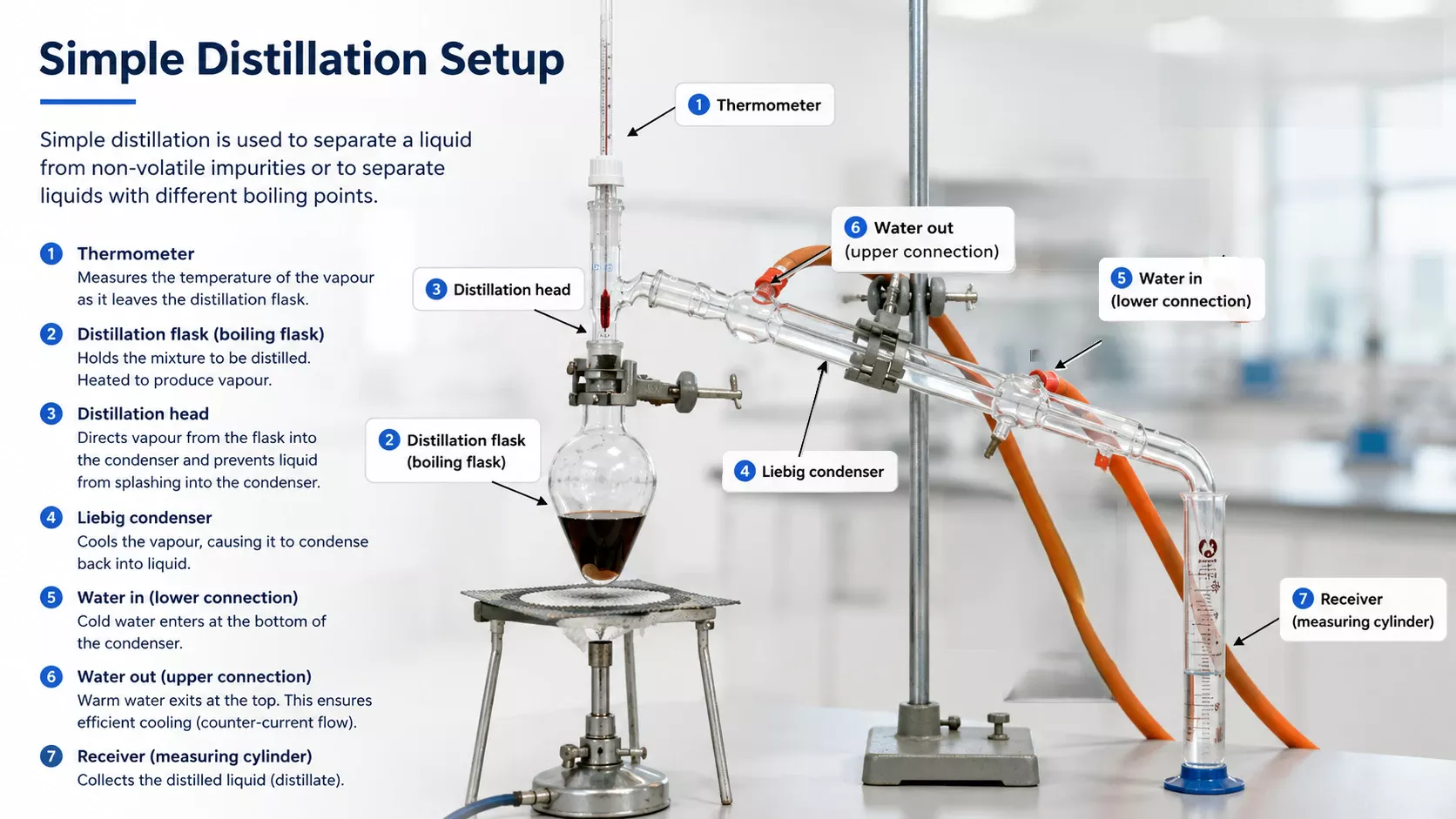
Simple distillation apparatus
The condenser cools the vapour so it condenses into the receiver. Water enters at the lower connection and leaves at the upper connection.
Reflux vs Distillation
Reflux and distillation both use a condenser, but they have different purposes. In reflux, condensed vapour returns to the reaction flask. In distillation, vapour is condensed and collected in a separate receiver.
| Technique | Purpose | What happens to the condensed liquid? | Why it matters for CP6 |
|---|---|---|---|
| Reflux | Heat a reaction mixture for a long time without losing volatile reactants or solvent. | It drips back into the flask. | Useful for carrying out reactions, but not for collecting a purified product. |
| Simple distillation | Separate and collect a liquid product based on boiling point. | It is collected in a receiver. | Used in CP6 to collect the 50-52 °C fraction of 2-chloro-2-methylpropane. |
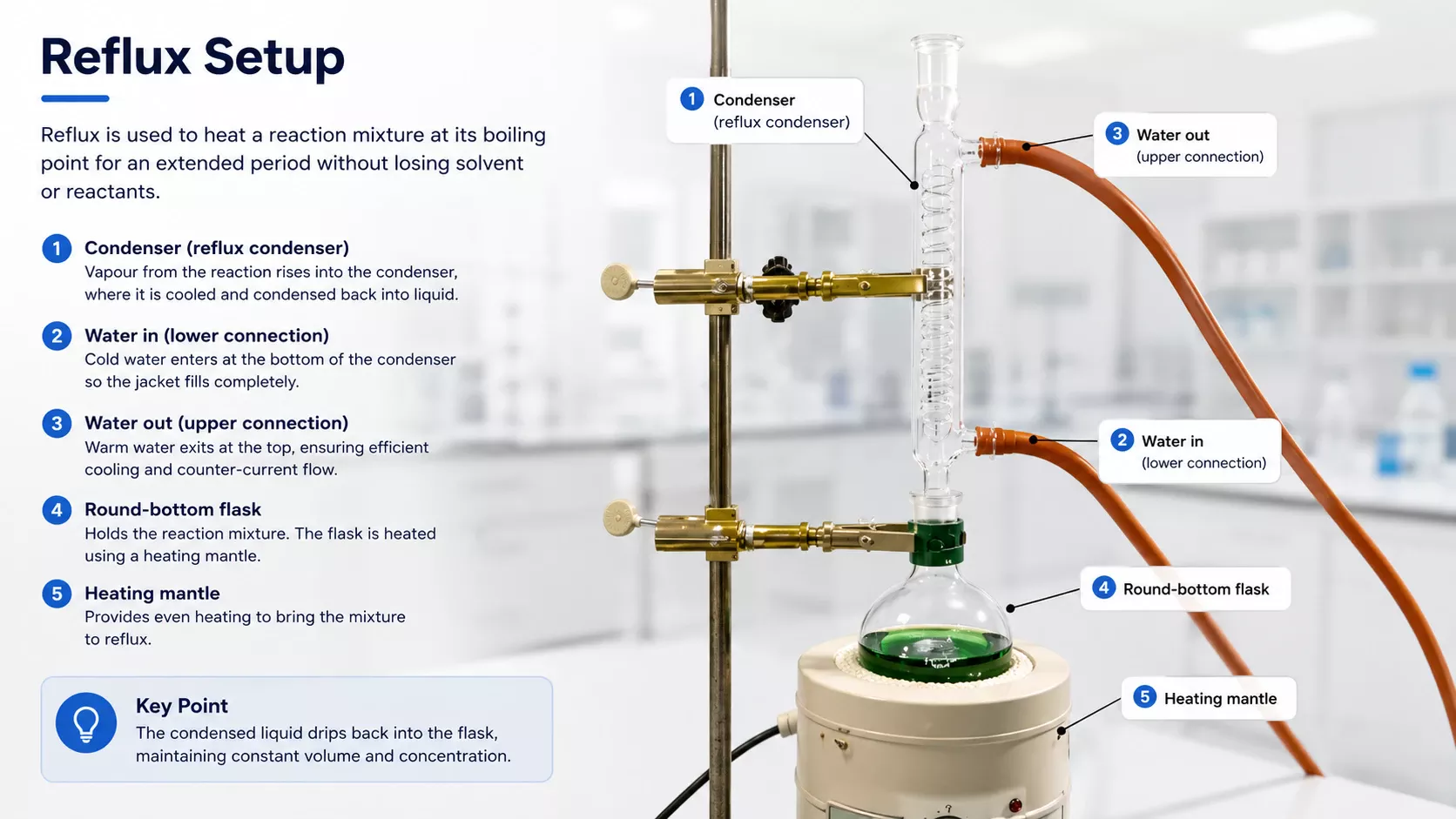
Reflux setup comparison
In reflux, the condenser is vertical and condensed liquid returns to the flask. In CP6 purification, the apparatus is rearranged for simple distillation so the product can be collected.
Analysis: Testing the Distillate for Chloride
The final sample is tested to show that it contains a chloroalkane. The chloroalkane must first be hydrolysed so chloride ions are released, then silver nitrate can be used to form a silver chloride precipitate.
Add distillate
Place a few drops of the distilled product into a test tube.
Add ethanol and NaOH
Add ethanol and aqueous sodium hydroxide, then warm in a water bath.
Hydrolyse
Hydroxide ions hydrolyse the chloroalkane, releasing chloride ions.
Acidify
Add excess nitric acid before silver nitrate to remove excess hydroxide ions.
Add AgNO3
Silver ions react with chloride ions.
Observation
A white precipitate of silver chloride forms.
Expected result: A white precipitate confirms chloride ions after hydrolysis of the chloroalkane.
Boiling Point, Solubility and Purity
The product and reactant have different physical properties because the alcohol can form hydrogen bonds, while the chloroalkane cannot form hydrogen bonds with water.
| Substance | Boiling temperature | Solubility in water | Explanation |
|---|---|---|---|
| 2-methylpropan-2-ol | 82 °C | Soluble | Can form hydrogen bonds between its own molecules and with water. |
| 2-chloro-2-methylpropane | 51 °C | Insoluble | Cannot form hydrogen bonds with water. Intermolecular forces are weaker overall. |
Purity check: A pure liquid has a boiling temperature close to the data-book value. Impurities can change the observed boiling range.
Exam-Style Yield Calculation Walkthrough
The exam-style question uses a related preparation of 2-bromopropane from propan-2-ol. The method for percentage yield is the same: use density to find mass, convert to moles, find theoretical product mass, then compare with actual mass.
Mass of alcohol
mass propan-2-ol = 3.0 × 0.79 = 2.37 g
Moles of alcohol
moles = 2.37 ÷ 60.1 = 0.0394 mol
Theoretical moles
The reaction is 1:1, so theoretical moles of 2-bromopropane = 0.0394 mol
Theoretical mass
0.0394 × 123 = 4.85 g
Actual mass
actual mass = 1.4 × 1.31 = 1.83 g
Percentage yield
% yield = 1.83 ÷ 4.85 × 100 = 38%
Why less than 100%? Product can be lost during purification, the reaction may be incomplete, or competing reactions may occur.
Questions and Answers
These are the key CP6 questions from the practical sheets, written in revision-note format.
1. Write the equation for CP6.
(CH3)3COH + HCl → (CH3)3CCl + H2O
2. What does sodium hydrogencarbonate remove?
It removes unreacted hydrochloric acid by neutralisation.
HCl + NaHCO3 → NaCl + CO2 + H2O
3. Why is pressure released during washing?
Carbon dioxide gas is produced when sodium hydrogencarbonate reacts with acid. The bung must be removed at intervals to release pressure safely.
4. Why does the alcohol dissolve in water?
2-methylpropan-2-ol can form hydrogen bonds with water, so it is soluble.
5. Why is 2-chloro-2-methylpropane insoluble in water?
It cannot form hydrogen bonds with water. It has weaker intermolecular attractions than the alcohol.
6. Why is the alcohol boiling temperature higher?
Intermolecular hydrogen bonds in the alcohol are stronger than the dipole-dipole attractions and London forces between 2-chloro-2-methylpropane molecules.
7. Why does a brown vapour form in the bromide extension?
Bromide ions are oxidised to bromine, Br2, by concentrated sulfuric acid. Bromine is brown.
8. Equations for brown vapour formation
KBr + H2SO4 → KHSO4 + HBr
2HBr + H2SO4 → SO2 + Br2 + 2H2O
Common Mistakes in CP6
Mistake 1: Keeping the wrong layer
The crude product is the upper organic layer. The lower aqueous layer is run off and discarded.
Mistake 2: Forgetting to vent
Sodium hydrogencarbonate produces CO2. Pressure builds up in the separating funnel if it is not vented.
Mistake 3: Adding AgNO3 too early
The chloroalkane must be hydrolysed first so chloride ions are released.
Mistake 4: Missing the acidification step
Nitric acid is added before silver nitrate to remove excess hydroxide ions that could interfere.
Mistake 5: Using reflux wording for distillation
Distillation collects the condensed liquid. Reflux returns condensed liquid to the flask.
Mistake 6: Using the wrong boiling range
For the Pearson CP6 procedure, collect the 50-52 °C fraction.
CP6 FAQs
What is the aim of CP6?
To produce and purify a sample of 2-chloro-2-methylpropane from 2-methylpropan-2-ol and concentrated hydrochloric acid.
Why is sodium hydrogencarbonate used?
It neutralises unreacted hydrochloric acid. Carbon dioxide gas is produced, so pressure must be released frequently.
Why is anhydrous sodium sulfate used?
It is a drying agent. It removes water from the organic product before distillation.
Why is the 50-52 °C fraction collected?
This boiling range matches the boiling temperature of 2-chloro-2-methylpropane, so collecting this fraction improves purity.
What does the silver nitrate test show?
After hydrolysis and acidification, a white precipitate of AgCl shows that chloride ions are present.