CP 11 Finding the Ka Value for a Weak Acid
A focused revision guide to Core Practical 11 for Edexcel International A Level Chemistry: finding the Ka of ethanoic acid from the pH of a known concentration and from the pH at half-neutralisation, reading a pH curve, choosing an indicator, explaining buffer action, and evaluating the pH meter method with worked uncertainties.
Finding the Kₐ of a Weak Acid: pH Meter, Half-Neutralisation and the pH Curve
Calibrate the meter, read the pH of 0.100 mol dm⁻³ ethanoic acid, follow its titration with sodium hydroxide on the meter, and read pKₐ directly at half-neutralisation.
© Dr. Mohammed Al-Fatah – onlinelearningsystem.net
Recap: pH, Strong and Weak Acids
Three quick questions on the ideas this practical builds on: pH = −log[H⁺], and what makes an acid weak rather than strong.
What This Practical Is Testing
This practical, Core Practical 11 on the Edexcel International course, finds the acid dissociation constant, Ka, of ethanoic acid at 0.100 mol dm⁻³. A weak acid dissociates only partially; Ka measures how far the equilibrium lies to the right.
CH₃COOH(aq) ⇌ CH₃COO⁻(aq) + H⁺(aq)
Ka = [H⁺(aq)][CH₃COO⁻(aq)] ÷ [CH₃COOH(aq)] units: mol dm⁻³
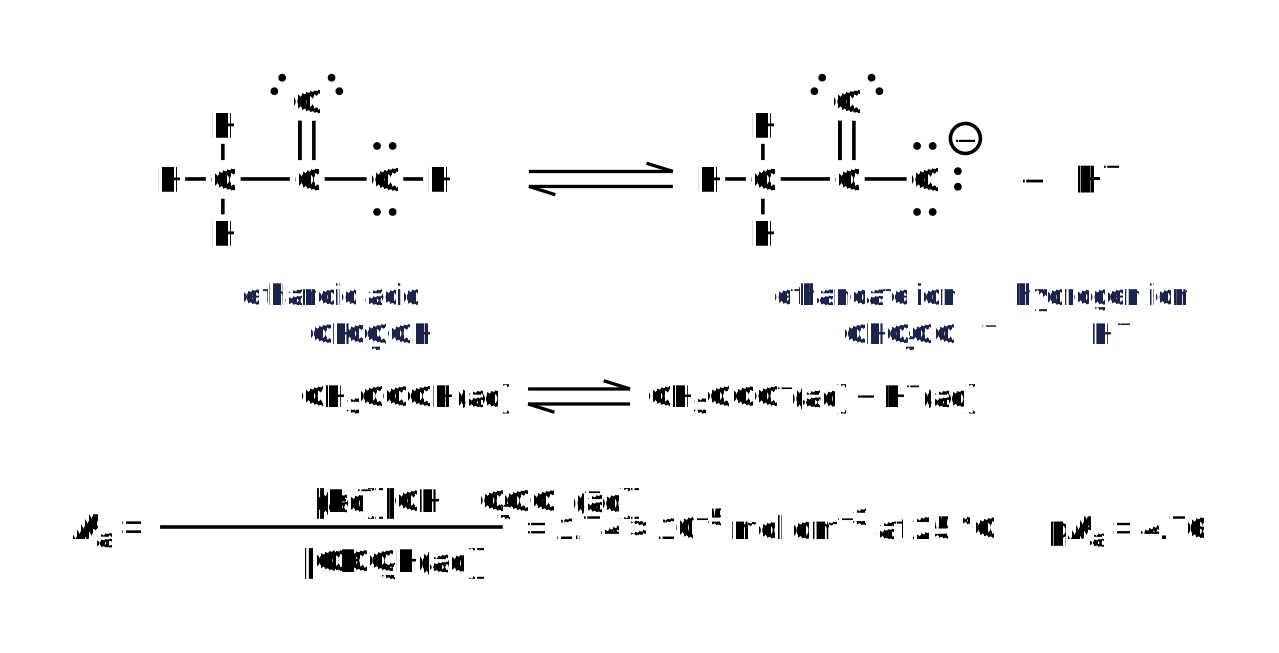
Ethanoic acid dissociates to the ethanoate ion and a hydrogen ion; Ka for the equilibrium is 1.74 × 10⁻⁵ mol dm⁻³ at 25 °C, so pKa = 4.76.
Route 1 reads the pH of the acid at a known concentration with a calibrated pH meter. Route 2 follows a titration with sodium hydroxide on the meter and reads the pH at half-neutralisation, where pH = pKa.
On the Edexcel International course this practical is examined through the Unit 6 practical skills paper (WCH16), which asks for methods, apparatus choices, data processing, uncertainty and evaluation.
Questions ask how the meter is calibrated and used, for the Ka calculation and its assumptions, for the features of the pH curve, for the choice of indicator, and for an evaluation of the errors.
The burette and pipette technique comes from Core Practical 3 (concentration of hcl by titration) and Core Practical 4 (preparation of a standard solution). What is new: a pH probe replaces the indicator, so the whole curve is recorded.
Key idea: pKa = −log Ka. At half-neutralisation [HA] = [A⁻], so Ka = [H⁺] and pH = pKa; for ethanoic acid at 25 °C this gives 4.76 and Ka = 1.74 × 10⁻⁵ mol dm⁻³.
Safety and Apparatus
The hazards are low; the expensive item is the glass pH probe, which must be clamped, kept wet and never allowed to touch the stirrer bar or the bottom of the beaker.
| Item | What it is for | Precision or note |
|---|---|---|
| pH meter and glass probe | Reads the pH of the acid, and of the mixture after every addition | ±0.01; calibrate before use; ±0.1 when reading a value off a curve |
| Calibration buffers pH 4.00, 7.00 and 10.00 | Set the meter against solutions of known pH | fresh buffers; rinse the probe between them |
| 25.0 cm³ pipette and filler | Measures the acid into the beaker | ±0.06 cm³ |
| 50 cm³ burette | Adds the sodium hydroxide in measured portions | ±0.05 cm³ per reading |
| 100 cm³ beaker and magnetic stirrer | Holds the mixture; stirring gives a uniform pH before each reading | a beaker, not a conical flask: the probe must reach the liquid |
| Thermometer | Records the temperature, because Ka depends on it | ±0.5 °C; quote the result at 25 °C |
| Wash bottle of distilled water and tissue | Rinses the probe between solutions | dab dry; never wipe the bulb |
Safety: Sodium hydroxide at 0.100 mol dm⁻³ irritates skin and eyes; the acid and the buffers are low hazard. Wear eye protection. Clamp the probe so the stirrer bar cannot strike it, and store it in its soaking solution, never dry.
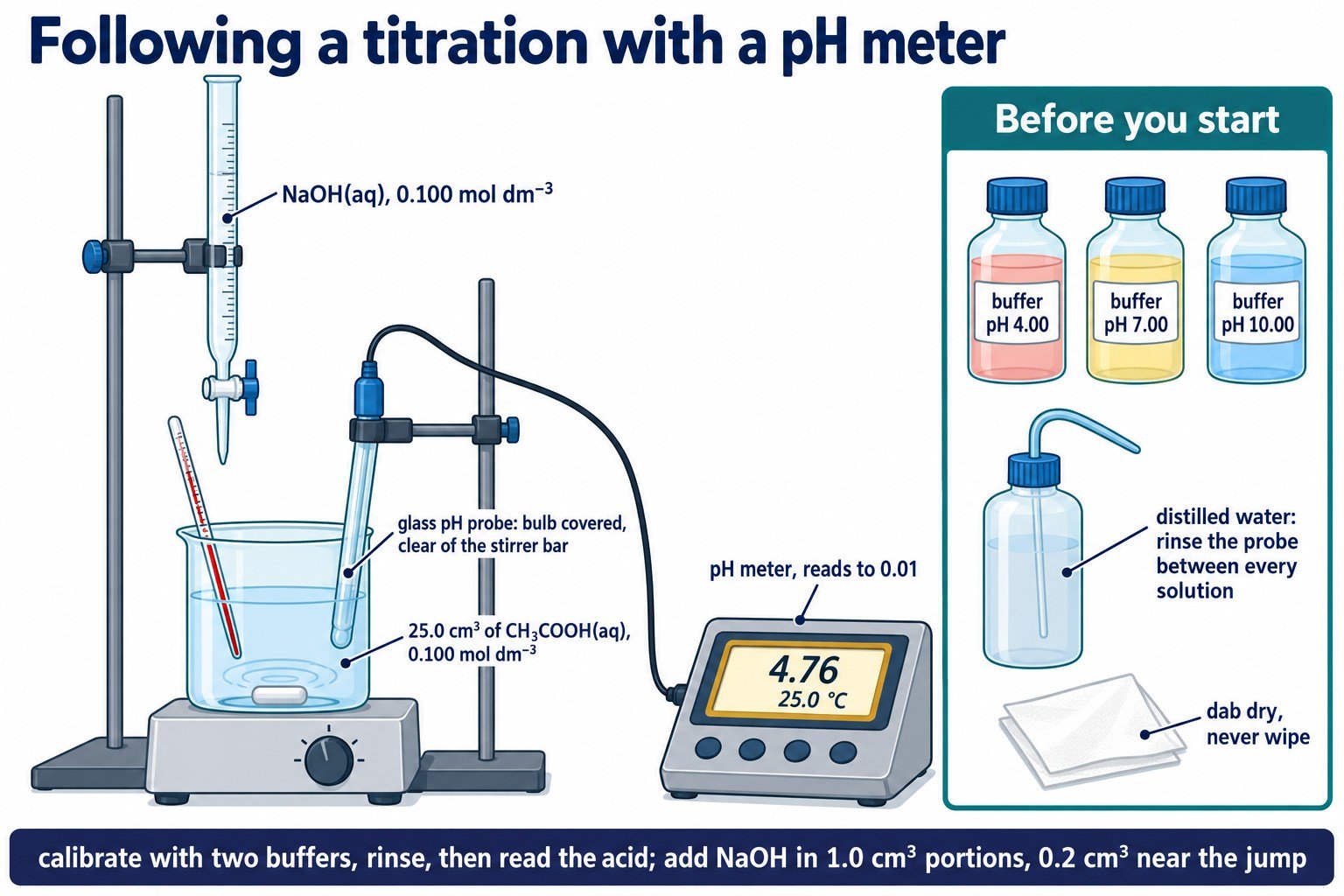
The pH titration set-up: sodium hydroxide from the burette into stirred ethanoic acid, the probe clamped in the liquid and the meter reading to 0.01, with the calibration buffers and wash bottle ready.
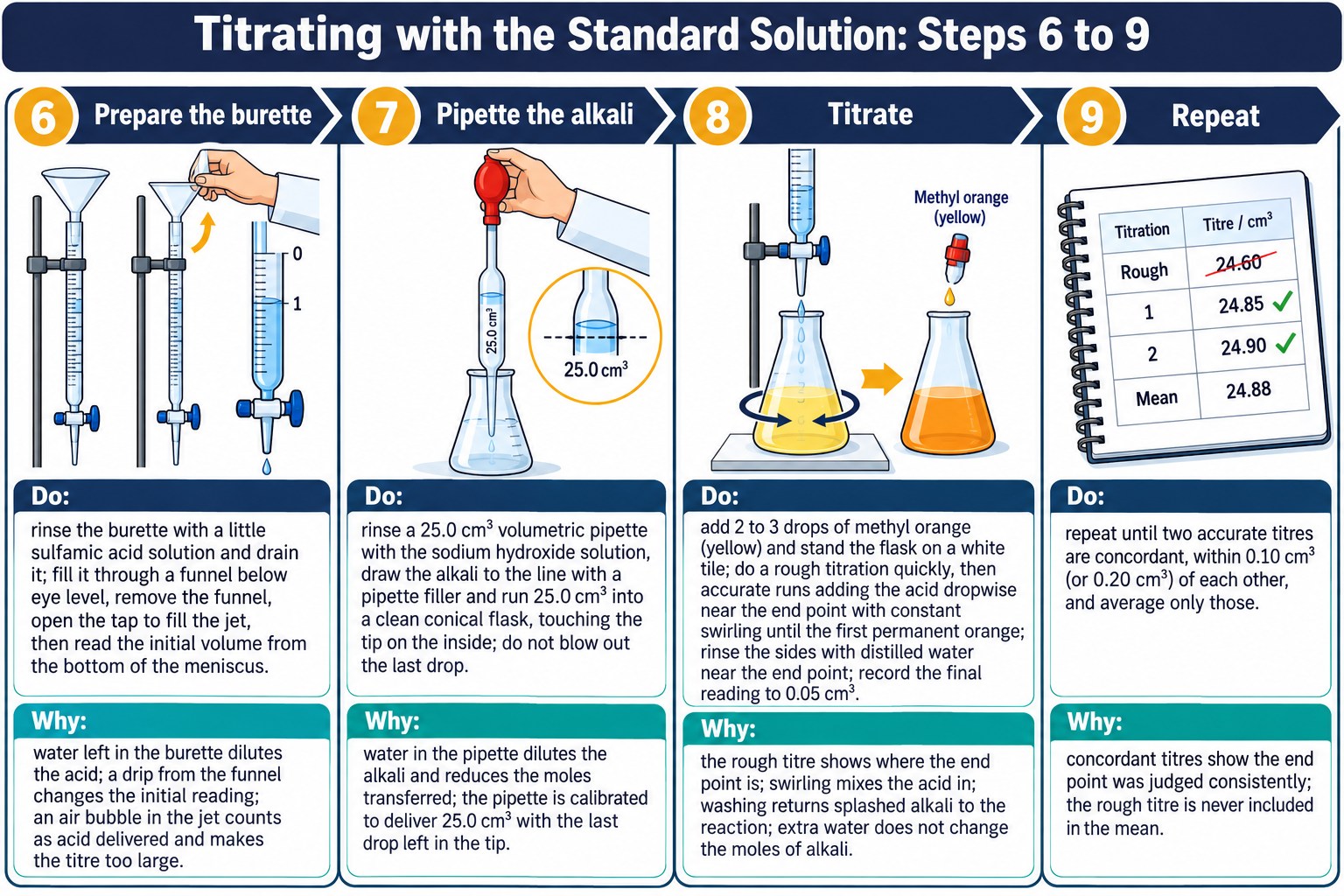
Burette and pipette technique carries over from the acid–base titrations: fill, remove the air bubble, read the bottom of the meniscus at eye level, and record every reading to 0.05 cm³.
Method 1: the pH of a Known Concentration
The quickest route to Ka reads the pH of the acid itself. Everything depends on the meter being calibrated and the concentration being exactly known.
| Step | What you do | Why |
|---|---|---|
| Calibrate | Put the rinsed probe in the pH 4.00 buffer and set the meter; rinse; repeat with pH 7.00 (and 10.00 if needed). | Meters drift between sessions; two known points fix the scale across the range used. |
| Rinse | Rinse the probe with distilled water and dab it dry before every new solution. | Buffer or alkali carried over would change the pH of the next sample. |
| Measure the acid | Pipette 25.0 cm³ of 0.100 mol dm⁻³ ethanoic acid into a beaker, lower the probe in and stir gently. | A pipette gives an accurate volume; stirring makes the solution uniform around the bulb. |
| Read | Wait for the display to settle, then record the pH to 2 d.p. and the temperature. | The glass electrode takes a few seconds to respond; Ka must be quoted at a stated temperature. |
| Repeat | Rinse, repeat with a fresh portion, and use the mean of readings that agree. | Repeats reduce random variation in the reading. |
Sample reading: pH 2.88 at 25 °C. The calculation uses the Ka expression with two simplifications, stated below.
Step 1: [H⁺] = 10⁻²·⁸⁸ = 1.32 × 10⁻³ mol dm⁻³
Step 2: [CH₃COO⁻] = [H⁺] = 1.32 × 10⁻³ mol dm⁻³ and [CH₃COOH] ≈ 0.100 mol dm⁻³
Step 3: Ka = [H⁺]² ÷ [HA] = (1.32 × 10⁻³)² ÷ 0.100 = 1.74 × 10⁻⁵ mol dm⁻³
Answer: Ka = 1.74 × 10⁻⁵ mol dm⁻³ and pKa = −log(1.74 × 10⁻⁵) = 4.76, to 3 s.f. to match a pH read to 2 d.p. The accepted value at 25 °C is 1.7 × 10⁻⁵ mol dm⁻³.
The assumptions, and why they matter
[H⁺] = [A⁻]: every hydrogen ion is assumed to come from the acid; the 10⁻⁷ mol dm⁻³ from water is ignored, a fair approximation at pH 2.88.
[HA] ≈ 0.100 mol dm⁻³: only 1.3% of the acid has dissociated, so the loss from the undissociated concentration is neglected.
The concentration is exactly known: Ka is proportional to 1 ÷ [HA], so a 2% error in making up the acid becomes a 2% error in Ka.
Exam wording: “[H⁺] is assumed equal to [A⁻] because the acid is the only significant source of hydrogen ions, and the equilibrium concentration of the acid is taken as its initial concentration because dissociation is slight.”
Check: Ka From a Single pH Reading
Apply the same three steps to a different weak acid at a different concentration.
Method 2: Half-Neutralisation With a pH Meter
Titrate the acid with sodium hydroxide of the same concentration, following the pH on the meter. The equivalence point is the middle of the vertical section of the curve; half-neutralisation is at half that volume, where pH = pKa.
CH₃COOH(aq) + NaOH(aq) → CH₃COONa(aq) + H₂O(l)
| Step | What you do | Why |
|---|---|---|
| Set up | Pipette 25.0 cm³ of 0.100 mol dm⁻³ ethanoic acid into a 100 cm³ beaker on a stirrer; clamp the calibrated probe in the liquid. | The bulb must be covered but clear of the stirrer bar. |
| Record the start | Read the pH before any base is added. | The first point on the curve, and a check on method 1. |
| Add in portions | Run in 0.100 mol dm⁻³ NaOH 1.0 cm³ at a time; stir, wait for a steady display, record volume and pH. | Enough points to draw the curve; stirring gives a uniform pH at the probe. |
| Near the jump | From about 23 cm³ add 0.2 cm³ portions until past 27 cm³, then return to 1.0 cm³ portions up to 40 cm³. | The pH changes fastest here; small portions locate the vertical section precisely. |
| Plot | Plot pH against volume added, draw a smooth curve and read the equivalence volume at the middle of the vertical section. | The equivalence volume fixes the half-neutralisation volume. |
| Half-neutralise | Pipette a fresh 25.0 cm³ of acid, add exactly half the equivalence volume (12.50 cm³) of NaOH, stir and read the pH. | Here [HA] = [A⁻], so the reading is pKa directly. |
Equivalence comes at 25.0 cm³, because equal concentrations react in equal volumes. At 12.5 cm³ half the acid has been converted to ethanoate, so [CH₃COOH] = [CH₃COO⁻] and the two terms cancel in the Ka expression.
Step 1: Ka = [H⁺] × [A⁻] ÷ [HA] = [H⁺] because [A⁻] = [HA]
Step 2: pH at 12.5 cm³ = 4.76, so pKa = 4.76
Step 3: Ka = 10⁻⁴·⁷⁶ = 1.74 × 10⁻⁵ mol dm⁻³
Answer: Ka = 1.74 × 10⁻⁵ mol dm⁻³, the same as method 1, but reached without assuming anything about [H⁺] or the exact acid concentration.
Why this beats method 1: No assumption that [H⁺] = [A⁻]; no need to know the acid concentration exactly, because half the equivalence volume fixes [HA] = [A⁻] whatever it is; and no reliance on a tiny dissociation. One pH reading gives pKa.
The pH Curve: Weak Acid With Strong Base
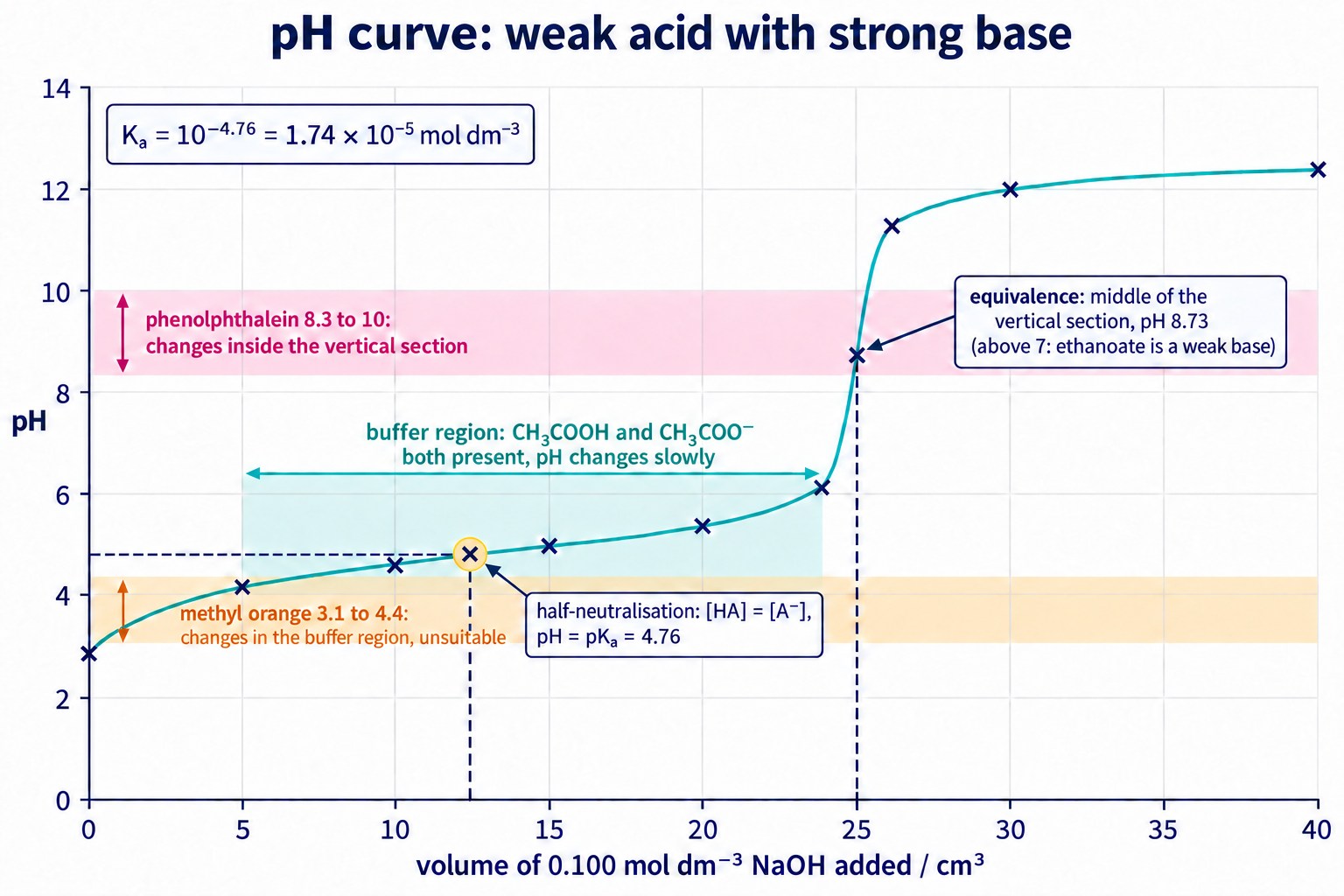
The pH curve for 25.0 cm³ of 0.100 mol dm⁻³ ethanoic acid titrated with 0.100 mol dm⁻³ sodium hydroxide: a gentle buffer region, pH = pKa = 4.76 at 12.5 cm³, and the vertical section at 25.0 cm³ with equivalence at pH 8.73.
Selected readings from the titration are tabulated below; all eleven points are plotted on the figure.
| Volume of NaOH / cm³ | pH | What is in the beaker |
|---|---|---|
| 0.0 | 2.88 | ethanoic acid only: [H⁺] from partial dissociation |
| 5.0 | 4.16 | acid and ethanoate: the buffer region begins |
| 12.5 | 4.76 | half-neutralisation: [HA] = [A⁻], pH = pKa |
| 20.0 | 5.36 | buffer region: pH rising slowly |
| 24.0 | 6.14 | acid nearly used up: the curve steepens |
| 25.0 | 8.73 | equivalence: sodium ethanoate solution, pH above 7 |
| 26.0 | 11.29 | excess NaOH: pH set by the excess base |
| 40.0 | 12.36 | excess NaOH: the curve flattens |
The other recorded points are 10.0 cm³ (pH 4.58), 15.0 cm³ (pH 4.94) and 30.0 cm³ (pH 11.96). Read the curve for five features, and be able to explain each.
Start: pH 2.88, not 1.00. The acid is weak, so only about 1% of its molecules have released H⁺.
Buffer region: from about 5 to 24 cm³ the pH climbs gently. The mixture of CH₃COOH and CH₃COO⁻ is a buffer, so each portion of OH⁻ is removed by the acid with little change in [H⁺].
Half-neutralisation: at 12.5 cm³ the two concentrations are equal and pH = pKa = 4.76. This is the flattest part of the curve.
Vertical section: around 25.0 cm³ the pH leaps from about 7 to 11 with one or two drops of base. Equivalence is its mid-point, pH 8.73.
Equivalence above 7: the beaker holds sodium ethanoate, and the ethanoate ion is a weak base that takes a proton from water.
CH₃COO⁻(aq) + H₂O(l) ⇌ CH₃COOH(aq) + OH⁻(aq)
Indicator: phenolphthalein (pH 8.3 to 10) changes colour inside the vertical section, so it marks equivalence. Methyl orange (3.1 to 4.4) would change in the buffer region, far before equivalence, so it is unsuitable.
Reading a curve: Equivalence volume: the middle of the vertical section. pKa: the pH at half that volume. Values read off a plotted curve carry about ±0.1 in pH and ±0.2 cm³ in volume.
Check: Reading a New pH Curve
Work out equivalence, pKa, Ka and the indicator for a different weak acid, then flip each card to check.
Comparing the Three pH Curves
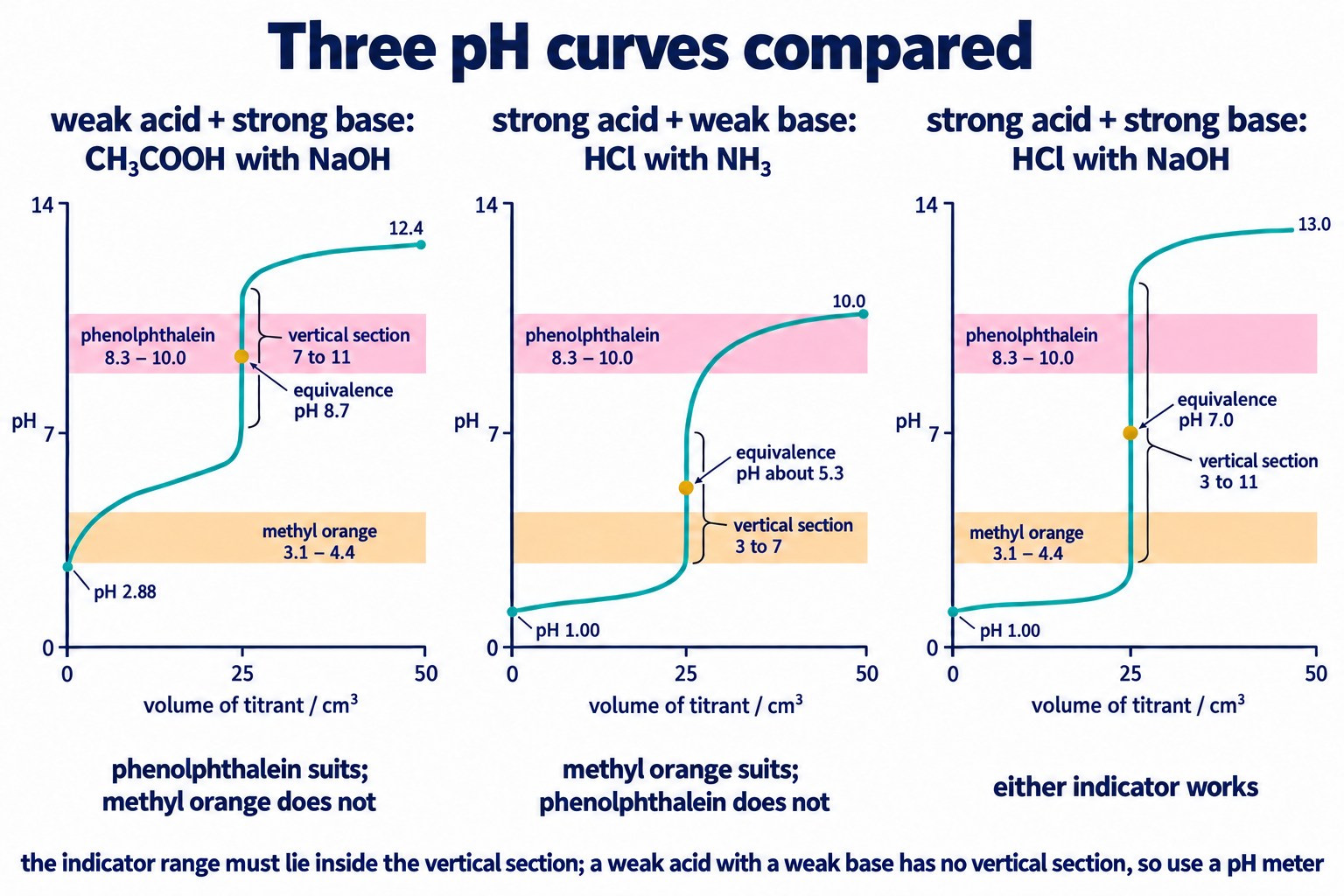
Three pH curves on the same scales: weak acid with strong base, strong acid with weak base, and strong acid with strong base, each with its equivalence pH, vertical section and the indicator that suits it.
Same volumes and concentrations, different strengths. The start pH, the position of the vertical section and the equivalence pH all change, and with them the indicator you may use.
| Titration | Start pH | Vertical section | Equivalence pH | Indicator |
|---|---|---|---|---|
| Weak acid + strong base: CH₃COOH with NaOH | 2.88 | about 7 to 11 | 8.7 | phenolphthalein |
| Strong acid + weak base: HCl with NH₃ | 1.00 | about 3 to 7 | about 5.3 | methyl orange |
| Strong acid + strong base: HCl with NaOH | 1.00 | about 3 to 11 | 7.0 | either |
Strong acid with weak base: 25.0 cm³ of 0.100 mol dm⁻³ HCl with 0.100 mol dm⁻³ ammonia starts at pH 1.00 and jumps at 25.0 cm³ from about 3 to 7. At equivalence the beaker holds ammonium chloride; the ammonium ion is a weak acid.
NH₃(aq) + HCl(aq) → NH₄Cl(aq) then NH₄⁺(aq) + H₂O(l) ⇌ NH₃(aq) + H₃O⁺(aq)
So equivalence is at about pH 5.3, below 7. Beyond it the excess ammonia and the ammonium ions form a buffer, so the curve levels off near pH 10 rather than climbing to 13.
Strong acid with strong base: the longest vertical section, about 3 to 11, with equivalence at exactly 7.0 because neither ion of NaCl reacts with water. Either indicator works.
Choosing an indicator: its colour change range must lie wholly inside the vertical section, so that one drop takes the solution right through it. Methyl orange suits the strong acid with weak base; phenolphthalein suits the weak acid with strong base.
Weak acid with weak base: there is no vertical section, only a gradual rise, so no indicator gives a sharp change. A pH meter and the curve are the only way to find equivalence.
Exam wording: “The indicator is suitable because its pH range lies within the vertical section of the curve, so the colour change occurs at the equivalence point with the addition of one drop.”
Check: Curves and Indicators
Five quick choices on equivalence pH, start pH and indicators for new acid–base pairs.
Buffer Action: Why the Curve Is Flat
A buffer is a solution that resists changes in pH when small amounts of acid or base are added. Between about 5 and 24 cm³ the beaker holds large reservoirs of both the weak acid and its conjugate base, which is exactly that.
Added alkali: CH₃COOH(aq) + OH⁻(aq) → CH₃COO⁻(aq) + H₂O(l)
Added acid: CH₃COO⁻(aq) + H⁺(aq) → CH₃COOH(aq)
Each portion of base shifts the ratio [A⁻] ÷ [HA] a little, and the pH moves only by the logarithm of that change. Rearranging Ka gives the working equation.
[H⁺] = Ka × [HA] ÷ [A⁻] so pH = pKa + log([A⁻] ÷ [HA])
Multiplying the ratio by 6 adds only log 6 = 0.78 to the pH: between 10.0 and 20.0 cm³ the ratio goes from 0.67 to 4 and the pH rises just 0.78, from 4.58 to 5.36.
Best at the middle: at 12.5 cm³ the ratio is 1, the two reservoirs are equal and pH = pKa; the buffer resists change in either direction equally well.
Running out: by 24 cm³ the acid reservoir is almost gone, the ratio shoots up to 24 and the curve climbs steeply towards the vertical section.
Buffers in biology: blood is held near pH 7.4 by the carbonic acid and hydrogencarbonate pair, H₂CO₃(aq) ⇌ HCO₃⁻(aq) + H⁺(aq); many foods are buffered to slow the pH changes caused by bacteria and fungi.
Key idea: The buffer region of a pH curve IS a buffer: a weak acid and its conjugate base, both in large amounts. That is why pH changes slowly there and why pH = pKa at its centre.
Check: How a Buffer Resists pH Change
Drag the words into place for a different buffer pair.
Choosing a Route to Ka
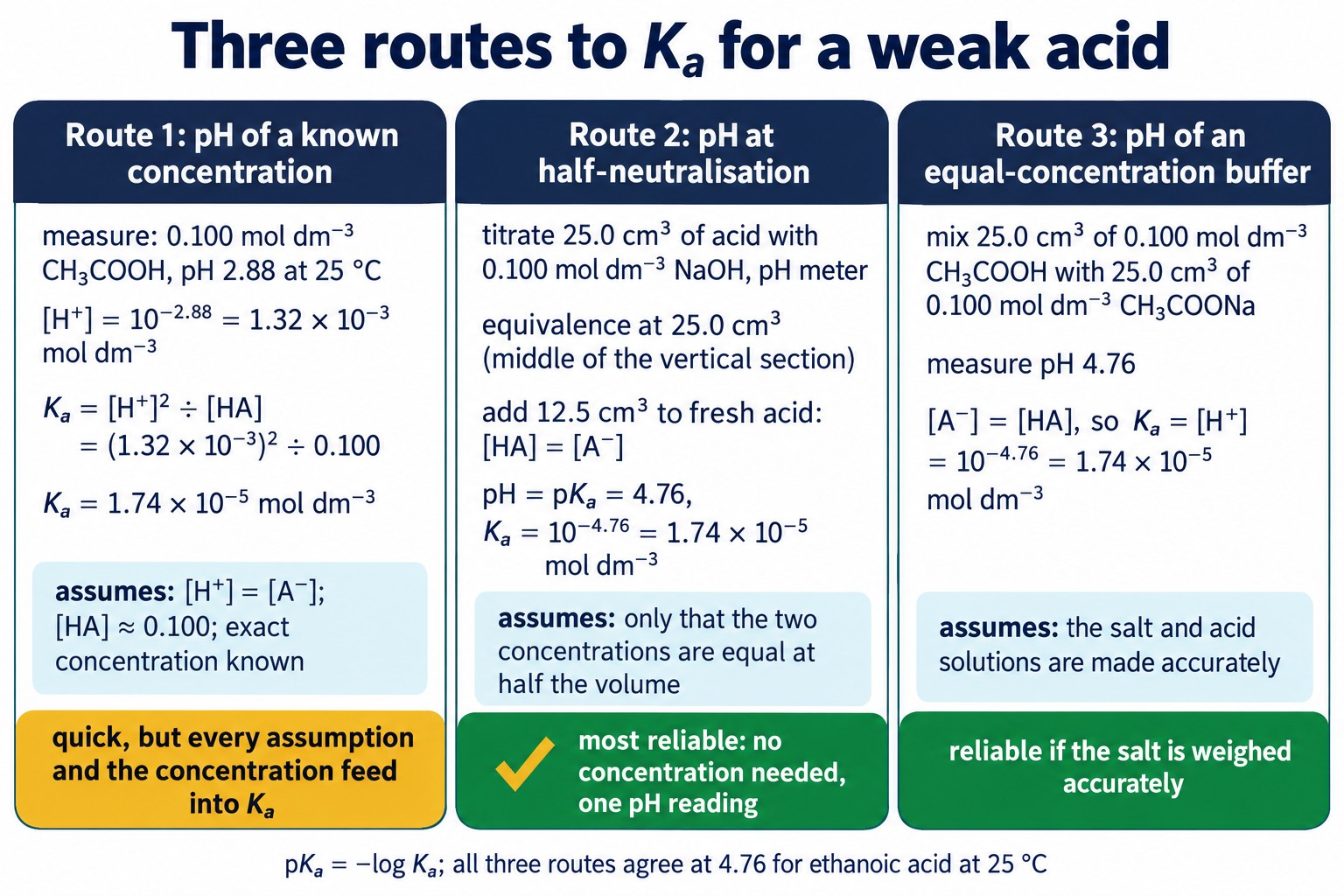
Three routes to Ka for ethanoic acid, with the worked numbers, the assumptions each makes and a verdict: half-neutralisation needs the fewest assumptions.
All three routes give 1.74 × 10⁻⁵ mol dm⁻³ for ethanoic acid, but they do not rest on the same assumptions, and the evaluation marks go to knowing which is the most trustworthy.
| Route | What you measure | What it relies on |
|---|---|---|
| pH of a known concentration | one pH reading of the acid | [H⁺] = [A⁻], [HA] unchanged, and an exact concentration |
| pH at half-neutralisation | a curve, then one pH at half the equivalence volume | only that half the acid has been converted to its anion |
| pH of an equal-concentration buffer | one pH reading of the mixture | the acid and salt solutions having the same concentration |
Half-neutralisation is preferred: it needs no exact concentration, no assumption about [H⁺], and the equivalence volume comes from the curve itself. Its weakness is the time taken to record the whole curve.
Errors, Uncertainty and Improvements
The burette and pipette uncertainties are small; the meter, its calibration and the temperature decide the quality of Ka.
| Source of error | Effect on the result | Improvement |
|---|---|---|
| Meter not calibrated, or drifting | Every pH offset the same way: systematic error in Ka | Calibrate with two buffers before use; re-check in a buffer at the end |
| Probe not rinsed between solutions | Carried-over buffer or NaOH raises the pH read | Rinse with distilled water and dab dry each time |
| Temperature not 25 °C | Ka changes with temperature; the value is not comparable | Use a water bath, or record the temperature and quote it with Ka |
| Reading taken before the display settles | pH slightly low or high at random | Stir, wait for a steady reading, then record |
| Portions too large near equivalence | Vertical section poorly defined; equivalence volume uncertain | Add 0.2 cm³ portions between 23 and 27 cm³ |
| CO₂ from the air dissolving in the alkaline mixture | Lowers the pH beyond equivalence | Keep the NaOH stoppered and record readings promptly |
| Acid concentration not exactly 0.100 mol dm⁻³ (method 1) | Ka in error by the same percentage | Use half-neutralisation, which needs no exact concentration |
Percentage uncertainty
The meter reads to ±0.01. A reading of pH 2.88 ± 0.01 puts [H⁺] between 10⁻²·⁸⁹ and 10⁻²·⁸⁷, a factor of 10⁰·⁰¹ either way.
Step 1: uncertainty in [H⁺] = (10⁰·⁰¹ − 1) × 100 = 2.3%
Step 2: Ka ∝ [H⁺]² in method 1, so uncertainty in Ka = 2 × 2.3% = 4.6%
Step 3: method 2 volume 12.50 cm³ from two burette readings: 0.10 ÷ 12.50 × 100 = 0.80%; pipette 0.06 ÷ 25.0 × 100 = 0.24%
Answer: method 1 carries about ±4.6% in Ka from the pH alone, plus any error in the concentration. Method 2 relies on one pH reading (±2.3% in Ka, since Ka = [H⁺]) and the burette (0.80%), which is why it is preferred.
Improvements: a data logger records pH continuously and plots the curve as it forms; a thermostatted water bath holds 25 °C; repeating the half-neutralisation reading three times and averaging reduces the random error.
Exam focus: For every error say which way the pH moves and therefore which way Ka moves: “the carried-over buffer raises the pH, so [H⁺] appears smaller and Ka is too small”.
Check: Errors in pH Measurement
Decide the direction of each error and calculate a percentage uncertainty for a new titration.
Common Mistakes
The same errors appear in write-ups and exam answers year after year. Each costs a mark that the corrected version earns.
Units: Ka for a monoprotic weak acid has units of mol dm⁻³; pKa has none. “Ka = 1.74 × 10⁻⁵” with no unit loses the mark.
Rounding early: carry [H⁺] as 1.318 × 10⁻³ through the working and round Ka at the end; rounding the pH or [H⁺] first shifts the third figure.
pKa from the start pH: the pH of the acid alone (2.88) is not pKa. pH = pKa only at half-neutralisation.
Half-neutralisation and equivalence confused: pH = pKa at half the equivalence volume (12.5 cm³), never at equivalence itself (25.0 cm³, pH 8.73).
Equivalence pH 7: only for a strong acid with a strong base. The ethanoate ion is a weak base, so this equivalence is at 8.73.
Calibrating with water: distilled water is not a standard; its pH drifts with dissolved CO₂. Calibrate with buffer solutions.
Methyl orange for a weak acid: its range lies in the buffer region, so it changes long before equivalence.
Check: Ka, pKa and pH Curves
Pick the accurate statement in each round: the last check before the exam points.
Common Exam Points
Say
“At half-neutralisation [HA] = [A⁻], so Ka = [H⁺] and pH = pKa.” “Equivalence is above pH 7 because the ethanoate ion is a weak base.” “The indicator’s range must lie within the vertical section.” “Ka = 1.74 × 10⁻⁵ mol dm⁻³ at 25 °C.”
Do not say
“pH = pKa at the equivalence point.” “The pH of the acid is its pKa.” “Ka has no units.” “Calibrate the meter in distilled water.” “Methyl orange is suitable for ethanoic acid with sodium hydroxide.”
Watch for
The three assumptions behind Ka = [H⁺]² ÷ [HA]; sketching the curve with buffer region, vertical section and equivalence; pKa at half the equivalence volume; buffer equations with state symbols; ±0.01 in pH giving 2.3% in [H⁺] and 4.6% in Ka; the temperature stated.
FAQs
Short answers to the questions students most often ask about finding the Ka of a weak acid.
Why is pH equal to pKa at half-neutralisation?
Because half the acid has been converted into its anion, so [HA] = [A⁻]. Those two terms cancel in Ka = [H⁺][A⁻] ÷ [HA], leaving Ka = [H⁺], and taking −log of both sides gives pKa = pH.
Why is half-neutralisation better than measuring the pH of the acid?
It needs no assumption that [H⁺] = [A⁻], and it does not depend on knowing the acid concentration exactly, because the 1 : 1 ratio is fixed by adding half the equivalence volume. One pH reading gives pKa directly.
Why is the equivalence pH above 7 for ethanoic acid and sodium hydroxide?
At equivalence the beaker holds sodium ethanoate. The ethanoate ion is a weak base and takes a proton from water, releasing OH⁻, so the solution is slightly alkaline, about pH 8.7 at these concentrations.
Why does the pH meter have to be calibrated with buffers?
The glass electrode drifts with age, storage and temperature, so its reading has to be set against solutions of known pH before each session. Two buffers (pH 4 and 7, or 7 and 10) fix the scale across the range you will measure.
What are the units of Ka, and why does pKa have none?
For a monoprotic weak acid Ka = [H⁺][A⁻] ÷ [HA] has two concentration terms on top and one below, leaving mol dm⁻³. pKa = −log Ka is a logarithm, so it is a pure number.
Copyright notice: This OLS revision content, including the explanations, layout, diagrams, tables and embedded learning structure, is authored for Online Learning System by Dr. Mohammed Al-Fatah. It may not be copied, reproduced, redistributed or adapted without written permission.
Keep this note — free
Save your progress across every Edexcel IAL topic. A free account remembers which topics you have covered, saves your question scores, and syncs across your phone and laptop.
- Track every topic you have finished
- Keep your practice-question scores
- No payment, no card, free forever
Already registered? Log in