CP4: Preparation of a Standard Solution
In this core practical, you prepare a standard solution of sulfamic acid from a solid sample, then use it in an acid-base titration to calculate the concentration of sodium hydroxide.
What This Practical Is Testing
The practical has two connected parts. First, you make a standard solution of sulfamic acid. A standard solution has a known concentration. Then, you use that acid in a titration to find the concentration of a sodium hydroxide solution.
The overall logic is: if the mass of sulfamic acid is known, the moles of acid are known. If the final volume in the volumetric flask is known, the concentration of the acid can be calculated. That acid can then be used to calculate the concentration of NaOH from the titre.
Weigh the acid
Find the accurate mass of sulfamic acid transferred.
Make the solution
Dissolve, transfer with washings, make up to 250 cm3.
Titrate NaOH
Use the acid in the burette against 25.0 cm3 sodium hydroxide.
Key idea: CP4 links accurate practical technique to quantitative chemistry. Every rinse, reading and volume affects the final concentration.
Safety and Apparatus
Sodium hydroxide is hazardous to the eyes, so eye protection is required. Avoid skin contact with both sulfamic acid and sodium hydroxide. Take care when clamping and filling the burette because it can crack or topple over.
Making the standard solution
Solid sulfamic acid, 250 cm3 beaker, distilled water, funnel, 250 cm3 volumetric flask and a 2 d.p. balance.
Carrying out the titration
Burette, clamp and stand, 25.0 cm3 volumetric pipette with safety filler, 250 cm3 conical flask, sodium hydroxide and methyl orange.
Preparing the Standard Solution
Start by weighing an empty test tube or weighing bottle. Add about 2.5 g of sulfamic acid, then reweigh the container and contents. The difference between the two masses gives the accurate mass of solid used.
Dissolve the sulfamic acid in about 100 cm3 of distilled water in a beaker. Transfer the solution to a 250 cm3 volumetric flask. Rinse the beaker, funnel and glass rod, then add the washings to the volumetric flask so that no acid is lost.
Finally, add distilled water until the bottom of the meniscus sits on the calibration mark. Stopper the flask and invert it several times to make the concentration uniform throughout the solution.
| Technique | Why it is done | What can go wrong |
|---|---|---|
| Reweigh the empty container | Finds the mass of solid actually transferred. | Assuming the starting mass was fully transferred can give an inaccurate mole value. |
| Rinse the beaker and funnel | Transfers any remaining acid into the volumetric flask. | Losing acid lowers the number of moles in the final solution. |
| Make up to the mark carefully | Gives the exact final volume needed for the concentration calculation. | Going above the mark makes the acid too dilute. |
| Invert the flask | Makes the solution uniform. | Poor mixing means different parts of the solution may have different concentrations. |
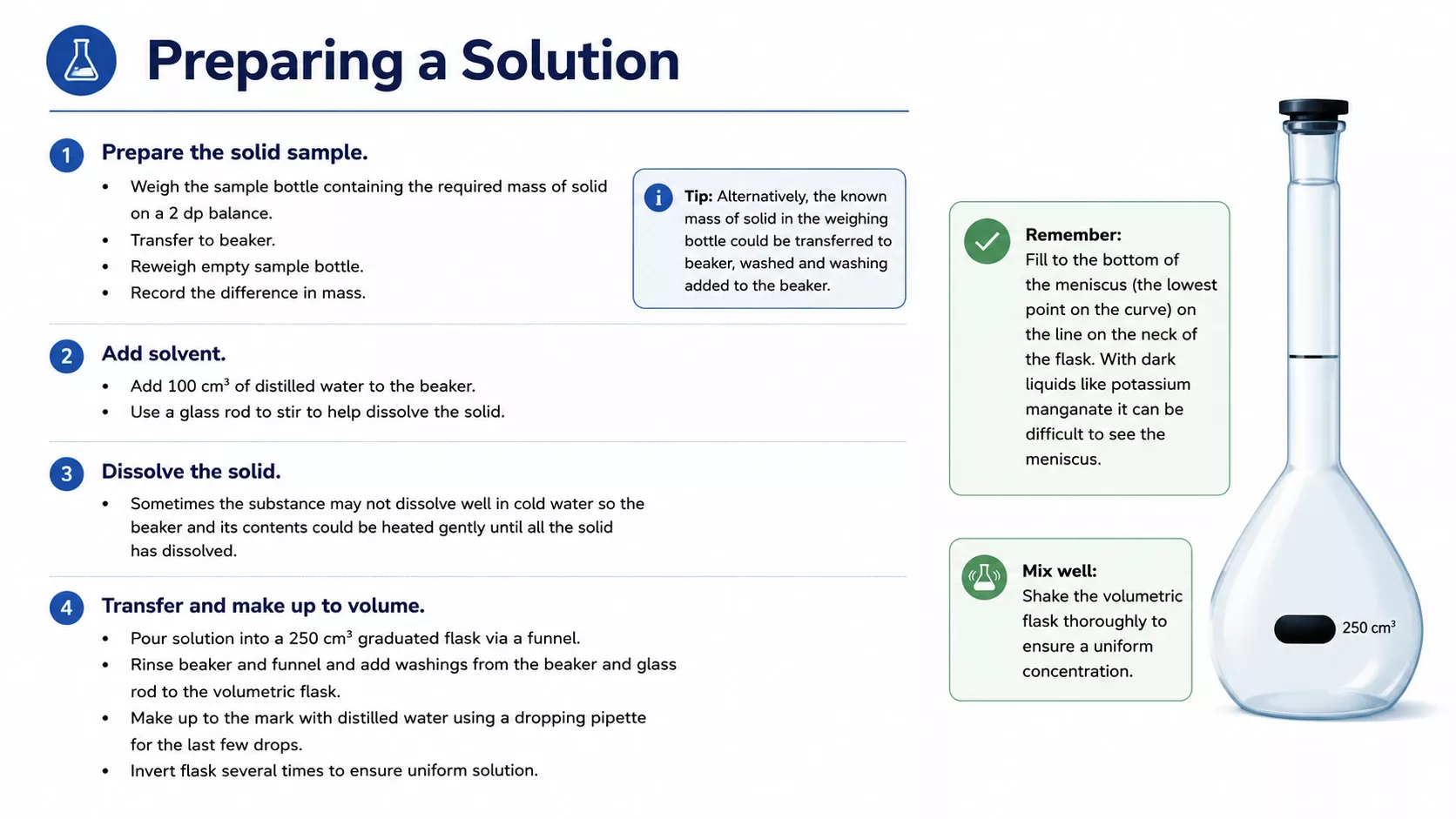
Preparing a standard solution from a solid
Use this sequence to revise the practical method: weigh accurately, dissolve fully, transfer with washings, make up to the mark, then invert to mix.
Using the Volumetric Flask Correctly
A volumetric flask has one calibration mark on its neck. This mark shows the exact volume the flask is designed to contain. In this practical, the solution is made up to 250 cm3.
The bottom of the meniscus should sit on the calibration line. Use a dropping pipette for the last few drops because it is easy to overshoot the line if you add water too quickly.
Do not heat the volumetric flask or pour hot solution into it. Heat can expand the glass, changing the volume and making the concentration inaccurate.
Exam wording: Say “make up to the mark with distilled water” rather than “fill it up”. The mark is what makes the volume accurate.
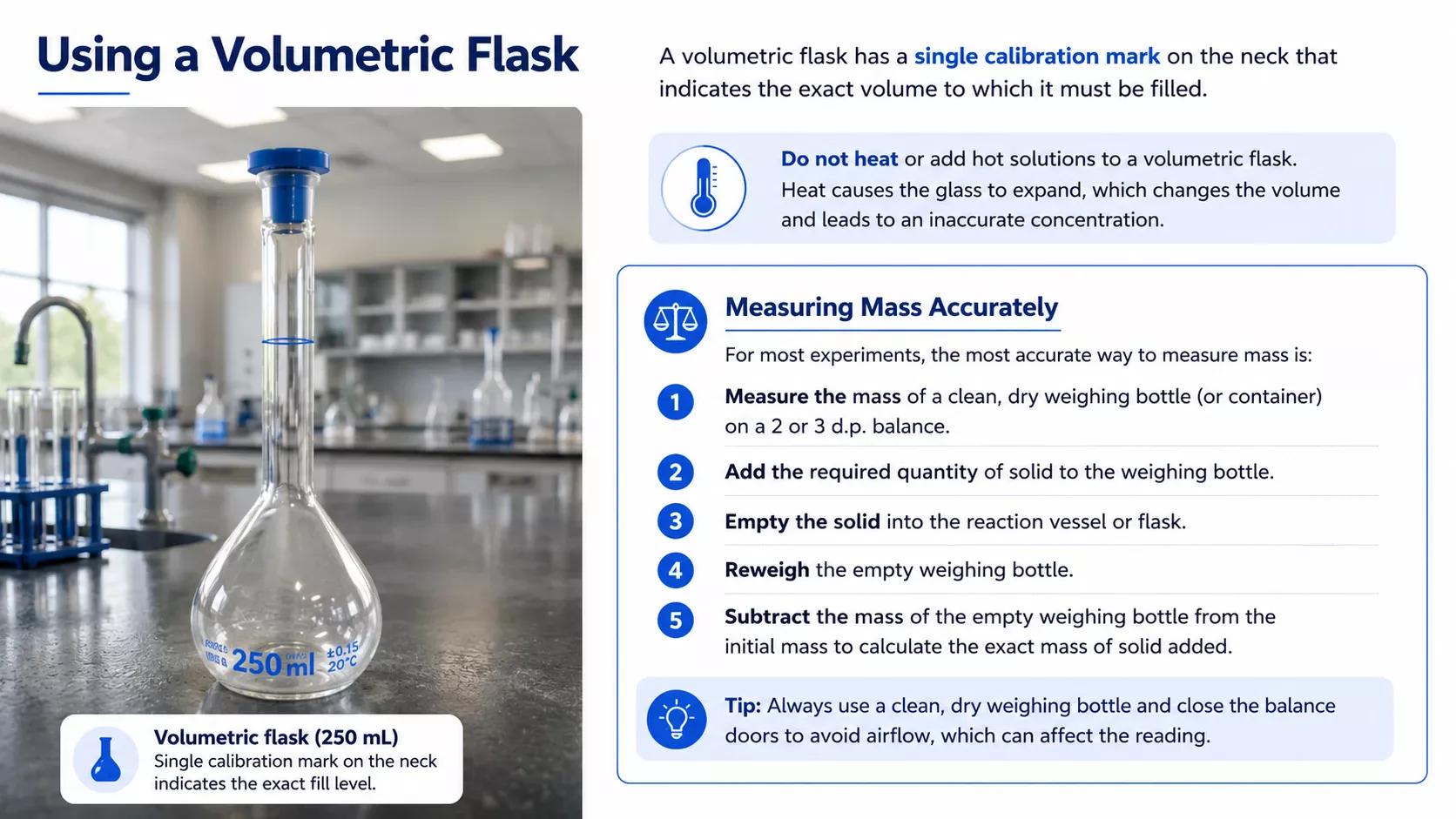
Volumetric flask technique
The calibration mark, meniscus position and mixing step are essential because the concentration calculation depends on the final volume being correct.
Carrying Out the Titration
After preparing the sulfamic acid solution, use it to titrate sodium hydroxide. The burette contains the sulfamic acid. The conical flask contains 25.0 cm3 of sodium hydroxide measured using a volumetric pipette.
Add methyl orange indicator to the sodium hydroxide in the conical flask. Run acid from the burette into the flask until the end point is reached. Burette readings should be recorded to the nearest 0.05 cm3.
Burette
Contains the standard sulfamic acid solution you prepared.
Pipette
Measures a fixed 25.0 cm3 aliquot of sodium hydroxide.
Conical flask
Contains sodium hydroxide and methyl orange indicator.
End point
Near the end point, add acid dropwise and swirl continuously.
Technique point: Rinse the pipette with sodium hydroxide after washing it with water. Any water left inside the pipette would dilute the sodium hydroxide and change the moles transferred.
From Burette Readings to Titres
A titre is calculated from:
titre = final burette reading – initial burette readingOnly concordant titres should be used to calculate the mean titre. In this sample data, trials 2 and 4 are concordant because they both give 20.05 cm3.
| Trial | Final burette reading / cm3 | Initial burette reading / cm3 | Titre / cm3 | Use in mean? |
|---|---|---|---|---|
| Trial 1 | 21.00 | 0.25 | 20.75 | No |
| Trial 2 | 41.05 | 21.00 | 20.05 | Yes |
| Trial 3 | 20.85 | 0.50 | 20.35 | No |
| Trial 4 | 40.90 | 20.85 | 20.05 | Yes |
Mean titre: (20.05 + 20.05) ÷ 2 = 20.05 cm3
Interactive: Build the CP4 Calculation
Work through the data in order. The aim is to connect the practical readings to the final concentration of sodium hydroxide.
Sample results
Mass of sulfamic acid: 2.41 g
| Trial | Final | Initial | Titre |
|---|---|---|---|
| 1 | 21.00 | 0.25 | ? |
| 2 | 41.05 | 21.00 | ? |
| 3 | 20.85 | 0.50 | ? |
| 4 | 40.90 | 20.85 | ? |
Walkthrough controls
Start here
Click the first button to calculate each titre from the final and initial burette readings.
titre = final reading – initial reading
Worked Calculation Ladder
This worked example uses the sample data above. The mass of sulfamic acid is 2.41 g and the mean titre is 20.05 cm3.
Calculate moles of sulfamic acid made
Use the mass and Mr of sulfamic acid, 97.1.
n = m ÷ Mr = 2.41 ÷ 97.1 = 0.0248 molCalculate concentration of sulfamic acid
The solution was made up to 250 cm3, which is 0.250 dm3.
c = n ÷ V = 0.0248 ÷ 0.250 = 0.0993 mol dm-3Calculate moles of acid in the mean titre
The mean titre is 20.05 cm3, which is 0.02005 dm3.
n = cV = 0.0993 × 0.02005 = 0.00199 molUse the mole ratio
Sulfamic acid is monoprotic, so it reacts with sodium hydroxide in a 1:1 ratio.
n(NaOH) = n(sulfamic acid) = 0.00199 molCalculate concentration of sodium hydroxide
The volume of NaOH in the conical flask is 25.0 cm3, which is 0.0250 dm3.
c = n ÷ V = 0.00199 ÷ 0.0250 = 0.0796 mol dm-3Common Exam Mistakes
Forgetting cm3 to dm3
Divide cm3 by 1000 before using c = n ÷ V.
Using every titre
Use concordant titres only. Ignore rough or non-concordant values when calculating the mean.
Not adding washings
If acid remains in the beaker or funnel, fewer moles reach the volumetric flask.
Filling above the mark
Adding too much water makes the acid solution more dilute, so a larger titre would be needed.
Too much indicator
Indicators are weak acids. Adding too much indicator can reduce the accuracy of the titration.
Drying the conical flask unnecessarily
Water in the conical flask does not change the moles of NaOH because the NaOH was measured before being added.
CP4 Exam Questions Students Should Be Ready For
Why is a volumetric flask used instead of a measuring cylinder?
A volumetric flask is more accurate because it is calibrated to contain one exact volume.
Why should the pipette be rinsed with sodium hydroxide?
Any water left in the pipette would dilute the sodium hydroxide, changing the number of moles transferred into the conical flask.
Why does water in the conical flask not matter?
The moles of sodium hydroxide are fixed by the 25.0 cm3 pipetted volume. Extra water only dilutes the solution in the flask, but it does not change the moles present.
What happens if the volumetric flask is filled above the mark?
The acid becomes too dilute. A larger titre would be required to neutralise the same amount of sodium hydroxide.