Collision Theory and Rates of Reaction
A concise revision guide to what rate of reaction means, effective collisions and activation energy, and how concentration, pressure, surface area and temperature change the rate in terms of collision frequency and collision energy.
- 8.1.1-a
- 8.1.1-b
- 8.1.1-c
- 8.1.1-d
- 8.1.2-a
- 8.1.2-b
- 8.2.1
- 8.2.3
What these spec points say
- 8.1.1-a explain and use the term rate of reaction
- 8.1.1-b explain and use the term frequency of collisions
- 8.1.1-c explain and use the term effective collisions
- 8.1.1-d explain and use the term non-effective collisions
- 8.1.2-a explain qualitatively, in terms of frequency of effective collisions, the effect of concentration changes on the rate of a reaction
- 8.1.2-b explain qualitatively, in terms of frequency of effective collisions, the effect of pressure changes on the rate of a reaction
- 8.2.1 define activation energy, EA, as the minimum energy required for a collision to be effective
- 8.2.3 explain qualitatively, in terms both of the Boltzmann distribution and of frequency of effective collisions, the effect of temperature change on the rate of a reaction
GCSE Recap: Rates of Reaction
Three quick questions on what you already know: what makes a reaction faster, what a catalyst is, and how rate is measured.
What Rate of Reaction Means
The rate of reaction is the change in the amount or concentration of a reactant or product in a given time.
It is measured in units such as mol dm⁻³ s⁻¹, g s⁻¹ or cm³ s⁻¹ depending on what is being followed.
A fast reaction has a large change in a short time; a slow one, such as rusting, has a small change over days or months.
Rate is not a fixed property of a reaction. It changes as the reaction goes on.
It depends on the conditions: how concentrated the solutions are, how hot they are, how finely divided a solid is and whether a catalyst is present.
Kinetics is the study of how and why those conditions change the rate.
Definition: Rate of reaction = change in concentration (or amount) ÷ time taken. The usual unit is mol dm⁻³ s⁻¹.
Collision Theory and Activation Energy
Collision theory says that particles can only react when they collide. A collision only leads to a reaction if two conditions are met: the particles must collide with at least a minimum energy, and they must be in the right orientation.
A collision that meets both conditions is an effective collision. Most collisions in a reaction mixture are not effective and the particles simply bounce apart.
The minimum energy is the activation energy, Eₐ: the minimum energy that colliding particles must have for a reaction to occur.
It is the energy needed to start breaking the bonds in the reactants so that new bonds can form.
A reaction with a high activation energy is slow at room temperature because very few collisions have enough energy; a reaction with a low activation energy is fast.
The rate therefore depends on two things: how often the particles collide (the collision frequency) and what fraction of those collisions have energy above Eₐ. Anything that raises either of these raises the rate.
Definition: Activation energy is the minimum energy that colliding particles must have for a reaction to take place.
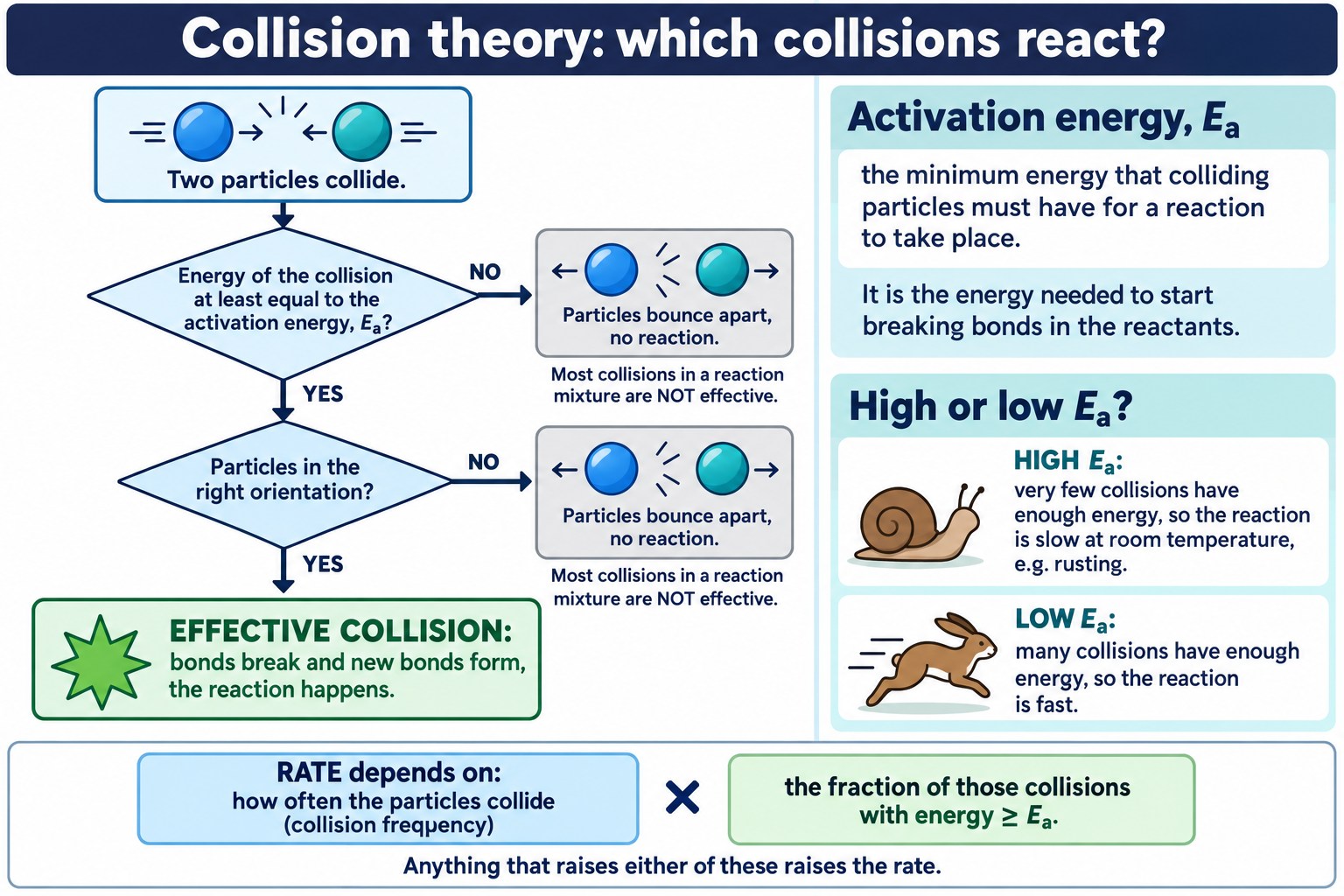
A collision is effective only when the particles have at least the activation energy and the right orientation, so the rate depends on the collision frequency and the fraction of collisions with enough energy.
Check: Effective Collisions
Decide which statements about collisions and activation energy are right for reactions you have not met on this page.
Concentration and Pressure
Increasing the concentration of a solution puts more particles into the same volume. The particles are closer together, so they collide more often.
The collision frequency rises, the frequency of effective collisions rises in proportion, and the rate increases.
The fraction of collisions with enough energy is unchanged, because the particles have the same energies as before; there are simply more collisions every second.
For gases, increasing the pressure has the same effect. Compressing a gas into a smaller volume, or pumping more gas into the same vessel, increases the number of molecules per unit volume, so they collide more frequently.
Doubling the concentration or pressure of a reactant doubles the number of particles per unit volume and doubles the frequency of collisions between them.
Exam wording: Say “more particles per unit volume, so more frequent (effective) collisions per second”. Do not say the collisions are “harder” or “more energetic”: concentration changes how often particles collide, not how much energy they have.
Surface Area and Temperature
A solid reacts only at its surface. Breaking a lump into powder increases its surface area, so more solid particles are exposed to the other reactant and collisions happen more often.
This is why powdered magnesium reacts much faster with acid than a ribbon of the same mass, and why flour dust can explode when a lump of flour would only smoulder.
Temperature is different from the other three factors because it changes both things at once.
Hotter particles move faster, so they collide slightly more often. Much more importantly, a larger fraction of the collisions now have energy above the activation energy.
A rise of 10 °C roughly doubles the rate of many reactions even though the collision frequency rises by only a few per cent. The Boltzmann distribution on the next page explains why.
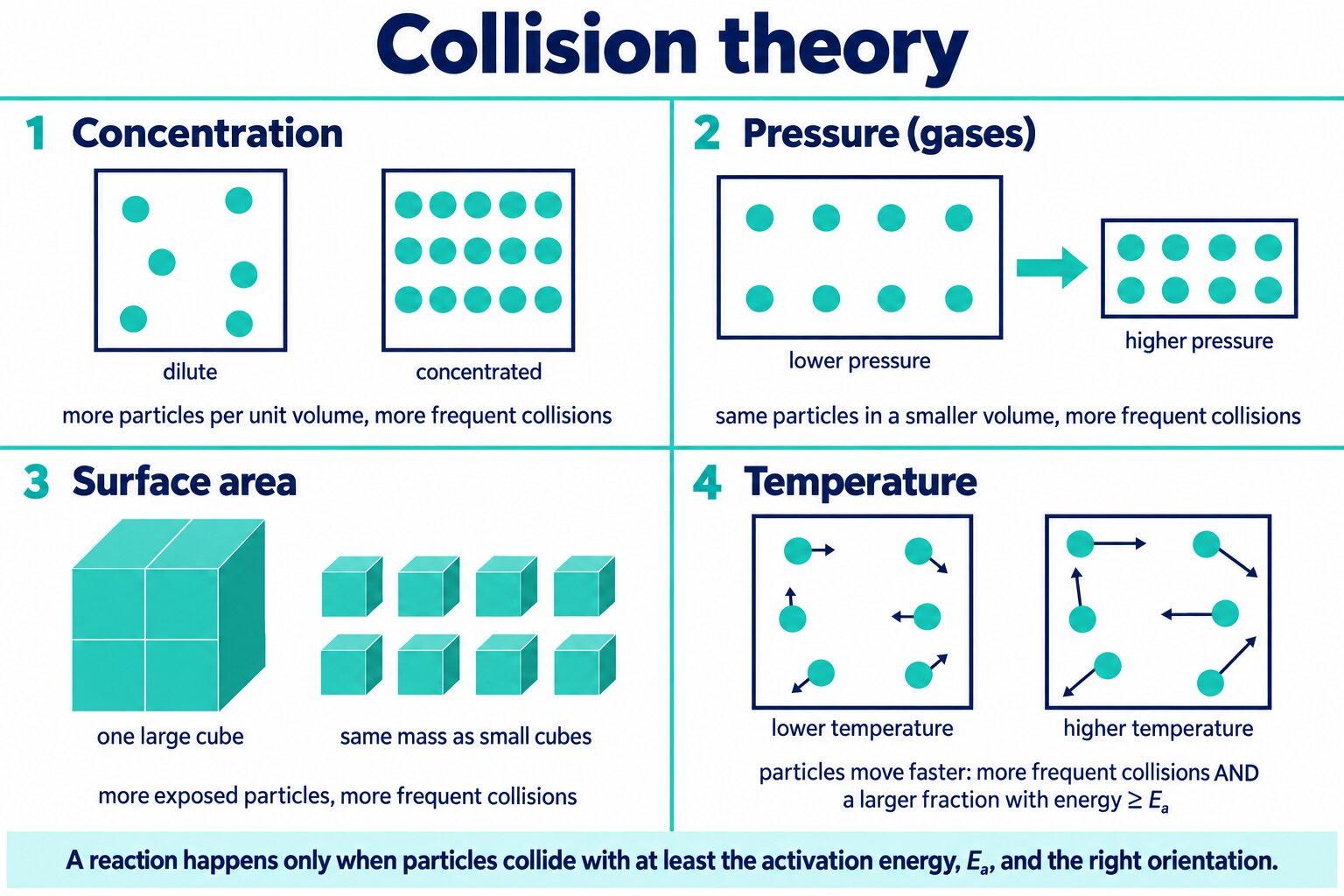
The four factors as particle pictures: concentration, pressure and surface area change how often particles collide; temperature also changes the fraction of collisions with energy above Eₐ.
Key idea: Concentration, pressure and surface area change the collision frequency. Temperature changes the collision frequency a little and the fraction of successful collisions a lot.
Check: Which Factor, Which Reason
Match each change in conditions to the correct reason for the change in rate.
Common Exam Points
Say
“Particles collide more frequently, so there are more effective collisions per second.” “A larger proportion of collisions have energy greater than or equal to the activation energy.”
Do not say
“The particles have more energy” when the change is in concentration or pressure. “Collisions are stronger.” “The activation energy is lowered by heating” (only a catalyst lowers Eₐ).
Watch for
Questions that ask for a comparison: a reaction at 40 °C is faster than at 20 °C because more collisions have E ≥ Eₐ, not because of the small rise in collision frequency.
Check: Explaining Rate Changes
Write and judge explanations for changes in rate in reactions not used above.
FAQs
Use these quick answers to check the collision theory ideas that come up most often.
Why do most collisions not lead to a reaction?
Most colliding particles do not have the activation energy between them, and some that do are not in the right orientation, so they bounce apart unchanged.
Does increasing concentration give the particles more energy?
No. It puts more particles into the same volume so they collide more often. The energy of each collision is unchanged; only the frequency rises.
Why does a small rise in temperature make such a big difference?
The collision frequency rises only slightly, but the fraction of collisions with energy above the activation energy rises a lot, because the high-energy tail of the energy distribution grows quickly with temperature.
Does pressure affect reactions in solution?
Not noticeably. Liquids are almost incompressible, so pressure does not change the concentration of dissolved particles. Pressure matters for gases.
Is a powdered solid more reactive than a lump?
It reacts faster, not because the substance is different but because far more of its particles are at a surface where collisions can happen.
Copyright and author footprint: This OLS revision page was written for Online Learning System by Dr. Mohammed Al-Fatah. It is designed for A Level Chemistry revision and should not be copied or redistributed without permission.
Keep this note — free
Save your progress across every Cambridge topic. A free account remembers which topics you have covered, saves your question scores, and syncs across your phone and laptop.
- Track every topic you have finished
- Keep your practice-question scores
- No payment, no card, free forever
Already registered? Log in