Oxidation of Alcohols
A concise revision guide to the oxidation of alcohols with acidified potassium dichromate(VI): primary alcohols to aldehydes by distillation and to carboxylic acids under reflux, secondary alcohols to ketones, why tertiary alcohols resist oxidation, equations with [O], and the tests for the products.
GCSE Recap: Oxidation
Three quick questions on oxidation as gain of oxygen, the colours of dichromate and manganate, and what an acid does to a carbonate.
The Oxidising Agent
The oxidising agent for alcohols is acidified potassium dichromate(VI): potassium dichromate(VI), K₂Cr₂O₇, dissolved in dilute sulfuric acid. As it oxidises the alcohol, the orange dichromate(VI) ion, Cr₂O₇²⁻, is reduced to the green chromium(III) ion, Cr³⁺, so the colour change from orange to green shows that oxidation has happened. In equations the oxidising agent is written as [O], one [O] for each oxygen gained or each pair of hydrogen atoms removed, and the equation is balanced with water.
Which product forms depends on two things: the class of the alcohol, and the conditions. Primary alcohols can be oxidised twice, secondary alcohols once, and tertiary alcohols not at all, and for a primary alcohol the choice between distilling and refluxing decides whether the aldehyde or the carboxylic acid is collected.
Definition: Oxidation of an alcohol removes the hydrogen from the O–H and a hydrogen from the carbon carrying the OH, forming a C=O bond. A tertiary alcohol has no hydrogen on that carbon, so it cannot be oxidised this way.
Primary Alcohols: Aldehyde, then Carboxylic Acid
A primary alcohol is first oxidised to an aldehyde, which is then oxidised to a carboxylic acid. To stop at the aldehyde, the alcohol is added to a limited amount of the warm oxidising agent and the aldehyde is distilled off as it forms. This works because the aldehyde has no OH group, so it cannot hydrogen bond and boils at a much lower temperature than the alcohol: propanal boils at 49 °C and propan-1-ol at 97 °C. Removing the aldehyde from the flask keeps it away from the oxidising agent.
To make the carboxylic acid, the alcohol is heated under reflux with an excess of the oxidising agent. Reflux keeps the aldehyde in the flask, in contact with the dichromate(VI), until it has been oxidised again. The acid is distilled off afterwards.
| Step | Equation with [O] | Conditions |
|---|---|---|
| Alcohol to aldehyde | CH₃CH₂CH₂OH + [O] → CH₃CH₂CHO + H₂O | limited acidified K₂Cr₂O₇, warm, distil the product as it forms |
| Aldehyde to acid | CH₃CH₂CHO + [O] → CH₃CH₂COOH | excess acidified K₂Cr₂O₇, heat under reflux |
| Alcohol straight to acid | CH₃CH₂CH₂OH + 2[O] → CH₃CH₂COOH + H₂O | excess acidified K₂Cr₂O₇, heat under reflux |
PAG 5 uses the same distillation and reflux techniques to prepare and purify the product.
Exam focus: Write CHO for an aldehyde, never COH, and COOH for the acid. Count the [O]: one for the aldehyde, two for the acid from the alcohol.
Check: Oxidising Primary Alcohols
Write products and conditions for primary alcohols other than propan-1-ol and ethanol.
Secondary and Tertiary Alcohols
A secondary alcohol is oxidised to a ketone when heated under reflux with acidified dichromate(VI): CH₃CH(OH)CH₃ + [O] → CH₃COCH₃ + H₂O. The ketone has no hydrogen on the carbonyl carbon, so it cannot be oxidised further under these conditions; there is no need to distil it off as it forms.
A tertiary alcohol is not oxidised by acidified dichromate(VI). The carbon carrying the OH has no hydrogen atom to lose, so a C=O bond cannot form without breaking a C–C bond, which dichromate(VI) cannot do. The mixture stays orange. This gives a simple test: warm the alcohol with acidified dichromate(VI); primary and secondary alcohols turn it green, a tertiary alcohol leaves it orange.
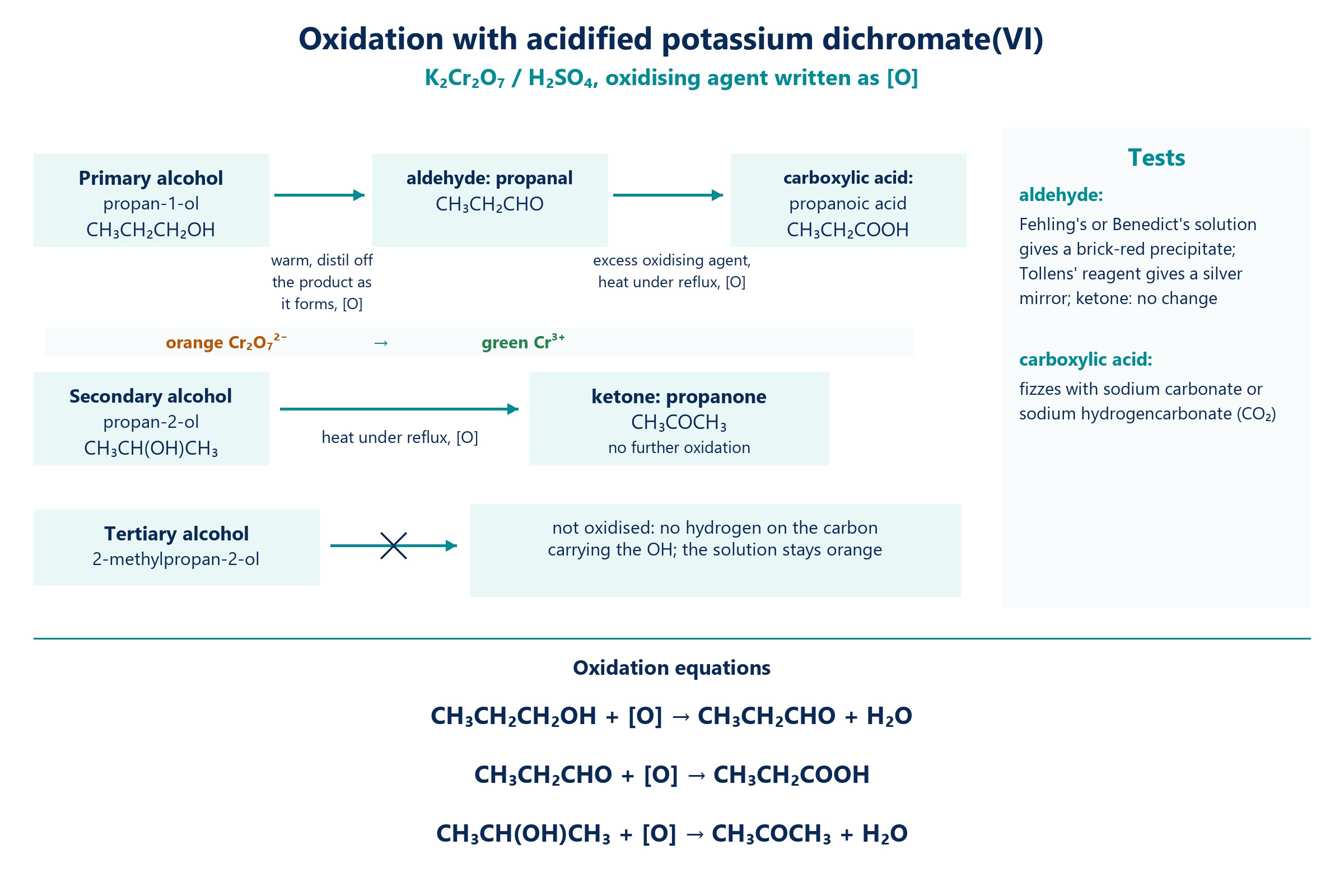
The oxidation flow chart: what each class of alcohol gives with acidified dichromate(VI), the conditions that select the aldehyde or the acid, and the tests for the products.
Key idea: Primary: aldehyde then carboxylic acid. Secondary: ketone. Tertiary: no reaction, the solution stays orange.
Check: Which Product?
Predict the oxidation product, or no reaction, for alcohols not shown on this page.
Testing the Products
Aldehydes and ketones both contain the C=O group, so the tests that tell them apart use the fact that an aldehyde can be oxidised further and a ketone cannot. With Fehling’s solution or Tollens’ reagent an aldehyde is oxidised to a carboxylic acid while the reagent is reduced: the blue copper(II) ions in Fehling’s solution give a brick-red precipitate of copper(I) oxide, Cu₂O, and the silver ions in Tollens’ reagent are reduced to a silver mirror on the glass. A ketone gives no change with either reagent.
A carboxylic acid is recognised by adding sodium carbonate or sodium hydrogencarbonate solution: the acid is strong enough to release carbon dioxide, which fizzes and turns limewater milky. 2CH₃COOH + Na₂CO₃ → 2CH₃COONa + H₂O + CO₂. Aldehydes, ketones and alcohols do not react with carbonates.
| Product | Test | Positive result |
|---|---|---|
| Aldehyde | Fehling’s solution, warm | blue solution to brick-red precipitate |
| Aldehyde | Tollens’ reagent, warm | silver mirror |
| Ketone | either reagent | no change |
| Carboxylic acid | sodium carbonate solution | fizzing, CO₂ turns limewater milky |
Exam wording: Give the reagent, the condition and the observation for the positive result AND say what the other compound does: “ketone: no change”.
Common Exam Points
Say
“Acidified potassium dichromate(VI), heat under reflux, orange to green.” “Distil off the aldehyde as it forms so it is not oxidised further.” “Tertiary alcohols are not oxidised because there is no hydrogen on the carbon bonded to the OH.”
Do not say
“Potassium dichromate” without “acidified”. “The aldehyde is distilled because it is more volatile” without saying why that stops further oxidation.
Watch for
Equations with [O] must balance: add H₂O on the right when the alcohol becomes a carbonyl compound, but not when the aldehyde becomes the acid.
Check: Tests and Equations
Choose tests and balance [O] equations for compounds not used above.
FAQs
Use these quick answers to check the oxidation of alcohols.
Why is the aldehyde distilled off as it forms?
The aldehyde boils at a much lower temperature than the alcohol because it cannot hydrogen bond, so it can be removed from the flask before the oxidising agent turns it into the carboxylic acid.
Why is reflux needed for the carboxylic acid?
Reflux keeps the aldehyde in contact with the excess oxidising agent long enough to be oxidised a second time, and stops the volatile aldehyde escaping.
Why can a ketone not be oxidised further?
Oxidation needs a hydrogen on the carbonyl carbon to be removed. A ketone has two carbon groups on that carbon and no hydrogen, so a C–C bond would have to break, which dichromate(VI) cannot do.
What does [O] stand for?
One oxygen atom supplied by the oxidising agent. It lets the equation be written without the full dichromate(VI) half-equation; balance it with water where needed.
How does Fehling’s solution tell an aldehyde from a ketone?
The aldehyde is oxidised by the reagent and reduces it, giving a visible change; a ketone cannot be oxidised so nothing happens.
Copyright and author footprint: This OLS revision page was written for Online Learning System by Dr. Mohammed Al-Fatah. It is designed for A Level Chemistry revision and should not be copied or redistributed without permission.
Keep this note — free
Save your progress across every OCR A topic. A free account remembers which topics you have covered, saves your question scores, and syncs across your phone and laptop.
- Track every topic you have finished
- Keep your practice-question scores
- No payment, no card, free forever
Already registered? Log in