Substitution and Elimination Reactions of Alcohols
A concise revision guide to the other reactions of alcohols: combustion, substitution of the OH group to make chloro-, bromo- and iodoalkanes (including the PCl₅ test), and elimination of water with concentrated phosphoric acid to make alkenes.
Combustion
Alcohols burn in air with a clean, almost invisible flame to give carbon dioxide and water: C₂H₅OH + 3O₂ → 2CO₂ + 3H₂O. The reaction is strongly exothermic, which is why ethanol is used as a fuel, in spirit burners and blended into petrol. Balancing the equation is a common two-mark question: balance the carbons, then the hydrogens, then count the oxygen on the right and remember that the alcohol already contains one oxygen atom.
Worked example: Butan-1-ol, C₄H₉OH: 4 C → 4CO₂; 10 H → 5H₂O; oxygen needed = 8 + 5 = 13, one is in the alcohol, so 12 from O₂ = 6O₂. C₄H₉OH + 6O₂ → 4CO₂ + 5H₂O.
Substitution: Making Haloalkanes
The OH group of an alcohol can be replaced by a halogen atom in a substitution reaction, which is the usual way of preparing a haloalkane in the laboratory. Three reagents are needed for the exam, one for each halogen.
With phosphorus(V) chloride, PCl₅, the reaction is immediate at room temperature: CH₃CH₂OH + PCl₅ → CH₃CH₂Cl + POCl₃ + HCl. The hydrogen chloride is given off as steamy white fumes that turn damp blue litmus red, so PCl₅ is also the qualitative test for an OH group: any compound with an O–H bond (alcohols, and also carboxylic acids and water) gives the fumes.
A bromoalkane is made by warming the alcohol with potassium bromide and 50% concentrated sulfuric acid. The acid and the bromide make hydrogen bromide in the flask, and the HBr substitutes the OH: CH₃CH₂OH + HBr → CH₃CH₂Br + H₂O. Concentrated sulfuric acid is diluted to 50% so that it does not oxidise the bromide ions to bromine.
An iodoalkane is made by heating the alcohol under reflux with red phosphorus and iodine. Phosphorus and iodine form phosphorus(III) iodide, which reacts with the alcohol: 3CH₃CH₂OH + PI₃ → 3CH₃CH₂I + H₃PO₃. Hydrogen iodide cannot be made from an iodide and concentrated sulfuric acid because the acid oxidises iodide ions to iodine.
| Halogen wanted | Reagent and conditions | Equation for ethanol |
|---|---|---|
| Chloroalkane | PCl₅, room temperature | C₂H₅OH + PCl₅ → C₂H₅Cl + POCl₃ + HCl |
| Bromoalkane | KBr and 50% concentrated H₂SO₄, warm | C₂H₅OH + HBr → C₂H₅Br + H₂O |
| Iodoalkane | red phosphorus and iodine, heat under reflux | 3C₂H₅OH + PI₃ → 3C₂H₅I + H₃PO₃ |
Exam focus: The PCl₅ test: “steamy (misty) white fumes of HCl”. That observation is the mark; “fizzing” or “bubbles” is not.
Check: Making Halogenoalkanes from Alcohols
Choose reagents and write equations for alcohols not used on this page.
Elimination: Dehydration to Alkenes
Heating an alcohol with concentrated phosphoric(V) acid (or concentrated sulfuric acid) removes a molecule of water and forms an alkene. This is an elimination reaction, also called dehydration: CH₃CH₂OH → CH₂=CH₂ + H₂O. The acid is a catalyst and a dehydrating agent. Phosphoric acid is preferred because concentrated sulfuric acid also oxidises the alcohol and produces sulfur dioxide and carbon.
The OH is removed together with a hydrogen atom from a neighbouring carbon, and the double bond forms between those two carbons. When the neighbouring carbons are different, more than one alkene can form: butan-2-ol gives but-1-ene (hydrogen removed from carbon 1) and but-2-ene (hydrogen removed from carbon 3), and but-2-ene itself exists as E and Z isomers, so three alkenes are possible from one alcohol.
The mechanism is not examined here; what is needed is the reagent, the conditions, the type of reaction and the products, including the isomers that can form.
Alkenes made this way are the monomers for addition polymers, so dehydrating alcohols from fermentation is a route to plastics that does not start from crude oil.
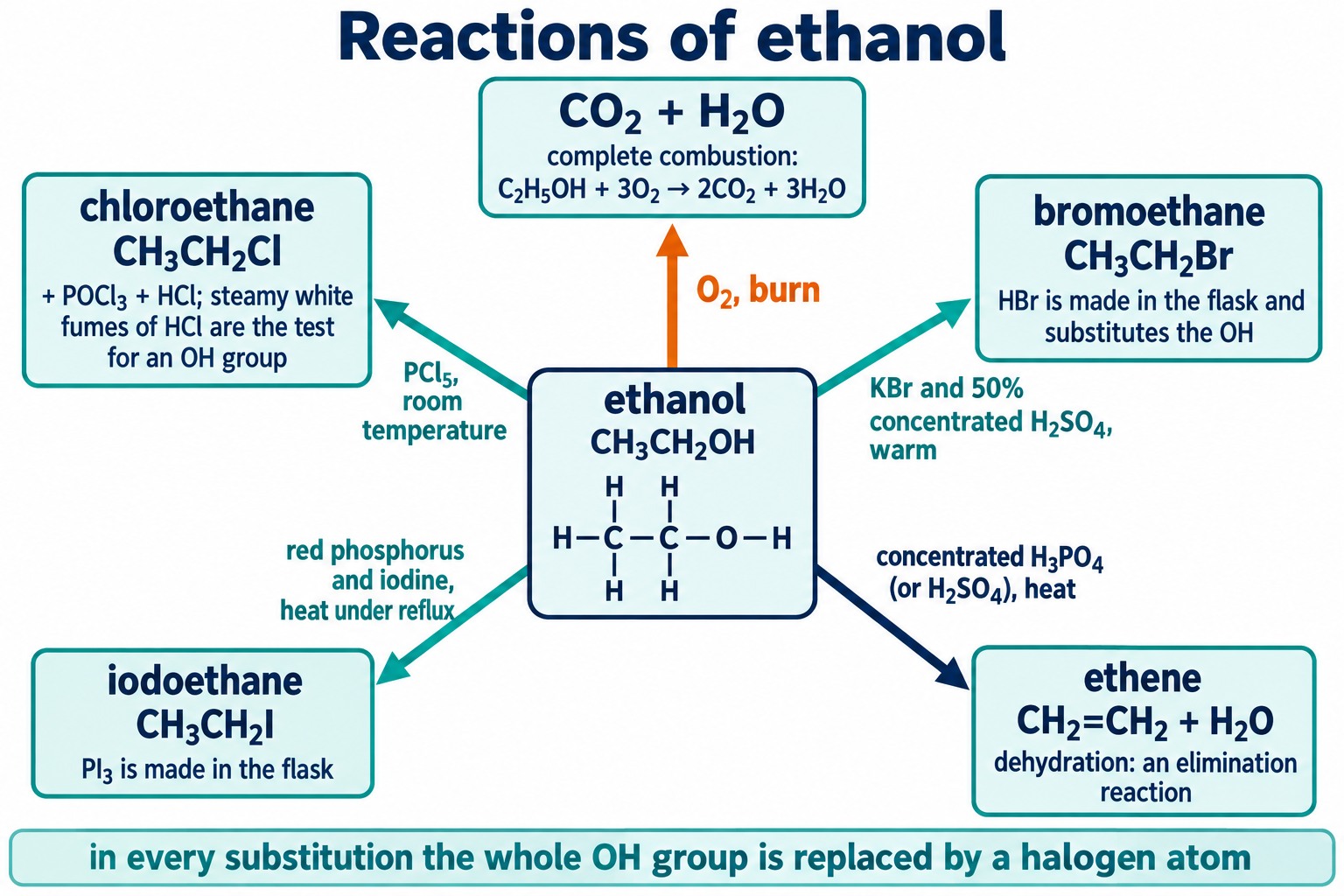
The reaction map of ethanol: combustion, the three substitutions that give a halogenoalkane, and the dehydration that gives ethene.
Exam wording: Elimination of water: “heat with concentrated phosphoric(V) acid; the H and OH are lost from adjacent carbons and a C=C bond forms”.
Check: Dehydration Products
Work out which alkenes form from alcohols other than butan-2-ol.
Common Exam Points
Say
“PCl₅ at room temperature gives steamy fumes of HCl: the test for an OH group.” “KBr with 50% sulfuric acid makes HBr in situ.” “Concentrated phosphoric acid, heat: elimination of water gives the alkene.”
Do not say
“HI is made from KI and concentrated sulfuric acid” (the acid oxidises iodide ions). “Addition of water” when you mean elimination.
Watch for
Questions on the number of alkenes: check both neighbouring carbons for hydrogens and remember E/Z isomers of the product.
Check: Reaction Types of Alcohols
Classify and complete reactions of alcohols not used above.
FAQs
Use these quick answers to check the other reactions of alcohols.
Why does PCl₅ act as a test for the OH group?
Any compound with an O–H bond reacts with PCl₅ to give hydrogen chloride, which appears as steamy white fumes. Compounds without O–H, such as ethers and ketones, give nothing.
Why is 50% sulfuric acid used with potassium bromide?
Concentrated acid would oxidise some of the bromide ions to bromine. Diluting it to 50% still generates HBr in the flask but limits the oxidation.
Why can iodoalkanes not be made with KI and sulfuric acid?
Iodide ions are strong enough reducing agents to be oxidised by sulfuric acid to iodine, so hydrogen iodide is not formed. Red phosphorus and iodine make PI₃ instead.
Why is phosphoric acid preferred to sulfuric acid for dehydration?
Concentrated sulfuric acid is also an oxidising agent and chars the alcohol, giving carbon and sulfur dioxide as by-products; phosphoric acid dehydrates cleanly.
How many alkenes can butan-2-ol give?
Three. Removing a hydrogen from carbon 1 gives but-1-ene; removing one from carbon 3 gives but-2-ene, which exists as E and Z isomers.
Copyright and author footprint: This OLS revision page was written for Online Learning System by Dr. Mohammed Al-Fatah. It is designed for A Level Chemistry revision and should not be copied or redistributed without permission.
Keep this note — free
Save your progress across every OCR A topic. A free account remembers which topics you have covered, saves your question scores, and syncs across your phone and laptop.
- Track every topic you have finished
- Keep your practice-question scores
- No payment, no card, free forever
Already registered? Log in