Preparing and Purifying Organic Liquids
A concise revision guide to the techniques used to prepare and purify a liquid organic product: heating under reflux, distillation, separation with a separating funnel, drying with an anhydrous salt, and boiling temperature determination.
Heating Under Reflux
Many organic reactions are slow at room temperature and need heating for a long time, but the reactants and products are volatile and flammable. Heating under reflux solves both problems: the mixture is heated in a round-bottomed flask with a Liebig condenser fitted vertically on top, so that any vapour condenses and runs back into the flask. Nothing is lost and the temperature stays at the boiling temperature of the mixture. The top of the condenser must be open, because sealing it would let pressure build up and the apparatus could burst.
Anti-bumping granules are added before heating to make the liquid boil smoothly with small bubbles instead of sudden violent bursts. A heating mantle or a water bath is used rather than a naked flame, because organic liquids are flammable. Water enters the condenser at the bottom and leaves at the top so that the outer jacket is always full.
Exam focus: Reflux is used to heat a reaction mixture for a long time without losing volatile substances. Give that reason in full, not just “to stop it evaporating”.
Distillation
Distillation separates a liquid from a mixture by boiling it off and condensing the vapour. The flask is fitted with a still head carrying a thermometer, the condenser slopes downwards to a receiving flask, and the fraction that boils at the product’s boiling temperature is collected. The thermometer bulb must sit level with the side arm so that it measures the temperature of the vapour that is leaving, not the liquid.
Distillation is used in two ways in organic preparations. During the oxidation of a primary alcohol the aldehyde is distilled off as it forms, so that it leaves the oxidising agent before it can be oxidised again. After a reaction is complete, distillation removes the product from the rest of the mixture, and a pure liquid distils over at a constant temperature.
Key idea: Reflux keeps everything in the flask; distillation takes the most volatile liquid out. The apparatus differs only in whether the condenser stands upright or slopes to a receiver.
Check: Reflux or Distil?
Choose the technique for preparations that are not described on this page.
Separating, Washing and Drying
The crude product from a distillation is often a mixture of an organic layer and an aqueous layer. They are separated in a separating funnel: the two immiscible liquids settle into layers, the stopper is removed, and the tap is opened to run off the lower layer. Which layer is which depends on density; most haloalkanes are denser than water and form the lower layer, while most alcohols and esters float on top. The organic layer is washed by shaking it with sodium hydrogencarbonate solution to remove acidic impurities (the funnel is inverted and the tap opened to release the carbon dioxide) and then with water.
The wet organic liquid is dried by adding a small amount of an anhydrous salt such as anhydrous magnesium sulfate or anhydrous calcium chloride and swirling. The salt absorbs the water; when the liquid is dry it changes from cloudy to clear and the drying agent runs freely. The liquid is decanted or filtered from the solid.
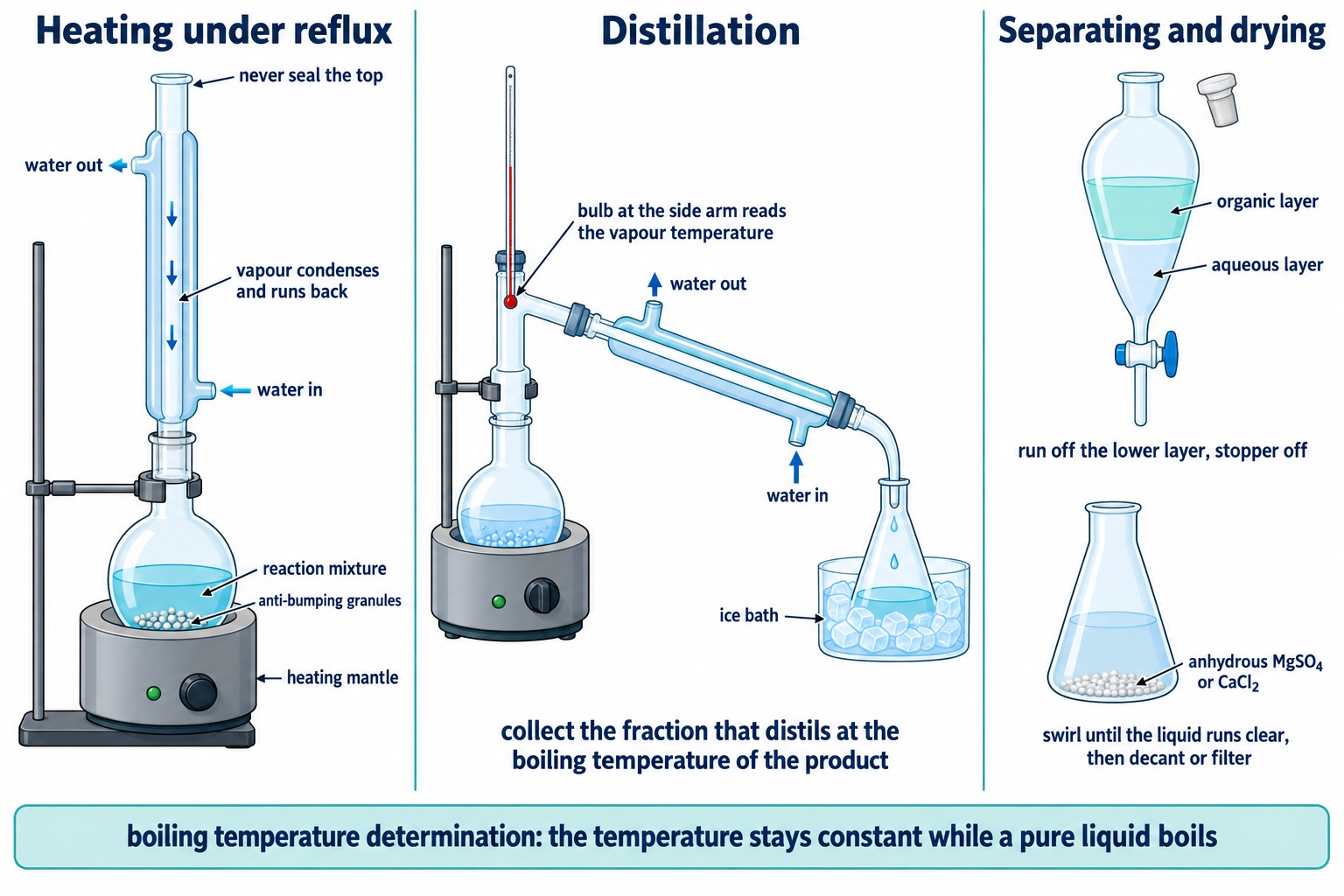
Reflux and distillation apparatus, with a separating funnel and a drying flask: the labels examiners expect on each.
Exam wording: “Add anhydrous magnesium sulfate until the liquid is clear, then decant.” The word anhydrous is the mark.
Check: Purifying the Product
Put purification steps in order and explain them for a product not used above.
Checking Purity: Boiling Temperature
A pure liquid boils at a constant, characteristic temperature at a given pressure, so measuring the boiling temperature checks both the identity and the purity of the product. The purified liquid is distilled again and the temperature at which it distils is compared with the data-book value. An impure liquid boils over a range of temperatures. For small volumes the boiling temperature can be found by heating a little of the liquid in a small tube with an inverted capillary and noting the temperature at which the bubbles stop and liquid is drawn back into the capillary as it cools.
The percentage yield compares the mass obtained with the maximum possible from the equation, and is always below 100% because of the reversible or side reactions, transfers between vessels, washing and distillation losses, and the product left on the drying agent.
Worked example: 5.0 g of propan-1-ol (Mr 60) is oxidised to propanoic acid (Mr 74) and 3.7 g is collected. Moles of alcohol = 5.0 ÷ 60 = 0.0833; maximum acid = 0.0833 × 74 = 6.17 g; percentage yield = 3.7 ÷ 6.17 × 100 = 60%.
Common Exam Points
Say
“Heat under reflux so that volatile reactants condense and return to the flask.” “Thermometer bulb level with the side arm.” “Anhydrous magnesium sulfate to dry.”
Do not say
“Reflux to speed up the reaction” (heating does that; reflux stops losses). “Filter to separate the layers” (use a separating funnel).
Watch for
Diagrams: the condenser must have a closed outer jacket with water in at the bottom, an open top in reflux, and no gap between flask and condenser.
Check: Apparatus and Yield
Spot errors in apparatus and calculate yields for preparations not shown above.
FAQs
Use these quick answers to check the practical techniques.
What is the difference between reflux and distillation?
In reflux the condenser is vertical and the vapour returns to the flask, so a mixture can be heated for a long time without loss. In distillation the condenser slopes to a receiver, so the most volatile liquid is removed.
Where should the thermometer bulb be in a distillation?
Level with the side arm of the still head, so that it measures the temperature of the vapour that is passing into the condenser.
Why must the top of a reflux condenser be open?
Heating a sealed apparatus builds up pressure until it bursts. The open top lets the pressure escape while the condenser returns the vapour.
Which layer is the organic layer in a separating funnel?
It depends on density. Bromoalkanes and iodoalkanes are denser than water and sink; most alcohols and esters are less dense and float. Check by adding a little water and seeing which layer grows.
What does the drying agent do?
Anhydrous magnesium sulfate or calcium chloride absorbs the dissolved water, turning the cloudy liquid clear. It is then removed by decanting or filtering.
Copyright and author footprint: This OLS revision page was written for Online Learning System by Dr. Mohammed Al-Fatah. It is designed for A Level Chemistry revision and should not be copied or redistributed without permission.
Keep this note — free
Save your progress across every OCR A topic. A free account remembers which topics you have covered, saves your question scores, and syncs across your phone and laptop.
- Track every topic you have finished
- Keep your practice-question scores
- No payment, no card, free forever
Already registered? Log in