CFCs and the Ozone Layer
A concise revision guide to ozone and CFCs: why ozone in the upper atmosphere is beneficial, how UV radiation breaks C–Cl bonds to form chlorine radicals, the radical equations for the catalysed decomposition of ozone, and the evidence, legislation and chlorine-free alternatives.
Ozone in the Upper Atmosphere
Ozone, O₃, forms a layer in the upper atmosphere where it absorbs much of the ultraviolet radiation arriving from the Sun. That absorption protects living things from the skin cancers, eye damage and crop damage that high-energy UV causes, so the ozone layer is beneficial. Ozone near the ground is different: there it is a pollutant formed in photochemical smog.
Chlorofluorocarbons, CFCs such as CF₂Cl₂ and CFCl₃, were used as refrigerants, aerosol propellants, solvents and foam-blowing agents because they are unreactive, non-flammable and non-toxic. That same unreactivity lets them survive long enough to drift up into the stratosphere.
Key idea: Ozone high up is protective because it absorbs UV; CFCs reach it because they are too stable to be broken down lower in the atmosphere.
Chlorine Radicals Destroy Ozone
In the upper atmosphere ultraviolet radiation has enough energy to break the C–Cl bond in a CFC homolytically, forming a chlorine radical: CF₂Cl₂ → CF₂Cl• + Cl•. The C–F bond is stronger and is not broken. The chlorine radical then destroys ozone in two propagation steps: Cl• + O₃ → ClO• + O₂ and ClO• + O₃ → 2O₂ + Cl•. Adding the two steps and cancelling the radicals gives the overall reaction 2O₃ → 3O₂. The chlorine radical is regenerated, so it acts as a catalyst, providing a route with a lower activation energy, and one radical can destroy many thousands of ozone molecules before it is removed.
Other radicals do the same. Nitrogen monoxide from aircraft exhausts catalyses ozone breakdown by NO• + O₃ → NO₂• + O₂ and NO₂• + O → NO• + O₂, with the same overall result.
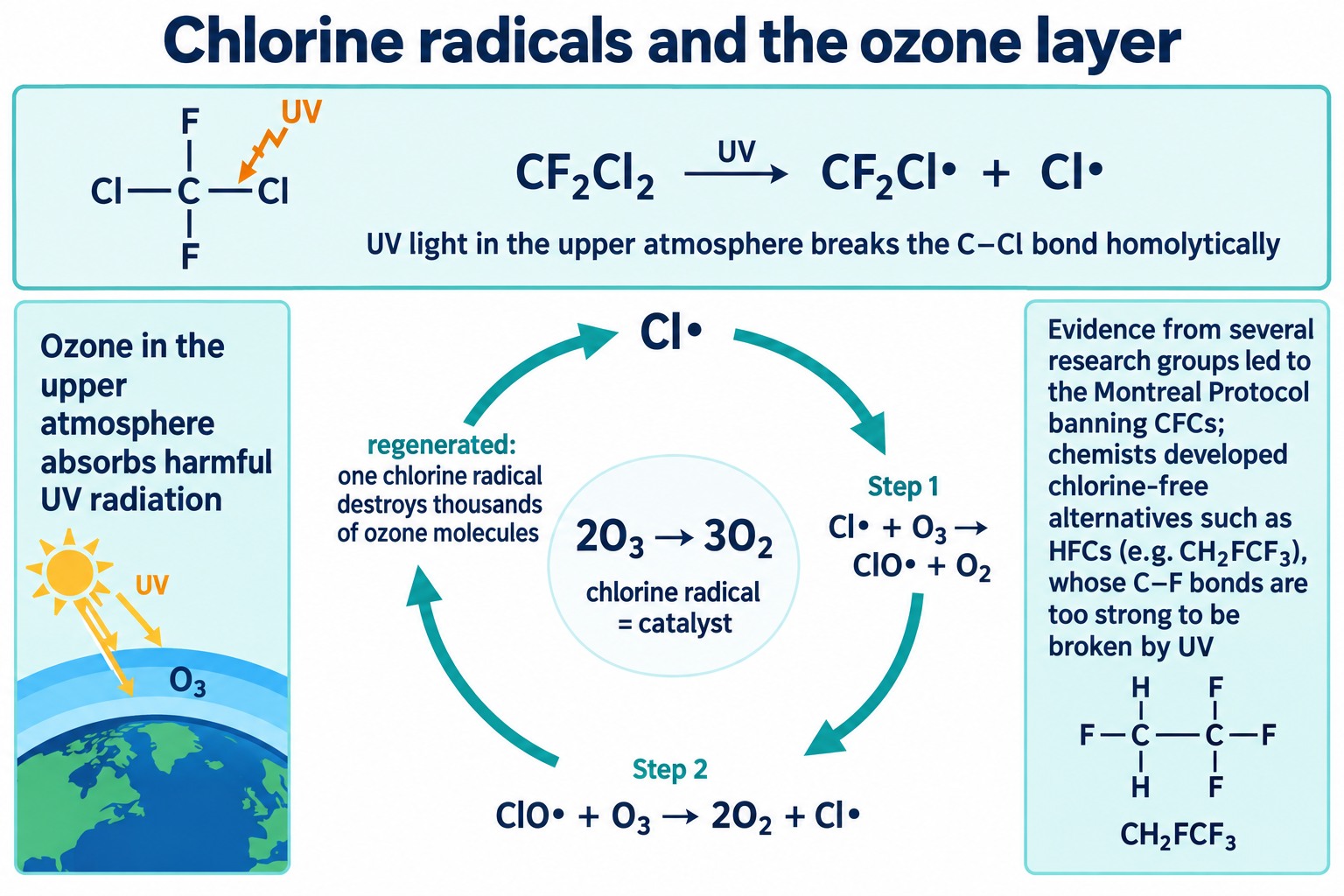
UV breaks a C–Cl bond in a CFC; the chlorine radical then cycles through two steps that turn ozone into oxygen and is regenerated.
Exam focus: Both propagation equations, the overall equation 2O₃ → 3O₂, and the word “catalyst” with the reason: the chlorine radical is regenerated.
Check: The Ozone Cycle
Write and use the radical equations for a scenario not given above.
Evidence, Legislation and Alternatives
Scientific evidence from different research groups, gathered by satellite and by balloon measurements, showed that CFCs were responsible for the fall in ozone. The evidence led to legislation, the Montreal Protocol of 1987, which banned the manufacture and use of CFCs. Chemists then developed chlorine-free alternatives: hydrofluorocarbons (HFCs) such as CH₂FCF₃ are now used in refrigerators and air conditioning. They contain no C–Cl bond, and the C–F bond is too strong to be broken by UV, so they do not produce ozone-destroying radicals. Hydrocarbons such as butane are used as propellants.
The ozone layer is recovering slowly, because CFCs already released stay in the atmosphere for decades. The story is used in exams as an example of how scientific evidence, gathered and checked by different groups, leads to legislation and to new chemistry.
Exam wording: “Chlorine-free alternatives such as HFCs contain C–F bonds that are not broken by UV radiation, so no chlorine radicals form.”
Common Exam Points
Say
“UV breaks the C–Cl bond homolytically to form a chlorine radical.” “Cl• is regenerated so it is a catalyst.” “2O₃ → 3O₂ overall.”
Do not say
“Ozone causes global warming” (that is carbon dioxide and infrared). “The C–F bond breaks.”
Watch for
Radicals must be written with the dot: Cl• and ClO•, not Cl and ClO.
Check: Evidence and Alternatives
Evaluate replacement compounds that are not the examples used above.
FAQs
Use these quick answers to check the ozone chemistry.
Why is ozone good high up but bad near the ground?
In the upper atmosphere it absorbs harmful UV radiation. Near the ground it is a pollutant formed in photochemical smog that damages lungs and plants.
Why does UV break the C–Cl bond and not the C–F bond?
The C–F bond is much stronger (about 467 kJ mol⁻¹ against 346 for C–Cl), so UV photons do not have enough energy to break it.
Why is the chlorine radical called a catalyst?
It is regenerated at the end of the two-step cycle, so it is not used up and one radical can destroy thousands of ozone molecules while providing a lower-energy route for 2O₃ → 3O₂.
How do the two equations give the overall equation?
Add them: Cl• + O₃ + ClO• + O₃ → ClO• + O₂ + 2O₂ + Cl•. The Cl• and ClO• cancel, leaving 2O₃ → 3O₂.
Why are HFCs safe for the ozone layer?
They contain no C–Cl bonds, and their C–F bonds are too strong to be broken by UV, so no radicals that destroy ozone are formed.
Copyright and author footprint: This OLS revision page was written for Online Learning System by Dr. Mohammed Al-Fatah. It is designed for A Level Chemistry revision and should not be copied or redistributed without permission.
Keep this note — free
Save your progress across every OCR A topic. A free account remembers which topics you have covered, saves your question scores, and syncs across your phone and laptop.
- Track every topic you have finished
- Keep your practice-question scores
- No payment, no card, free forever
Already registered? Log in