Reaction Types, Mechanisms and Nucleophiles
A concise revision guide to classifying organic reactions as addition, elimination, substitution, oxidation, reduction, hydrolysis or polymerisation, what a mechanism and a curly arrow show, heterolytic bond breaking, electrophiles and nucleophiles, and how bond polarity decides the mechanism.
GCSE Recap: Organic Reactions
Three quick questions on what you already know: addition across a double bond, what a catalyst does, and what happens when a polymer forms.
Classifying Organic Reactions
Organic reactions are sorted into a small number of reaction types according to what happens to the molecule. In an addition reaction two molecules join to form one, and a double bond is used up: ethene and bromine give 1,2-dibromoethane. In an elimination reaction a small molecule is removed and a double bond forms. In a substitution reaction one atom or group is replaced by another, and the number of groups on the carbon stays the same.
Oxidation is the gain of oxygen or the loss of hydrogen, written with [O]; reduction is the reverse, written with [H]. Hydrolysis is the splitting of a molecule by reaction with water, or with hydroxide ions, so the hydrolysis of a haloalkane is also a substitution. Polymerisation joins many small molecules into a long chain. A reaction can belong to two classes at once: elimination and substitution describe what happens to the organic molecule, while nucleophilic or electrophilic describes how.
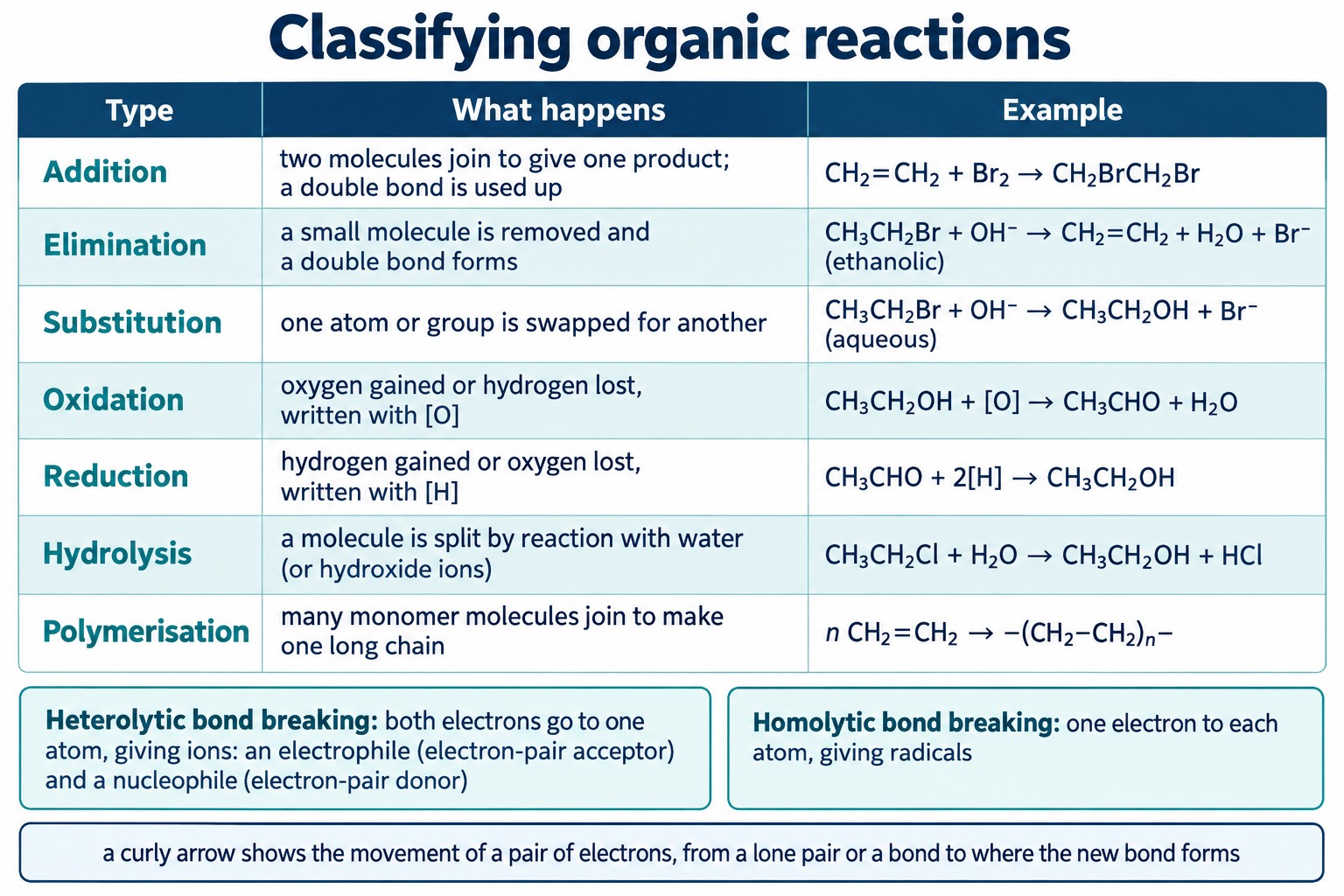
The seven reaction types with a definition and an example equation for each, and the two ways a covalent bond can break.
Key idea: Ask two questions: has the number of molecules changed (addition or elimination) and has a group been swapped (substitution)? Then check whether oxygen or hydrogen has been gained or lost.
Check: Naming the Reaction Type
Classify reactions that are not the examples on this page.
What a Mechanism Is
A reaction mechanism is a description of the steps by which the reactants become the products, showing which bonds break, which bonds form, and in what order. An overall equation says only what goes in and what comes out; the mechanism explains why the conditions matter, why some compounds react faster than others, and why the products are what they are.
Mechanisms are drawn with curly arrows. A full curly arrow shows the movement of a pair of electrons. It always starts from where the electrons are, a lone pair or the middle of a bond, and ends where they go, a new bond or an atom that becomes negatively charged. The arrows are the answer; a mechanism with the right products but the arrows starting from the wrong place scores no marks.
Definition: A curly arrow starts at a lone pair or a covalent bond and ends where a new bond forms or where the electrons come to rest as a charge.
Heterolytic Bond Breaking: Electrophiles and Nucleophiles
A covalent bond can break in two ways. In homolytic fission each atom keeps one electron and two radicals form; this is what happens to chlorine in ultraviolet light in the reactions of alkanes. In heterolytic fission both electrons of the bond go to one atom, so a positive ion and a negative ion form. Heterolytic fission produces the two kinds of reactive species that drive most organic mechanisms.
An electrophile is an electron-pair acceptor: a species with a positive charge or a δ+ atom that is attacked by electron-rich centres. A nucleophile is an electron-pair donor: a species with a lone pair of electrons, and often a negative charge, that attacks an electron-deficient, δ+ atom. Hydroxide ions, cyanide ions, water and ammonia are all nucleophiles because each has a lone pair to donate.
| Species | Lone pair on | Charge | Role |
|---|---|---|---|
| OH⁻ | oxygen | negative | nucleophile |
| CN⁻ | carbon | negative | nucleophile |
| H₂O | oxygen | neutral, δ− | nucleophile (weak) |
| NH₃ | nitrogen | neutral | nucleophile |
| H⁺, Br⁺ (δ+ end of Br₂) | none | positive | electrophile |
Exam wording: Nucleophile: “an electron-pair donor” or “a species with a lone pair that attacks a δ+ carbon”. Both are accepted; “negative ion” is not, because water and ammonia are nucleophiles without a charge.
Check: Electrophile or Nucleophile?
Sort species that are not in the table above.
Bond Polarity Decides the Mechanism
The type of mechanism a compound undergoes follows from the polarity of its bonds. An alkene has a non-polar C=C bond whose π electrons are exposed and electron-rich, so it is attacked by electrophiles: alkenes undergo electrophilic addition. A haloalkane has a polar C–X bond, because the halogen is more electronegative than carbon, so the carbon is δ+ and electron-deficient: haloalkanes are attacked by nucleophiles and undergo nucleophilic substitution. An alkane has only non-polar C–C and C–H bonds, so neither electrophiles nor nucleophiles attack it, and its only reactions are radical reactions started by ultraviolet light.
This is the link the specification wants: look at the bond, decide which end is electron-rich and which is electron-poor, and that tells you which kind of species attacks and where.
Key idea: Electron-rich C=C attracts electrophiles; electron-poor δ+ carbon in C–X attracts nucleophiles; non-polar C–H and C–C only react with radicals.
Common Exam Points
Say
“Substitution: the Br is replaced by OH.” “Heterolytic fission: both electrons go to the more electronegative atom.” “Nucleophile: electron-pair donor with a lone pair.”
Do not say
“Hydrolysis is a reaction with acid.” “A nucleophile is attracted to the nucleus.” “The arrow shows where the atom moves” (it shows electrons).
Watch for
Reaction types are asked with the reagent: “ethanolic KOH gives an elimination; aqueous KOH gives a substitution”.
Check: Predicting the Mechanism Type
Link bond polarity to mechanism for molecules not discussed above.
FAQs
Use these quick answers to check the reaction-type and mechanism vocabulary.
Can a reaction be both substitution and hydrolysis?
Yes. When a haloalkane reacts with water or hydroxide ions the halogen is swapped for OH (substitution) and the molecule is split by water (hydrolysis). Both names are correct.
What is the difference between a nucleophile and a base?
Both donate a lone pair. A nucleophile donates it to a δ+ carbon and forms a bond to carbon; a base donates it to a hydrogen and removes a proton. The hydroxide ion can do either, depending on the solvent.
Where does a curly arrow start?
At the electrons that are moving: a lone pair or the middle of a covalent bond. It ends where a new bond forms or where the electrons come to rest as a negative charge.
Why are alkanes attacked by neither electrophiles nor nucleophiles?
Their C–C and C–H bonds are almost non-polar, so there is no electron-rich or electron-poor site to attack. Only radicals, formed by UV light, react with them.
What is the difference between homolytic and heterolytic fission?
Homolytic fission gives one electron to each atom, forming two radicals. Heterolytic fission gives both electrons to one atom, forming a positive and a negative ion.
Copyright and author footprint: This OLS revision page was written for Online Learning System by Dr. Mohammed Al-Fatah. It is designed for A Level Chemistry revision and should not be copied or redistributed without permission.
Keep this note — free
Save your progress across every OCR A topic. A free account remembers which topics you have covered, saves your question scores, and syncs across your phone and laptop.
- Track every topic you have finished
- Keep your practice-question scores
- No payment, no card, free forever
Already registered? Log in