Alcohols: Naming, Classification and Properties
A concise revision guide to the alcohol functional group: naming alcohols and drawing their structural, displayed and skeletal formulae, classifying them as primary, secondary or tertiary, and explaining their boiling temperatures and solubility through hydrogen bonding.
GCSE Recap: Alcohols
Three quick questions on the alcohols you met at GCSE: the functional group, the first four members and what ethanol is used for.
The Alcohol Functional Group
An alcohol is an organic compound in which a hydroxyl group, –OH, is bonded to a saturated carbon atom. The homologous series of straight-chain alcohols has the general formula CₙH₂ₙ₊₁OH, so ethanol is C₂H₅OH and butan-1-ol is C₄H₉OH. The –OH group is polar because oxygen is much more electronegative than hydrogen or carbon, and it is this group that gives alcohols their reactions and their physical properties.
Three ways of writing an alcohol are needed in the exam. The structural formula shows the groups in order, CH₃CH₂CH₂OH; the displayed formula shows every atom and every bond, including the O–H bond; the skeletal formula shows the carbon chain as a zigzag with the OH written at the end of the correct line. Students lose marks by leaving the hydrogen off the oxygen in a displayed formula and by drawing the OH as a single blob attached to the wrong carbon.
Definition: An alcohol contains the –OH (hydroxyl) group bonded to a carbon atom that is not part of a C=O group. Compounds with the OH on a benzene ring are phenols and behave differently.
Naming Alcohols
The name of an alcohol is the name of the parent alkane with the final -e replaced by -ol, and a number showing the carbon that carries the OH group. The chain is numbered from the end that gives the OH the lowest number: CH₃CH(OH)CH₂CH₃ is butan-2-ol, not butan-3-ol. Methanol and ethanol need no number because the OH can only be on one carbon. Propan-1-ol and propan-2-ol are different compounds with different boiling temperatures and different reactions.
Two or more OH groups are shown with di- or tri- and the -e of the alkane is kept: ethane-1,2-diol, HOCH₂CH₂OH, is antifreeze, and propane-1,2,3-triol is glycerol. When the molecule also contains a group that takes priority in the name, such as a carboxylic acid, the OH is named as a prefix, hydroxy-: 2-hydroxypropanoic acid is lactic acid. Side chains are named as in alkanes, so (CH₃)₂CHCH₂OH is 2-methylpropan-1-ol.
| Compound | Structural formula | Name |
|---|---|---|
| Two carbons | CH₃CH₂OH | ethanol |
| Three carbons, OH on carbon 2 | CH₃CH(OH)CH₃ | propan-2-ol |
| Four carbons, OH on carbon 1 | CH₃CH₂CH₂CH₂OH | butan-1-ol |
| Branched, four carbons | (CH₃)₃COH | 2-methylpropan-2-ol |
| Two OH groups | HOCH₂CH₂OH | ethane-1,2-diol |
Exam focus: Write the number between the stem and -ol with hyphens on both sides: butan-2-ol. Never write 2-butanol or butanol-2.
Check: Naming Alcohols
Name and draw alcohols that are not the ones used on this page.
Primary, Secondary and Tertiary Alcohols
Alcohols are classified by the number of carbon atoms bonded to the carbon that carries the OH group. In a primary alcohol that carbon is attached to one other carbon (or none, in methanol): propan-1-ol, CH₃CH₂CH₂OH. In a secondary alcohol it is attached to two carbons: propan-2-ol, CH₃CH(OH)CH₃. In a tertiary alcohol it is attached to three carbons: 2-methylpropan-2-ol, (CH₃)₃COH. The classification does not depend on the length of the chain, only on what is joined to the C–OH carbon.
The classification matters because the three classes react differently with oxidising agents: primary alcohols can be oxidised to aldehydes and then carboxylic acids, secondary alcohols to ketones, and tertiary alcohols not at all under the same conditions. Questions often give a skeletal formula and ask for the class; find the carbon carrying the OH, count the carbon atoms bonded to it, and ignore the hydrogens.
A molecule with more than one OH group is classified one group at a time. In butane-1,3-diol, CH₃CH(OH)CH₂CH₂OH, the OH on carbon 1 is primary and the OH on carbon 3 is secondary, so mild oxidation would give a compound with both an aldehyde and a ketone group.
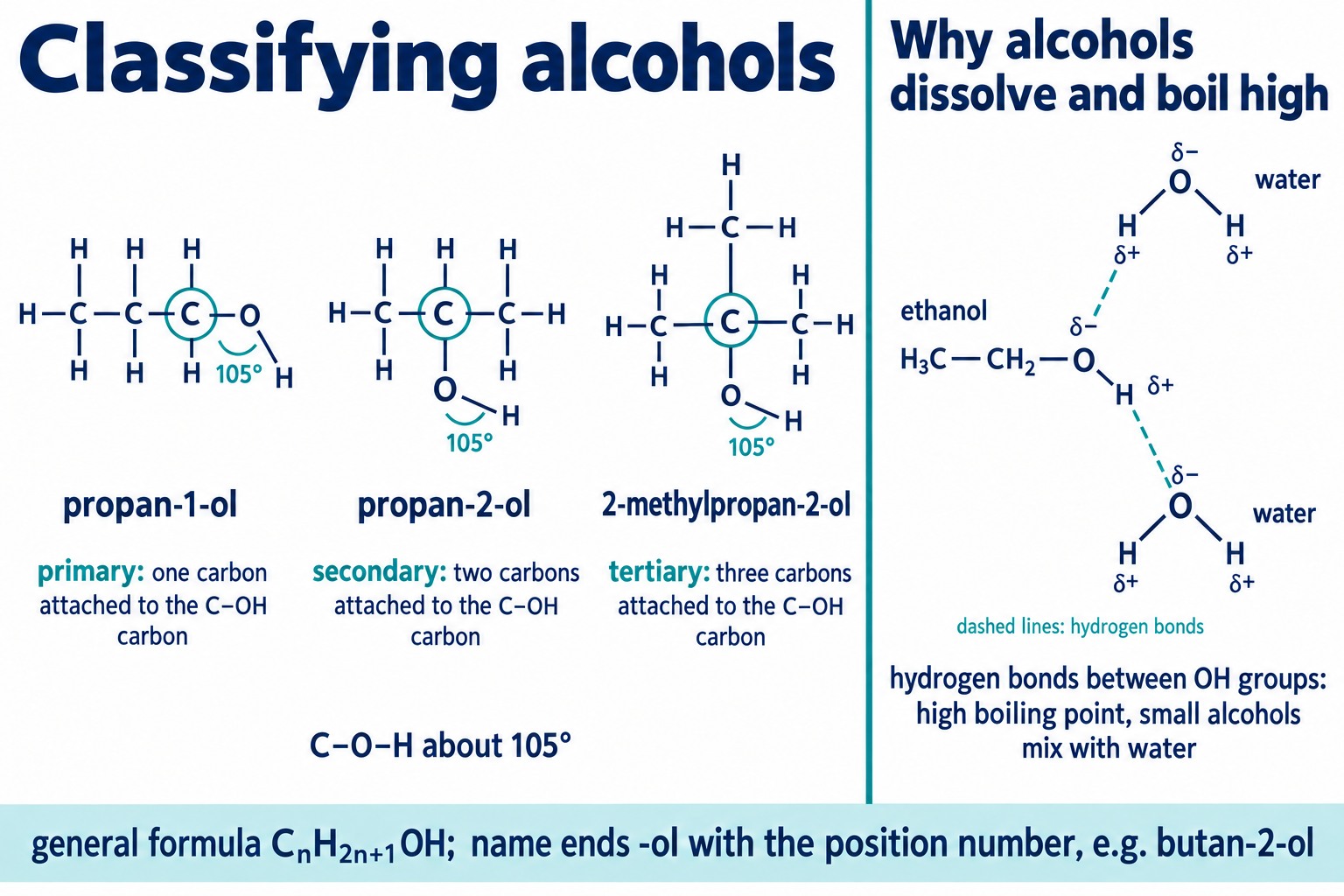
Primary, secondary and tertiary alcohols with the C–OH carbon highlighted, and the hydrogen bonds between ethanol and water that explain why small alcohols dissolve.
Key idea: Count the carbons bonded to the carbon that carries the OH: one gives a primary alcohol, two a secondary, three a tertiary.
Check: Classifying Alcohols
Decide the class of alcohols you have not met above.
Physical Properties: Hydrogen Bonding
The O–H bond in an alcohol is polar, and the oxygen carries two lone pairs, so alcohol molecules form hydrogen bonds with each other. Hydrogen bonds are the strongest intermolecular force, which is why ethanol (Mr 46) boils at 78 °C while propane (Mr 44), which has only London forces between its molecules, boils at −42 °C. Alcohols therefore have low volatility and relatively high boiling temperatures for their size. Boiling temperature rises along the series as the London forces between the longer chains grow.
Alcohols also form hydrogen bonds to water, so methanol, ethanol and propanol mix with water in all proportions. As the hydrocarbon chain grows the non-polar part of the molecule dominates: butan-1-ol is only partly soluble and hexan-1-ol hardly dissolves at all, because the energy released by hydrogen bonding to water no longer makes up for the water–water hydrogen bonds that must be broken.
The bond angles follow the electron-pair repulsion rules. The carbon carrying the OH is tetrahedral, with bond angles of about 109.5°, while the C–O–H angle is about 105° because the two lone pairs on the oxygen repel more strongly than the bonding pairs.
Exam wording: “Alcohols form hydrogen bonds between molecules, which are stronger than the London forces between alkane molecules, so more energy is needed to separate them.” Name the force, compare it and link it to energy.
Common Exam Points
Say
“The OH is on carbon 2, which is bonded to two other carbons, so the alcohol is secondary.” “Hydrogen bonds form between the OH groups of neighbouring molecules.”
Do not say
“Tertiary because it has three carbons.” “Ethanol has a high boiling point because the O–H bond is strong” (it is the force between molecules, not the covalent bond, that matters).
Watch for
Displayed formulae: show the O–H bond, not “OH” as a group. Skeletal formulae: the OH sits at the end of a line and the carbon there is not drawn.
Check: Properties of Alcohols
Explain boiling temperatures and solubility for alcohols not discussed above.
FAQs
Use these quick answers to check the naming and classification of alcohols.
Is methanol a primary alcohol?
Yes. The carbon carrying the OH is bonded to no other carbon, and by convention that counts as primary; it is oxidised like a primary alcohol, to methanal and then methanoic acid.
Why is propan-2-ol not called propan-3-ol?
The chain is numbered from the end that gives the OH the lowest number. Counting from the other end would put it on carbon 2 as well, so 2 is the lowest possible.
Why does ethanol boil so much higher than propane?
Ethanol molecules form hydrogen bonds between their OH groups, the strongest intermolecular force. Propane has only London forces, so far less energy is needed to separate its molecules.
Why do long-chain alcohols not dissolve in water?
The OH group still hydrogen bonds to water, but the long non-polar chain cannot, and the water–water hydrogen bonds that would have to be broken to fit it in are not repaid.
Do I need to draw the H on the oxygen in a displayed formula?
Yes. A displayed formula shows every atom and every bond, so the O–H bond must be drawn. Leaving it off loses the mark.
Copyright and author footprint: This OLS revision page was written for Online Learning System by Dr. Mohammed Al-Fatah. It is designed for A Level Chemistry revision and should not be copied or redistributed without permission.
Keep this note — free
Save your progress across every Cambridge topic. A free account remembers which topics you have covered, saves your question scores, and syncs across your phone and laptop.
- Track every topic you have finished
- Keep your practice-question scores
- No payment, no card, free forever
Already registered? Log in