Producing Alcohols: Hydration, Fermentation and Biofuels
A concise revision guide to the two industrial routes to ethanol, hydration of ethene and fermentation of glucose, with their conditions, advantages and disadvantages, and to biofuels and the carbon-neutral argument.
Hydration of Alkenes
Ethanol is made industrially by the hydration of ethene: ethene and steam are passed over a catalyst of concentrated phosphoric(V) acid absorbed on a solid support at about 300 °C and 60 to 70 atmospheres. The equation is CH₂=CH₂(g) + H₂O(g) → CH₃CH₂OH(g). The reaction is an addition reaction, is reversible, and is exothermic, so the conditions are a compromise: the temperature is high enough for an acceptable rate but not so high that the equilibrium yield falls too far, and unreacted ethene is recycled.
The ethene comes from cracking fractions of crude oil, so this route depends on a finite resource, but it is fast, continuous and gives a pure product with an atom economy of 100%, because the only product is the alcohol.
Key idea: Hydration adds water across the double bond. Steam, an acid catalyst, high temperature and high pressure are the four conditions to state.
Check: Hydration
Apply the hydration reaction to an alkene that is not ethene.
Fermentation of Glucose
Fermentation converts the sugar in plant material into ethanol using the enzymes in yeast: C₆H₁₂O₆(aq) → 2C₂H₅OH(aq) + 2CO₂(g). The conditions are a temperature of 30 to 40 °C, an aqueous solution, yeast, and the absence of air. Each condition has a reason. Below about 30 °C the enzymes work too slowly; above about 40 °C they are denatured and the yeast dies. Air is excluded because oxygen allows other microorganisms to oxidise the ethanol to ethanoic acid, which is how wine turns to vinegar.
Fermentation stops when the ethanol concentration reaches about 15%, because ethanol is toxic to the yeast, so the product is a dilute, impure solution that must be separated by fractional distillation. The raw material is renewable and the equipment is simple and cheap, but the process is slow and works in batches, and the land used could grow food.
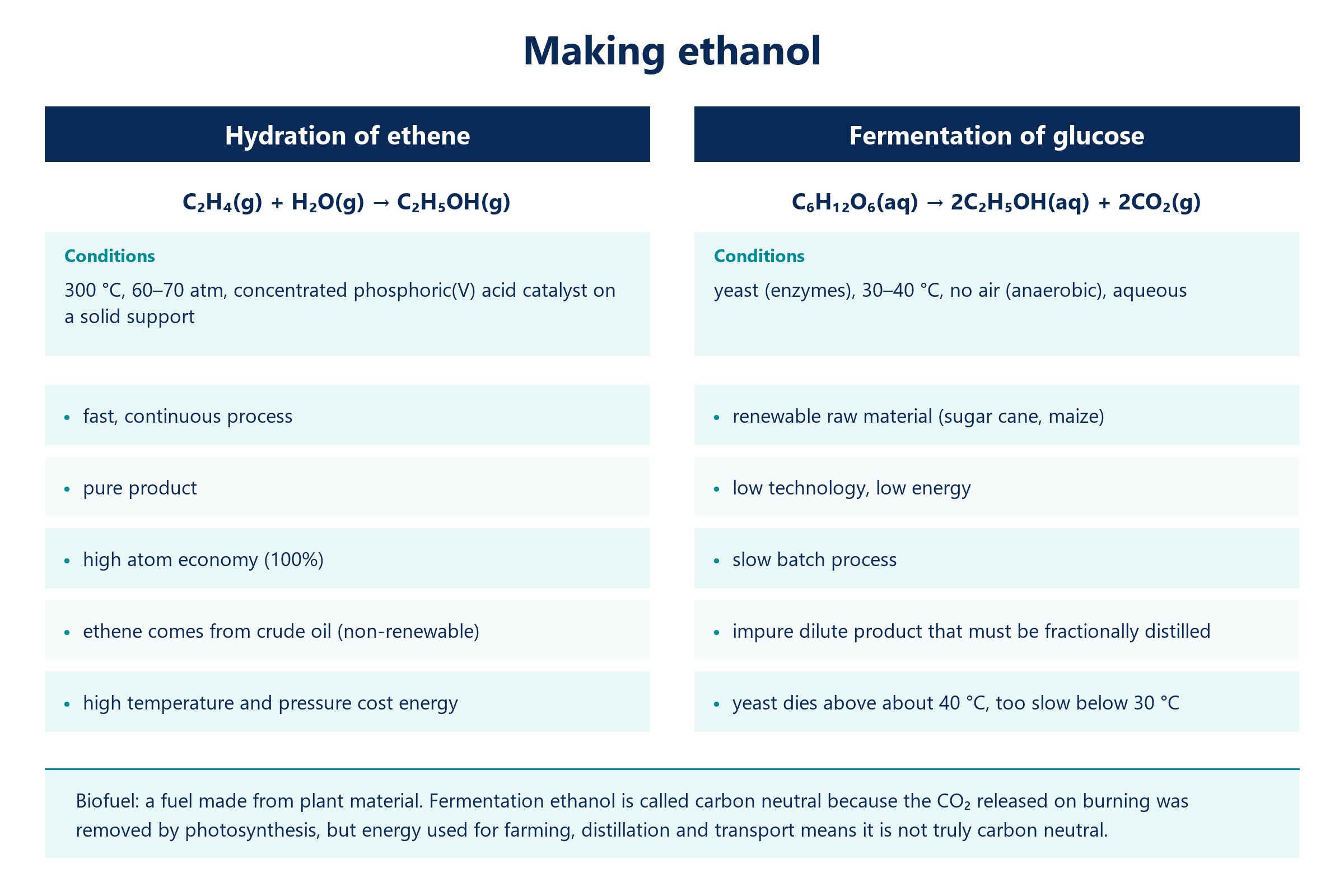
Hydration of ethene and fermentation of glucose compared: equations, conditions, and the advantages and disadvantages of each route.
Exam focus: Learn both sets of conditions with their reasons. “Warm” is not enough: give the temperature range and say why it is limited at both ends.
Check: Fermentation Conditions
Justify fermentation conditions in a scenario that is not the one above.
Biofuels and Carbon Neutrality
A biofuel is a fuel made from plant material, or from waste derived from plants and animals. Ethanol from fermentation is a biofuel and is blended with petrol in many countries. It is described as carbon neutral because the carbon dioxide released when it burns is the same carbon dioxide that the plant removed from the air by photosynthesis. Three equations show the balance: photosynthesis 6CO₂ + 6H₂O → C₆H₁₂O₆ + 6O₂, fermentation C₆H₁₂O₆ → 2C₂H₅OH + 2CO₂, and combustion 2C₂H₅OH + 6O₂ → 4CO₂ + 6H₂O. Six molecules of carbon dioxide are taken in and six are released.
The claim is not fully valid, because the equations leave out the energy used to grow, harvest and transport the crop and to distil the ethanol. If that energy comes from fossil fuels, extra carbon dioxide is released and the fuel is not carbon neutral. There are also ethical questions: land and water used for fuel crops are not available for food, and clearing forest for plantations releases stored carbon.
Exam answer model: Carbon neutral: “no net carbon dioxide emission because the CO₂ released on burning equals the CO₂ absorbed by photosynthesis”. Not valid because “energy from fossil fuels is used for farming, transport and distillation”.
Common Exam Points
Say
“Concentrated phosphoric(V) acid catalyst, 300 °C, 60–70 atm, steam.” “Yeast, 30–40 °C, anaerobic, aqueous.” “Renewable raw material but a slow batch process giving an impure product.”
Do not say
“Fermentation uses bacteria” (yeast is a fungus and the enzymes are the catalysts). “Carbon neutral because plants are natural.”
Watch for
Questions that ask you to compare the routes: pick advantages that are different in kind (rate, purity, raw material, energy, cost) and match each to a route.
Check: Comparing the Routes
Weigh up the two routes for a country whose situation is not described above.
FAQs
Use these quick answers to check the ethanol production ideas.
Why is the hydration of ethene run at high pressure?
Two moles of gas become one, so a high pressure pushes the equilibrium towards ethanol and also increases the rate. It is limited because compressing the gases is expensive and the vessel must be strong.
Why does fermentation stop at about 15% ethanol?
Ethanol is toxic to yeast at that concentration, so the enzymes stop working. The dilute solution then has to be fractionally distilled to concentrate the ethanol.
Why must air be kept out during fermentation?
Oxygen lets microorganisms oxidise the ethanol to ethanoic acid, so the product would be vinegar rather than alcohol.
Is fermentation ethanol really carbon neutral?
Only in the equations. The carbon dioxide released on burning equals the carbon dioxide absorbed by photosynthesis, but the energy used for farming, transport and distillation usually comes from fossil fuels and adds extra emissions.
What is the atom economy of the hydration route?
100%: ethene and water give ethanol and nothing else, so every atom of the reactants ends up in the desired product.
Copyright and author footprint: This OLS revision page was written for Online Learning System by Dr. Mohammed Al-Fatah. It is designed for A Level Chemistry revision and should not be copied or redistributed without permission.
Keep this note — free
Save your progress across every Cambridge topic. A free account remembers which topics you have covered, saves your question scores, and syncs across your phone and laptop.
- Track every topic you have finished
- Keep your practice-question scores
- No payment, no card, free forever
Already registered? Log in