Elimination Reactions of Halogenoalkanes
A concise revision guide to the elimination reactions of halogenoalkanes with ethanolic potassium hydroxide: the hydroxide ion as a base, the alkenes formed, why substitution and elimination compete, and how the solvent decides.
Hydroxide as a Base
The same reagent, potassium hydroxide, gives a different reaction when the solvent is changed. Heating a halogenoalkane under reflux with potassium hydroxide dissolved in ethanol removes a hydrogen atom and the halogen from adjacent carbons and forms an alkene: CH₃CH₂CH₂Br + OH⁻ → CH₃CH=CH₂ + H₂O + Br⁻. This is an elimination reaction, and here the hydroxide ion acts as a base: it removes a proton rather than attacking the carbon.
The hydrogen that is removed must come from a carbon next to the carbon carrying the halogen, because the double bond forms between those two carbons. If that carbon has no hydrogen, elimination cannot happen.
Key idea: Aqueous KOH: OH⁻ is a nucleophile, substitution, alcohol. Ethanolic KOH, heated: OH⁻ is a base, elimination, alkene.
The Elimination Mechanism
The mechanism can be described in three movements of electron pairs: the lone pair on the hydroxide ion takes a proton from the carbon next to the C–Br carbon; the electrons of that C–H bond move in to form the C=C double bond; and the C–Br bond breaks with both electrons going to the bromine, which leaves as a bromide ion. The products are the alkene, water and a bromide ion.
Elimination and substitution compete, so a mixture of products usually forms. Primary halogenoalkanes tend towards substitution, tertiary halogenoalkanes towards elimination, and the balance can be pushed either way by the solvent and the temperature: water and lower temperatures favour substitution, ethanol and higher temperatures favour elimination.
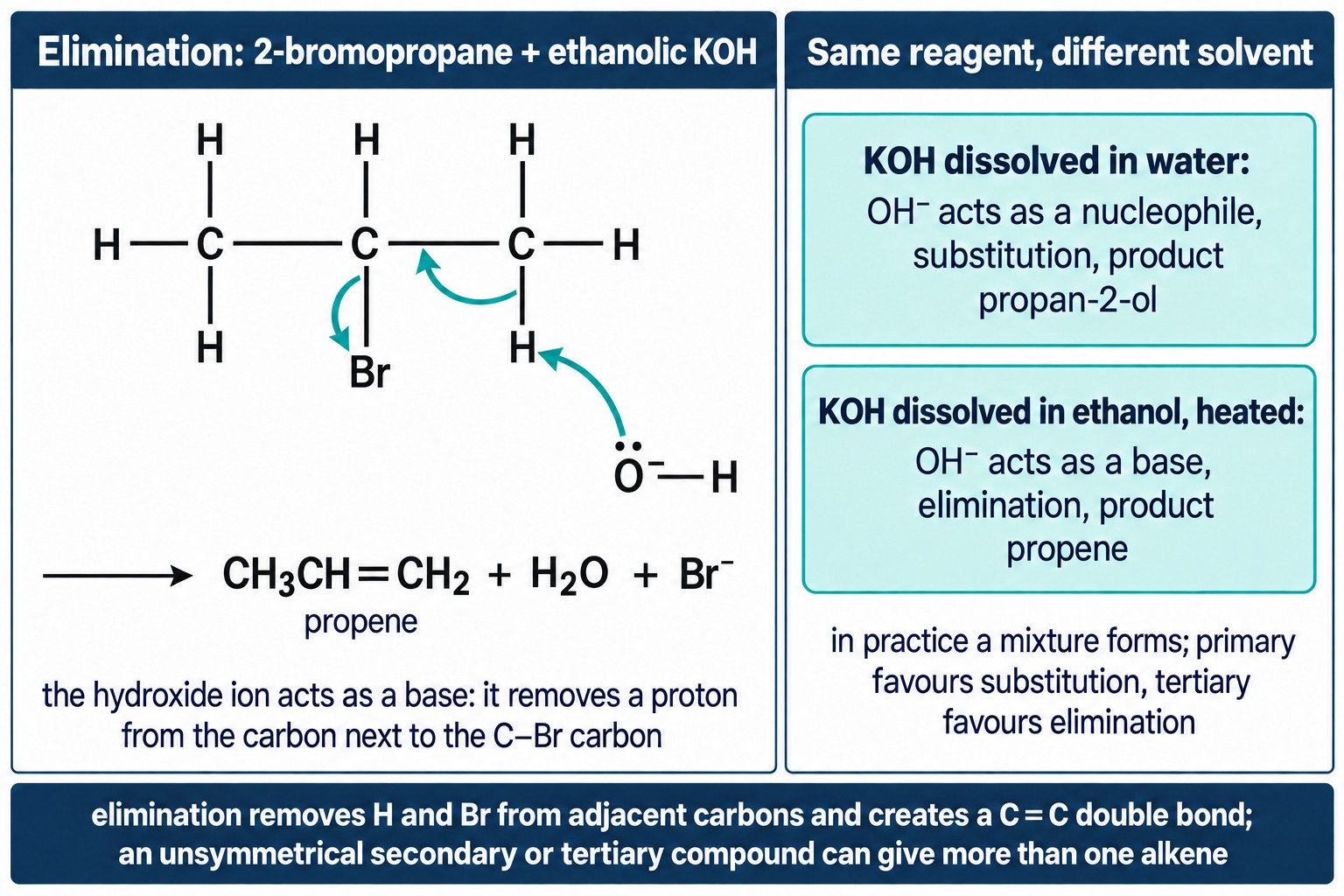
The elimination of 2-bromopropane by ethanolic potassium hydroxide, and the same reagent giving substitution in water.
Exam focus: The examiner wants the reagent, the solvent, the condition, the role of OH⁻ as a base and the products; draw the structure of the alkene carefully.
Check: Elimination Conditions and Products
Choose conditions and predict alkenes for compounds other than 1-bromopropane and 2-bromopropane.
More Than One Alkene
When the carbon carrying the halogen has two different neighbouring carbons that both carry hydrogen, the base can remove a hydrogen from either side and two structural isomers form. 2-bromobutane gives but-1-ene when the hydrogen comes from carbon 1 and but-2-ene when it comes from carbon 3. But-2-ene has two different groups on each carbon of the double bond, so it exists as E and Z isomers, giving three alkenes in total. The more substituted alkene, but-2-ene, is usually the major product.
2-bromopropane, by contrast, gives only propene because both its neighbouring carbons are identical CH₃ groups, and 1-bromopropane gives only propene because the only neighbouring carbon is carbon 2.
| Compound | Neighbouring carbons with H | Alkenes formed |
|---|---|---|
| 1-bromopropane | C2 only | propene |
| 2-bromopropane | C1 and C3, identical | propene |
| 2-bromobutane | C1 and C3, different | but-1-ene, E-but-2-ene, Z-but-2-ene |
| 2-bromo-2-methylpropane | three identical CH₃ | 2-methylpropene |
| 1-bromo-2,2-dimethylpropane | none with H | no elimination |
Exam technique: List the carbons next to the C–X carbon, check each for hydrogen, draw one alkene per different neighbour, then check the products for E/Z isomerism.
Check: Counting the Alkenes
Work out how many alkenes form from compounds not in the table above.
Common Exam Points
Say
“Potassium hydroxide dissolved in ethanol, heat under reflux; the hydroxide ion acts as a base.” “H and Br are removed from adjacent carbons and a C=C bond forms.”
Do not say
“Ethanoic KOH.” “The OH⁻ attacks the carbon” (that is substitution). “Elimination of HBr” without saying which carbons lose the H and the Br.
Watch for
The solvent is the whole point of the question: if it says “in ethanol” think elimination, if it says “aqueous” think substitution, and if it says both were formed explain the mixture.
Check: Substitution versus Elimination
Decide which reaction dominates in situations not described above.
FAQs
Use these quick answers to check elimination.
What exactly does “hydroxide acts as a base” mean?
The hydroxide ion uses its lone pair to remove a hydrogen ion from a carbon next to the C–X carbon, forming water, rather than bonding to the carbon.
Why does the solvent matter so much?
In water the hydroxide ion is surrounded by water molecules and behaves as a nucleophile towards the δ+ carbon; in ethanol it is a stronger base and takes a proton instead, and the higher temperature of refluxing ethanol also favours elimination.
Which hydrogen is removed?
One on a carbon adjacent to the carbon carrying the halogen, because the double bond forms between those two carbons.
Why do tertiary compounds favour elimination?
The three alkyl groups crowd the δ+ carbon and block the nucleophile, while there are plenty of neighbouring hydrogens for the base to remove and the alkene formed is stable.
Do I always get a mixture of products?
Usually. Substitution and elimination compete, and an unsymmetrical secondary or tertiary compound can also give more than one alkene. Questions ask for the major product or for all the possible alkenes.
Copyright and author footprint: This OLS revision page was written for Online Learning System by Dr. Mohammed Al-Fatah. It is designed for A Level Chemistry revision and should not be copied or redistributed without permission.
Keep this note — free
Save your progress across every Cambridge topic. A free account remembers which topics you have covered, saves your question scores, and syncs across your phone and laptop.
- Track every topic you have finished
- Keep your practice-question scores
- No payment, no card, free forever
Already registered? Log in