Halogenoalkanes: Naming, Classification and the C–X Bond
A concise revision guide to halogenoalkanes: naming and drawing them, classifying them as primary, secondary or tertiary, the polarity and strength of the carbon–halogen bond, and their properties and uses.
Naming Halogenoalkanes
A halogenoalkane is an alkane in which one or more hydrogen atoms have been replaced by halogen atoms, so the general formula of a mono-substituted compound is CₙH₂ₙ₊₁X. They are named as substituted alkanes: the halogen is a prefix, fluoro-, chloro-, bromo- or iodo-, with a number giving its position, and prefixes are listed in alphabetical order. CH₃CH₂CH₂Br is 1-bromopropane, CH₃CHBrCH₃ is 2-bromopropane, and CH₃CHClCH₂CH₃ is 2-chlorobutane. Two of the same halogen use di-: CH₂BrCH₂Br is 1,2-dibromoethane.
The same three representations are needed as for alcohols: structural, displayed and skeletal formulae. In a skeletal formula the halogen is written at the end of the line, Br or Cl, and the carbon carrying it is the vertex.
| Structural formula | Name | Class |
|---|---|---|
| CH₃CH₂CH₂Cl | 1-chloropropane | primary |
| CH₃CHBrCH₃ | 2-bromopropane | secondary |
| (CH₃)₃CCl | 2-chloro-2-methylpropane | tertiary |
| CH₃CH₂CH₂CH₂I | 1-iodobutane | primary |
| CH₂ClCH₂Cl | 1,2-dichloroethane | primary (both carbons) |
Exam focus: Number from the end that gives the halogen the lowest number, and put the prefixes in alphabetical order: 1-bromo-2-chloropropane, not 2-chloro-1-bromopropane.
Primary, Secondary and Tertiary
Like alcohols, halogenoalkanes are classified by the number of carbon atoms bonded to the carbon that carries the halogen. In a primary halogenoalkane that carbon is bonded to one other carbon (1-bromopropane); in a secondary compound to two (2-bromopropane); in a tertiary compound to three (2-bromo-2-methylpropane). The class affects both the rate of hydrolysis and the balance between substitution and elimination, which is why examiners keep asking for it.
Halogenoalkanes are made in three ways covered elsewhere in the course: free-radical substitution of an alkane with chlorine or bromine in ultraviolet light, electrophilic addition of a halogen or a hydrogen halide to an alkene at room temperature, and substitution of the OH group of an alcohol using HX, KCl with concentrated sulfuric or phosphoric acid, PCl₃ with heat, PCl₅, or SOCl₂.
Key idea: Find the carbon bonded to the halogen and count its carbon neighbours: one primary, two secondary, three tertiary.
Check: Naming and Classifying
Name and classify halogenoalkanes not shown on this page.
The Polar C–X Bond
Every halogen is more electronegative than carbon, so the carbon–halogen bond is polar: the carbon is δ+ and the halogen is δ−. The δ+ carbon is electron-deficient and is the site attacked by nucleophiles. The polarity is greatest for C–F and least for C–I, because electronegativity falls down Group 17: fluorine 4.0, chlorine 3.0, bromine 2.8, iodine 2.5, against carbon 2.5. On that basis chloroalkanes should be the most reactive, but they are not.
The rate of a nucleophilic substitution depends on how easily the C–X bond breaks, that is on the bond enthalpy. Going down the group the halogen atom gets larger, the bond gets longer, and the bond enthalpy falls: C–F 467, C–Cl 346, C–Br 290, C–I 228 kJ mol⁻¹. The C–I bond is the weakest and breaks most easily, so iodoalkanes are hydrolysed fastest; fluoroalkanes are so unreactive that they are used in non-stick coatings and refrigerants. Bond strength, not bond polarity, controls the rate.
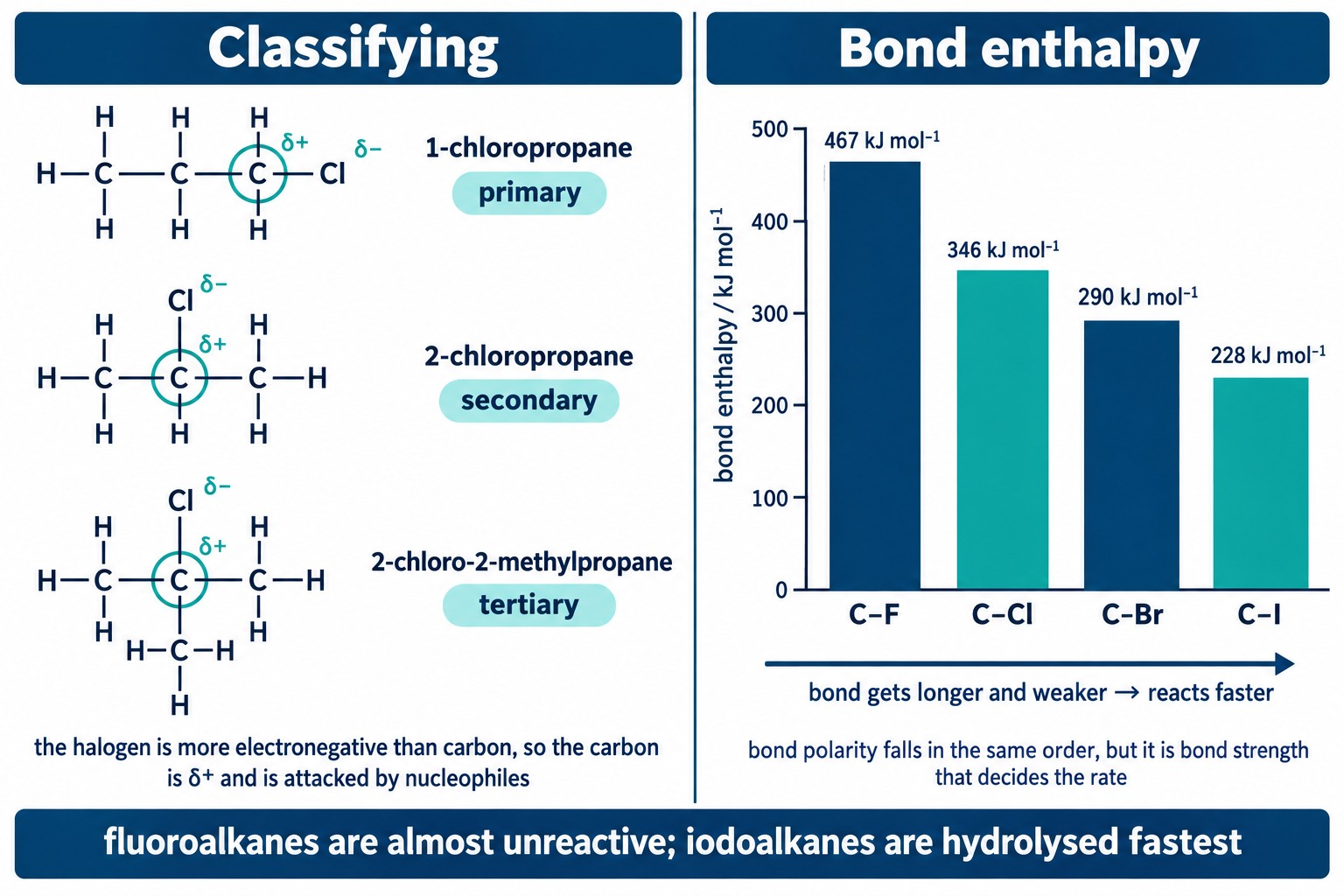
Primary, secondary and tertiary chloroalkanes with the polar C–Cl bond, and the bond enthalpies of the four carbon–halogen bonds.
The Carbon–Halogen Bond: Polarity and Strength
Compare the C–Cl, C–Br and C–I bonds in the halogenoethanes, drawn to scale, and see why the weakest bond, not the most polar one, reacts fastest with a nucleophile.
© Dr. Mohammed Al-Fatah – onlinelearningsystem.net
Exam trap: Polarity predicts the wrong order. Write: “the C–I bond has the lowest bond enthalpy, so it breaks most easily and iodoalkanes react fastest”.
Check: Bond Polarity and Bond Strength
Apply the polarity and bond enthalpy ideas to compounds not compared above.
Uses and Properties of Halogenoalkanes
Halogenoalkanes are useful because the C–X bond can be swapped for other groups, so they are the starting point for making alcohols, amines and nitriles in synthesis. Chloroalkanes and chlorofluoroalkanes were used as solvents, refrigerants, aerosol propellants and anaesthetics, and many of those uses have been stopped because the compounds are toxic or damage the ozone layer.
Their physical properties follow from the polar C–X bond and the size of the halogen. Halogenoalkanes have permanent dipole–dipole forces as well as London forces, so they boil at higher temperatures than the alkanes of similar size, and boiling temperature rises from chloro- to iodo- as the number of electrons and the London forces increase. They are not soluble in water, because they cannot hydrogen bond, which is why an ethanol solvent is needed when they are reacted with aqueous reagents.
Key idea: Insoluble in water, denser than water for most bromo- and iodo- compounds, and boiling temperature rising down the halogen group with the London forces.
Common Exam Points
Say
“The C–Br bond is polar because bromine is more electronegative than carbon, so the carbon is δ+.” “C–I has the lowest bond enthalpy so it is broken most easily.”
Do not say
“Iodoalkanes react fastest because the C–I bond is most polar.” “Tertiary because there are three carbons in the molecule.”
Watch for
Questions that give bond enthalpy data and ask you to predict a rate: quote the numbers in your answer.
Check: Properties and Uses
Explain properties of halogenoalkanes that are not the examples used above.
FAQs
Use these quick answers to check the halogenoalkane basics.
How do I order two different halogens in a name?
Alphabetically, ignoring the numbers: 1-bromo-2-chloroethane, because b comes before c.
Why is the carbon of a C–Br bond δ+?
Bromine is more electronegative than carbon, so it pulls the bonding electrons towards itself, leaving the carbon slightly positive.
If C–Cl is the most polar bond, why are chloroalkanes the least reactive?
Because the rate depends on breaking the C–X bond, and C–Cl is the strongest of the three (346 kJ mol⁻¹). Bond enthalpy, not polarity, controls the rate.
Why do halogenoalkanes not dissolve in water?
They have no O–H or N–H, so they cannot hydrogen bond to water; the water–water hydrogen bonds are not replaced by anything as strong.
Why do halogenoalkanes boil higher than alkanes of similar mass?
The polar C–X bond gives permanent dipole–dipole forces in addition to London forces, and the large halogen atom adds electrons that strengthen the London forces.
Copyright and author footprint: This OLS revision page was written for Online Learning System by Dr. Mohammed Al-Fatah. It is designed for A Level Chemistry revision and should not be copied or redistributed without permission.
Keep this note — free
Save your progress across every Cambridge topic. A free account remembers which topics you have covered, saves your question scores, and syncs across your phone and laptop.
- Track every topic you have finished
- Keep your practice-question scores
- No payment, no card, free forever
Already registered? Log in