Measuring the Molar Volume of a Gas
Practical Skills: Gas Volumes (AQA A Level Chemistry): measuring the molar volume of carbon dioxide from calcium carbonate and ethanoic acid, with the apparatus and its reasons, weighing by difference, the volume against mass graph, the full mole calculation, the excess check, and the errors, uncertainties and improvements examiners ask about.
GCSE Recap: Moles, Gas Collection and 24 dm³
Three quick questions on the GCSE ideas this practical builds on: moles from mass, which gases can be collected over water, and the molar gas volume.
What This Practical Is Testing
This practical, Practical Skills: Gas Volumes on the AQA course, measures the molar volume of a gas: the volume occupied by one mole of carbon dioxide at room temperature and pressure.
The value depends on both temperature and pressure, so both are recorded and quoted with the answer.
Carbon dioxide is made by reacting weighed masses of calcium carbonate with an excess of ethanoic acid. The gas is collected over water in a 100 cm³ measuring cylinder, and the volume is plotted against the mass of solid used.
CaCO₃(s) + 2CH₃COOH(aq) → (CH₃COO)₂Ca(aq) + CO₂(g) + H₂O(l)
The equation gives a 1 : 1 ratio between calcium carbonate and carbon dioxide, so the amount of gas in moles equals the amount of solid in moles. Molar volume is simply the volume of gas divided by that amount.
Because the acid is in excess, the volume of gas depends only on the mass of calcium carbonate, which is why the graph is a straight line through the origin.
On the AQA course this practical is examined through the written papers (at least 15% of the marks test practical skills) and the practical endorsement.
Questions ask you to justify the apparatus, explain why the solid is weighed before and after tipping, read a value from a line of best fit, and complete the mole calculation with units and significant figures.
They also ask you to state the direction of each error, and suggest a gas syringe or a larger mass as an improvement.
The same mole ideas are tested in Required Practical 1 (preparation of a standard solution) and Required Practical 1 (concentration of hcl by titration).
This experiment is not one of the twelve set practicals on the AQA specification, but molar gas volume, the ideal gas equation and gas collection appear regularly in the written papers.
The practical endorsement expects you to have measured a gas volume with a syringe or over water. Treat it as examinable technique.
Key idea: Molar volume = volume of gas ÷ amount of gas in moles. Quote it with its conditions: about 24 dm³ mol⁻¹ at room temperature and pressure.
Measuring Gas Volumes
There are two ways to measure a gas volume in the laboratory. A gas syringe collects the gas directly: the plunger is pushed out as gas enters and the volume is read from the barrel.
Collecting over water uses a measuring cylinder that is filled with water, inverted in a trough and clamped vertically.
Gas bubbling in through a delivery tube collects at the closed end and pushes the water level down, and the volume is read from the graduations at the water level.
This practical uses a 100 cm³ measuring cylinder over water, and its capacity sets the largest mass of solid that can be used.
Collecting over water only works for gases that are almost insoluble and do not react with water. Hydrogen, oxygen and nitrogen are fine; ammonia, hydrogen chloride and sulfur dioxide are not.
Carbon dioxide is slightly soluble, so a little of it dissolves in the trough and the measured volume is slightly too low.
Working in the other direction, any gas collected over water is saturated with water vapour, which adds to the volume and makes the reading slightly too high.
Exam focus: The two effects partly cancel, but an examiner expects you to name both and give their directions.
Three rules for the reading itself. Wait until the gas has returned to room temperature, because the reaction is exothermic and warm gas occupies more space. Keep the cylinder vertical and read at eye level to avoid parallax.
There is no need to level the water inside and outside the cylinder, because it is the volume of the gas space, not its pressure, that is being read.
The small pressure difference is one reason the answer is quoted only to two significant figures.
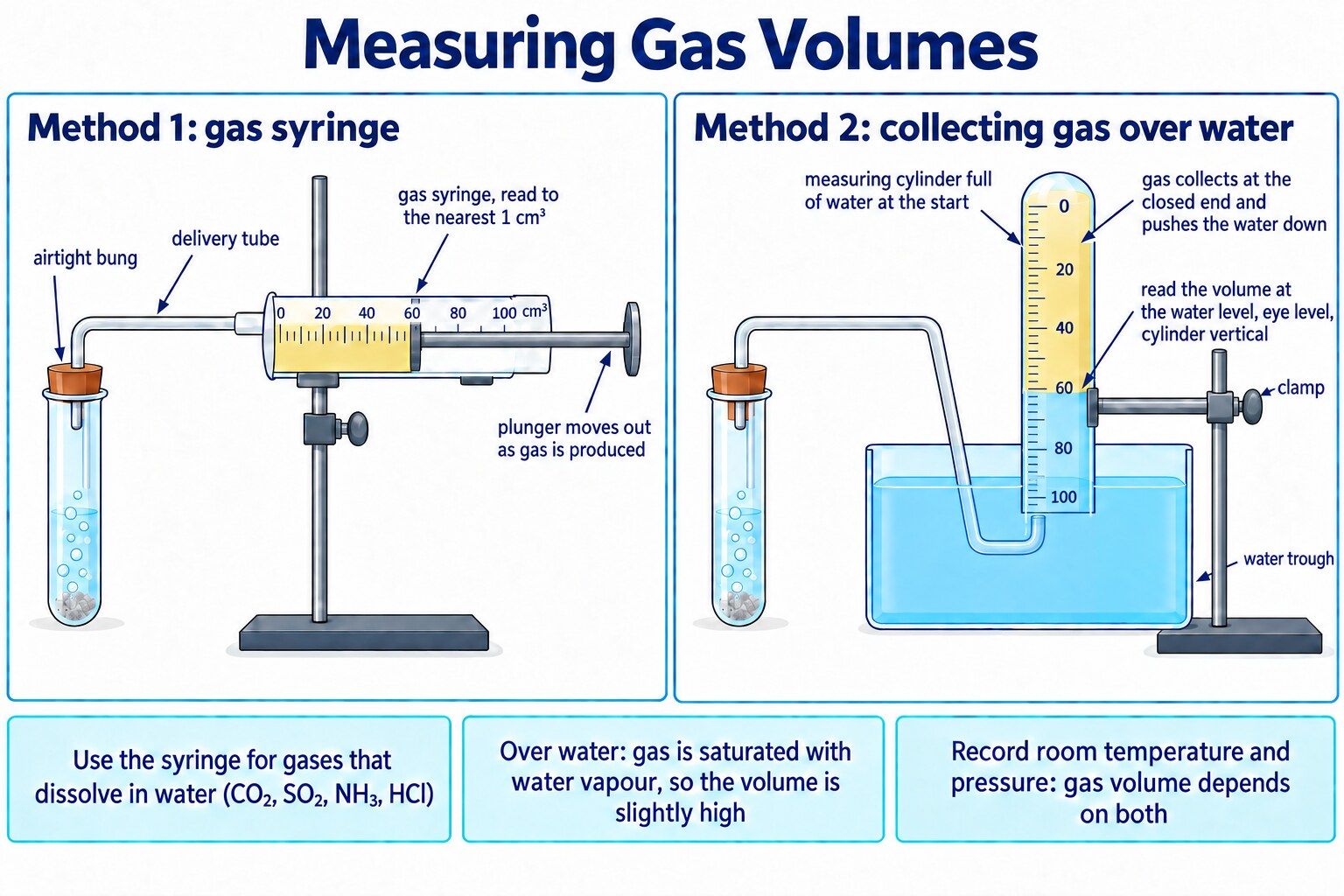
Gas syringe and collection over water side by side, with the errors of each method and the reminder to record room temperature and pressure.
Exam wording: “Carbon dioxide is slightly soluble in water, so some is lost and the volume collected is too low; a gas syringe avoids this.” Name the gas, the direction and the fix.
Check: Which Gases Can Be Collected Over Water
Decide which gases suit which method and which way each error pushes the reading.
Safety and Apparatus
Every item has a job and, where it is used for a measurement, a precision that you should be able to quote. The balance and the measuring cylinder are the two instruments whose uncertainties carry into the result; the acid volume does not matter because the acid is in excess.
| Apparatus | What it is for | Precision |
|---|---|---|
| Boiling tube, rubber bung and delivery tube | Reaction vessel for 30 cm³ of acid; the bung seals it so that every bubble of gas travels down the tube | Bung must be airtight and fitted immediately |
| 100 cm³ measuring cylinder | Inverted over water to collect and measure the carbon dioxide | Graduated in 1 cm³, read to ±0.5 cm³ |
| Water trough and two clamp stands | Holds the water seal; one clamp holds the boiling tube, the other keeps the cylinder vertical | Cylinder must be vertical for a true reading |
| Balance reading to 2 decimal places | Weighs the test tube and calcium carbonate before and after tipping | ±0.005 g per reading, ±0.01 g for the difference |
| Test tube and spatula | Holds the weighed calcium carbonate powder; weighed again after tipping so the mass used is known exactly | Any powder left behind is not counted |
| 50 cm³ measuring cylinder | Measures 30 cm³ of 1 mol dm⁻³ ethanoic acid | ±0.5 cm³, not critical because the acid is in excess |
| Thermometer and barometer (or weather data) | Records room temperature and atmospheric pressure so the molar volume can be quoted at stated conditions | ±0.5 °C; pressure to the nearest 1 kPa |
Once the bung is fitted the whole train of apparatus is a closed system with one outlet: the end of the delivery tube under the mouth of the cylinder.
Gas produced in the boiling tube pushes the air already in the tube ahead of it, so the first bubbles are air.
Keep them: at the end of the run an equal volume of carbon dioxide is left behind in the tube and the space above the acid, so the two exactly cancel and the volume in the cylinder is the volume of carbon dioxide made.
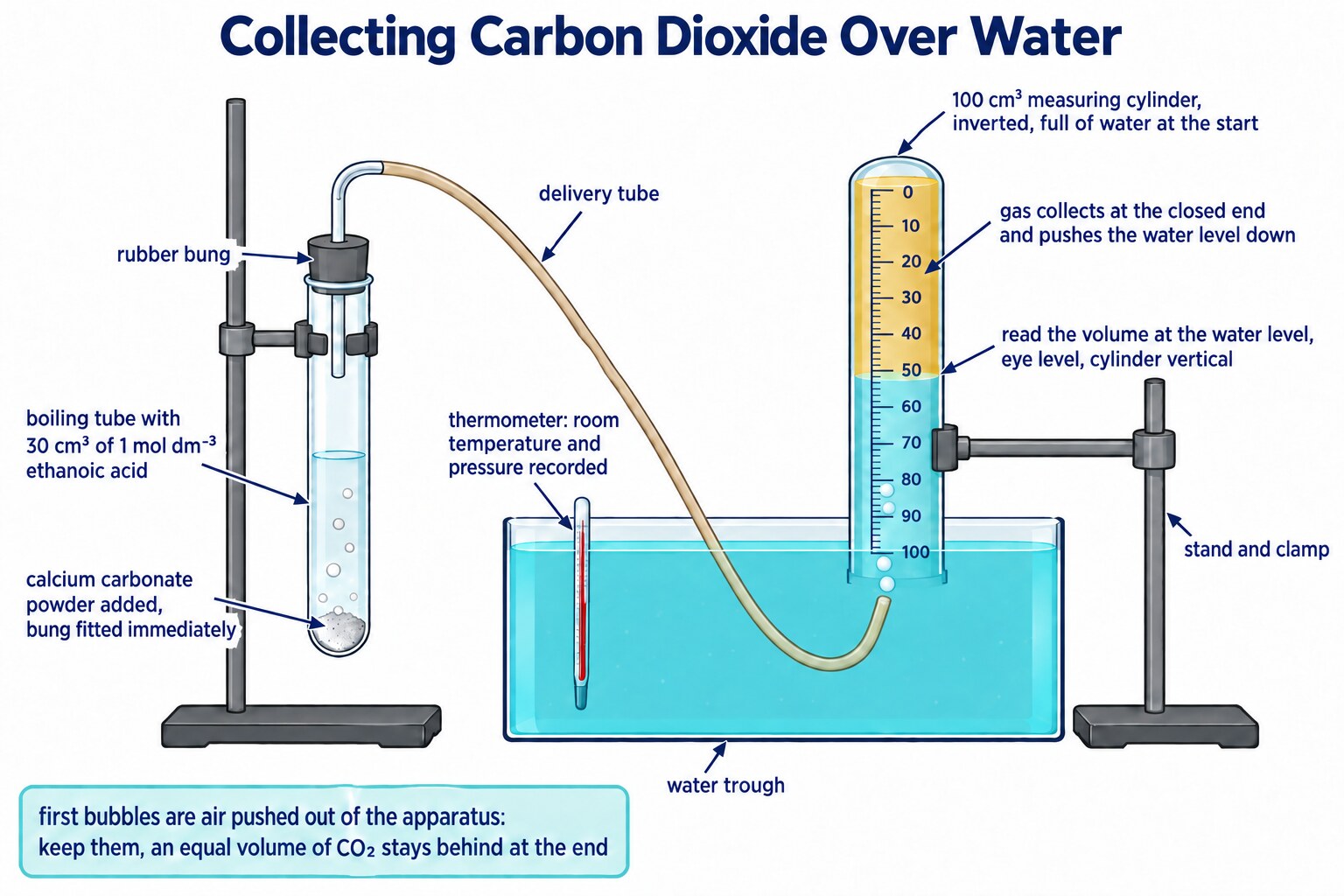
The assembled apparatus: clamped boiling tube of ethanoic acid, airtight bung and delivery tube, water trough and inverted 100 cm³ measuring cylinder read at the water level.
Safety: 1 mol dm⁻³ ethanoic acid is an irritant: wear eye protection and rinse splashes at once. Calcium carbonate is low hazard.
Never let the delivery tube become blocked or pinched while gas is being produced: pressure builds and the bung can be ejected. Clamp the boiling tube so it cannot tip when the powder is added.
Method: Step by Step
The method is built around two ideas. The first is knowing exactly how much solid reacted, which is why the test tube is weighed before and after tipping.
The second is losing no gas, which is why the bung goes on the instant the powder is in.
Every step below carries its reason, because the reason is what the mark scheme rewards.
| Step | What you do | Why |
|---|---|---|
| 1 | Fill the 100 cm³ measuring cylinder with water, invert it in the trough without letting air in, clamp it vertically and place the end of the delivery tube under its mouth. | The cylinder must start full of water so that every bubble collected displaces water and is measured. Air at the top before you start would be counted as gas. |
| 2 | Measure 30 cm³ of 1 mol dm⁻³ ethanoic acid into the boiling tube and clamp it. Fit the bung and delivery tube loosely ready for use. | The acid is in large excess (checked below), so its volume does not need high precision. Having the bung ready means it can be fitted in under a second. |
| 3 | Put about 0.05 g of calcium carbonate powder in a dry test tube. Weigh the test tube and contents on a balance reading to 2 decimal places (0.01 g) and record the mass. | The mass used is found by difference, so the reading before tipping is one of the two numbers you need. Powder reacts faster than chips, so the run finishes quickly. |
| 4 | Tip the powder into the acid and fit the bung immediately. | The reaction is fastest in the first seconds. Any gas made before the bung is in escapes to the room and the volume is too low, a systematic error that cannot be corrected for. |
| 5 | Reweigh the empty test tube while the gas is collecting. The difference between the two readings is the mass of calcium carbonate that reacted. | Some powder always clings to the tube. Weighing by difference counts only the solid that went in, which is what the mole calculation needs. |
| 6 | When no more bubbles appear and the water level stops moving, allow the gas to return to room temperature, then read the volume at the water level with the cylinder vertical and your eye level with the meniscus. | The reaction is exothermic: warm gas occupies more volume, so an early reading is too high. Reading off-vertical or above eye level introduces parallax. |
| 7 | Record room temperature and atmospheric pressure. | The molar volume is only meaningful at stated conditions; the value at 20 °C and 101 kPa differs from the value at 25 °C and 100 kPa. |
| 8 | Repeat with fresh acid and masses increasing by about 0.05 g each time up to 0.40 g, refilling the cylinder with water between runs. | Several masses give a line of best fit, which averages random error and shows up an anomalous run. Fresh acid keeps the excess large in every run. |
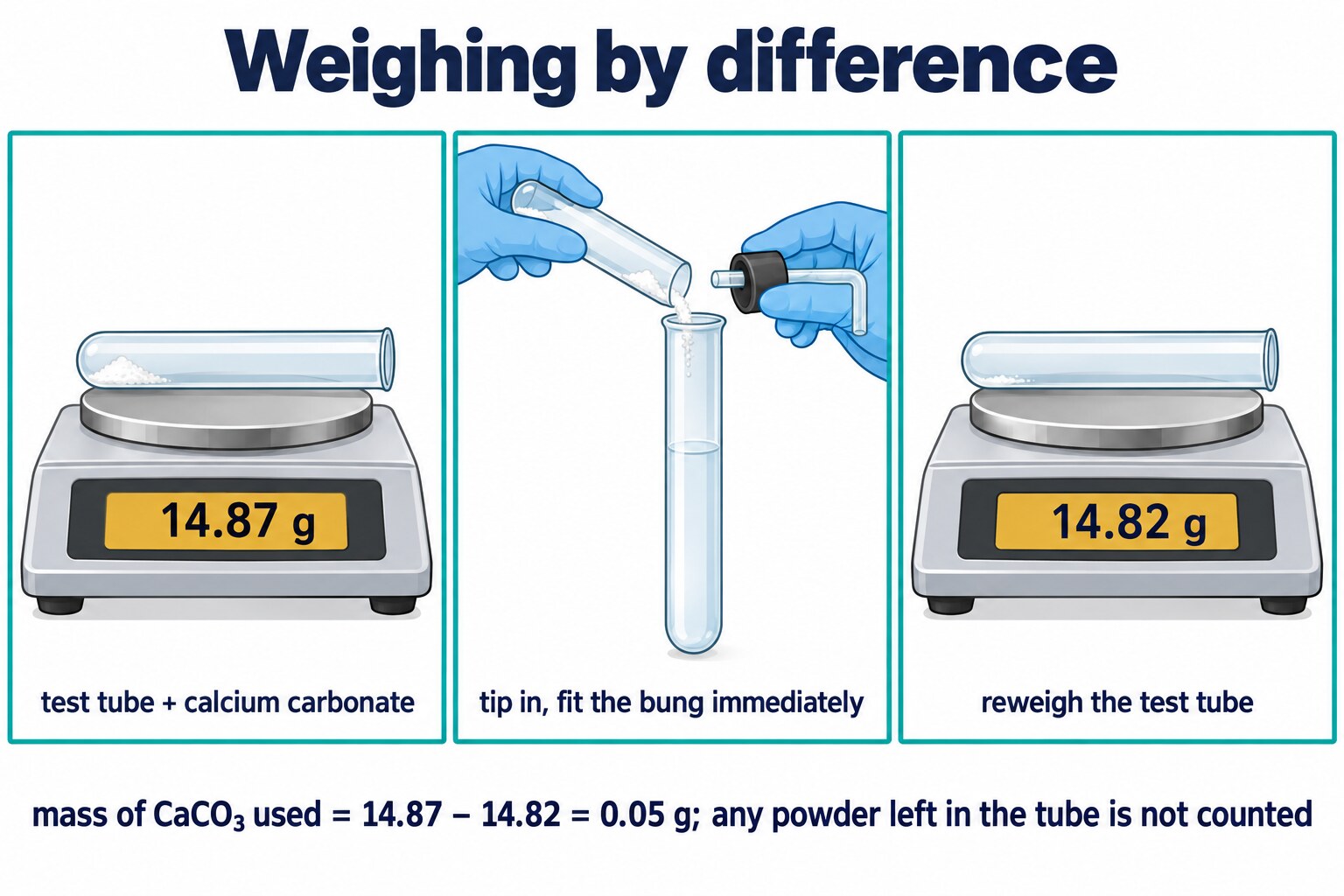
Weighing by difference: the test tube is weighed with the powder (14.87 g), the powder is tipped into the acid, and the tube is reweighed (14.82 g), so 0.05 g reacted.
Why stop at 0.40 g: 0.40 g of CaCO₃ is 0.40 ÷ 100.1 = 0.0040 mol, which would give about 0.0040 × 24 000 = 96 cm³ of CO₂, almost filling the 100 cm³ cylinder. A larger mass would push gas out of the mouth of the cylinder and the run would be lost.
Molar Volume of CO2 Bench
Collect the carbon dioxide made when calcium carbonate reacts with ethanoic acid, repeat with different masses, and use a graph to find the volume of one mole of gas at room temperature and pressure.
© Dr. Mohammed Al-Fatah – onlinelearningsystem.net
Check: The Order of the Method
Put the steps of a hydrogen version of this practical in a workable order.
Results and the Graph
Seven runs give the results below. Experimental data are scattered by random error: small differences in how quickly the bung went on, how long the gas was left to cool and how the water level was read.
A single run could therefore be badly wrong, and a mean of seven runs at different masses is meaningless. Instead the results are plotted and a line of best fit is drawn.
The line averages out the random errors, and a point that lies well off it can be identified as anomalous and ignored.
That is why the practical uses several masses rather than one, and why the final volume is read from the line rather than from any single run.
| Mass of CaCO₃ / g | Volume of CO₂ collected / cm³ | Volume predicted by the line / cm³ |
|---|---|---|
| 0.05 | 11 | 12 |
| 0.11 | 27 | 26 |
| 0.17 | 32 | 41 |
| 0.21 | 50 | 50 |
| 0.24 | 59 | 58 |
| 0.32 | 74 | 77 |
| 0.33 | 80 | 79 |
Mass of calcium carbonate is the independent variable and goes on the x-axis; volume of carbon dioxide is the dependent variable and goes on the y-axis.
The line of best fit is a straight line through the origin, because no solid reacting means no gas produced, and it is positioned so that the points are scattered evenly either side of it.
The third column shows what the line predicts at each mass: six runs lie within 3 cm³ of the line, while the 0.17 g run gave 32 cm³ against a predicted 41 cm³ and is anomalous.
This is most likely because gas escaped before the bung was fitted. It is ignored when the line is drawn.
The gradient of the line is about 240 cm³ g⁻¹, and reading it at 0.25 g gives about 60 cm³.
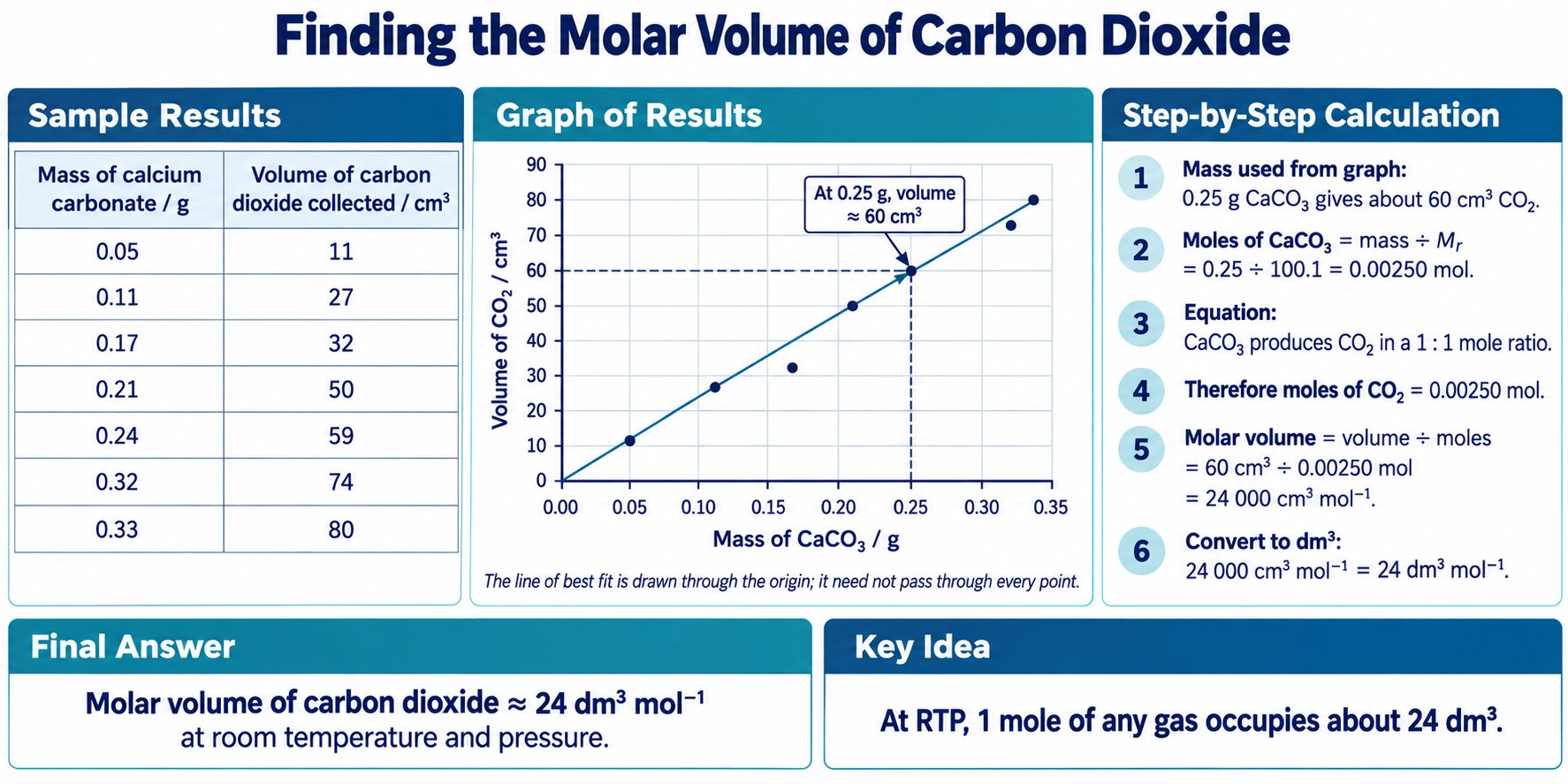
The results table, the graph with its line of best fit through the origin read at 0.25 g to give 60 cm³, and the calculation to 24 dm³ mol⁻¹.
Graph rule: Independent variable on the x-axis, dependent on the y-axis, units in the axis labels as “mass of CaCO₃ / g” and “volume of CO₂ / cm³”, a straight line through the origin with equal scatter either side, and any anomaly circled and labelled.
Calculating the Molar Volume
The graph is read at 0.25 g, a mass inside the measured range that does not correspond to any single run, so the value comes from the line, not from one measurement.
Every step is written out with its unit; students lose marks by jumping from 60 cm³ to 24 dm³ mol⁻¹ without showing the moles.
amount of CaCO₃ = mass ÷ molar mass = 0.25 g ÷ 100.1 g mol⁻¹ = 0.00250 mol
amount of CO₂ = 0.00250 mol (1 : 1 ratio in the equation)
molar volume = volume ÷ amount = 60 cm³ ÷ 0.00250 mol = 24 000 cm³ mol⁻¹ = 24 dm³ mol⁻¹
The molar mass of CaCO₃ is 40.1 + 12.0 + (3 × 16.0) = 100.1 g mol⁻¹.
The volume was read from the graph to 2 significant figures, so the answer is quoted to 2 significant figures: 24 dm³ mol⁻¹ at room temperature and pressure.
Room temperature and pressure is about 293 K and 101 kPa; with 298 K and 100 kPa the ideal gas equation gives 24.8 dm³ mol⁻¹, so always state which conditions you mean.
Writing 24.0 dm³ mol⁻¹ claims a precision the reading does not have.
A second route that examiners like uses the gradient directly. The gradient of the line is the volume of gas per gram of solid, so multiplying by the mass of one mole gives the volume of one mole.
Molar volume = gradient × Mr = 240 cm³ g⁻¹ × 100.1 g mol⁻¹ = 24 000 cm³ mol⁻¹.
The two routes must agree because reading at 0.25 g is just the gradient multiplied by 0.25.
Show the units: g ÷ g mol⁻¹ = mol, then cm³ ÷ mol = cm³ mol⁻¹, then ÷ 1000 for dm³ mol⁻¹. A unit chain that works is proof the method is right.
Comparing With the Accepted Value
The accepted molar volume of an ideal gas at room temperature and pressure is 24.0 dm³ mol⁻¹.
A result of 24 dm³ mol⁻¹ agrees with it within the precision of the reading, and the comment “the result agrees with the accepted value to 2 significant figures” earns the evaluation mark.
A stricter reading of the line at 0.25 g gives 59 cm³ rather than 60 cm³, and then:
molar volume = 59 ÷ 0.00250 = 23 600 cm³ mol⁻¹ = 23.6 dm³ mol⁻¹
percentage error = (23.6 − 24.0) ÷ 24.0 × 100 = −1.7%
The negative sign matters: it says the experiment gives a molar volume that is too low.
That is exactly what the two main systematic errors, gas escaping before the bung is fitted and carbon dioxide dissolving in the water, would produce.
A percentage error whose sign matches the expected direction of the systematic errors is strong evidence that the method, not carelessness, is responsible.
The accepted value itself depends on conditions, which is why they are recorded.
The ideal gas equation pV = nRT gives, for one mole at the recorded 21 °C (294 K) and 101 kPa, V = nRT ÷ p = 1 × 8.314 × 294 ÷ 101 000 = 0.0242 m³ = 24.2 dm³.
Comparing 24 dm³ mol⁻¹ with 24.2 dm³ mol⁻¹ is the fairest test of the experiment, and quoting the conditions with the result is what allows anyone else to make the same comparison.
Exam wording: “The result is lower than the accepted value. Gas escaped before the bung was fitted and some CO₂ dissolved in the water, both of which make the volume collected, and so the molar volume, too low.”
Check: The Calculation With New Data
Carry out the full calculation, both routes, on a magnesium carbonate experiment and comment on the error.
Checking That Ethanoic Acid Is in Excess
For the volume of gas to depend only on the mass of solid, calcium carbonate must be the limiting reagent in every run, so the acid must be in excess even for the largest mass allowed. This check should appear in your write-up and is a common two-mark question.
largest mass of CaCO₃ = 0.40 g, so amount = 0.40 ÷ 100.1 = 0.003996 mol
amount of CH₃COOH available = 1.00 mol dm⁻³ × 30 ÷ 1000 dm³ = 0.030 mol
amount of CH₃COOH needed = 2 × 0.003996 = 0.00799 mol
The acid available, 0.030 mol, is nearly four times the 0.00799 mol needed, so ethanoic acid is in excess and calcium carbonate is the limiting reagent in every run.
That is why the volume of carbon dioxide is proportional to the mass of calcium carbonate and the graph is a straight line through the origin.
The excess is large for one run but not for all of them together. The seven masses add up to 1.43 g, or 0.0143 mol of calcium carbonate, which would need 2 × 0.0143 = 0.0286 mol of acid.
If the same 30 cm³ of acid were reused for every run the acid would still be in excess, but only just, and the last runs would be reacting in a much weaker solution and finishing slowly.
Exam tip: Using fresh acid for each run costs nothing and keeps the excess unquestionable; if you are told the acid was reused, say that the excess is marginal and the largest masses are the least reliable.
Exam wording: “Moles of acid available (0.030 mol) is greater than moles needed (2 × 0.0040 = 0.0080 mol), so the acid is in excess and CaCO₃ is the limiting reagent.” Show both numbers and the comparison.
Check: Limiting Reagent
Decide whether the acid is in excess for a different carbonate and a different acid.
Errors, Uncertainty and Improvements
Evaluation questions ask for the source of an error, its direction (does it make the molar volume too high or too low?) and an improvement that removes it.
Random errors scatter the points and are dealt with by the line of best fit; systematic errors shift every point the same way and can only be dealt with by changing the method.
| Source of error | Effect on the result | Improvement |
|---|---|---|
| Gas escapes before the bung is fitted | Volume too low, so molar volume too low; systematic, and cannot be corrected for | Have the bung in hand, drop the solid in and seal in one movement; or suspend the solid in a small tube inside the flask and tip it after sealing |
| Carbon dioxide dissolves in the water in the trough | Volume too low, so molar volume too low; systematic | Collect the gas in a gas syringe instead of over water |
| Gas collected over water is saturated with water vapour | Volume slightly too high, so molar volume slightly too high; systematic | Use a gas syringe, or correct for the vapour pressure of water at the recorded temperature |
| Some carbon dioxide stays dissolved in the acid solution | Volume too low, so molar volume too low | Swirl the tube at the end of the run to release dissolved gas before reading |
| Gas is warm from the exothermic reaction and read at once | Volume too high until it cools | Wait until the water level stops moving and the tube is at room temperature before reading |
| Cylinder not vertical or read above eye level (parallax) | Random error in either direction | Clamp the cylinder vertical and read with the eye level with the water surface |
| Two balance readings of ±0.005 g on a 0.05 g sample | ±0.01 g on 0.05 g is a 20% uncertainty; the smallest masses carry the largest percentage error | Use a balance reading to 3 decimal places, use larger masses, and take the value from the line of best fit rather than a single run |
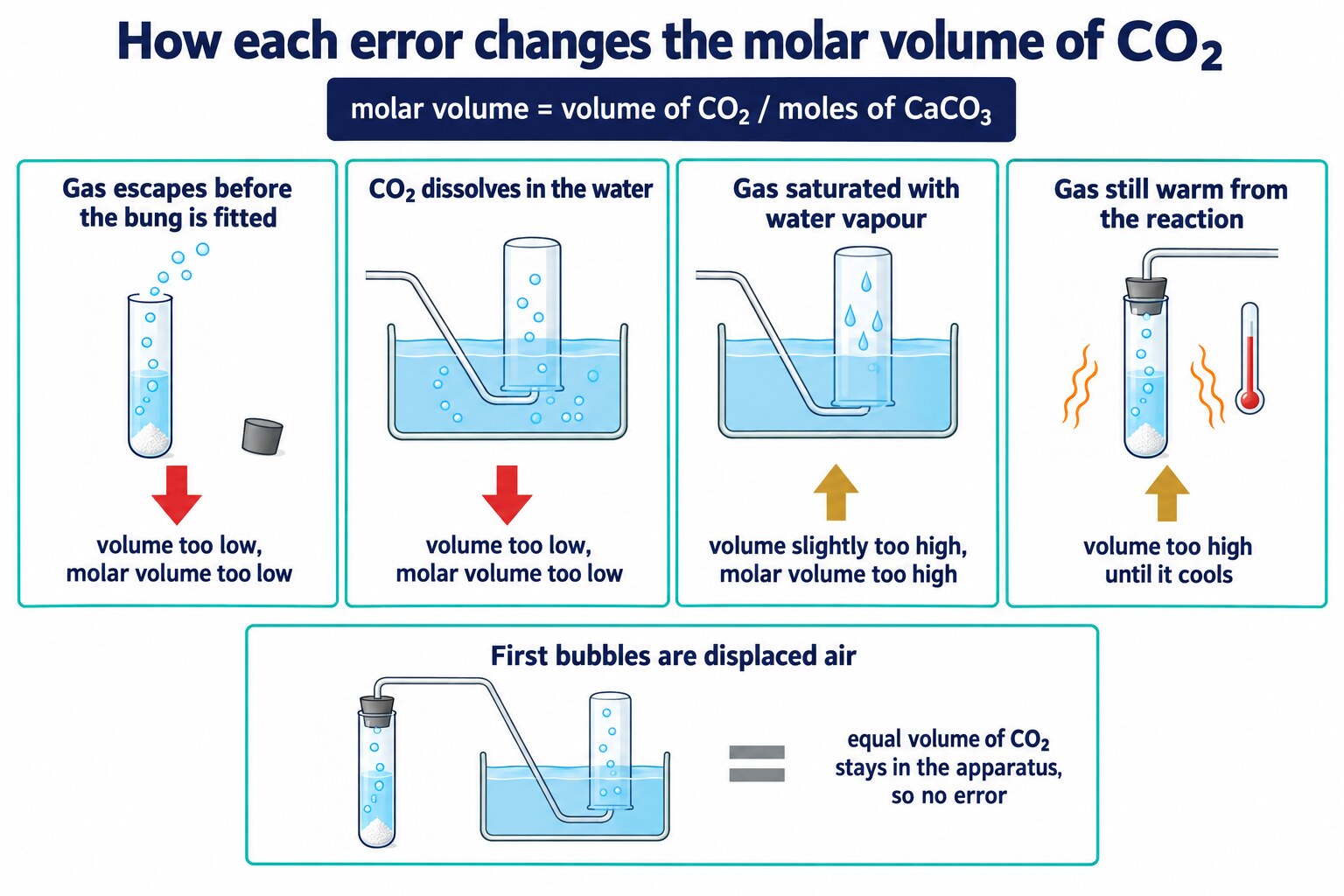
Direction of each error: gas escaping and dissolved CO₂ make the molar volume too low, water vapour and warm gas make it too high, and the first bubbles of displaced air cause no error at all.
Percentage uncertainty is (uncertainty ÷ reading) × 100, using the actual uncertainty of the instrument. The balance reads to ±0.005 g, and a mass by difference uses two readings, so its uncertainty is ±0.01 g. The 100 cm³ cylinder is read to ±0.5 cm³. For the smallest run, 0.05 g and 11 cm³:
mass: 0.01 ÷ 0.05 × 100 = 20%; volume: 0.5 ÷ 11 × 100 = 4.5%; total = 24.5%
For the largest run, 0.33 g and 80 cm³, the same working gives 0.01 ÷ 0.33 × 100 = 3.0% and 0.5 ÷ 80 × 100 = 0.6%, a total of 3.6%.
The mass, not the volume, dominates the uncertainty at every mass, so the useful improvements are a 3 decimal place balance (±0.0005 g, cutting the mass uncertainty tenfold) and larger masses, not a finer measuring cylinder.
The graph is itself an improvement: reading from the line at 0.25 g uses all seven runs, so the random part of these uncertainties is largely averaged out.
Random or systematic: A slow bung, dissolved CO₂ and water vapour shift every run the same way (systematic): the line of best fit cannot remove them. Parallax and timing scatter the points (random): the line does remove them.
Check: Which Way Does Each Error Push the Result
Predict the direction of each error in experiments on hydrogen and oxygen.
Variant: Hydrogen From Magnesium in a Gas Syringe
The same molar volume can be found with a different gas and a different collecting vessel, and this is the version many schools use: a weighed length of magnesium ribbon reacts with an excess of hydrochloric acid and the hydrogen is collected in a 100 cm³ gas syringe.
Mg(s) + 2HCl(aq) → MgCl₂(aq) + H₂(g)
The ratio is again 1 : 1, so the amount of hydrogen equals the amount of magnesium (Ar = 24.3). Magnesium is far lighter per mole than calcium carbonate, so the masses are small.
0.10 g of magnesium is 0.0041 mol and would give about 99 cm³ of hydrogen, so the runs use about 0.02 g to 0.09 g and the ribbon is cleaned with emery paper first to remove the oxide layer.
Weighing by difference uses a weighing boat rather than a test tube.
The acid check is the same shape: 25 cm³ of 1.0 mol dm⁻³ HCl is 0.025 mol, and 0.09 g of magnesium (0.0037 mol) needs 0.0074 mol, so the acid is in excess.
The syringe removes the dissolving error and the water-vapour error at once, so the result is usually closer to the accepted value. It brings its own points for the evaluation.
The plunger must move freely: a sticking plunger gives a volume that is too low and a syringe left tilted can let the plunger creep out.
The syringe scale is in 1 cm³ divisions, so each reading carries ±0.5 cm³ (some mark schemes accept ±1 cm³ because the plunger seal is wide). The gas must still be allowed to cool to room temperature before the reading.
Because the reaction is faster than carbonate and acid, the delay in fitting the bung matters even more. A better arrangement suspends the magnesium in a small tube inside the flask and tips it in after the bung is fitted.
| Feature | Carbon dioxide over water | Hydrogen in a gas syringe |
|---|---|---|
| Reaction | CaCO₃(s) + 2CH₃COOH(aq) | Mg(s) + 2HCl(aq) |
| Mass range | 0.05 g to 0.40 g of CaCO₃ (Mr 100.1) | 0.02 g to 0.09 g of Mg (Ar 24.3) |
| Largest error | Gas escaping before the bung is fitted; CO₂ dissolving in water | Gas escaping before the bung is fitted; sticking plunger |
| Reading | ±0.5 cm³ at the water level, cylinder vertical | ±0.5 cm³ at the plunger seal, syringe horizontal |
| Expected result | Slightly below 24.0 dm³ mol⁻¹ | Close to 24.0 dm³ mol⁻¹ at room temperature and pressure (about 293 K and 101 kPa; with 298 K and 100 kPa the ideal gas equation gives 24.8 dm³ mol⁻¹, so always state which conditions you mean) |
Exam wording: “A gas syringe was used because hydrogen is collected directly, so none is lost by dissolving and no water vapour is added to the volume.”
Common Mistakes
The same errors appear in students’ write-ups and exam answers year after year. Each one costs a mark that the corrected version earns.
- Writing “the volume of one mole of gas is 24 dm³” with no conditions. The value is only meaningful at a stated temperature and pressure.
- Quoting the molar volume as 24.0 dm³ mol⁻¹ from a volume read to 2 significant figures. Match the significant figures to the least precise measurement.
- Using the mass of powder weighed out instead of the mass by difference. Some powder always stays in the test tube.
- Reading a single run instead of the line, or drawing the line through the anomalous point instead of ignoring it.
- Saying the first bubbles should be discarded “because they are air”. They are, and they are matched by gas left in the apparatus at the end.
- Giving “human error” or “the equipment was inaccurate” as an error. Name the source, its direction and a specific improvement.
- Calculating percentage uncertainty with a made-up uncertainty. Use the instrument’s actual value: ±0.005 g per balance reading, ±0.5 cm³ for the cylinder.
- Forgetting the 2 : 1 ratio in the excess check and comparing 0.030 mol of acid with 0.0040 mol of carbonate directly.
Check: Graphs, Gas Syringes and Conditions
Pick the accurate statement in each round; one word usually makes a statement wrong.
Common Exam Points
Say
“Weighing the test tube before and after tipping gives the mass of CaCO₃ that actually reacted.”
“The line passes through the origin because no solid gives no gas, and reading from it at 0.25 g averages out random error.”
“The molar volume is 24 dm³ mol⁻¹ at room temperature and pressure (2 s.f.); CO₂ escaping before the bung was fitted and dissolving in the water make it too low.”
“A gas syringe avoids the loss of CO₂ by dissolving.”
Do not say
“The acid must be exactly the right amount” (it must be in excess so that CaCO₃ is the limiting reagent).
“Discard the first bubbles because they are air” (keep them; an equal volume of CO₂ stays in the apparatus).
“The result was wrong because of human error” (name the source and its direction). “24 dm³” with no conditions.
Watch for
The excess check needs the 2 : 1 ratio. Percentage error uses the accepted value as the denominator. Percentage uncertainty of a mass by difference uses two readings, ±0.01 g.
The independent variable (mass) goes on the x-axis. Water vapour is the one error that makes the volume too high; every loss of gas makes it too low.
FAQs
Quick answers to the questions students ask most about measuring the molar volume of a gas: fitting the bung, the graph, the first bubbles and the conditions.
Why must the bung be fitted so quickly?
The reaction is fastest in the first few seconds, so gas produced before the bung is in escapes to the room.
The volume collected is then too low and so is the calculated molar volume, and because the loss cannot be measured it cannot be corrected for.
A better arrangement suspends the solid inside the sealed tube and tips it in afterwards.
Why is the line of best fit drawn through the origin?
If no calcium carbonate reacts, no carbon dioxide is produced, so the point (0 g, 0 cm³) is a known point on the graph. The line is fixed at the origin and then angled so that the measured points are scattered evenly either side of it, ignoring any anomaly.
Why read the graph at 0.25 g instead of using one of the runs?
0.25 g lies inside the range of masses measured, so the reading comes from the line of best fit rather than from a single run.
The line averages the random errors of all seven runs and ignores the anomalous one, so the volume read at 0.25 g (about 60 cm³) is more reliable than any single measurement.
Any mass on the line would give the same molar volume, because the line has one gradient.
Why are the first bubbles not discarded?
They are air pushed out of the delivery tube and the space above the acid by the gas being made.
At the end of the run that same space is full of carbon dioxide that never reached the cylinder, and its volume equals the volume of air pushed out at the start.
Keeping the first bubbles lets the two cancel; discarding them makes the volume too low.
Why record room temperature and pressure?
The volume of a fixed amount of gas depends on both. One mole occupies about 24.0 dm³ at 20 °C and 101 kPa but 24.8 dm³ at 25 °C and 100 kPa, so a molar volume without its conditions cannot be compared with anything.
The ideal gas equation pV = nRT gives the expected value at the recorded conditions.
When is a gas syringe better than collecting over water?
Whenever the gas dissolves in water: carbon dioxide slightly, ammonia, hydrogen chloride and sulfur dioxide almost completely.
The syringe collects the gas directly, so nothing is lost by dissolving and no water vapour is added to the volume. Its own weaknesses are a sticking plunger and a scale read only to the nearest 1 cm³.
Copyright and author footprint: This OLS revision page was written for Online Learning System by Dr. Mohammed Al-Fatah. It is designed for A Level Chemistry revision and should not be copied or redistributed without permission.
Keep this note — free
Save your progress across every AQA topic. A free account remembers which topics you have covered, saves your question scores, and syncs across your phone and laptop.
- Track every topic you have finished
- Keep your practice-question scores
- No payment, no card, free forever
Already registered? Log in