Required Practical 2: Measurement of an Enthalpy Change
AQA A Level Chemistry revision notes for Required Practical 2: finding the enthalpy change of decomposition of potassium hydrogencarbonate by measuring the reactions of K₂CO₃ and KHCO₃ with hydrochloric acid in a polystyrene cup, then combining them with Hess’s law. Method with reasons, q = mcΔT, moles, the excess check, the cycle, uncertainties and the direction of every error.
GCSE Recap: Energy Changes
Four quick questions on exothermic and endothermic changes, the polystyrene cup and the units of energy from GCSE.
What This Practical Is Testing
The aim of Required Practical 2 is to find the enthalpy change of thermal decomposition of potassium hydrogencarbonate, a reaction that cannot be measured directly:
2KHCO₃(s) → K₂CO₃(s) + CO₂(g) + H₂O(l) ΔH₃ (the target)
Direct measurement fails for two reasons that both earn marks. First, the solid must be heated continuously to decompose it, so the energy supplied by the Bunsen cannot be separated from the energy absorbed by the reaction.
Second, the reaction is solid to solid and gas: there is no solution into which a thermometer can be placed to record a temperature change.
Instead, two related reactions that do take place in solution are measured with a thermometer in a polystyrene cup, and Hess’s law is used to combine them.
Water is written as H₂O(l) because both measured reactions produce liquid water at room temperature, so the value obtained is for the equation with H₂O(l).
The written papers (at least 15% of the marks test practical skills) and the practical endorsement.
For this practical that means: the method with reasons, q = mcΔT with the assumptions stated, moles and ΔH with the correct sign, the excess check, the Hess cycle, percentage uncertainties and the direction of the error caused by heat loss.
Key idea: Measure two reactions you can do in a cup; calculate the one you cannot. Hess’s law says the enthalpy change is the same whichever route is taken from reactants to products, provided the conditions are the same.
The Two Reactions Being Measured
Both solids react with the same acid: 30.0 cm³ of 2.00 mol dm⁻³ hydrochloric acid in a polystyrene cup.
Using the same volume and concentration of acid in both runs is deliberate: the acid appears on both sides of the Hess cycle and cancels out. The temperature change is measured after adding the solid.
| Reaction | Equation | Observation and sign |
|---|---|---|
| Reaction 1: potassium carbonate, ΔH₁ | K₂CO₃(s) + 2HCl(aq) → 2KCl(aq) + CO₂(g) + H₂O(l) | The temperature rises: exothermic, ΔH₁ negative. Effervescence as CO₂ is given off. |
| Reaction 2: potassium hydrogencarbonate, ΔH₂ | KHCO₃(s) + HCl(aq) → KCl(aq) + CO₂(g) + H₂O(l) | The temperature falls: endothermic, ΔH₂ positive. Effervescence as CO₂ is given off. |
Notice the mole ratios. One mole of K₂CO₃ needs two moles of HCl; one mole of KHCO₃ needs one mole of HCl. The target equation contains two moles of KHCO₃, so ΔH₂ will have to be doubled when the cycle is built.
Sign trap: A temperature rise gives a negative ΔH; a temperature fall gives a positive ΔH. Students calculate the size of q correctly and then lose the mark by giving the wrong sign.
Check: Exothermic or Endothermic?
Decide the sign of ΔH for temperature changes in reactions that are not the ones on this page.
Safety and Apparatus
| Apparatus | What it is for | Precision |
|---|---|---|
| Polystyrene cup in a 250 cm³ beaker | The reaction vessel; polystyrene is a poor conductor of heat and has a very small heat capacity, so almost all the energy change stays in the solution. The beaker stops the light cup tipping over. | |
| Lid with a hole for the thermometer | Reduces heat loss (or gain) through the open top and stops spray from the effervescence escaping. | |
| Burette (or 25 cm³ pipette plus a 5 cm³ measure) | Delivers exactly 30.0 cm³ of acid. A burette is chosen over a measuring cylinder because its uncertainty is smaller and the volume becomes the mass in q = mcΔT. | ±0.05 cm³ per reading |
| Thermometer, 0 to 50 °C | Records the start temperature and the highest or lowest temperature reached. The bulb must stay fully in the liquid. | ±0.1 °C per reading (0.1 °C divisions) or ±0.5 °C (1 °C divisions) |
| Test tube and 2 d.p. balance | The solid is weighed in the tube, tipped into the acid, and the tube is reweighed so the mass added is found by difference. | ±0.01 g per reading |
| Stirring rod (or the thermometer itself) | Mixes the solid into the acid so the whole solution reaches the same temperature quickly. | |
| Stopwatch | Times the readings every 30 s so that a temperature-time graph can be plotted and extrapolated. |
Hazards and precautions: 2.00 mol dm⁻³ hydrochloric acid is an irritant: wear eye protection and wipe up spills.
Potassium carbonate is an irritant to the eyes and skin: avoid raising dust and wash hands after use.
Both reactions give off CO₂ rapidly, so add the solid steadily enough that the mixture does not froth over the rim of the cup, and keep the cup in the beaker for stability.
Method: Step by Step
Every step has a reason, and the reason is what the mark scheme rewards. The method below is for reaction 1; reaction 2 repeats it with about 3.5 g of KHCO₃ and a fresh 30.0 cm³ of the same acid.
| Step | What you do | Why |
|---|---|---|
| 1 | Weigh a test tube containing about 3 g of K₂CO₃ on a 2 d.p. balance and record the mass. | About 3 g is enough for a measurable ΔT while the acid stays in excess. The exact mass does not matter because it is found later by difference. |
| 2 | Use a burette to run 30.0 cm³ of 2.00 mol dm⁻³ HCl into a polystyrene cup standing in a beaker. | The burette has a small uncertainty (±0.05 cm³ per reading) and the 30.0 cm³ becomes the 30.0 g of solution in q = mcΔT. The beaker supports the cup. |
| 3 | Put the thermometer in and record the temperature every 30 s for 3 minutes (or 4 minutes) until it is steady. | The readings before addition are extrapolated forward to the time of addition and give the true start temperature. |
| 4 | At the next 30 s mark (the time of addition) tip all the solid in at once, stir, replace the lid, and continue recording every 30 s for a further 8 to 10 minutes without stirring stops. | Adding at a known time lets the cooling line be extrapolated back to that moment; the lid and stirring limit heat exchange and keep the solution uniform. |
| 5 | Reweigh the emptied test tube and record the mass. | Weighing by difference: some solid always sticks to the tube, so the mass added is (mass before − mass after), not the nominal 3 g. |
| 6 | Repeat steps 1 to 5 with about 3.5 g of KHCO₃ in a fresh 30.0 cm³ portion of the same acid; this time record the readings and extrapolate to the minimum. | Reaction 2 is endothermic so the temperature falls; using the same acid means it cancels in the Hess cycle. |
Why a polystyrene cup?: Polystyrene is a better insulator than glass, so less heat is transferred to or from the surroundings, and its own heat capacity is so small that the heat it absorbs can be ignored.
Standing the cup in a beaker stops it tipping over and is worth stating.
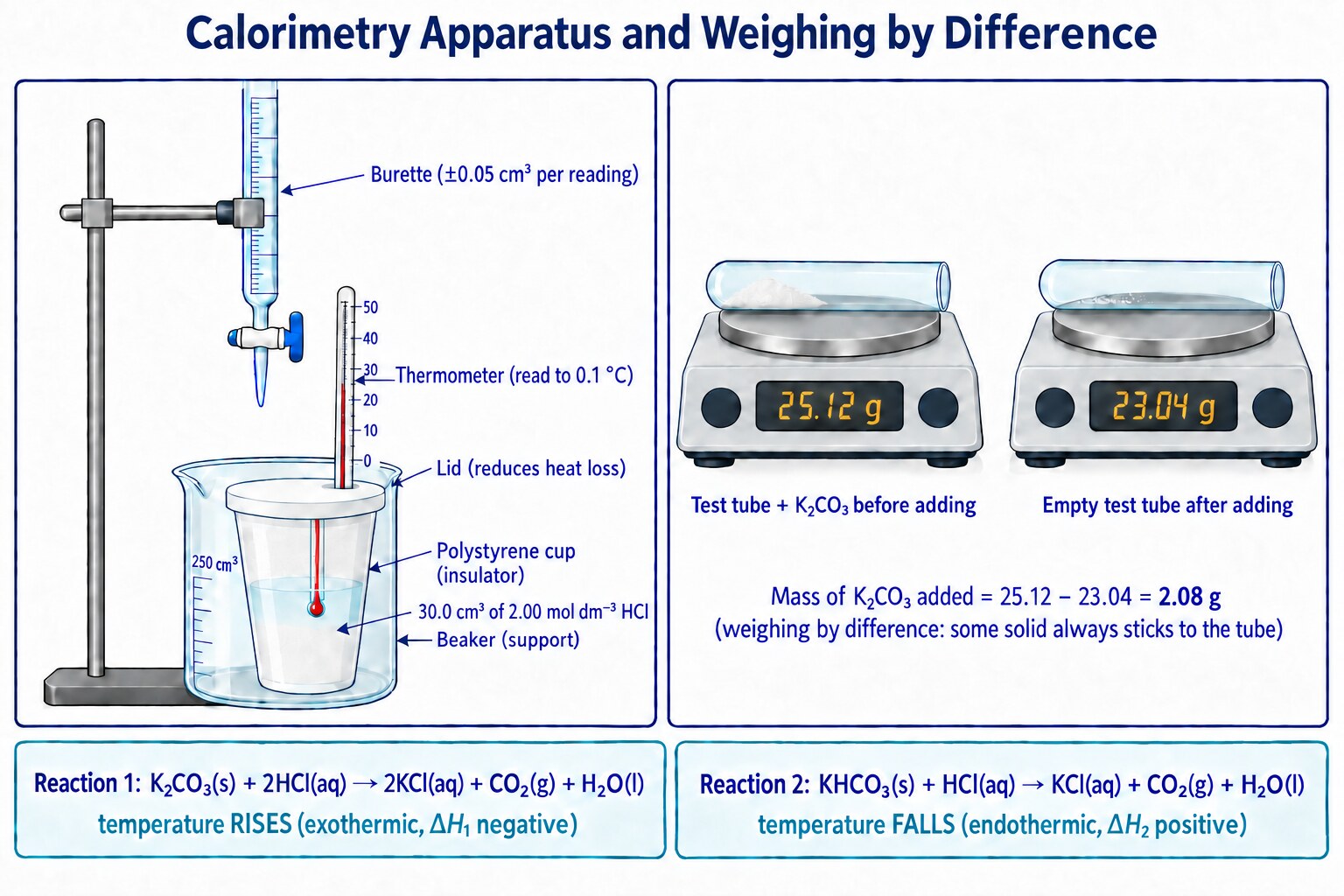
The apparatus, and weighing by difference: the mass actually added is the difference between the two balance readings.
Calorimetry Bench: K₂CO₃ and KHCO₃ with HCl
Measure the temperature change when each potassium salt reacts with hydrochloric acid, then combine the two results in a Hess cycle to find the enthalpy change for the decomposition of potassium hydrogencarbonate.
© Dr. Mohammed Al-Fatah – onlinelearningsystem.net
Check: Order the Method
Put the steps of the calorimetry method for a different carbonate into the correct order.
Measuring the Temperature Change Accurately
Heat exchange with the surroundings starts the moment the solid is added, so the highest (or lowest) temperature recorded is never the true final temperature.
While the reaction is still finishing, heat is already leaving (or entering) the cup. The extrapolation method corrects for this and is the method expected in Papers 1, 2 and 3.
The correction is a temperature-time graph. Readings are taken every 30 s for 3 minutes before the solid is added, and for 8 to 10 minutes afterwards.
A straight line is drawn through the readings after the peak (never through the rising part of the curve) and extrapolated back to the time of addition; the pre-addition readings are extrapolated forward to the same time.
ΔT is the vertical gap between the two lines at the time of addition. For an endothermic reaction the extrapolated minimum is lower than the recorded minimum, so ΔT is again larger in magnitude than the uncorrected value.
A results table for the K₂CO₃ run, with the solid added at 3.5 min, shows how the corrected value is read:
| Time / min | 0.0 | 0.5 | 1.0 | 1.5 | 2.0 | 2.5 | 3.0 | 3.5 | 4.0 | 4.5 | 5.0 | 5.5 | 6.0 | 6.5 | 7.0 |
|---|---|---|---|---|---|---|---|---|---|---|---|---|---|---|---|
| Temperature / °C | 23.2 | 23.2 | 23.2 | 23.2 | 23.2 | 23.2 | 23.2 | add | 26.8 | 27.0 | 26.9 | 26.8 | 26.7 | 26.6 | 26.5 |
The line through the readings from 4.5 min onwards falls by 0.1 °C every 30 s; extended back to 3.5 min it reaches 27.2 °C.
The corrected ΔT is 27.2 − 23.2 = +4.0 °C, slightly larger than the 3.8 °C from the highest reading alone.
Give every column a heading with its unit and every reading the same number of decimal places: both are credited.
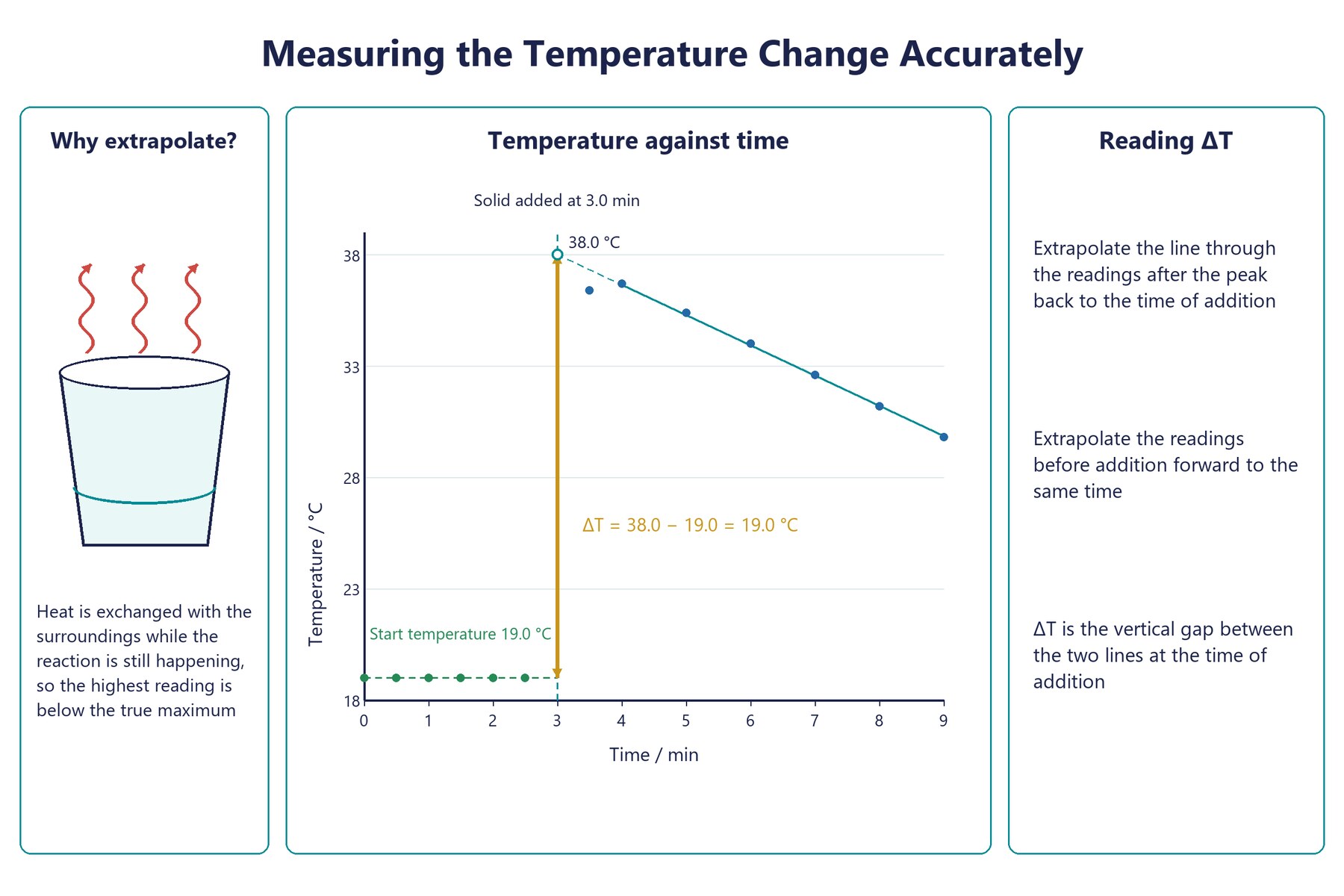
Why the cooling line is extrapolated back to the time of addition, and how ΔT is read as the vertical gap between the two lines at that time. Model data, not the results below.
Exam wording: “Plot temperature against time, draw a line of best fit through the readings after the maximum and extrapolate it back to the time of addition; ΔT is the difference between this value and the start temperature at that time.”
Name the line, the direction and where ΔT is read.
Sample Results
The same test tube (empty mass 23.04 g) was used for both solids. Temperatures are the start temperature and the extrapolated maximum or minimum; masses are read from a 2 d.p. balance.
| Measurement | K₂CO₃ run (reaction 1) | KHCO₃ run (reaction 2) |
|---|---|---|
| Mass of test tube with solid / g | 25.12 | 26.37 |
| Mass of test tube after emptying / g | 23.04 | 23.04 |
| Mass of solid added / g | 2.08 | 3.33 |
| Volume of 2.00 mol dm⁻³ HCl / cm³ | 30.0 | 30.0 |
| Start temperature / °C | 23.2 | 23.1 |
| Maximum temperature / °C | 27.2 | |
| Minimum temperature / °C | 19.2 | |
| Temperature change ΔT / °C | +4.0 | −3.9 |
Masses are to 4 significant figures and temperatures to 3, so ΔT is known to 2 significant figures and a final ΔH quoted to 3 significant figures is the most that can be justified.
The sign of ΔT tells you whether the reaction is exothermic or endothermic; q = mcΔT is then worked with the magnitude of ΔT and the sign is put on ΔH by inspection: rise → negative, fall → positive.
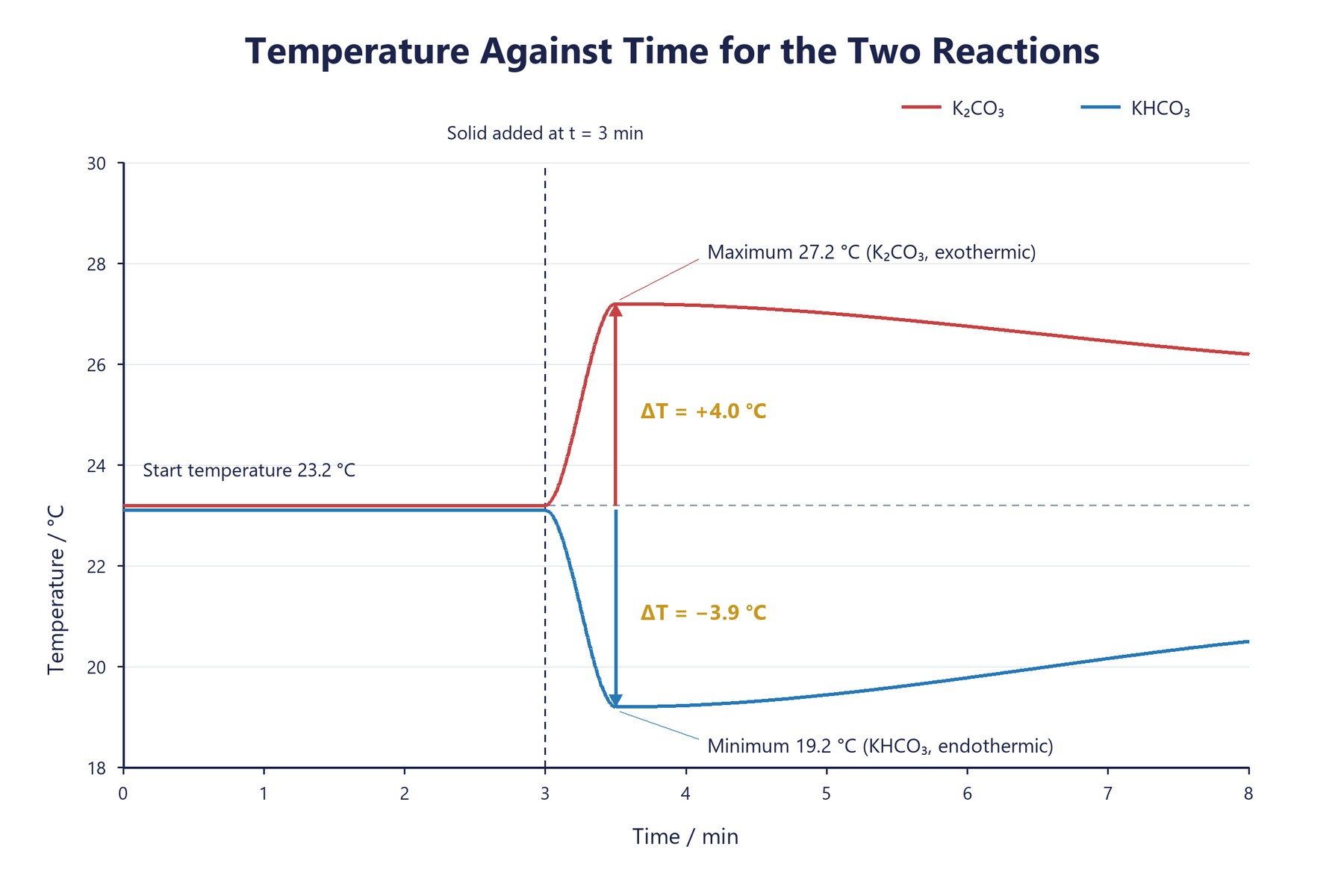
Where the table values come from: both runs on one temperature-time axis, the K₂CO₃ run rising to 27.2 °C and the KHCO₃ run falling to 19.2 °C after the solid is added.
Exam focus: Record the mass by difference, not the nominal mass, and record both the start and the extreme temperature so that ΔT can be checked. A table with headings, units and consistent decimal places earns marks on its own.
Check: Completing a Results Table
Fill in the mass by difference, ΔT and the sign of ΔH for a fresh set of balance and thermometer readings.
The Core Equation: q = mcΔT
The energy transferred to or from the solution is calculated with q = mcΔT.
Here q is the energy change in joules, m the mass of solution in grams, c the specific heat capacity in J g⁻¹ K⁻¹ and ΔT the temperature change in K or °C.
A change of 1 °C is a change of 1 K, so the two are interchangeable here.
| Symbol | Meaning | In this practical |
|---|---|---|
| q | Energy change of the solution / J | Calculated; for 2.08 g or 3.33 g of solid, not for a mole |
| m | Mass of solution / g | 30.0 cm³ of acid taken as 30.0 g: the density is assumed to be 1.00 g cm⁻³ and the mass of the solid is ignored |
| c | Specific heat capacity / J g⁻¹ K⁻¹ | 4.18 J g⁻¹ K⁻¹: the solution is assumed to have the same c as water |
| ΔT | Temperature change / °C or K | Highest or lowest temperature minus start temperature; magnitude used in the calculation |
Three assumptions are built in and are asked for by name: the density of the solution is 1.00 g cm⁻³; the specific heat capacity of the solution equals that of water; and the heat capacity of the cup and thermometer is negligible.
State all three when asked why the calculated value is approximate.
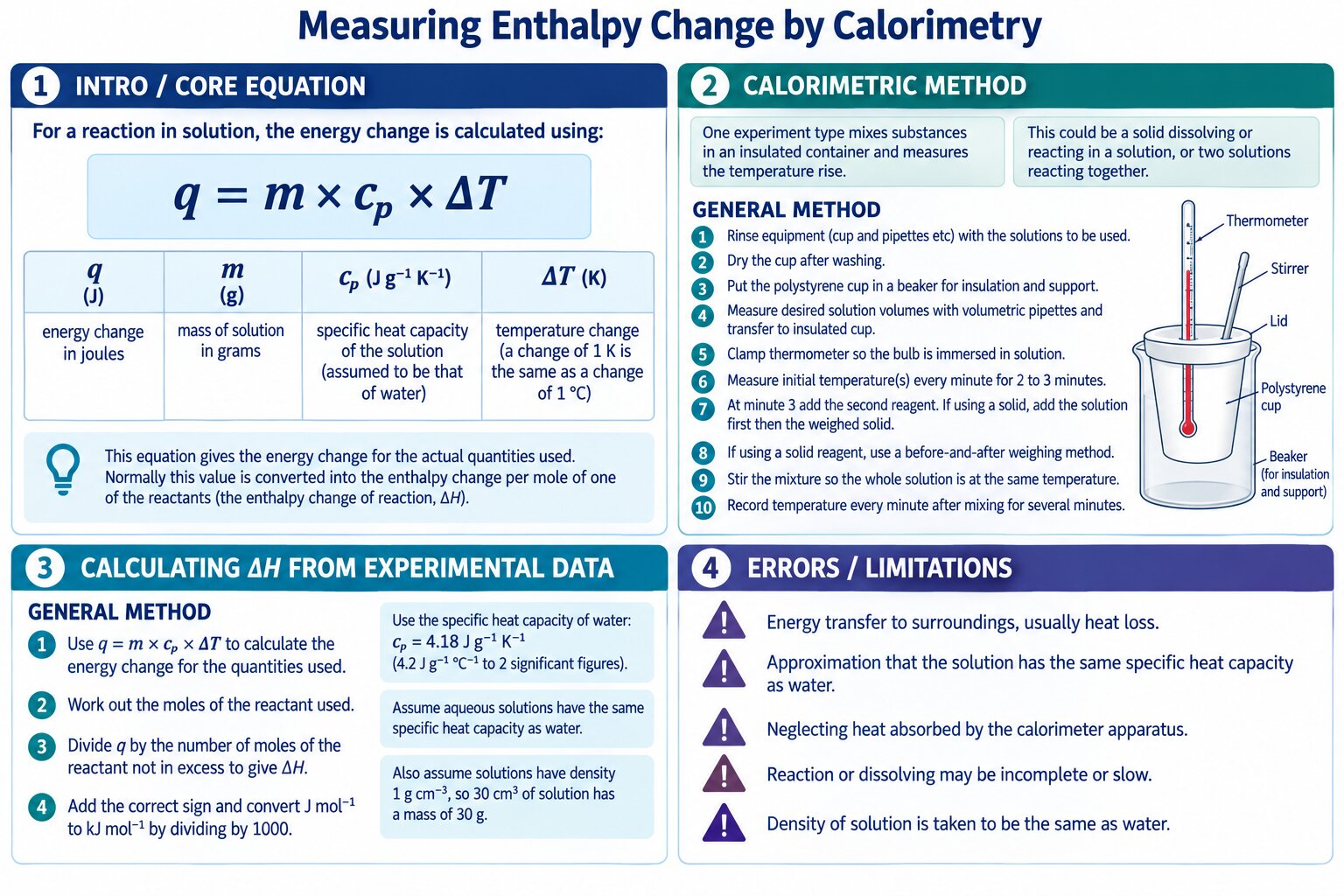
The equation, the meaning of each symbol, the insulated-cup method and its limitations in one figure. Its diagram shows the version in which two solutions are mixed; the method on this page adds a solid to the acid.
Exam wording: c = 4.18 J g⁻¹ K⁻¹ is the value given in the exam. If a question quotes 4.2, use 4.2 and round to 2 significant figures; never mix the two in one calculation.
Worked Calculation: From ΔT to ΔH
Three steps, each with units, for each reaction. Convert joules to kilojoules before dividing by moles so that ΔH comes out in kJ mol⁻¹.
Reaction 1: K₂CO₃ (exothermic)
q = m × c × ΔT = 30.0 g × 4.18 J g⁻¹ K⁻¹ × 4.0 K = 501.6 J = 0.5016 kJ (energy given out by 2.08 g of K₂CO₃)
Mr(K₂CO₃) = (2 × 39.1) + 12.0 + (3 × 16.0) = 138.2, so n = 2.08 g ÷ 138.2 g mol⁻¹ = 0.01505 mol
ΔH₁ = −0.5016 kJ ÷ 0.01505 mol = −33.3 kJ mol⁻¹ (negative because the temperature rose)
Reaction 2: KHCO₃ (endothermic)
q = 30.0 g × 4.18 J g⁻¹ K⁻¹ × 3.9 K = 489.1 J = 0.4891 kJ (energy taken in by 3.33 g of KHCO₃)
Mr(KHCO₃) = 39.1 + 1.0 + 12.0 + (3 × 16.0) = 100.1, so n = 3.33 g ÷ 100.1 g mol⁻¹ = 0.03327 mol
ΔH₂ = +0.4891 kJ ÷ 0.03327 mol = +14.7 kJ mol⁻¹ (positive because the temperature fell)
Keep the moles to 4 significant figures inside the calculation and round only the final ΔH. Rounding n to 0.0151 mol first and then writing −33.3 gives working that does not check (0.5016 ÷ 0.0151 = 33.2), and examiners do check.
Important: ΔH₁ is for one mole of K₂CO₃ reacting and ΔH₂ for one mole of KHCO₃ reacting, exactly as the equations are written. The Hess cycle has to respect that ratio.
Check: Full Calculation
Work through q, moles, ΔH with its sign and the excess check for sodium hydrogencarbonate, then flip each card to compare your working.
Checking That the Acid Is in Excess
The acid must be in excess so that the solid is the limiting reagent: q is then the energy change for the moles of solid added, and dividing by those moles gives ΔH per mole of solid.
The concentration and volume of acid are chosen so that even the largest mass of solid that might be added reacts completely.
n(HCl) available = 2.00 mol dm⁻³ × 30.0 cm³ ÷ 1000 = 0.0600 mol
| Solid | Moles of solid | HCl needed | HCl available | Excess? |
|---|---|---|---|---|
| K₂CO₃ (1 : 2) | 2.08 ÷ 138.2 = 0.01505 mol | 2 × 0.01505 = 0.0301 mol | 0.0600 mol | Yes: 0.0600 > 0.0301 |
| KHCO₃ (1 : 1) | 3.33 ÷ 100.1 = 0.03327 mol | 1 × 0.03327 = 0.0333 mol | 0.0600 mol | Yes: 0.0600 > 0.0333 (about 1.8 times) |
The KHCO₃ run is the closer of the two, which is why the method says “about 3.5 g” and not more: with 6 g of KHCO₃ the acid would run out and the moles of solid would no longer limit the reaction.
Exam wording: Compare the moles: “0.0600 mol of HCl is available and only 0.0333 mol is needed, so the acid is in excess and the moles of solid limit the reaction.” Show both numbers.
Using Hess’s Law to Find the Target ΔH
Hess’s law: the enthalpy change of a reaction is independent of the route taken. Draw the cycle rather than listing equations: examiners ask for it.
Across the top is the target, 2KHCO₃(s) → K₂CO₃(s) + CO₂(g) + H₂O(l), with 2HCl(aq) added to both sides so that each side can react with the same acid.
At the bottom are the common products, 2KCl(aq) + 2CO₂(g) + 2H₂O(l): one CO₂ and one H₂O come from reaction 1 and the other pair from the target itself.
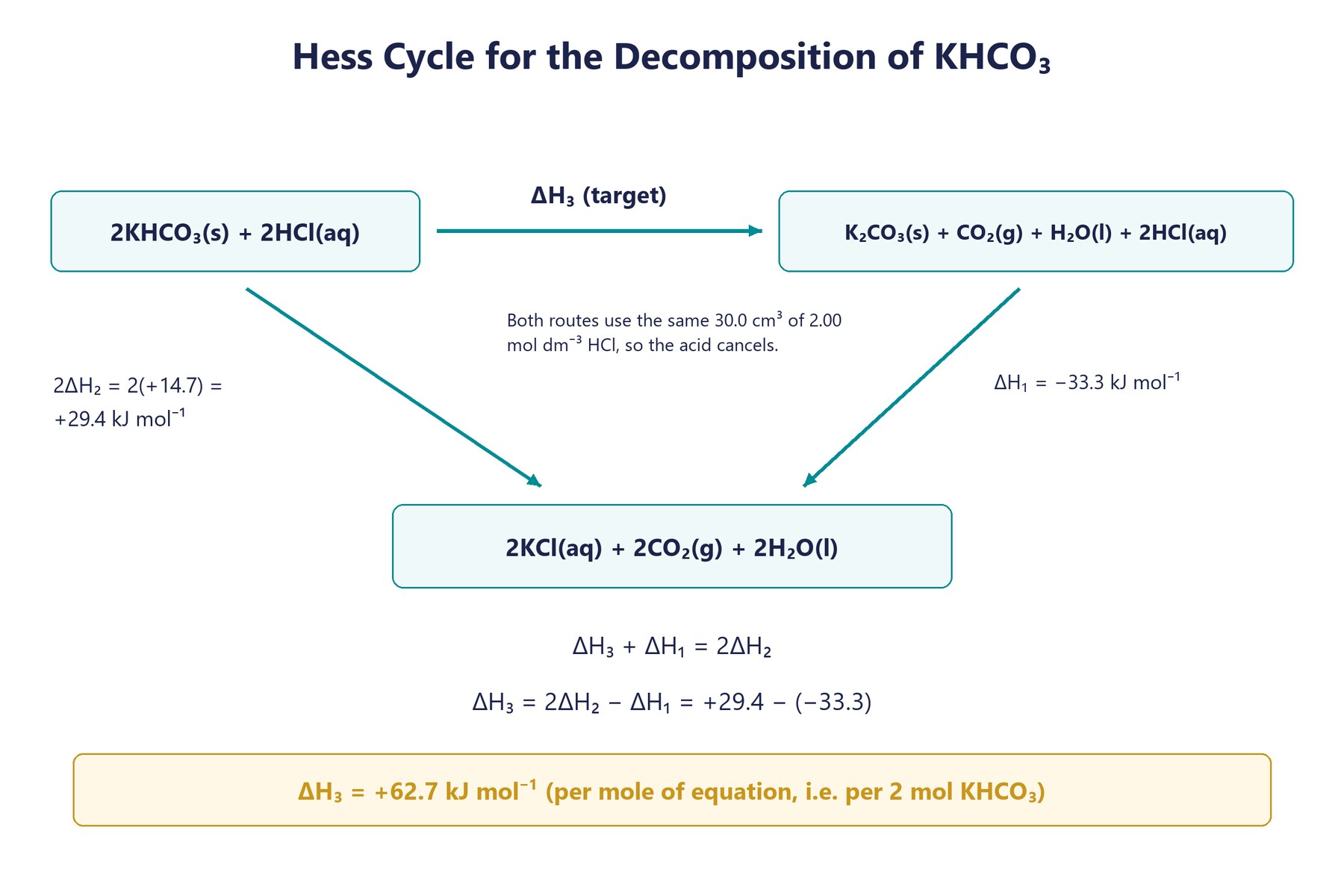
The Hess cycle. The left arrow is two lots of reaction 2 (2ΔH₂), the right arrow is reaction 1 (ΔH₁); going round the cycle, ΔH₃ + ΔH₁ = 2ΔH₂.
Route 1 (left arrow): 2KHCO₃(s) + 2HCl(aq) → 2KCl(aq) + 2CO₂(g) + 2H₂O(l), enthalpy change 2ΔH₂ because two moles of KHCO₃ react.
Route 2 (across then down): the target ΔH₃ followed by reaction 1, K₂CO₃(s) + 2HCl(aq) → 2KCl(aq) + CO₂(g) + H₂O(l), enthalpy change ΔH₁.
Equating the routes: ΔH₃ + ΔH₁ = 2ΔH₂, so
ΔH₃ = 2ΔH₂ − ΔH₁ = 2(+14.7) − (−33.3) = +29.4 + 33.3 = +62.7 kJ mol⁻¹
The decomposition is endothermic, as expected for a reaction that needs heating.
Say what “per mole” means here: +62.7 kJ mol⁻¹ is per mole of the equation as written, that is per 2 mol of KHCO₃ or per mole of K₂CO₃ formed.
Exam tip: If a question asks for the enthalpy change per mole of KHCO₃ decomposed, the answer is +62.7 ÷ 2 = +31.4 kJ mol⁻¹. This is a frequent trap.
Comparison with the accepted value. From standard enthalpies of formation the value for the equation with H₂O(l) is about +96 kJ mol⁻¹, with ΔH₁ about −33 kJ mol⁻¹ and ΔH₂ about +32 kJ mol⁻¹.
The measured ΔH₁ (−33.3) agrees within its uncertainty, but the measured ΔH₂ (+14.7) is much less endothermic than the true value because the cold solution gained heat from the surroundings, so its temperature fall was too small.
Since ΔH₂ is doubled in the cycle, that shortfall is doubled in ΔH₃, which is why the experimental value is well below +96 kJ mol⁻¹.
Exam wording: “ΔH₃ = 2ΔH₂ − ΔH₁: reaction 2 is doubled because the target contains 2 mol of KHCO₃, and reaction 1 is reversed because K₂CO₃ is a product in the target.” Give the reason for the 2 and the reason for the minus.
Check: Building the Hess Cycle
Build the cycle for the sodium salts from two new measured values and avoid the per-mole trap.
Variant: Enthalpy Change of Hydration of Magnesium Sulfate
The same Hess’s law idea is used for a target that cannot be measured directly for a different reason: anhydrous magnesium sulfate cannot be made to take up exactly seven moles of water in a cup. The target is
MgSO₄(s) + 7H₂O(l) → MgSO₄·7H₂O(s) ΔH (hydration)
Both the anhydrous and the hydrated salt dissolve in water to give the same solution, MgSO₄(aq), so their two enthalpy changes of solution form the two other sides of the cycle.
The anhydrous salt dissolves exothermically (the temperature rises); the hydrated salt dissolves endothermically (the temperature falls).
ΔH(hydration) = ΔH₁(anhydrous) − ΔH₂(hydrated).
| Step | What you do | Why |
|---|---|---|
| 1 | Weigh about 3.0 g of anhydrous MgSO₄ (0.025 mol) by difference; run 50.0 cm³ of deionised water into a polystyrene cup and record its temperature every 30 s for 3 min. | Anhydrous MgSO₄ absorbs water from the air, so weigh it quickly from a sealed container; the water readings give a steady baseline. |
| 2 | At 3.5 min add the solid, stir until dissolved, put the lid on and record every 30 s to 12 min. Plot the graph and extrapolate to 3.5 min. | Dissolving takes longer than the carbonate reactions, so extrapolation is essential here. |
| 3 | Repeat with about 6.2 g of MgSO₄·7H₂O (also 0.025 mol) in 50.0 cm³ of water. | Equal moles give the same final solution; both q values are worked per mole of MgSO₄. |
Sample results:
| Quantity | Anhydrous | Hydrated |
|---|---|---|
| Mass | 3.01 g | 6.16 g |
| Mr | 120.4 | 246.4 |
| n | 0.0250 mol | 0.0250 mol |
| ΔT | +10.6 °C | −1.7 °C |
| q | 50.0 × 4.18 × 10.6 = 2215 J | 50.0 × 4.18 × 1.7 = 355 J |
| ΔH | ΔH₁ = −2.215 ÷ 0.0250 = −88.6 kJ mol⁻¹ | ΔH₂ = +0.355 ÷ 0.0250 = +14.2 kJ mol⁻¹ |
So ΔH(hydration) = −88.6 − (+14.2) = −103 kJ mol⁻¹, close to the accepted value of about −104 kJ mol⁻¹.
The mass of water is taken as 50.0 g in both runs; strictly the hydrated salt adds 7 × 0.0250 = 0.175 mol of water, which is ignored.
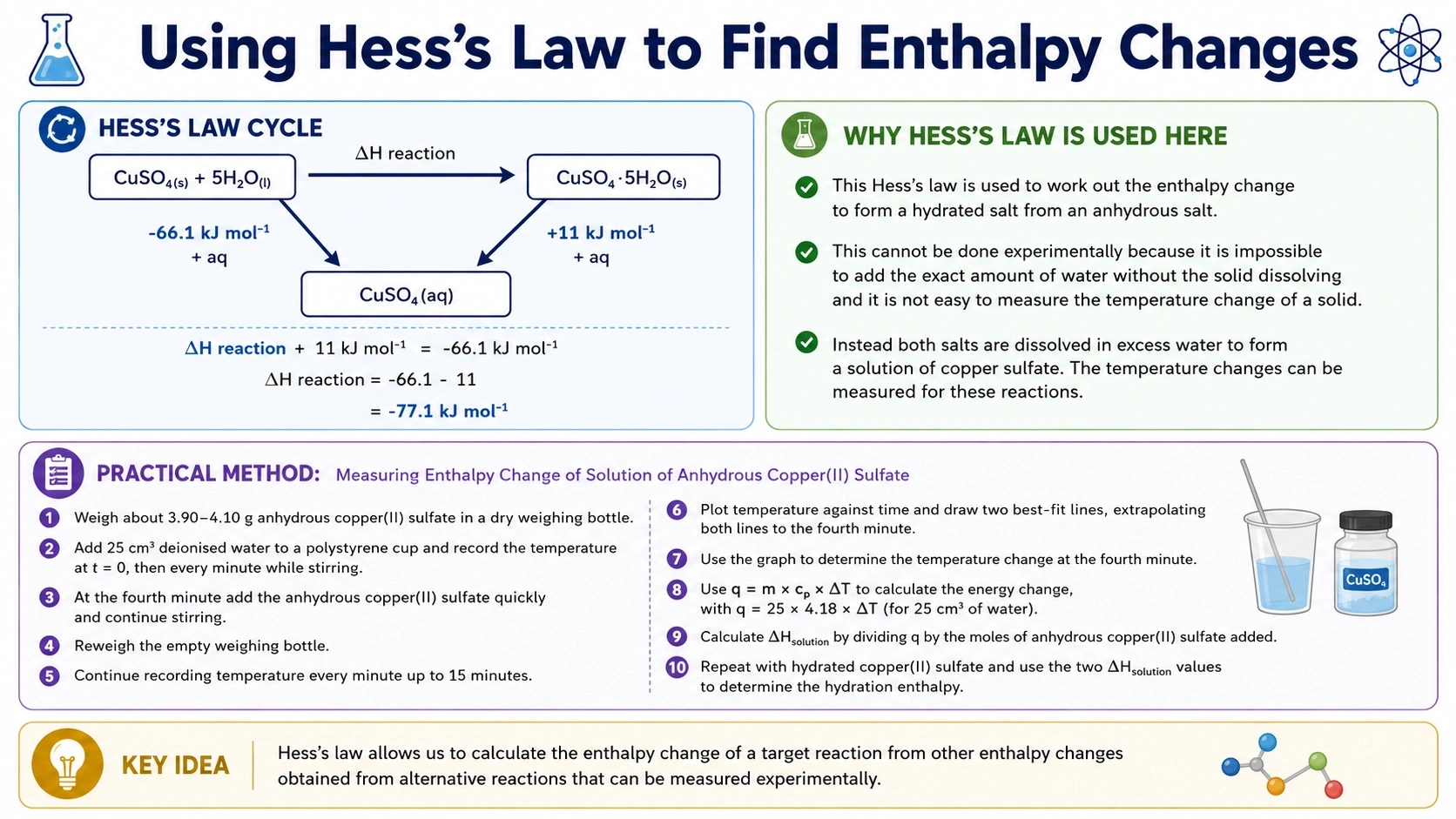
The same cycle drawn for copper(II) sulfate, CuSO₄(s) + 5H₂O(l) → CuSO₄·5H₂O(s), from the two enthalpy changes of solution, with the extrapolation method used to find each ΔT.
Exam focus: The two solutions must be the same: equal moles of salt in equal volumes of water.
The small ΔT for the hydrated salt (about −1.7 °C) carries the largest percentage uncertainty, so it is the value examiners ask you to improve, for example by using more solid in less water.
Other Calorimetry Calculations You Must Recognise
The same three-step pattern (q = mcΔT, moles of the reactant not in excess, q ÷ n with the sign) covers every calorimetry question. What changes is the mass in q = mcΔT and what “per mole” refers to.
| Type of reaction | Mass m in q = mcΔT | Divide q by | Sign |
|---|---|---|---|
| Solid added to excess solution (this practical, displacement) | The volume of solution in g | Moles of the solid | Rise → negative; fall → positive |
| Neutralisation, acid + alkali | The total volume of both solutions in g | Moles of water formed (equal to the moles of acid or alkali if neither is in excess) | Negative, about −57 kJ mol⁻¹ for strong acid and strong alkali |
| Combustion of a liquid fuel | The water in the calorimeter, not the fuel | Moles of fuel burned (from the mass lost by the burner) | Negative; large heat losses make it far less negative than the data-book value |
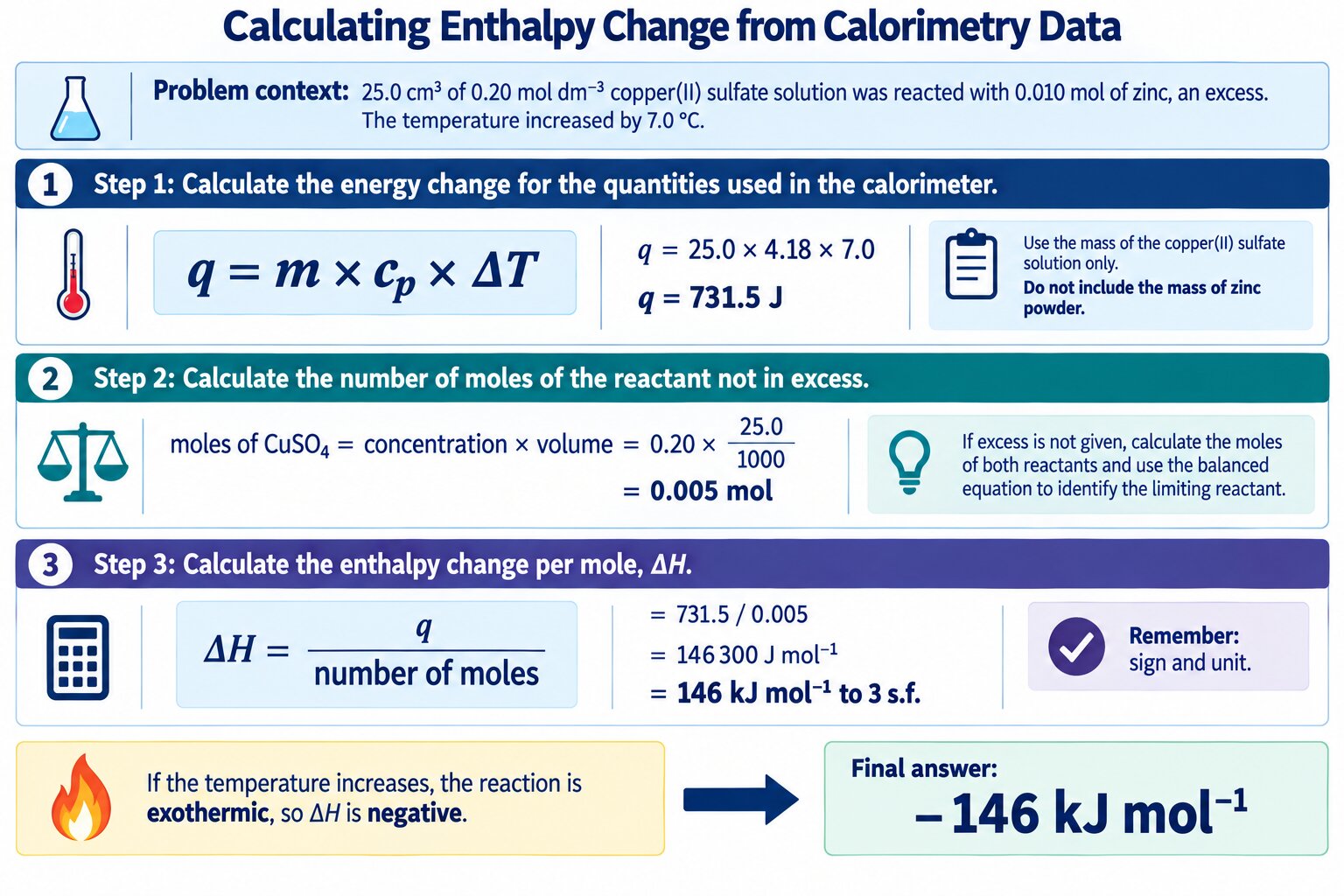
Displacement: 25.0 cm³ of 0.20 mol dm⁻³ copper(II) sulfate with excess zinc; the mass is the 25.0 g of solution and q is divided by the 0.0050 mol of Cu²⁺, the reactant not in excess.
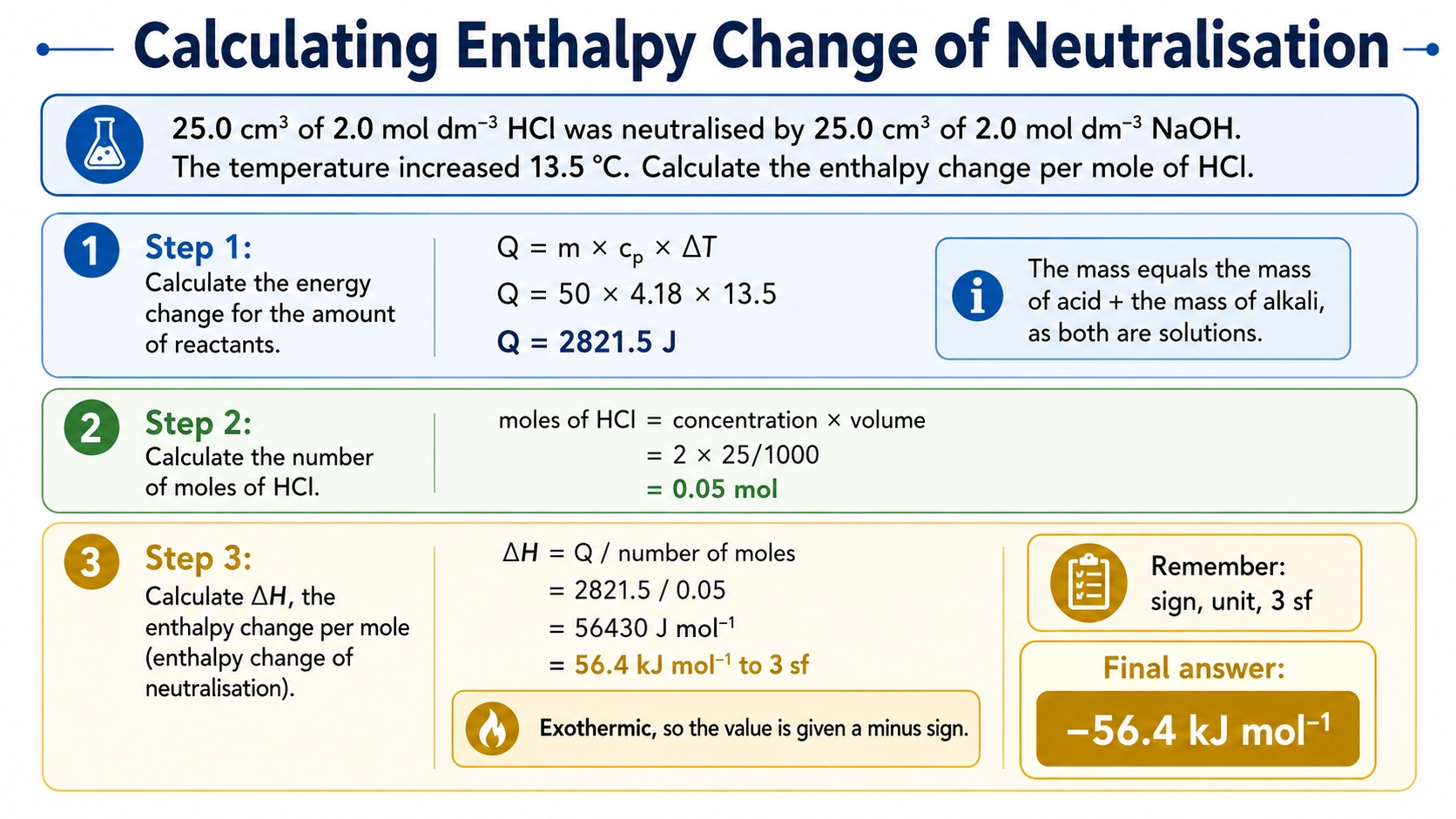
Neutralisation: the mass is the total 50.0 g of both solutions and the result is per mole of water formed, here the same as per mole of HCl.
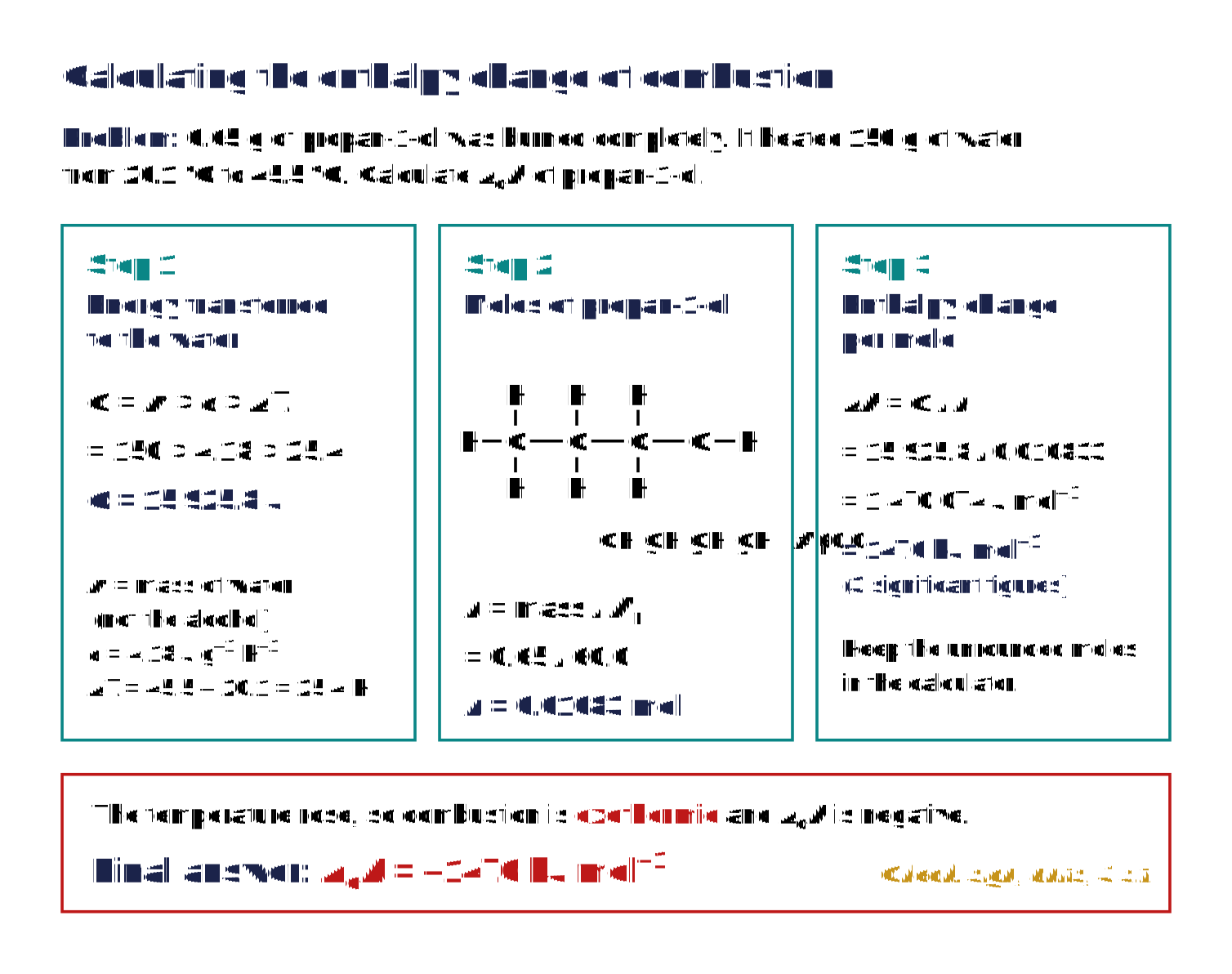
Combustion: the mass heated is the 150 g of water, the moles are those of propan-1-ol burned, and the answer is much less negative than the accepted −2021 kJ mol⁻¹ because of heat loss and incomplete combustion.
Exam strategy: Identify the target enthalpy change first, then decide which measured equation is reversed, which is multiplied and what is being heated. Only then pick up the calculator.
Errors, Uncertainty and Improvements
Questions ask for the source of an error, its direction (is the result too large or too small?) and a specific improvement. Vague answers (“human error”, “use better equipment”) score nothing.
| Source of error | Effect on the result | Improvement |
|---|---|---|
| Heat lost to the surroundings during the exothermic reaction | ΔT too small, so q too small and ΔH₁ less negative than the true value | Lid on the cup, cup of low heat capacity standing in a beaker, plot temperature against time and extrapolate to the time of addition |
| Heat gained from the surroundings during the endothermic reaction | ΔT too small in magnitude, so ΔH₂ less positive than the true value; the error is doubled in ΔH₃ = 2ΔH₂ − ΔH₁ | The same lid, insulation and extrapolation; add the solid in one portion so the reaction is over quickly |
| Specific heat capacity of the solution taken as that of water | A small systematic error either way; acceptable for dilute solutions | Accepted approximation: state it as an assumption rather than proposing to change it |
| Heat absorbed by the cup and thermometer ignored | Slightly reduces the measured ΔT | Polystyrene has a very small heat capacity, so the effect is small: this is why the cup is chosen |
| Solid not all transferred, or nominal 3 g used instead of the mass by difference | Moles too high, so ΔH too small in magnitude | Weigh the tube before and after; use the difference |
| K₂CO₃ has absorbed water from the air (it is deliquescent) | The mass weighed includes water, so the moles calculated are too high and ΔH₁ too small in magnitude | Keep the solid in a sealed container and weigh quickly |
| CO₂ escaping carries some heat; spray lost during effervescence | Small loss of energy and mass from the cup | Lid with a small hole for the thermometer; add the solid steadily |
| Thermometer bulb not fully in the liquid, or read before the reading is steady | Random error in ΔT in either direction | Keep the bulb immersed and stir; wait for a steady start temperature |
Percentage uncertainty in the K₂CO₃ run
Every quantity found from two readings carries twice the reading uncertainty.
Temperature: ±0.1 °C on each of two readings gives ±0.2 °C on ΔT, so (0.2 ÷ 4.0) × 100 = 5.0 %.
Mass: ±0.01 g on each of two readings gives ±0.02 g on 2.08 g, so (0.02 ÷ 2.08) × 100 = 1.0 %.
Volume: ±0.05 cm³ on each burette reading gives ±0.1 cm³ on 30.0 cm³, so (0.1 ÷ 30.0) × 100 = 0.3 %.
Total about 6.3 %, which on ΔH₁ = −33.3 kJ mol⁻¹ is ±2.1 kJ mol⁻¹. For the KHCO₃ run the temperature term is (0.2 ÷ 3.9) × 100 = 5.1 % and the mass term 0.6 %.
The temperature change is by far the largest contributor, so the worthwhile improvements attack ΔT.
Use a larger mass of solid or a smaller volume of acid to give a bigger temperature change (keeping the acid in excess).
Or use a thermometer reading to 0.1 °C if a 1 °C thermometer was used (±0.5 °C per reading would make the ΔT term 25 %). Improving the balance changes almost nothing.
Exam wording: “Percentage uncertainty = (2 × 0.1 ÷ 4.0) × 100 = 5.0 %, the largest of the three, so the thermometer limits the accuracy; a larger ΔT would reduce it.” Two readings, the arithmetic, the comparison and the improvement.
Check: Uncertainty and Error Direction
Percentage uncertainties on a new data set, which instrument to improve first, and which way heat loss pushes each value.
Common Mistakes
- Wrong sign: calculating q correctly and then giving an exothermic reaction a positive ΔH. Rise → negative; fall → positive.
- Forgetting the 2: writing ΔH₃ = ΔH₂ − ΔH₁ when the target contains two moles of KHCO₃.
- Wrong “per mole”: quoting +62.7 kJ mol⁻¹ as the value per mole of KHCO₃ (it is +31.4).
- Dividing joules by moles and forgetting to convert to kJ, giving an answer 1000 times too large.
- Using the mass of solid as m in q = mcΔT, or adding it to the 30.0 g. The mass is the solution being heated.
- Nominal mass: using “3.00 g” instead of the mass found by difference.
- Cooling line through the rising points on a temperature-time graph, or reading ΔT anywhere other than the time of addition.
- “Human error” or “use better equipment” as an evaluation. Name the error, its direction and a specific improvement.
- One reading, one uncertainty: forgetting that ΔT and a mass by difference each come from two readings.
Check: Assumptions and Final Checks
Pick the accurate statement about each assumption behind the calculation.
Common Exam Points
Say
“The acid is in excess (0.0600 mol available, 0.0333 mol needed) so the solid limits the reaction.”
“q = 30.0 × 4.18 × 4.0 = 501.6 J, assuming a density of 1.00 g cm⁻³ and the specific heat capacity of water.”
“ΔH₃ = 2ΔH₂ − ΔH₁ because the target contains 2 mol of KHCO₃ and reaction 1 is reversed.”
“Heat gained from the surroundings makes ΔH₂ less positive, and the error is doubled in the cycle.”
“Percentage uncertainty in ΔT = (0.2 ÷ 4.0) × 100 = 5.0 %.”
Do not say
“The reaction is exothermic so ΔH is positive.” “The mass is 2.08 g” (in q = mcΔT). “Heat loss makes the value more negative.”
“Use a more accurate specific heat capacity” or “calibrate the calorimeter” as improvements.
“Extrapolate” when describing a method that records the highest temperature, or “highest temperature” when the question asked for the graphical method.
Watch for
State symbols on every equation. Units on every line of working: g, J g⁻¹ K⁻¹, K, J, kJ, mol, kJ mol⁻¹. Significant figures: 3 in the final ΔH.
Whether a question wants ΔH per mole of KHCO₃ or per mole of equation. Whether the cooling line has been drawn only through the readings after the peak. Whether both readings have been counted in each percentage uncertainty.
FAQs
The questions students ask most about calorimetry, enthalpy calculations and Hess’s law for this practical.
Why can the decomposition of potassium hydrogencarbonate not be measured directly?
The solid has to be heated continuously to decompose, so the energy supplied by the Bunsen cannot be separated from the energy absorbed by the reaction.
There is no solution into which a thermometer can be placed to measure a temperature change. Two reactions that do happen in solution are measured instead and combined with Hess’s law.
Why is a polystyrene cup used, and why is it stood in a beaker?
Polystyrene is a poor conductor with a very small heat capacity, so almost all of the energy change stays in the solution and very little is absorbed by the cup or lost to the surroundings. The beaker simply supports the light cup so it cannot tip over.
Why must the hydrochloric acid be in excess?
So that the solid is the limiting reagent. The energy change q then belongs to the moles of solid added, and dividing q by those moles gives ΔH per mole of solid. With 30.0 cm³ of 2.00 mol dm⁻³ acid there is 0.0600 mol of HCl against a maximum of about 0.033 mol needed.
Why is reaction 2 doubled and reaction 1 reversed in the Hess calculation?
The target equation contains 2 mol of KHCO₃ but reaction 2 is written for 1 mol, so ΔH₂ is multiplied by 2. K₂CO₃ is a reactant in reaction 1 but a product in the target, so reaction 1 is reversed and the sign of ΔH₁ changes. That gives ΔH₃ = 2ΔH₂ − ΔH₁.
Why is the experimental value so much smaller than the data-book value?
Mainly because the endothermic KHCO₃ reaction gains heat from the surroundings while the solution is cold, so its temperature fall and ΔH₂ are too small; ΔH₂ is doubled in the cycle, so the shortfall is doubled in ΔH₃.
Heat exchange with the surroundings always makes the magnitude of a measured enthalpy change too small.
What is the single most common calculation mistake?
The sign. A temperature rise means the reaction is exothermic and ΔH is negative; a temperature fall means endothermic and ΔH is positive. Work q with the magnitude of ΔT, then put the sign on by inspection.
Copyright and author footprint: This OLS revision page was written for Online Learning System by Dr. Mohammed Al-Fatah. It is designed for A Level Chemistry revision and should not be copied or redistributed without permission.
Keep this note — free
Save your progress across every AQA topic. A free account remembers which topics you have covered, saves your question scores, and syncs across your phone and laptop.
- Track every topic you have finished
- Keep your practice-question scores
- No payment, no card, free forever
Already registered? Log in