Required Practical 1: Acid–Base Titration
Required Practical 1 finds the concentration of a hydrochloric acid solution by diluting it tenfold and titrating 25.0 cm³ aliquots against standardised 0.0800 mol dm⁻³ sodium hydroxide with phenolphthalein. This page gives the method with the reason for every step, corrected sample results, the full calculation to 0.963 mol dm⁻³, the error directions and the percentage uncertainty budget that Papers 1, 2 and 3 questions demand.
GCSE Recap: Neutralisation and Volumes
Three quick questions on what you already know: the apparatus that measures a fixed 25.0 cm³, the products of neutralisation and how a burette volume is worked out.
What This Practical Is Testing
In Required Practical 1 you find the concentration of a hydrochloric acid solution that is too concentrated to titrate directly.
You pipette 25.0 cm³ of the original acid into a 250 cm³ volumetric flask and make it up to the mark with distilled water.
You then titrate 25.0 cm³ portions (aliquots) of the diluted acid against a standardised sodium hydroxide solution of concentration 0.0800 mol dm⁻³ using phenolphthalein.
The mean titre gives the moles of alkali, the equation gives the moles of acid, and a scale-up of ten takes you back to the original solution.
The reaction is a strong acid neutralising a strong base:
HCl(aq) + NaOH(aq) → NaCl(aq) + H₂O(l)
The ionic equation, which is asked for at least as often, is H⁺(aq) + OH⁻(aq) → H₂O(l). The ratio is 1 : 1, so at the end point the moles of NaOH delivered from the burette equal the moles of HCl in the flask.
The sodium hydroxide has to be standardised first because it cannot be a primary standard: solid NaOH absorbs water and carbon dioxide from the air, so a solution made by weighing it never has the concentration you calculate.
Its concentration is found by titrating it against a primary standard such as anhydrous sodium carbonate (see Required Practical 1 (preparation of a standard solution)).
Common mistake: Students lose marks by writing “the NaOH is a standard solution” as if weighing it out were enough.
Required Practical 1 on AQA is usually run the other way round: you first make a standard solution from a weighed solid, most often anhydrous sodium carbonate (see Required Practical 1 (preparation of a standard solution)).
You then titrate the acid against it, with methyl orange as the usual indicator.
Every technique below (pipette, burette, end point, concordant titres, uncertainty) is examined in exactly the same way, and the calculation from a mass is worked through further down this page.
You are assessed through the written papers (at least 15% of the marks test practical skills) and the practical endorsement.
For this practical that means: the reasons for each technique step, the direction of the error each mistake causes, the treatment of the results table, the calculation with correct units and significant figures, and the percentage uncertainty budget.
Key idea: The whole practical is stoichiometry on top of accurate volumes: moles of alkali from c × V, moles of acid from the equation, then scale from the aliquot to the flask and back to the original acid.
Check: Equations and Mole Ratios
Write state symbols and the ionic equation for a different acid and alkali, and use the mole ratio.
Safety and Apparatus
An apparatus question wants the full list with a reason for each item, and the precision of the measuring glassware. The items students forget are the small ones: the white tile, the funnel, the wash bottle, the dropping pipette and the stopper.
| Item | What it is for | Precision or note |
|---|---|---|
| 25 cm³ volumetric pipette and filler | Measures 25.0 cm³ of the original acid into the volumetric flask, then 25.0 cm³ aliquots of the diluted acid into the conical flask | ±0.06 cm³; never mouth-pipette |
| 250 cm³ volumetric flask with stopper | Dilutes the 25.0 cm³ sample to exactly 250 cm³; stoppered and inverted to mix | ±0.3 cm³; one graduation line only |
| 50 cm³ burette, clamp and stand | Delivers a measured, variable volume of NaOH(aq) into the flask | ±0.05 cm³ per reading, read to the nearest 0.05 cm³ |
| Small funnel | Fills the burette without spills; removed before the initial reading | Left in, it drips and lowers the reading |
| 250 cm³ conical flask | Holds the aliquot during titration; its shape lets you swirl without loss | Rinsed with distilled water only |
| White tile | Sits under the flask so the faint pink end point is seen against white | A sheet of white paper also works |
| Wash bottle of distilled water and dropping pipette | Makes the volumetric flask up to the mark, the last drops one at a time; rinses the pipette tip into the flask | Overshooting the mark means starting again |
| Beakers | Hold the original acid, the diluted acid and the NaOH(aq) while pipetting and filling | Label them |
| Reagents | Hydrochloric acid, about 1 mol dm⁻³; sodium hydroxide, 0.0800 mol dm⁻³, standardised; phenolphthalein indicator | Quote the alkali concentration with its status: standardised |
Hazards and precautions: Hydrochloric acid at about 1 mol dm⁻³ is low hazard; sodium hydroxide at 0.0800 mol dm⁻³ is an irritant; phenolphthalein is dissolved in ethanol, which is flammable.
Wear eye protection throughout, wipe up spills at once and wash any splash off the skin with plenty of water. Use a pipette filler, never the mouth.
Fill the burette below eye level, standing it on the bench or a low stool, so that alkali cannot splash into the eyes.
That last point is the safety mark examiners give; “take care with glassware” earns nothing.
Check: What Each Precaution Does
Decide whether each step in a titration reduces random error, reduces systematic error or is there for safety only.
Method: Step by Step
Every step carries a reason. Method questions in Papers 1, 2 and 3 are marked on the reasons and the numbers, not on the bare instruction, so learn the third column as carefully as the second.
| Step | What you do | Why |
|---|---|---|
| 1 | Rinse the 25 cm³ pipette with a little of the hydrochloric acid and discard the rinsings | Water left inside would dilute the acid drawn up, so fewer moles would be transferred |
| 2 | Pipette 25.0 cm³ of the hydrochloric acid into a rinsed 250 cm³ volumetric flask, touching the tip against the inside of the neck; do not blow out the last drop | The pipette is calibrated to leave that drop behind; blowing it out transfers extra acid |
| 3 | Rinse the pipette tip and the neck of the flask into the bulb with distilled water | Every drop of acid must end up in the 250 cm³ |
| 4 | Add distilled water to about 1 cm below the line, then add the last drops with a dropping pipette until the bottom of the meniscus sits on the line, read at eye level | Overshooting cannot be undone: the flask is emptied and the dilution repeated |
| 5 | Stopper and invert the flask at least ten times | Without mixing the aliquots taken later would have different concentrations (a random error) |
| 6 | Rinse the burette with distilled water, then with the NaOH(aq); fill through a funnel, open the tap to fill the jet, then remove the funnel and take the initial reading to the nearest 0.05 cm³ | Water in the burette dilutes the alkali; an air bubble in the jet and drips from the funnel both give false readings; the initial reading need not be 0.00 |
| 7 | Rinse the conical flask with distilled water only, pipette in 25.0 cm³ of the diluted acid (rinsing the pipette with diluted acid first) and add 2 to 3 drops of phenolphthalein | Water in the conical flask does not change the moles of acid in it, but rinsing it with acid would add extra moles and enlarge the titre |
| 8 | Stand the flask on a white tile and run in NaOH(aq) from the burette, swirling continuously, until the first permanent pink appears; record the final reading. This is the rough titre | The rough titre locates the end point roughly so that the accurate titrations can be run dropwise near it; it is never used in the mean |
| 9 | Repeat with fresh aliquots, adding the alkali quickly to within about 2 cm³ of the rough titre and then drop by drop, swirling, until the first faint pink persists for about 30 s | One drop is about 0.05 cm³, so dropwise addition is what makes the end point sharp |
| 10 | Continue until at least two titres agree within 0.10 cm³ of each other; record every reading to two decimal places ending in 0 or 5 | Concordant titres show the random error is small; the mean of those titres alone goes into the calculation |
Exam wording: “Rinse the pipette with the acid, the burette with the alkali and the conical flask with distilled water.” One sentence, three rinses, three different reasons; students who write “rinse all the glassware with water” lose the mark.
Titration: HCl against Standardised NaOH
Dilute a sample of hydrochloric acid, titrate 25.0 cm³ portions against 0.0800 mol dm⁻³ sodium hydroxide with phenolphthalein, and work back to the concentration of the original acid.
© Dr. Mohammed Al-Fatah – onlinelearningsystem.net
Diluting Before You Titrate
The dilution step is not always part of Required Practical 1 as you meet it, but the reasoning is examined in planning questions and the technique is the same one used to make a standard solution.
An acid of about 1 mol dm⁻³ contains 0.025 mol of HCl in 25.0 cm³. Titrating that with 0.0800 mol dm⁻³ NaOH would need 0.025 ÷ 0.0800 = 0.31 dm³, about 300 cm³ of alkali, six burette fillings, each adding its own reading uncertainty.
After a tenfold dilution the 25.0 cm³ aliquot holds 0.0025 mol and needs about 30 cm³, which fits a 50 cm³ burette comfortably and keeps the percentage uncertainty in the titre near 0.3%.
The dilution factor is 250 ÷ 25.0 = 10. Every mole that was in the 25.0 cm³ sample is now spread through 250 cm³, so a 25.0 cm³ aliquot of the diluted acid contains one tenth of the original moles.
Common mistake: That factor of ten reappears in the calculation, and forgetting it is the most common calculation error on this practical.
Technique decides whether the diluted concentration is what you think it is. The pipette is rinsed with the acid, not water, and is filled until the bottom of the meniscus sits on the line at eye level.
The tip touches the inside of the flask neck as it drains and the last drop stays in the pipette.
Water is added to about 1 cm below the line and then dropwise, because once the meniscus is past the line the only cure is to discard and repeat: water cannot be taken back out.
Finally the flask is stoppered and inverted at least ten times; a flask that is not inverted gives aliquots of different concentrations and scattered titres.
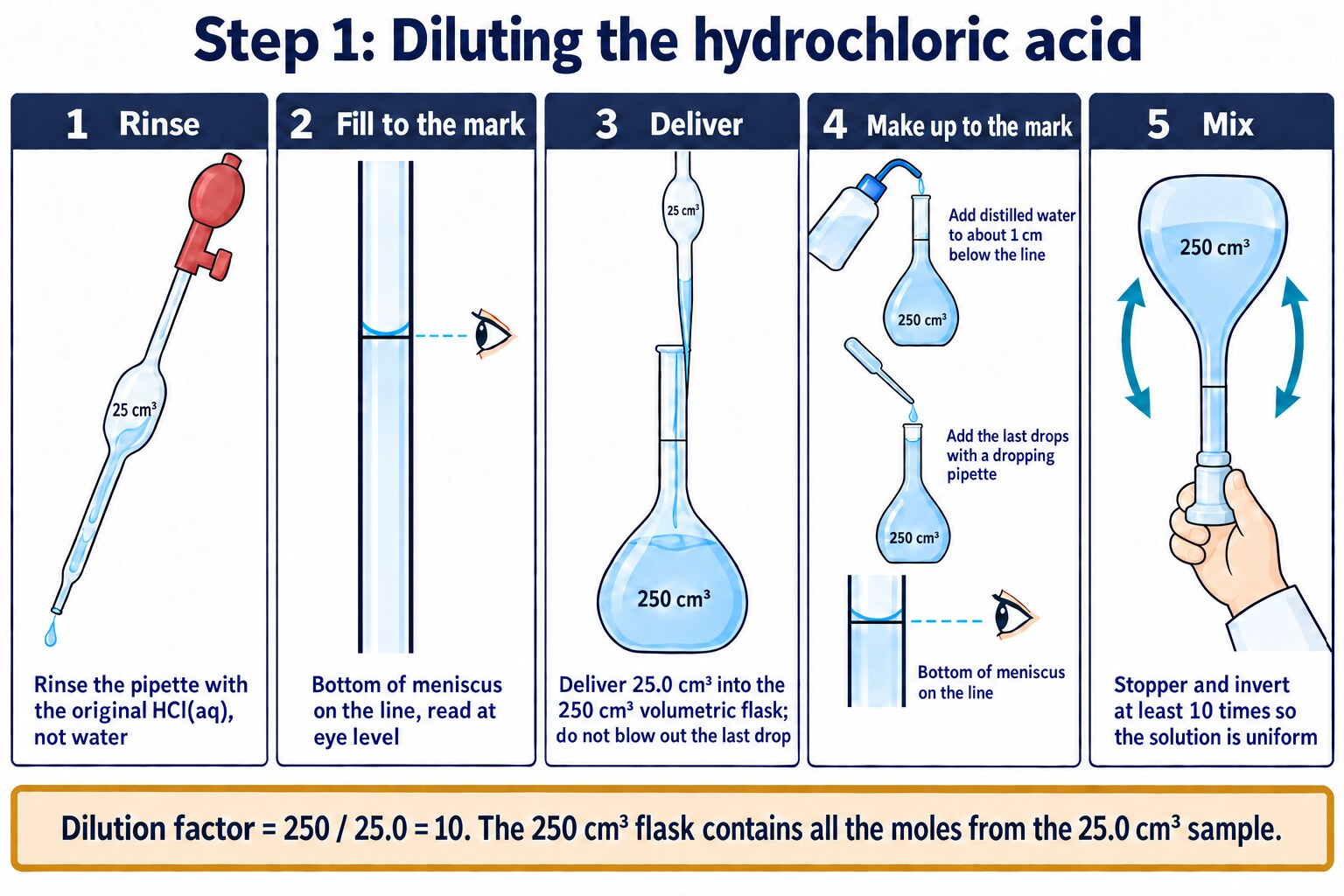
Diluting the acid: rinse the pipette with the acid, fill to the mark, deliver 25.0 cm³ into the 250 cm³ volumetric flask, make up to the line with a dropping pipette, then stopper and invert ten times. Dilution factor = 250 ÷ 25.0 = 10.
Exam focus: Why dilute? “So that the titre is about 30 cm³ and fits the burette; an undiluted titration would need about 300 cm³ of alkali.” Why invert? “So the solution is homogeneous and every aliquot has the same concentration.” Both are one-mark answers that most students leave blank.
Check: Dilution Errors
Apply the dilution reasoning to a different acid and a different flask, and decide which way the error goes.
Setting Up the Burette and Running the Titration
The burette is rinsed with distilled water and then with the sodium hydroxide solution it will hold.
Filled with a wet burette, the alkali is slightly diluted, a larger volume is needed to supply the same moles of OH⁻, the titre is too large and the calculated acid concentration is too high.
The burette is filled through a small funnel, below eye level, and the tap is opened briefly to fill the jet.
An air bubble that sits in the jet at the start and is pushed out during the titration counts as delivered volume that never reached the flask, so again the titre is too large.
Then the funnel is removed before the initial reading; left in, it drips, the final reading is lower than it should be and the titre is too small.
The initial reading does not have to be 0.00 cm³. Read the bottom of the meniscus at eye level and record to the nearest 0.05 cm³, so every reading ends in 0 or 5 in the second decimal place.
Reading from the top of the meniscus every time cancels out in the titre, because the titre is a difference of two readings; reading inconsistently does not cancel and adds random error.
The conical flask is rinsed with distilled water only. Any water left in it makes no difference to the result because all the acid in the flask is titrated whatever its volume.
Rinsing the flask with the diluted acid, by contrast, adds acid that was not measured and enlarges the titre.
A conical flask rather than a beaker is used because it can be swirled vigorously without splashing out solution.
Two or three drops of phenolphthalein are enough; the indicator is itself a weak acid and consumes a trace of alkali.
During the titration the flask is swirled continuously so that the alkali mixes at once and the pink flashes where it lands disappear.
In the rough titration the alkali is run in steadily to find the approximate end point.
In the accurate titrations it is run in quickly to about 2 cm³ short of that value and then added drop by drop, with the flask swirled after each drop, so that the end point is fixed to within one drop, about 0.05 cm³.
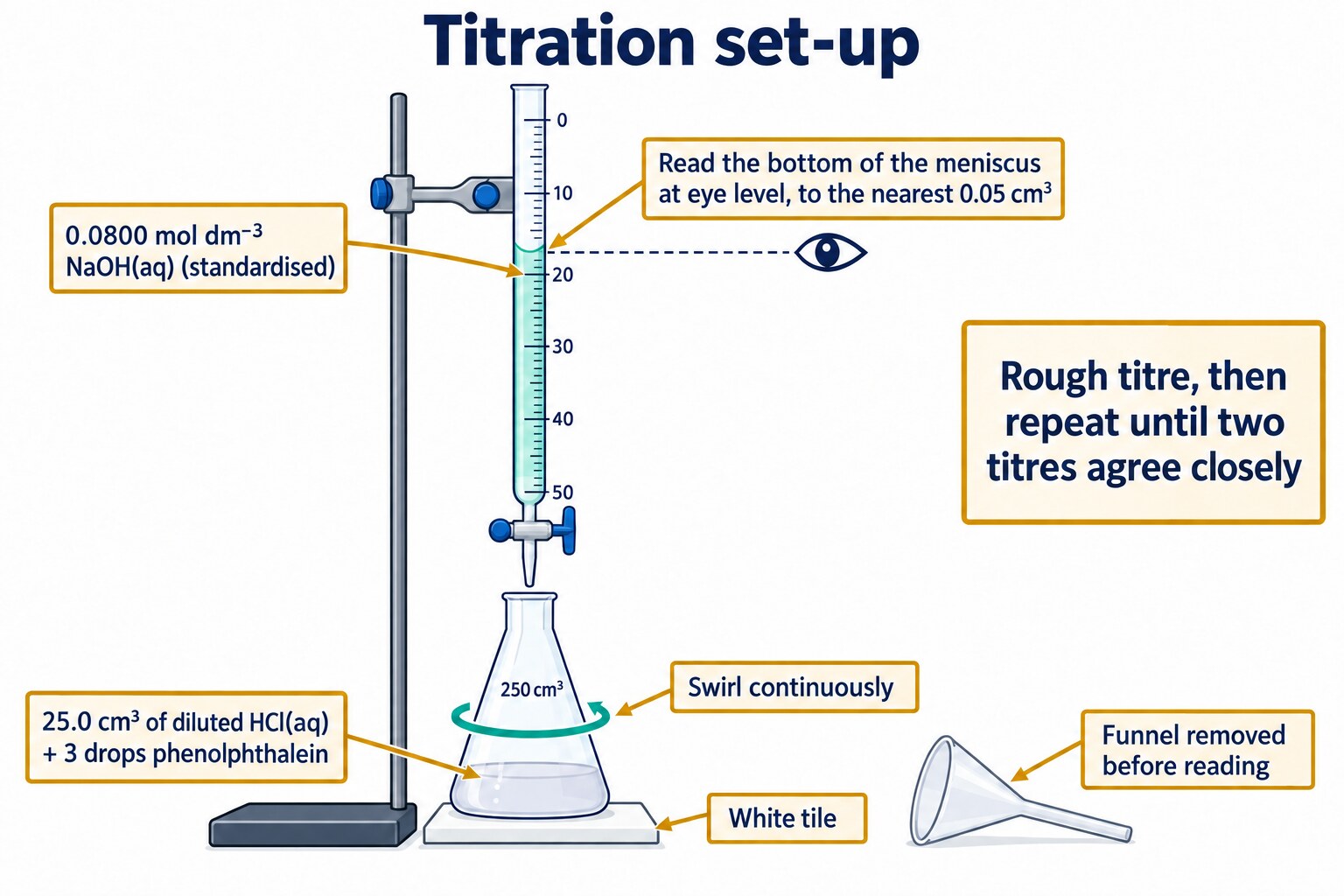
The titration set-up: 50 cm³ burette of 0.0800 mol dm⁻³ NaOH(aq) clamped vertically with the funnel removed, 25.0 cm³ of diluted HCl(aq) with three drops of phenolphthalein in a 250 cm³ conical flask on a white tile, and the eye level with the meniscus.
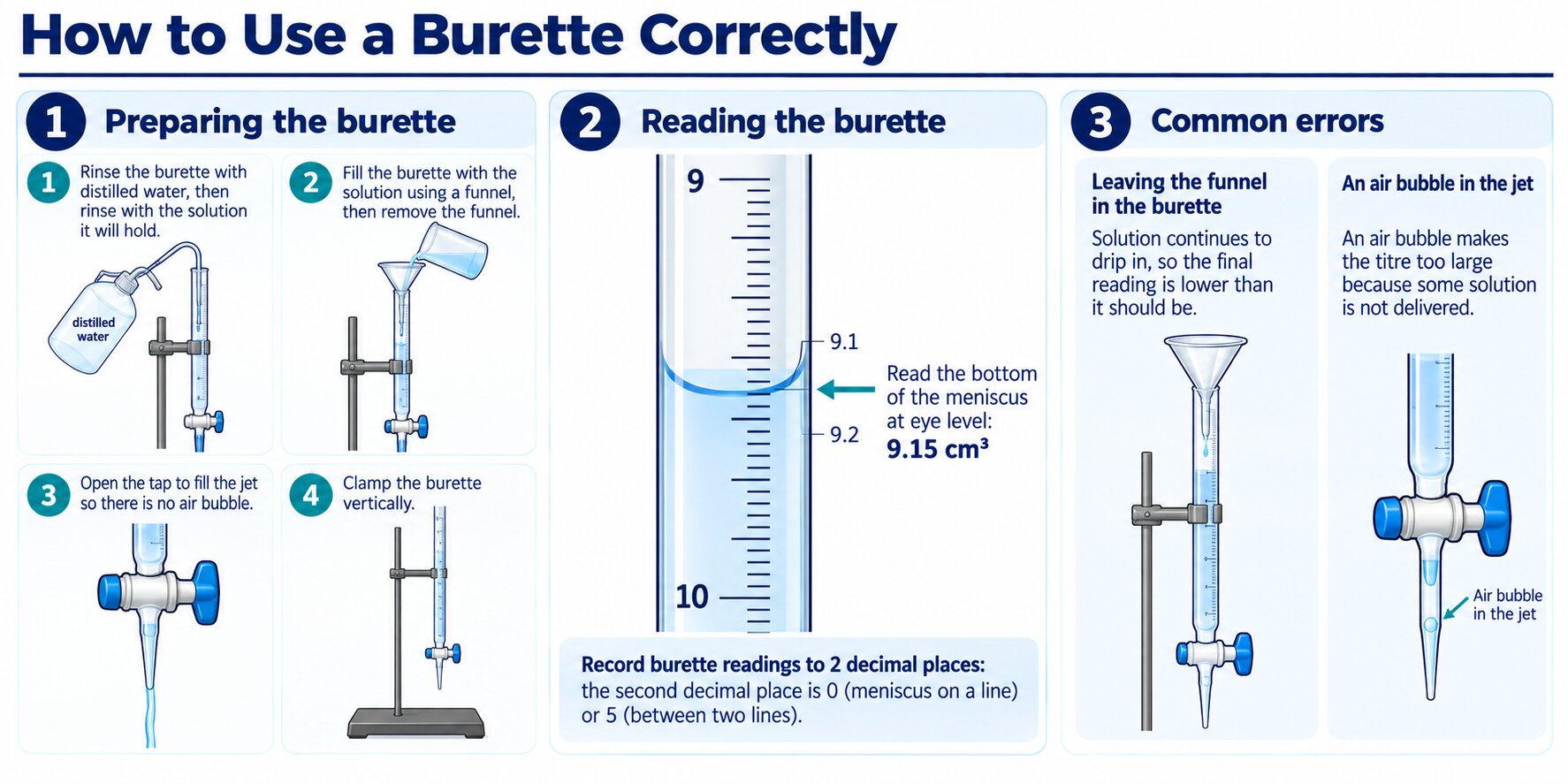
Using the burette: rinse with the solution, fill with the funnel then remove it, open the tap to fill the jet, and read the bottom of the meniscus at eye level to the nearest 0.05 cm³ (here 9.15 cm³).
A funnel left in lowers the final reading; a bubble in the jet inflates the titre.
Exam focus: Three rinsing errors, three directions: pipette rinsed with water, fewer moles of acid, titre too small; burette rinsed with water, dilute alkali, titre too large; conical flask rinsed with acid, extra moles of acid, titre too large. Always finish with the effect on the calculated concentration.
Spotting the End Point
The diluted acid starts colourless because phenolphthalein is colourless below pH 8.2. As the alkali is added the pH rises slowly, then jumps through many units in a single drop near the equivalence point.
Phenolphthalein changes colour between pH 8.3 and 10, which lies inside the near-vertical section of the strong acid–strong base curve (roughly pH 3.5 to 10.5), so one drop of alkali takes it through its whole colour change and the end point is sharp.
The end point is the first faint pink that does not disappear on swirling and persists for about 30 s. A strong pink means the end point has been overshot; that titre is rejected, not corrected.
The equivalence point is the volume at which the moles of OH⁻ added exactly equal the moles of H⁺ present, pH 7 for a strong acid and strong base.
The end point is the volume at which the indicator changes colour, pH about 8.3 for phenolphthalein.
With a suitable indicator they differ by a fraction of one drop, which is why the indicator must change colour on the vertical part of the curve.
Methyl orange (red below pH 3.1, yellow above pH 4.4, orange at the end point) is the indicator AQA mark schemes name most often for a strong acid, especially when the alkali is sodium carbonate.
This is because carbonate titrations have their vertical section at low pH where phenolphthalein would change too early.
Universal indicator is never acceptable, because it changes gradually through several colours and gives no sharp end point.
Whichever indicator is used, the colour change is described in the direction of this titration: alkali added to acid, so colourless to pink for phenolphthalein or red to orange for methyl orange.
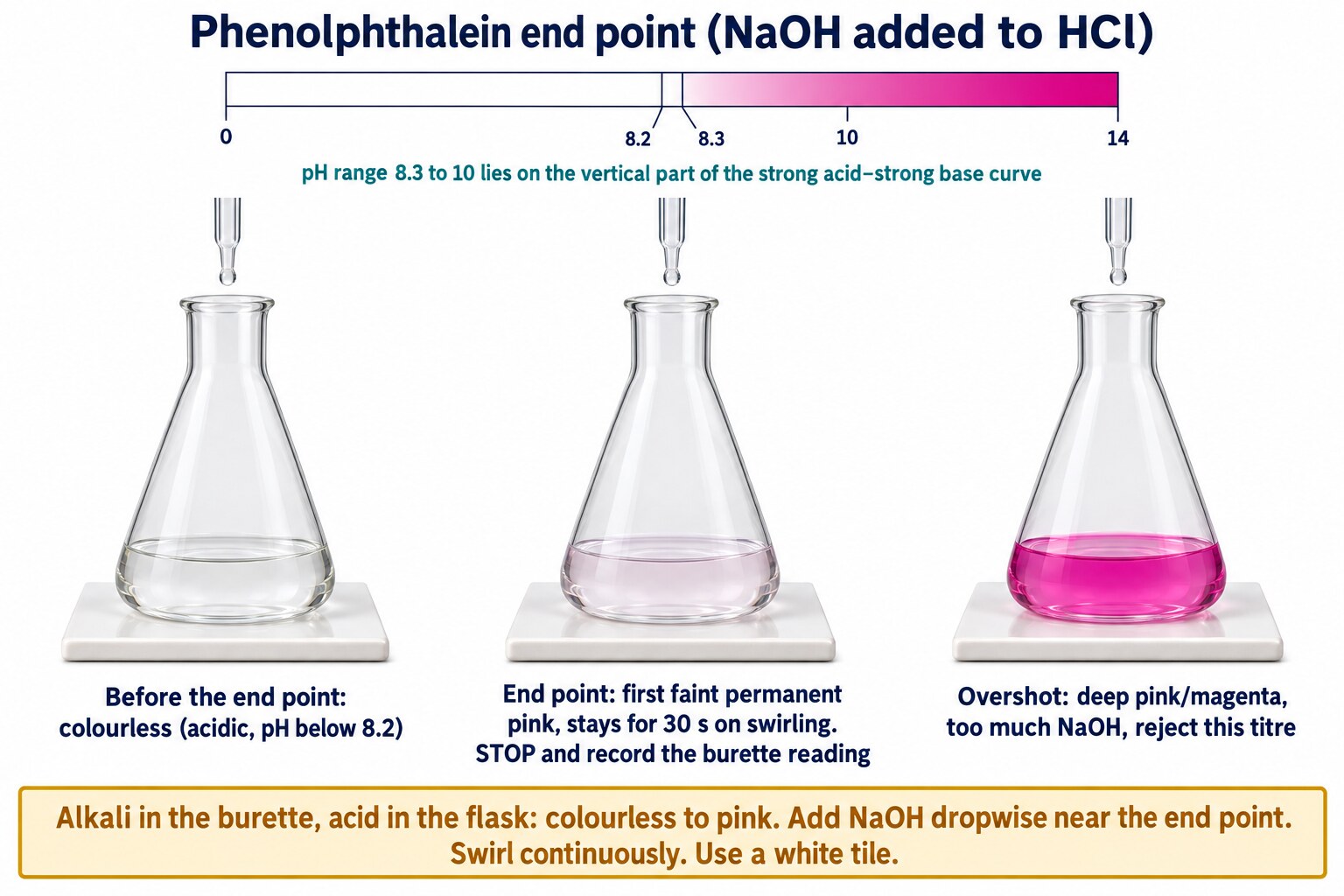
Phenolphthalein with alkali running into acid: colourless before the end point, the first faint permanent pink at the end point (stop and read the burette), and the deep magenta of an overshot titre that must be rejected. The colour strip shows the change over pH 8.3 to 10.
Exam wording: Indicator choice: “Phenolphthalein changes colour over pH 8.3 to 10, which is within the vertical part of the titration curve, so the end point and the equivalence point coincide to within one drop.” Name the range, place it on the curve, link it to one drop.
Check: Choosing an Indicator
Pick the accurate statement in each round for a weak acid titrated with a strong base.
Recording Titres and Choosing Concordant Results
Results are set out with the initial reading before the final reading, every value to two decimal places, and the titre as final minus initial.
The first row is the rough titre, usually the largest because it is deliberately run past the end point; it is labelled as rough and never enters the mean.
Concordant titres are within 0.10 cm³ of each other. Below is a corrected set of sample data.
| Titration | Initial burette reading / cm³ | Final burette reading / cm³ | Titre / cm³ | Used? |
|---|---|---|---|---|
| Rough | 0.00 | 30.60 | 30.60 | No: rough titre |
| 1 | 0.45 | 30.55 | 30.10 | Yes: concordant |
| 2 | 2.15 | 32.45 | 30.30 | No: rejected |
| 3 | 0.60 | 30.65 | 30.05 | Yes: concordant |
Titrations 1 and 3 differ by 0.05 cm³, so they are concordant. Titration 2 is 0.25 cm³ away from titration 3 and is rejected even though its readings were taken carefully.
Something, perhaps a pink flash mistaken for the end point or a slow drop after the tap was closed, made it drift.
Mean titre = (30.10 + 30.05) ÷ 2 = 30.075 cm³, written as 30.08 cm³ to two decimal places. If you carry the working on a calculator keep 30.075 and round only the final answer.
Students lose marks in three ways here: averaging every titre including the rough one, quoting the mean to three decimal places as if the burette could read it, and writing burette readings such as 30.1 or 30.12 that a burette graduated in 0.1 cm³ cannot give. Write 30.10 and 30.05.
Key idea: Rough titre to locate the end point; accurate titres added dropwise; mean of the concordant titres only (within 0.10 cm³ of each other); two decimal places ending in 0 or 5.
Check: Building a Results Table
Work out the titres from new burette readings, sort them into rough, concordant and rejected, and find the mean.
Worked Calculation from the Mean Titre
Data: mean titre 30.08 cm³ of 0.0800 mol dm⁻³ NaOH(aq); 25.0 cm³ aliquots of acid that had been diluted from 25.0 cm³ to 250 cm³. Every line carries its unit.
| Step | Working | Result |
|---|---|---|
| 1. Titre in dm³ | 30.08 cm³ ÷ 1000 | 0.03008 dm³ |
| 2. Moles of NaOH | n = c × V = 0.0800 mol dm⁻³ × 0.03008 dm³ | 0.0024064 mol |
| 3. Moles of HCl in the aliquot | 1 : 1 ratio from HCl(aq) + NaOH(aq) → NaCl(aq) + H₂O(l) | 0.0024064 mol |
| 4. Moles of HCl in the 250 cm³ flask | 0.0024064 mol × (250 cm³ ÷ 25.0 cm³) | 0.024064 mol |
| 5. Concentration of the original acid | All of that came from 25.0 cm³ = 0.0250 dm³: c = 0.024064 mol ÷ 0.0250 dm³ | 0.963 mol dm⁻³ (3 s.f.) |
The direct route is equally acceptable and many students find it safer: concentration of the diluted acid = 0.0024064 mol ÷ 0.0250 dm³ = 0.0963 mol dm⁻³.
The original acid was ten times more concentrated, so c(original) = 0.0963 × 10 = 0.963 mol dm⁻³.
Either way, the answer is quoted to 3 significant figures because the least precise datum, the NaOH concentration 0.0800 mol dm⁻³, has three.
Two slips account for most lost marks. Forgetting the dilution factor gives 0.0963 mol dm⁻³, ten times too small.
Dividing by 0.250 dm³ (the flask) instead of 0.0250 dm³ (the original sample) in step 5 gives the same wrong answer by a different route.
If the answer for “an acid of about 1 mol dm⁻³” comes out near 0.1, look for a lost factor of ten before writing it down.
General scaling rule: moles in the whole flask = moles in the aliquot × (flask volume ÷ aliquot volume). Write the volumes in the same unit and the factor is dimensionless.
Check: A Diluted Diprotic Acid
Follow the same route for sulfuric acid, where the mole ratio is not 1 : 1.
Starting From a Weighed Solid Standard
On AQA the practical is often run with a primary standard made from a solid instead of a diluted acid.
Anhydrous sodium carbonate is the usual choice because it is pure, stable, non-hygroscopic and has a high molar mass, so a weighing error is a small percentage of the mass.
The technique is in Required Practical 1 (preparation of a standard solution); the calculation is worked here.
Sample data: 2.65 g of Na₂CO₃ (Mr 106.0) dissolved and made up to 250 cm³; 25.0 cm³ aliquots titrated with the hydrochloric acid, mean titre 23.60 cm³, methyl orange indicator.
Na₂CO₃(aq) + 2HCl(aq) → 2NaCl(aq) + H₂O(l) + CO₂(g)
| Step | Working | Result |
|---|---|---|
| 1. Moles of Na₂CO₃ in the flask | 2.65 g ÷ 106.0 g mol⁻¹ | 0.0250 mol |
| 2. Concentration of the standard | 0.0250 mol ÷ 0.250 dm³ | 0.100 mol dm⁻³ |
| 3. Moles of Na₂CO₃ in a 25.0 cm³ aliquot | 0.100 mol dm⁻³ × 0.0250 dm³ | 0.00250 mol |
| 4. Moles of HCl in the titre | 2 : 1 ratio | 0.00500 mol |
| 5. Concentration of the acid | 0.00500 mol ÷ 0.02360 dm³ | 0.212 mol dm⁻³ (3 s.f.) |
The mole ratio is where marks go: 2 mol of HCl react with 1 mol of Na₂CO₃, so the moles of acid are double, not half, the moles of carbonate.
Weighing by difference (weigh the bottle with solid, tip it out, weigh the bottle again) is the technique mark.
A 2 d.p. balance contributes ±0.005 g per reading, ±0.01 g in 2.65 g, which is 0.38%.
Errors, Uncertainty and Improvements
Evaluation questions want three things: the source of error, the direction it pushes the titre and the calculated concentration, and the improvement. Start with the measuring apparatus, using the uncertainty of each reading (±0.05 cm³ per burette reading, ±0.06 cm³ for the 25 cm³ pipette, ±0.3 cm³ for the 250 cm³ flask).
| Measurement | Reading | Uncertainty | Percentage uncertainty |
|---|---|---|---|
| Burette titre (two readings) | 30.08 cm³ | ±0.10 cm³ | 0.10 ÷ 30.08 × 100 = 0.33% |
| Pipette, original acid | 25.0 cm³ | ±0.06 cm³ | 0.06 ÷ 25.0 × 100 = 0.24% |
| Pipette, aliquot of diluted acid | 25.0 cm³ | ±0.06 cm³ | 0.24% |
| Volumetric flask | 250 cm³ | ±0.3 cm³ | 0.3 ÷ 250 × 100 = 0.12% |
| Total | 0.33 + 0.24 + 0.24 + 0.12 = 0.93%, about 1% |
The absolute uncertainty in the answer is 0.963 mol dm⁻³ × 0.0093 = 0.009, so the result is 0.963 ± 0.01 mol dm⁻³ (round the uncertainty to one significant figure).
The end point itself adds up to one drop, about ±0.05 cm³, which is why dropwise addition and a persistent colour matter.
The burette dominates, and its percentage uncertainty falls as the titre grows: this is the quantitative reason the acid was diluted only tenfold and not a hundredfold. A titre of 3 cm³ would carry 0.10 ÷ 3.00 × 100 = 3.3%.
Improvements that examiners credit: a larger titre (a more dilute alkali or a larger aliquot), a burette with finer graduations, repeating to get more concordant titres, a pipette rather than a measuring cylinder for every fixed volume.
Improvements they do not credit: “be more careful”, “use more accurate equipment” without naming it, and “do more repeats” with no reason.
| Source of error | Effect on the titre | Calculated concentration | Improvement |
|---|---|---|---|
| Pipette rinsed with water | Smaller: fewer moles of acid transferred | Too low | Rinse the pipette with the solution it will measure |
| Burette rinsed with water | Larger: alkali diluted | Too high | Rinse the burette with the alkali |
| Pipette blown out into the volumetric or conical flask | Larger: extra acid transferred | Too high | Let the pipette drain, leave the last drop |
| Volumetric flask overfilled past the mark | Smaller: diluted acid too dilute | Too low | Add the last water dropwise; discard and repeat if overshot |
| Volumetric flask not inverted | Scattered: aliquots not uniform | Random error, poor concordance | Stopper and invert at least ten times |
| Air bubble in the jet expelled during the titration | Larger: bubble counted as delivered alkali | Too high | Open the tap to fill the jet before the initial reading |
| Funnel left in the burette | Smaller: drips lower the final reading | Too low | Remove the funnel before reading |
| Reading the top of the meniscus every time | No change: the offset cancels in final − initial | Unchanged | Read the bottom at eye level anyway, for consistency |
| Overshooting the end point | Larger | Too high | Add dropwise near the end point, swirl, use a white tile; reject the titre |
| Conical flask rinsed with acid | Larger: unmeasured extra acid | Too high | Rinse the conical flask with distilled water only |
Exam focus: Always chain the argument: what changes in the flask or burette, which way the titre moves, which way the calculated concentration moves. “Titre too large” on its own is half an answer.
Check: Evaluating a Different Titration
Work through the uncertainties and one error for a nitric acid titration, then decide what would improve it.
Common Mistakes
- Writing HCl + NaOH → NaCl + H₂O without state symbols, or the ionic equation with (l) on the ions.
- Calling the sodium hydroxide a standard solution: it was standardised by titration against a primary standard.
- Leaving out why the acid was diluted: about 300 cm³ of alkali would be needed otherwise.
- Rinsing “everything with distilled water”: the pipette takes the acid, the burette takes the alkali, only the conical flask takes water.
- Including the rough titre in the mean, or averaging all the titres because “more data is better”.
- Burette readings written as 30.1 or 30.12: the second decimal place is 0 or 5.
- Getting an error direction backwards, especially a blown-out pipette: more acid means a larger titre and a concentration that is too high.
- Forgetting the factor of ten, or dividing by 0.250 dm³ instead of 0.0250 dm³, giving 0.0963 instead of 0.963 mol dm⁻³.
- Quoting the percentage uncertainty of one burette reading (0.05 cm³) instead of the titre (0.10 cm³, two readings).
- “Persists for a few seconds” for the end point: the accepted phrase is the first permanent pale pink, persisting for about 30 s on swirling.
Common Exam Points
Say
“Rinse the pipette with the acid so that residual water does not dilute it.” “Remove the funnel before taking the initial reading.”
“Concordant titres agree within 0.10 cm³ of each other; only these are averaged.”
“Phenolphthalein changes colour on the vertical part of the curve, so the end point coincides with the equivalence point to within one drop.”
“Percentage uncertainty of the titre = 0.10 ÷ 30.08 × 100 = 0.33%.”
Do not say
“Rinse the burette with water so it is clean.” “Add indicator until the colour is clear.” “The rough titre is included to give more results.” “A bigger flask would reduce the error.” “Blowing out the pipette makes the titre smaller.”
Watch for
Volumes in cm³ in the question but dm³ in n = c × V. The direction of the titration (alkali into acid) when describing the colour change.
The unit of the final answer, mol dm⁻³, and its three significant figures. Whether the question wants the percentage uncertainty of a single reading or of the titre. The word “standardised” against “standard”.
FAQs
Quick answers to the questions students ask most about Required Practical 1 and its titration technique.
Why is the hydrochloric acid diluted before the titration?
The original acid is about 1 mol dm⁻³. Titrating 25.0 cm³ of it with 0.0800 mol dm⁻³ sodium hydroxide would need about 300 cm³ of alkali, six fillings of a 50 cm³ burette. Diluting tenfold gives a titre near 30 cm³, which fits one burette and keeps the percentage uncertainty near 0.3%.
Why can sodium hydroxide not be used as a primary standard?
Solid sodium hydroxide absorbs water and carbon dioxide from the air, so a weighed sample is never pure NaOH. Its solution must be standardised by titration against a primary standard such as anhydrous sodium carbonate before it can be used to find the concentration of the acid.
What counts as concordant titres on AQA?
Titres that agree within 0.10 cm³ of each other. The rough titre is never one of them. Only the concordant titres are averaged, and the mean is written to two decimal places.
Which way does the error go if the pipette is blown out?
The last drop is calibrated to stay in the pipette. Blowing it out transfers extra acid, so the flask holds more moles, the titre is larger and the calculated concentration is too high.
Rinsing the pipette with water has the opposite effect: fewer moles, a smaller titre, a concentration that is too low.
How do I calculate the total percentage uncertainty?
Work out each piece of apparatus separately: burette titre 0.10 ÷ 30.08 × 100 = 0.33%, each 25.0 cm³ pipetting 0.06 ÷ 25.0 × 100 = 0.24% (used twice), volumetric flask 0.3 ÷ 250 × 100 = 0.12%. Add them: 0.93%, about 1%, so the answer is 0.963 ± 0.01 mol dm⁻³.
Why is phenolphthalein suitable for this titration?
Its colour change over pH 8.3 to 10 lies within the vertical section of the strong acid–strong base curve.
So one drop of alkali takes the flask from colourless to pink and the end point coincides with the equivalence point to within a drop.
Methyl orange also works for this pair; universal indicator does not, because it changes gradually.
Copyright and author footprint: This OLS revision page was written for Online Learning System by Dr. Mohammed Al-Fatah. It is designed for A Level Chemistry revision and should not be copied or redistributed without permission.
Keep this note — free
Save your progress across every AQA topic. A free account remembers which topics you have covered, saves your question scores, and syncs across your phone and laptop.
- Track every topic you have finished
- Keep your practice-question scores
- No payment, no card, free forever
Already registered? Log in