PAG 5 Synthesis of an Organic Liquid: 2-chloro-2-methylpropane
Prepare and purify 2-chloro-2-methylpropane from 2-methylpropan-2-ol and concentrated hydrochloric acid: why the tertiary alcohol reacts at room temperature, how to use the separating funnel, what each wash and the drying agent remove, how to distil the 50–52 °C fraction, how to test the distillate for chloride and how to calculate the percentage yield with units at every step.
GCSE Recap: Distillation, Layers and the Halide Test
Four quick questions on what you already know: what the condenser does, where the thermometer goes, which liquid floats and what the silver nitrate test shows.
What This Practical Is Testing
PAG 5 converts a tertiary alcohol into a haloalkane. 2-Methylpropan-2-ol, (CH₃)₃COH, is shaken with concentrated hydrochloric acid at room temperature and the hydroxyl group is replaced by a chlorine atom to give 2-chloro-2-methylpropane, (CH₃)₃CCl.
The reaction is a nucleophilic substitution that goes through a tertiary carbocation, which is why no heating and no catalyst are needed: a primary alcohol would not react under these conditions.
(CH₃)₃COH(l) + HCl(aq) → (CH₃)₃CCl(l) + H₂O(l)
The reaction itself takes twenty minutes. The marks are in what follows: separating the crude product from the aqueous layer, washing out the acid, drying, distilling the fraction that boils at 50–52 °C, testing the distillate for chloride and calculating the percentage yield.
Marks come from the written papers (practical skills are examined in every paper) and the practical endorsement, so every step of the method must come with its reason.
Common mistake: Students lose marks by describing what they did without saying why, and by naming a piece of apparatus without saying what it removes.
Three skills run through the whole practical: using a separating funnel (which layer to keep, when to remove the stopper, how to vent) and simple distillation (where the thermometer bulb sits, which way the water flows, what to collect).
The third is a qualitative test (hydrolysis, acidify with nitric acid, silver nitrate).
The same three skills appear in PAG 5 (oxidation of an alcohol) and PAG 4 and PAG 7 (analysis of inorganic and organic unknowns), so learn them here properly.
Key idea: This is a purification practical as much as a preparation. Track where the organic product is at every stage: it is the upper layer in the funnel, the clear liquid over the drying agent and the 50–52 °C fraction in the receiver.
Safety and Apparatus
The whole preparation is done in a fume cupboard because concentrated hydrochloric acid releases hydrogen chloride gas, which is toxic and corrosive, and because the product is a volatile, highly flammable liquid.
Exam focus: A safety question worth several marks expects each precaution linked to the hazard it controls, not a list of “goggles and gloves”.
| Substance | Hazard | Precaution and reason |
|---|---|---|
| Concentrated hydrochloric acid | Corrosive; gives off toxic hydrogen chloride fumes | Fume cupboard, eye protection and gloves; add the acid in small portions so the funnel does not pressurise |
| 2-Methylpropan-2-ol | Flammable; irritant | No naked flames; measure it out in the fume cupboard |
| 2-Chloro-2-methylpropane | Highly flammable; volatile (boiling point 51 °C) | Heat with a hot-water bath or electric heater, never a Bunsen burner; keep the stoppered sample cool and away from the heater |
| Sodium hydroxide solution | Corrosive | Eye protection; wash spills with plenty of water |
| Silver nitrate solution | Stains skin and clothing; oxidising | Gloves; wipe up drops at once |
| Hot glassware and pressure in the funnel | Burns; stopper can be ejected | Vent the funnel through the tap every few shakes; let apparatus cool before dismantling |
The reaction and the washing are both done in the separating funnel: the alcohol and acid are mixed in it, it is stoppered, shaken and vented through its tap. A conical flask is needed only under the tap and later, dry, for the drying step.
| Apparatus | What it is for | Precision |
|---|---|---|
| 100 cm³ separating funnel with stopper | Reaction vessel, then separation of the two layers and the washes | Not a measuring instrument |
| 10 cm³ measuring cylinder | Measuring 10.0 cm³ of 2-methylpropan-2-ol and later the volume of product | ±0.1 cm³ |
| 50 cm³ measuring cylinder | Measuring 35 cm³ of concentrated hydrochloric acid and the washes | ±0.5 cm³ |
| Dry conical flask with stopper | Drying the organic layer over the drying agent | Must be dry: water would overload the drying agent |
| Pear-shaped flask, still head, thermometer, Liebig condenser, receiver adaptor, receiving flask | Simple distillation of the dried product | Thermometer ±0.5 °C |
| Electric heating mantle or hot-water bath | Heating without a flame | Water bath is ideal: the product boils below 100 °C |
| Beaker of iced water | Cooling the receiver so the volatile product does not evaporate | |
| Test tubes, water bath, dropping pipettes | Hydrolysis and the silver nitrate test on the distillate |
Safety wording: Always pair the precaution with the hazard: “in a fume cupboard because concentrated hydrochloric acid gives off toxic hydrogen chloride fumes”; “heated in a water bath because 2-chloro-2-methylpropane is highly flammable and boils at 51 °C”. A precaution on its own scores nothing.
Check: Hazards and Precautions
A different preparation, 1-bromobutane from butan-1-ol, so that you link each precaution to the hazard it controls rather than recall this page.
Method: Step by Step
The quantities below are the standard ones: 10.0 cm³ of 2-methylpropan-2-ol and 35 cm³ of concentrated hydrochloric acid.
The acid is in large excess (about 0.39 mol against 0.105 mol of alcohol), so the alcohol is the limiting reagent and the yield is calculated from it.
Every row carries the reason, because the reason is what the mark scheme rewards.
| Step | What you do | Why |
|---|---|---|
| 1 Measure | Measure 10.0 cm³ of 2-methylpropan-2-ol into the separating funnel using the 10 cm³ measuring cylinder. | The alcohol is the limiting reagent, so its volume fixes the theoretical yield; the small cylinder keeps the percentage uncertainty low. |
| 2 Add acid in portions | Add 35 cm³ of concentrated hydrochloric acid about 5 cm³ at a time, swirling after each addition. | The reaction is exothermic and the acid releases hydrogen chloride vapour; adding it in portions controls the temperature and the pressure inside the funnel. |
| 3 Stopper, shake, vent | Stopper the funnel, shake it for a few seconds, then invert it and open the tap to release the pressure. Repeat for 15 to 20 minutes. | Pressure builds from hydrogen chloride vapour and from the volatile product (it boils at 51 °C). With the funnel inverted the tap is above the liquid, so venting releases gas, not liquid. |
| 4 Watch the layers form | The single clear solution turns cloudy and two layers gradually separate: an upper organic layer and a lower aqueous layer. | The alcohol is miscible with the aqueous acid, but the chloroalkane is immiscible with water and less dense (0.84 g cm⁻³), so it collects on top as it forms. |
| 5 Add anhydrous calcium chloride | Add a spatula of anhydrous calcium chloride and swirl until it dissolves in the aqueous layer. | Calcium chloride forms a complex with any unreacted 2-methylpropan-2-ol and draws it, with some water, into the aqueous layer, so the alcohol does not co-distil with the product later. |
| 6 Run off the lower layer | Stand the funnel in a clamp, remove the stopper, open the tap and run the lower aqueous layer into a conical flask until the boundary reaches the tap. Discard it. | With the stopper in, no air can enter and the liquid will not flow. Stopping at the boundary keeps the product in the funnel. |
| 7 Wash with sodium hydrogencarbonate solution | Add about 20 cm³ of sodium hydrogencarbonate solution, stopper, invert, vent, shake gently and vent again. Let the layers settle and run off the lower aqueous layer. | Neutralises the remaining acid: HCl(aq) + NaHCO₃(aq) → NaCl(aq) + CO₂(g) + H₂O(l). Carbon dioxide pressurises the funnel, so vent often. A weak base is used because hydroxide ions would hydrolyse the product back to the alcohol. |
| 8 Wash with water | Add about 20 cm³ of water, shake, settle, run off and discard the lower layer. | Removes dissolved sodium hydrogencarbonate and sodium chloride so the drying agent is not overloaded. |
| 9 Dry | Run the organic layer into a dry conical flask. Add anhydrous magnesium sulfate, MgSO₄ (anhydrous sodium sulfate also works) a spatula at a time, stopper and swirl, until the liquid is clear and some solid remains free-flowing. | The cloudy liquid is a fine emulsion of water droplets; a clear liquid means the water has been absorbed. Free-flowing solid shows enough drying agent has been added. |
| 10 Decant | Decant the clear liquid (or filter it through a small plug of cotton wool or a fluted filter paper) into the distillation flask with two or three anti-bumping granules. | Solid drying agent must not go into the distillation flask; the granules give smooth boiling. |
| 11 Distil | Heat with a water bath or heating mantle. Discard the first few drops, then collect the fraction that distils at 50–52 °C in a receiver cooled in iced water. Stop when the temperature rises above 52 °C or falls. | Pure 2-chloro-2-methylpropane has a boiling point of 51 °C; the first drops carry traces of water and acid, and above 52 °C unreacted alcohol (boiling point 82 °C) begins to distil. A falling reading means vapour is no longer reaching the bulb. |
| 12 Test and measure | Measure the volume of distillate, then test a few drops for chloride (see the analysis card below). | The volume gives the actual yield; the test confirms the product contains chlorine bonded to carbon. |
Exam focus: Three manipulations are marked again and again: add the acid in portions; invert and open the tap to vent; remove the stopper before running off the lower layer. Write each one with its reason.
Chlorination of 2-methylpropan-2-ol: Make, Purify, Distil, Test
Watch 2-chloro-2-methylpropane being made in a separating funnel, washed, dried and distilled at 50–52 °C, then work out the yield and test it for chloride.
© Dr. Mohammed Al-Fatah – onlinelearningsystem.net
The Reaction: Sₙ1 at a Tertiary Carbon
The reaction is a nucleophilic substitution, Sₙ1, and it happens in three steps.
First the lone pair on the oxygen of the alcohol accepts a proton from hydrochloric acid, turning the poor leaving group OH into the good leaving group –OH₂⁺.
Second, the C–O bond breaks and a molecule of water leaves, giving the tertiary carbocation (CH₃)₃C⁺.
Third, a chloride ion uses a lone pair to form a new bond to the positive carbon, giving 2-chloro-2-methylpropane.
The middle step is slow and decides the rate, and it is only fast enough at room temperature because the carbocation is tertiary.
The three methyl groups release electron density towards the positive carbon (a positive inductive effect) and spread out the charge, so the ion is much more stable than a secondary or primary carbocation.
Butan-1-ol would give a primary carbocation, which is far too unstable to form, so a primary alcohol has to be heated with a catalyst such as zinc chloride, or treated with a different chlorinating agent, to make the chloroalkane.
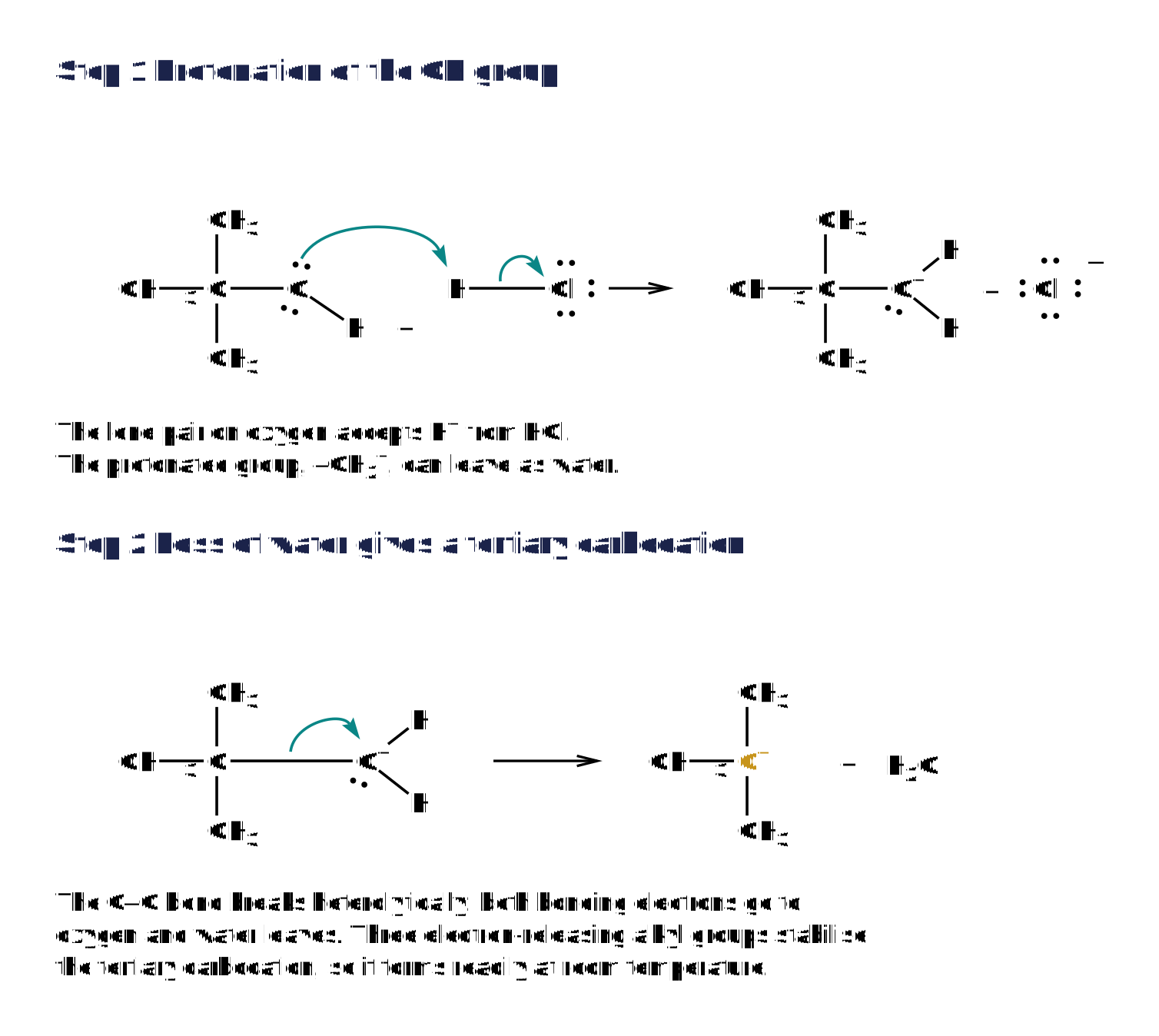
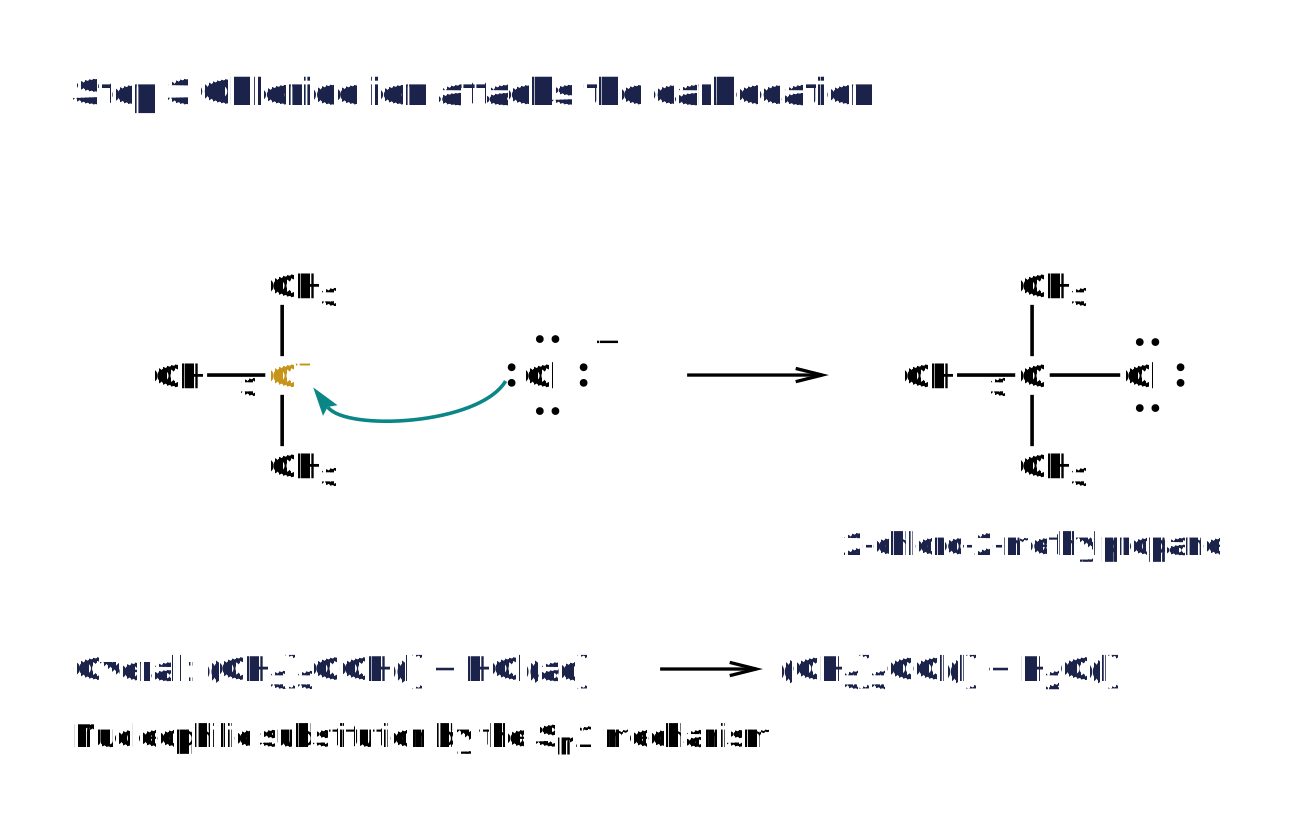
The three stages: protonation of the OH group, loss of water to give the tertiary carbocation (CH₃)₃C⁺, then attack by the chloride ion. The carbocation is stabilised by the three electron-releasing methyl groups.
The same idea explains why the product is tested by hydrolysis so easily: a tertiary haloalkane forms the same carbocation when its C–Cl bond breaks, so it reacts with water or hydroxide ions far faster than a primary haloalkane.
This is the pattern examined in the rates of hydrolysis practical.
Exam wording: “The tertiary alcohol is protonated, loses water to form a tertiary carbocation that is stabilised by three electron-releasing alkyl groups, and the carbocation is then attacked by a chloride ion.
A primary alcohol would form an unstable primary carbocation, so it does not react under these conditions.”
Name the mechanism: Sₙ1, nucleophilic substitution, unimolecular.
Check: Tertiary Alcohols and Concentrated Acid
Apply the carbocation idea to 2-methylbutan-2-ol and to butan-1-ol: which product, why no heating, and why the primary alcohol behaves differently.
Separating Funnel: Which Layer and Why
When the shaking stops, the mixture settles into two layers. The upper layer is the crude 2-chloro-2-methylpropane and the lower layer is aqueous.
Students are asked to justify this, and the answer has two parts. The chloroalkane is immiscible with water because it cannot form hydrogen bonds with water molecules.
It is less dense than the aqueous layer (0.84 g cm⁻³ against more than 1.0 g cm⁻³ for the acid solution), so it floats.
Common mistake: Never write “organic layers are always on top”: 1-bromobutane (1.27 g cm⁻³) sinks, and the exam likes to swap the compound.
Running off the lower layer has three marked manipulations. Remove the stopper first: with it in place no air can enter and the liquid stops flowing after a moment.
Open the tap slowly and watch the boundary. Close the tap as the boundary reaches it, so that the organic layer stays in the funnel.
Remember: a small amount of aqueous layer left behind is removed by the next wash, but organic product run into the waste is lost for good.
Venting is the other technique. After sodium hydrogencarbonate is added, carbon dioxide is produced and the pressure would eject the stopper.
Stopper the funnel, invert it so the tap is uppermost, open the tap for a second to release the gas, close it, shake gently, and vent again.
Only with the funnel upright and the stopper out is liquid run through the tap.
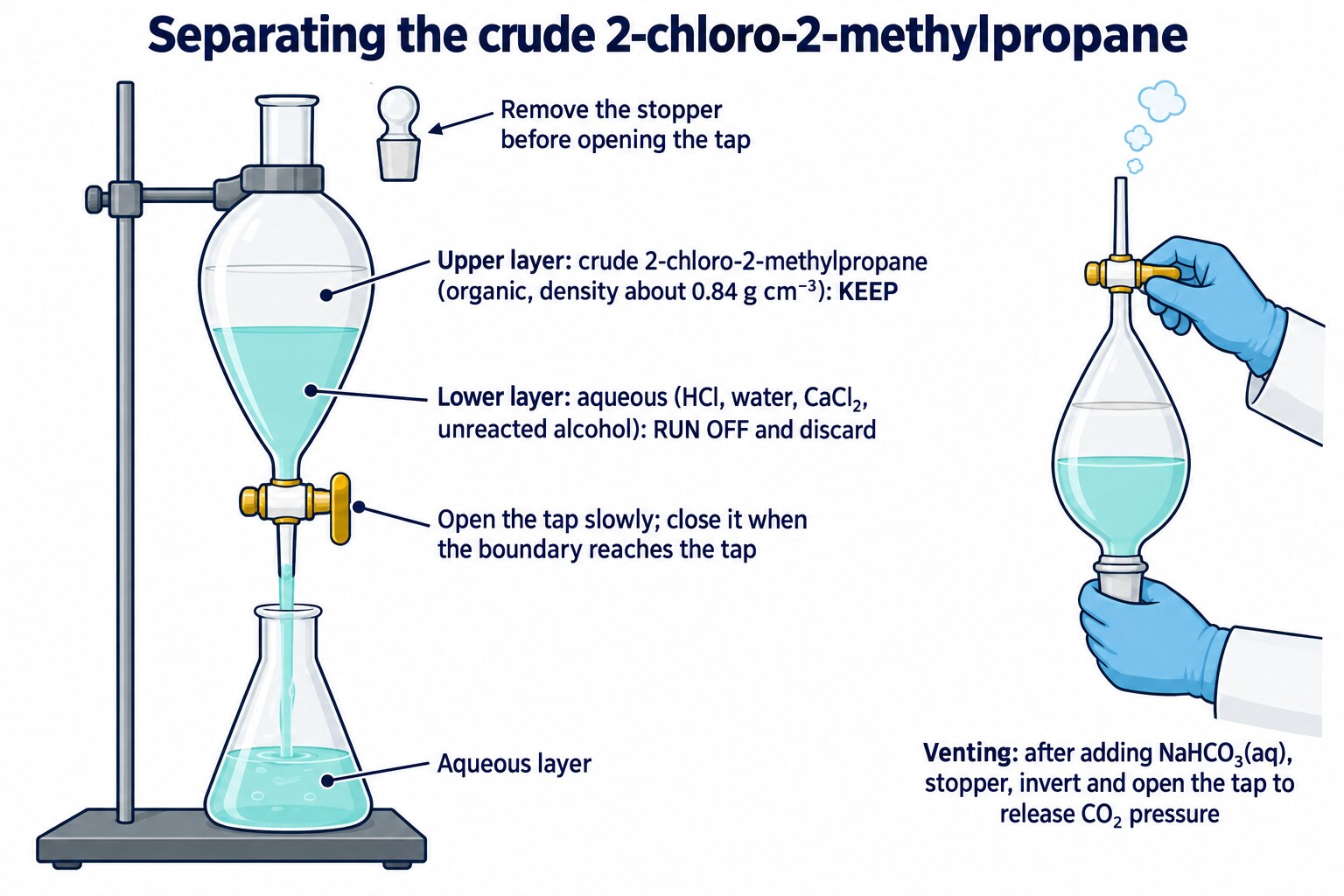
Left: stopper out, tap open, the lower aqueous layer running into the conical flask until the boundary reaches the tap. Right: the funnel inverted and vented through the tap after the hydrogencarbonate wash.
Key idea: Which layer is which comes from density, not from “organic” or “aqueous”. Quote the density of the product (0.84 g cm⁻³) and say it is immiscible with water.
Purification: What Each Step Removes
The crude upper layer contains 2-chloro-2-methylpropane together with dissolved hydrogen chloride, water and a little unreacted alcohol. Each purification step targets one impurity, and the exam asks for the target, not just the step.
| Step | Reagent | What it removes or achieves | Reason and equation |
|---|---|---|---|
| Complexing the alcohol | Anhydrous calcium chloride, swirled into the mixture until it dissolves | Unreacted 2-methylpropan-2-ol (and some water) | Calcium chloride forms a complex with the alcohol and draws it into the aqueous layer, so the alcohol (boiling point 82 °C) cannot co-distil with the product |
| Separation | Separating funnel: stopper out, tap open | The aqueous layer: acid, water, calcium chloride, alcohol complex | Two immiscible liquids of different density separate under gravity; the boundary is run down to the tap |
| Neutralising wash | Sodium hydrogencarbonate solution, then vent | Dissolved hydrogen chloride | HCl(aq) + NaHCO₃(aq) → NaCl(aq) + CO₂(g) + H₂O(l); ionic: H⁺(aq) + HCO₃⁻(aq) → CO₂(g) + H₂O(l). Acid left in the product would give acidic fumes on distillation and be carried over as an impurity |
| Water wash | Distilled water | Dissolved sodium hydrogencarbonate and sodium chloride | Salts would be left as a residue and would use up drying agent |
| Drying | anhydrous magnesium sulfate, MgSO₄ (anhydrous sodium sulfate also works) | Dissolved and suspended water | The anhydrous salt absorbs water as water of crystallisation; the cloudy emulsion turns clear when the liquid is dry |
| Decanting | Cotton wool plug or fluted filter paper | The solid drying agent | Solid in the distillation flask would cause bumping and hold back product |
| Distillation | Collect 50–52 °C | Anything with a different boiling point: traces of water, acid and alcohol | A pure liquid distils over a narrow range at its data-book boiling point (51 °C) |
Why sodium hydrogencarbonate and not sodium hydroxide? Hydroxide ions are a strong nucleophile and base and would hydrolyse the tertiary chloroalkane back to the alcohol: (CH₃)₃CCl(l) + OH⁻(aq) → (CH₃)₃COH(aq) + Cl⁻(aq). Hydrogencarbonate is a weak base that neutralises the acid but leaves the product alone.
Exam focus: Three “why” points are asked every year: calcium chloride removes unreacted alcohol; hydrogencarbonate rather than hydroxide because hydroxide would hydrolyse the product; MgSO₄ until the liquid is clear because a clear liquid is a dry liquid.
Check: Purifying a Crude Bromoalkane
Put the purification of 1-bromobutane in order. It is denser than water, so decide which layer you keep from the density, not from habit.
Simple Distillation: Collecting the Pure Product
The dried liquid is distilled and the fraction boiling at 50–52 °C is collected: the data-book boiling point of 2-chloro-2-methylpropane is 51 °C and the range is ±1 °C around it.
The apparatus is a pear-shaped flask with anti-bumping granules, a still head carrying the thermometer, a Liebig condenser sloping down to a receiver adaptor, and a receiving flask standing in iced water.
The thermometer bulb is level with the side arm, the opening into the condenser, so that it measures the temperature of the vapour that is actually distilling over.
A bulb in the liquid reads the liquid temperature, which rises as the alcohol concentrates and tells you nothing about what is in the receiver.
Cooling water enters the condenser at the lower connection, nearest the receiver, and leaves at the upper one: the jacket stays full and the coldest water meets the vapour that has already partly cooled, giving efficient counter-current cooling.
Heat with a water bath or an electric heating mantle, never a Bunsen burner: the product is highly flammable and a water bath is enough because it boils below 100 °C.
The receiver stands in a beaker of iced water because the product is volatile, and the system is open to the air at the receiver; a sealed apparatus would burst.
Discard the first few drops (traces of water and acid), collect while the thermometer stays in the 50–52 °C range, and stop when the reading rises (alcohol, boiling point 82 °C, is coming over) or falls (no more vapour reaching the bulb).
Remember: Never distil to dryness.
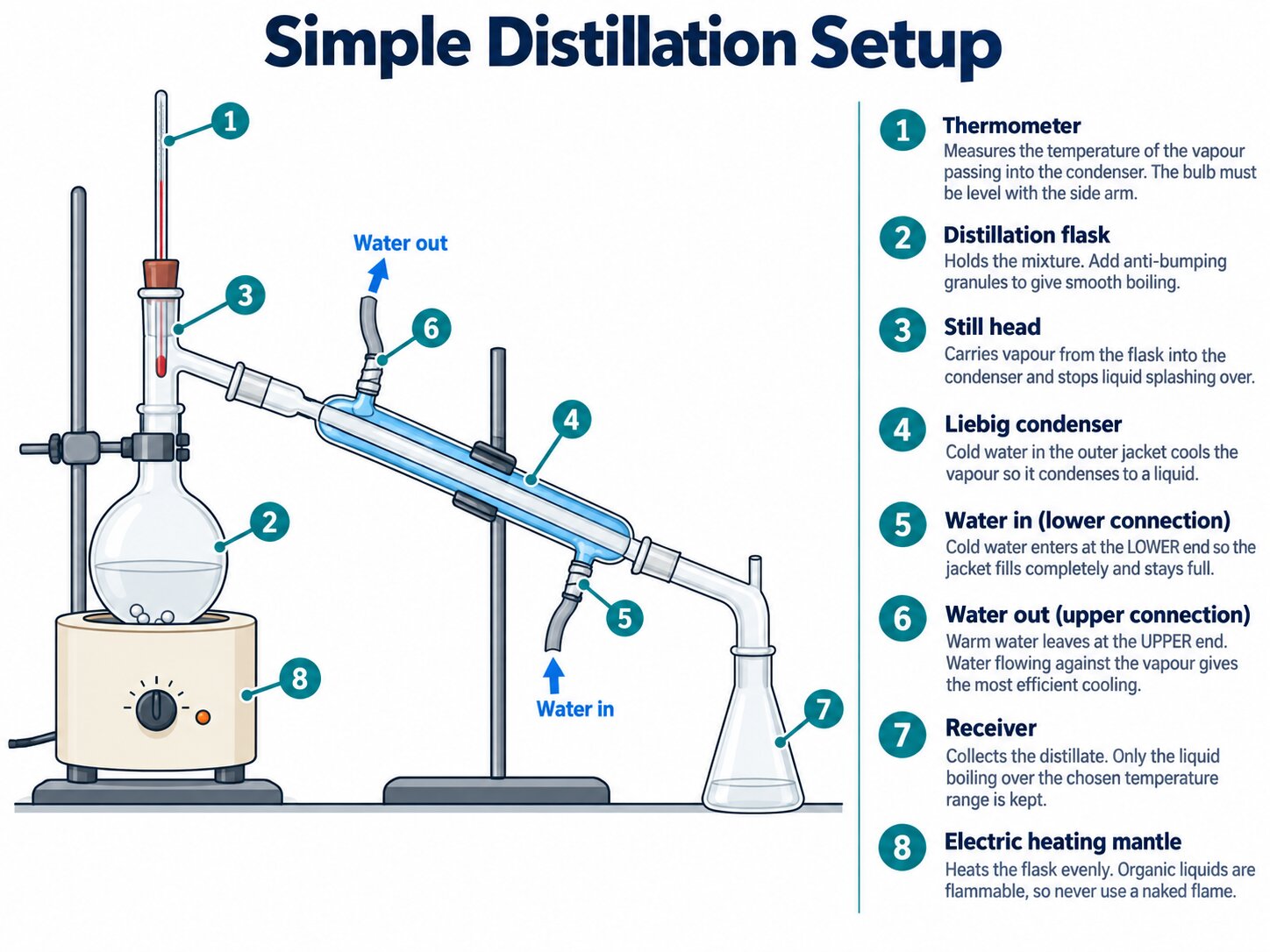
Simple distillation: thermometer bulb level with the side arm, water in at the lower connection and out at the upper, anti-bumping granules, electric heating and a receiver open to the air. Add a beaker of iced water under the receiver and collect the 50–52 °C fraction.
Reflux Compared with Distillation
Both techniques use a Liebig condenser and both are assessed in PAG 5.
In reflux the condenser stands vertically above the flask, so vapour condenses and drips back; the mixture can be heated for a long time without losing volatile reactants, solvent or product.
In distillation the condenser slopes downwards, so the condensed vapour runs away into a receiver and is separated from the mixture.
| Feature | Reflux | Simple distillation |
|---|---|---|
| Condenser | Vertical, open at the top | Sloping down, leading to a receiver |
| Condensed liquid | Returns to the flask | Collected in the receiver |
| Purpose | Complete a slow reaction without loss of volatile substances | Separate and collect a liquid by its boiling point |
| Used here? | No: the reaction runs at room temperature and heating would boil off the product | Yes: collect the fraction at 50–52 °C |
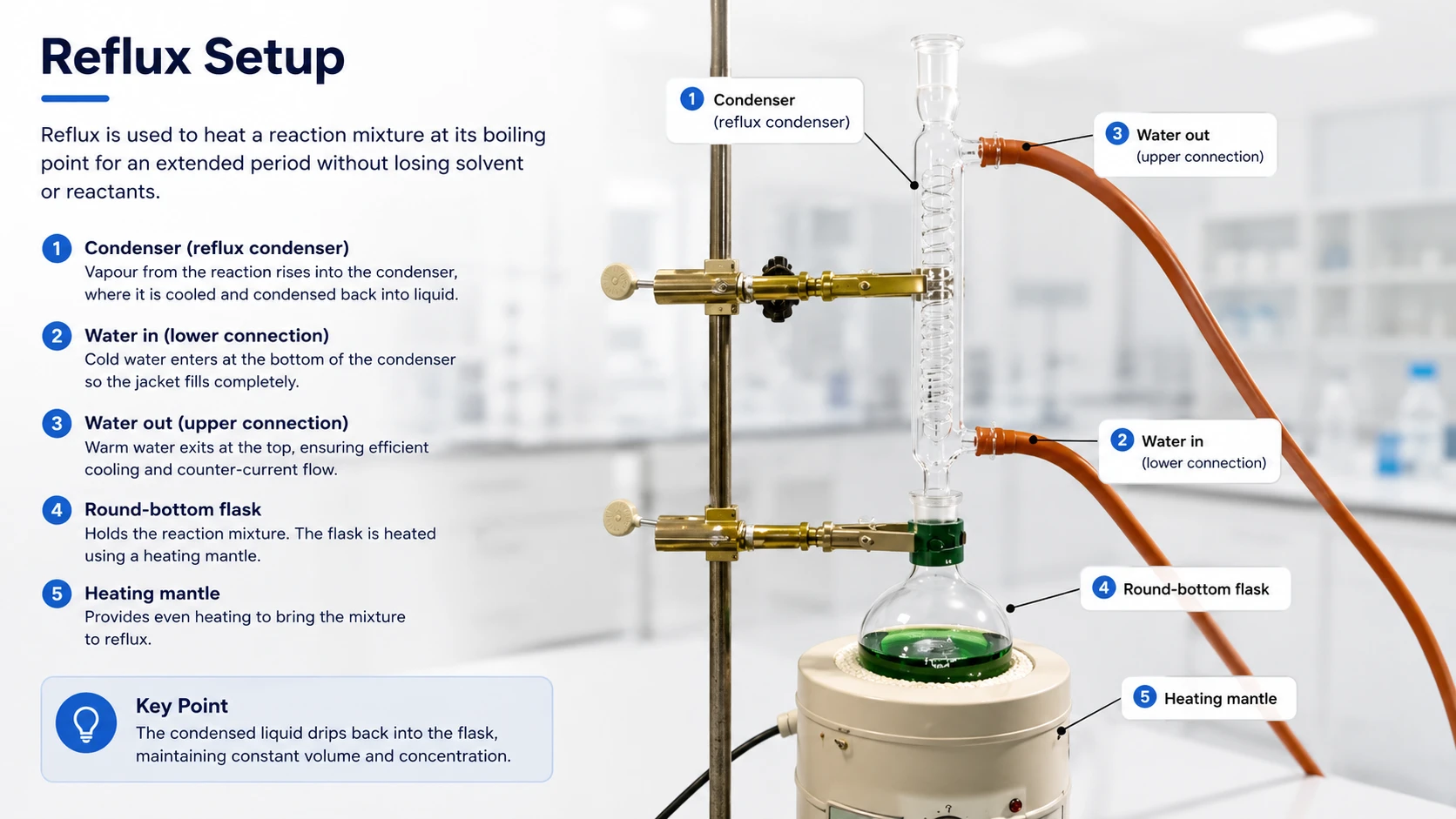
Reflux: the condenser is vertical and condensed vapour drips back into the heated flask. The coil-type condenser shown works like the straight Liebig condenser usually drawn in exams.
Check: Distilling a Bromoalkane
A distillation of 2-bromo-2-methylpropane contaminated with its parent alcohol: fill in the range, the bulb position, the water direction, the cooling and the heating.
Analysis: Testing the Distillate for Chloride
The distillate is a covalent liquid, so silver nitrate alone shows nothing: there are no free chloride ions. The chloroalkane must first be hydrolysed.
Put a few drops of distillate in a test tube, add about 2 cm³ of ethanol and a few drops of sodium hydroxide solution, and warm in a water bath.
Ethanol is used because the chloroalkane does not dissolve in water; ethanol dissolves both the chloroalkane and the aqueous reagents, so the molecules can meet.
(CH₃)₃CCl(l) + OH⁻(aq) → (CH₃)₃COH(aq) + Cl⁻(aq)
Because the haloalkane is tertiary, the hydrolysis is fast even with water alone: (CH₃)₃CCl(l) + H₂O(l) → (CH₃)₃COH(aq) + HCl(aq).
So a simpler version of the test warms the distillate with ethanol and aqueous silver nitrate directly.
Either way, the next step is to add dilute nitric acid until the solution is acidic, then silver nitrate solution. A white precipitate of silver chloride confirms chloride ions:
Ag⁺(aq) + Cl⁻(aq) → AgCl(s)
Why acidify at all? If the solution is still alkaline, silver ions give a brown-black precipitate of silver oxide, Ag₂O, which masks the test.
Why nitric acid? Hydrochloric acid would add chloride ions and give a white precipitate whatever the sample contained (a false positive).
Sulfuric acid gives a white precipitate of silver sulfate with concentrated silver nitrate solutions. Nitric acid adds nothing that reacts with silver ions.
To confirm the precipitate is silver chloride rather than silver bromide or iodide, add dilute ammonia solution: silver chloride dissolves in dilute ammonia, silver bromide only in concentrated ammonia and silver iodide in neither. Silver chloride also darkens in sunlight.
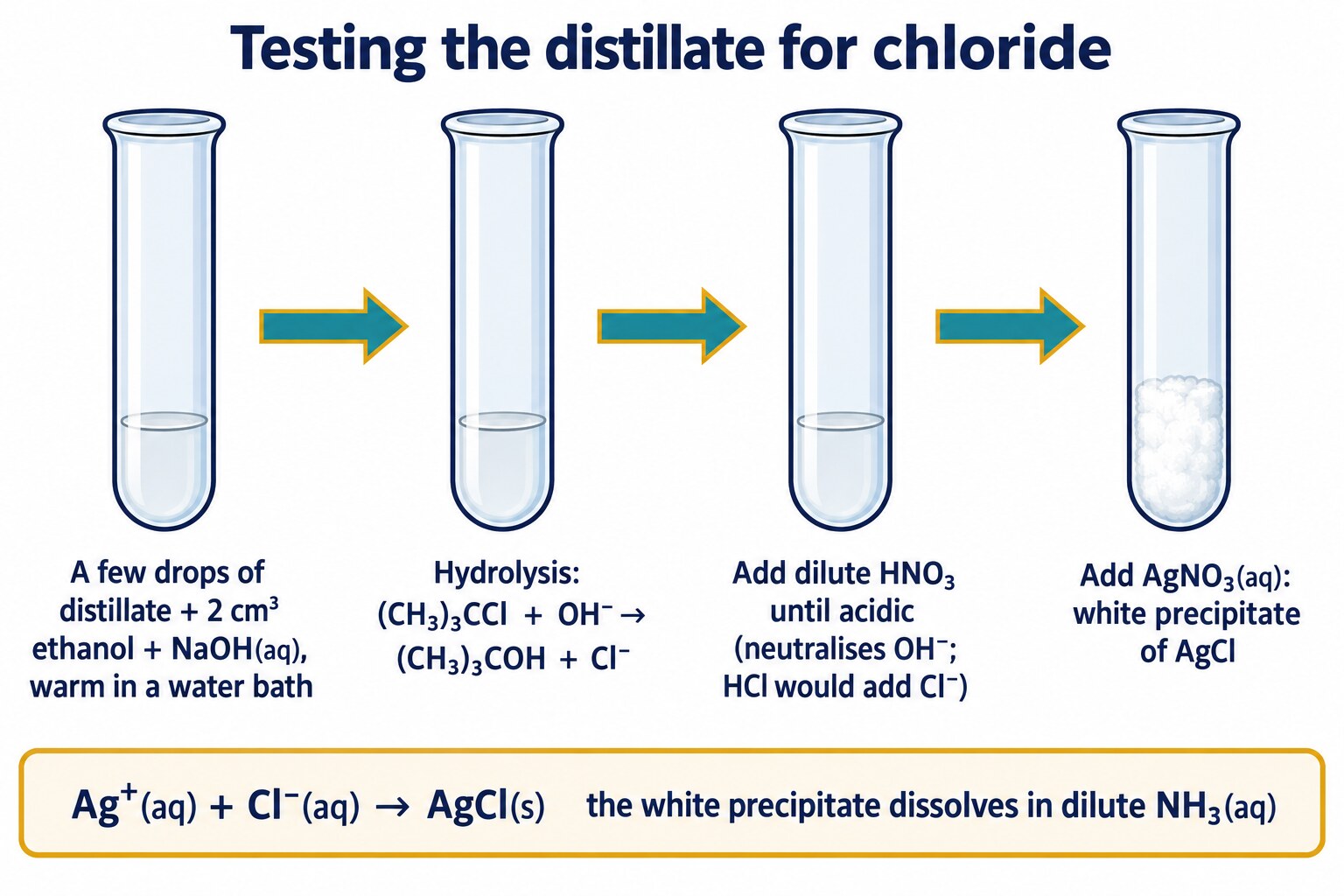
Hydrolyse with ethanol and warm sodium hydroxide, acidify with dilute nitric acid, add silver nitrate: a white precipitate of silver chloride that dissolves in dilute ammonia solution.
A positive test proves only that the distillate contains chlorine bonded to carbon. Identity and purity come from the whole set of evidence: the distillate boiled at 50–52 °C, it is immiscible with water, and it gives chloride ions on hydrolysis.
Exam wording: “Warm with ethanol and aqueous sodium hydroxide to hydrolyse the chloroalkane and release chloride ions; add dilute nitric acid to neutralise the hydroxide ions, which would otherwise precipitate silver oxide; add silver nitrate solution: a white precipitate of silver chloride forms, which dissolves in dilute ammonia.”
Check: Testing a Bromoalkane Distillate
The same test on a bromoalkane: which acid, what colour, what goes wrong in alkali, and which ammonia solution tells the halides apart.
Boiling point, Solubility and Purity
The alcohol and its product have very different physical properties, and the exam asks you to explain both differences in terms of intermolecular forces.
| Substance | Boiling point | Density | Solubility in water | Explanation |
|---|---|---|---|---|
| 2-Methylpropan-2-ol, (CH₃)₃COH (Mr 74.1) | 82 °C | 0.78 g cm⁻³ | Miscible | The O–H group forms hydrogen bonds between alcohol molecules and with water molecules |
| 2-Chloro-2-methylpropane, (CH₃)₃CCl (Mr 92.6) | 51 °C | 0.84 g cm⁻³ | Immiscible | No hydrogen bonding: the permanent dipole–dipole and London forces between its molecules are weaker than the hydrogen bonds between alcohol molecules, even though its molar mass is larger |
Be careful with the boiling point explanation. The chloroalkane has the larger Mr, so its London forces are actually stronger than the alcohol’s; what it lacks is hydrogen bonding.
Write: “2-chloro-2-methylpropane cannot form hydrogen bonds between its molecules; the dipole–dipole and London forces present are weaker than the hydrogen bonds between alcohol molecules, so less energy is needed to separate them and its boiling point is lower.”
Common mistake: Students lose the mark by writing “weaker intermolecular forces” without naming which force is missing.
Solubility follows the same logic. 2-Methylpropan-2-ol forms hydrogen bonds with water, so it mixes with water and with the acid at the start of the reaction.
The product cannot hydrogen bond with water, so as it forms it separates as a second layer: that is why the mixture turns cloudy and why the separating funnel works.
The boiling point is also the purity check. A pure liquid distils over a narrow range, 1 to 2 °C, at its data-book value.
Impurities widen the range and usually raise the temperature, because the more volatile component distils first and the mixture becomes richer in the less volatile one.
A sample that comes over at 50–52 °C, is immiscible with water and gives a positive chloride test is accepted as 2-chloro-2-methylpropane.
Key idea: Lower boiling point and insolubility have the same cause: the product has no O–H group and so cannot form hydrogen bonds, with itself or with water.
Percentage Yield: The Worked Calculation
The question gives the volume and density of the alcohol used and the volume and density of the product collected.
The route is always the same: volume × density gives mass; mass ÷ Mr gives moles; the 1 : 1 equation gives the theoretical moles of product; multiply by the product’s Mr for the theoretical mass; compare with the actual mass.
Quote every value with its unit and keep three significant figures until the last step.
Data: 10.0 cm³ of 2-methylpropan-2-ol, density 0.78 g cm⁻³, Mr 74.1; 35 cm³ of concentrated hydrochloric acid (about 11 mol dm⁻³, so about 0.39 mol, in excess); 6.0 cm³ of 2-chloro-2-methylpropane collected, density 0.84 g cm⁻³, Mr 92.6.
| Step | Working | Result |
|---|---|---|
| 1 Mass of alcohol | mass = volume × density = 10.0 cm³ × 0.78 g cm⁻³ | 7.80 g |
| 2 Moles of alcohol | moles = 7.80 g ÷ 74.1 g mol⁻¹ | 0.105 mol (3 s.f.) |
| 3 Check the acid is in excess | 35 cm³ × 11 mol dm⁻³ ÷ 1000 = 0.385 mol of HCl against 0.105 mol of alcohol | HCl in excess (about 3.7 times); alcohol is limiting |
| 4 Theoretical moles of product | (CH₃)₃COH(l) + HCl(aq) → (CH₃)₃CCl(l) + H₂O(l) is 1 : 1 | 0.105 mol |
| 5 Theoretical mass of product | 0.105 mol × 92.6 g mol⁻¹ | 9.75 g |
| 6 Theoretical volume (if asked) | 9.75 g ÷ 0.84 g cm⁻³ | 11.6 cm³ |
| 7 Actual mass collected | 6.0 cm³ × 0.84 g cm⁻³ | 5.04 g |
| 8 Percentage yield | (5.04 g ÷ 9.75 g) × 100 | 51.7 % = 52 % (2 s.f.) |
A yield of 50 to 60 % is typical and the examiner wants specific reasons why it is below 100 %.
Some alcohol is left unreacted or is held in the calcium chloride complex. Product dissolves slightly in the aqueous washings.
Product is lost as vapour because it is volatile. Liquid stays behind on the drying agent, in the funnel and on the glassware.
The first drops of distillate are discarded and some product is left in the flask so that it is not distilled to dryness.
Common mistake: “Side reactions” scores nothing unless one is named: a little elimination to 2-methylpropene is possible.
Exam focus: Write the units on every line: 10.0 cm³ × 0.78 g cm⁻³ = 7.80 g. A number without a unit in step 1 usually costs the mark, and rounding 0.1053 mol to 0.1 mol early makes every later answer wrong.
Check: Yield of a Chloroalkane
Work through the yield of 2-chloro-2-methylbutane from 2-methylbutan-2-ol step by step, then flip each card to compare with the full working.
Related Preparation: a Bromoalkane from an Alcohol
A bromoalkane cannot be made the same way, because concentrated hydrobromic acid is not kept in school laboratories.
Instead the hydrogen bromide is made in situ: the alcohol is mixed with potassium (or sodium) bromide and 50 % sulfuric acid is added, then the mixture is heated under reflux and the bromoalkane distilled off.
The purification is the one described above, except that 1-bromobutane (density 1.27 g cm⁻³) is the lower layer in the funnel.
KBr(s) + H₂SO₄(aq) → KHSO₄(aq) + HBr(g)
CH₃CH₂CH₂CH₂OH(l) + HBr(g) → CH₃CH₂CH₂CH₂Br(l) + H₂O(l)
Why 50 % acid and not concentrated? Concentrated sulfuric acid is an oxidising agent and would oxidise the bromide ions (as HBr) to bromine, an orange-brown vapour, while itself being reduced to sulfur dioxide.
2HBr(g) + H₂SO₄(l) → Br₂(g) + SO₂(g) + 2H₂O(l). Some orange colour in the flask is a sign of this side reaction; it lowers the yield and the bromine is toxic.
A primary alcohol reacts by a different route from the tertiary alcohol above and needs the heating, which is why reflux is used here and not for 2-methylpropan-2-ol.
The same 2-bromopropane calculation is a common exam question: 3.0 cm³ of propan-2-ol (density 0.79 g cm⁻³, Mr 60.0) gives 2.37 g and 0.0395 mol; the theoretical mass of 2-bromopropane (Mr 122.9) is 0.0395 mol × 122.9 g mol⁻¹ = 4.85 g; collecting 1.4 cm³ (density 1.31 g cm⁻³) is 1.83 g, a yield of (1.83 ÷ 4.85) × 100 = 38 %.
Key idea: Bromide with 50 % sulfuric acid: enough acid to make HBr, not enough to oxidise it to bromine. The orange-brown vapour in a bromoalkane preparation is Br₂, and the sulfuric acid has been reduced to SO₂.
Errors, Uncertainty and Improvements
Evaluation questions ask where the product went and what each error does to the yield or the purity. Say the direction of the error and the improvement, not just “human error”.
| Source of error | Effect on the result | Improvement |
|---|---|---|
| Funnel not vented while shaking | Stopper ejected, product lost as vapour: yield too low | Invert and open the tap every few shakes |
| Stopper left in when running off the lower layer | Liquid stops flowing; students then shake the funnel and re-mix the layers: yield too low | Remove the stopper before opening the tap |
| Tap left open past the boundary | Organic product run into the waste: yield too low | Close the tap as the boundary reaches it; the next wash removes any aqueous layer left |
| Washing with sodium hydroxide instead of hydrogencarbonate | Product hydrolysed back to the alcohol: yield too low, alcohol impurity | Use the weak base, sodium hydrogencarbonate |
| Too little drying agent, or liquid still cloudy | Water distils at the start; range widened, purity too low | Add drying agent until the liquid is clear and some solid stays free-flowing |
| Thermometer bulb in the liquid or above the side arm | Wrong temperature recorded, wrong fraction collected: purity too low | Bulb level with the side arm |
| Heating too fast, collecting above 52 °C | Alcohol (boiling point 82 °C) co-distils: purity too low, apparent yield too high | Heat gently with a water bath; stop at 52 °C |
| Receiver not cooled, or open flask left in the fume cupboard | Volatile product evaporates: yield too low | Receiver in iced water; stopper the sample at once |
| Product volume measured in a large measuring cylinder | Large percentage uncertainty in the yield | Use the 10 cm³ cylinder, or weigh the product on a two-decimal-place balance |
Percentage uncertainty. A 10 cm³ measuring cylinder reads to ±0.1 cm³, so the alcohol volume of 10.0 cm³ carries (0.1 ÷ 10.0) × 100 = 1.0 % and the product volume of 6.0 cm³ carries (0.1 ÷ 6.0) × 100 = 1.7 %.
The percentage yield combines both, about 2.7 %, so 52 % is really 52 ± 1 %. The thermometer reading of 51 °C is uncertain by (0.5 ÷ 51) × 100 = 1.0 %.
Weighing the product instead of measuring its volume cuts its uncertainty to (0.005 ÷ 5.04) × 100 = 0.1 %, which is why “weigh the product” is the accepted improvement.
The densities and Mr values quoted in the question carry no experimental uncertainty.
Exam focus: For every improvement, say what it changes: “weigh the product on a balance reading to 0.01 g, which reduces the percentage uncertainty from 1.7 % to 0.1 %”. A bigger sample also cuts the percentage uncertainty because the absolute uncertainty stays the same.
Common Mistakes
- Keeping the wrong layer. Here the product is the upper layer (0.84 g cm⁻³), but decide from the density every time; a bromoalkane sinks.
- Not venting. Hydrogen chloride vapour, the volatile product and then carbon dioxide all pressurise the funnel. Invert and open the tap; do not pull the stopper out of a pressurised funnel.
- Leaving the stopper in while running off the lower layer, then blaming the tap.
- Washing with sodium hydroxide. Hydroxide ions hydrolyse the tertiary chloroalkane back to the alcohol; use sodium hydrogencarbonate.
- Distilling too fast or too hot, so the alcohol (boiling point 82 °C) comes over and the “product” boils over a wide range.
- Thermometer bulb in the liquid rather than level with the side arm.
- Receiver not cooled. The product boils at 51 °C; an uncooled open receiver in a warm fume cupboard loses it as vapour.
- Adding silver nitrate before hydrolysis, or before acidifying, or acidifying with hydrochloric acid. No free chloride without hydrolysis; brown silver oxide in alkali; a false positive with hydrochloric acid.
- Yield working without units or with early rounding, and “side reactions” as the reason for a low yield with no reaction named.
- Reflux wording for a distillation. The condensate is collected in the receiver; it does not return to the flask.
Check: Purifying an Organic Liquid
Six pairs of statements about separating funnels, washes, thermometers and the halide test, phrased for any volatile organic liquid. Pick the accurate one each time.
Common Exam Points
Say
“The tertiary alcohol forms a stable tertiary carbocation, so it reacts with concentrated hydrochloric acid at room temperature.”
“The chloroalkane is the upper layer because it is immiscible with water and less dense (0.84 g cm⁻³).”
“Sodium hydrogencarbonate neutralises the acid; hydroxide would hydrolyse the product.”
“The bulb is level with the side arm to measure the temperature of the vapour distilling over.”
“Dilute nitric acid is added because it neutralises hydroxide ions without adding halide ions.”
Do not say
“The OH is replaced by chlorine” (a chlorine atom, not Cl₂). “Add acid before silver nitrate” without naming nitric acid. “The organic layer is always on top.” “Weaker intermolecular forces” without saying that hydrogen bonding is missing. “Some was lost” or “human error” as the reason for a yield below 100 %.
Watch for
State symbols on every equation, including (l) for the alcohol and the product. Units on every line of the yield calculation and three significant figures until the end.
The 50–52 °C range is a ±1 °C window around the data-book value of 51 °C. Density decides the layer; hydrogen bonding decides the boiling point and the solubility.
FAQs
Quick answers to the questions students ask most about PAG 5.
Why does a tertiary alcohol react with concentrated hydrochloric acid at room temperature?
After protonation of the OH group, loss of water gives a tertiary carbocation, (CH₃)₃C⁺, which is stabilised by the three electron-releasing methyl groups.
Because the carbocation forms easily the reaction is fast without heating or a catalyst. A primary alcohol would give an unstable primary carbocation, so it does not react this way.
Why is the product the upper layer in the separating funnel?
2-Chloro-2-methylpropane cannot form hydrogen bonds with water, so it is immiscible, and its density (0.84 g cm⁻³) is lower than that of the aqueous layer, so it floats. Always argue from density: a bromoalkane such as 1-bromobutane (1.27 g cm⁻³) would be the lower layer.
Why is sodium hydrogencarbonate used to remove the acid rather than sodium hydroxide?
Hydrogencarbonate is a weak base that neutralises the hydrogen chloride (HCl(aq) + NaHCO₃(aq) → NaCl(aq) + CO₂(g) + H₂O(l)) without attacking the product. Hydroxide ions would hydrolyse the tertiary chloroalkane back to 2-methylpropan-2-ol. Because carbon dioxide is produced, the funnel must be vented through the tap.
Why is the 50–52 °C fraction collected?
The data-book boiling point of 2-chloro-2-methylpropane is 51 °C, so a ±1 °C window around it collects the pure product. Below 50 °C traces of water and acid come over; above 52 °C unreacted alcohol (82 °C) begins to distil. A pure liquid distils over a narrow range at the data-book value.
Why is nitric acid added before the silver nitrate in the chloride test?
The hydrolysis is done in alkali, and silver ions in alkali give a brown-black precipitate of silver oxide that masks the test. Nitric acid neutralises the hydroxide ions without adding halide ions. Hydrochloric acid would add chloride ions and give a false positive; sulfuric acid can precipitate silver sulfate.
What does anhydrous calcium chloride do in this preparation?
Added to the reaction mixture after shaking and swirled until it dissolves, it forms a complex with any unreacted 2-methylpropan-2-ol and pulls the alcohol, with some water, into the aqueous layer. That stops the alcohol co-distilling with the product later.
Copyright and author footprint: This OLS revision page was written for Online Learning System by Dr. Mohammed Al-Fatah. It is designed for A Level Chemistry revision and should not be copied or redistributed without permission.
Keep this note — free
Save your progress across every OCR A topic. A free account remembers which topics you have covered, saves your question scores, and syncs across your phone and laptop.
- Track every topic you have finished
- Keep your practice-question scores
- No payment, no card, free forever
Already registered? Log in