PAG 5 Oxidation of an Alcohol: Distil or Reflux
Revision notes for PAG 5: the controlled oxidation of ethanol by acidified potassium dichromate(VI). Learn why distillation gives ethanal (b.p. 21 °C) while reflux with excess oxidant gives ethanoic acid, how to draw and justify both sets of apparatus, the equations, the orange-to-green colour change, and the test results that identify the product.
GCSE Recap: Distillation and Alcohols
Three quick questions on separating liquids by boiling point, how a condenser is connected and spotting an alcohol from its formula.
What This Practical Is Testing
PAG 5 asks you to oxidise a primary alcohol, ethanol, with acidified potassium dichromate(VI) and to steer the reaction to one of two products: the aldehyde, ethanal, or the carboxylic acid, ethanoic acid.
The chemistry is the same in both cases. What changes is the technique: distil the product off as it forms and you stop at the aldehyde; heat under reflux with an excess of oxidising agent and you go all the way to the acid.
The oxidising agent, orange dichromate(VI) ions, is reduced to green chromium(III) ions, so the colour change tells you the oxidation is happening.
Practical skills are assessed in the written papers (practical skills are examined in every paper) and the practical endorsement.
For this practical that means drawing and labelling reflux and distillation apparatus, and explaining every choice (why the water enters at the bottom, why the thermometer bulb sits level with the side arm, why the receiver is cooled, why there must be no naked flame).
It also means writing the equations with [O], reading a thermometer against the boiling points, and identifying the product from a pattern of test results.
The related organic preparation is PAG 5 (chlorination of 2-methylpropan-2-ol), and the test-tube reactions reappear in PAG 4 and PAG 7 (analysis of inorganic and organic unknowns).
Key idea: Same reagents, different apparatus. Distillation removes ethanal (boiling point 21 °C) from the oxidising mixture the moment it forms; reflux keeps it there until it becomes ethanoic acid.
The Decision: Distil or Reflux?
Everything on this page turns on the boiling points. Ethanal boils at 21 °C, far below ethanol (78 °C), water (100 °C) and ethanoic acid (118 °C).
When the warm oxidising mixture is heated gently in a distillation flask, ethanal is by far the most volatile substance present, so it boils off first, passes into the condenser and is collected.
The thermometer at the side arm should read close to 21 °C while the product is collected, and the heating must stay well below 78 °C so that unreacted ethanol is not carried over.
Under reflux the vapour is condensed and runs back into the flask. The ethanal that forms is therefore returned to the hot, acidified dichromate(VI) and oxidised a second time to ethanoic acid.
To make sure every molecule is oxidised twice, an excess of oxidising agent is used.
For the aldehyde the logic is reversed: the diluted alcohol is dripped in so that each drop meets oxidant and reacts once, and the product escapes before it can react again.
| Substance | Formula | Boiling point / °C | Consequence |
|---|---|---|---|
| ethanol | CH₃CH₂OH | 78 | Must not be allowed to distil over; keep the vapour temperature well below this |
| ethanal | CH₃CHO | 21 | Lowest boiling point in the flask: distils first; collect at about this reading, receiver in ice |
| ethanoic acid | CH₃COOH | 118 | Hydrogen-bonded dimers give the highest boiling point; distils with water after reflux as an aqueous solution |
| water | H₂O | 100 | Co-distils with the acid; the acid distillate is aqueous, not pure |
Exam wording: “Ethanal has a lower boiling point (21 °C) than ethanol (78 °C), so it can be distilled off as soon as it forms, before it is oxidised further.” Quote both numbers.
Check: Which Product Forms?
Predict the product when other alcohols meet acidified dichromate(VI) under distillation or reflux.
Safety and Apparatus
The hazards here are real and the mark scheme expects you to name them.
Potassium dichromate(VI) is toxic, an oxidiser and a category 1B carcinogen: weigh it in a fume cupboard or with the sash down, avoid raising dust, wear gloves and goggles.
Concentrated sulfuric acid, from which the acidified solution is made, is corrosive; the dilute acid used in the flask is still an irritant.
Ethanol and ethanal are highly flammable, and ethanal boils at only 21 °C, so its vapour spreads quickly: heat with a water bath or an electric heating mantle, never a naked flame.
Ethanal is also an irritant, and ethanoic acid is corrosive with a sharp smell.
| Item | What it is for | Precision or note |
|---|---|---|
| Pear-shaped or round-bottomed flask, 50 cm³ | Holds the acidified dichromate(VI); the alcohol is added to it | Small volume so the vapour reaches the still-head quickly |
| Dropping funnel (or teat pipette down the condenser) | Adds the diluted alcohol drop by drop | Controls the exothermic reaction |
| Liebig condenser | Vertical for reflux, sloping downwards for distillation | Straight inner tube; jacket closed at both ends; two side arms |
| Still-head and thermometer (0 to 110 °C) | Reads the temperature of the vapour entering the condenser | ±0.5 °C per reading; bulb level with the side arm |
| Receiving test tube in a beaker of iced water | Collects the volatile distillate without loss | ethanal boils at 21 °C |
| Heating mantle or water bath | Gentle, flame-free heating | Adjustable so the vapour temperature stays near the aldehyde boiling point |
| Anti-bumping granules | Smooth boiling | Added before heating, never to a hot liquid |
| Balance (2 d.p.) and 10 cm³ measuring cylinder | Weighs the dichromate(VI); measures the acid, alcohol and water | ±0.005 g per reading; ±0.1 cm³ |
Safety line for the exam: Potassium dichromate(VI) is toxic and carcinogenic (fume cupboard, gloves, no dust); the alcohol and the aldehyde are highly flammable (heating mantle or water bath, no naked flames); the apparatus is never sealed.
Method A: Making Ethanal by Distillation
The aldehyde route uses the quantities below so that each drop of alcohol meets oxidant, reacts once and leaves.
The alcohol is diluted with water before it is added: this moderates the exothermic reaction and keeps the concentration of aldehyde near the oxidant low, so less of it is oxidised a second time.
| Step | What you do | Why |
|---|---|---|
| 1 | Dissolve 3.0 g of potassium dichromate(VI) in 10 cm³ of dilute sulfuric acid in a 50 cm³ pear-shaped flask; add three anti-bumping granules and stand the flask in an ice-water bath. | The oxidation is exothermic; cooling controls the rate and stops the aldehyde evaporating before the apparatus is ready to collect it. Granules go in before any heating. |
| 2 | Set the flask up for simple distillation: still-head, thermometer with its bulb level with the side arm, condenser sloping downwards with water in at the lower end, open receiving test tube standing in a beaker of iced water. | The thermometer must read the vapour that is about to be condensed; the cold receiver stops the volatile aldehyde (b.p. 21 °C) evaporating away. |
| 3 | Mix 1.5 cm³ of ethanol with 5 cm³ of water in a dropping funnel fitted to the flask (or use a teat pipette through the still-head). | Dilution moderates the heat released and lowers the aldehyde concentration next to the oxidant. |
| 4 | Add the diluted alcohol drop by drop, swirling. The orange solution turns green as each drop reacts. | Slow addition keeps the mixture cool and gives an excess of oxidant around each drop; the colour change shows Cr(VI) being reduced to Cr(III). |
| 5 | Remove the ice and warm the flask very gently with a warm water bath or a heating mantle on a low setting. Watch the thermometer: collect the distillate while it reads about 21 °C and do not let it rise towards 78 °C. | Ethanal boils off first; a rising temperature means water and unreacted ethanol are starting to distil and would contaminate the product. |
| 6 | Collect 2 to 3 cm³ of distillate, then stop heating and remove the receiver. | Enough for the test-tube reactions; prolonged heating only carries over impurities. |
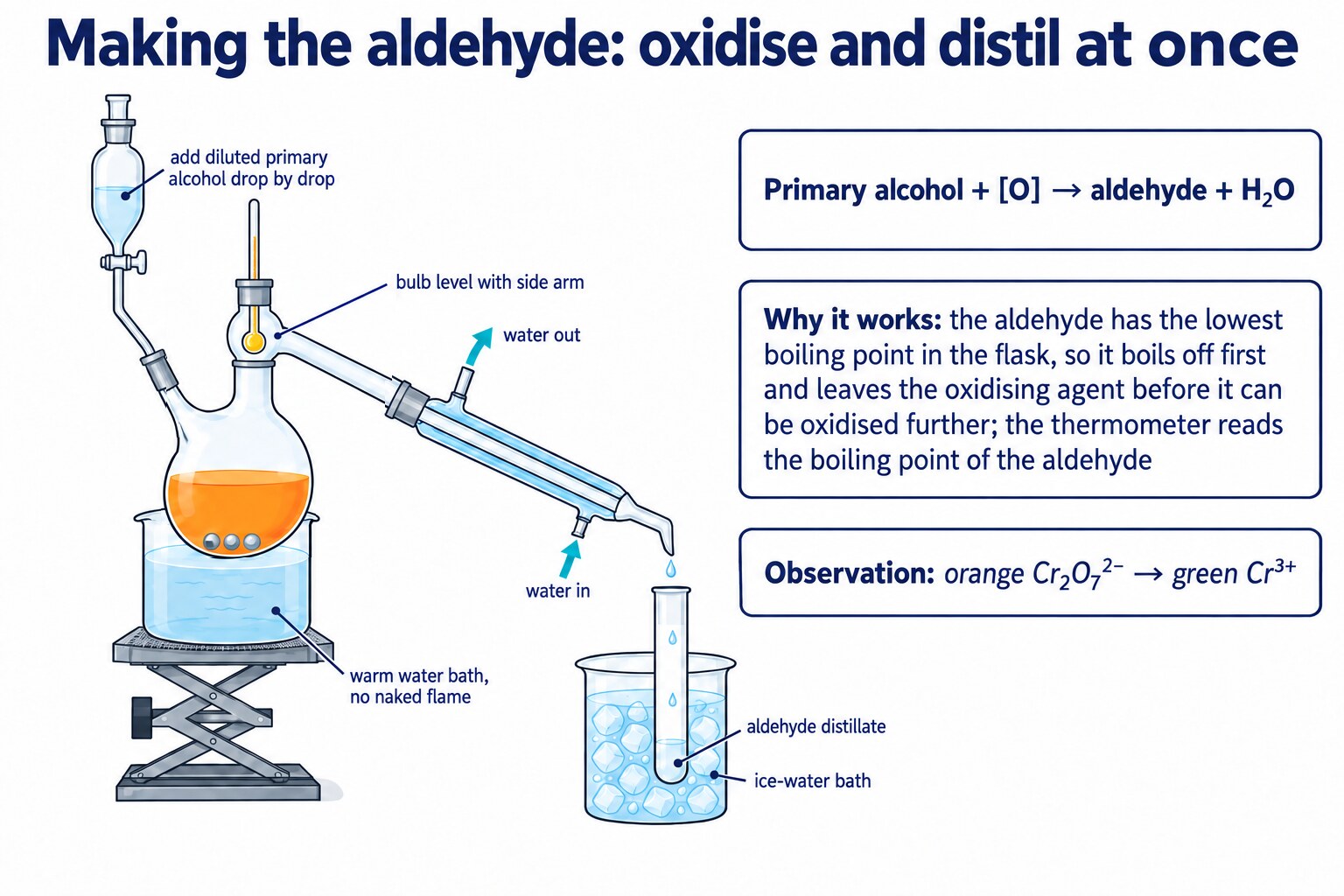
Distillation set-up for ethanal: the alcohol is dripped onto the oxidant, the thermometer bulb sits level with the side arm and reads about 21 °C, and the open receiver stands in iced water.
Equation: CH₃CH₂OH(l) + [O] → CH₃CHO(l) + H₂O(l) (partial oxidation, one [O])
The distillate is mostly ethanal but also contains a little water and ethanol. Left standing in air it slowly oxidises, so a faint acid test after a few days is not a fault in the method. It smells sweet and slightly sharp.
Why not reflux?: Under reflux ethanal is condensed and returned to the acidified dichromate(VI), where it is oxidised again to ethanoic acid. To stop at the aldehyde it must leave the flask as soon as it forms.
Check: Oxidising Another Primary Alcohol
Complete the equation and conditions for a different alcohol, using the boiling points given.
Method B: Making Ethanoic acid by Reflux then Distillation
The acid route uses an excess of oxidising agent and keeps the intermediate aldehyde in the flask until it has been oxidised a second time. The mixture goes green during the reflux.
Distillation is still needed at the end, but for a different reason: to separate the volatile ethanoic acid and water from the non-volatile chromium(III) salts and sulfuric acid left in the flask.
| Step | What you do | Why |
|---|---|---|
| 1 | Dissolve 6.0 g of potassium dichromate(VI) in 20 cm³ of dilute sulfuric acid in a round-bottomed flask; add anti-bumping granules and cool the flask in ice. | Twice the oxidant used in method A, so the dichromate(VI) is in excess and the aldehyde is fully oxidised. |
| 2 | Add 1.5 cm³ of ethanol slowly, a few drops at a time, swirling and keeping the flask in the ice. | The reaction is exothermic; slow addition prevents the mixture boiling and vapour escaping before the condenser is fitted. |
| 3 | Fit a Liebig condenser vertically in the neck of the flask, water in at the lower side arm, top open to the air. Heat under reflux for about 30 minutes using a heating mantle or water bath. | Reflux returns the condensed vapour to the flask so nothing volatile is lost during prolonged heating; the open top prevents a pressure build-up. The mixture turns green. |
| 4 | Allow the flask to cool, then rearrange the apparatus for simple distillation with the thermometer bulb level with the side arm and a receiver in cold water. | Rearranging hot apparatus risks burns and flammable vapour; the product is separated from the non-volatile chromium(III) and acid residues. |
| 5 | Distil off 3 to 4 cm³ of a clear, colourless liquid with a sharp, vinegar-like smell. | This is aqueous ethanoic acid, not the pure acid: the acid (b.p. 118 °C) co-distils with water. Green chromium(III) stays behind. |
| 6 | Test the distillate with universal indicator and sodium hydrogencarbonate. | pH about 3 and effervescence of carbon dioxide confirm a carboxylic acid. |
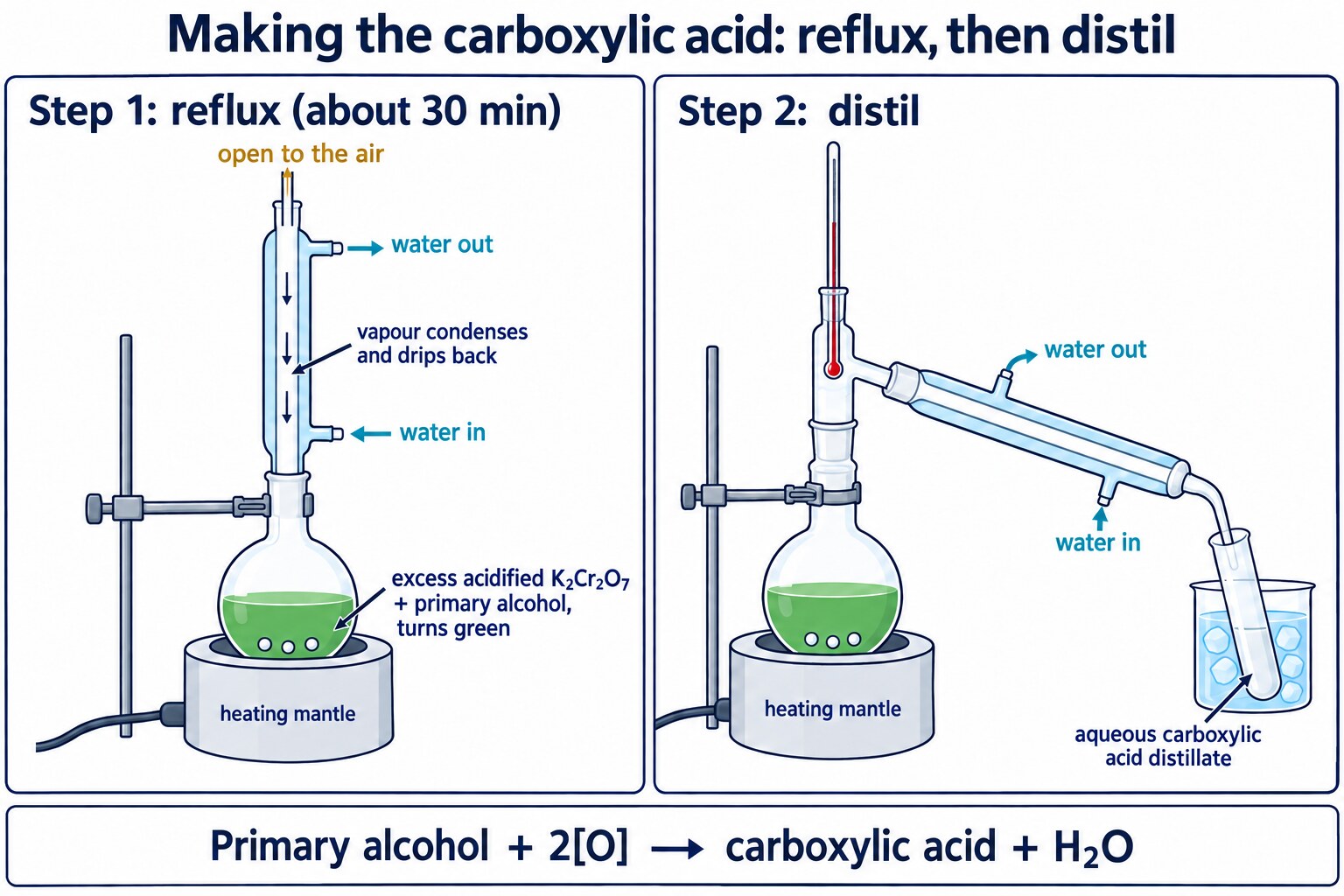
Reflux then distillation for ethanoic acid: vertical condenser open at the top with no line drawn across the joint, water in at the bottom, then the same flask rearranged for distillation.
Equation: CH₃CH₂OH(l) + 2[O] → CH₃COOH(l) + H₂O(l) (complete oxidation, two [O])
The reaction goes through the aldehyde, so the second stage can be asked for on its own: CH₃CHO(l) + [O] → CH₃COOH(l). Students lose marks by writing a single [O] for the acid, or by forgetting the water molecule that balances the first stage.
Exam focus: Reflux drawing: vertical condenser, open top, no bung, water in at the bottom, no line across the flask-to-condenser joint, granules in the flask. A sealed apparatus would explode as the pressure rose.
Oxidise a Primary Alcohol: Distil or Reflux?
Watch propan-1-ol oxidised by acidified potassium dichromate(VI): distilled at once to give propanal, heated under reflux to give propanoic acid, and each product tested.
© Dr. Mohammed Al-Fatah – onlinelearningsystem.net
Check: Order of the Reflux Method
Put the steps for preparing a carboxylic acid from another primary alcohol into a working order.
Apparatus: What Examiners Look For
Drawing marks are cheap to lose. The apparatus is judged against a short checklist, and every item has a reason that can be asked as a separate question.
Reflux
- Condenser vertical, fitted directly into the flask, with no line drawn across the joint (a line reads as a bung).
- Top of the condenser open. Never stopper it: a sealed apparatus builds pressure and would burst.
- Water in at the lower side arm and out at the upper: the jacket fills completely, with no air gaps, and the coldest water meets the vapour at the exit, a counter-current flow that gives the most efficient cooling.
- Anti-bumping granules added before heating begins, never to a hot liquid: they provide nucleation sites so many small bubbles form instead of violent bumping.
- Heating mantle or water bath drawn beneath the flask; no Bunsen burner under a flammable liquid.
Distillation
- Thermometer bulb level with the side arm (the opening to the condenser), so it reads the temperature of the vapour that is being condensed, about 21 °C when ethanal is collected. A bulb dipped in the liquid reads the mixture, not the product.
- Condenser sloping downwards towards the receiver, water in at the lower end.
- Receiver open, standing in iced water. The apparatus is never sealed at the receiving end either.
- Reasonable proportions: the flask no more than half full, the condenser long enough to condense all the vapour.
Two marks in one sentence: Water enters at the bottom so the jacket is always full of cold water and the flow is counter to the vapour, giving efficient condensation.
Check: Labelling the Apparatus
Drag the labels into a description of reflux and distillation apparatus; watch for the distractors.
Equations, Colour Change and Oxidation Numbers
Organic equations for oxidation use [O] for one oxygen atom supplied by the oxidising agent.
One [O] takes a primary alcohol to the aldehyde (removing two hydrogen atoms as water); a second [O] adds to the aldehyde to make the acid. So ethanol needs one [O] for ethanal and two for ethanoic acid.
The oxidising agent is acidified potassium dichromate(VI), K₂Cr₂O₇ in dilute sulfuric acid. The dichromate(VI) ion is reduced to chromium(III), and the colour changes from orange to green:
Half-equation: Cr₂O₇²⁻(aq) + 14H⁺(aq) + 6e⁻ → 2Cr³⁺(aq) + 7H₂O(l)
Chromium falls from oxidation number +6 to +3: it gains three electrons per chromium atom, six per dichromate(VI) ion.
Each Cr₂O₇²⁻ therefore supplies three [O], because each [O] removes two electrons from the organic molecule.
Exam focus: Examiners accept “orange to green” only if you name the species: dichromate(VI) ions, Cr₂O₇²⁻, to chromium(III) ions, Cr³⁺.
| Alcohol class | Example | Product with acidified dichromate(VI) | Observation |
|---|---|---|---|
| Primary, distilled | ethanol | ethanal (aldehyde) | Orange to green |
| Primary, refluxed with excess oxidant | ethanol | ethanoic acid (carboxylic acid) | Orange to green |
| Secondary | propan-2-ol | propanone (ketone); no further oxidation | Orange to green |
| Tertiary | 2-methylpropan-2-ol | No reaction | Stays orange |
A secondary alcohol gives a ketone and stops: the ketone has no hydrogen on the carbonyl carbon to remove.
A tertiary alcohol has no hydrogen on the carbon carrying the OH, so it is not oxidised at all, and the solution stays orange.
This is the basis of the test that distinguishes the three classes.
Quantities: Checking Which Reagent Is in Excess
The quantities in the methods are not arbitrary. Each dichromate(VI) ion supplies three [O], so you can check which reagent limits the reaction.
Moles of potassium dichromate(VI) in method A = 3.00 g ÷ 294.2 g mol⁻¹ = 0.0102 mol, giving 3 × 0.0102 = 0.0306 mol [O].
Mass of 1.5 cm³ of ethanol = 1.5 cm³ × 0.79 g cm⁻³ = 1.19 g; moles = 1.19 g ÷ 46.1 g mol⁻¹ = 0.0257 mol.
Oxidation to ethanal needs 0.0257 mol [O], so the oxidant is in slight excess (0.0306 mol available) and every drop of alcohol meets enough dichromate(VI) to react.
Oxidation to ethanoic acid would need 2 × 0.0257 = 0.0514 mol [O], which is why method B doubles the dichromate(VI) to 6.0 g (0.0612 mol [O]): a clear excess that drives the reaction to completion.
Percentage yield questions follow the same route. If method B gave 0.90 g of ethanoic acid after purification, the theoretical mass is 0.0257 mol × 60.1 g mol⁻¹ = 1.54 g, so the yield is 0.90 ÷ 1.54 × 100 = 58 % (2 significant figures). Losses come from the aqueous distillate, evaporation of the volatile intermediate and transfers between vessels.
Working to show: Moles of oxidant, [O] available (× 3), moles of alcohol from volume × density ÷ Mr, then compare. State which is in excess and why that suits the product wanted.
Testing the Product
The distillate is identified by a pattern of results, never a single test.
Aldehydes are reducing agents, so they reduce Fehling’s solution or Tollens’ reagent and Tollens’ reagent; carboxylic acids are not, but they behave as acids. Ketones give none of these reactions.
Remember: Warm the tubes in a water bath, never over a flame.
| Test | Result with ethanal | Result with ethanoic acid | What it shows |
|---|---|---|---|
| Tollens’ reagent, warm in a water bath | Silver mirror on the inside of the tube (Ag⁺ reduced to Ag) | No change | Aldehyde present (ketones give no mirror) |
| Fehling’s solution, warm in a water bath | Blue solution gives a brick-red precipitate of copper(I) oxide, Cu₂O | Stays blue | Aldehyde present (ketones give no precipitate) |
| Universal indicator or pH probe | Neutral, pH about 7 | pH about 3 | Carboxylic acid is a weak acid |
| Magnesium ribbon | No reaction | Effervescence; the gas pops with a lit splint (hydrogen) | Mg(s) + 2CH₃COOH(aq) → (CH₃COO)₂Mg(aq) + H₂(g) |
| Sodium hydrogencarbonate solution | No effervescence | Effervescence; the gas turns limewater milky (carbon dioxide) | CH₃COOH(aq) + NaHCO₃(aq) → CH₃COONa(aq) + H₂O(l) + CO₂(g) |
| 2,4-dinitrophenylhydrazine (2,4-DNPH) | Orange precipitate | No precipitate | Carbonyl group present (aldehyde or ketone); the melting point of the derivative identifies the carbonyl compound |
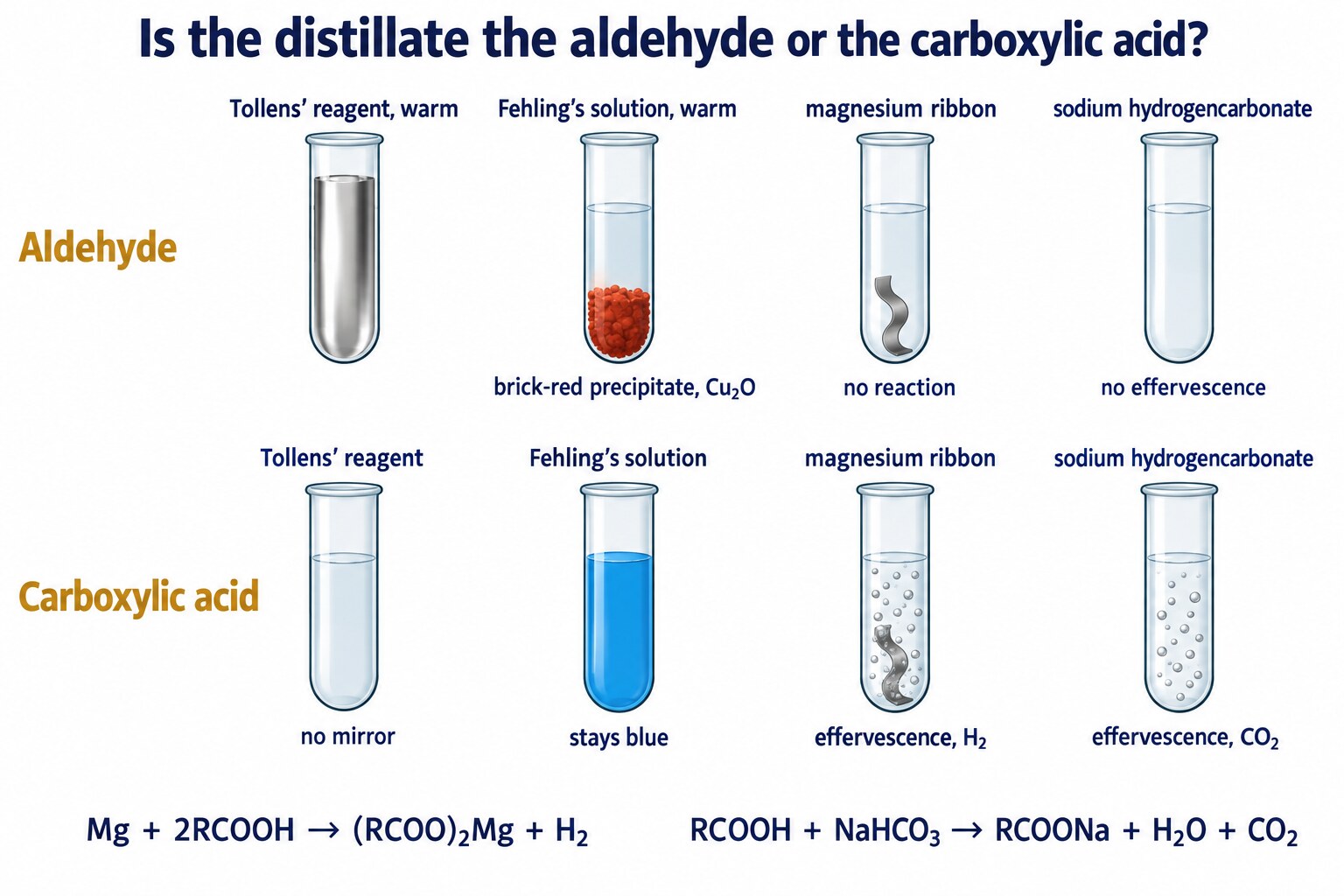
Two rows of test tubes: the aldehyde gives a silver mirror and a brick-red precipitate but no gas with magnesium or sodium hydrogencarbonate; the carboxylic acid does the opposite.
Write the observation the examiner wants: for Fehling’s solution it is a brick-red precipitate, not a “reddish-brown solution”; for Tollens’ it is a silver mirror on warming.
Name the gas and give its test (squeaky pop for hydrogen, limewater milky for carbon dioxide). If an aldehyde distillate gives a faint acid result, remember it contains traces of ethanol and water and slowly oxidises in air.
Pattern to remember: Aldehyde: positive with Fehling’s solution or Tollens’ reagent and Tollens’, nothing with magnesium or hydrogencarbonate. Carboxylic acid: the reverse.
Check: Identifying an Unknown Distillate
Read a set of test results for a distillate made from a different alcohol and decide what was made.
Errors, Uncertainty and Improvements
The product is a few cubic centimetres of liquid, so small losses matter, and the apparatus errors change which product you get rather than just how much.
| Source | Effect on the result | Improvement |
|---|---|---|
| Heating too strongly during distillation | Vapour temperature rises towards 78 °C; ethanol and water distil over, contaminating the ethanal | Use a water bath or a mantle on a low setting; keep the thermometer near 21 °C |
| Receiver not cooled | Volatile ethanal (b.p. 21 °C) evaporates; yield too low | Stand the receiver in iced water; keep the tube stoppered once collected |
| Alcohol added too fast or not diluted | Mixture heats up, aldehyde is oxidised further or vapour is lost; product impure and yield low | Dilute the alcohol with water, add dropwise with the flask in ice |
| Reflux too short or too little oxidant (method B) | Incomplete oxidation; the distillate contains ethanal and gives a silver mirror | Use an excess of dichromate(VI) and reflux for the full 30 minutes |
| Transfers and rearranging the apparatus | Liquid left on glassware; yield too low | Rinse with a little water into the flask; use as few transfers as possible |
| Thermometer bulb below or above the side arm | Reads the liquid or the cooler still-head, so the wrong fraction is collected | Bulb level with the side arm |
Percentage uncertainty in the measurements, using the actual uncertainty of each piece of apparatus:
- Mass of potassium dichromate(VI), 3.00 g on a 2 d.p. balance: two readings, ±0.005 g each, so ±0.01 g; percentage uncertainty = (0.01 ÷ 3.00) × 100 = 0.33 %.
- Volume of ethanol, 1.5 cm³ in a 10 cm³ measuring cylinder, ±0.1 cm³: (0.1 ÷ 1.5) × 100 = 6.7 %. This is the dominant uncertainty; a 2 cm³ graduated pipette (±0.02 cm³) cuts it to (0.02 ÷ 1.5) × 100 = 1.3 %.
- Thermometer reading of 21 °C, ±0.5 °C: (0.5 ÷ 21) × 100 = 2.4 %.
- Volume of distillate, 2.0 cm³ in the same measuring cylinder: (0.1 ÷ 2.0) × 100 = 5.0 %.
Adding them gives an overall measurement uncertainty of about 12 %, yet real yields are often only 40 to 60 %. The difference is not measurement error: it is loss of volatile product, incomplete reaction and the aqueous distillate. Say so when a question asks you to compare the two.
Evaluation wording: Name the source, say whether it makes the yield or purity too high or too low, and give the improvement with the number that justifies it.
Common Mistakes
- Writing “the mixture turns reddish-brown” for Fehling’s solution: the answer is a brick-red precipitate of copper(I) oxide.
- Drawing the reflux condenser with a bung in the top, or with the water going in at the top.
- Putting the thermometer bulb in the liquid, or drawing a line across the joint between flask and condenser.
- Explaining the choice of distillation without a single boiling point. Quote 21 °C and 78 °C.
- Using one [O] for the acid, or leaving out H₂O in the aldehyde equation.
- “Dichromate turns green” without naming the species or the oxidation numbers (+6 to +3).
- Calling the acid distillate “pure ethanoic acid” when it is an aqueous solution that co-distilled with water.
- Saying “propan-2-ol would give an acid on longer heating”: a secondary alcohol stops at the ketone, propanone.
- Suggesting a Bunsen burner for gentle heating of a highly flammable liquid.
Check: Planning a Different Oxidation
Decide whether each part of a plan to oxidise 2-methylpropan-1-ol is true or false.
Exam-Style Reasoning
Scenario 1. A student set out to make ethanal but the distillate gave no precipitate with Fehling’s solution and effervesced with sodium hydrogencarbonate. The product was ethanoic acid.
Accepted explanations: the apparatus was set up for reflux, the mixture was heated too strongly or for too long before distillation began, or the aldehyde was not distilled off as it formed.
The correction is to distil at once, collecting at about 21 °C, with the alcohol dripped into the oxidant.
Scenario 2. The thermometer read 73 °C while the distillate was collected. The vapour was no longer mainly ethanal: ethanol (b.p. 78 °C) and water were distilling over.
The sample is contaminated, so a test for the alcohol (it does not reduce Fehling’s solution) would be inconclusive because ethanal is also present. Heating was too strong.
Scenario 3. If propan-2-ol were used instead of ethanol, the product would be propanone, a ketone: CH₃CH(OH)CH₃(l) + [O] → CH₃COCH₃(l) + H₂O(l).
Prolonged reflux would give no carboxylic acid, and the distillate would give no silver mirror and no brick-red precipitate but would still show the orange-to-green colour change in the flask.
Scenario 4. Which of ethanol, ethanal and ethanoic acid can hydrogen bond to itself? Ethanol and ethanoic acid, because each has hydrogen bonded directly to oxygen.
Ethanal has a polar C=O bond but no O−H, so it has only permanent dipole and London forces, which is why its boiling point (21 °C) is the lowest of the three.
Ethanoic acid forms hydrogen-bonded dimers, giving it the highest boiling point (118 °C).
Check: Explain the Wrong Product
Write a short explanation of why a student obtained the acid instead of the aldehyde, then compare it with the mark points.
Same Method, Different Alcohol: Propan-1-ol
Other specifications run this practical with propan-1-ol instead of ethanol, and exam questions may use either. Nothing in the method changes except the numbers.
Propan-1-ol (b.p. 97 °C) is oxidised to propanal (b.p. 49 °C) by distillation and to propanoic acid (b.p. 141 °C) by reflux: CH₃CH₂CH₂OH(l) + [O] → CH₃CH₂CHO(l) + H₂O(l) and CH₃CH₂CH₂OH(l) + 2[O] → CH₃CH₂COOH(l) + H₂O(l).
Propanal boils at 49 °C, so it is easier to collect cleanly than ethanal, and the thermometer reads about 49 °C while it is collected.
The tests are identical: the aldehyde gives a silver mirror and a brick-red precipitate, the acid effervesces with magnesium and with sodium hydrogencarbonate. If a question uses the other alcohol, swap the names, formulae and boiling points and keep every reason the same.
Common Exam Points
Say
“Ethanal (b.p. 21 °C) is more volatile than ethanol (b.p. 78 °C), so it distils off as soon as it forms and cannot be oxidised further.”
“Under reflux the condensed aldehyde returns to the excess acidified dichromate(VI) and is oxidised to ethanoic acid.”
“Brick-red precipitate with Fehling’s solution; silver mirror with Tollens’ reagent.”
Do not say
“Reddish-brown solution” for Fehling’s solution. “Reflux stops the smell.” “The thermometer measures the temperature of the liquid.” “Concentrated sulfuric acid is used as the oxidising agent” (it acidifies; dichromate(VI) oxidises).
Watch for
Diagrams: open condenser top, water in at the bottom, bulb level with the side arm, no line across the joint, granules drawn, heating mantle not Bunsen.
Equations: [O] count (one for the aldehyde, two for the acid), H₂O in the first step, state symbols.
Product identity: always argue from a pattern of tests.
FAQs
Quick answers to the questions students ask most about PAG 5, the oxidation of ethanol.
Why does distillation give ethanal but reflux gives ethanoic acid?
Ethanal boils at 21 °C, well below ethanol (78 °C), so during distillation it leaves the flask as soon as it forms and cannot meet the oxidising agent again. Under reflux the condensed aldehyde runs back into the excess acidified dichromate(VI) and is oxidised a second time to ethanoic acid.
What should the thermometer read while ethanal is collected?
About 21 °C, the boiling point of ethanal. The bulb sits level with the side arm so it reads the vapour entering the condenser. If the reading climbs towards 78 °C, unreacted ethanol is distilling over and the heating is too strong.
What is the correct observation with Fehling’s solution?
A brick-red precipitate of copper(I) oxide, Cu₂O, forms on warming with an aldehyde. “Reddish-brown solution” is marked wrong. Ketones and carboxylic acids leave the solution blue.
Why is the reflux condenser left open at the top?
So that the apparatus is never sealed. Vapour condenses and runs back into the flask, but any pressure can escape. A stoppered condenser would build pressure and could shatter.
Why is the acid distillate not pure?
Ethanoic acid boils at 118 °C but co-distils with water (100 °C), so the distillate is an aqueous solution of the acid. It is still identified by pH about 3 and effervescence with sodium hydrogencarbonate.
Why is a water bath or heating mantle used instead of a Bunsen burner?
Ethanol and ethanal are highly flammable, and the aldehyde’s low boiling point means its vapour spreads easily. Flame-free heating removes the ignition source and gives the gentle, adjustable heat needed to hold the vapour near 21 °C.
Copyright and author footprint: This OLS revision page was written for Online Learning System by Dr. Mohammed Al-Fatah. It is designed for A Level Chemistry revision and should not be copied or redistributed without permission.
Keep this note — free
Save your progress across every OCR A topic. A free account remembers which topics you have covered, saves your question scores, and syncs across your phone and laptop.
- Track every topic you have finished
- Keep your practice-question scores
- No payment, no card, free forever
Already registered? Log in